









MVP Development in Canada: Cost, Process & Benefits 2026

The pressure to build fast and get it right has reached its highest point in history. Startups are now evaluated by their ability to validate and launch products that show actual market demand. Startups need to adopt MVP development because it has become an essential method for achieving their business objectives.
The data makes this shift clear. Nearly 42 percent of startups fail because there is no real market need, which means many products are built without validation.
At the same time, the global MVP development market is expanding steadily, valued at $288 million in 2024 and projected to reach $541 million by 2031, driven by the need for faster product validation and lean development approaches.
Zooming out further, the broader MVP services market is expected to grow from $4.7 billion in 2025 to nearly $10 billion by 2035, reflecting how businesses are prioritizing rapid experimentation and iterative product building.
What stands out is not just growth, but intent. Modern founders are no longer willing to invest months or years into full-scale products without feedback. An MVP allows them to test assumptions, gather real user insights, and move forward with clarity instead of guesswork. In many cases, it reduces time to market by up to 40 percent while cutting development costs significantly.
This blog is built on that exact philosophy. It draws from our hands-on experience in MVP development, where we have helped startups and businesses turn early-stage ideas into scalable digital products. The focus is practical, grounded, and aligned with how real products are built and launched today.
If you are looking to understand how to build, launch, and scale faster through MVP development in Canada, this guide will walk you through every step with clarity and precision.
- MVP development helps validate ideas quickly and reduce product risk.
- A structured process ensures faster launch and better product decisions.
- Costs in Canada vary based on complexity, features, and team setup.
- Continuous iteration is key to scaling a successful MVP.
- MVP development allows businesses to test product ideas with minimal investment, helping them avoid building solutions that lack real market demand.
- Skipping MVP development often leads to wasted budgets, delayed launches, and products that fail to meet user expectations.
- A step-by-step MVP development process ensures clarity, from defining the problem to launching and improving the product based on real feedback.
- Post-launch success depends on tracking user behavior, refining core features, and making data-driven improvements.
- MVP development costs in Canada typically range from CAD 15,000 to CAD 80,000, depending on product complexity and technical requirements.
- Emerging trends such as AI integration, no-code platforms, and cloud-based development are reshaping how MVPs are built and scaled.
- Canada offers a strong ecosystem for MVP development, supported by skilled talent, government initiatives, and growing tech hubs.
Common Challenges Businesses Face Without an MVP
Building a full-scale product without validating the idea often leads to avoidable setbacks. Businesses invest time, money, and effort, only to realize later that the foundation itself needs adjustment.
Here are the most common challenges teams face when they skip MVP development:
- Building Without Market Validation: Many businesses rely on assumptions instead of real user feedback. This results in products that look complete but fail to solve a meaningful problem.
- Wasted Development Budget: Without early testing, companies tend to overinvest in features that users may never use. This inflates costs without improving product value.
- Longer Time to Market: Developing a full product from the start delays launch timelines. Competitors who validate and release faster often capture the market first.
- Feature Overload and Complexity: Teams try to include everything in the first version. This leads to cluttered user experiences and makes the product harder to adopt.
- High Risk of Product Failure: When feedback comes only after launch, fixing core issues becomes expensive and time-consuming. In many cases, businesses are forced to pivot or abandon the product entirely.
- Lack of Clear Product Direction: Without early user insights, decision-making becomes reactive. Teams struggle to prioritize what truly matters.
Skipping MVP development increases uncertainty at every stage of product building. These challenges highlight why a lean, validation-driven approach is essential before committing to full-scale development.
How MVP Development Solves These Challenges
MVP development addresses these risks by focusing on speed, validation, and continuous improvement. Instead of building everything at once, businesses launch with a focused version that delivers core value.
Here is how MVP development directly solves the challenges outlined above:
- Validates Real Market Demand Early: An MVP allows businesses to test their idea with actual users. Feedback collected at this stage confirms whether the problem and solution align.
- Optimizes Development Costs: By focusing only on essential features, companies reduce unnecessary spending. Resources are allocated based on what users actually need.
- Accelerates Time to Market: A lean product can be built and launched much faster. This helps businesses enter the market early and start learning from real usage.
- Keeps the Product Simple and Focused: MVPs prioritize core functionality. This leads to cleaner user experiences and makes it easier for users to understand the product’s value.
- Reduces Risk Through Iteration: Instead of large-scale failures, businesses make smaller, informed improvements over time. Each update is guided by real data.
- Provides Clear Direction for Growth: User behavior and feedback shape future development. Teams can confidently decide which features to build next.
MVP development replaces guesswork with evidence. It gives businesses a structured path to build smarter, launch faster, and scale with confidence.
Also Check: How to Build MVP for Startup: From Idea to Successful Launch
Step-by-Step Process to Build and Launch an MVP
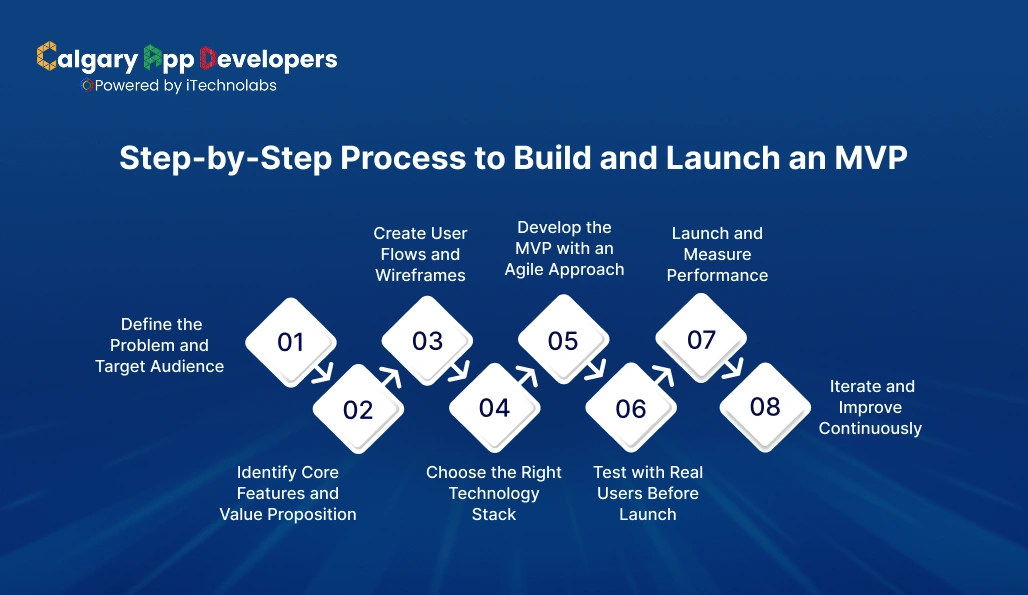
Building an MVP is not about cutting corners. It is about building with intention. Strong MVP development focuses on reducing uncertainty, validating decisions early, and creating a product that can evolve based on real user behavior.
This process is not linear in practice. Teams often move back and forth between steps as they learn. But having a structured framework keeps the product grounded and prevents costly missteps.
Here is a detailed breakdown of how to approach MVP development from idea to launch and beyond.
- Define the Problem and Target Audience
Most products fail long before development begins. The issue is not execution; it is misunderstanding the problem.
- Start by identifying a very specific problem. Avoid vague ideas like improving productivity or enhancing user experience. Instead, define a clear scenario where a user is struggling and needs a solution.
- Go deeper into who your users are. Segment them into primary and secondary audiences. Focus your MVP only on the primary group to maintain clarity.
- Build detailed user personas that include goals, frustrations, behaviors, and decision-making patterns. This helps in designing a product that feels relevant from day one.
- Study existing solutions in the market. Look at what they do well, where users complain, and where gaps exist. These gaps often define your opportunity.
- Conduct real conversations with potential users. Ask open-ended questions and listen carefully to how they describe their challenges.
- Validate willingness to use or pay. Interest alone is not enough. You need signals that indicate real demand.
- Define success metrics early. Decide what outcomes will tell you that your MVP is working, such as signups, active usage, or retention.
A clearly defined problem acts as a filter for every decision that follows. It ensures your MVP development stays focused and meaningful.
- Identify Core Features and Value Proposition
This is where most teams struggle. The instinct is to build more, but effective MVP development is about building less with greater impact.
- Start by listing every feature you think your product needs. Do not filter at this stage, just capture everything.
- Break these features into categories based on importance. Identify which ones directly solve the core problem and which ones are supportive or optional.
- Define the smallest possible version of your product that can still deliver value. This is your MVP scope.
- Craft a clear value proposition that answers three questions. What does the product do, who is it for, and why is it better than alternatives.
- Evaluate each feature against your value proposition. If it does not strengthen your core offering, remove it from the initial version.
- Consider the user journey while selecting features. Ensure that users can complete a meaningful action from start to finish.
- Avoid adding features based on assumptions or internal preferences. Every feature should have a clear purpose tied to user value.
This step creates discipline. It ensures that MVP development remains efficient and avoids feature bloat that slows down progress.
- Create User Flows and Wireframes
Before writing a single line of code, you need to understand how the product will actually work in the hands of a user.
- Map out the complete journey a user will take, starting from the moment they discover your product to the point where they achieve their goal.
- Break the journey into smaller steps and define what happens at each stage. This helps identify unnecessary complexity or missing elements.
- Design user flows that are simple and intuitive. Every additional step increases the chances of user drop-off.
- Create wireframes that represent the structure of your product. Focus on layout, navigation, and interaction rather than visual design.
- Ensure that key actions are easy to find and complete. Users should not have to think too much to use your product.
- Test these flows internally with your team. Walk through different scenarios and identify friction points.
- If possible, share wireframes with potential users and observe their reactions. Early feedback here can save significant development effort later.
Clear user flows act as a blueprint for development. They reduce confusion, improve collaboration, and ensure that the product is built with the user in mind.
- Choose the Right Technology Stack
Technology decisions are not just technical; they are strategic. The wrong choices can slow you down or limit your ability to scale.
- Start by understanding your product requirements. Consider factors like performance, user load, integrations, and platform preferences.
- Decide whether you need a mobile app, a web app, or both. In many cases, starting with one platform is more efficient.
- Evaluate whether to use native development or cross-platform frameworks based on your timeline and budget.
- Choose technologies that allow rapid development without compromising stability. Speed is important at this stage.
- Leverage third-party tools and services for common functionalities such as authentication, payments, and notifications.
- Design your architecture in a way that allows flexibility. You should be able to add features and scale without major rework.
- Avoid overengineering. Complex systems are harder to build, test, and maintain, especially in the early stages.
A well-chosen tech stack supports faster MVP development and creates a strong foundation for future growth.
- Develop the MVP with an Agile Approach
Now the focus shifts from planning to execution. This is where ideas become a working product.
- Break the development process into smaller sprints, each with clear goals and deliverables.
- Prioritize building core features first. Secondary features should only be considered once the core is stable.
- Maintain constant communication between developers, designers, and stakeholders to ensure alignment.
- Test continuously during development. Do not wait until the end to identify issues.
- Keep the product functional at every stage. Even incomplete versions should be usable for testing purposes.
- Stay flexible. If new insights emerge, be ready to adjust priorities without disrupting progress.
- Track progress closely and ensure that timelines are realistic and achievable.
Agile development keeps MVP development dynamic and responsive. It allows teams to move quickly while maintaining control over quality.
- Test with Real Users Before Launch
Internal testing is not enough. Real users interact with products in unpredictable ways, and that is where true insights come from.
- Select users who closely match your target audience. Their feedback will be more relevant and actionable.
- Observe how users navigate your product. Pay attention to where they hesitate, get confused, or drop off.
- Ask users to complete specific tasks and measure how easily they can do so.
- Collect direct feedback about what they like, what frustrates them, and what they expect.
- Identify critical bugs and usability issues that could impact the core experience.
- Test the product across different devices, screen sizes, and environments to ensure consistency.
- Refine the product based on feedback, focusing on improvements that enhance usability and clarity.
This step ensures that your MVP is not just functional, but actually usable and valuable.
- Launch and Measure Performance
Launching your MVP is a strategic move, not just a milestone. The goal is to learn, not just to release.
- Decide on a launch approach. A controlled launch can help you gather focused feedback, while a broader launch can provide more data.
- Set up analytics tools to track user behavior in detail. Understand how users move through your product.
- Monitor key metrics such as user acquisition, engagement, retention, and conversion.
- Collect feedback through multiple channels, including in-app prompts, surveys, and direct communication.
- Identify patterns in user behavior. Look for signs of strong engagement as well as areas where users drop off.
- Evaluate whether your product is delivering on its core promise.
A well-managed launch provides the insights needed to move from validation to growth.
- Iterate and Improve Continuously
MVP development does not end at launch. In many ways, that is where the real work begins.
- Analyze user data and feedback to identify what is working and what needs improvement.
- Prioritize updates that enhance the core experience before adding new features.
- Introduce new functionality gradually, ensuring each addition aligns with user needs.
- Continuously improve performance, speed, and reliability as usage increases.
- Revisit your product strategy based on market response and evolving user expectations.
- Maintain an ongoing feedback loop with users to guide future development.
- Scale your product carefully, ensuring that growth does not compromise quality.
Iteration is what transforms an MVP into a mature product. It allows you to build with confidence, backed by real insights.
A strong MVP development process is not about moving fast blindly. It is about moving with clarity, learning at every step, and making decisions based on evidence. When executed well, this approach reduces risk and improves the product.
Read Also: Top MVP Development Companies Best for Startups
Post-Launch Strategies to Improve and Scale Your MVP
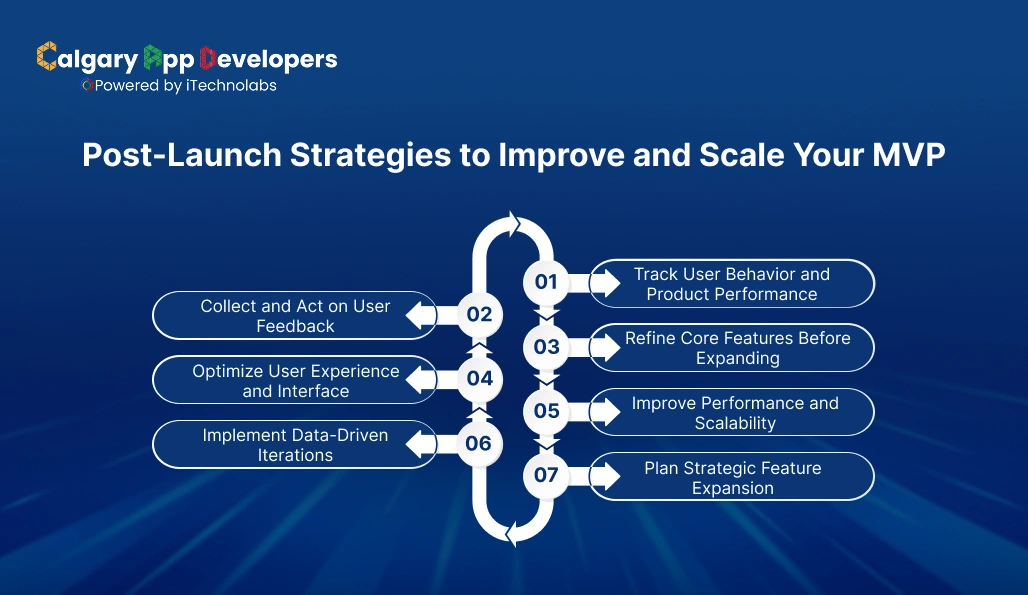
Your MVP launch is only the start of your business journey. Actual business expansion depends on your ability to learn and adapt based on user interactions and market feedback. The current stage requires businesses to stop development work and start their optimization and scaling process.
- Track User Behavior and Product Performance
Closely monitor how users interact with your MVP using analytics tools. Study engagement patterns, session duration, feature usage, and drop-off points. These insights help you understand what drives value and where users struggle, allowing you to make informed improvements that directly impact retention and growth.
- Collect and Act on User Feedback
Establish consistent feedback channels through surveys, in-app prompts, and direct communication. Focus on identifying repeated concerns, usability issues, and unmet expectations. Prioritize updates that address real user needs rather than assumptions, ensuring that your product evolves in alignment with market demand.
- Refine Core Features Before Expanding
Strengthen the foundation of your product by improving the performance, usability, and reliability of core features. Ensure that your main offering delivers a smooth and consistent experience. Scaling becomes more effective when the core product is stable and capable of delivering clear value.
- Optimize User Experience and Interface
Continuously improve the interface by simplifying navigation and reducing friction in key user journeys. Even small design enhancements can significantly improve user satisfaction. A clean, intuitive experience encourages users to engage more frequently and increases overall retention.
- Improve Performance and Scalability
As user demand grows, ensure your product can handle increased traffic without compromising speed or reliability. Optimize backend systems, reduce load times, and strengthen infrastructure. A scalable system prevents performance bottlenecks and supports long-term growth.
- Implement Data-Driven Iterations
Base every product decision on real data rather than assumptions. Test new features, measure their impact, and refine accordingly. This iterative approach ensures continuous improvement and reduces the risk of building features that do not add value.
- Plan Strategic Feature Expansion
Introduce new features gradually, guided by user behavior and business goals. Focus on enhancements that strengthen your product’s value proposition. Avoid unnecessary expansion and ensure that each addition contributes meaningfully to user experience and product growth.
Scaling an MVP requires discipline and continuous learning. By focusing on user insights, performance, and strategic improvements, businesses can turn an early-stage product into a reliable and scalable solution.
MVP Development Cost in Canada in 2026
In 2026, MVP development in Canada typically ranges from CAD 15,000 to CAD 80,000 for most startups, with advanced builds going beyond CAD 100,000 depending on complexity and features.
This range reflects a lean MVP approach focused on validation. As features, integrations, and scalability requirements increase, costs rise accordingly.
Estimated MVP Development Cost Breakdown
| Stage / Component | Estimated Cost (CAD) | What It Includes |
| Discovery and Planning | 3,000 – 8,000 | Market research, product strategy, feature planning |
| UI/UX Design | 5,000 – 15,000 | Wireframes, user flows, interface design |
| Development (Frontend + Backend) | 20,000 – 60,000 | Core feature development, APIs, and database |
| Testing and QA | 3,000 – 10,000 | Bug fixing, usability testing, performance checks |
| Deployment and Launch | 2,000 – 5,000 | App store setup, server configuration |
| Post Launch Maintenance | 1,000 – 3,000 per month | Updates, bug fixes, and infrastructure scaling |
MVP Cost by Type and Complexity
| MVP Type | Cost Range (CAD) | Typical Use Case |
| Basic MVP | 15,000 – 30,000 | Simple apps with limited features |
| Standard MVP | 30,000 – 70,000 | Apps with user accounts, APIs, and payments |
| Advanced MVP | 70,000 – 120,000+ | AI features, real-time systems, marketplaces |
These estimates align with broader industry benchmarks where MVPs can range from simple prototypes to scalable early-stage products.
Factors Affecting MVP Development Cost
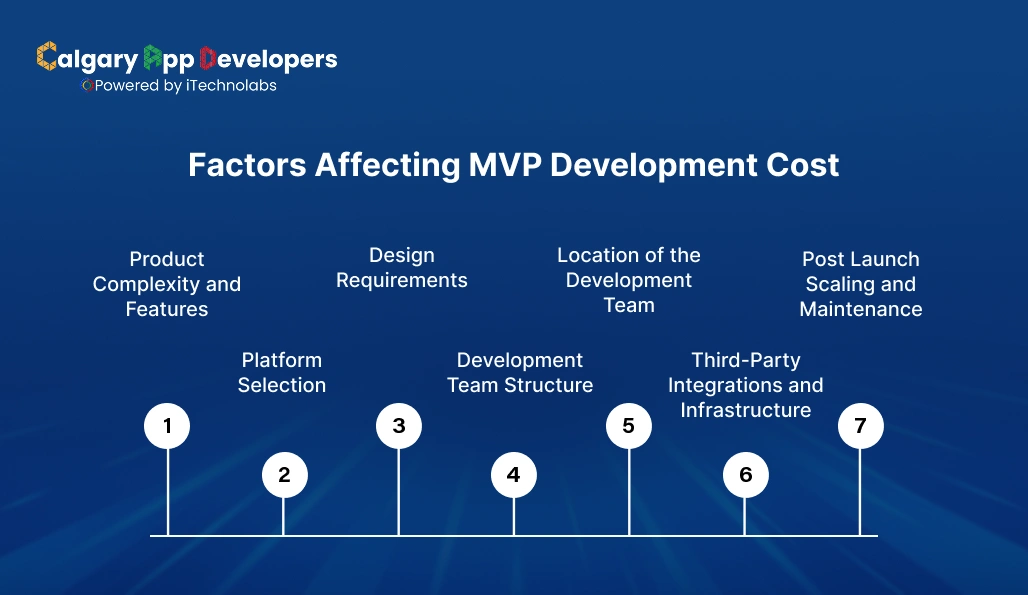
The cost of MVP development is not fixed. It depends on several strategic and technical decisions made early in the process.
- Product Complexity and Features
The number and sophistication of features have the biggest impact on cost. A simple MVP with basic functionality requires less time and fewer resources, while platforms with real-time data, integrations, or AI capabilities significantly increase development effort.
- Platform Selection
Choosing between iOS, Android, or cross-platform development affects both cost and timeline. Cross-platform solutions can reduce initial investment, while native apps may require higher budgets due to separate development efforts.
- Design Requirements
A basic interface costs less, but custom UI/UX with advanced interactions, animations, and user personalization increases design and development time. High-quality design is often essential for user retention, especially in competitive markets.
- Development Team Structure
Hiring freelancers, in-house teams, or agencies changes the cost structure. Agencies typically offer end-to-end expertise but come at a higher price compared to smaller teams.
- Location of the Development Team
Developer rates vary across cities in Canada. For example, cities like Toronto often have higher hourly rates, while regions like Calgary offer competitive pricing with strong technical talent.
This creates a practical advantage. Businesses working with teams in Calgary can often achieve a balance between cost efficiency and high-quality development, making it an increasingly attractive hub for MVP development.
- Third-Party Integrations and Infrastructure
Features like payment gateways, cloud hosting, analytics tools, and APIs add to the overall cost. While they accelerate development, they also introduce recurring expenses.
- Post Launch Scaling and Maintenance
MVP development does not end at launch. Ongoing improvements, infrastructure scaling, and feature expansion require continuous investment, often accounting for a significant portion of long-term costs.
The cost of MVP development in Canada reflects both opportunity and strategy. A well-planned MVP does not aim to minimize cost at all costs. It focuses on maximizing learning and validation within a controlled budget, setting the stage for sustainable growth.
Also Read: MVP App Development Services for Startups in Canada
Emerging Trends in MVP and Product Development
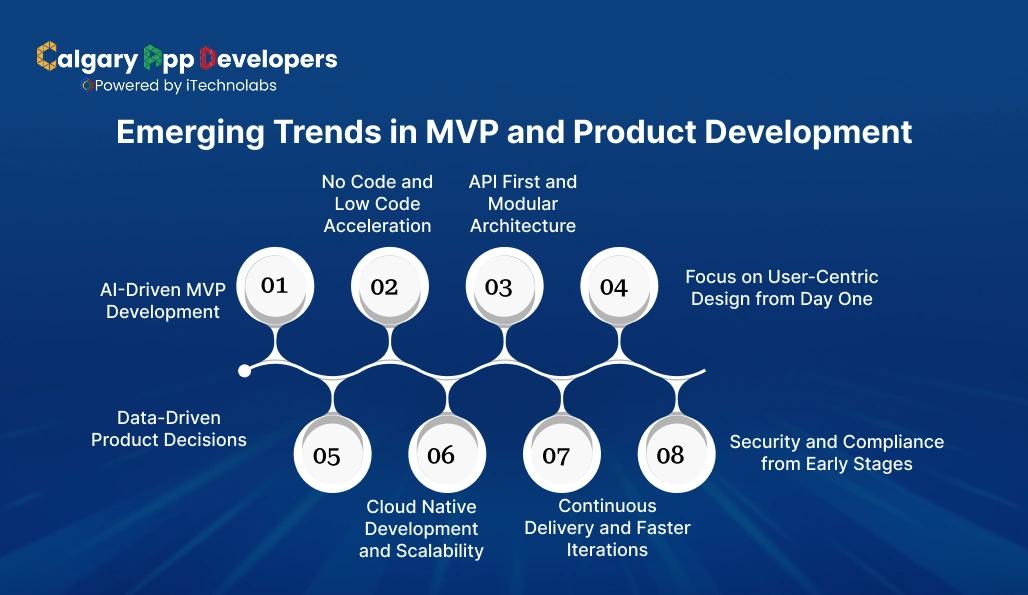
The way products are built and launched is evolving quickly. MVP development is no longer limited to basic prototypes. It is becoming smarter, faster, and more aligned with real-time user expectations. Businesses that stay ahead of these trends are better positioned to validate ideas and scale efficiently.
- AI-Driven MVP Development: Artificial intelligence is changing how MVPs are built and tested. Teams are using AI tools for rapid prototyping, user behavior analysis, and feature recommendations. This reduces development time and helps create more personalized user experiences from the very first version.
- No Code and Low Code Acceleration: No-code and low-code platforms are enabling faster MVP creation without heavy engineering effort. Startups can quickly build functional products, test ideas, and iterate without large upfront investments. This trend is making MVP development more accessible and cost-efficient.
- API First and Modular Architecture: Modern MVPs are increasingly built using modular systems and API driven architectures. This approach allows businesses to integrate third-party services easily and scale their products without rebuilding the core system. It also supports faster updates and feature expansion.
- Focus on User-Centric Design from Day One: User experience is no longer treated as a later-stage improvement. MVPs are now designed with usability and clarity in mind from the beginning. A strong focus on intuitive design helps improve early adoption and user retention.
- Data-Driven Product Decisions: Product development is becoming more evidence-based. Teams rely heavily on analytics, user behavior tracking, and feedback loops to guide decisions. This ensures that every iteration in MVP development is aligned with real user needs.
- Cloud Native Development and Scalability: Cloud infrastructure is now a standard for MVPs. It allows products to scale quickly, handle varying user loads, and reduce infrastructure costs. This flexibility is critical for startups expecting rapid growth.
- Continuous Delivery and Faster Iterations: The shift toward continuous integration and delivery enables faster updates and improvements. Instead of large, infrequent releases, businesses can roll out smaller updates regularly based on user feedback.
- Security and Compliance from Early Stages: As digital products handle more sensitive data, security is becoming a priority even in MVP stages. Businesses are integrating basic compliance and security practices early to avoid risks as they scale.
MVP development is becoming more strategic and technology-driven. These emerging trends are helping businesses build smarter products, validate ideas faster, and scale with greater confidence in an increasingly competitive market.
Why Canada Is the Best Choice for MVP Development
Location shapes how fast you build, how well you execute, and how efficiently you scale. Canada has positioned itself as a reliable and forward-looking destination for MVP development, combining strong technical talent, supportive policies, and a growing innovation ecosystem that benefits early-stage products.
- Access to Highly Skilled and Diverse Tech Talent
Canada consistently produces top-tier engineering and design talent through its universities and global immigration programs. This creates a workforce that is not only technically strong but also diverse in experience and perspective. For MVP development, this matters because early-stage products require both problem-solving and adaptability, not just coding.
- Government-Backed Innovation and Funding Programs
One of Canada’s biggest advantages is its strong government support for startups and innovation. Programs such as SR and ED tax credits, IRAP funding, and various provincial grants help reduce development costs and encourage experimentation.
At a regional level, Calgary strengthens this further through initiatives like Alberta Innovates and support from organizations such as Platform Calgary, which provide funding access, mentorship, and infrastructure for early-stage startups. These combined efforts allow businesses to invest more confidently in MVP development while managing financial risk in the early stages.
- Balanced Cost and Quality Advantage
Compared to major US tech hubs, Canada offers a more balanced cost structure without compromising on quality. Businesses can access experienced developers and product teams at competitive rates, which is especially valuable when building and iterating on an MVP. This balance allows for better allocation of resources across development, testing, and scaling.
- Strong and Growing Startup Ecosystem
Canada’s startup ecosystem continues to expand, supported by incubators, accelerators, and venture capital networks. Founders benefit from mentorship, partnerships, and access to funding opportunities. This environment creates a natural advantage for MVP development, where early feedback, collaboration, and rapid iteration are critical.
- Focus on Scalable and Future-Ready Development
Development teams in Canada are known for building products with long-term scalability in mind. Instead of focusing only on short-term delivery, there is a strong emphasis on clean architecture, performance, and maintainability. This ensures that MVPs can evolve into full-scale products without requiring complete rebuilds.
- Emerging Tech Hubs Offering Strategic Advantages
While cities like Toronto and Vancouver are well established, Calgary is quickly gaining recognition as a smart choice for MVP development. It offers a growing pool of skilled professionals, lower operational costs, and a supportive business environment. For startups looking to optimize both budget and quality, Calgary provides a practical advantage without sacrificing expertise.
- Favorable Business Environment and Stability
Canada offers a transparent regulatory system, strong intellectual property protection, and economic stability. These factors reduce uncertainty and allow businesses to focus on product development and growth rather than operational risks.
- Global Collaboration and Time Zone Flexibility
Canada’s time zones make it easier to collaborate with clients and teams across North America and Europe. This flexibility supports smoother communication, faster feedback cycles, and more efficient development timelines.
Canada stands out not just as a development destination, but as a strategic partner in building successful products. With strong talent, government support, and emerging hubs like Calgary offering added efficiency, MVP development in Canada creates the right conditions for faster validation and scalable growth.
Our Experience in Building Scalable MVPs
Building an MVP is one thing. Building an MVP that scales into a reliable, high-performing product is where real expertise shows. Calgary App Developer’s experience in MVP development is rooted in delivering solutions that are not only functional at launch but also ready to evolve as user demand grows.
Here are two examples that reflect our approach in action.
- Rolling Meadows
An app designed to keep patients and their families connected with daily activities and updates from the Rolling Meadows Retirement Community.
- We started by identifying a clear communication gap between residents, staff, and families. The MVP focused on delivering real-time updates, announcements, and activity tracking in a simple, accessible format.
- The product was designed with a user-first mindset, considering elderly users and non-technical family members. This influenced decisions around navigation, readability, and ease of use.
- Core features included live updates, event notifications, and a centralized communication system, ensuring families could stay informed without complexity.
- The architecture was built to scale, allowing the platform to expand with additional features such as messaging, scheduling, and integration with care systems.
- Post launch, user feedback helped refine the experience, improving accessibility and performance while maintaining simplicity.
This project highlights how MVP development can solve real-world communication challenges while creating a foundation for long-term growth.
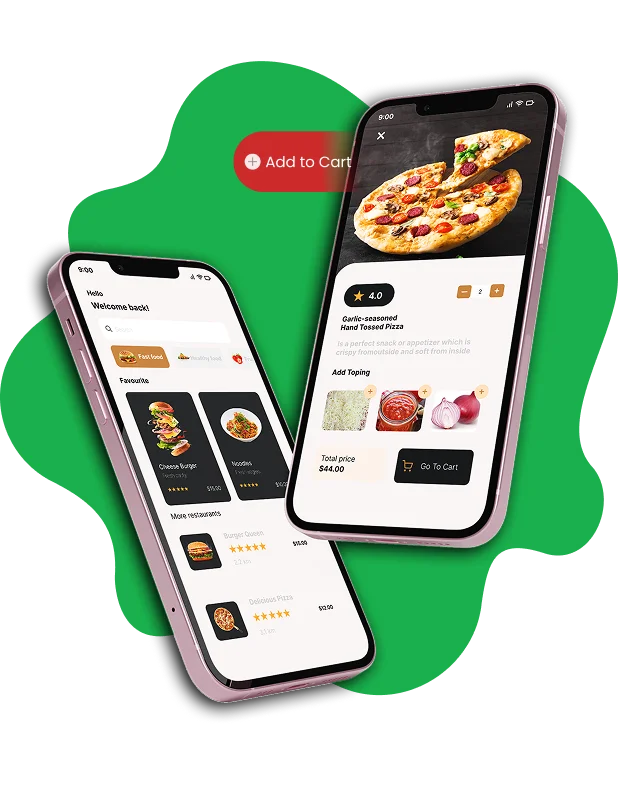
- Rapido Food Delivery
A fast-paced food delivery platform built to handle real-time demand, user interactions, and scalable operations.
- The MVP focused on core functionalities such as user registration, restaurant listings, order placement, and real-time tracking.
- Speed and performance were prioritized to ensure smooth ordering experiences, even during peak usage.
- The system was designed with a scalable backend to handle increasing order volumes, multiple vendors, and location-based services.
- Third-party integrations, such as payment gateways and mapping services, were implemented early to streamline operations.
- Continuous iteration based on user behavior helped optimize delivery flows, reduce friction, and improve overall user satisfaction.
This project demonstrates how MVP development can be used to enter competitive markets quickly while building a system capable of scaling with demand.
Our approach to MVP development focuses on clarity, scalability, and real-world usability. Each product we build is designed to validate ideas quickly while laying the groundwork for long-term success.
Conclusion
MVP development has become a practical strategy for startups and businesses that want to move fast without losing direction. It allows you to validate ideas, reduce risk, and build products based on real user needs rather than assumptions. In a competitive market, this approach creates a clear advantage by focusing on what truly works.
From defining the right problem to launching and scaling with confidence, every stage of MVP development plays a critical role in shaping long-term success. The difference lies in how well each step is executed and how effectively insights are turned into improvements.
This is where the right MVP development company matters. At Calgary App Developer, we specialize in building scalable MVPs that are designed for real-world performance and future growth. Our approach combines strategic planning, user-focused design, and reliable engineering to help businesses launch faster and scale with clarity.
FAQs
- What is MVP development, and why is it important?
MVP development is the process of building a product with only the core features needed to solve a specific problem. It helps businesses validate ideas quickly, reduce risk, and gather real user feedback. Instead of investing heavily up front, companies can test, learn, and improve before scaling.
- How long does it take to build an MVP?
MVP development typically takes 8 to 16 weeks, depending on complexity, features, and team size. A basic MVP can be built in 6 to 10 weeks, while more advanced products with integrations or custom features may take up to 20 weeks with testing and iteration included.
- How much does MVP development cost in Canada?
The cost of MVP development in Canada usually ranges between CAD 15,000 and CAD 80,000. Simple MVPs fall around CAD 15,000 to CAD 30,000, while more complex applications with advanced features can exceed CAD 100,000 depending on scope and technical requirements.
- What features should be included in an MVP?
An MVP should include only the core features required to solve the main user problem. Typically, this includes basic user flows, essential functionality, and minimal design elements. The goal is to deliver value quickly, not to build a complete product with every possible feature.
- Can an MVP be scaled into a full product later?
Yes, a well-built MVP is designed to scale. With proper architecture and planning, it can evolve into a full product through continuous updates and feature additions. MVP development focuses on building a strong foundation that supports future growth without requiring a complete rebuild.
- Why should I choose Canada for MVP development?
Canada offers skilled mobile app developers, competitive pricing, and strong government support through funding programs and tax credits. Cities like Calgary provide a balance of cost efficiency and technical expertise, making it a practical choice for startups looking to build and scale MVPs effectively.
- What happens after launching an MVP?
After launch, the focus shifts to analyzing user behavior, collecting feedback, and improving the product. Businesses typically iterate on features, fix usability issues, and optimize performance. This phase determines whether the product achieves market fit and is ready for scaling.


Pankaj Arora is a seasoned technology leader and the Founder of Calgary App Developer, with 10+ years of expertise in crafting high-performance digital solutions. His core competencies include full-stack app development, cloud-native architecture, API integration, and agile product delivery. Under his leadership, Calgary App Developers has empowered startups and enterprises alike with scalable mobile applications, secure web platforms, and AI-driven SaaS products.