









How Much Does It Cost To Build AI App In Canada 2026

Artificial intelligence has transformed into a present-day business solution that all companies can use. Across Canada, businesses have started to use this technology as their main tool for achieving better operational performance and creating advanced consumer interactions. Across all sectors, companies show increasing interest in artificial intelligence because they want to create applications that use artificial intelligence technology.
With this growing interest comes a critical question: how much does it actually cost to build an AI app in Canada? The answer is not straightforward. Costs can vary widely depending on the type of AI technology used, the complexity of the solution, the industry, and the level of customization required.
This blog breaks down the cost of developing an AI app from a practical perspective. Drawing from our hands-on experience in building AI-driven applications for businesses of different sizes, we will walk you through the real factors that influence pricing. You will gain a clear understanding of where your investment goes, what impacts the budget the most, and how to plan your AI app development journey with confidence.
Whether you are exploring your first AI initiative or planning to scale an existing solution, this guide will help you make informed decisions without unnecessary guesswork.
TL;DR
- AI app development in Canada typically ranges from CAD 30,000 to CAD 300,000+, depending on complexity and features.
- Costs are driven by data requirements, AI technology, infrastructure, and integration needs.
- Project scope, industry, and team structure significantly influence the final budget.
- A phased and strategic approach helps optimize costs while maintaining quality and scalability.
Key Points
- The cost of building an AI app in Canada varies widely based on factors such as technology type, feature set, project complexity, and industry requirements.
- Basic AI apps with limited functionality can be built at a lower cost, while advanced solutions with custom models and real-time capabilities require significantly higher investment.
- Different AI technologies, such as machine learning, NLP, computer vision, and generative AI, come with distinct cost implications due to varying data and infrastructure needs.
- Industry choice plays a major role in pricing, as sectors like healthcare and fintech require higher accuracy, compliance, and security compared to retail or education.
- Feature selection directly impacts development cost, with advanced capabilities like generative AI and real-time processing increasing both complexity and budget.
- AI app development involves multiple phases, including planning, design, data preparation, model development, deployment, and ongoing maintenance, each contributing to the total cost.
- Team composition, expertise, and engagement model significantly affect overall expenses, with AI engineers and data scientists being key cost contributors.
- Businesses can control costs by starting with a focused MVP, leveraging pre-built models, and adopting an iterative development approach.
- Canada’s growing AI ecosystem, supported by strong talent and government initiatives, makes it a competitive market for AI app development.
Overview of the AI App Market in Canada
Canada has positioned itself as one of the most promising markets for AI app development, driven by strong research foundations, government backing, and growing enterprise adoption. Cities like Toronto, Montreal, Vancouver, and Calgary have evolved into global AI hubs, attracting startups, enterprises, and venture capital focused on building intelligent applications.
- From a market size perspective, the growth trajectory is clear and aggressive. The Canadian AI app market generated approximately $137 million in 2024 and is expected to reach nearly $970 million by 2030, expanding at a compound annual growth rate of over 33 percent.
- The broader AI ecosystem further reinforces this momentum. As per Grand View Research, Canada’s overall AI market is projected to grow from over $40 billion in 2025 to more than $362 billion by 2033, reflecting a sustained annual growth rate of around 30 percent.
Government investment is also playing a decisive role. Canada was among the first countries to launch a national AI strategy, and recent funding initiatives like the Alberta Artificial Intelligence Strategy, backed by Alberta Innovates, have injected significant capital into AI research, infrastructure, and commercialization, further strengthening the ecosystem for AI app development.
For businesses considering an AI app, this environment creates both opportunity and pressure. The Canadian market offers access to talent, infrastructure, and funding, but competition is intensifying as more companies invest in AI-driven solutions.
This evolving landscape directly impacts development costs. As demand rises and technologies mature, the cost of building an AI app is shaped not just by technical choices but by market expectations, scalability requirements, and the speed at which businesses need to launch.
AI App Development Costs by Technology Type
The cost to build an AI app in Canada typically ranges from CAD 30,000 to CAD 300,000+, depending on the type of AI technology used and the level of sophistication required.
Below is a practical cost breakdown based on common AI technologies:
| AI Technology Type | Estimated Cost (CAD) | Typical Use Cases |
| Rule-Based AI | 30,000 – 60,000 | Basic automation, decision trees |
| Machine Learning (ML) Models | 50,000 – 120,000 | Predictions, recommendations |
| Natural Language Processing | 60,000 – 150,000 | Chatbots, sentiment analysis |
| Computer Vision | 80,000 – 180,000 | Image recognition, facial detection |
| Generative AI | 100,000 – 300,000+ | Content generation, AI assistants |
| Voice and Speech AI | 70,000 – 160,000 | Voice assistants, speech recognition |
-
Rule-Based AI
Estimated Cost: CAD 30,000 to CAD 70,000
This is the simplest form of AI and works on predefined logic and rules. It does not learn from data but follows programmed instructions to make decisions.
Use Cases:
- Customer support chatbots with predefined responses
- Business process automation
- Decision tree-based systems
- Form validation and rule-driven workflows
- Basic helpdesk and ticket routing systems
Cost remains on the lower side because there is no need for model training or large datasets. It is ideal for workflow automation, basic chatbots, and structured decision systems where outcomes are predictable.
-
Machine Learning Models
Estimated Cost: CAD 50,000 to CAD 120,000
Machine learning introduces data-driven intelligence into your AI app. These systems learn patterns from historical data and improve over time.
Use Cases:
- Recommendation engines for eCommerce and streaming platforms
- Fraud detection in banking and fintech
- Predictive analytics for sales and demand forecasting
- Customer segmentation and personalization
- Churn prediction and user behavior analysis
Costs increase due to data collection, model training, testing, and continuous optimization. Applications include recommendation engines, fraud-detection systems, and predictive analytics platforms.
-
Natural Language Processing
Estimated Cost: CAD 60,000 to CAD 150,000
NLP enables AI apps to understand and respond to human language. This is widely used in chatbots, virtual assistants, and customer support automation.
Use Cases:
- AI-powered chatbots and virtual assistants
- Sentiment analysis for customer feedback
- Automated email and ticket responses
- Language translation tools
- Voice-to-text and text analysis systems
The cost depends on the complexity of language understanding, the number of supported languages, and whether the solution is built from scratch or integrated with APIs like OpenAI or other providers.
-
Computer Vision
Estimated Cost: CAD 80,000 to CAD 180,000
Computer vision allows AI apps to interpret and analyze visual data such as images and videos. This is commonly used in healthcare diagnostics, retail analytics, and security systems.
Use Cases:
- Facial recognition and identity verification
- Medical image analysis and diagnostics
- Object detection in retail and manufacturing
- Surveillance and security monitoring
- Quality inspection in production lines
Development costs are higher due to the need for labeled image datasets, model training, and high computational resources.
-
Generative AI
Estimated Cost: CAD 100,000 to CAD 300,000+
Generative AI is one of the most advanced and in-demand technologies today. It powers applications that can generate text, images, code, and even videos.
Use Cases:
- AI content generation for marketing and media
- Code generation and developer copilots
- Personalized AI assistants
- Image and video generation tools
- Conversational AI for advanced user interactions
Costs are higher due to model integration, fine-tuning, prompt engineering, and infrastructure requirements. Apps like AI copilots, content generators, and personalized assistants fall into this category.
-
Voice and Speech AI
Estimated Cost: CAD 70,000 to CAD 160,000
This technology focuses on speech recognition and voice interaction. It enables users to communicate with apps through voice commands.
Use Cases:
- Voice assistants for mobile and smart devices
- Speech-to-text transcription tools
- Voice-enabled search and navigation
- Call center automation and voice bots
- Accessibility solutions for hands-free interaction
Costs depend on accuracy requirements, multilingual support, and real-time processing capabilities. It is widely used in voice assistants, transcription tools, and accessibility solutions.
Each of these technologies comes with its own cost implications. The final budget for your AI app often depends on how these technologies are combined to deliver a complete user experience.
Also Read: AI App Development: Build Intelligent Solutions
What Drives Costs Across Different AI Technologies
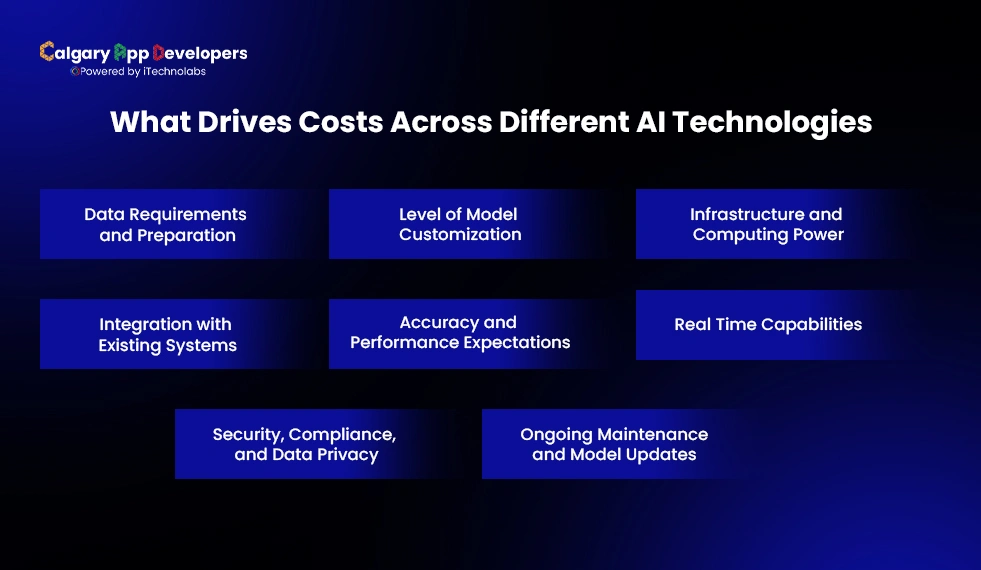
The cost of building an AI app is shaped less by the label of the technology and more by how that technology is implemented. Two apps using the same AI capability can have very different budgets based on data, performance expectations, and system complexity.
Below are the core factors that consistently influence costs across AI technologies.
-
Data Requirements and Preparation:
Data is the foundation of any AI system. Costs rise when relevant, clean, and well-labeled data is not readily available. If your project requires collecting raw data, annotating it, and preparing it for training, this can become one of the most expensive phases. Technologies like computer vision and NLP are especially data-intensive and demand large, high-quality datasets.
-
Level of Model Customization:
Using pre-trained models or third-party APIs keeps costs relatively controlled. However, many real-world applications require customization to meet specific business needs. Custom model development involves training, fine-tuning, and continuous testing. This significantly increases both time and budget, especially in industries where accuracy cannot be compromised.
-
Infrastructure and Computing Power
AI systems rely heavily on computing resources, particularly during model training and deployment. Advanced technologies such as deep learning and generative AI require GPU-based environments and scalable cloud infrastructure. The more complex the model and the higher the usage, the greater the infrastructure cost.
-
Integration with Existing Systems
An AI app is rarely built in isolation. It needs to connect with internal systems, third-party tools, and data sources. The complexity of these integrations directly impacts development effort. Seamless data flow, system compatibility, and reliability require additional engineering time, which adds to overall costs.
-
Accuracy and Performance Expectations
Higher performance expectations demand greater investment. Applications such as recommendation engines may tolerate moderate accuracy, while systems in healthcare or finance require near-perfect precision. Achieving higher accuracy involves better data, more training cycles, and advanced optimization techniques.
-
Real Time Capabilities
AI apps that operate in real time are more resource-intensive than those that process data in batches. Real-time systems require low-latency architecture, faster processing pipelines, and continuous availability. This increases both development and operational costs.
-
Security, Compliance, and Data Privacy
AI apps that handle sensitive data must meet strict regulatory standards. Implementing security protocols, data encryption, and compliance frameworks adds another layer of cost. In Canada, this often includes aligning with regulations such as PIPEDA, especially for apps dealing with personal or financial data.
-
Ongoing Maintenance and Model Updates
AI development does not end at deployment. Models need to be monitored, retrained, and updated as new data becomes available. This ongoing effort ensures the app remains accurate and relevant, but it also contributes to long-term costs that businesses must plan for from the start.
These factors directly determine how much an AI app will cost. A clear understanding of these cost drivers helps in making better technical decisions and building solutions that scale efficiently without unnecessary spending.
Read Also: How to Make an AI in 7 Simple Steps
AI App Development Cost by Project Complexity
The cost of building an AI app in Canada varies significantly based on project complexity. As complexity increases, so do requirements around data, infrastructure, integrations, and performance.
Here is a clear breakdown based on complexity levels:
| Project Complexity | Estimated Cost (CAD) | Timeline | Typical Capabilities |
| Basic AI App | 30,000 – 70,000 | 2 – 4 months | Rule-based logic, simple automation |
| Mid-Level AI App | 70,000 – 150,000 | 4 – 7 months | ML models, APIs, moderate data handling |
| Advanced AI App | 150,000 – 300,000+ | 7 – 12+ months | Deep learning, real-time processing, scaling |
1. Basic AI App
Estimated Cost: CAD 30,000 to CAD 70,000
Basic AI apps focus on predefined logic and limited intelligence. They are designed to solve clearly defined problems where outcomes are predictable and do not require continuous learning.
These applications typically rely on rule-based systems or lightweight AI integrations through third-party APIs. They are often the starting point for businesses exploring AI app development without committing to heavy investment.
Common use cases include simple chatbots for customer queries, internal workflow automation, and basic recommendation systems based on fixed conditions.
Key Features:
- Rule-based decision-making with predefined logic
- Basic chatbot or virtual assistant functionality
- Simple task and workflow automation
- Limited or no model training involved
- Integration with pre-built AI services or APIs
- Low data dependency and minimal processing needs
- Faster development cycles with lower infrastructure requirements
2. Mid-Level AI App
Estimated Cost: CAD 70,000 to CAD 150,000
Mid-level AI apps introduce learning capabilities, allowing the system to improve outcomes based on data. These applications move beyond static rules and begin to deliver adaptive, data-driven experiences.
They typically use machine learning models and NLP to analyze patterns, make predictions, and personalize interactions. While many solutions at this level still leverage existing frameworks or APIs, they require more structured data pipelines and tuning to achieve reliable performance.
These apps are widely used in customer experience platforms, recommendation engines, predictive analytics tools, and intelligent search systems.
Key Features:
- Machine learning-driven predictions and insights
- Personalized user experiences based on behavior and data
- NLP capabilities for chat, search, or sentiment analysis
- Integration with multiple systems, such as CRM, ERP, or analytics tools
- Moderate data collection, storage, and processing requirements
- Model tuning and performance optimization
- Improved UI and interaction design to support intelligent features
3. Advanced AI App
Estimated Cost: CAD 150,000 to CAD 300,000+
Advanced AI apps are built for complex, high-impact use cases where intelligence, scalability, and real-time performance are critical. These systems are deeply integrated into business operations and often serve as core product offerings.
They involve custom model development, deep learning architectures, and large-scale data engineering. Unlike basic or mid-level apps, these solutions are designed to continuously learn, adapt, and deliver highly accurate outputs.
Examples include generative AI platforms, fraud detection systems, autonomous decision-making tools, and enterprise-grade analytics platforms.
Key Features:
- Custom-built AI and deep learning models tailored to specific use cases
- Real-time data processing with low latency performance
- Generative AI capabilities such as content, code, or image generation
- High scalability supported by cloud and distributed infrastructure
- Advanced analytics, forecasting, and decision intelligence
- Seamless integration across multiple enterprise systems and data sources
- Continuous model training, monitoring, and improvement
- Strong focus on security, compliance, and data governance
As project complexity increases, the shift is not just in features but in the entire development approach. From simple automation to intelligent systems that evolve, each level brings a corresponding increase in cost, effort, and long-term value.
Also Read: AI Integration Calgary Services: Smarter Business Solutions
Cost Drivers at Each Complexity Level
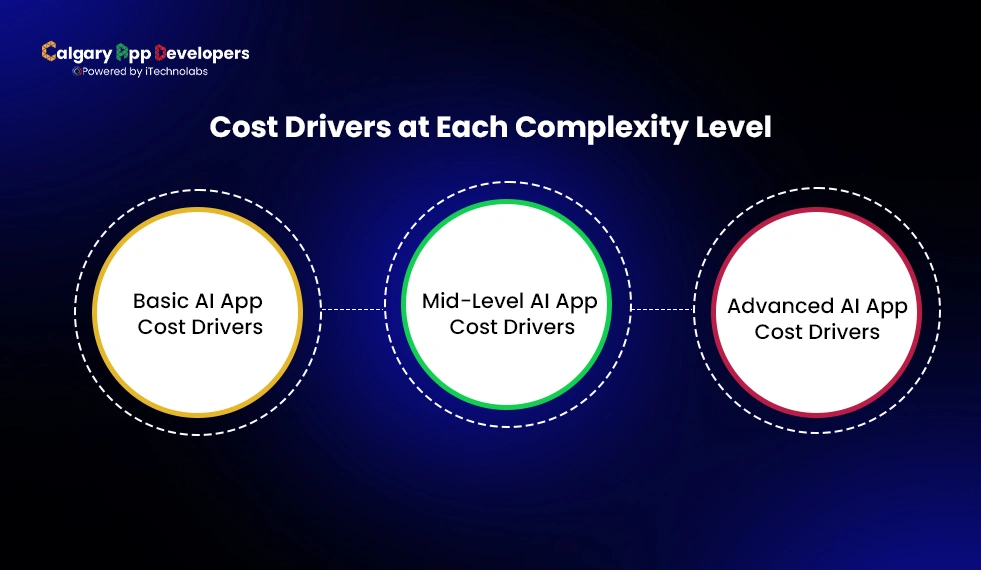
The complexity of an AI app directly shapes how costs are distributed across development. As you move from basic to advanced solutions, the shift is not only in features but also in data requirements, infrastructure, and long-term operational needs.
Understanding what drives costs at each level helps in setting realistic budgets and avoiding unexpected escalations.
-
Basic AI App Cost Drivers
At the basic level, costs are largely influenced by development effort and the choice of tools rather than heavy data or infrastructure demands. Since these apps rely on predefined logic or simple integrations, the focus remains on building clean workflows and user interfaces. At this level, keeping the scope focused is the biggest factor in controlling costs.
-
Mid-Level AI App Cost Drivers
Mid-level applications introduce machine learning and data driven functionality, which brings additional layers of cost. Here, the emphasis shifts toward data handling, model performance, and system integrations. Costs begin to scale as the app becomes more intelligent and dynamic. At this stage, the quality of data and the level of customization play a major role in determining the final budget.
-
Advanced AI App Cost Drivers
Advanced AI apps involve complex architectures and continuous learning systems, making them the most resource-intensive to build and maintain. Costs are driven not only by development but also by infrastructure, scalability, and ongoing optimization. At this level, the cost extends beyond initial development and becomes an ongoing investment in performance, scalability, and accuracy.
Every complexity level introduces a new layer of technical and operational demands. Aligning your app’s requirements with the right level of complexity ensures that you invest where it truly matters while keeping development efficient and scalable.
Read Also: How Much Does It Cost to Hire an AI Developer?
Industry-Wise AI App Development Costs
The cost of building an AI app in Canada also varies significantly by industry. Each sector comes with its own data complexity, compliance requirements, and performance expectations, all of which directly impact development costs.
| Industry | Estimated Cost (CAD) | Typical Use Cases |
| Healthcare | 100,000 – 300,000+ | Diagnostics, patient monitoring, and medical imaging |
| Fintech | 80,000 – 250,000 | Fraud detection, risk analysis, trading insights |
| Retail & E-commerce | 50,000 – 150,000 | Recommendations, chatbots, and demand forecasting |
| Education | 40,000 – 120,000 | Personalized learning, virtual tutors |
| Logistics | 60,000 – 180,000 | Route optimization, demand prediction |
| Real Estate | 50,000 – 140,000 | Property recommendations, price prediction |
| Media & Entertainment | 70,000 – 200,000 | Content generation, personalization engines |
1. Healthcare
Estimated Cost: CAD 100,000 to CAD 300,000+
Healthcare AI apps are among the most complex and expensive to build. They often require high accuracy, strict compliance, and advanced data processing capabilities.
Use cases such as medical imaging or predictive diagnostics demand custom models and large, well-structured datasets. Regulatory requirements further increase development time and cost.
2. Fintech
Estimated Cost: CAD 80,000 to CAD 250,000
AI apps in fintech focus on precision, security, and real-time decision-making. Fraud detection systems, credit scoring, and algorithmic trading platforms rely heavily on machine learning.
Costs are driven by the need for robust data pipelines, secure infrastructure, and integration with financial systems. Compliance and data protection also add to the overall investment.
3. Retail and e-commerce
Estimated Cost: CAD 50,000 to CAD 150,000
Retail AI apps are more flexible in terms of complexity and budget. They often focus on enhancing customer experience through personalization and automation.
Recommendation engines, chatbots, and demand forecasting systems can be built using mid-level AI capabilities, making this one of the more cost-efficient industries for AI adoption.
4. Education
Estimated Cost: CAD 40,000 to CAD 120,000
AI in education focuses on personalization and accessibility. Applications include adaptive learning platforms, AI tutors, and automated grading systems.
These apps typically fall within the lower to mid cost range, depending on the level of personalization and content intelligence required.
5. Logistics
Estimated Cost: CAD 60,000 to CAD 180,000
Logistics AI apps are built to optimize operations and improve efficiency. Common use cases include route optimization, fleet management, and demand prediction.
Costs increase with real-time tracking, integration with IoT systems, and the need for accurate predictive models.
6. Real Estate
Estimated Cost: CAD 50,000 to CAD 140,000
AI apps in real estate are used for property recommendations, price estimation, and customer engagement.
These applications usually rely on structured data and predictive models, placing them in the mid-range of AI app development costs.
7. Media and Entertainment
Estimated Cost: CAD 70,000 to CAD 200,000
This industry is rapidly adopting AI for content creation, personalization, and audience insights. Generative AI and recommendation engines are widely used.
Costs can vary widely depending on whether the app focuses on simple personalization or advanced content generation capabilities.
Industry selection plays a critical role in determining the cost of an AI app. Sectors with higher regulatory requirements and data complexity naturally demand greater investment, while others allow faster and more cost-efficient development.
Also Read: How to Develop an AI App: A Breif Guide
How Industry Choice Impacts AI App Pricing
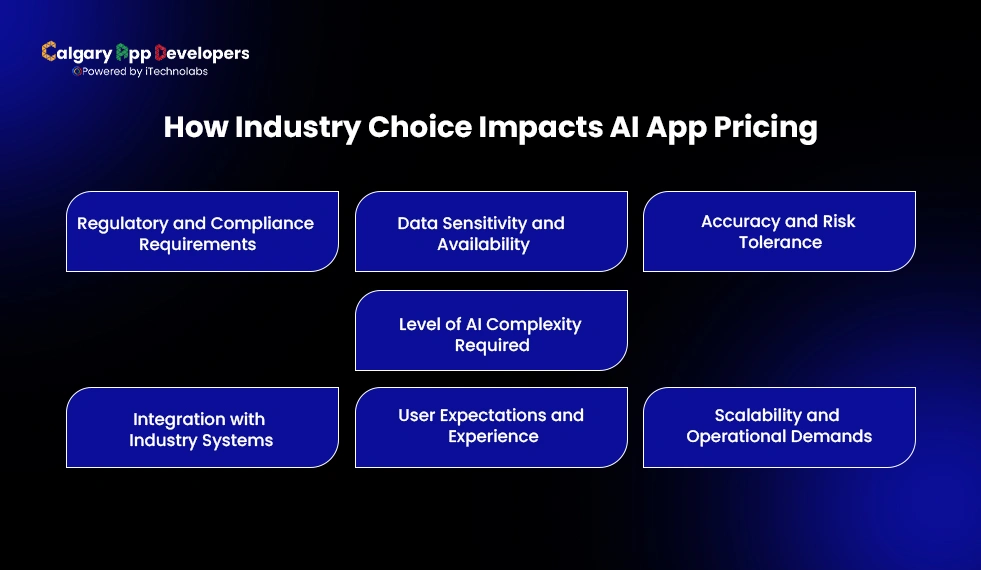
The industry you choose for your AI app has a direct and often significant impact on development costs. Even when the underlying technology is similar, factors such as compliance, data sensitivity, user expectations, and operational complexity can change the overall budget.
Here are the key ways industry selection influences AI app pricing.
1. Regulatory and Compliance Requirements
Industries like healthcare and finance operate under strict regulations. In Canada, this often involves compliance with laws such as PIPEDA and other data protection standards.
Major Cost Factors:
- Implementation of data encryption and secure storage systems
- Audit trails and compliance reporting mechanisms
- Legal and regulatory validation processes
- Additional testing to meet compliance standards
- Documentation and certification requirements
2. Data Sensitivity and Availability
Different industries handle different types of data. Healthcare and fintech apps deal with highly sensitive data, while sectors like retail or media often work with more accessible datasets.
Major Cost Factors:
- Secure data collection and storage infrastructure
- Data anonymization and access control mechanisms
- Cost of acquiring or licensing industry-specific datasets
- Data cleaning, labeling, and preparation efforts
- Ongoing data governance and monitoring
3. Accuracy and Risk Tolerance
Not all industries can tolerate the same level of error. High-risk industries require near-perfect accuracy, which increases development effort.
Major Cost Factors:
- Additional model training and fine-tuning cycles
- Extensive testing and validation processes
- Use of high-quality and domain-specific datasets
- Implementation of fallback and error handling systems
- Continuous performance monitoring and optimization
4. Level of AI Complexity Required
Some industries demand more advanced AI capabilities than others, which directly impacts cost.
Major Cost Factors:
- Use of advanced models such as deep learning or generative AI
- Custom model development instead of pre-built solutions
- Increased computational and infrastructure requirements
- Longer development timelines for complex features
- Need for specialized AI expertise
5. Integration with Industry Systems
AI apps often need to connect with existing systems, which vary in complexity across industries.
Major Cost Factors:
- Integration with legacy systems and databases
- API development and third-party service connections
- Data synchronization across multiple platforms
- Handling system compatibility and performance issues
- Maintenance of integrations over time
6. User Expectations and Experience
User expectations differ across industries, influencing both frontend and backend development.
Major Cost Factors:
- Advanced UI and UX design for consumer-facing apps
- Real-time personalization and responsiveness
- Multi-platform support, such as web and mobile
- Continuous user experience optimization
- Feature enhancements based on user behavior
7. Scalability and Operational Demands
Some industries require AI apps to handle large volumes of users or real-time operations.
Major Cost Factors:
- Cloud infrastructure and scaling capabilities
- Load balancing and performance optimization
- Real-time data processing systems
- Monitoring and uptime management
- Ongoing infrastructure and operational costs
Industry choice shapes every layer of AI app development, from compliance and data handling to performance and scalability. Understanding these factors early helps in building an AI app that aligns with both business goals and budget expectations.
Read Also: How to Hire AI Developer: A Complete Guide
AI App Development Cost Based on Features
The features you choose for your AI app play a decisive role in shaping the overall development cost. Each added capability increases not only the development effort but also the complexity of data handling, infrastructure, and long-term maintenance.
Below is a feature-wise cost estimation to give a clearer picture:
| Feature Type | Estimated Cost (CAD) | Description |
| User Authentication & Profiles | 5,000 – 15,000 | Login, roles, user management |
| Chatbot Integration (Basic NLP) | 10,000 – 40,000 | Conversational interface, FAQs |
| Recommendation Engine | 15,000 – 60,000 | Personalized suggestions |
| Predictive Analytics | 20,000 – 80,000 | Forecasting, behavior analysis |
| Computer Vision Features | 30,000 – 100,000 | Image recognition, object detection |
| Generative AI Capabilities | 40,000 – 150,000+ | Content, text, or image generation |
| Voice and Speech Recognition | 25,000 – 90,000 | Voice commands, transcription |
| Real Time Data Processing | 30,000 – 120,000 | Live analytics, instant responses |
| Admin Dashboard & Analytics | 10,000 – 40,000 | Insights, reporting, monitoring |
| Third Party Integrations | 10,000 – 50,000 | APIs, external systems |
- User Authentication and Profiles: This is a foundational feature in most AI apps. It manages user identity, access control, and personalization. While not AI-heavy, it is essential for structuring user data and enabling tailored experiences. Costs depend on the complexity of roles, permissions, and security layers.
- Chatbot Integration: Chatbots powered by NLP allow users to interact with the app through natural language. Basic chatbot functionality can be built using existing APIs, keeping costs moderate. However, more advanced conversational flows and contextual understanding increase development effort.
- Recommendation Engine: Recommendation systems analyze user behavior to deliver personalized suggestions. Costs depend on the level of personalization and the volume of data processed. More advanced systems require machine learning models and continuous optimization.
- Predictive Analytics: Predictive features use historical data to forecast outcomes such as user behavior, demand trends, or risk levels. These features require data modeling, training, and validation, which increases cost as accuracy expectations rise.
- Computer Vision Features: Computer vision enables the app to process and interpret visual data. This includes tasks like image recognition, object detection, or facial analysis. Costs are driven by dataset preparation, model training, and processing requirements.
- Generative AI Capabilities: Generative AI is one of the most advanced feature sets, enabling the app to create content such as text, images, or code. Costs are higher due to model integration, fine-tuning, and infrastructure needs. The complexity increases further if customization or domain-specific outputs are required.
- Voice and Speech Recognition: This feature allows users to interact with the app through voice input. Costs vary based on accuracy requirements, language support, and real-time processing capabilities. Integration with speech APIs can reduce initial costs.
- Real Time Data Processing: Real-time features enable instant responses and live insights. These systems require optimized backend architecture and scalable infrastructure, making them more expensive than batch processing solutions.
- Admin Dashboard and Analytics: Dashboards provide visibility into app performance, user behavior, and AI outputs. While not core AI features, they are essential for managing and improving the system. Costs depend on the level of detail and customization required.
- Third Party Integrations: Most AI apps rely on external services for payments, data, or additional functionalities. Each integration adds development effort and ongoing maintenance requirements, contributing to the overall cost.
Feature selection is one of the most controllable aspects of AI app development. Prioritizing essential features for the initial release and scaling gradually helps in managing costs while still delivering meaningful value.
Also Read: Top AI Companies in Canada to Know
Phase-Wise Breakdown of AI App Development Costs
Creating an AI application requires multiple development steps. The expenses of the project extend throughout its different stages which each produce their own results. Budget distribution at every project phase provides essential information that enables better project management and prevents budget excesses.
In Canada, the total cost is typically divided across the following development phases:
| Development Phase | Estimated Cost (CAD) | Contribution to Total Cost |
| Discovery and Planning | 5,000 – 20,000 | 5% – 10% |
| UI and UX Design | 10,000 – 30,000 | 10% – 15% |
| Data Collection and Prep | 10,000 – 50,000 | 10% – 20% |
| AI Model Development | 20,000 – 100,000+ | 20% – 35% |
| App Development | 20,000 – 80,000 | 20% – 30% |
| Testing and Quality Assurance | 10,000 – 40,000 | 10% – 15% |
| Deployment and Integration | 5,000 – 20,000 | 5% – 10% |
| Maintenance and Updates | Ongoing (10% – 20% annually) | Post-launch cost |
1. Discovery and Planning
This phase sets the strategic and technical direction of the AI app. It involves aligning business goals with AI capabilities and defining a clear roadmap before development begins.
Process:
- Requirement gathering through stakeholder discussions
- Identifying use cases where AI adds real value
- Feasibility analysis based on available data and technology
- Selecting the appropriate AI approach, such as ML, NLP, or computer vision
- Defining project scope, timelines, and success metrics
- Creating technical architecture and development roadmap
Cost Drivers:
- Clarity and scope of requirements
- Complexity of use cases being defined
- Depth of research and feasibility validation
- Level of technical planning and architecture design
- Involvement of senior AI consultants or domain experts
A well-executed discovery phase reduces uncertainty and prevents costly changes later. Poor planning often leads to scope creep, rework, and delays that inflate the overall budget.
2. UI and UX Design
Design plays a critical role in how users interact with the AI app. It is not just about visual appeal but about making intelligent features understandable and usable.
Process:
- Creating user personas and mapping user journeys
- Designing wireframes and interactive prototypes
- Structuring how AI outputs are displayed to users
- Designing intuitive interfaces for complex AI interactions
- Iterating designs based on feedback and usability testing
Cost Drivers:
- Complexity of user flows and the number of screens
- Level of customization in design
- Need for advanced interactions or animations
- Cross-platform design requirements, such as mobile and web
- Iteration cycles based on testing and feedback
AI apps often require additional design effort to ensure users trust and understand AI-driven outputs, which can increase costs compared to standard applications.
3. Data Collection and Preparation
Data is the backbone of any AI app. This phase ensures that the data used for training is accurate, relevant, and usable.
Process:
- Identifying data sources, such as internal systems or external providers
- Collecting raw data from multiple channels
- Cleaning and removing inconsistencies in data
- Labeling and annotating datasets for training
- Structuring data into usable formats for models
Cost Drivers:
- Availability and accessibility of quality data
- Volume of data required for training
- The effort involved in data cleaning and labeling
- Cost of acquiring third-party datasets
- Need for domain-specific data preparation
If data is not readily available, this phase can become one of the most time-consuming and expensive parts of the entire project.
4. AI Model Development
This is where the intelligence of the AI app is actually built. The goal is to create models that can learn from data and deliver accurate results.
Process:
- Selecting the appropriate model or algorithm
- Training models using prepared datasets
- Fine-tuning parameters to improve performance
- Validating model accuracy and reliability
- Iterating to achieve desired outcomes
Cost Drivers:
- Complexity of the model being developed
- Need for custom models versus pre-trained solutions
- Computational resources required for training
- Number of training and testing iterations
- Expertise required from AI engineers and data scientists
Advanced AI apps with custom models and high accuracy requirements significantly increase costs in this phase.
5. App Development
This phase brings the AI functionality into a usable application. It involves building both the frontend and backend systems.
Process:
- Developing user interfaces and frontend components
- Building backend architecture and APIs
- Integrating AI models into the application
- Ensuring smooth data flow between systems
- Implementing security and performance optimization
Cost Drivers:
- Number and complexity of features
- Platform selection, such as web, mobile, or both
- Level of integration with external systems
- Scalability and performance requirements
- Development team size and expertise
The more feature-rich and scalable the app, the higher the development cost in this phase.
6. Testing and Quality Assurance
Testing ensures that the AI app functions correctly and delivers reliable outputs. This phase is critical for maintaining performance and user trust.
Process:
- Functional testing of app features
- Performance testing under different conditions
- Validation of AI model outputs
- Identifying and fixing bugs or inconsistencies
- Conducting user acceptance testing
Cost Drivers:
- Complexity of features being tested
- Accuracy requirements for AI outputs
- Number of test scenarios and edge cases
- Tools and frameworks used for testing
- Iteration cycles needed for bug fixing and optimization
AI apps require additional validation compared to standard apps, especially when accuracy is critical.
7. Deployment and Integration
This phase involves launching the AI app in a live environment and ensuring it works seamlessly with other systems.
Process:
- Setting up cloud or on-premises infrastructure
- Deploying the application and AI models
- Integrating with existing systems and APIs
- Configuring monitoring and logging tools
- Ensuring system stability during launch
Cost Factors:
- Complexity of the deployment environment
- Infrastructure requirements, such as cloud services
- Number of integrations with external systems
- Security and compliance requirements
- Level of monitoring and support setup
A smooth deployment requires careful planning, especially for apps that depend on real-time data and integrations.
8. Maintenance and Updates
AI apps require continuous improvement after launch. This phase ensures that the app remains accurate, secure, and scalable over time.
Process:
- Monitoring app performance and user behavior
- Fixing bugs and improving system stability
- Updating features and adding enhancements
- Retraining models with new data
- Scaling infrastructure as usage grows
Cost Factors:
- Frequency of updates and feature enhancements
- Volume of new data for retraining models
- Infrastructure scaling requirements
- Ongoing support and monitoring efforts
- Need for continuous optimization
Unlike traditional apps, AI apps evolve. Maintenance is not optional but an essential investment to keep the system effective and competitive.
Read Also: Best AI Business Solutions Driving Business Growth
Cost Based on Project Scale and Scope
The scale and scope of your AI app define how extensive the development effort will be. This includes the number of features, supported users, data volume, integrations, and overall system architecture.
Instead of looking at AI app development as a fixed cost, it is more practical to understand how pricing evolves as your project expands in scope.
1. Small-Scale AI App
Estimated Cost: CAD 30,000 to CAD 70,000
Small-scale AI apps are focused, lightweight solutions built to solve a specific problem with limited functionality.
These apps typically include one or two core AI features, minimal integrations, and a simple user interface. They are designed for quick deployment and validation rather than large-scale operations.
Best Use For:
- MVPs or proof of concept projects
- Startups testing an AI idea in the market
- Internal tools for process automation
- Basic chatbots or recommendation features
2. Medium-Scale AI App
Estimated Cost: CAD 70,000 to CAD 150,000
Medium-scale apps expand on core functionality by introducing multiple AI features, better user experience, and deeper integrations.
These applications handle moderate user traffic, structured data pipelines, and more dynamic interactions. They are built for businesses looking to move beyond experimentation and deliver real value through AI.
Best Use For:
- Customer-facing applications with AI features
- Personalized recommendation platforms
- Predictive analytics tools
- AI-powered SaaS products with a moderate user base
3. Large-Scale AI App
Estimated Cost: CAD 150,000 to CAD 300,000+
Large-scale AI apps are complex systems designed for high performance, scalability, and advanced intelligence.
They often include multiple AI models, real-time processing, enterprise-level integrations, and support for large volumes of users and data. These apps are built as core business platforms rather than standalone tools.
Best Use For:
- Enterprise-grade AI platforms
- Generative AI products and copilots
- Real-time analytics and decision systems
- High-traffic consumer applications
- Multi-module AI solutions across departments
4. Enterprise and Ecosystem Level AI Solutions
Estimated Cost: CAD 300,000+
At this level, AI is deeply embedded across systems, workflows, and business functions. These are not just apps but full-scale AI ecosystems.
They require advanced infrastructure, continuous model training, cross-platform integration, and strong governance frameworks. Development is ongoing and evolves with business needs.
Best Use For:
- Large enterprises with complex operations
- AI-driven digital transformation initiatives
- Platforms requiring continuous learning and scaling
- Multi-region or global AI deployments
The broader the scope and the larger the scale, the greater the investment required. Defining a clear scope early and scaling in phases is often the most effective way to balance cost, speed, and long-term value.
Also Read: Top Sites to Hire AI Developers | Best AI Engineers for Hire
Choosing the Right Engagement Model for Your Budget
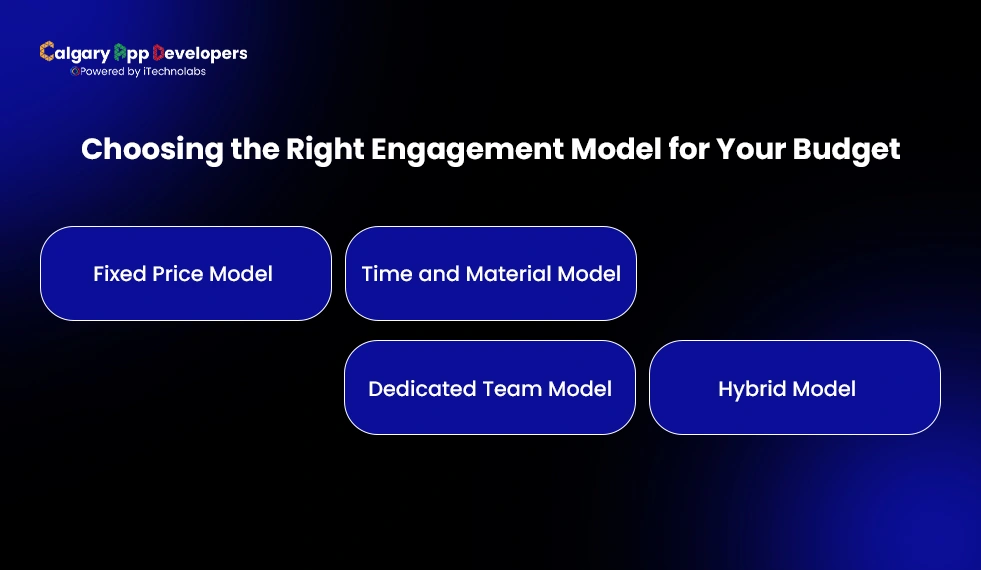
The engagement model you choose has a direct impact on the cost, flexibility, and overall success of your AI app development. It determines how your team is structured, how resources are allocated, and how efficiently the project is executed.
Selecting the right model depends on your project scope, budget clarity, and long-term goals.
1. Fixed Price Model
This model works best when the project scope, features, and timelines are clearly defined from the start. The development cost is agreed upon in advance, which makes budgeting predictable.
It is a suitable choice for small to mid-scale AI apps where requirements are stable and unlikely to change. However, it offers limited flexibility if you need to modify features or expand the scope during development.
2. Time and Material Model
In this model, you pay based on the actual time and resources spent on development. It offers greater flexibility, making it ideal for AI projects where requirements evolve.
This approach works well for mid to large-scale AI apps, especially those involving experimentation, model tuning, or ongoing iterations. While costs can vary, it allows for better control over quality and adaptability.
3. Dedicated Team Model
This model provides you with a team of developers, AI engineers, and designers who work exclusively on your project.
It is best suited for long-term or complex AI app development where continuous improvements, scaling, and maintenance are required. Although it involves a higher initial commitment, it offers better collaboration, faster development cycles, and more control over the project.
4. Hybrid Model
The hybrid approach combines elements of fixed price and time-based models. Core features are developed under a fixed scope, while evolving or experimental components are handled on a time and material basis.
This model is useful for AI apps where some parts of the project are clearly defined, while others require flexibility. It helps balance cost predictability with adaptability.
Choosing the right engagement model is not just about cost control. It is about aligning your development approach with the nature of your AI app, ensuring that you can scale, adapt, and deliver value without unnecessary constraints.
Read Also: Best AI Cloud Business Tools for Smarter Management
Cost Breakdown Based on Team and Resources
The cost of building an AI app in Canada is heavily influenced by the team you hire and the resources required to execute the project. Beyond technology and features, the composition, expertise, and location of your team play a major role in determining the final budget.
In most cases, team and resource costs account for 50 percent to 70 percent of the total development cost.
1. Core Team Structure and Cost Contribution
A typical AI app development team includes multiple roles, each contributing to different parts of the project.
AI Engineers and Data Scientists
- Estimated Cost: CAD 80 to CAD 180 per hour
- These are the most critical and often the most expensive resources. They handle model development, training, and optimization.
Backend Developers
- Estimated Cost: CAD 60 to CAD 140 per hour
- Responsible for building APIs, managing data flow, and integrating AI models into the application.
Frontend Developers
- Estimated Cost: CAD 50 to CAD 120 per hour
- Focus on building user interfaces and ensuring smooth interaction with AI features.
UI and UX Designers
- Estimated Cost: CAD 40 to CAD 100 per hour
- Design intuitive user experiences, especially important for presenting AI-driven outputs clearly.
QA Engineers
- Estimated Cost: CAD 40 to CAD 90 per hour
- Ensure the app performs reliably and validate both functional and AI-related outputs.
Project Managers
- Estimated Cost: CAD 60 to CAD 130 per hour
- Oversee timelines, coordination, and overall project execution.
2. Team Size and Project Duration
The total cost is directly impacted by how many people are involved and how long they are engaged.
Smaller projects may require a lean team working for a few months, while complex AI apps often need larger teams over extended periods. As team size and duration increase, costs scale proportionally.
In-House vs. Outsourced Team
Choosing between an in-house team and an external development partner significantly affects cost.
- In-house teams offer greater control but involve higher costs due to salaries, infrastructure, and long-term commitments.
- Outsourced teams or development agencies provide access to skilled resources with more flexible pricing models.
Many businesses prefer outsourcing to balance quality and cost efficiency, especially for AI expertise.
3. Geographic Location of Resources
Developer rates vary based on location. Canadian-based teams typically charge higher rates compared to offshore teams.
While local teams offer advantages in communication and compliance, global teams can reduce costs without compromising quality if managed effectively.
4. Tools, Infrastructure, and Licenses
AI application development requires both human resources and financial investment.
The project needs cloud platforms together with data storage, model training environments, and third-party APIs. The expenses will continue to occur because they increase with usage.
5. Expertise Level and Specialization
The level of expertise required also impacts cost.
Projects involving advanced AI technologies or domain-specific applications require highly skilled professionals. Specialized expertise comes at a premium but is often essential for building reliable and scalable solutions.
The overall cost of an AI app is not just about how many people are involved, but about the quality, structure, and efficiency of the team. Building the right mix of talent and resources ensures that your investment translates into a high-performing and scalable AI solution.
Also Read: Best Artificial Intelligence Consulting Companies in Canada
How to Reduce AI App Development Costs Without Sacrificing Quality
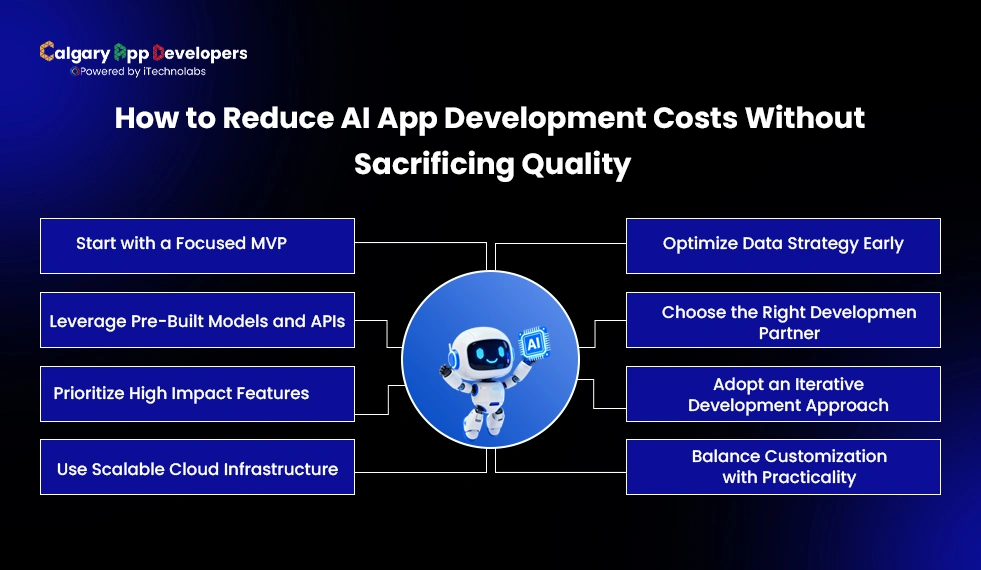
Building an AI app can require significant investment, but high cost does not always mean better outcomes. With the right approach, it is possible to control expenses while still delivering a high-quality, scalable product.
The key lies in making smart decisions early and focusing resources where they create the most impact.
- Start with a Focused MVP: Instead of building a full-scale AI app from day one, begin with a minimum viable product that includes only core features. This approach reduces initial development costs and allows you to validate your idea in the market. Once you gather user feedback and real data, you can scale the app in phases without unnecessary spending.
- Leverage Pre-Built Models and APIs: Building AI models from scratch is expensive and time-consuming. In many cases, pre-trained models and third-party APIs can deliver strong results at a lower cost. Using services for NLP, vision, or generative AI reduces development effort while maintaining quality, especially in early stages.
- Prioritize High Impact Features: Not every feature adds equal value. Focus on features that directly solve user problems or drive business outcomes. Avoid overloading the app with complex functionalities in the initial phase. A clear feature prioritization strategy helps control scope and prevents budget overruns.
- Use Scalable Cloud Infrastructure: Investing in flexible cloud infrastructure allows you to pay only for what you use. Instead of setting up expensive fixed systems, cloud platforms help manage costs efficiently, especially during early growth stages. As your AI app scales, infrastructure can grow with demand.
- Optimize Data Strategy Early: Data preparation can become one of the most expensive parts of AI development if not planned properly. Using existing datasets, improving data quality early, and avoiding unnecessary data collection can significantly reduce costs. A well-structured data pipeline saves both time and resources.
- Choose the Right Development Partner: Working with an experienced AI development team can prevent costly mistakes. A skilled partner brings proven processes, reusable components, and technical expertise that reduce development time and improve efficiency. This often leads to better outcomes at a lower overall cost.
- Adopt an Iterative Development Approach: AI apps benefit from continuous improvement. Instead of aiming for perfection in the first release, build, test, and refine in cycles. This approach helps identify what works and what does not early, reducing the risk of investing heavily in features that may not deliver value.
- Balance Customization with Practicality: Custom solutions are powerful but not always necessary. Evaluate where customization is truly required and where standard solutions can work. This balance helps control costs while still delivering a tailored user experience.
Reducing AI app development cost is not about cutting corners. It is about making informed decisions, optimizing resources, and building with a clear strategy. When done right, it allows businesses to achieve both efficiency and quality without compromise.
Read Also: Top AI Software Development Companies
Our Experience of Cost-Effective AI App Development
Building a high-quality AI app while keeping costs under control requires more than technical execution. It demands the right balance of planning, technology selection, and iterative development. Calgary App Developer’s experience across multiple AI projects has shown that cost efficiency comes from making smart decisions at every stage, not from cutting corners.
Here are two examples that highlight how we deliver cost-effective AI solutions without compromising performance.
1. AI Splasher Text to Image Generation AI App
AI Splasher was designed as a generative AI platform that transforms text prompts into high-quality images. The challenge was to build a visually rich and scalable product without the high cost of training models from scratch.
Approach:
- Leveraged pre-trained generative AI models instead of building custom models from the ground up
- Focused on prompt optimization and output quality rather than infrastructure-heavy training
- Built a clean and intuitive interface to simplify user interaction
- Used scalable cloud infrastructure to manage usage-based costs
Outcome:
- Reduced the initial development cost significantly
- Faster time to market with a production-ready solution
- Delivered high-quality image generation with controlled infrastructure expenses
This project demonstrated that generative AI apps can be built efficiently by focusing on integration and optimization rather than unnecessary reinvention.
2. TBIO, an AI Chatbot Solution
TBIO was developed as an intelligent AI chatbot designed to handle conversations, automate responses, and improve user engagement across platforms.
The goal was to create a scalable conversational system that could deliver accurate responses while keeping development and operational costs manageable.
Approach:
- Integrated advanced NLP models through reliable APIs instead of building from scratch
- Designed structured conversation flows to improve accuracy and reduce model load
- Implemented modular architecture to allow easy updates and feature expansion
- Focused on optimizing response handling to reduce compute usage
Outcome:
- Achieved strong conversational accuracy with optimized resource usage
- Lower development and maintenance costs compared to fully custom solutions
- Scalable chatbot architecture that supports future enhancements
These projects reflect a consistent approach. Focus on the right technology, avoid unnecessary complexity, and build with scalability in mind.
Cost-effective AI app development is not about limiting capabilities. It is about aligning technology, business goals, and execution strategy to deliver maximum value with controlled investment.
Conclusion
The cost of building an AI app in Canada is not defined by a single number. It depends on multiple factors, including technology choices, project complexity, industry requirements, features, team structure, and long-term scalability goals.
AI app development is not just a technical process but a strategic investment. Businesses that define clear objectives, prioritize the right features, and choose the right development partner are far more likely to control costs and achieve strong outcomes.
From initial planning and data preparation to model development and ongoing maintenance, every phase contributes to the overall investment. The most effective approach is to align spending with business value. Not every solution requires advanced custom models or large-scale infrastructure from the beginning. A phased and focused strategy often delivers better results while minimizing risk.
Canada continues to be a strong market for AI innovation, supported by skilled talent, government initiatives, and growing enterprise adoption. This creates the ideal environment for businesses looking to build impactful AI solutions.
As a trusted AI App Development Company in Canada, Calgary App Developer brings hands-on expertise in delivering scalable and cost-effective AI applications. By combining the right technologies, efficient development practices, and a deep understanding of business needs, the focus remains on building AI solutions that deliver measurable value.
Successful AI app development is not about increasing budgets. It is about making the right decisions at every stage to build solutions that are both high-performing and cost-efficient.
FAQs
- What is the cost of developing an AI app in Canada?
The cost of building an AI app in Canada typically ranges from CAD 30,000 to CAD 300,000 or more. The final investment depends on factors such as app complexity, features, AI technology used, data requirements, and team expertise. Simple applications cost less, while advanced, scalable solutions with custom models require significantly higher budgets.
- How much time does it take to build an AI app in Canada?
AI app development timelines usually range from 2 to 12 months. Basic applications can be completed within a few months, while mid-level apps take longer due to model integration and data handling. Advanced AI apps require extended timelines for custom model development, testing, and scaling, especially when accuracy and real-time performance are critical.
- What does the future of AI apps in Canada look like?
The future of AI apps in Canada is highly promising, driven by strong government support, growing enterprise adoption, and advancements in generative AI. The market is expected to grow rapidly over the next decade, with AI becoming a core component across industries such as healthcare, finance, retail, and logistics, creating continuous opportunities for innovation.
- How can businesses reduce AI app development costs without affecting quality?
Businesses can optimize costs by starting with a focused MVP, using pre-trained models, and prioritizing high-impact features. Choosing the right AI app development company and adopting an iterative approach also helps control expenses. A well-planned data strategy and scalable infrastructure ensure efficiency while maintaining performance, accuracy, and long-term value.


Pankaj Arora is a seasoned technology leader and the Founder of Calgary App Developer, with 10+ years of expertise in crafting high-performance digital solutions. His core competencies include full-stack app development, cloud-native architecture, API integration, and agile product delivery. Under his leadership, Calgary App Developers has empowered startups and enterprises alike with scalable mobile applications, secure web platforms, and AI-driven SaaS products.