








Revenue-First MVP Apps: How Canadian Founders Win Big Fast

In many startup journeys, the idea of a Minimum Viable Product is often misunderstood. Founders rush to build something functional, launch quickly, and hope traction follows. The result is usually a product that gains users but struggles to generate meaningful revenue. This gap between usage and profitability is where many early-stage products stall.
A growing number of founders in Canada are approaching MVP development differently. Instead of treating revenue as a later milestone, they design their MVPs with monetization in mind from the very beginning. Every feature, user flow, and validation effort is aligned with a single objective: proving that customers are willing to pay.
This shift toward revenue-first thinking is not about adding complexity to early-stage products. It is about building with clarity and intention. By focusing on value that directly translates into revenue, founders reduce risk, validate faster, and create a stronger foundation for sustainable growth.
Let’s first understand the revenue-first MVP approach. Besides, if you need assistance with MVP development in Canada, you can reach out to our reliable MVP development company in Calgary, Canada.
This blog explores how Canadian founders are redefining MVP development through a revenue-first lens, the principles guiding their approach, and how you can apply the same thinking to build products that are not only usable but profitable from the start.
- A revenue-first MVP prioritizes generating income from the earliest stage, ensuring that the product solves a problem customers are willing to pay for.
- Unlike traditional MVPs that rely on user growth and engagement metrics, this approach uses revenue as the primary indicator of success and validation.
- Focusing on high-value problems increases the likelihood of conversion, as customers are more willing to pay for solutions that directly impact their outcomes or efficiency.
- Limiting features to those that directly support value delivery and monetization helps reduce development time, cost, and complexity.
- Early validation through paying customers provides more accurate feedback than surveys or free user behavior, leading to better product decisions.
- Continuous pricing and revenue optimization allow founders to refine their business model based on real market response.
- Canadian founders emphasize discipline, niche targeting, and financial efficiency, which helps them build sustainable and scalable MVPs.
- A balanced approach to speed, cost, and profitability ensures that the MVP is not only launched quickly but also capable of generating consistent revenue.
What a Revenue-First MVP Really Means
A revenue-first MVP is built with a clear intention: to validate whether a product can generate income, not just attract users. Instead of focusing only on usability or feature completeness, this approach prioritizes real customer value that people are willing to pay for from the very beginning.
In traditional MVP development, success is often measured through metrics like downloads, signups, or engagement. While these indicators are useful, they do not always prove that the product solves a problem worth paying for. A revenue-first MVP shifts that focus toward outcomes that directly impact the business.
Key aspects that define a revenue-first MVP include:
Validation through payment, not just interest
- Success is measured by paying customers rather than signups or traffic
- Revenue acts as proof that the problem being solved is meaningful
Focused problem-solving
- Targets a specific, high-value problem instead of trying to serve multiple use cases
- Eliminates non-essential features that do not contribute to monetization
Early monetization strategy
- Pricing is introduced from the start, not after product-market fit
- Founders test different pricing models to understand willingness to pay
Lean feature prioritization
- Every feature is evaluated based on its potential to drive revenue
- Development efforts are aligned with business outcomes, not assumptions
Faster and more reliable feedback loops
- Real transactions provide stronger insights than surveys or user opinions
- Iterations are based on customer behavior rather than guesswork
This approach changes how founders evaluate progress. Instead of asking how many users are interested, the focus shifts to how many are willing to pay and what drives that decision. This clarity leads to better product decisions, stronger positioning, and a more sustainable path to growth.
Also Read: How to Build MVP for Startup: From Idea to Successful Launch
Why Revenue-First MVPs Deliver Better Results Than Traditional Approaches
Revenue-first MVPs shift the focus from surface-level traction to real business validation. This approach produces stronger outcomes because it ties product decisions directly to value creation and monetization.
- Validates real demand, not just interest: Traditional MVPs often rely on metrics like downloads or signups, which can be misleading. Revenue-first MVPs prove demand through actual payments, ensuring that the problem being solved is important enough for customers to spend money on.
- Eliminates reliance on vanity metrics: User growth without revenue does not guarantee sustainability. A revenue-first approach replaces vanity metrics with meaningful indicators such as conversion rates, customer lifetime value, and early revenue streams.
- Drives sharper product focus: When revenue is the priority, every feature must contribute to solving a high-value problem. This prevents feature overload and keeps the product lean, relevant, and aligned with customer needs.
- Speeds up feedback and iteration: Paying customers provide more direct and actionable feedback. Their expectations are clearer, and their behavior highlights what truly works. This leads to faster and more confident product improvements.
- Supports early financial sustainability: Generating revenue early helps offset development costs and reduces dependence on external funding. It allows founders to reinvest in growth while maintaining greater control over their business.
- Builds a stronger foundation for scaling: Products that generate revenue from the start are easier to scale. They already have a validated business model, making it simpler to attract investors, expand into new markets, and grow sustainably.
By focusing on revenue from day one, founders move beyond experimentation and start building products that are both valuable and viable.
Core Elements That Define a Revenue-First MVP
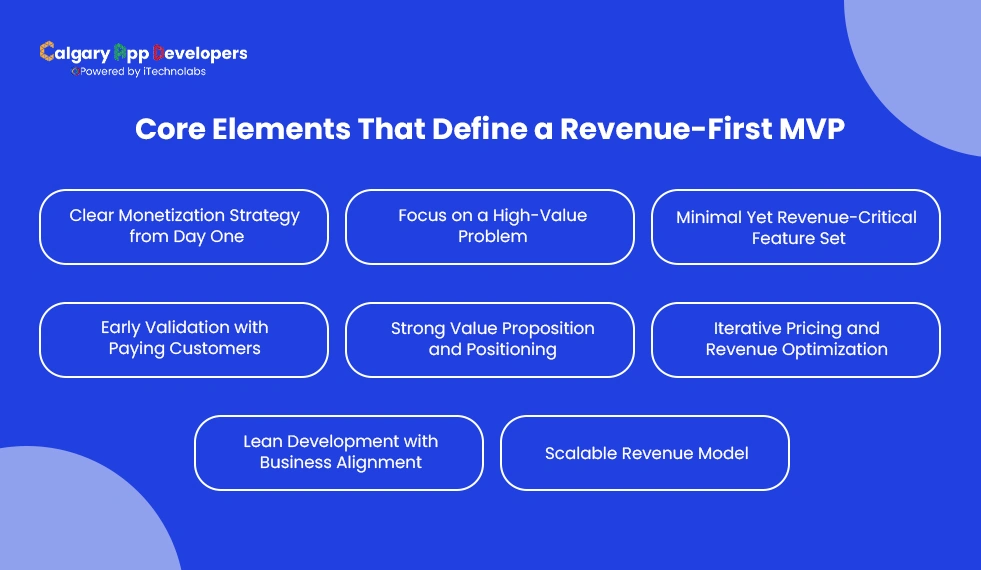
Building a revenue-first MVP requires more than just adding a pricing layer to an early product. It demands a shift in how founders think about value, validation, and growth. Every decision, from problem selection to feature prioritization, is tied to one core objective: generating real revenue as early as possible. Below are the key elements that define this approach in depth.
1. Clear Monetization Strategy from Day One
A revenue-first MVP starts with a defined monetization plan before a single line of code is written. Founders identify how the product will make money and who will pay for it. This includes selecting the right pricing model, whether it is subscription-based, transactional, freemium with paid upgrades, or usage-driven billing.
This early clarity shapes product architecture and user experience. For example, onboarding flows, feature access, and value delivery are all designed to support conversion. Instead of adding pricing later as an afterthought, monetization becomes part of the product’s foundation.
Equally important is early pricing validation. Founders test different price points, offer structures, and packaging strategies even in the earliest versions. This helps uncover what customers truly value and how much they are willing to pay. Over time, this reduces guesswork and ensures the business model is grounded in real market behavior rather than assumptions.
2. Focus on a High-Value Problem
Revenue-first MVPs are built around problems that carry tangible value for the customer. These are not minor inconveniences or nice-to-have improvements. Instead, they are issues that impact revenue, efficiency, time, or outcomes in a meaningful way.
To identify such problems, founders engage deeply with their target audience. They conduct interviews, analyze workflows, and observe where friction creates measurable loss or missed opportunity. The goal is to find pain points that customers already care about solving, even if current solutions are inadequate.
By focusing on high-value problems, the product naturally earns its place in the customer’s budget. This makes pricing conversations easier and reduces resistance to payment. It also strengthens product positioning, as the solution is seen as essential rather than optional. Over time, this focus leads to stronger retention and more consistent revenue streams.
3. Minimal Yet Revenue-Critical Feature Set
A revenue-first MVP is intentionally minimal, but not incomplete. The focus is on delivering only those features that directly contribute to solving the core problem and enabling payment. Every feature must justify its inclusion based on its ability to drive value and support monetization.
This requires disciplined prioritization. Founders must resist the urge to build for scale, edge cases, or future possibilities in the early stages. Instead, they concentrate on creating a tight feature set that delivers immediate impact.
This approach accelerates development and reduces costs, but more importantly, it sharpens the product’s value proposition. Users are not overwhelmed with options. They experience a clear, focused solution that addresses their primary need. As a result, the path from discovery to payment becomes shorter and more intuitive, increasing conversion rates and early revenue.
4. Early Validation with Paying Customers
One of the defining characteristics of a revenue-first MVP is validation through actual transactions. Instead of relying solely on feedback, surveys, or engagement metrics, founders seek proof that customers are willing to pay.
This often involves launching with a smaller audience and offering early access at a price. Even a handful of paying customers can provide powerful validation. It confirms that the problem is real, the solution is valuable, and the pricing is acceptable.
Paying users also provide higher-quality feedback. Their expectations are aligned with the value they receive, and their insights are grounded in real usage. This creates a stronger feedback loop that guides product improvements. Over time, this approach reduces the risk of building features that users like but do not value enough to pay for.
5. Strong Value Proposition and Positioning
In a revenue-first MVP, the value proposition must be clear, specific, and compelling. Customers should immediately understand what the product does, who it is designed for, and why it is worth paying for.
This clarity is achieved through continuous refinement. Founders test different messaging, positioning angles, and use cases to see what resonates most with their audience. They focus on outcomes rather than features, highlighting the tangible benefits the product delivers.
Strong positioning also helps differentiate the product in a crowded market. Instead of competing broadly, the MVP targets a defined segment with a precise solution. This makes marketing more effective and improves conversion rates. When customers see the product as a direct answer to their needs, the decision to pay becomes much easier.
6. Iterative Pricing and Revenue Optimization
Pricing in a revenue-first MVP is not fixed. It evolves based on customer behavior, feedback, and market response. Founders treat pricing as an ongoing experiment rather than a one-time decision.
This involves testing different pricing tiers, adjusting feature access, and exploring packaging strategies. For example, a founder might introduce a basic plan to attract entry-level users and a premium plan for advanced needs. Observing how customers respond to these options provides valuable insight into perceived value.
Over time, these iterations lead to a more refined pricing structure that maximizes both conversion and revenue. Founders learn not only what customers are willing to pay, but also what drives them to upgrade, renew, or churn. This continuous optimization ensures that the revenue model remains aligned with user expectations and market conditions.
7. Lean Development with Business Alignment
Revenue-first MVPs are built using lean development principles, but with a strong alignment to business outcomes. Every development decision is evaluated based on its impact on revenue and value delivery.
This alignment ensures that resources are used efficiently. Teams focus on building what matters most, avoiding unnecessary complexity and technical debt. It also creates better collaboration between product, engineering, and business teams, as everyone is working toward a shared objective.
Lean development in this context is not just about speed. It is about building intelligently, with a clear understanding of how each component contributes to the overall business model. This results in a product that is both efficient to build and effective in generating revenue.
8. Scalable Revenue Model
Even at the MVP stage, a revenue-first approach considers long-term scalability. Founders design their revenue model in a way that can grow alongside the product and its user base.
This includes thinking about how pricing will evolve, how different customer segments will be served, and how revenue streams can expand over time. For example, an MVP might start with a single pricing plan but later introduce tiers, add-ons, or enterprise offerings.
Planning for scalability early prevents the need for major structural changes later. It ensures that the product can handle increased demand without compromising profitability. A scalable revenue model also makes the business more attractive to investors and partners, as it demonstrates a clear path to sustained growth.
These elements work together to create a disciplined and outcome-driven approach to MVP development. Instead of building for attention alone, founders build for value that converts into revenue, setting a stronger foundation for long-term success.
Read Also: MVP App Development Services for Startups in Canada
Real-World Examples of Revenue-First MVPs in Action
Understanding revenue-first MVPs becomes clearer when you look at how successful companies applied these principles early on. The following case studies highlight how global startups focused on monetization, validated demand through paying users, and built scalable businesses from simple beginnings.
- Airbnb: Validating Demand Through Immediate Revenue
Airbnb did not begin as a fully developed global platform. Its founders started with a simple idea during a design conference in San Francisco when hotels were fully booked. They created a basic website offering air mattresses in their apartment, along with breakfast for a fee.
What made this approach revenue-first was their decision to charge from the very beginning. Instead of testing whether people liked the idea of staying in someone else’s home, they validated whether people were willing to pay for it. The first bookings confirmed real demand and provided immediate proof that the concept could generate income.
Rather than building complex features upfront, they focused on the essentials needed to facilitate bookings. As more users joined, they reinvested early revenue into improving the platform, adding trust features like reviews and better listings.
This approach allowed Airbnb to validate both sides of the marketplace while maintaining a clear path to monetization. By prioritizing revenue early, they avoided building a product that attracted interest without financial viability. Their MVP proved that a simple, well-positioned offering could unlock a massive global opportunity.
- Buffer: Testing Willingness to Pay Before Building
Buffer, a social media scheduling tool, took a highly strategic approach to MVP development. Instead of building the product first, the founder created a landing page that explained the concept and included pricing plans. Users could select a plan, but instead of completing a purchase, they were informed that the product was still in development.
This simple test provided a powerful insight. People were not only interested in the idea but were also willing to pay for it. The pricing page acted as a validation tool, helping the founder understand which plans attracted the most attention and what users valued.
Only after confirming this demand did development begin. Even then, the initial product was minimal, focusing only on core scheduling functionality. Early users were onboarded gradually, and their feedback helped refine both the product and pricing model.
This approach reduced risk significantly. By validating revenue potential before building, Buffer ensured that development efforts were aligned with a proven business opportunity. It also demonstrated how founders can use simple experiments to test monetization without investing heavily in product development.
Balancing Speed, Cost, and Profitability in MVP Development
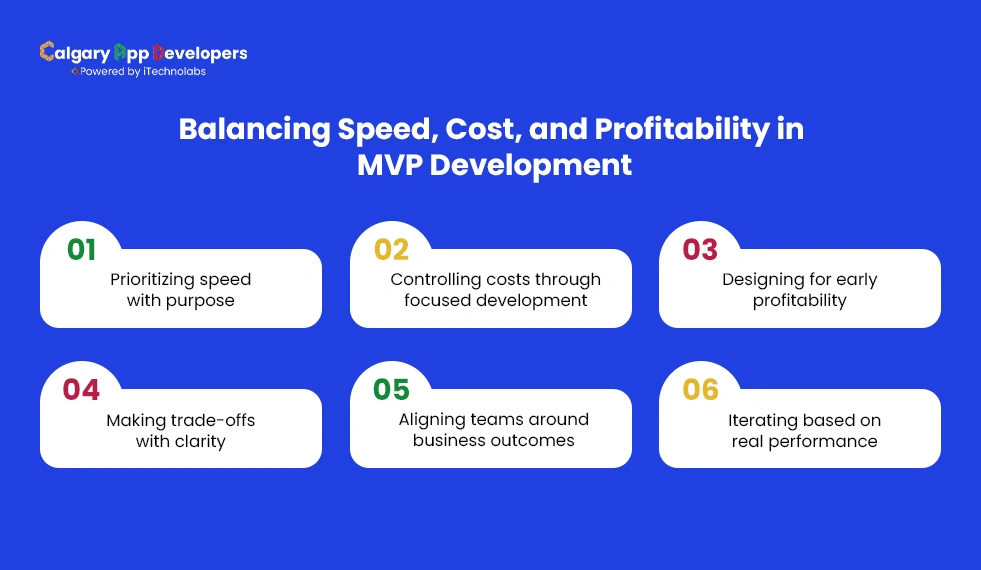
One of the biggest challenges in MVP development is managing three competing priorities: launching quickly, controlling costs, and building a product that can generate revenue. Many startups optimize for speed alone, which often leads to rushed decisions, unnecessary features, and weak monetization. A revenue-first approach requires a more disciplined balance where each factor supports the other.
1. Prioritizing speed with purpose
Speed matters in early-stage development, but it must be directed toward meaningful outcomes. Launching quickly is valuable only when the product is capable of validating revenue. This means focusing on delivering a functional version that can solve a specific problem and enable payment. Instead of aiming for a broad release, founders benefit more from launching to a smaller, targeted audience that is most likely to convert.
2. Controlling costs through focused development
Cost management is not just about spending less, but about spending wisely. A revenue-first MVP avoids unnecessary features, complex infrastructure, and long development cycles. By limiting the scope to what directly supports value delivery and monetization, startups can significantly reduce initial investment. This also lowers financial risk, making it easier to iterate and improve without exhausting resources.
3. Designing for early profitability
Profitability at the MVP stage does not mean large-scale profits. It means creating a model where revenue begins to offset costs as early as possible. Even small streams of income can validate the business model and extend the runway. Founders who think about pricing, conversion, and revenue flows from the start are better positioned to reach this balance.
4. Making trade-offs with clarity
Every MVP involves trade-offs. Adding features may improve user experience, but increase cost and delay launch. Reducing scope may speed up delivery but limit initial appeal. Revenue-first founders make these decisions based on impact. If a feature does not contribute to solving the core problem or driving revenue, it is postponed.
5. Aligning teams around business outcomes
Balancing speed, cost, and profitability requires alignment across product, engineering, and business teams. Everyone must understand that the goal is not just to launch, but to build something that can sustain itself. This alignment ensures that technical decisions support commercial objectives, leading to a more efficient development process.
6. Iterating based on real performance
Once the MVP is live, the balance continues to evolve. Founders track how users interact with the product, where conversions happen, and what drives revenue. These insights guide future investments in features, marketing, and scaling. Instead of guessing, decisions are based on real performance data.
Achieving this balance is not about perfection. It is about making intentional choices that connect product development with financial outcomes. When speed, cost, and profitability are aligned, the MVP becomes more than just a starting point. It becomes a foundation for sustainable growth.
Also Read: MVP Development in Canada: Cost, Process & Benefits
Key Lessons from Canadian Founders on Building Revenue-Driven MVPs
Canadian founders have gained a reputation for building practical, sustainable products that prioritize long-term value over short-term hype. Their approach to MVP development reflects a strong emphasis on disciplined execution, early monetization, and efficient use of resources. The following lessons capture how they consistently build revenue-driven MVPs.
- Start with the business model, not just the product: Many Canadian founders begin by defining how the product will make money before they focus on features or design. This ensures that every product decision is grounded in a viable business model. By identifying the target customer, pricing strategy, and revenue streams early, they reduce the risk of building something that cannot sustain itself.
- Validate willingness to pay as early as possible: Instead of waiting until later stages, founders actively test whether users are willing to pay from the outset. This could involve pre-orders, paid pilots, or limited early access. The goal is to replace assumptions with real transactions, which provide stronger and more reliable validation.
- Build for a specific audience, not the masses: A common pattern among Canadian startups is their focus on niche markets in the early stages. Rather than trying to appeal to a broad audience, they target a well-defined segment with a clear problem. This makes it easier to deliver value, position the product effectively, and convert users into paying customers.
- Keep the product simple and outcome-focused: Simplicity is a recurring theme. Founders avoid overbuilding and concentrate on delivering a clear outcome for the user. Every feature is tied to solving the core problem and supporting monetization. This not only speeds up development but also improves user understanding and conversion.
- Use early revenue to guide product decisions: Revenue is treated as a feedback mechanism, not just a financial outcome. Founders analyze which features drive conversions, what customers are willing to pay for, and where value is strongest. These insights directly influence product iterations and future investments.
- Maintain financial discipline from the beginning: Canadian founders often operate with a strong focus on efficiency. They manage costs carefully, avoid unnecessary spending, and prioritize activities that contribute to revenue. This disciplined approach allows them to extend their runway and grow without excessive reliance on external funding.
- Iterate quickly, but with clear intent: Speed is important, but it is always tied to purpose. Founders iterate based on real user behavior and revenue data, rather than chasing trends or adding features without direction. Each iteration is designed to improve value delivery and strengthen the business model.
- Think long-term while building short-term solutions: Even while developing an MVP, Canadian founders keep scalability in mind. They design products and revenue models that can grow over time, ensuring that early decisions do not limit future expansion. This balance between immediate validation and long-term vision creates a strong foundation for growth.
These lessons highlight a consistent mindset: build with intention, validate with revenue, and grow with discipline. By following these principles, founders can create MVPs that are not only functional but financially viable from the start.
Read Also: Why Canadian Founders Should Hire Local App Developers
How to Build Your MVP with a Revenue-First Mindset
Building an MVP with a revenue-first mindset requires a shift from feature-driven thinking to value-driven execution. The goal is not just to launch quickly, but to launch with a clear path to monetization. This approach ensures that every step, from idea validation to product release, contributes to generating real business outcomes.
- Define the problem in terms of economic value: Start by identifying a problem that has a direct impact on your target audience. The stronger the impact, the higher the willingness to pay. Focus on challenges that affect revenue, efficiency, or critical workflows. This creates a natural foundation for monetization and positions your product as a necessity rather than an option.
- Identify your paying customer early: Not every user is a customer. A revenue-first approach requires clarity on who will actually pay for the solution. Define your ideal customer profile based on their needs, budget, and urgency to solve the problem. This helps you avoid building for a broad audience and instead focus on a segment that is most likely to convert.
- Validate the idea with a monetization test: Before investing heavily in development, test whether people are willing to pay. This can be done through landing pages, pre-orders, pilot programs, or early access offers. Even a small number of paying users can validate your idea more effectively than large volumes of free signups.
- Build only what drives value and conversion: Once validation is clear, develop a minimal product that solves the core problem and enables payment. Avoid adding features that do not directly support value delivery or monetization. A focused product not only reduces development time but also makes it easier for users to understand and adopt.
- Integrate pricing into the product experience: Pricing should be part of the product, not an afterthought. Design user flows that clearly communicate value and guide users toward conversion. Experiment with pricing structures and observe how users respond. Early insights into pricing behavior can shape both product and business strategy.
- Launch to a targeted audience first: Instead of a broad launch, release your MVP to a carefully selected group of users who closely match your ideal customer profile. This increases the likelihood of early conversions and provides more relevant feedback. A smaller, high-quality user base is far more valuable than large numbers without revenue.
- Use revenue as your primary feedback loop: Track how users interact with your product, where they convert, and what drives payments. Revenue data provides clear signals about what is working and what needs improvement. Use these insights to refine features, pricing, and positioning.
- Iterate with discipline and purpose: Every iteration should aim to strengthen value delivery and increase revenue potential. Avoid reacting to every piece of feedback. Instead, prioritize changes that align with your monetization goals and improve the overall business model.
Building an MVP with this mindset requires experience in aligning product strategy with business outcomes. This is where working with a team like Calgary App Developer can make a difference, as the focus remains not just on development, but on creating products that are designed to generate revenue from the start.
By following these steps, founders can move beyond experimentation and start building products that are both useful and financially viable.
Final Words
Building an MVP is no longer just about launching quickly or testing an idea in the market. The real challenge lies in building something that can sustain itself from the start. A revenue-first approach brings that clarity by aligning product decisions with business outcomes, ensuring that value creation and monetization go hand in hand.
Canadian founders have shown that early revenue is not a distant milestone but a powerful validation tool. By focusing on real customer problems, testing willingness to pay, and keeping products intentionally simple, they reduce risk and create stronger foundations for growth. This approach replaces assumptions with measurable results and turns early-stage products into viable businesses.
For founders, the takeaway is clear. Prioritize value that customers are willing to pay for, build with discipline, and treat revenue as the most reliable form of feedback. When these principles guide MVP development, the result is not just a functional product, but a business that is ready to grow with confidence and direction.
FAQs
- What is a revenue-first MVP?
A revenue-first MVP is an early version of a product designed to validate whether customers are willing to pay. Instead of focusing only on user growth or engagement, it prioritizes monetization from the start. This approach helps founders confirm real demand and build financially viable products, not just popular among users.
- How is a revenue-first MVP different from a traditional MVP?
A traditional MVP focuses on testing usability and gaining user traction, often delaying monetization. In contrast, a revenue-first MVP validates the business model early by generating income from initial users. This shift ensures that the product solves a problem worth paying for and reduces the risk of building something that cannot sustain itself.
- Why is early monetization important in MVP development?
Early monetization provides direct proof that customers see value in the product. It helps founders avoid relying on vanity metrics like downloads or signups. Revenue also creates a feedback loop, allowing startups to refine pricing, features, and positioning based on real customer behavior rather than assumptions or opinions.
- What are the key steps to building a revenue-first MVP?
Key steps include identifying a high-value problem, defining a clear monetization strategy, validating willingness to pay, and building only essential features. Founders should launch to a targeted audience, integrate pricing early, and use revenue data to guide iterations. This structured approach ensures the product is both useful and capable of generating income.
- Can a revenue-first MVP work for all types of startups?
A revenue-first MVP works best for products that solve clear, high-impact problems where customers are willing to pay early. While some ideas may require user growth before monetization, most startups benefit from testing revenue early. It helps validate demand, improve decision-making, and build a stronger foundation for long-term growth.


Pankaj Arora is a seasoned technology leader and the Founder of Calgary App Developer, with 10+ years of expertise in crafting high-performance digital solutions. His core competencies include full-stack app development, cloud-native architecture, API integration, and agile product delivery. Under his leadership, Calgary App Developers has empowered startups and enterprises alike with scalable mobile applications, secure web platforms, and AI-driven SaaS products.