






AI App Development: Build Intelligent Solutions
Apps no longer wait for instructions. They anticipate needs, adjust in real time, and interact like intelligent assistants. Whether it is a shopping app that learns user preferences or a healthcare app that flags risks early, modern applications are built to think, not just respond.
This shift is powered by AI-based app development. What once felt experimental is now shaping how products are designed, how users engage, and how businesses scale digital experiences. AI has moved from the background into the core of application architecture, changing expectations around speed, personalization, and decision-making.
The momentum is undeniable. According to Grand View Research report, the global AI software market is expected to reach $1.09 trillion by 2030, growing at a CAGR of 37.3 percent from 2024 onward. That growth reflects a clear demand for applications that can learn, adapt, and deliver intelligence at scale.
This blog explores what truly transformative AI in app development looks like today. It breaks down the technologies behind it, the industries applying it effectively, and the trends shaping what comes next. The insights shared here are grounded in our hands-on experience building and scaling web applications, where AI is no longer an add-on but a foundation for creating smarter, more resilient digital products.
- AI app development is shifting apps from rule-based tools to intelligent, adaptive systems.
- Technologies like machine learning, NLP, computer vision, and generative AI power this transformation.
- AI apps are driving real impact across healthcare, finance, retail, education, and logistics.
- Cost, ethics, and scalability matter as much as innovation when building AI-powered applications.
- Transformative AI app development focuses on building applications that learn, adapt, and personalize experiences in real time rather than following fixed rules.
- Core technologies such as machine learning, deep learning, NLP, computer vision, and large language models form the foundation of modern AI-powered apps.
- AI applications improve user experience through personalization, boost efficiency through automation, and enable smarter decisions through real-time data insights.
- Industries including healthcare, fintech, retail, education, and logistics are using AI apps to solve complex problems and scale intelligent services.
- AI app development costs typically range from $50,000 to $400,000, depending on complexity, data readiness, integrations, and compliance needs.
- Ethical considerations like data privacy, algorithmic bias, and regulatory compliance are critical for building trustworthy and future-ready AI applications.
What is Transformative AI in App Development?
Transformative AI app development means the inclusion of sophisticated artificial intelligence technologies that not just improve but also reshape how apps function, learn, and engage with users. Traditional apps, based on static rules and predetermined user sequences, are dissimilar from AI-driven apps, which learn, grow, and personalize experiences in real time.
In essence, AI App development aims to develop applications that:
- Use context through natural language processing (NLP)
- Foretell outcomes using machine learning (ML)
- Make decisions with smart algorithms
- Improve over time based on fresh data
Think of it like the transition from creating apps that respond to ones that think.
Traditional vs. Transformative AI Apps
| Feature | Traditional App | AI-Powered App (Transformative) |
| Logic | Rule-based | Data-driven & adaptive |
| Personalization | Limited | Hyper-personalized in real-time |
| User Interaction | Static forms/buttons | Conversational, visual, predictive |
| Learning from Users | No | Yes – learns continuously |
| Examples | To-do lists, calculators | Chatbots, recommendation engines |
By leveraging transformational AI, developers are not simply updating apps—they’re building smart digital experiences that actively fix issues, predict user requirements, and generate consequential results.
AI App development is not just a trend in the hyper-competitive environment of today—it’s a strategic differentiator.
Also Read: Top AI Companies In Canada
Core Technologies Powering AI Apps
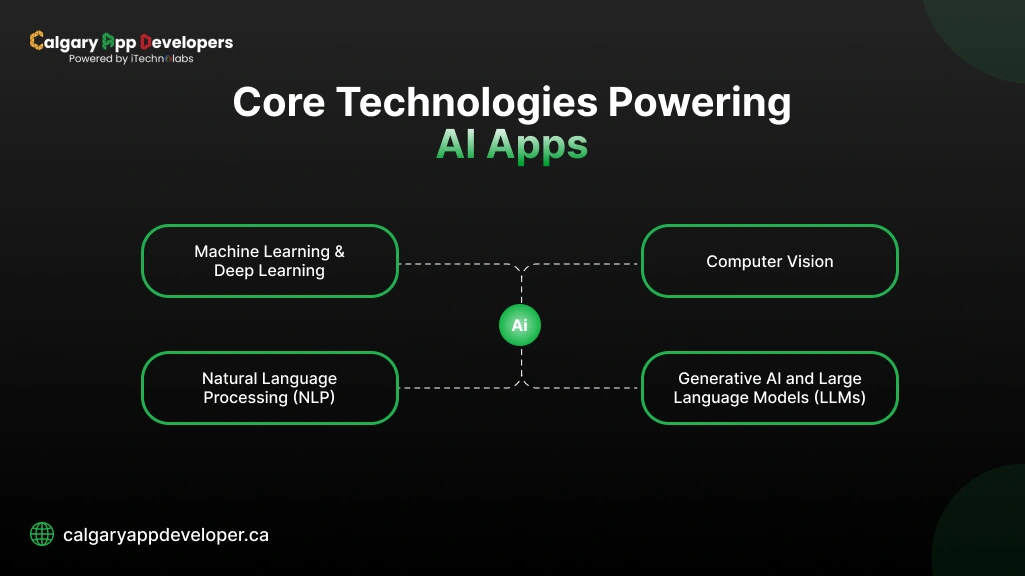
At the core of AI App development are several advanced technologies that enable apps to learn, evolve, and react like never before. These technologies transform passive software into intelligent, responsive, and contextualized digital tools. Let’s dissect the foundational pillars propelling this revolution:
1. Machine Learning & Deep Learning
Machine Learning (ML) enables apps to learn from data, identify patterns, and make decisions—without being explicitly programmed. Deep Learning, a subset of ML inspired by the human brain uses neural networks to solve more complex problems like image recognition and speech synthesis.
In AI App development, ML and DL are used to:
- Predict user behavior (e.g., what content or product they’ll like)
- Detect fraud or anomalies in real time
- Automate workflows through predictive modeling
Example: A fitness app that adjusts workout plans based on your performance over time uses ML at its core.
2. Natural Language Processing (NLP)
NLP allows apps to understand, interpret, and respond to human language—both written and spoken. This technology powers everything from virtual assistants to AI-driven customer support.
Key NLP capabilities in AI App development:
- Sentiment analysis for reviews and feedback
- Voice-to-text and conversational interfaces
- Language translation and summarization
Example: AI chatbots in banking apps that understand and respond to customer queries 24/7.
3. Computer Vision
Computer Vision enables apps to “see” and make sense of visual input like images and videos. It’s especially powerful in sectors like healthcare, security, retail, and manufacturing.
In AI App development, Computer Vision is used for:
- Facial recognition and biometric authentication
- Object detection and tracking
- Visual search and augmented reality
Example: Retail apps that let users snap a photo of a product and find similar items instantly.
4. Generative AI and Large Language Models (LLMs)
Generative AI, including powerful LLMs like GPT and Claude, can create original content—text, images, audio, or even code. In AI App development, this unlocks new levels of automation and creativity.
Common applications:
- Content creation and auto-summarization
- Code generation and software testing
- Hyper-personalized marketing messages
Example: An AI writing app that drafts email responses in your tone of voice using a fine-tuned LLM.
These technologies form the intelligent backbone of modern apps, allowing developers to build tools that aren’t just reactive but intuitive, adaptive, and increasingly autonomous.
Together, they are revolutionizing AI App development, pushing the boundaries of what’s possible in mobile, web, and enterprise applications.
Read Also: Top 10 Business Mobile App Features to Scale Your Business
Benefits of AI-Powered Applications
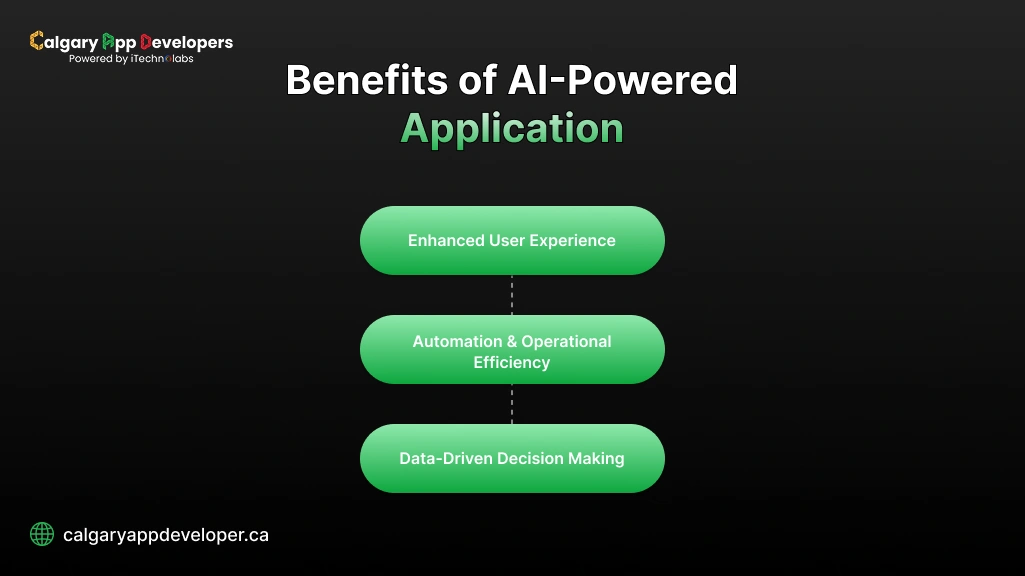
The true value of AI App development lies in the tangible benefits it brings to both users and businesses. By integrating artificial intelligence into applications, companies unlock new capabilities that go far beyond traditional software. Here are the three most impactful advantages:
1. Enhanced User Experience
AI-powered apps are designed to adapt to user behavior, preferences, and context in real time. This results in highly personalized experiences that feel intuitive and relevant.
Benefits include:
- Dynamic content and feature recommendations
- Natural, conversational interfaces through NLP
- Predictive features that anticipate user needs
For users, this means faster, smarter, and more enjoyable interactions. For businesses, it leads to improved engagement, retention, and customer satisfaction.
2. Automation & Operational Efficiency
AI App development enables apps to perform complex tasks without manual input, reducing time, cost, and human error. Whether it’s processing data, handling repetitive queries, or managing supply chains, AI brings automation to a new level.
Key outcomes:
- Streamlined workflows and faster turnaround times
- Scalable operations with reduced staffing needs
- Real-time monitoring and adaptive decision-making
Organizations can redirect resources to more strategic work while AI handles the routine.
3. Data-Driven Decision Making
AI apps not only collect data—they make sense of it. With built-in analytics, machine learning models, and forecasting tools, AI enables businesses to make smarter decisions faster.
Advantages include:
- Real-time insights from large, complex datasets
- Predictive analytics for future planning
- Customized dashboards for stakeholders
This shift toward intelligent data use transforms decision-making from reactive to proactive—giving businesses a competitive edge.
In essence, AI App development is more than a technological trend—it’s a strategic driver of growth, efficiency, and user loyalty in the digital age.
Also Read: Must-Ask Questions Before Choosing a Development Firm
Use Cases Across Industries in AI App Development
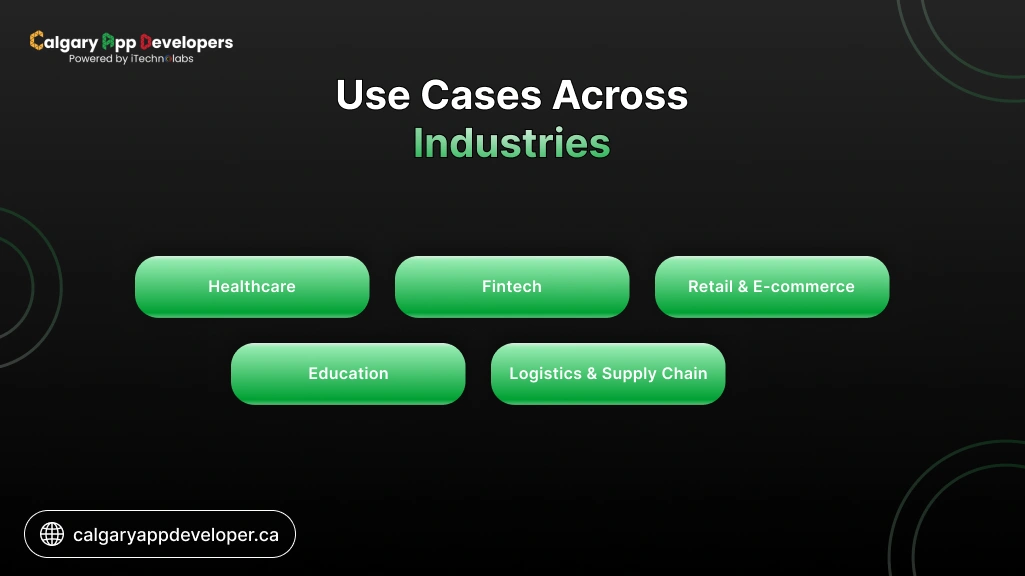
The impact of AI App development extends far beyond niche applications—it’s transforming entire industries. By embedding intelligence into apps, businesses are solving complex problems, enhancing customer experiences, and unlocking new levels of efficiency.
Below are some of the most compelling use cases across key sectors:
1. Healthcare
AI-powered healthcare apps are revolutionizing diagnostics, treatment planning, and patient care. These apps use machine learning to analyze medical data, detect anomalies, and offer personalized health insights.
Common use cases:
- AI-driven symptom checkers and virtual health assistants
- Predictive diagnostics using patient history and imaging data
- Remote monitoring and early detection of chronic conditions
AI is helping healthcare providers improve accuracy, reduce costs, and expand access to care.
2. Fintech
In the financial sector, AI App development is driving smarter and safer digital banking experiences. Apps are using AI to automate complex financial processes and make real-time risk assessments.
Key use cases:
- Fraud detection through anomaly recognition
- AI chatbots for 24/7 customer support
- Credit scoring and loan approvals based on alternative data
These apps enhance security while enabling faster, more personalized financial services.
3. Retail & E-commerce
AI is transforming how consumers shop by delivering hyper-personalized experiences. E-commerce platforms are using AI to analyze customer behavior and tailor recommendations.
Use cases include:
- Product recommendations based on real-time behavior
- AI-powered visual search and virtual try-ons
- Dynamic pricing and inventory forecasting
With AI, retailers can boost conversions, optimize stock, and deliver seamless shopping journeys.
4. Education
In education, AI apps are making learning more personalized, accessible, and engaging. From adaptive learning paths to automated feedback, these tools are reshaping both teaching and learning.
Examples:
- Personalized tutoring apps that adjust content to student progress
- Automated grading and assessment tools
- AI-based language learning and speech recognition apps
AI App development in education is bridging learning gaps and improving outcomes at scale.
5. Logistics & Supply Chain
AI is enabling smarter logistics and real-time supply chain management. Apps equipped with AI optimize routes, forecast demand, and prevent disruptions.
Key applications:
- Predictive maintenance for fleet management
- AI-powered demand forecasting and inventory planning
- Real-time route optimization and delivery tracking
These innovations reduce delays, cut costs, and improve supply chain resilience.
From hospitals to classrooms to warehouses, AI App development is unlocking smarter solutions across industries—proving that intelligent technology is no longer optional, but essential.
Read Also: Why Startups in the U.S. Are Hiring Fractional Dev Teams
How Much Does AI App Development Costs
AI app development typically costs between $50,000 and $400,000, depending on how intelligent, scalable, and production-ready the application needs to be.
Below is a total cost estimate for a full AI app development process. Use this as a planning guide, not a hard quote.
| Phase | Estimated cost | Notes |
| Market research and requirements | $3,000 to $12,000 | User research, competitor analysis, scope definition |
| Data preparation and engineering | $8,000 to $60,000 | Data cleaning, pipelines, storage, labeling |
| Model selection and training | $10,000 to $120,000 | Model licensing, training compute, fine tuning |
| Backend and API development | $8,000 to $60,000 | Microservices, integrations, authentication |
| Frontend and mobile apps | $10,000 to $80,000 | iOS, Android or cross platform UI and UX work |
| Integrations and third-party services | $3,000 to $40,000 | Payments, analytics, cloud services, monitoring |
| Testing, QA and security audits | $4,000 to $25,000 | Functional tests, performance, vulnerability scans |
| Deployment and launch | $1,500 to $8,000 | App Store submissions, infra setup, initial monitoring |
| Post-launch maintenance first year | $6,000 to $30,000 | Bug fixes, model retraining, feature updates |
| Contingency and unexpected costs | $2,500 to $14,000 | Buffer for scope change or delays |
| Total estimated project cost | $50,000 to $400,000 | Range varies with complexity and scale |
Factors that affect cost
- Project complexity and features: Complex features such as real-time inference, AR, or on-device models add substantial development and testing time. More features mean more integration points and higher QA effort.
- Data readiness and quality: High-quality, well-labeled data reduces model training time and cost. If data needs heavy cleaning or custom labeling, the budget increases significantly for engineering and annotation.
- Model choice and compute needs: Off-the-shelf models are cheaper to adopt but may require customization. Training large models from scratch or fine-tuning on private data raises compute costs and extends timelines.
- Integrations and external services: Connecting to payment gateways, ERPs, or logistics providers adds integration work and ongoing fees. Each external service can introduce latency, security needs, and extra testing.
- Team and labor rates, including location: Developer, data scientist, and designer rates vary by region. North American teams charge more than many other regions, yet cities like Calgary offer a strong balance of skilled talent and competitive rates that lower total cost while keeping quality high.
- Compliance, security, and governance: Healthcare, finance, and regulated industries require additional audits, encryption, and legal review. Meeting these standards raises both initial and recurring expenses.
Plan with realistic buffers, prioritize a small set of high-value use cases, and stage delivery so you prove value early while keeping cost under control.
Challenges and Ethical Considerations in AI App Development
While AI App development opens up exciting opportunities, it also introduces a new set of challenges—especially when it comes to trust, fairness, and accountability. As apps become more intelligent, the decisions they make can significantly impact individuals, communities, and even entire industries.
Below are the most pressing concerns that developers, businesses, and policymakers must address:
1. Data Privacy & Security
AI-powered apps thrive on data—but with that comes a critical responsibility to protect it. Users often share sensitive personal information with these apps, and any breach or misuse can lead to serious consequences.
Key concerns:
- How data is collected, stored, and used
- Risk of unauthorized access or data leaks
- Ensuring transparency around data usage
Effective AI App development must prioritize encryption, anonymization, and compliance with privacy standards like GDPR or HIPAA to maintain user trust.
2. Bias in Algorithms
AI systems learn from data—and if that data reflects existing societal biases, the outcomes can be unfair or discriminatory. Whether it’s hiring, lending, or medical diagnostics, biased algorithms can reinforce inequality instead of solving problems.
Challenges include:
- Training data that lacks diversity or balance
- Algorithms that produce skewed or unethical results
- Difficulty identifying and correcting hidden biases
Addressing this requires intentional data design, regular audits, and a commitment to fairness throughout the development lifecycle.
3. Regulatory Compliance
As AI evolves, so does the regulatory landscape. Countries and industries are rapidly developing laws to govern how AI can be used, especially in critical sectors like finance, healthcare, and education.
Key considerations:
- Adhering to evolving global regulations (e.g., EU AI Act, U.S. AI Bill of Rights)
- Building explainable, auditable AI systems
- Maintaining compliance across jurisdictions and data sources
For companies investing in AI App development, staying ahead of legal standards is not just about avoiding penalties—it’s about building responsible, future-ready solutions.
Also Read: IT Outsourcing to Calgary: A Smart Move for U.S. Businesses
Future Trends in AI App Development
The field of AI App development is evolving rapidly, with new innovations pushing the boundaries of what intelligent applications can do. As user expectations rise and technology matures, the next generation of AI apps will be more personalized, responsive, and immersive than ever before.
Here are three transformative trends shaping the future:
1. Personalized AI Agents
AI is moving beyond general-purpose automation toward deeply personalized digital agents—apps that understand individual users on a contextual, emotional, and behavioral level. These agents can act as companions, assistants, or advisors tailored to each user’s preferences, routines, and goals.
What to expect:
- Apps that adapt in real time to mood, behavior, and context
- Proactive suggestions based on historical patterns
- Custom workflows that feel like one-on-one human support
In AI App development, this means shifting from one-size-fits-all functionality to deeply individualized experiences driven by persistent learning.
2. Edge AI & On-Device Intelligence
To reduce latency, improve privacy, and enable real-time responsiveness, AI processing is increasingly happening on the edge—directly on user devices like smartphones, wearables, and IoT hardware.
Benefits include:
- Faster performance with minimal cloud dependency
- Improved user privacy through local data processing
- Lower infrastructure costs for developers
This trend is critical for industries like healthcare, automotive, and retail, where immediate and secure insights are essential. For developers, AI App development will involve building models that are optimized for low-power, offline environments.
3. Multimodal and Conversational Interfaces
AI apps are becoming more natural and intuitive through multimodal interfaces—those that understand and respond across voice, text, images, and gestures. Combined with large language models, these interfaces enable highly interactive and human-like experiences.
Emerging features:
- Seamless conversation with voice, touch, and visuals in a single flow
- AI that can “see” (via camera), “hear” (via microphone), and “understand” (via language)
- More accessible apps that adapt to diverse user needs and devices
As multimodal capabilities become mainstream, AI App development will focus on creating more immersive, emotionally aware, and universally accessible user interfaces.
Must Check: Top Reasons to Hire a Calgary App Developer for Your Next Project
How Calgary App Developers Can Help You in AI App Development
If you’re looking to bring your intelligent app idea to life, partnering with the right team is critical. Calgary’s AI app development ecosystem is rapidly emerging as a hub for innovation—offering the perfect blend of technical expertise, strategic thinking, and industry-specific insight.
Here’s how Calgary-based developers can accelerate your AI-powered vision:
- Deep Technical Expertise in AI & Emerging Technologies
We are equipped with hands-on experience in leading AI technologies, including machine learning, natural language processing, computer vision, and generative AI. Whether you’re building a custom recommendation engine, a predictive analytics platform, or a voice assistant, local experts can architect scalable, intelligent solutions tailored to your needs.
- End-to-End Development Services
From ideation to deployment, Our Calgary AI app development teams offer full-cycle services:
- Strategy & planning
- Data infrastructure design
- Model training & optimization
- Frontend/backend integration
- Testing, compliance, and post-launch support
This integrated approach ensures your AI app is not only functional but also fast, secure, and ready to scale.
- Industry-Specific Knowledge
Calgary developers bring domain expertise across key sectors like energy, healthcare, finance, and logistics. This means they understand your unique business challenges—and can develop AI applications that deliver measurable value in real-world environments.
- Commitment to Ethical and Responsible AI
AI comes with responsibility, and leading development teams in Calgary are aligned with the latest global standards in data privacy, algorithmic fairness, and transparency. They build AI apps that are not just intelligent but also trustworthy and compliant.
Whether you’re a startup exploring an MVP or an enterprise ready to scale AI across operations, Calgary AI app development talent offers the innovation, agility, and reliability you need to succeed in a rapidly changing digital landscape.
Also Read: Best AI Business Solutions Driving Business Growth
Our Hands-On AI Development Experience
Our experience in AI app development comes from building production-grade applications where artificial intelligence is not an add-on, but the core engine driving user value. We focus on practical AI that performs reliably at scale, integrates cleanly with existing systems, and delivers measurable outcomes. Below are two representative applications that reflect our hands-on work across conversational AI and generative intelligence.
1. TBIO – AI Chatbot Platform
TBIO is an AI-powered chatbot application designed to deliver fast, context-aware conversations across multiple use cases. The platform was built to understand intent, maintain conversation context, and continuously improve through learning.
Key capabilities
- Natural language understanding with intent detection
- Context-aware, multi-turn conversations
- Integration with backend systems and APIs
- Scalable architecture for high concurrent usage
Business impact
- Reduced manual support workload through automation
- Faster response times and improved user satisfaction
- Consistent conversational performance across channels
2. AI Splasher – Text to Image Generation App
AI Splasher is a generative AI application that transforms text prompts into high-quality images. It was designed for speed, creative flexibility, and scalable usage across different user segments.
Key capabilities
- Text-to-image generation using advanced generative models
- Prompt optimization and style control
- High-resolution image output with fast processing
- Secure, scalable backend for heavy compute workloads
Business impact
- Enabled rapid content creation without design dependency
- Improved engagement through interactive creative tools
- Supported high-volume generation without performance drops
Our approach to AI app development is grounded in real-world execution. We prioritize reliability, scalability, and clear business value over experimentation alone. Each solution is built to perform in production environments where accuracy, speed, and trust matter.
Conclusion
The era of intelligent applications is no longer on the horizon—it’s here. As AI continues to reshape how we interact with technology, AI app development is becoming a foundational approach to building digital products that are adaptive, predictive, and deeply personalized.
From healthcare and finance to retail and logistics, industries are leveraging AI to solve complex challenges, improve decision-making, and deliver exceptional user experiences. But with great potential comes responsibility—developers and organizations must also navigate issues like data privacy, bias, and regulatory compliance with care.
Looking ahead, trends like personalized AI agents, on-device intelligence, and multimodal interfaces will push the boundaries of what apps can achieve. Embracing these innovations with purpose and integrity will define the next generation of truly transformative digital experiences.
FAQs:
- What defines an AI-powered application?
An AI-powered app integrates artificial intelligence technologies—such as machine learning, natural language processing, and computer vision—to make smart decisions, automate tasks, and improve user experiences. These apps continuously learn from data and adapt to user behavior, enabling more personalized, efficient, and intelligent interactions compared to traditional software.
- Why should you hire a custom AI app development company?
A custom AI app development company provides tailored solutions built around your specific business needs and data. They offer deep expertise in AI frameworks, scalable architecture, and compliance requirements, ensuring your app is not only intelligent but also secure, efficient, and ready for real-world use in your unique industry context.
- How long does it take to develop an AI-powered app?
The development timeline for an AI-powered app typically ranges from 3 to 9 months, depending on complexity, data availability, and feature set. Simple apps with basic AI features can be built faster, while advanced solutions involving large datasets, predictive modeling, or real-time analytics may require more extensive planning and testing.
- Which industries gain the most from AI apps?
Industries like healthcare, finance, retail, logistics, and education benefit significantly from AI apps. These sectors use AI for predictive analysis, automation, personalized services, fraud detection, and real-time decision-making. By adopting AI, businesses in these fields improve operational efficiency, enhance user experiences, and gain a competitive edge.
- What makes “Calgary App Developer” a leading AI app development firm in Calgary?
“Calgary App Developer” stands out due to its specialized AI expertise, custom development approach, and deep understanding of local and global markets. The team combines technical proficiency with strategic insight to build AI apps that are scalable, user-centric, and aligned with business goals—making them a trusted partner for innovation in Calgary.


Pankaj Arora is a seasoned technology leader and the Founder of Calgary App Developer, with 10+ years of expertise in crafting high-performance digital solutions. His core competencies include full-stack app development, cloud-native architecture, API integration, and agile product delivery. Under his leadership, Calgary App Developers has empowered startups and enterprises alike with scalable mobile applications, secure web platforms, and AI-driven SaaS products.