







AI Integration Calgary Services: Smarter Business Solutions
You don’t need to invent a jet engine to fly; you just need the right runway. AI integration services are the runway for smart technology in business. You don’t build AI from scratch. You bring in expertise that plugs it into your systems and makes it work for you.
Here’s the thing: AI isn’t just buzzing in boardrooms; it’s shaping tomorrow’s business landscape. As per Grand View Research, the global AI market is poised to swell from around $279 billion today to nearly $1.82 trillion by 2030, at a compound annual growth rate of nearly 36 percent. That kind of leap tells you this isn’t hype; it’s momentum.
In this guide, we’ll walk through what AI integration services really are, why they matter, the advantages they bring, how to do it well, how to pick the right partner and even how to frame AI integration as a compelling service pitch. Let’s break it down.
- AI integration services help businesses use AI without rebuilding existing systems.
- Successful AI adoption depends on clear goals, clean data, and proper integration.
- The right integration approach delivers efficiency, smarter decisions, and scalability.
- AI integration is a long-term strategy, not a one-time implementation.
- AI integration services embed artificial intelligence into existing business systems to deliver practical, measurable outcomes.
- Businesses use AI integration to improve decision-making, automate operations, and enhance customer experiences.
- A structured integration process includes defining outcomes, auditing data, selecting use cases, and piloting solutions.
- APIs, generative AI, NLP, OCR, and cloud platforms power modern AI integrations.
- Choosing the right integration partner requires proven experience, strong security practices, and scalability.
- Future AI integration trends focus on personalization, ethical AI, automation, and human-AI collaboration.
Introduction to AI Integration Services
AI integration services are all about making artificial intelligence practical for businesses. Instead of treating AI as a stand-alone technology, these services focus on weaving it into the tools and processes a company already uses. That could mean connecting AI with customer support systems, financial planning software, supply chain management, or even marketing platforms.
Think of it like upgrading a house. The house is already built, but new wiring, stronger foundations, and smarter utilities make it more efficient and future-ready. In the same way, AI integration services strengthen existing systems by bringing intelligence into everyday operations.
The goal is simple. Businesses do not just want access to AI. They want AI to deliver real results such as saving time, cutting costs, improving decision-making, and creating better customer experiences. AI integration services provide the bridge between advanced technology and practical business outcomes.
Why AI Integration Services Matter for Businesses
Every business runs on systems, data, and people working together. The challenge is that these parts often operate in silos, which limits efficiency and slows growth. AI integration services matter because they bring intelligence into these existing systems without forcing companies to start over from scratch.
For example, customer service teams can use AI integration services to connect chatbots with CRM platforms so support becomes faster and more accurate. Finance departments can integrate predictive analytics to forecast cash flow more precisely. Supply chain managers can link AI to logistics software and cut down on delays and wasted resources.
What this really means is that businesses do not just adopt AI as a trendy tool. Through AI integration services, they embed intelligence directly into the way they operate. This makes processes smoother, decisions smarter, and strategies more future-focused.
How does AI Integration work?
AI integration is less about building brand-new systems and more about connecting intelligence to the ones you already trust. The process starts with mapping your data and understanding where it lives, then linking AI models that can analyze, predict, or automate specific tasks. These models are connected through APIs, pipelines, and custom connectors so information flows smoothly across platforms like CRM, ERP, or analytics tools.
The key is alignment. Instead of disrupting existing workflows, AI integration works in the background to make them faster, smarter, and more reliable. Think of it as adding an intelligent layer over your operations that learns, adapts, and helps your business make better decisions while saving time and resources.
Also Read: How to Make an AI
Key Benefits of Using AI Integration Services
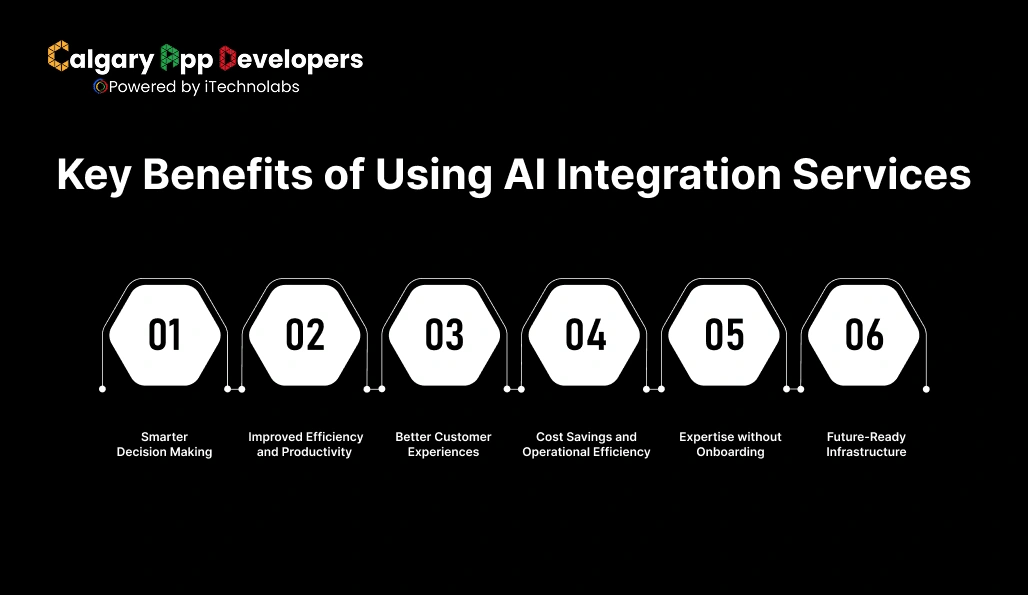
- Smarter Decision Making
AI integration services gives businesses the ability to make choices based on real data rather than assumptions. Connected systems can analyze large volumes of information in real time, revealing patterns in customer behavior, operations, and market trends. Leaders respond faster, reduce risks, and act with more confidence. - Improved Efficiency and Productivity
When AI takes over repetitive tasks like scheduling, invoicing, or handling routine queries, employees can focus on creative and strategic work. This not only boosts productivity but also reduces the need to hire additional staff for operational support, helping companies do more without inflating costs. - Better Customer Experiences
Customers value quick, accurate, and personalized service. Integrated AI tools power chatbots, recommendation engines, and 24/7 support systems that provide tailored interactions. Over time, this builds stronger relationships and enhances customer loyalty while allowing businesses to scale service without straining teams. - Cost Savings and Operational Efficiency
Beyond long-term financial savings, AI integration helps reinvent business processes altogether. Automated forecasting prevents stock issues, predictive maintenance reduces downtime, and streamlined workflows save resources. The result is a leaner, more efficient operation with a measurable impact on profitability. - Expertise without Onboarding
Accessing AI through an integration partner means companies gain top-tier expertise without recruiting or training in-house specialists. This eliminates hiring burdens while ensuring AI solutions are implemented and managed by professionals who understand both the technology and its business applications. - Future-Ready Infrastructure
AI integration often begins with an IT audit that strengthens foundations for future growth. By building a secure, scalable infrastructure, businesses stay prepared for continuous innovation. This future-ready approach ensures systems can adapt as new AI technologies and use cases emerge.
Steps to Successfully Integrate AI into Your Business
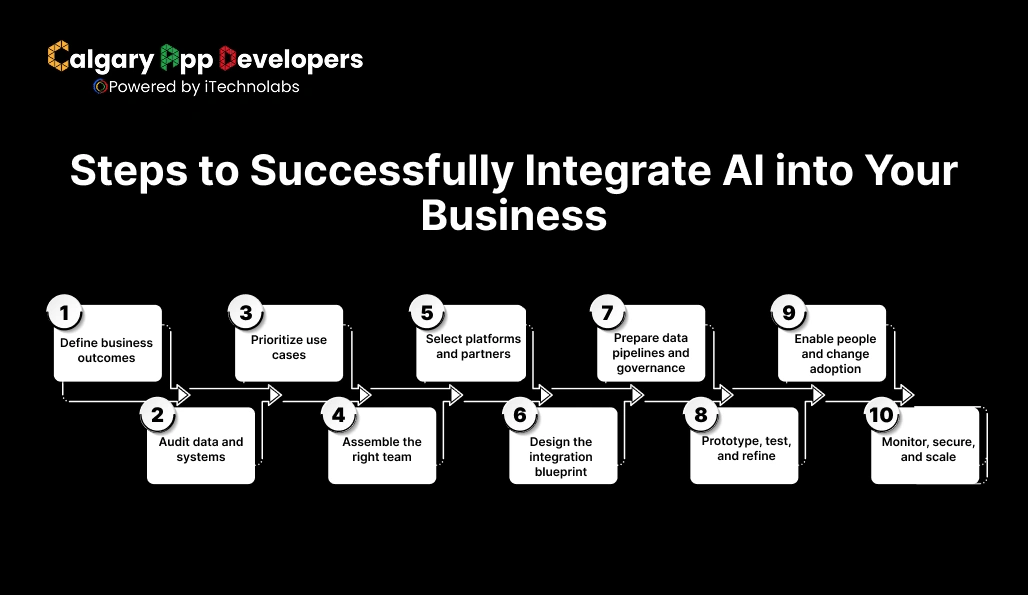
Getting value from AI starts with intent and ends with disciplined execution. Here is a clear path that keeps AI Integration Services practical and outcome focused.
Step 1: Define business outcomes
Start with the result you want, then work backward. Pick two or three goals that tie directly to revenue, cost, risk, or customer experience. Translate each goal into a measurable statement so you know what success looks like. Align leadership early so priorities do not shift midstream. When you brief any provider of AI Integration Services, share these outcomes first so every technical choice supports the same finish line.
Step 2: Audit data and systems
Good AI depends on clean, connected data. Map where your data lives, how often it updates, and who owns it. Check data quality, access controls, and compliance needs. List the core systems that AI must connect with, such as CRM, ERP, analytics, and data warehouses. This audit lets AI Integration Services design connectors, pipelines, and safeguards that fit your real environment, not a theoretical one.
-
-
- Create a data inventory with owners and retention rules
- Identify gaps in data freshness and accuracy
- Note integration points and API readiness
-
Step 3: Prioritize use cases
Not every idea deserves a sprint. Score potential use cases on impact, effort, and time to value. Start with one quick win and one strategic bet. Quick wins build confidence and unlock budget. Strategic bets move the needle in a lasting way. AI Integration Services can help you size the work, estimate payback, and avoid distractions that add complexity without clear returns.
Step 4: Assemble the right team
Pair business experts with technical specialists. You need product owners who understand the workflow, engineers who can integrate, data professionals who can prepare and govern information, and operations leaders who can drive adoption. Assign clear roles, decision rights, and a weekly cadence. With a focused core team, AI Integration Services can move faster and avoid rework.
Step 5: Select platforms and partners
Choose tools that fit your goals, budget, and compliance posture. Look for strong integration options with your existing stack, transparent pricing, and proven security. Ask any provider of AI Integration Services for reference architectures and case studies that mirror your size and industry. Favor solutions that scale as usage grows and that let you keep control of your data.
-
-
- Verify security certifications and audit trails
- Confirm data residency and retention controls
- Check roadmap and support commitments
-
Step 6: Design the integration blueprint
Create a blueprint that shows data flow, model touchpoints, and system interactions from input to outcome. Include authentication, rate limits, logging, and fallback paths if an AI step is unavailable. Define how errors are handled and what gets monitored. This plan gives engineering a single source of truth and lets AI Integration Services deliver predictable results.
Step 7: Prepare data pipelines and governance
Build pipelines that collect, clean, enrich, and deliver data reliably. Add validation at every step and maintain versioned datasets for audits. Set policies for access control, human review, and responsible use. AI Integration Services should help you balance speed with safeguards so innovation never outruns compliance.
Step 8: Prototype, test, and refine
Launch a small pilot inside one team or region. Measure accuracy, latency, and user satisfaction against your success metrics. Capture feedback from frontline users, then adjust prompts, thresholds, and workflows. Expand only after the pilot proves value. Short feedback loops help AI Integration Services tune the solution before it scales.
Step 9: Enable people and change adoption
Tools do not change outcomes unless people use them. Train teams on what will change, why it matters, and how to escalate issues. Provide simple playbooks, short videos, and office hours. Celebrate early wins and share numbers that show impact. Adoption is the bridge between technical success and business value.
Step 10: Monitor, secure, and scale
Put observability in place for performance, cost, and quality. Track model behavior, drift, and errors. Review permissions and audit logs regularly. Revisit your metrics each quarter and retire features that do not earn their keep. With steady monitoring, AI Integration Services can scale safely while keeping value visible to leadership.
Quick checklist
- Outcomes defined and quantified
- Data inventory completed and gaps identified
- Two use cases selected and scored
- Team, roles, and cadence set
- Platforms and partners approved
- Integration blueprint documented
- Pipelines and governance ready
- Pilot executed with clear metrics
- Training and support in place
- Monitoring active and scale plan approved
Use this path as your playbook. It keeps AI Integration Services focused on results, not noise.
Read Also: AI App Development: Build Intelligent Solutions
AI Integration Technology
1. Building Intelligence through APIs
Modern businesses don’t need to reinvent AI. They can tap into ready-made services from providers like Google Cloud, IBM Watson, Microsoft Azure, and Amazon AI. These APIs bring advanced capabilities such as predictive analytics, computer vision, and natural language understanding into existing platforms, creating a smarter layer without disrupting what is already working.
2. Generative AI as a Creative Partner
Generative AI is changing the role of technology in business. It doesn’t just automate tasks; it collaborates. From drafting reports and brainstorming campaign ideas to modeling business scenarios, tools like ChatGPT give teams an extra creative partner who can deliver options at scale and on demand.
3. Turning Paper into Data with OCR
For many companies, valuable information is still locked in paper files and scanned documents. Optical Character Recognition bridges that gap by transforming static images into editable, searchable text. This unlocks faster data entry, easier compliance tracking, and digital record-keeping that cuts down on inefficiency.
4. Language as a Data Source
Natural language processing makes everyday communication a valuable dataset. By analyzing customer feedback, emails, and support queries, NLP tools help businesses understand intent and emotion, not just words. This deeper context drives smarter automation, sharper customer insights, and interactions that feel more personal.
How to Select the Right AI Integration Service Provider
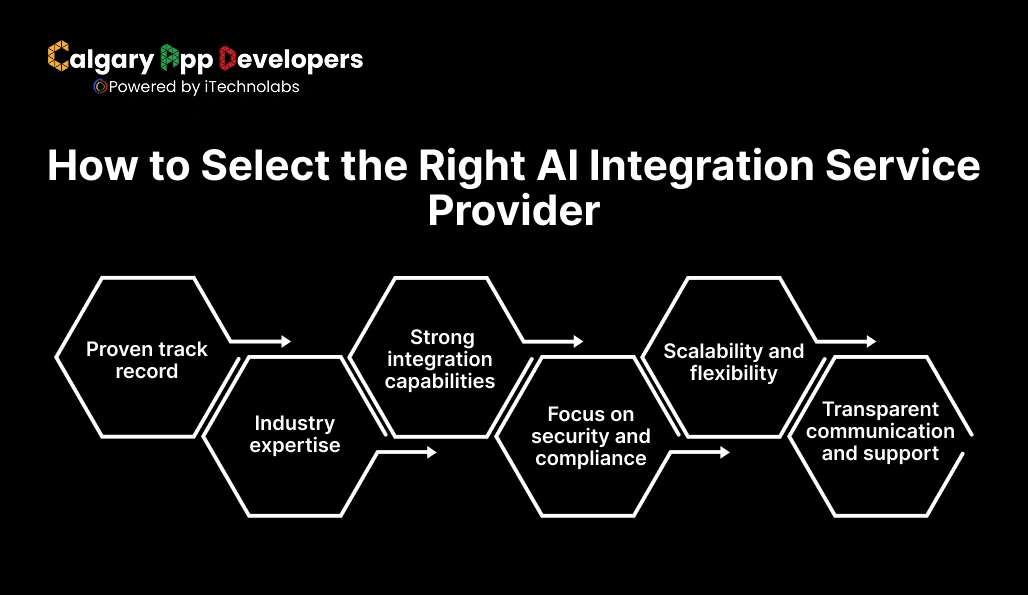
Choosing the right partner is often the difference between an AI project that delivers measurable results and one that stalls after the pilot phase. With so many vendors in the market, it helps to know what to look for when evaluating AI Integration Services.
- Proven track record
Start by reviewing the provider’s past work. Ask for case studies that show how they have integrated AI into businesses similar to yours. A credible provider of AI Integration Services should demonstrate not only technical ability but also clear business impact, such as faster workflows, reduced costs, or improved customer satisfaction. - Industry expertise
Every industry has its own rules, data structures, and customer expectations. A provider with knowledge of your sector can anticipate challenges you might not see. For example, a company in healthcare will need strict compliance measures, while a retailer will need fast and scalable integrations. Choosing an AI Integration Services partner who understands your industry saves time and reduces risk. - Strong integration capabilities
AI is only valuable if it connects smoothly with the systems you already use. Look closely at the provider’s ability to integrate with CRM, ERP, data warehouses, and cloud platforms. Providers of AI Integration Services should offer ready-made connectors or the skills to build custom solutions that fit into your existing tech stack. - Focus on security and compliance
AI often handles sensitive data, so security cannot be an afterthought. Ask about data protection standards, encryption practices, and compliance with regulations such as GDPR or HIPAA. A trustworthy provider of AI Integration Services will have clear answers and documented processes for keeping your information safe. - Scalability and flexibility
Your AI needs today may look very different in two years. Choose a provider who can scale solutions as your business grows. This means being able to handle larger datasets, more users, and new use cases without requiring a full rebuild. Flexible AI Integration Services let you start small but expand easily. - Transparent communication and support
Integration is not a one-time event. It requires ongoing updates, monitoring, and support. Look for a provider who communicates clearly, sets realistic timelines, and offers reliable post-launch support. Providers of AI Integration Services who see themselves as long-term partners rather than short-term vendors are often the best fit.
Selecting the right provider comes down to more than technical skills. The best AI Integration Services partner understands your business goals, communicates openly, and grows with you over time.
Also Read: AI Business Solutions Driving Business Growth
Future Trends in AI Integration Every Business Should Watch
AI is moving quickly, and the way it integrates with business systems is evolving just as fast. To stay competitive, leaders need to look ahead and understand the shifts that will shape how AI Integration Services are delivered in the coming years.
- Deeper personalization across industries
AI is becoming more context aware, which means businesses will be able to offer highly personalized products, services, and interactions. AI Integration Services will focus on connecting personalization engines with customer data in real time, creating tailored experiences at scale. From retail recommendations to financial planning, personalization will become the standard, not the exception. - Growth of AI-powered automation
Automation is already common in tasks like customer support and invoicing, but the next wave will extend to more complex decision-making. AI Integration Services will be key in blending automation with human oversight, allowing businesses to streamline operations without losing quality or accountability. Expect to see automation expand into legal review, medical diagnostics, and supply chain strategy. - Increased focus on ethical AI and compliance
As AI adoption grows, regulators and customers are paying more attention to how it is used. Transparency, fairness, and accountability are becoming business essentials. Providers of AI Integration Services will play a major role in embedding compliance and ethical standards into workflows, ensuring AI solutions are trusted and aligned with regulations. - Stronger collaboration between AI and human workers
The future is not about replacing people but about helping them work smarter. AI Integration Services will be designed to enhance human roles, providing insights, predictions, and recommendations that make teams more effective. This human-AI partnership will redefine productivity and open up new roles that did not exist before. - Expansion of AI across connected ecosystems
Businesses are no longer looking at AI as a tool for isolated processes. The future will involve AI systems that work across entire ecosystems, connecting supply chains, customer platforms, and partner networks. AI Integration Services will need to ensure that these systems communicate securely and efficiently across different environments.
Watching these trends helps companies prepare for what is next. By staying alert and working with providers of AI Integration Services who embrace these future shifts, businesses can position themselves ahead of the curve.
Pitching AI Integration Services to Customers
Selling AI is not about dazzling people with technical terms. Customers want to know how it will make their business run better, save money, or create new opportunities. When you pitch AI Integration Services, focus less on the algorithms and more on the outcomes.
- Start with their pain points
Every business has challenges. Maybe it is slow customer response times, rising operational costs, or poor visibility into data. Begin by showing that you understand their struggles. Then explain how AI Integration Services connect directly to those problems and provide practical solutions. This builds trust and makes the pitch relevant from the start. - Translate features into business value
Customers rarely care about technical features like APIs or machine learning models. What they want is clarity on how AI Integration Services will impact revenue, cost savings, and efficiency. Speak in terms of numbers and outcomes. For example, highlight how predictive analytics could cut forecasting errors by half or how automation could free up 30 percent of staff time. - Share relatable examples and case studies
Concrete stories are powerful. Share examples of how other businesses in similar industries have benefited from AI Integration Services. A logistics firm might relate to reduced delivery delays, while a retailer will connect with higher conversion rates from personalized recommendations. Case studies make the pitch feel real instead of theoretical. - Address risks and concerns openly
Many customers hesitate because they worry about cost, complexity, or security. Tackle these concerns upfront. Show how AI Integration Services come with clear governance, compliance measures, and long-term support. When you acknowledge risks honestly and explain how they are managed, customers are more likely to trust you. - End with a clear next step
A strong pitch does not end with a broad promise. It ends with a defined action such as scheduling a discovery workshop, running a pilot project, or reviewing a custom proposal. By giving customers a concrete path forward, you make it easier for them to commit and explore the benefits of AI Integration Services.
When pitching, the secret is empathy and clarity. Customers respond to solutions that solve their real problems, not abstract ideas. If you keep the conversation focused on their needs and the business value of AI Integration Services, your pitch will resonate.
Read Also: AI App Development Cost Breakdown: From Idea to Launch
Final Thoughts:
AI is no longer a distant idea reserved for tech giants. It is a practical tool that can transform everyday business operations when used the right way. The key lies in integration. AI integration services make it possible to connect intelligence with the systems you already rely on, creating real improvements in efficiency, decision-making, and customer experience.
If you are considering the next step for your business, the right partner makes all the difference. At Calgary App Developers, we specialize in delivering AI Integration Services as a leading AI Development company that is tailored to your goals, industry, and infrastructure. Our team ensures that AI is not just added on but becomes a driving force for measurable growth.
The future of business belongs to companies that can combine human creativity with intelligent technology. With Calgary App Developers, you have a partner who can help you make that future a reality.
FAQ’s About AI Integration Services
1. What is an AI integration service?
An AI integration service is the process of embedding artificial intelligence into your existing systems, workflows, and data pipelines. Calgary App Developers ensures AI tools connect seamlessly with platforms you already rely on, such as customer service, finance, or supply chain systems. The aim is practical impact: efficiency, accuracy, and business growth powered by intelligent automation.
2. Do you provide customer support?
Yes, we provide full customer support before, during, and after AI integration. Our team helps with onboarding, training, troubleshooting, and system monitoring so your business gets consistent results. We also keep communication clear and responsive, making sure you always have expert guidance when adopting and scaling AI solutions.
3. Do you customize AI Integration Services as per my business requirements?
Absolutely. Every business has unique processes, data structures, and goals. Calgary App Developers tailors AI integration services to match your specific needs, whether that’s customer service automation, predictive analytics, or supply chain optimization. We align every solution with your outcomes and industry standards, ensuring you get measurable results without unnecessary complexity.
4. Which industries can benefit from AI Integration Services?
AI integration is industry-agnostic, meaning any sector can benefit. Calgary App Developers works with retail, healthcare, finance, logistics, manufacturing, and more. Whether it’s predictive maintenance in factories, automated compliance in healthcare, or customer personalization in retail, AI integration adapts to the unique challenges and opportunities of each industry.
5. How can I initiate the process of using Calgary App Developers’ AI Integration Services?
Getting started is simple. Reach out to Calgary App Developers for an initial consultation. We’ll discuss your goals, review your current systems, and identify opportunities for AI integration. From there, we design a roadmap tailored to your needs, starting with pilots or quick wins that deliver value early and build confidence for scaling.
6. What types of AI services do you offer?
Calgary App Developers offers services across machine learning, natural language processing, computer vision, and robotic process automation. These services cover areas such as predictive analytics, chatbots, recommendation engines, fraud detection, and workflow automation. Each is integrated into your systems in a way that supports your business outcomes and adapts to future growth.
7. Will integrating AI necessitate substantial alterations to my current infrastructure?
Not necessarily. Calgary App Developers specializes in making AI work with your existing systems. Most integrations require adjustments like data pipelines, connectors, or API configurations rather than a full infrastructure overhaul. Our goal is to enhance what you already use, reducing disruption while delivering measurable improvements in efficiency and performance.


Pankaj Arora is a seasoned technology leader and the Founder of Calgary App Developer, with 10+ years of expertise in crafting high-performance digital solutions. His core competencies include full-stack app development, cloud-native architecture, API integration, and agile product delivery. Under his leadership, Calgary App Developers has empowered startups and enterprises alike with scalable mobile applications, secure web platforms, and AI-driven SaaS products.