











How Much Does it Cost to Build an App Like Gauth?

The creation of Gauth: AI Homework Helper is an app development to use in schools as more than just another educational tool. It is about providing the students with a digital partner in their studies who will help them understand the studied material, solve the problems, and gain confidence in their learning process.
- In the year 2023, the worldwide AI education marketing was USD 4.06 billion and is expected to be USD 26.98 billion by the year 2030, thus growing at the rate of 36.0% CAGR, as per Grand View Research.
- This huge growth shows how fast the use of smart learning assistants by students and teachers has increased in making study support more accessible and effective.
Now, the question that comes up is, Why Is This the Right Time to Build a Study Companion App?
Well, education is going through a transformation and is being reshaped by personalization and technology-driven learning. Today’s students prefer the help that is instantaneous and interactive rather than static study materials. Parents and teachers are also switching to digital tools for monitoring student performance and giving accurate feedback.
Making an app like Gauth now means entering a market that is not only growing but also has ever-increasing needs for smart problem-solving, continuous user engagement, and scalable education solutions. With the perfect combination of innovation, usability, and reliability, an app can easily attract a broad user base and gain long-term significance in the ed-tech area.
TL;DR
- Creating a Gauth-like application usually costs somewhere between $40,000 and $180,000, depending on the quality and number of the features included.
- AI-enabled study buddies are in great demand and thus, it is the right time for new players to enter the market.
- The app’s future largely hinges upon the selection of the right features, the choice of platform, and post-launch maintenance.
- Long-term profitability can be ensured through such monetization strategies as subscriptions and licensing to educational institutions.
Key Points
- The market of study companion apps is significantly increasing, as they are becoming more personalized and accessible globally. Startups can now confidently launch their unique and affordable solutions in the space.
- The creation of an app like Gauth goes through many phases, like discovery, product design and development, testing, and maintenance. A structured process can help in controlling costs and keeping quality high.
- The cost for development is influenced by various aspects, such as the complexity of design, location of the development team, choice of platform, and use of third-party API integrations. As of now, Calgary has the lowest developer rates among the major global cities providing similar services.
- Some of the features that are considered a must-have for such an application include photo-based question scanning, step-by-step solutions, personalized insights, and gamified learning. All of these together consist of a vibrant and interactive experience that keeps the users’ interest alive.
- The different ways of making money from the application include offering it for free, subscription plans, institutional licensing, and in-app purchases. Using several of these approaches together will make the revenue growth be sustainable.
- The long-term strategy for success includes constant updates, feedback from users, and keeping high data privacy standards. The education technology market is likely to be very competitive; hence, the apps that adapt to the users’ needs are more likely to survive.
What Is the Gauth AI Study Companion App and How Does It Work?
Gauth is a digital study buddy that helps students solve questions about their coursework, demystify difficult concepts and improve their learning outcomes. It is an interactive space where learners can upload a problem and be shown the step-by-step explanation and logic each step uses.
The application helps students across several subjects, including math, science, and languages. Students can either scan a question using their phone camera or simply type the question directly into the app. The Gauth app processes the question, determines the nature of the issue, and presents a clear explanation of the answer, which walks the student through each step instead of simply putting out the answer.
The Gauth app also contains features such as breakdown concepts, visual explanations, and personalized learning recommendations based on a student’s activity and progress – this promotes an organized and structured approach to study habits and concepts.
In short, Gauth acts as a very smart study buddy that adapts to a student’s needs, breaks down difficult concepts, and helps with efficient studying instead of being an information overload.
How Much Does It Cost to Develop an AI Study Companion App like Gauth?
The price to create an app like Gauth can cost between USD 40,000 and USD 180,000, based on the app features, platform, and complexities of the technology. This range encompasses everything from simple MVP versions to sophisticated, full-featured study companion platforms.
Below is a breakdown of the estimated cost structure:
| Development Stage | Description | Estimated Cost (USD) |
| Market Research & Planning | Defining the target audience, studying competitors, and preparing technical documentation | 3,000 – 7,000 |
| UI/UX Design | Creating an intuitive and engaging interface for mobile and web platforms | 4,000 – 10,000 |
| Core App Development | Building main features like question scanning, solution generation, and progress tracking | 20,000 – 70,000 |
| AI/ML Integration | Implementing intelligent learning and problem-solving capabilities | 10,000 – 40,000 |
| Backend & API Development | Setting up servers, databases, and APIs for data processing and storage | 6,000 – 20,000 |
| Testing & Quality Assurance | Conducting functional, usability, and security tests | 3,000 – 8,000 |
| Deployment & Launch | App Store and Play Store publishing, launch support, and performance optimization | 2,000 – 5,000 |
| Maintenance & Updates (Annual) | Regular updates, bug fixes, and feature enhancements | 5,000 – 20,000 |
Total Estimated Cost: USD 40,000 – 180,000
Cost can vary significantly based on any number of factors, including depth of features, platform (iOS, Android, or both), location of the team, or third-party integration. A simple MVP may be worth the lower end of the range, but a full-featured educational companion app with personalized analytics and smart tutoring could be at the high end.
What Drives the Cost of Building an App Like Gauth
The cost of creating a Gauth-like app depends on many factors that will affect the time and the resources allocated to the project during the development phase. Knowing these cost drivers aids in setting the budget and also in the making of decisions about where the money should be directed in terms of better performance and scalability.
- App Complexity and Core Features
Cost is most affected by the number and complexity of functionalities. A basic application for homework assistance with written explanations is significantly cheaper than a full-fledged one that includes scanning questions with a photo, interactive learning modules, and instant tutoring support.
| Feature Type | Description | Impact on Cost |
| Basic Features | Question input, instant answers, and simple UI | Low |
| Intermediate Features | Step-by-step explanations, progress tracking, and user profiles | Medium |
| Advanced Features | AI-driven problem solving, analytics dashboards, and voice or image recognition | High |
- Technology Stack
The selection of technology influences both the range of features available and the extent of the developer’s future scalability. The introduction of sophisticated AI frameworks, the use of cloud storage solutions, and the adoption of modern frontend technologies raise costs but at the same time guarantee improved performance and user satisfaction.
| Component | Common Technologies | Cost Influence |
| Frontend | React Native, Flutter | Moderate |
| Backend | Node.js, Python (Django or FastAPI) | High |
| Database | MongoDB, PostgreSQL | Moderate |
| AI Integration Tools | TensorFlow, PyTorch, OpenAI APIs | High |
- Design and User Experience
A study companion app is all about the user-friendly design. A neat layout, logical content progression, and visual learning tools such as charts and illustrations attract the audience. The high-quality UI/UX with custom animations or interactive visuals means more development time and thus, higher costs.
- Team Location and Expertise
The price dissimilarities between countries for software development are still significant. The price per hour reflects local market conditions, salaries, and the availability of talented developers. Tech cities with established ecosystems usually charge more, whereas the talent supply in the case of less developed countries can still offer the same quality at a cheaper price.
| City | Average Hourly Rate (USD) | Cost Level |
| San Francisco, USA | 110 – 180 | Very High |
| London, UK | 90 – 150 | High |
| Berlin, Germany | 70 – 120 | High |
| Sydney, Australia | 60 – 110 | Moderate |
| Warsaw, Poland | 45 – 85 | Moderate |
| Bangalore, India | 30 – 65 | Low |
| Calgary, Canada | 25 – 55 | Lowest |
Calgary, among the global development centers, is the best choice because it combines giving access to a top tech workforce with a reasonable pay rate. Besides, Calgary’s startup ecosystem is expanding, its infrastructure is dependable, and the environment is conducive to business, which makes it possible to get an app like Gauth developed with no compromise on quality or cost efficiency.
- Platform Selection
The platform selection significantly impacts both the reach and the cost. App development like Gauth on the Android or iOS platform only by itself will result in lowered costs and shorter time frames. Using cross-platform tools such as Flutter or React Native while working on projects for both platforms will increase the project area, but using the tools will allow a wider access point with resource-efficient deployment.
- Integration of Third-Party Services
Using third-party tools adds to the expenses as well as the capabilities. Payment, authentication, and analytics services, while making the development easy, are also likely to entail a subscription or licensing fee. Examples of such tools are Firebase for backend infrastructure, Stripe for payment processing, and Google Analytics for performance tracking, among others. The higher the number of integrations, the greater the associated operational costs.
- Testing and Quality Assurance
Well-planned testing is paramount to ensure the app, like Gauth, is running without a hitch on all devices. Testing includes checking the app for functionality, usability, and security of personal data, especially student information, which requires maximum protection. When an app has such complicated functionalities or it runs on several platforms, then it needs more time for testing and a higher budget as well; however, this investment will be rewarded with no expensive issues arising after the launch, thus building a long-lasting reliability.
- Post-Launch Maintenance
After the launch of the app, regular maintenance continuously keeps it good to go. Maintenance consists of fixing bugs, enhancing performance, updating dependencies, and adding new features as per users’ suggestions. Maintenance costs typically account for about 15% to 25% of the total annual development expenses, which means the app will still be competitive and user-friendly in the long run.
The price of creating an app like Gauth depends on the level of sophistication you want, the technology stack you select, and the development team you partner with. Careful planning and precise scope definition can effectively maximize both performance and budget.
Also Read: Importance of User-Centered Design in App Development
Must-Have Features for an AI Study Companion App like Gauth

Creating an app like Gauth requires more than just problem-solving capabilities. It needs features that make studying easier, faster, and more engaging for students across different subjects and age groups. Here are the key features every AI study companion app should include.
- Photo-Based Question Scanning: Students should be able to take a photo of a problem instead of typing it. The app analyzes the question and provides an instant, step-by-step explanation. This feature improves accessibility and saves time during study sessions.
- Step-by-Step Solutions: Rather than showing only final answers, the app should guide students through each step of the process. This helps learners understand the logic behind every solution and builds long-term conceptual clarity.
- Multi-Subject Support: An effective study companion should cover a wide range of subjects such as mathematics, physics, chemistry, and language learning. Multi-subject coverage broadens the user base and enhances engagement.
- Interactive Learning Interface: The user interface should be clean, easy to navigate, and visually structured to aid comprehension. Interactive elements like charts, diagrams, or highlight-based explanations improve retention and make the learning process more enjoyable.
- Personalized Learning Insights: By tracking user progress and question history, the app can generate performance insights and recommend areas for improvement. Personalized feedback encourages continuous learning and helps students stay consistent.
- In-App Tutoring and Chat Assistance: Offering optional access to tutors or chat-based help can turn a self-learning app into a complete educational ecosystem. This feature adds real-time support and keeps users engaged.
- Offline Mode: Many students study in areas with limited internet access. Offline functionality allows them to access previous solutions and notes without a live connection, improving usability and convenience.
- Gamification and Rewards: Gamified elements such as badges, streaks, and progress points motivate students to study regularly. This approach transforms learning into an engaging habit rather than a task.
- Data Security and Privacy Controls: An app like Gauth handles sensitive student data, so implementing secure authentication, encryption, and parental access options is crucial. Compliance with global data protection standards builds user trust and credibility.
Including these features ensures your study companion app not only mirrors the effectiveness of Gauth but also delivers a richer, more adaptive learning experience that keeps students motivated and confident.
Read Also: How Much Does It Cost to Maintain an App?
Step-by-Step Development Process for Building an App like Gauth
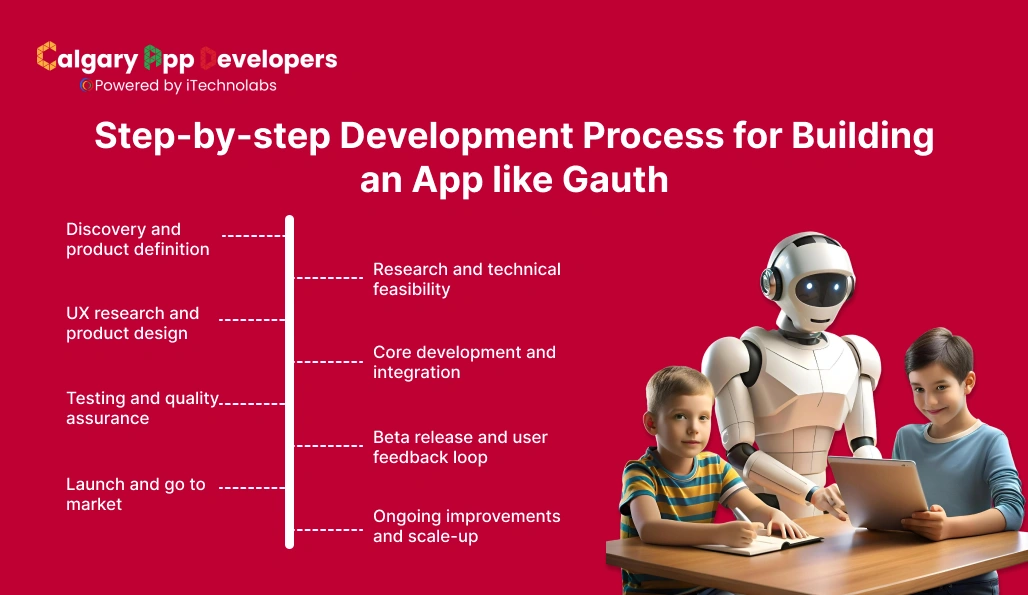
Building an app like gauth requires a clear sequence of work streams. Below are the practical steps, with focused subpoints that explain what happens at each stage and who is typically involved.
- Discovery and product definition
- Define target users and core use cases, including student levels and subjects.
- List must-have features and nice-to-have features for an initial release.
- Set success metrics such as user retention, accuracy of solutions, and time to first answer.
- Prepare a high-level roadmap and rough budget estimate for development and launch.
- Research and technical feasibility
- Evaluate technical requirements for photo-based question capture, text parsing, and step-by-step solution flow.
- Identify third-party services for OCR, authentication, storage, and analytics.
- Run quick prototypes or proof of concept to validate feasibility and uncover major risks.
- Document APIs, data flow, and compliance requirements for handling student data.
- UX research and product design
- Conduct user interviews or surveys to confirm onboarding flow and common pain points.
- Design wireframes for key screens such as question capture, solution view, and progress dashboard.
- Create interactive prototypes and test them with real students to refine language and layout.
- Finalize the visual design system, including typography, spacing, and accessibility rules.
- Core development and integration
- Implement a frontend for the chosen platform or cross-platform framework and build backend services for processing.
- Integrate OCR and the solution generation engine using modular APIs for easier iteration.
- Implement user accounts, roles, and basic analytics tracking.
- Build content management tools to allow subject experts to update explanations and learning resources.
- Testing and quality assurance
- Run functional tests for all features and device tests across target mobile models.
- Perform usability tests with students and educators to confirm clarity of step-by-step explanations.
- Conduct security and privacy audits for data storage and transmission.
- Fix critical bugs and create a regression test suite for future releases.
- Beta release and user feedback loop
- Release a closed beta to a representative group of users and collect quantitative and qualitative feedback.
- Track core metrics and prioritize fixes and small enhancements based on user impact.
- Add instrumentation to measure where users drop off or request clarifications.
- Iterate quickly on wording, explanation depth, and onboarding to improve first-week retention.
- Launch and go to market
- Prepare app store listings, screenshots, and educational copy for discoverability.
- Align launch activities with target channels such as schools, tutoring partners, or student communities.
- Monitor performance, crash reports, and user reviews closely for the first 30 days.
- Roll out staged releases while keeping a rapid hotfix process ready.
- Ongoing improvements and scale-up
- Schedule regular releases that include new subjects, advanced explanation types, and personalization.
- Expand backend capacity and caching strategies to reduce latency as user count grows.
- Use product analytics to introduce adaptive learning paths and targeted content recommendations.
- Maintain a roadmap for internationalization, platform parity, and paid features.
What this really means is plan deliberately, build modular systems, and keep the user feedback loop tight. That approach lowers risk, controls cost, and improves the odds that your app like gauth will gain traction and deliver real learning value.
Also Read: How Much Money Can You Earn if You Own an App?
Smart Monetization Ideas for an AI Study Companion App like Gauth

Monetization plays a critical role in sustaining and scaling an app like Gauth. The goal is to balance accessibility for students with revenue models that reward continuous innovation and platform growth. Below are practical and proven ways to monetize a study companion app effectively.
1. Freemium Model
Offer core features for free while reserving advanced capabilities such as detailed step-by-step solutions, concept videos, or priority support for paid users. This model attracts a large user base quickly and converts engaged students into paying subscribers over time.
2. Subscription Plans
Introduce tiered monthly or yearly subscription plans based on learning depth or subject coverage. For instance, a basic plan could focus on math and science, while a premium plan unlocks additional subjects and analytics tools for progress tracking. Recurring subscriptions ensure predictable revenue.
3. Pay-Per-Use Model
Allow students to pay only for specific features such as instant tutor sessions, advanced quizzes, or detailed performance reports. This flexible approach appeals to learners who want short-term access without committing to a subscription.
4. In-App Purchases
Integrate optional purchases for study packs, practice questions, or exam preparation modules. Gamified elements like badges or custom themes can also serve as small but consistent revenue streams.
5. Advertising Partnerships
Collaborate with education-focused brands, online course providers, or academic publishers to display relevant ads or sponsored content. Carefully manage placement and frequency to keep the learning experience distraction-free.
6. Affiliate and Referral Programs
Partner with online learning platforms or book publishers and earn commissions on referred sales. A referral system encouraging students to invite friends can also boost user acquisition at minimal cost.
7. Institutional Licensing
Offer tailored versions of your app to schools, tutoring centers, and universities under a bulk licensing agreement. This business-to-business approach provides steady revenue and positions the app as an institutional learning tool.
8. Data-Driven Insights for Educators
Provide educators with analytics dashboards that highlight learning patterns, performance gaps, and student engagement trends. Selling these premium insights to schools or private tutors adds another reliable income stream.
A successful app like Gauth combines multiple revenue strategies to serve both individual learners and institutions. Blending affordability with valuable premium offerings ensures long-term user trust and sustainable business growth.
Read Also: How Long Does it Take to Develop an App?
Final Thoughts
Building an app like Gauth is more than a technology project. It is an opportunity to redefine how students learn, engage, and grow through accessible digital study tools. With the right balance of strong features, smart monetization, and a scalable tech foundation, your app can become a trusted learning companion for millions.
If you are planning to bring your idea to life, Calgary App Developers can help you every step of the way. Our team specializes in designing and developing intelligent education apps that combine performance, usability, and cost efficiency. We turn ideas into products that make a real impact in the classroom and beyond.
Start your journey with Calgary App Developers and build a study companion app that truly stands out in the global education market.
FAQs:
- How much does developing an AI-powered study companion app like Gauth cost?
The cost to develop an app like Gauth typically ranges from $40,000 to $180,000, depending on design complexity, features, and developer location. Factors such as cross-platform support, third-party integrations, and data security also influence the total cost. A clear roadmap and phased approach help manage expenses efficiently. - How long does developing an AI homework helper app take?
Building a fully functional AI homework helper app generally takes four to nine months. The exact timeline depends on scope, feature depth, and testing cycles. Developing a minimum viable product with core features can be completed faster, while large-scale apps with multiple subjects and personalization tools take longer. - What are the key features to include in an AI-powered study companion app?
Essential features include photo-based question scanning, step-by-step explanations, personalized insights, multi-subject support, and offline access. Additional elements like gamification, progress tracking, and in-app tutoring improve engagement and learning outcomes. These features together create a user-friendly and effective study experience. - Can AI study companion apps work offline?
Yes. Many study companion apps offer offline functionality for reviewing previous solutions, notes, and downloaded resources. While real-time AI processing often requires internet access, offline access ensures students can continue learning even in low-connectivity environments. It also enhances usability and broadens the app’s accessibility.


Pankaj Arora is a seasoned technology leader and the Founder of Calgary App Developer, with 10+ years of expertise in crafting high-performance digital solutions. His core competencies include full-stack app development, cloud-native architecture, API integration, and agile product delivery. Under his leadership, Calgary App Developers has empowered startups and enterprises alike with scalable mobile applications, secure web platforms, and AI-driven SaaS products.