






Development Cost for eSIM App Like Airalo and Holafly
Imagine you have just arrived in a new nation. No SIM card. No WiFi. And the kiosk at the airport is charging you three times as much as usual for data. That is when eSIM apps such as Airalo and Holafly step in. With only a few taps, you’re up and running. No changing SIMs. No scouring local stores. Just instant mobile data on your phone.
Now here’s the thing. These eSIM apps didn’t magically materialize. Behind that slick user interface is some serious piece of engineering, design, strategy, and investment. And if you’re considering creating something like that, the first question is simple. How much is it going to cost?
This blog breaks it down. We’ll look at what makes eSIM apps like Airalo and Holafly stand out, what it takes to build one, and what kind of budget you’re looking at from start to launch. Whether you’re a startup founder, a product manager, or just curious, you’ll get a clear picture of what goes into building an eSIM app that actually works.
TL;DR
- Building an eSIM app like Airalo or Holafly typically requires a budget between $40,000 and $200,000.
- Costs depend heavily on features, telecom integrations, security, and platform choices.
- Strong UX, global coverage, and reliable activation are critical to success.
- Monetization and scalability determine long-term viability in the eSIM market.
Key Points
- eSIM apps succeed because they eliminate traditional SIM card friction and provide instant mobile data for international travelers.
- Development costs vary based on whether the product is a basic MVP or a full-scale app with subscriptions, live support, and advanced analytics.
- Core technical requirements include secure eSIM provisioning, backend scalability, real-time usage tracking, and reliable payment integrations.
- Regulatory compliance and security standards play a major role in both development complexity and overall cost.
- A well-designed user experience directly impacts trust, retention, and repeat purchases in travel-focused apps.
- Monetization strategies often combine direct data plan sales, subscriptions, and telecom partnerships to generate recurring revenue.
- Future growth in the eSIM space will be driven by smarter plan recommendations, deeper device integration, and bundled connectivity services.
What Makes Airalo and Holafly Stand Out
eSIM apps are everywhere now, but only a few have managed to earn real global trust. Airalo and Holafly lead the pack, and they’ve done it by focusing on different types of users and travel needs. Here’s how each one carved out its space.
Airalo: Built for Budget-Conscious Global Travelers
Launched in 2019 by Ahmad Al Hanandeh and Abraham Burak, Airalo quickly positioned itself as the go-to eSIM app for global travelers who want flexibility without overspending. Its biggest strength is reach. The app offers eSIMs in over 200 countries and regions, giving users a wide range of options whether they’re moving between continents or just planning a short trip.
Airalo lets users choose from local, regional, or global plans, often at rates that beat traditional SIM cards. That pricing model, along with usage tracking and a clean app interface, makes it ideal for digital nomads, frequent flyers, and remote workers who need reliable mobile data wherever they go.
Holafly: Focused on Simplicity and Unlimited Data
Holafly was launched in 2018 by Jose Luis Fernandez and Pedro Lopez, and from the beginning, it followed a very different playbook. Instead of charging users per GB, Holafly built its brand around unlimited data plans. The idea was to remove data anxiety for travelers who just want to land, connect, and go.
With coverage in over 160 countries, Holafly is popular among short-term travelers and vacationers who value simplicity. Setup is quick, support is strong, and the 24/7 live chat means users are never stuck waiting if something goes wrong. The app’s onboarding flow is clean and beginner-friendly, making it a favorite for first-time eSIM users.
So What Sets Them Apart?
Let’s break down the key benefits and how they differ.
| Feature/Benefit | Airalo | Holafly |
| Coverage | 200+ countries and regions | 160+ countries and regions |
| Data Plans | Local, regional and global plans | Mostly unlimited data plans per country |
| Pricing | Competitive, pay-per-GB pricing | Flat-rate unlimited plans, often higher upfront |
| App Experience | Clean interface with smart usage tracking and alerts | Simplified user flow focused on ease of activation |
| Target User | Budget travelers, digital nomads, long-term globetrotters | Casual tourists, short-term international travelers |
| Customer Support | Basic in-app support and help center | 24/7 live chat with multilingual support |
| Top Selling Point | Flexibility and choice across data sizes and destinations | Peace of mind with unlimited data |
| Extra Features | Loyalty rewards and referral programs | eSIM renewal and reactivation reminders |
Breaking Down the eSIM App Development Costs
Building an eSIM app like Airalo or Holafly typically costs between $40,000 and $200,000, depending on how feature-rich you want the first version to be.
That range covers everything from designing the interface to developing the backend, integrating telecom APIs, setting up user accounts, testing, and launching across platforms. The wide gap comes down to choices like basic MVP vs. full product, one platform vs. cross-platform, and in-house vs. outsourced teams.
Here’s a breakdown of what that budget might look like:
| Development Area | Estimated Cost Range |
| UI and UX Design | $5,000 to $15,000 |
| iOS App Development | $10,000 to $40,000 |
| Android App Development | $10,000 to $40,000 |
| Backend Development | $8,000 to $30,000 |
| API Integration (eSIM, Payment) | $5,000 to $20,000 |
| Testing and QA | $3,000 to $10,000 |
| Project Management | $2,000 to $8,000 |
| Deployment and Store Setup | $1,000 to $5,000 |
| Post-Launch Support (3-6 months) | $5,000 to $20,000 |
Total Estimated Cost: $40,000 to $200,000
Keep in mind, these are ballpark figures. A simple MVP for one platform with core features only might stay under $50K. A polished, cross-platform app with extras like loyalty rewards, live chat support, and advanced analytics can push the upper end.
Want to target a sweet spot between quality and cost? The next sections will help you understand what to build and how to build it smart.
Also Read: How to Choose the Best Company for Calgary Mobile App Development
Core eSIM App Development Factors to Consider
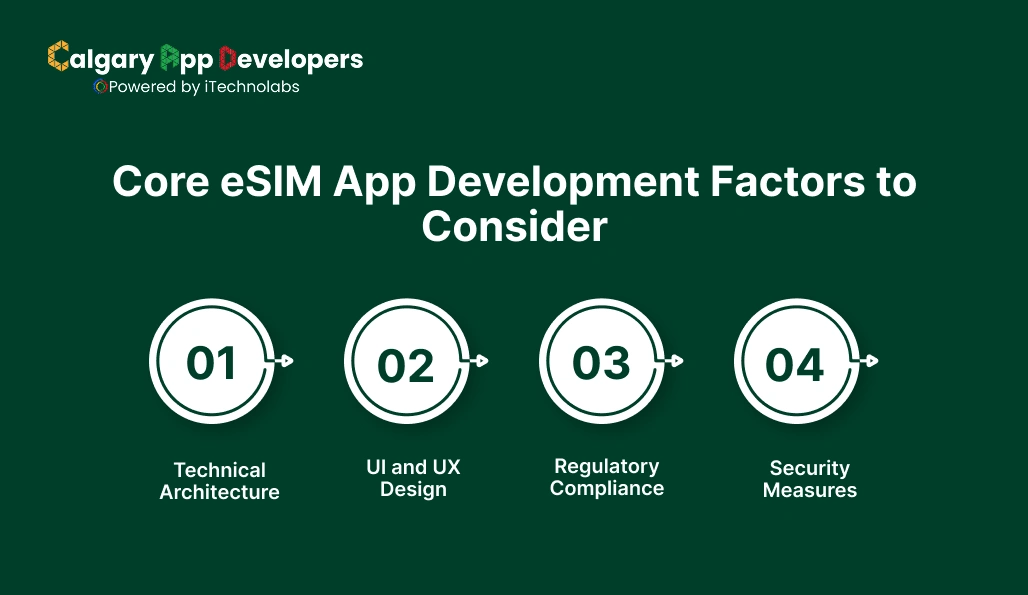
When you build an eSIM app, you’re not just stitching screens together. You’re building a digital product that must handle real-time connectivity, comply with telecom regulations, protect user data, and deliver a smooth experience across devices and countries. Here are the core development factors you need to get right from day one.
1. Technical Architecture
Think of this as the blueprint for how your app works behind the scenes. An eSIM app handles many moving parts at once, such as user authentication, real-time data activation, payment processing, network switching, and more.
A typical architecture will include:
- Frontend (iOS and Android apps)
- Backend server (handles data plans, eSIM provisioning, user profiles, payments)
- Third-party APIs (eSIM providers, payment gateways, support systems)
- Database (stores user info, usage stats, transaction history)
- Admin panel (to manage plans, monitor activity, handle customer issues)
Your app should be designed for high availability, low latency, and the ability to scale quickly if usage spikes.
2. UI and UX Design
Travelers need your app to work fast, load quickly, and feel intuitive. That means no bloated onboarding, no confusing menus, and absolutely no clutter.
Key principles for eSIM app design:
- Simple activation flow: Users should be able to buy and install an eSIM in 3 to 5 steps max
- Real-time usage tracking: Show data remaining, validity and alerts in a glance
- Localized experience: Support multiple languages and currencies based on the user’s region
- Offline awareness: Clearly indicate what actions require an internet connection
A good UX isn’t just about making things pretty. It directly impacts user trust, retention, and conversion.
3. Regulatory Compliance
You’re dealing with mobile networks, international users, and personal data. That means you’ll need to navigate a few key compliance areas:
- GDPR for European users
- Data localization rules in countries like India
- Carrier compliance depending on which telecom APIs you use
- App store policies related to digital SIM functionality
Missing compliance requirements can delay your launch or get you kicked off app stores, so this needs to be planned early.
4. Security Measures
Security isn’t optional when you’re handling mobile identity, payment info, and personal data.
What a secure eSIM app needs:
- End-to-end encryption for all sensitive transactions
- Secure eSIM profile downloads through certified telecom APIs
- Multi-factor authentication for account access
- Fraud prevention tools to flag unusual usage or transactions
- Data backups and recovery plans
Even one breach can permanently damage your brand. Security should be baked into every part of development, not tacked on later.
5. App Development Team Location
Where your team is based plays a big role in your overall budget, communication flow, and even product quality. Some locations are known for top-tier engineering. Others offer better rates without compromising too much on skill.
| Region | Hourly Rate (USD) | Pros | Cons |
| North America | $100 – $200+ | High quality, easy collaboration | Most expensive |
| Canada | $80 – $150 | Reliable talent, strong communication, growing tech hubs | Can be slower to scale up teams |
| Western Europe | $80 – $150 | Strong design and technical talent | Expensive, timezone gaps |
| Eastern Europe | $40 – $80 | Balanced cost and quality | May need tighter project oversight |
| India | $25 – $60 | Cost-effective, fast turnaround | Varies in consistency |
| Southeast Asia | $30 – $70 | Affordable, improving talent pool | Communication can be a challenge |
If you’re considering North America but want something more cost-effective than Silicon Valley, Calgary is quietly becoming a smart choice for tech talent without the big-city price tag.
A blended approach also works well. Many startups use a hybrid model, keeping product strategy and design local while outsourcing development to trusted offshore teams. It offers the best of both worlds.
Read Also: How Much Does it Cost to Hire App Developers in Canada?
Features and Tech Stack Overview
Your eSIM app can’t just look good. It needs to deliver real utility across different networks, devices, and regions. Users expect it to work the moment their plane lands. That means zero friction, reliable performance, and a smart feature set that anticipates their needs.
Here’s what your app must have to stand a chance in the market, followed by the tech stack that helps power it.
Core Features Every eSIM App Should Include:
1. Multi-Device Compatibility
Your app should support both Android and iOS across phones, tablets, and even laptops that accept eSIMs.
- Users should be able to log in from different devices using the same account
- Auto-detect device compatibility and guide the installation process
2. Customer Support
Support isn’t just about solving problems. It’s part of the user experience.
- Live chat, email ticketing and in-app FAQs
- Consider adding multilingual support for global users
- Automate basic queries using a chatbot but keep human agents available
3. Global Connectivity
This is the whole point of your app. Users should be able to browse and buy eSIMs in multiple countries or regions.
- Interactive map or list of supported countries
- Real-time pricing and availability updates
- Option to purchase global or regional plans
4. Flexible Data Plans
Some users want 1 GB for a week. Others want 10 GB for a month. Give them a choice.
- Offer multiple plans per region with clear pricing
- Time-based and usage-based options
- Auto-expiry reminders and top-up suggestions
5. Local Calling Options
While not every eSIM app offers voice calls, adding this can be a competitive advantage.
- Partner with local carriers to offer VoIP or bundled voice/data plans
- Let users make or receive local calls using in-app credits or add-ons
6. Rewards and Cashback
Everyone loves perks. Rewards can drive repeat purchases.
- Referral bonuses for inviting friends
- Cashback on repeat purchases or top-ups
- Loyalty tiers or user milestones with benefits
7. Offline Functionality
Sometimes the app itself is the only thing a user can access.
- Show downloaded eSIM info even without internet
- Allow QR code scanning and profile activation offline after purchase
- Cache help content and support instructions
8. Data Monitoring and Notifications
Users need to know how much data they have left before it runs out.
- Real-time usage tracking
- Smart alerts when data drops below a threshold
- Push notifications for plan expiry, usage spikes or roaming detection
Recommended Tech Stack for an eSIM App Development
Here’s a typical tech stack used to build and maintain a reliable eSIM application:
| Component | Suggested Technologies |
| Frontend (Mobile) | React Native or Flutter for cross-platform apps |
| Backend | Node.js or Django for scalable APIs and logic |
| Database | PostgreSQL or MongoDB for handling user and plan data |
| Authentication | Firebase Auth or OAuth 2.0 |
| Payment Integration | Stripe, Razorpay or PayPal SDKs |
| eSIM Provisioning | GSMA-certified telecom APIs like Truphone, BICS, 1oT |
| Push Notifications | Firebase Cloud Messaging or OneSignal |
| Analytics | Mixpanel, Google Analytics, or Amplitude |
| Customer Support | Zendesk, Freshdesk or Intercom integrations |
| Cloud Hosting | AWS, Google Cloud or Microsoft Azure |
Get these features right, and your app won’t just compete, it’ll convert and retain users. Skip them, and even the best marketing won’t save you.
Also Read: How to Develop an iOS App
End-to-End eSIM App Development Process For App Like Airalo or Holafly
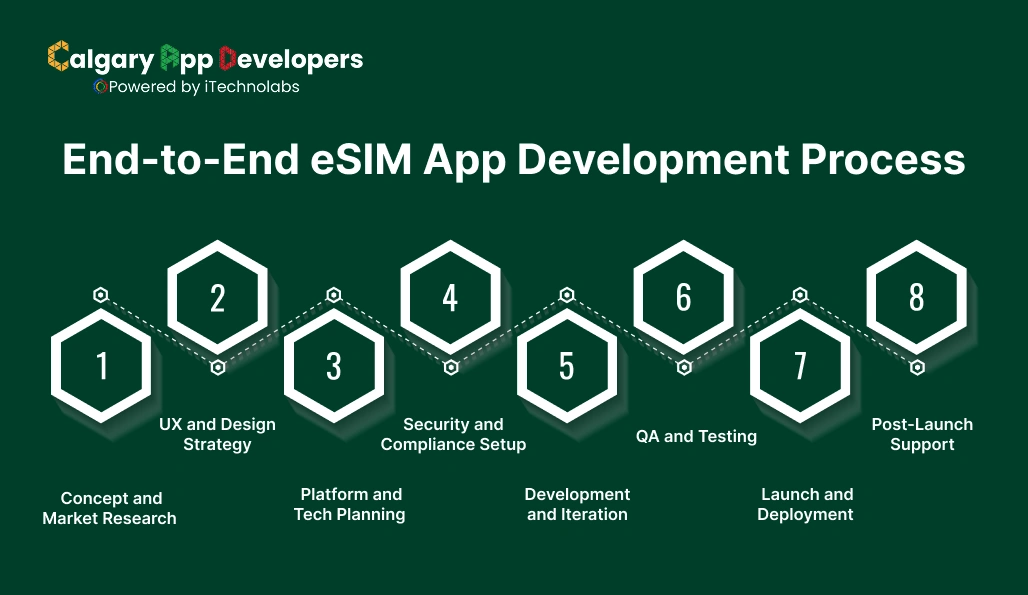
Creating a full-featured eSIM app is a multi-stage process that takes more than just good coding. It’s about aligning the product with real user needs, staying technically solid, and meeting strict telecom and security standards. Here’s how the process typically unfolds from idea to launch and beyond.
- Concept and Market Research
This is where everything starts. You define your user base, analyze competitors like Airalo and Holafly and map out your product vision. Without this stage, you risk building something no one wants.
What happens here:
- Identify the target audience (backpackers, business travelers, remote workers)
- Study user pain points
- Research pricing models and data plan structures
- Validate demand through interviews or surveys
Time and Cost:
- 2 to 3 weeks
- Estimated cost: $2,000 to $5,000
- UX and Design Strategy
Once you know who you’re building for, the focus shifts to how they’ll interact with your app. This stage covers the user flow, visual design, and prototyping.
What happens here:
- Wireframing key user flows (buying a plan, activating an eSIM, tracking usage)
- Designing high-fidelity UI screens
- Creating an interactive prototype to test usability
- Planning accessibility, localization and responsiveness
Time and Cost:
- 3 to 5 weeks
- Estimated cost: $5,000 to $15,000
- Platform and Tech Planning
Now it’s time to define what technologies will power your app. You’ll choose frameworks, backend architecture, database solutions, APIs, and third-party tools.
What happens here:
- Decide between native vs cross-platform development
- Plan integrations for eSIM provisioning, payments and analytics
- Structure backend services for scale, performance and security
- Define cloud hosting, CI/CD pipelines and deployment strategies
Time and Cost:
- 1 to 2 weeks
- Often included in development planning costs
- Security and Compliance Setup
eSIM apps deal with sensitive user data and telecom regulations. That means security and compliance cannot be an afterthought.
What happens here:
- Ensure GDPR compliance for data privacy
- Integrate secure authentication and data encryption
- Validate telecom compliance with GSMA standards
- Prepare for audits or approvals if required by certain carriers
Time and Cost:
- 2 to 3 weeks
- Estimated cost: $3,000 to $10,000 depending on requirements
- Development and Iteration
This is the heavy lifting phase. Developers build the app, backend, and admin dashboard. Features are tested as they’re developed, with regular feedback loops to stay on track.
What happens here:
- Build the frontend (Android and iOS)
- Connect APIs for eSIMs, payments, notifications and customer support
- Build backend services (user management, data plans, activation history)
- Develop the admin dashboard to manage plans and user activity
Time and Cost:
- 8 to 16 weeks
- Estimated cost: $20,000 to $80,000+ depending on complexity and team size
- QA and Testing
Before launch, everything is tested across devices, countries, and network conditions. This stage ensures your app is bug-free, secure, and stable under real-world use.
What happens here:
- Functional testing of all features
- Load testing to handle spikes in usage
- Device and network testing (especially for eSIM activation)
- Usability testing with real users
Time and Cost:
- 2 to 4 weeks
- Estimated cost: $3,000 to $10,000
- Launch and Deployment
After testing, the app is submitted to app stores and pushed live. You’ll also need to configure your backend server, monitor logs, and prepare your support channels.
What happens here:
- Submit to Google Play and Apple App Store
- Handle app store compliance reviews
- Monitor backend performance post-launch
- Onboard users and handle first batch of feedback
Time and Cost:
- 1 to 2 weeks
- Estimated cost: $1,000 to $3,000
- Post-Launch Support
Launch is not the end. You’ll need a dedicated team to fix bugs, release updates, and support users. This is where long-term trust is built.
What happens here:
- Resolve issues raised by early users
- Release performance and security updates
- Monitor analytics for feature usage and drop-offs
- Plan future upgrades and features
Time and Cost:
- Ongoing
- Monthly cost: $2,000 to $5,000 depending on support and update frequency
Getting an eSIM app from concept to launch is a serious commitment of time, talent, and money. But when done right, you’re not just building an app. You’re building a product people rely on every time they travel.
Read Also: How Long Does it Take to Develop an App?
Monetization Strategies For eSIM App Like Airalo or Holafly
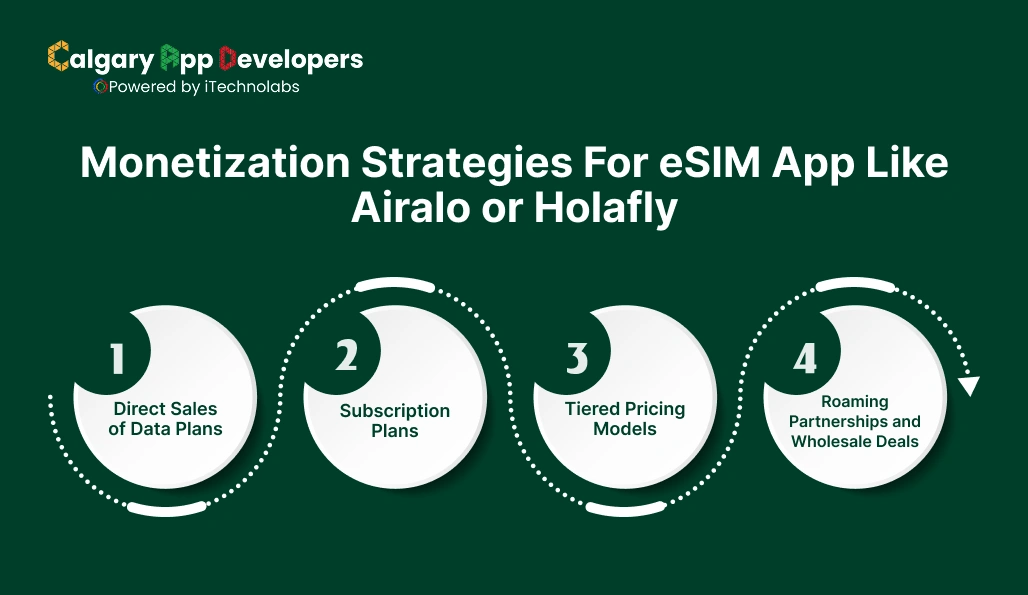
You’re building an eSIM app not just to offer convenience, but to run a profitable business. The good news is that the eSIM space offers multiple ways to generate recurring and scalable revenue.
Here are the main monetization models used by successful eSIM apps:
- Direct Sales of Data Plans
This is the most straightforward model. Users pay once for a local, regional, or global data plan.
How it works:
- The app partners with telecom carriers or aggregators to get wholesale data packages
- You mark up the price and sell the plans to users through the app
- The more plans sold, the more revenue you generate
Why it works:
- One-time purchases are easy for new users
- Scales well with international travelers and seasonal surges
- No long-term commitment required from the user
- Subscription Plans
This model works well for frequent travelers or digital nomads who need continuous coverage across countries.
How it works:
- Offer monthly or annual plans with recurring data bundles
- Subscriptions can include perks like global coverage, priority support or loyalty rewards
- Payments are charged automatically at regular intervals
Why it works:
- Generates predictable monthly revenue
- Builds user retention
- Appeals to business travelers and long-stay tourists
- Tiered Pricing Models
Not every traveler has the same needs. Tiered pricing lets you serve budget-conscious users as well as power users who want more data, speed, or features.
How it works:
- Offer different plans based on data volume, validity or speed
- Create value-based tiers like Basic, Plus and Premium
- Upsell higher tiers with features like unlimited data, voice support or global access
Why it works:
- Gives users choice and control
- Makes it easier to upsell once a user is onboarded
- Increases average revenue per user (ARPU)
- Roaming Partnerships and Wholesale Deals
This model happens behind the scenes, but it can be a significant revenue stream.
How it works:
- Your app acts as a reseller or aggregator, buying data from network operators at wholesale rates
- You can also license your app to smaller travel brands or telecom resellers under a white-label model
- Some apps earn a commission from roaming agreements or bundled packages
Why it works:
- Higher profit margins when negotiated well
- Opens B2B revenue streams in addition to B2C
- Builds long-term carrier relationships that are hard to replicate
There’s no single right answer. The best monetization strategy usually combines these models. Direct sales bring in quick cash, subscriptions drive loyalty, and roaming deals create long-term value. The key is understanding your users, testing what works, and adapting your pricing as you grow.
Also Read: How Much Money Can You Make if You Own an App?
Future Trends Shaping eSIM Apps Like Airalo and Holafly
The eSIM market is still early, and the next few years will reshape how these apps are built, priced, and experienced. As adoption grows, expectations will rise fast. Here are the key trends we see influencing the future of eSIM app development.
- Deeper Integration at the OS and Device Level: Smartphone manufacturers are moving toward eSIM-first hardware, and some models are already removing physical SIM slots entirely. This will push eSIM apps to integrate more tightly with device settings, system notifications, and native onboarding flows. Activation will feel less like installing a service and more like turning on a built-in feature.
- AI-Driven Plan Recommendations and Smart Usage Controls: Users no longer want to guess which plan fits their trip. Future eSIM apps will rely more on AI to suggest plans based on travel duration, destination, past usage, and app behavior. Expect smarter alerts, predictive top-ups, and automated plan switching when users cross borders.
- Expansion Beyond Data Into Full Connectivity Bundles: Data-only plans are just the starting point. We expect more apps to bundle voice, SMS, VoIP calling, and even local numbers into their offerings. This shift will make eSIM apps more competitive with traditional carriers and more attractive to business travelers and long-stay users.
- Stronger Focus on Compliance and Identity Verification: As governments tighten telecom and data privacy regulations, eSIM apps will need stronger identity verification and clearer compliance workflows. This includes region-specific data handling, KYC processes in certain countries, and closer alignment with carrier-level security standards.
- B2B and White Label Growth: Beyond consumers, eSIM platforms are increasingly being used by airlines, travel agencies, corporate mobility providers, and IoT services. White label eSIM solutions will grow as companies look to embed connectivity directly into their own apps rather than sending users elsewhere.
- Subscription-First Business Models: One-time purchases work well for casual travelers, but subscriptions offer predictability. We expect more apps to introduce flexible monthly plans, global roaming subscriptions, and team or family bundles that lock in long-term users instead of relying on seasonal travel spikes.
- Improved Offline and Pre-Travel Experiences: Future eSIM apps will put more emphasis on preparing users before they travel. This includes offline access to setup guides, cached QR codes, country-specific tips, and clearer instructions that work even when the user has no internet access at all.
The direction is clear. eSIM apps are evolving from simple data resellers into full connectivity platforms. For anyone building an app in this space, designing with these trends in mind is not optional. It is how you stay relevant as the market matures and competition tightens.
Conclusion
Building an eSIM app like Airalo or Holafly isn’t just a tech project. It’s a full-scale product journey that involves smart planning, user-first design, airtight security, and a well-defined business model. The development cost can range anywhere from $40,000 for a lean MVP to $200,000 or more for a full-featured, cross-platform app with global reach.
The opportunity is real. As more travelers shift to digital SIM solutions, there’s a growing market for apps that make connectivity effortless. But success depends on getting the execution right, from technical architecture to launch strategy to long-term support.
If you’re exploring the idea of building an eSIM app or any telecom-focused product, working with a team that understands the technical and regulatory landscape makes a big difference. That’s where Calgary App Developers comes in. Based in one of Canada’s emerging tech hubs, we help companies build scalable, secure, and market-ready apps that go beyond just looking good; they perform under pressure.
Whether you’re starting from scratch or looking to expand an existing product, the right development partner can save time, reduce risk, and help turn a good idea into a working product that people actually use.
FAQs:
1. How long does it take to develop apps like Airalo and Holafly?
Developing a full-featured eSIM app typically takes 4 to 6 months, depending on complexity and team size. Here’s a rough breakdown:
- 2–4 weeks for research and planning
- 4–6 weeks for UI/UX design
- 8–12 weeks for development and integration
- 2–4 weeks for testing and deployment
Timelines can extend if you’re building for multiple platforms or integrating with multiple telecom providers.
2. How much does eSIM app development cost?
The cost of building an eSIM app ranges from $40,000 to $200,000+. This depends on features, team location, and platform support.
Here’s a basic breakdown:
- MVP with core features: $40K to $70K
- Mid-range app with global support: $80K to $120K
- Advanced app with subscriptions, offline mode, and analytics: $150K to $200K+
Costs also vary depending on whether your team is in-house, outsourced, or a mix of both.
3. What affects the cost of eSIM app development?
Several elements impact the overall budget:
- Feature set: More features mean more time and development effort
- Platform choice: iOS, Android, or both
- eSIM integration: Telecom APIs and provisioning setup
- Security and compliance: Especially for handling user data across countries
- Team location: Rates vary between North America, Europe, and Asia
On average, expect a solid product to start around $50K and go up based on your goals and roadmap.


Pankaj Arora is a seasoned technology leader and the Founder of Calgary App Developer, with 10+ years of expertise in crafting high-performance digital solutions. His core competencies include full-stack app development, cloud-native architecture, API integration, and agile product delivery. Under his leadership, Calgary App Developers has empowered startups and enterprises alike with scalable mobile applications, secure web platforms, and AI-driven SaaS products.