










How Much Does It Cost to Create Crypto Trading App Like Swyftx?
Cryptocurrency trading is no longer limited to early adopters and tech enthusiasts. It has evolved into a mainstream financial activity attracting retail investors, institutions, and fintech startups worldwide. As adoption grows, so does the demand for reliable, secure, and user-friendly trading platforms.
This shift has sparked strong interest in building a crypto trading app like Swyftx. Platforms such as Swyftx have demonstrated how intuitive design, competitive fees, strong security measures, and access to a wide range of digital assets can create a loyal and expanding user base. For entrepreneurs and enterprises, this represents more than a trend. It signals a clear market opportunity.
However, developing a crypto trading platform is not simply about replicating existing features. It requires strategic planning, regulatory awareness, advanced security infrastructure, and a scalable technology foundation. Most importantly, businesses need clarity on one critical question: how much does it cost to build a crypto trading app like Swyftx?
In this blog, we draw on our direct experience in developing crypto trading platforms to outline the real cost structure, critical development stages, technology decisions, and investment factors that shape a successful product.
Having worked on platforms similar in scope and complexity to a crypto trading app like Swyftx, we understand the technical, regulatory, and operational challenges involved. This guide reflects practical insights gained from building and scaling such solutions, helping you approach development with clarity and confidence.
- Building a crypto trading app like Swyftx typically costs between $40,000 and $300,000+, depending on complexity and compliance needs.
- Development timelines range from 3 to 12 months based on feature scope and infrastructure depth.
- Security, scalability, and regulatory alignment are the biggest cost drivers.
- A phased development strategy helps optimize investment and reduce long-term risk.
- The cost of developing a crypto trading app like Swyftx varies based on platform complexity, advanced trading features, security architecture, and regional compliance requirements.
- A basic MVP can be launched within a few months, while a full-scale exchange with liquidity integration, derivatives trading, and institutional-grade security requires a longer and more resource-intensive development cycle.
- Core features such as secure onboarding, high-performance trading engines, wallet integration, and real-time analytics are essential to compete in the current crypto exchange market.
- Development expenses are distributed across planning, design, frontend and backend engineering, blockchain integration, testing, deployment, and ongoing maintenance.
- Hidden costs, including licensing, liquidity provider fees, security audits, infrastructure scaling, and payment processing, must be factored into the overall budget.
- Long-term profitability depends on well-defined monetization models such as transaction fees, spread margins, staking services, subscriptions, and advanced trading features.
Market Overview: Growth Opportunities in Crypto Trading Platforms
The market for crypto trading solutions is expanding at a notable pace as digital assets gain traction with individual investors and institutions. The segment that includes platforms like a crypto trading app like Swyftx is part of a broader exchange ecosystem that continues to grow in value and scope.
Current Market Size and Near-Term Forecast
- The global crypto trading platform market was valued at roughly $29 billion in 2024 and is on track to reach about $33.5 billion in 2025. By 2026, projections put the market size around $38.5 billion, reflecting steady growth as more people participate in crypto trading and platforms broaden their services. This growth rate underscores growing demand for intuitive trading experiences, real-time access to markets, and diversified digital asset offerings.
- In a wider view that includes centralized and decentralized exchange activity, the crypto exchange market is projected to be worth about $85.75 billion in 2026, with a long-term trend that could see it exceed $300 billion by the early 2030s. This expansion is driven by rising user adoption and increasing institutional engagement.
Demand for platforms that deliver smooth trading, strong security, and accessible features will grow as the market expands. Building a crypto trading app like Swyftx puts a business in a position to capture a share of this expanding opportunity. Increasing volumes, wider adoption, and rising institutional participation provide a favorable backdrop for new entrants that can deliver reliable performance and clear value to both novice and experienced traders.
Why Businesses Are Investing in Crypto Trading Apps Like Swyftx Development
Digital assets have evolved into a structured financial market with sustained demand. For many companies, building a crypto trading app like Swyftx is a strategic move to capture recurring revenue in a rapidly expanding sector.
- Expanding User Base: Crypto adoption continues to grow across retail and institutional segments. Active traders rely on mobile platforms for real-time transactions and portfolio management, creating consistent engagement. For businesses, this means higher lifetime customer value and steady platform activity.
- Multiple Revenue Streams: A crypto trading app like Swyftx supports diverse monetization models, including transaction fees, spreads, subscriptions, staking services, and token listing fees. As trading volumes grow, revenue scales without proportional increases in operational cost.
- Strong Market Positioning in Fintech: Crypto platforms operate at the intersection of finance and technology. Launching a trading app strengthens brand credibility and opens opportunities for partnerships with financial institutions, blockchain networks, and liquidity providers.
- Scalability and Global Reach: With cloud infrastructure and API driven integrations, crypto platforms can expand across regions without heavy physical investment. A well-structured compliance framework enables global market access and scalable growth.
- Innovation and Institutional Growth: Advanced analytics, automation tools, and strong security features differentiate successful platforms. At the same time, rising institutional participation strengthens long-term market stability.
Investing in a crypto trading app like Swyftx is not trend-driven. It is a calculated entry into a high-growth digital finance ecosystem with global potential.
Also Check: Top Cold Crypto Wallets: Ultimate Security Guide
Core Features of a Crypto Trading App Like Swyftx
Developing a crypto trading app like Swyftx requires a focused set of features that balance performance, security, and usability. The goal is to deliver a smooth trading experience while maintaining strong technical and regulatory foundations.
- Secure Registration and Compliance: A reliable onboarding system with KYC and AML verification is essential. The process must be secure, fast, and compliant with regional regulations to build trust and reduce user drop-offs.
- Multi-Asset Trading with Advanced Order Types: The platform should support major cryptocurrencies along with multiple trading pairs. Core order types such as market, limit, and stop loss orders are necessary to meet the needs of both beginner and active traders.
- High Performance Trading Engine: A powerful backend engine ensures real-time order matching and low-latency execution. Stability during high-volume trading periods directly impacts user retention and platform credibility.
- Strong Security Infrastructure: Two-factor authentication, encrypted data transmission, cold wallet storage, and continuous monitoring are critical components. Security investment protects user funds and safeguards the platform’s reputation.
- Real-Time Analytics and Market Insights: Live price charts, historical data, and portfolio tracking tools allow users to make informed trading decisions. Clear data visualization improves usability without overwhelming new investors.
- Integrated Wallet and Payment Support: Secure wallet functionality combined with seamless fiat deposit and withdrawal options simplifies transactions. Efficient payment integration enhances accessibility and supports long-term user growth.
A well-structured crypto trading app like Swyftx combines these core capabilities to create a secure, scalable, and competitive trading environment.
Cost to Build a Crypto Trading App Like Swyftx Based on Complexity Levels
The cost to build a crypto trading app like Swyftx typically ranges from $40,000 to $300,000 or more, depending on feature depth, security architecture, compliance scope, and scalability requirements.
Development investment largely depends on how advanced you want the platform to be at launch. Some businesses start with a lean MVP, while others aim for a full-scale exchange ready for high-volume trading.
Estimated Cost and Timeline by Complexity
| Complexity Level | Ideal For | Estimated Cost Range | Estimated Timeline |
| Basic Platform | Startups validating market demand | $40,000 to $70,000 | 3 to 4 months |
| Mid-Level Platform | Growing businesses targeting active traders | $70,000 to $150,000 | 4 to 7 months |
| Advanced Platform | Enterprises building large-scale exchanges | $150,000 to $300,000+ | 7 to 12+ months |
- Basic Platform
A basic crypto trading app like Swyftx typically costs between $40,000 and $70,000 and focuses on essential trading capabilities required to enter the market quickly. It is commonly developed as a Minimum Viable Product to test user response and validate revenue potential before committing to a larger investment.
Key features include:
- Secure user registration and KYC verification
- Basic wallet integration
- Limited cryptocurrency listings
- Market and limit order functionality
- Basic admin dashboard
- Standard security measures, such as two-factor authentication
This approach minimizes upfront investment while allowing businesses to refine their product based on real user behavior.
- Mid-Level Platform
A mid level crypto trading app like Swyftx generally requires an investment of $70,000 to $150,000, as it introduces more advanced trading functionality and stronger infrastructure. This version is built for businesses aiming to attract active traders and support higher transaction volumes.
Key features include:
- Multiple order types, including stop loss and take profit
- Real-time charts with technical indicators
- Multi-asset trading pairs
- Liquidity provider integration
- Fiat payment gateway integration
- Advanced encryption and monitoring systems
- Scalable backend architecture
At this stage, performance optimization and infrastructure planning become critical to ensure stable trading during market volatility.
- Advanced Platform
An advanced crypto trading app like Swyftx can cost $150,000 to $300,000 or more due to its enterprise grade architecture and expanded feature ecosystem. This level is designed to compete with established regional or global exchanges and requires deeper technical and compliance investment.
Key features include:
- High-performance trading engine with low-latency execution
- Deep liquidity aggregation
- Margin and derivatives trading
- Staking and yield generation modules
- AI-driven analytics and portfolio insights
- Multi-currency and multi-language support
- Institutional-grade security framework
- Disaster recovery and high availability architecture
Development at this level involves extensive backend engineering, cybersecurity investment, and compliance integration. The longer timeline reflects the complexity of building a resilient, high-volume trading ecosystem.
While these ranges provide a practical benchmark, the final cost of a crypto trading app like Swyftx depends on customization level, regulatory jurisdiction, and long-term scalability goals. Clear product planning at the outset significantly improves cost control and development efficiency.
Also Read: Blockchain Wallet Development: An Ultimate Guide
Crypto Trading App Development Cost Breakdown by Project Stages
The development cost of a crypto trading app like Swyftx typically ranges between $40,000 and $300,000+, depending on feature complexity, compliance scope, infrastructure requirements, and scalability goals. This investment is distributed across clearly defined development stages, each contributing directly to the stability, security, and long-term success of the platform.
Estimated Cost Allocation by Project Stage
| Project Stage | Key Activities | Estimated Cost Range | Estimated Duration |
| Research and Planning | Market analysis, feature roadmap, compliance planning | $5,000 to $15,000 | 2 to 4 weeks |
| UI and UX Design | Wireframes, prototypes, interface design | $5,000 to $20,000 | 3 to 5 weeks |
| Frontend Development | Web and mobile interface development | $10,000 to $50,000 | 1 to 3 months |
| Backend Development | Trading engine, database, APIs, server setup | $15,000 to $100,000 | 2 to 5 months |
| Blockchain and API Integration | Wallets, liquidity providers, payment gateways | $10,000 to $40,000 | 1 to 2 months |
| Testing and Quality Assurance | Security audits, load testing, bug fixes | $5,000 to $25,000 | 3 to 6 weeks |
| Deployment and Post-Launch Support | Production deployment, monitoring, updates | $5,000 to $30,000 annually | Ongoing |
- Research and Planning
This stage sets the foundation for a successful crypto trading app like Swyftx. It defines the product vision, identifies the target audience, and determines the regulatory framework required for operation. Skipping structured planning often leads to costly rework and compliance issues later.
Key activities include:
- Market and competitor analysis to define positioning
- Identification of core and advanced feature requirements
- Regulatory assessment based on operating regions
- Monetization model planning
- Technical architecture blueprint creation
- Risk and security requirement mapping
A well-executed planning phase ensures development proceeds with clarity and cost control.
Crypto trading platforms handle complex financial data. The design stage focuses on presenting this information in a clear and intuitive way. An effective interface improves onboarding, reduces user friction, and increases retention.
Key activities include:
- User journey mapping and workflow structuring
- Wireframe development for key screens
- Interactive prototype creation
- Dashboard and trading interface design
- Mobile responsiveness planning
- Usability testing and feedback integration
For a crypto trading app like Swyftx, design quality directly impacts user trust and platform credibility.
- Frontend Development
Frontend development transforms approved designs into interactive web and mobile applications. This stage ensures users can access trading tools, portfolio insights, and account management features smoothly.
Key activities include:
- Development of trading dashboards and order panels
- Integration of live market data feeds
- Portfolio tracking interface implementation
- Secure authentication flow integration
- Cross-platform compatibility optimization
- Performance tuning for responsiveness
A stable and responsive frontend strengthens user engagement and supports high-frequency trading activity.
- Backend Development
Backend development is the core technical investment in a crypto trading app like Swyftx. It powers the trading engine, processes transactions, manages databases, and ensures secure communication between system components.
Key activities include:
- Trading engine development with order matching logic
- Database architecture and optimization
- API creation for frontend communication
- Server infrastructure setup
- User account and transaction management logic
- Scalability planning for peak trading volumes
This stage demands strong engineering expertise, as performance and reliability directly affect platform reputation.
- Blockchain and API Integration
This phase connects the application to blockchain networks, liquidity providers, and financial systems. Integration quality influences transaction speed, pricing accuracy, and overall trading efficiency.
Key activities include:
- Crypto wallet integration for deposits and withdrawals
- Blockchain node connection setup
- Liquidity provider API integration
- Payment gateway integration for fiat transactions
- Transaction validation and confirmation logic
- Security protocol configuration for external connections
Proper integration ensures seamless asset transfers and competitive trading spreads.
- Testing and Quality Assurance
Testing ensures that the crypto trading app, as Swyftx operates securely and reliably under various conditions. Given the financial nature of the platform, this stage is critical.
Key activities include:
- Functional testing across all features
- Security audits and penetration testing
- Load and stress testing for high traffic scenarios
- Bug identification and resolution
- Compliance validation checks
- Performance optimization adjustments
Thorough testing minimizes operational risks and protects user funds.
- Deployment and Post-Launch Support
Once development and testing are complete, the platform is deployed to production servers and made available to users. However, launch is not the end of the investment cycle.
Key activities include:
- Production server deployment and configuration
- App store submission and approval management
- Continuous system monitoring
- Regular security updates and patches
- Feature enhancements based on user feedback
- Technical support and maintenance
For a crypto trading app like Swyftx, ongoing support ensures long-term performance stability, regulatory compliance, and competitive relevance.
A structured stage-wise investment approach provides transparency in budgeting and timeline planning. Businesses that allocate resources strategically across these phases are better positioned to build a secure, scalable, and profitable crypto trading platform.
Read Also: What is MPC Wallet? Brief Guide to Multi-Party Computation
Key Factors That Influence Crypto Trading App Development Costs
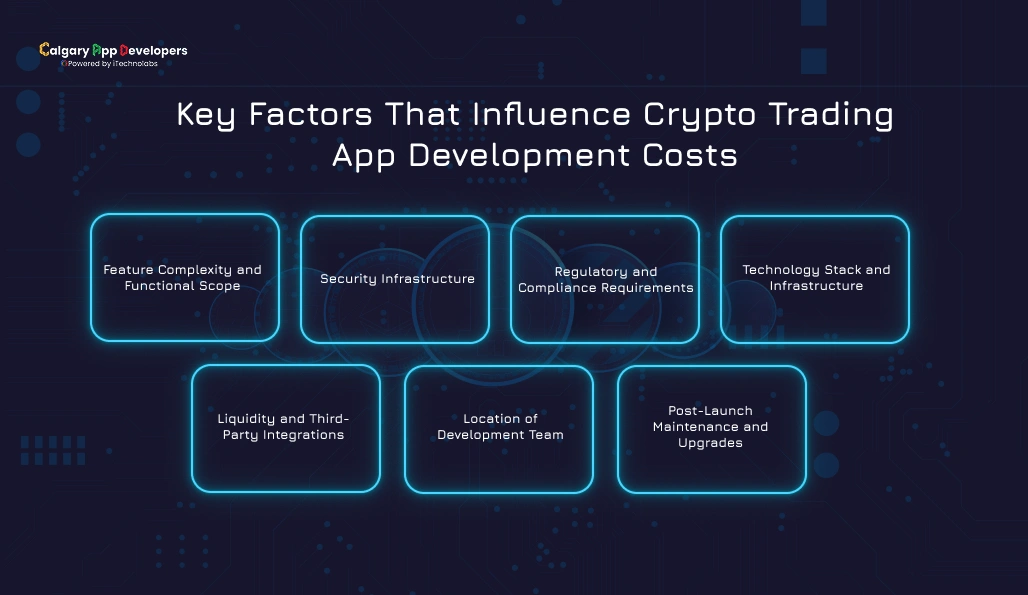
The total cost of building a crypto trading app like Swyftx depends on multiple strategic and technical decisions. Two platforms with similar interfaces can differ significantly in investment based on infrastructure depth, compliance scope, and long-term scalability planning.
Below are the primary factors that directly influence development expenses.
- Feature Complexity and Functional Scope
The broader and more advanced your feature set, the higher the development cost. A basic trading interface requires limited backend logic, while a full-scale exchange demands sophisticated architecture and performance engineering.
Core cost drivers include:
- Number of supported cryptocurrencies and trading pairs
- Advanced order types, such as stop loss and margin trading
- Real-time analytics and charting integrations
- AI-based insights or automated trading tools
- Staking, yield generation, or derivatives modules
- Multi-language and multi-currency support
Each additional capability increases backend logic, security requirements, testing effort, and integration complexity.
- Security Infrastructure
Security is one of the most significant investment areas in a crypto trading app like Swyftx. Since the platform handles financial assets and sensitive user data, security cannot be treated as a secondary layer.
Security-related cost components include:
- Multi-factor authentication systems
- End-to-end encryption protocols
- Cold wallet storage implementation
- Multi-signature wallet management
- DDoS protection and threat monitoring
- Regular security audits and penetration testing
Stronger security architecture increases upfront cost but significantly reduces long-term operational risk.
- Regulatory and Compliance Requirements
Compliance requirements vary by region and can significantly impact development cost. Platforms operating in multiple jurisdictions must align with different financial regulations, identity verification standards, and reporting obligations.
Key compliance considerations:
- KYC and AML integration
- Data protection regulations
- Transaction monitoring systems
- Licensing and legal consultation fees
- Audit trail and reporting mechanisms
The stricter the regulatory environment, the higher the development and operational investment.
- Technology Stack and Infrastructure
The choice of programming languages, frameworks, cloud providers, and database architecture directly influences both cost and scalability. A high-performance trading engine requires optimized backend systems capable of handling large transaction volumes with minimal latency.
Infrastructure cost factors include:
- Cloud hosting and server capacity
- Microservices architecture implementation
- Real-time data processing systems
- Third-party API integrations
- Ongoing infrastructure maintenance
Investing in scalable architecture from the start prevents expensive system migrations later.
- Liquidity and Third-Party Integrations
To ensure smooth trade execution, a crypto trading app like Swyftx must integrate with liquidity providers and payment gateways. These integrations require technical expertise and sometimes involve setup or service fees.
Integration-related costs include:
- Liquidity provider API configuration
- Payment gateway setup for fiat deposits
- Blockchain node management
- Transaction processing systems
- Spread management logic
The number and complexity of integrations can significantly affect development timelines and budgets.
- Location of Development Team
Development cost varies considerably depending on the geographic location of your technical team. Developer hourly rates differ across regions due to economic factors, talent demand, and operational costs.
Below is an estimated comparison of average hourly development rates for building a crypto trading app like Swyftx in major cities:
| City | Average Hourly Development Rate |
| Calgary | $70 to $110 |
| London | $110 to $170 |
| San Francisco | $130 to $190 |
| Sydney | $100 to $160 |
| Toronto | $90 to $140 |
| Dubai | $80 to $130 |
| New York | $120 to $180 |
While quality and expertise remain essential, Calgary offers a strong balance between technical capability and cost efficiency. The region is supported by initiatives such as the Opportunity Calgary Investment Fund and Innovate Calgary, which provide funding, mentorship, and startup support that strengthen the local technology ecosystem and innovation landscape.
- Post-Launch Maintenance and Upgrades
Development does not end at launch. Ongoing maintenance ensures security updates, performance optimization, feature expansion, and compliance alignment.
Recurring cost areas include:
- Server and hosting expenses
- Continuous security monitoring
- Feature enhancements
- Customer support systems
- Regulatory updates
Long-term planning for maintenance is essential when budgeting for a crypto trading app like Swyftx.
Every factor above contributes to the final development investment. Businesses that evaluate these elements early can build a realistic financial roadmap, reduce unexpected expenses, and position their crypto trading platform for scalable growth.
Also Read: How Much Does It Cost to Build a Cryptocurrency Exchange App like Coinbase?
Technology Stack Required to Build a Crypto Trading App Like Swyftx
Selecting the right technology stack is critical when developing a crypto trading app like Swyftx. The platform must support high-speed transactions, real-time data processing, strong security controls, and seamless scalability. A poorly chosen stack can limit performance and increase long-term operational costs.
Below is a structured overview of the core technologies typically required.
Recommended Technology Stack
| Layer | Technologies | Purpose |
| Frontend Development | React, Angular, Vue.js, Swift, Kotlin | Builds responsive web and mobile interfaces with real-time updates |
| Backend Development | Node.js, Python, Java, Go | Handles trading logic, APIs, user management, and transaction processing |
| Database | PostgreSQL, MongoDB, MySQL | Stores user data, transaction records, and trading history securely |
| Trading Engine | Custom Engine using Go, Java, or C++ | Executes order matching with low latency and high throughput |
| Blockchain Integration | Web3.js, Ethers.js, Bitcoin Core, Ethereum Nodes | Connects to blockchain networks for wallet and transaction validation |
| Wallet Infrastructure | Multi-signature wallets, Cold storage solutions | Secures digital asset storage and fund management |
| Cloud and Hosting | AWS, Google Cloud, Microsoft Azure | Ensures scalability, uptime, and global accessibility |
| Security Layer | SSL encryption, OAuth 2.0, JWT, DDoS protection | Protects data, accounts, and system integrity |
| Payment Gateway | Stripe, Plaid, and regional banking APIs | Enables fiat deposits and withdrawals |
| Analytics and Monitoring | Grafana, Kibana, Firebase Analytics | Tracks performance, user activity, and system health |
Hidden Costs in Crypto Trading App Development
When estimating the budget for a crypto trading app like Swyftx, many businesses focus only on visible development expenses such as design and coding. However, several indirect and ongoing costs can significantly impact the total investment. Identifying these early prevents financial strain and ensures smoother execution.
- Regulatory and Licensing Fees
Operating a crypto trading platform often requires licenses depending on the jurisdiction. Legal consultations, compliance documentation, and government application fees can add substantial upfront costs.
If the platform plans to operate across multiple regions, each regulatory environment may require separate approvals, reporting systems, and audits. These compliance-related expenses are often underestimated during initial budgeting.
- Liquidity Setup and Provider Fees
Integrating with liquidity providers is essential for smooth trade execution. However, setup charges, minimum deposit requirements, and transaction-based service fees can increase operational costs.
Some providers also require volume commitments or revenue-sharing models, which affect long-term profitability.
- Security Audits and Penetration Testing
A crypto trading app like Swyftx must undergo rigorous security assessments before and after launch. Independent penetration testing, vulnerability assessments, and smart contract audits involve specialized cybersecurity firms.
These audits are not one-time expenses. Regular testing is necessary to maintain platform integrity and user trust.
- Infrastructure Scaling Costs
Initial hosting costs may appear manageable, but infrastructure expenses rise as user activity grows. Higher server capacity, database scaling, content delivery networks, and backup systems increase monthly operational spending.
Unexpected traffic spikes during market volatility can also demand temporary resource expansion, adding to cloud service costs.
- Ongoing Maintenance and Updates
Post-launch support includes bug fixes, feature upgrades, performance optimization, and security patches. Skilled development teams are required for continuous improvements.
Without a dedicated maintenance budget, platforms risk technical debt and declining user satisfaction.
- Payment Processing and Banking Fees
Payment gateways and banking partners often charge transaction fees, currency conversion costs, and settlement charges. These recurring expenses impact revenue margins and must be factored into the financial model.
- Customer Support Operations
As user numbers grow, so does the need for support infrastructure. Live chat systems, ticket management tools, and trained support teams require ongoing investment.
For a crypto trading app like Swyftx, responsive customer service directly influences retention and brand credibility.
Hidden costs can quietly inflate the total investment if not carefully planned. A realistic financial strategy accounts for compliance, infrastructure, security, and operational overhead from the beginning. Businesses that anticipate these factors are better positioned to build a stable and profitable crypto trading platform.
Proven Strategies to Optimize Crypto Trading Development Costs
Building a crypto trading app like Swyftx requires significant investment, but smart planning can reduce unnecessary expenses without compromising quality or security. Cost optimization is not about cutting corners. It is about making strategic, technical, and operational decisions from the beginning.
1. Start with a Focused MVP
Launching with a Minimum Viable Product allows businesses to validate demand before committing to full-scale development.
Instead of building every advanced feature at once, focus on:
- Secure onboarding and KYC
- Core trading functionality
- Wallet integration
- Basic analytics
- Admin controls
Once user traction is confirmed, advanced modules such as staking or margin trading can be introduced in later phases. This phased approach reduces upfront risk and improves budget control.
2. Prioritize Scalable Architecture Early
Investing in scalable backend architecture from the start prevents expensive system rebuilds later. A modular structure allows new features to be added without disrupting the core system.
Cloud-based infrastructure with auto scaling capabilities helps manage fluctuating trading volumes efficiently while optimizing hosting expenses.
3. Use Reliable Third-Party Integrations
Instead of building every component in-house, leverage established APIs for liquidity, payment gateways, and identity verification.
This reduces development time, minimizes technical complexity, and ensures compliance standards are met. Well-chosen integrations accelerate time to market while maintaining reliability.
4. Choose the Right Development Location
Development rates vary globally. Selecting a region that offers strong technical expertise at competitive pricing can significantly lower overall investment.
Balancing cost efficiency with proven blockchain experience ensures quality is not compromised while optimizing expenditure.
5. Implement Agile Development Practices
Agile methodology promotes iterative releases and continuous feedback. This approach prevents large-scale rework and ensures resources are allocated efficiently.
Frequent testing and milestone reviews help identify issues early, reducing costly corrections later in the project lifecycle.
6. Plan Compliance from Day One
Regulatory delays can increase both time and cost. Engaging compliance experts during the planning phase avoids expensive redesigns or system modifications after development.
A crypto trading app like Swyftx must align with financial regulations from the outset to prevent legal setbacks.
7. Automate Testing and Monitoring
Automated testing frameworks and real-time monitoring tools reduce long-term maintenance expenses. Early detection of bugs and performance issues minimizes downtime and costly emergency fixes.
Cost optimization is about disciplined execution. Businesses that define a clear roadmap, adopt scalable technology, and phase development strategically can build a crypto trading app like Swyftx efficiently while maintaining high standards of security and performance.
Read Also: OTC Crypto Exchange Development: Benefits, Features, Process & Costs
Monetization Models for a Crypto Trading App Like Swyftx
A crypto trading app needs a properly designed revenue strategy to achieve permanent business growth. The business model demonstrates its strength because it generates steady income through various revenue sources instead of depending on a single revenue stream.
Below are the most effective monetization models used by successful crypto trading platforms.
- Transaction Fees
Transaction fees are the primary revenue source for most crypto exchanges. A small percentage is charged on every trade executed on the platform.
This model scales naturally with trading volume. As user activity increases, platform revenue grows without requiring additional infrastructure expansion at the same rate. Fee structures can vary based on trading volume tiers to attract high-frequency traders.
- Spread Markup
Instead of charging a visible trading fee, some platforms generate revenue by adding a small margin between the buy and sell price.
This model is simple for users to understand and works well for beginner-friendly platforms. A crypto trading app like Swyftx can combine spread markup with standard transaction fees for diversified income.
- Deposit and Withdrawal Fees
Platforms may charge fees on fiat deposits, crypto withdrawals, or both. These fees often cover payment gateway charges, blockchain network fees, and operational costs.
While these fees should remain competitive, they contribute to steady secondary revenue.
- Premium Subscriptions
Advanced traders often seek enhanced analytics, priority customer support, or lower transaction fees. Offering tiered subscription plans provides predictable monthly revenue.
Premium features may include advanced charting tools, automated trading strategies, or exclusive market insights.
- Staking and Yield Services
Many crypto platforms generate revenue by offering staking services. Users lock their digital assets to earn rewards, and the platform takes a small commission from the staking returns.
This model encourages long-term asset holding within the platform, improving liquidity and user retention.
- Token Listing Fees
Emerging crypto projects often pay listing fees to have their tokens added to a trading platform.
For a crypto trading app like Swyftx, listing new tokens can generate substantial revenue while expanding the asset portfolio. However, strict due diligence is essential to maintain credibility.
- Margin and Derivatives Trading
Advanced platforms generate higher revenue through margin trading and derivatives contracts. These products typically involve higher fees and attract experienced traders seeking leveraged positions.
This model requires strong risk management systems but significantly increases earning potential.
A successful crypto trading app like Swyftx rarely depends on a single monetization method. Combining transaction-based income with subscription services, staking commissions, and premium trading features creates a balanced and scalable revenue structure. Strategic pricing and transparent fee policies are critical to maintaining competitiveness while maximizing profitability.
Step-by-Step Process to Develop a Crypto Trading App Like Swyftx
Developing a crypto trading app like Swyftx requires a structured approach that balances technical execution, regulatory alignment, and long-term scalability. A clear development roadmap reduces risk, controls cost, and accelerates time to market.
Below is a practical step-by-step process followed in successful crypto exchange projects.
Step 1: Market Research and Business Planning
The process begins with defining your target audience, geographic market, and competitive positioning. This stage includes analyzing existing exchanges, identifying feature gaps, and outlining a sustainable revenue model.
Key outcomes at this stage include a detailed product roadmap, compliance strategy, and technical architecture blueprint.
Step 2: Regulatory Assessment and Compliance Setup
Before development begins, legal requirements must be reviewed based on operating regions. Licensing obligations, KYC and AML integration, and data protection regulations should be clearly defined.
Addressing compliance early prevents costly redesigns later and ensures a smooth launch.
Step 3: Define Core Features and Platform Scope
At this stage, you determine whether the initial launch will be a basic MVP or a feature-rich trading platform.
This includes finalizing:
- Supported cryptocurrencies and trading pairs
- Order types and trading functionality
- Wallet and payment integrations
- Security framework requirements
- Admin dashboard capabilities
A clear scope definition keeps development timelines realistic and budgets controlled.
Step 4: UI and UX Design
Design teams create wireframes and interactive prototypes that map user journeys. The goal is to simplify complex trading processes into an intuitive interface.
For a crypto trading app like Swyftx, clarity in dashboard layout, order placement flow, and portfolio tracking is essential for user adoption.
Step 5: Backend and Trading Engine Development
The backend infrastructure and trading engine are built during this phase. This includes order matching logic, database configuration, API development, and server setup.
Performance, scalability, and low-latency execution are prioritized to handle high trading volumes efficiently.
Step 6: Blockchain and Third-Party Integrations
The platform is connected to blockchain networks for transaction validation and wallet operations. Liquidity providers and payment gateways are integrated to enable seamless trading and fiat transactions.
Careful configuration ensures accurate pricing and secure asset transfers.
Step 7: Security Implementation and Testing
Security protocols are implemented across the system. Penetration testing, load testing, and performance testing are conducted to identify vulnerabilities.
This stage ensures that the crypto trading app like Swyftx can operate securely under real-world conditions.
Step 8: Deployment and Launch
Once testing is complete, the platform is deployed to production servers and made available to users. App store approvals, domain configuration, and monitoring systems are finalized.
A phased rollout may be used to manage early user feedback and performance adjustments.
Step 9: Post-Launch Optimization and Scaling
After launch, continuous monitoring, feature upgrades, and performance improvements are essential. User feedback is analyzed to refine the platform and introduce advanced features in later stages.
Scalability planning ensures the system can support growth in the user base and trading volume.
Developing a crypto trading app like Swyftx is a strategic process that combines technical precision with regulatory discipline. Businesses that follow a structured roadmap are better positioned to launch a secure, scalable, and competitive trading platform.
How to Differentiate Your Crypto Trading App Like Swyftx in a Competitive Market
Launching a crypto trading app like Swyftx is only the first step. The real challenge lies in standing out in a market filled with established exchanges and emerging platforms. Differentiation requires more than adding features. It demands a clear value proposition, superior user experience, and strategic positioning.
- Prioritize Simplicity and Performance: A clean interface, smooth onboarding, and fast trade execution create immediate impact. Many platforms are complex. Simplicity combined with reliability builds stronger user retention.
- Lead with Transparent Pricing: Clear fee structures and competitive trading costs increase trust. Transparent pricing reduces friction and encourages higher trading activity.
- Elevate Security Standards: A visible commitment to strong security practices, such as cold storage, multi-factor authentication, and continuous monitoring, strengthens credibility and user confidence.
- Offer Smart Tools and Added Value: Advanced analytics, automated trading options, and portfolio insights attract serious traders. Expanding into services like staking or yield programs also increases platform stickiness.
- Focus on a Defined Target Market: Serving a specific region or user segment allows more precise feature development and branding. Tailored experiences often outperform generic platforms.
Differentiation is built on clarity, reliability, and user trust. A crypto trading app like Swyftx that prioritizes performance, transparency, and strategic innovation can carve out a strong position even in a crowded marketplace. Success depends on delivering consistent value that aligns with evolving user expectations.
Conclusion
Building a crypto trading app like Swyftx is a strategic investment that requires careful planning, strong technical execution, and long-term vision. From defining the right feature set and selecting a scalable technology stack to ensuring regulatory compliance and security, every decision directly impacts cost, performance, and market success.
The opportunity in the crypto trading space continues to expand, but success depends on execution. A well-architected platform backed by clear monetization models and cost optimization strategies can position your business for sustainable growth in a competitive digital finance landscape.
At Calgary App Developers, we bring hands-on experience in designing and developing secure, scalable fintech and blockchain solutions. Our team focuses on building high-performance trading platforms that align with regulatory standards and long-term business goals. If you are planning to develop a crypto trading app like Swyftx, we can help you transform your concept into a reliable and market-ready product with the right technical foundation and strategic direction.
FAQs
- What Is the Estimated Cost to Develop a Crypto Trading App Like Swyftx?
The cost to build a crypto trading app like Swyftx typically ranges between $40,000 and $300,000 or more, depending on platform complexity, security standards, compliance requirements, and scalability goals. A basic MVP with essential trading features falls on the lower end, while a fully featured exchange with advanced trading tools, liquidity integration, and institutional-grade security requires a significantly higher investment. Ongoing maintenance, licensing, and infrastructure costs should also be factored into the total budget.
- What Is the Typical Timeline for Building a Crypto Trading App Like Swyftx?
The development timeline generally ranges from 3 to 12 months, depending on the feature scope and regulatory requirements. A streamlined MVP version can be completed in about 3 to 4 months. More advanced platforms with custom trading engines, extensive security layers, and multi-region compliance frameworks may require 7 to 12 months or longer. Proper planning and phased development help reduce delays and improve time to market.
- Which Technology Stack Is Needed to Develop a Crypto Exchange App Like Swyftx?
A crypto trading app like Swyftx requires a robust and scalable technology stack. Frontend development typically uses frameworks such as React or Angular for web and Swift or Kotlin for mobile apps. Backend systems are often built with Node.js, Python, Java, or Go to support trading logic and APIs. PostgreSQL or MongoDB is used for database management, while cloud platforms such as AWS or Google Cloud handle scalability. Blockchain integration tools, secure wallet infrastructure, and strong encryption protocols are also essential components.
- How Do Enterprises Ensure Secure Wallet Integration in Custom Crypto Trading Apps?
Secure wallet integration is achieved through a combination of technical safeguards and operational controls. Enterprises typically use multi-signature wallet systems, cold storage solutions for asset protection, and encrypted communication protocols to secure transactions. Dedicated blockchain nodes or trusted node providers are integrated to validate transactions reliably. Regular security audits, penetration testing, and real-time monitoring further reduce risk. A well-designed wallet infrastructure protects user funds while maintaining efficient deposit and withdrawal processes within the platform.
- What Are the Ongoing Maintenance Costs for a Crypto Trading App Like Swyftx?
Ongoing maintenance costs for a crypto trading app like Swyftx typically range between 15 percent and 25 percent of the initial development cost annually. These expenses include server hosting, cloud infrastructure scaling, security monitoring, regular updates, bug fixes, compliance upgrades, and customer support operations. As user activity grows, infrastructure and liquidity management costs may also increase. Continuous maintenance is essential to ensure platform stability, protect user funds, and maintain regulatory compliance in a rapidly evolving crypto market.


Pankaj Arora is a seasoned technology leader and the Founder of Calgary App Developer, with 10+ years of expertise in crafting high-performance digital solutions. His core competencies include full-stack app development, cloud-native architecture, API integration, and agile product delivery. Under his leadership, Calgary App Developers has empowered startups and enterprises alike with scalable mobile applications, secure web platforms, and AI-driven SaaS products.