



How Much Does It Cost To Develop A Delivery App
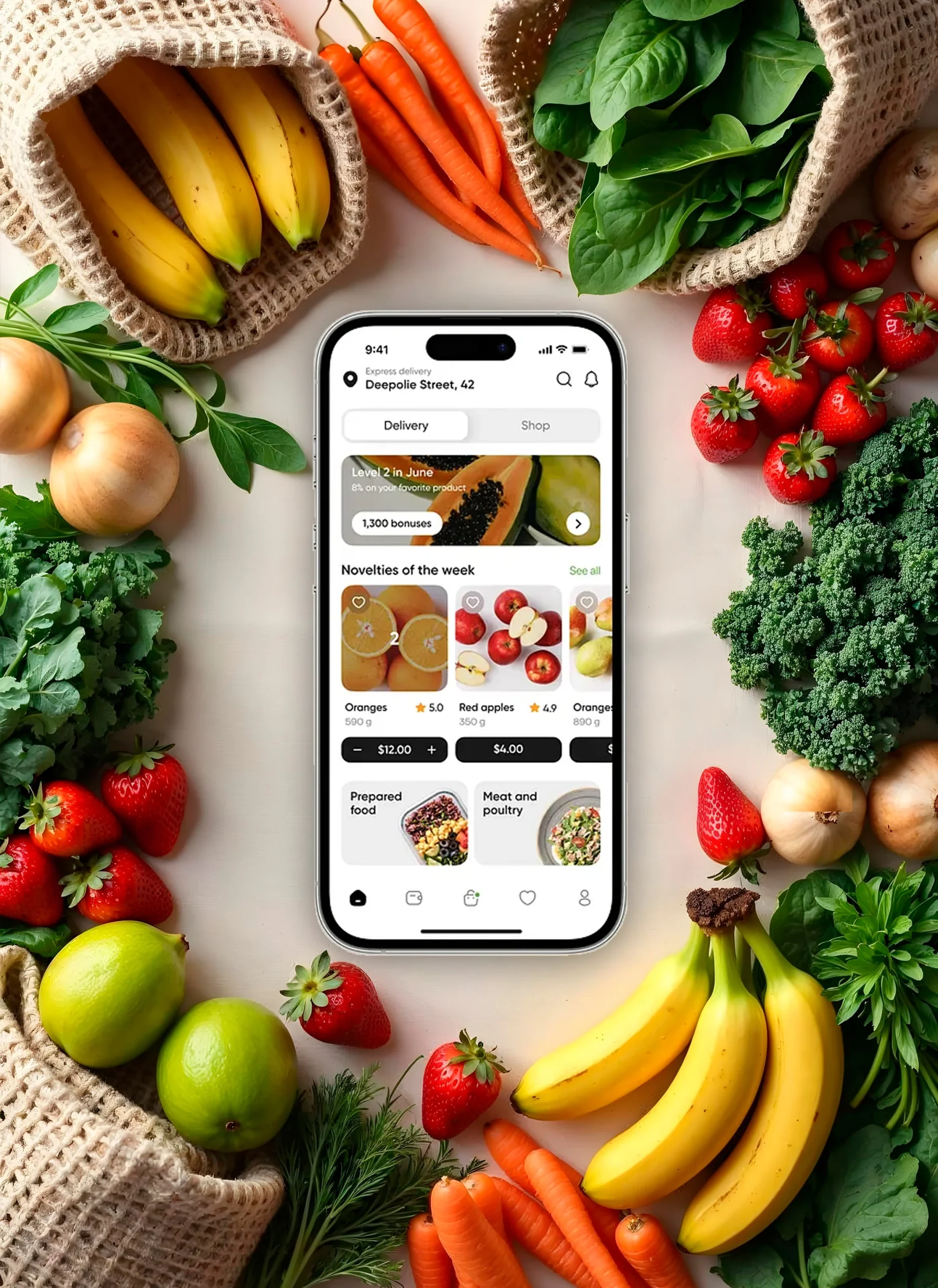
Ordering food or groceries feels effortless. A few taps, live tracking, and a delivery at your doorstep. What users never see is the complex system behind that experience, logistics, designing intuitive flows, building real-time tracking, and making sure everything works under pressure. That complexity is the real work of delivery app development.
This raises the question most founders and businesses eventually face. How much does it actually cost to build a delivery app that can stand alongside platforms like Postmates, Zomato, or Dunzo? The answer depends on far more than a fixed price. Features, platform choices, technology stack, and development location all shape the final cost.
This blog is based on our hands-on experience building delivery apps. We break down the real cost drivers, practical budget ranges, and smart planning decisions so you can understand what goes into delivery app development and invest with clarity rather than guesswork.
TL;DR
- Delivery app development costs vary widely based on features, platforms, and technical complexity.
- Starting with a focused MVP helps control the budget while validating demand.
- Real-time tracking, payments, and logistics are the biggest cost drivers.
- Smart planning reduces long-term development and scaling costs.
Key Points
- The cost to build a delivery app depends on the app type, feature set, platform choice, and backend infrastructure.
- Food, grocery, and parcel delivery apps have different technical requirements that directly affect development budgets.
- Platform decisions, such as native versus cross-platform development, influence both cost and time to market.
- Development team location and experience significantly impact overall cost and product quality.
- A phased approach that prioritizes essential features helps businesses launch faster and scale efficiently.
Why Investing in a Delivery App Matters
Let’s break it down with real figures and the trends shaping what’s next.
- Massive market opportunity
What this really means is growth on a global scale. As per grand view research, in 2024 the global online food delivery market stood at roughly US $289 billion. That’s expected to hit US $505 billion by 2030, growing at about 9.4 percent each year.
Focusing on mobile, the food delivery mobile app market alone is slated to climb from about US $90 billion in 2024 to over US $365 billion by 2033, unpacking a staple annual growth rate near 17 percent.
- Tailwinds from on-demand buying:
Here’s the thing: smartphone usage is soaring. Almost seven billion people are already mobile-enabled, and by 2025 that nears 7.3 billion. On-demand delivery apps? That space is predicted to generate a staggering US $335 billion in annual revenue by then.
- Grocery delivery is taking off
This isn’t just food. Grocery delivery alone is booming. Forecasts predict that by 2030, the grocery delivery app market could reach a whopping US $1.1 trillion.
- Profitability is finally here
Let’s talk numbers grounded in 2024 performance. Global food delivery app revenue jumped 15.5 percent to US $114.5 billion. Grocery delivery reached US $22.8 billion.
Meanwhile, big names are posting profits. DoorDash turned a profit of US $117 million. Deliveroo delivered £12.2 million. Uber Eats reached a staggering US $2.4 billion in adjusted EBITDA
- Innovation is changing the game
This isn’t just numbers. Delivery is becoming smarter. Drone deliveries are poised to go mainstream. PwC forecasts 800 million drone deliveries a year, totaling US $65 billion by 2034.
Subscriptions, personalization, and sustainability all are winning over consumers. Subscription-based meal kits could reach US $19 billion by 2028.
This Means:
- The delivery app market is on fire. We’re talking hundreds of billions now and into the future.
- Innovative tech and changing consumer habits keep fueling that fire.
- Businesses that invest now aren’t just tapping demand; they’re building platforms that pay off over and over.
Also Read: How to Create a Food Delivery App
How Much Does It Cost to Develop a Delivery App
The cost of delivery app development typically starts around $25,000 for a basic MVP and can scale up to $200,000 or more for a fully featured platform. The final figure depends on scope, features, design complexity, and the region where your development team is based.
Here’s a simplified breakdown of cost estimates:
| Component | Estimated Cost Range | Notes |
| UI/UX Design | $3,000 – $10,000 | Covers wireframing, prototyping, and user interface design |
| User App Development | $10,000 – $40,000 | Core features like browsing, ordering, payments, and tracking |
| Delivery Agent App | $8,000 – $25,000 | Navigation, delivery status updates, route optimization |
| Admin Dashboard | $5,000 – $20,000 | Analytics, order management, customer and vendor management |
| Backend Development | $7,000 – $35,000 | API integrations, database management, server setup |
| QA & Testing | $3,000 – $15,000 | Ensures app stability, security, and bug fixing |
| Maintenance & Updates | $1,000 – $5,000/month | Regular updates, server costs, new features |
Total Estimated Cost: $25,000 – $200,000+
What this really means is delivery app development is not a one-size-fits-all investment. A startup testing the waters can get started with a leaner budget, while enterprises competing with established giants will need to allocate significantly more. The smartest move is to align your features and user expectations with your budget so you build an app that doesn’t just launch but actually thrives.
Factors Affecting the Cost of Delivery App Development
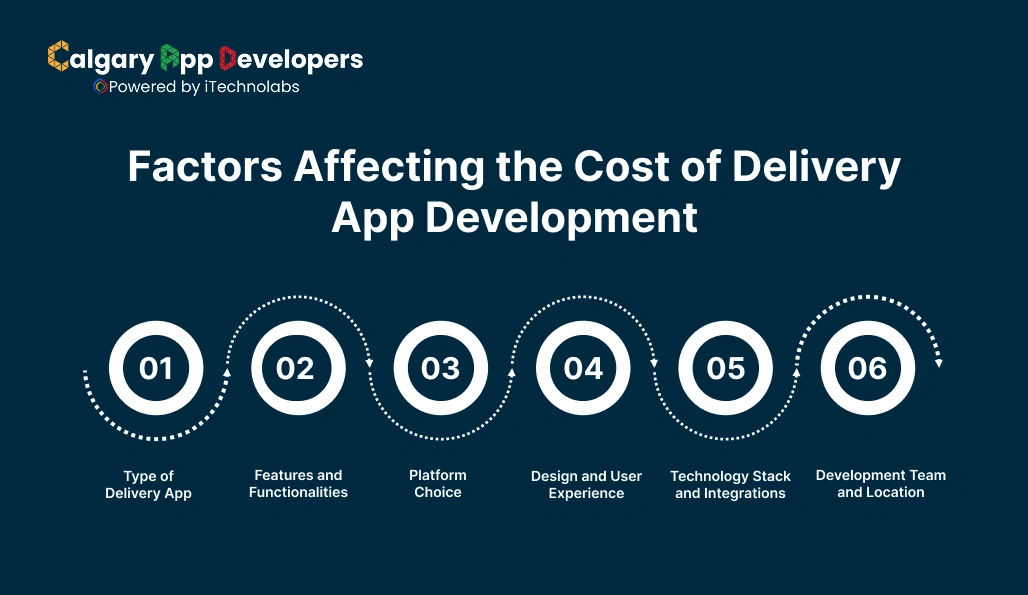
The budget for delivery app development isn’t a flat figure. It’s shaped by dozens of decisions that come together to define the quality, scalability, and performance of the final product. Whether you are planning food delivery app development or grocery delivery app development, understanding these factors helps you budget smarter and avoid hidden surprises.
1. Type of Delivery App
The very first factor that determines cost is the type of delivery app you want to build.
- Food Delivery App Development:
Building a food delivery app typically costs $40,000 – $150,000. Think about platforms like Uber Eats, DoorDash, or Deliveroo. They require features such as dynamic restaurant listings, menu customization, live tracking, real-time notifications, and secure payment gateways. Since users expect quick updates and a smooth experience, food delivery apps usually need advanced integrations with restaurant POS systems and GPS APIs, which increases the timeline and overall expense.
- Grocery Delivery App Development:
The cost of grocery delivery app development usually falls between $50,000 – $180,000. Apps like Instacart, Amazon Fresh, or Walmart Grocery are more complex because they manage large catalogs, inventory synchronization, multiple product categories, and delivery slot scheduling. Many also include recurring orders and loyalty programs, which require a more powerful backend to track and personalize customer experiences. This higher logistical complexity makes grocery delivery apps slightly more expensive than food delivery apps.
- Pickup and Delivery App Development
Creating a pickup and delivery app ranges from $35,000 – $120,000. These apps focus on courier assignment, logistics, route optimization, and proof-of-delivery features. Examples include Postmates (in its earlier model) or Roadie. They often integrate with barcode scanning, route planning, and sometimes IoT-enabled lockers. While less catalog-heavy than grocery apps, the challenge here is ensuring reliable fleet management and accurate real-time tracking.
| Type of Delivery App | Key Features | Estimated Cost Range |
| Food Delivery App Development | Restaurant listings, menus, live tracking, POS integration, payments | $40,000 – $150,000 |
| Grocery Delivery App Development | Large catalogs, inventory sync, slot scheduling, recurring orders, loyalty | $50,000 – $180,000 |
| Pickup and Delivery App Development | Courier assignment, route optimization, proof-of-delivery, fleet management | $35,000 – $120,000 |
Your delivery model, whether it’s a single-vendor app, a multi-vendor aggregator, or a hybrid, also changes the scope of work.
2. Features and Functionalities
Every new feature adds hours of coding, design, and testing. Here’s how features directly influence costs:
| Feature Set | Examples | Impact on Cost |
| Basic Features | Login, search bar, order placement, in-app payments | Essential for launch. Keeps costs on the lower side but offers limited appeal. |
| Advanced Features | Real-time order tracking, push notifications, reviews, chat support | Adds value for users and requires more backend logic and APIs. |
| Premium Features | AI-driven recommendations, loyalty programs, AR-based previews, voice ordering | Creates a competitive edge but increases development time significantly. |
The takeaway here is simple: if your app focuses only on core functionality, your investment stays modest. But if you aim to stand out in a crowded market, premium features will raise the cost considerably.
3. Platform Choice
Your platform strategy is another major cost driver.
- iOS or Android only: This is the cheapest option, but you’re limiting your user base.
- Cross-platform (React Native, Flutter): A good middle ground. You save time and cost while reaching both platforms.
- Native apps for iOS and Android: Offer the best performance and user experience, but double your cost because each platform needs its own dedicated codebase.
Choosing between these depends on your audience, timeline, and growth plans.
4. Design and User Experience
A delivery app is judged at first glance. If the interface is clunky, people uninstall quickly.
- Minimal UI/UX: Affordable and straightforward, with basic navigation and clean layouts.
- Custom UI/UX: More expensive but delivers a polished look, animations, micro-interactions, and unique branding.
Since design often influences user retention rates, investing here is not just about looks; it directly impacts your revenue potential.
5. Technology Stack and Integrations
The tools and frameworks you use affect both performance and cost. For example:
- Adding AI-powered chatbots or machine learning-driven suggestions requires more time and expertise.
- Using blockchain for payments or high-security systems raises backend expenses.
- Integration with third-party services like Google Maps, Stripe, PayPal, SMS notifications, or CRM tools increases development hours.
The complexity of your tech stack often decides how scalable your app will be in the long run.
6. Development Team and Location
Where your team is based can make or break your budget. Different cities around the world have become hubs for delivery app development, each offering unique advantages.
| City/Region | Hourly Rate (approx.) | What to Expect |
| San Francisco, USA | $100 – $150/hr | Premium expertise, top-tier infrastructure, but one of the most expensive cities |
| London, UK | $80 – $120/hr | Strong talent pool with experience in enterprise-level projects |
| Berlin, Germany | $70 – $100/hr | Known for innovative startups and mid-range development costs |
| Warsaw, Poland | $40 – $70/hr | Affordable with solid technical expertise, popular among European startups |
| Calgary, Canada | $30 – $50/hr | One of the lowest-cost yet highly reliable hubs in North America, offering excellent value for quality development |
Hiring an in-house team in cities like San Francisco or London gives you access to world-class developers but at a steep price. Nearshoring to places like Warsaw can balance cost and expertise.
Interestingly, Calgary has emerged as a surprisingly cost-effective hub, combining North American standards of quality with some of the lowest development rates in the region, making it one of the best choices for delivery app development today.
Read Also: Build Smarter: Custom On-Demand App Development Guide
Tips to Minimize the Cost of Delivery App Development
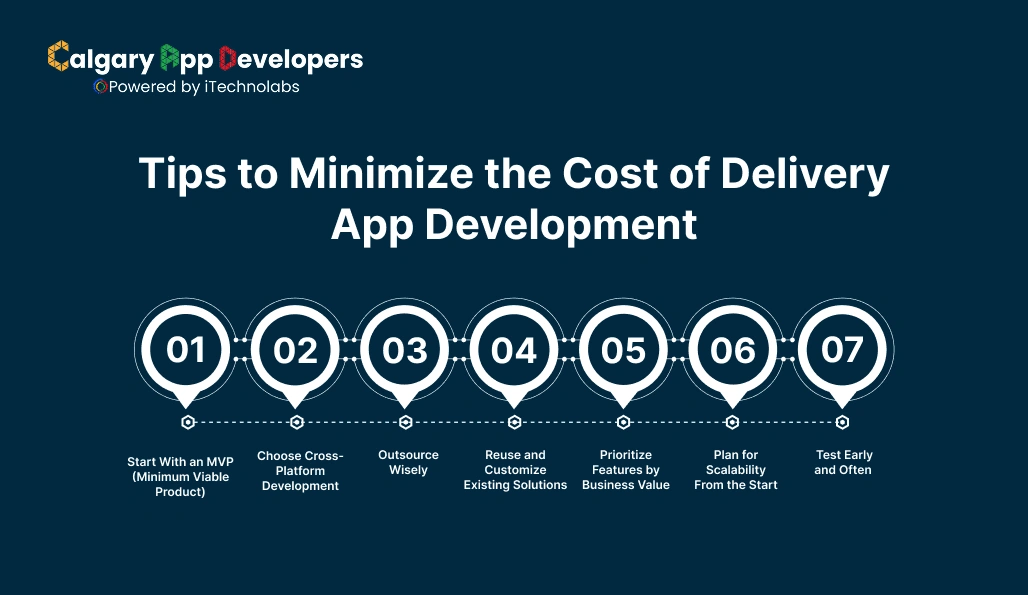
Creating a delivery app can get expensive, but there are smart ways to control costs without cutting corners on quality. The goal is to prioritize value and efficiency at every stage of the project.
- Start With an MVP (Minimum Viable Product)
- What it means: Launch a simplified version of your app with only must-have features like product browsing, cart, checkout, payments, and order tracking.
- Why it works: You spend less upfront, validate your idea in the real market, and gather insights from early adopters before scaling up.
Cost impact: Can reduce initial spending by 30–40 percent.
- Choose Cross-Platform Development
- What it means: Instead of building separate apps for iOS and Android, use frameworks like Flutter or React Native to create a single codebase.
- Why it works: Saves time, ensures faster updates, and lowers testing costs while reaching both major platforms.
Cost impact: Cuts development hours by nearly 50 percent.
- Outsource Wisely
- What it means: Partner with skilled developers in cost-effective regions such as Eastern Europe or Asia.
- Why it works: You get access to quality talent at lower hourly rates while maintaining standards.
Extra tip: If you prefer North American expertise, consider Calgary. It has become a hub for affordable and reliable delivery app development, offering better rates than cities like San Francisco or New York.
- Reuse and Customize Existing Solutions
- What it means: Skip building every feature from scratch. Instead, integrate ready-made APIs and SDKs for payments, maps, notifications, and chat.
- Why it works: Speeds up development and reduces long-term maintenance.
Examples: Stripe for payments, Firebase for push notifications, and Twilio for customer messaging.
- Prioritize Features by Business Value
- What it means: Rank your feature list by impact on customer experience and revenue potential.
- Why it works: Prevents overspending on extras that look impressive but don’t immediately drive value.
Example: Focus on frictionless checkout before exploring AI-driven recommendations.
- Plan for Scalability From the Start
- What it means: Build on cloud-based infrastructure that grows with your user base.
- Why it works: Saves you from costly reengineering when traffic spikes.
Extra tip: Services like AWS and Google Cloud offer pay-as-you-go models so you only pay for what you actually use.
- Test Early and Often
- What it means: Don’t leave testing to the final stage. Implement continuous testing throughout development.
- Why it works: Bugs are cheaper to fix early, and catching issues early avoids costly delays at launch.
Tools: Automated testing with frameworks like Selenium or Appium.
Delivery app development doesn’t have to drain your budget. By starting with an MVP, adopting cross-platform frameworks, outsourcing smartly, and leveraging existing tools, you can keep costs manageable while still building an app that users trust and enjoy. Careful planning, prioritization, and smart scaling are what turn a limited budget into a successful app.
Our Experience in Delivery App Development
At Calgary App Developer, our delivery app development experience comes from building real, production-ready platforms that handle logistics, payments, and real-time coordination at scale. We focus on reliability, performance, and usability because delivery apps operate in high-pressure, time-sensitive environments. Below are two delivery platforms that reflect our hands-on expertise.
1. Hitchmail – Parcel Delivery App
Hitchmail is an on-demand parcel delivery application built to streamline last-mile logistics by connecting users with nearby delivery partners in real time. The platform was designed for speed, transparency, and operational efficiency.
Key Features
- Real-time parcel booking with instant courier matching
- Live GPS tracking from pickup to final delivery
- Dynamic availability management for delivery partners
- Secure in-app payments with automated transaction handling
- Push notifications for pickup, transit, and delivery milestones
- Proof-of-delivery support with status updates
- Admin dashboard for order monitoring, courier management, and analytics
Outcome
Hitchmail reduced delivery turnaround time, improved visibility for customers, and enabled couriers to manage requests efficiently. The platform demonstrates our strength in building location-driven, real-time delivery systems that scale smoothly.
2. Serve It Local – Online Food Delivery Platform
Serve It Local is an online food delivery platform created to help local restaurants manage direct orders without relying on third-party aggregators. The app focuses on ownership, control, and a frictionless ordering experience.
Key Features
- Restaurant discovery with location-based listings
- Digital menu management with real-time updates
- Smooth ordering and checkout flow
- Multiple payment options with secure processing
- Live order status tracking for preparation and delivery
- Vendor dashboard for order management and menu control
- Admin panel for user management, payouts, and performance insights
Outcome
Serve It Local empowered restaurants to increase margins, retain customer data, and build stronger direct relationships with their customers. The platform highlights our ability to deliver scalable, multi-vendor food delivery solutions with a strong operational backbone.
We understand the delivery platforms beyond surface-level features. We know how real-time systems behave under load, how logistics workflows break, and how to architect apps that remain reliable as demand grows. That experience allows us to build delivery apps that are not just functional at launch, but scalable, secure, and built for long-term business success.
Conclusion
The truth is, whether you’re exploring food delivery app development, scaling into grocery delivery app development, or building a custom pickup and delivery app development solution, success comes down to smart planning and the right development partner. Costs vary based on features, design, platforms, and team location, but what matters most is building an app that users actually love and trust.
If you want a team that blends affordability with North American quality, Calgary App Developers is your best choice. We specialize in crafting delivery apps that are intuitive, scalable, and built to thrive in competitive markets. From MVPs to enterprise-grade platforms, we help you launch faster, control costs, and create products that stand out.
Your next step is simple: start with a clear vision, let experts guide the development process, and watch your delivery app turn into a long-term business asset.
FAQ’s About Delivery App Development Cost
1. How much does it cost to develop an app like DoorDash?
An app like DoorDash typically costs between $70,000 and $200,000, depending on the features, platform choice, and region of development. Advanced functionalities like real-time tracking, multi-vendor support, and seamless payment integration increase costs. Starting with an MVP helps reduce the initial investment while still capturing core functionality.
2. Can I make my own delivery app?
Yes, you can build your own delivery app if you have the right technical expertise or work with a skilled development team. Using pre-built APIs for payments, maps, and chat can save time and money. Partnering with a professional agency ensures your app is scalable, secure, and user-friendly from the start.
3. What is the average cost to develop an app?
On average, app development costs range from $25,000 for a basic MVP to over $200,000 for a feature-rich platform. Factors like app type, design complexity, platform choice, and backend infrastructure play a major role. Delivery apps, in particular, tend to fall on the higher end due to logistics and real-time features.
4. How much to build an app like Uber?
Developing an Uber-style app can cost anywhere from $80,000 to $250,000. Core requirements include GPS-based tracking, route optimization, multiple payment gateways, and robust driver-rider matching. The final cost depends on whether you build it for a single platform or go cross-platform, along with the choice of custom versus reusable solutions.
5. Are food delivery apps profitable?
Yes, food delivery apps are profitable when designed with a solid revenue model. Platforms like Uber Eats and DoorDash earn through delivery fees, commissions from restaurants, ads, and subscription models. With rising consumer demand, well-built apps can generate steady income, especially if they offer convenience, speed, and reliability while scaling effectively.


Pankaj Arora is a seasoned technology leader and the Founder of Calgary App Developer, with 10+ years of expertise in crafting high-performance digital solutions. His core competencies include full-stack app development, cloud-native architecture, API integration, and agile product delivery. Under his leadership, Calgary App Developers has empowered startups and enterprises alike with scalable mobile applications, secure web platforms, and AI-driven SaaS products.