









How Much Does It Cost to Hire an AI Developer?

Employing an AI developer is about wagering on someone who converts new ideas into intelligent, productive solutions. It’s not just about hiring talent. You need to have clarity on what drives costs and why figures automatically seem to escalate rapidly.
The world AI market is booming currently. Its worth is estimated at about USD 273.6 billion in 2023, and the projections are going up to USD 5.26 trillion by 2035, growing at a rate of 30.8 percent per annum. That fast market growth boosts demand and sends recruiting expenses upwards.
When you’re hiring now, you’re operating amid a surging market of AI App Development. Let’s unpack what that means for your budget and how to navigate cost without overpaying.
- Hiring an AI developer in 2026 involves more than hourly rates and depends on scope, skill, and location.
- Costs vary widely based on project complexity, engagement model, and technology choices.
- Smart planning helps control hidden expenses like data, cloud infrastructure, and maintenance.
- The right hiring strategy balances budget efficiency with long-term business value.
- AI developer costs range from affordable junior rates to premium senior pricing, depending on expertise and project demands.
- Project type plays a major role in pricing, with basic integrations costing far less than enterprise-grade AI platforms.
- Developer location significantly impacts cost, with emerging tech hubs offering strong talent at more competitive rates.
- Engagement models such as freelance, agency, or in-house hiring directly influence total investment and risk level.
- Hidden expenses like data preparation, cloud computing, testing, and ongoing maintenance can add substantially to the budget.
- Clear scoping, use of open-source tools, and flexible hiring models help reduce costs without sacrificing quality.
How Much Does It Cost to Hire an AI Developer
On average, hiring an AI developer costs between USD 60 and 120 per hour, though rates can dip as low as USD 25 for junior talent and climb to USD 200 or more for senior specialists. The actual amount you spend depends on project scope, developer expertise, and location.
To paint a clear picture, here is an estimate of overall cost quotes for various project types. These are rough figures intended to assist you in budgeting realistically:
| Project Type | Scope | Estimated Total Cost |
| Basic AI Integration | Adding AI features to an existing app, like chatbot support | USD 10,000 – 25,000 |
| Custom AI Model Development | Building and training a model for tasks such as predictions or recommendations | USD 25,000 – 60,000 |
| Advanced AI System | End-to-end solution with data pipelines, model deployment, and scalability | USD 60,000 – 150,000+ |
| Enterprise-Grade AI Platform | Large-scale, multi-feature AI applications with ongoing support | USD 150,000 – 500,000+ |
These numbers can shift depending on whether you work with freelancers, agencies, or in-house developers. They also change if you need long-term maintenance or additional cloud resources.
Also Read: How to Make an AI
Key Factors That Affect AI Developer Rates
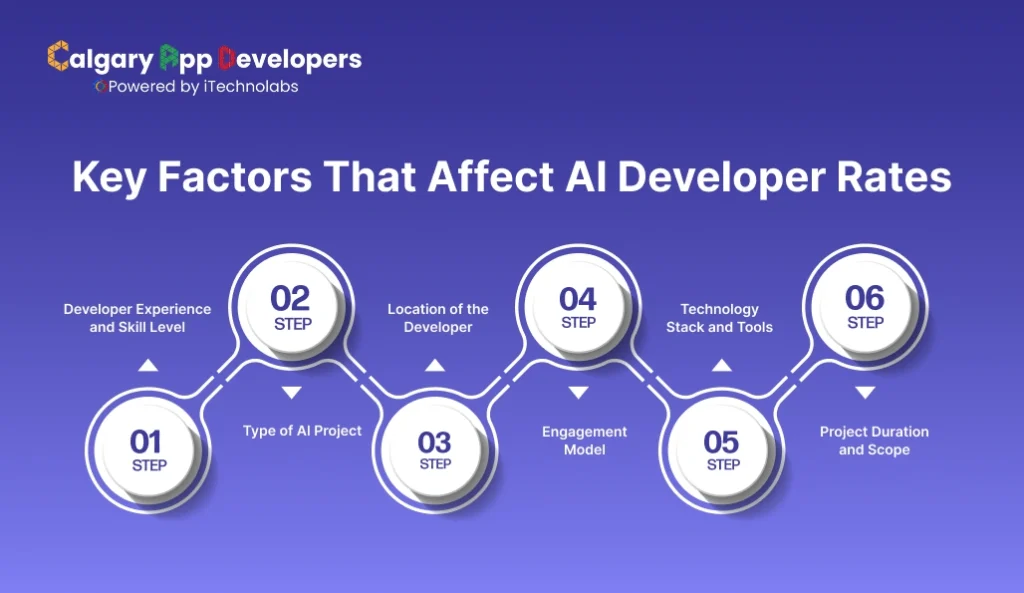
AI development costs are highly variable, and knowing the reasons for those figures aids you in planning better. What follows are the primary factors that determine what you will actually pay.
- Developer Experience and Skill Level
- Junior Developers (0–2 years) tend to do more basic work, such as integrating APIs or tweaking pre-made models. They are cheaper but perhaps require more guidance.
- Mid-Level Developers (3–5 years) perform end-to-end training of models, optimization, and development of custom features. They are mid-priced and balance affordability and expertise.
- Senior Developers (5+ years) introduce high-level capabilities like building scalable AI systems, team management, and innovating on intricate algorithms. Their prices are the highest but their efficiency tends to save time.
- Type of AI Project
The project’s complexity has a direct impact on cost.
- Simple AI activities such as chatbots or recommendation systems are comparatively cheap.
- Computer vision or NLP model building, like custom model development, demands more expertise and training hours.
- Enterprise-level solutions with cloud integration, data pipelines, and security capabilities are the costliest.
- Location of the Developer
Where a developer lives matters a great deal when it comes to price. New tech centers tend to come with premium prices, but up-and-coming cities can provide quality talent for much less.
| City | Typical Hourly Rate |
| San Francisco | USD 120 – 200 |
| New York | USD 100 – 180 |
| London | USD 90 – 160 |
| Berlin | USD 70 – 140 |
| Bangalore | USD 30 – 90 |
| Calgary | USD 25 – 70 |
As you can see, location shapes costs just as much as skill or project type. While big-name cities command high premiums, places like Calgary offer a strong pool of AI talent at far more competitive rates, making them a smart choice for businesses looking to balance quality with budget.
- Engagement Model
The way you engage the developer also affects the final cost.
- Freelancers are inexpensive and versatile for small projects but possibly lacking in long-term commitment.
- Development firms or agencies supply groups of several skill sets, which is more expensive but provides assurance of reliability.
- Full-time in-house employees are the most costly but justified if AI is a core, long-term strategy.
- Technology Stack and Tools
The tools and frameworks a developer uses can either keep costs manageable or push them higher.
| Approach | Examples | Impact on Cost | Typical Range |
| Off-the-Shelf Frameworks | TensorFlow, PyTorch, Hugging Face, Scikit-learn | Lower cost since much of the groundwork is already done | USD 25,000 – 60,000 (for mid-sized projects) |
| Custom Algorithms | Proprietary neural networks, specialized ML pipelines | Higher cost due to research, design, and testing needs | USD 60,000 – 120,000+ |
| Hybrid Approach | Mix of prebuilt tools with custom modules | Balanced cost with flexibility to scale | USD 40,000 – 90,000 |
Using off-the-shelf frameworks speeds up development and reduces expenses. Custom solutions give you more control and differentiation, but they require more time and money. A hybrid approach is often a middle ground, combining the speed of existing tools with the flexibility of tailored features.
- Project Duration and Scope
Long-term work tends to be more expensive overall, but rates might be negotiable on a per-hour or per-month basis for longer engagements. Short-term work tends to have higher hourly fees because developers must cycle up fast.
In short: costs depend not only on who you hire but also on what you need, where you hire from, and how you structure the engagement. Balancing these factors is key to staying within budget without sacrificing quality.
Read Also: Best AI Business Solutions Driving Business Growth
How AI Developers Determine Their Fees
AI developers don’t rip numbers out of the air. Their rates are influenced by how they charge, the size of your project, and the value that they think they’re bringing to the table. Knowing these fee structures allows you to select the correct model for your budget and objectives.
- Hourly Rates
- Ideal for small projects or tasks where the scope is fluid.
- Pay for the fixed number of working hours.
- Typical for freelancers and consultants.
- Fixed Project Pricing
- Pre-agreed flat price for development to commence.
- Best for when the project scope is well known.
- Favored for mid-sized projects to small projects with short and known timelines.
- Retainer or Monthly Engagement
- Companies pay a monthly retainer to have a developer or team on standby.
- Suitable for continuous support, maintenance, or AI improvements on a continuous basis.
- Offers security for both sides.
- Value-Based Pricing
- Fees are aligned with the business value provided by the solution, rather than time or effort.
- For instance, if an AI system is expected to save an organization millions, the developer can charge a premium.
- Less prevalent but more being observed on high-impact AI projects.
Pricing Models at a Glance
| Pricing Model | When It Works Best | Typical Range |
| Hourly Rates | Small tasks, flexible projects | USD 25 – 200 per hour |
| Fixed Project Pricing | Clearly defined scope | USD 10,000 – 100,000+ |
| Retainer/Monthly | Ongoing work, long-term needs | USD 5,000 – 25,000+ per month |
| Value-Based | High ROI projects with measurable outcomes | Custom pricing, often premium |
Developers consider their time, skill level, project complexity, and the worth you’re going to receive. Familiarity with these models will enable you to bargain efficiently and select a format that guards your budget as well as your results.
Also Read: How to Hire AI Developer: A Complete Guide
Step-by-Step Guide to Calculating AI Developer Costs
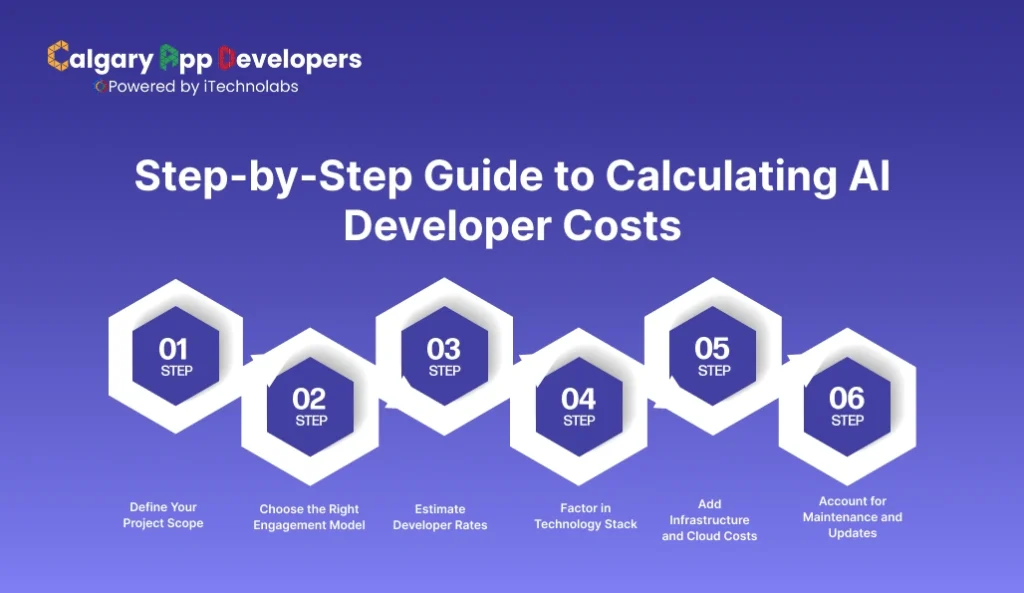
Estimating the cost of hiring an AI developer can feel overwhelming, but breaking it into steps makes it manageable. Follow this process to arrive at a realistic budget.
Step 1: Define Your Project Scope
Start by outlining what you need. Are you building a chatbot, training a custom vision model, or creating a full-scale AI platform? The clearer your scope, the easier it becomes to match the right skill set and estimate a realistic budget without costly surprises later.
Step 2: Choose the Right Engagement Model
Decide whether you want to hire freelancers, an agency, or in-house developers. Freelancers are flexible and affordable, agencies provide reliability and broad expertise, and in-house hires are best for long-term goals. Your choice here plays a big role in determining both upfront and ongoing costs.
Step 3: Estimate Developer Rates
Look at the hourly or monthly rates based on developer experience and location. Rates range widely, from USD 25 per hour in affordable tech hubs like Calgary to over USD 200 in cities like San Francisco. Matching your budget to the right talent pool helps you plan smarter.
Step 4: Factor in Technology Stack
The tools you choose affect costs. Using prebuilt frameworks like TensorFlow or Hugging Face lowers development time and budget, while custom algorithms increase costs due to research and testing. Consider whether you need speed, scalability, or innovation, and budget accordingly for the technology stack.
Step 5: Add Infrastructure and Cloud Costs
AI projects often need significant computing power, storage, and hosting. Cloud providers like AWS, Google Cloud, or Azure charge for usage, and these costs can grow as your project scales. Always add a buffer for infrastructure to avoid underestimating the true cost of deployment and maintenance.
Step 6: Account for Maintenance and Updates
AI systems are not one-and-done projects. Models require retraining, updates, and monitoring to remain accurate and secure. Ongoing maintenance can add 15 to 20 percent to your initial cost annually. Factoring this early ensures you don’t stretch your budget thin once the system is live.
Also Read: AI App Development: Build Intelligent Solutions
Hidden Expenses to Watch Out For
AI projects rarely stop at developer fees. There are hidden costs that can add up quickly if you don’t plan for them in advance. Being aware of these helps you budget realistically and avoid surprises later.
- Data Collection and Cleaning
AI systems thrive on quality data. If your data is incomplete or unstructured, you’ll need to invest in gathering, cleaning, and labeling it. This process is time-intensive and often requires specialized tools or outsourced services, which can quietly inflate your overall project budget. - Cloud and Compute Costs
Training AI models requires significant computing power. Cloud platforms like AWS, Google Cloud, or Azure charge for processing, storage, and bandwidth. While the initial fees might seem small, usage often scales rapidly, leading to higher monthly bills than many businesses initially expect. - Third-Party Tools and Licenses
Not all AI work is done on open-source frameworks. Some projects demand paid APIs, libraries, or proprietary software. Licensing costs can be recurring and vary depending on the number of users, making them an expense you need to plan for in advance. - Integration with Existing Systems
Getting your AI solution to work with your current infrastructure may require extra development hours, middleware, or even system upgrades. Integration is often underestimated, but it can be one of the trickiest and most expensive parts of an AI deployment. - Testing and Quality Assurance
AI models don’t just need to work—they need to perform consistently in real-world environments. Comprehensive testing, debugging, and fine-tuning are essential, and this extra time adds to the final invoice. Skipping this step can lead to higher costs later when fixes become urgent. - Ongoing Maintenance
Even after deployment, AI solutions require monitoring, retraining, and security updates. This recurring expense can run 15 to 20 percent of the initial development cost annually. Ignoring it risks reduced performance and vulnerability to failures or cyber threats.
The sticker price of hiring an AI developer is only part of the story. True cost includes infrastructure, integration, and upkeep. Smart businesses anticipate these hidden expenses from the start. This is where cities like Calgary stand out, since lower developer rates help offset ongoing costs without compromising quality.
Read Also: Top Sites to Hire AI Developers | Best AI Engineers for Hire
Strategies to Hire Skilled AI Developers Without Breaking the Bank
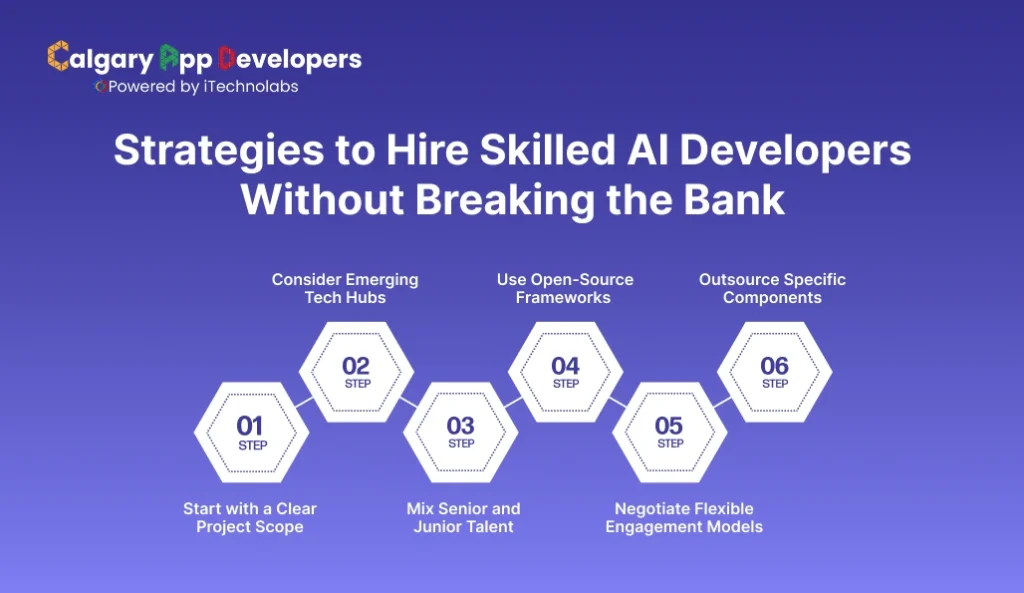
Hiring skilled AI talent can feel expensive, but smart strategies help you control costs without cutting corners on quality. Here’s how to approach it.
- Start with a Clear Project Scope
Unclear goals are the fastest way to burn through your budget. Define exactly what you need your AI system to achieve before reaching out to developers.
A well-scoped project reduces wasted hours and helps you negotiate fair pricing.
- Consider Emerging Tech Hubs
Instead of defaulting to high-cost cities like San Francisco or London, look to growing tech hubs such as Calgary.
These cities offer strong AI talent at lower rates, giving you the best of both worlds: quality expertise without the premium price tag.
- Mix Senior and Junior Talent
You don’t always need senior developers for every task.
A hybrid team where senior talent handles complex system design and junior developers manage routine tasks can lower overall costs while maintaining quality standards.
- Use Open-Source Frameworks
Leverage free and proven AI frameworks like TensorFlow, PyTorch, or Hugging Face.
By reducing licensing fees and cutting down development time, you keep your budget focused on innovation rather than reinvention.
- Negotiate Flexible Engagement Models
Freelancers and agencies often allow room for negotiation.
You can reduce costs by committing to longer-term contracts, setting milestone-based payments, or combining fixed-price and hourly models depending on project stages.
- Outsource Specific Components
Not every part of your AI project has to be done in-house.
Outsourcing tasks such as data cleaning, annotation, or integration can reduce costs significantly while letting your core team focus on the most critical areas.
Smart hiring isn’t just about finding the cheapest rate. It’s about combining the right talent, tools, and location. Choosing cost-effective cities like Calgary, defining clear project goals, and tapping into open-source resources all make it possible to bring AI talent on board without overspending.
Read Also: Top AI Companies In Canada
Platforms and Places to Find AI Developers
Once you know what type of AI solution you’re building and how much you can afford to spend, the next step is finding the right talent. If you’re looking to hire skilled AI developers in Canada, there are several options worth considering, each with advantages and trade-offs.
Here’s a rundown of where to begin your search.
- Freelance Platforms
If you need temporary support or want to test the waters before committing long-term, freelance platforms are a reliable entry point.
Some of the most popular include:
- Upwork
- Toptal
- Freelancer
- Fiverr Pro
These platforms allow you to browse portfolios, check reviews, and compare hourly rates. You’ll find AI specialists ranging from junior data scientists to senior ML engineers. Just make sure to thoroughly screen candidates, set clear milestones, and stay actively involved in project management.
- Job Boards and Tech Communities
If you’re open to hiring contractors or full-time employees, tech-specific job boards are a good place to start. They attract professionals who are actively looking for AI-focused roles.
Top options include:
- AngelList (Wellfound)
- Stack Overflow Jobs
- Indeed Canada
This route works well if you’re ready to screen applications, conduct interviews, and manage the recruitment process in-house. It’s especially effective for businesses looking for dedicated, long-term AI talent.
- Development Agencies and Studios
For businesses needing end-to-end AI solutions, an AI App Development Company offer a complete package that covers design, model development, testing, deployment, and ongoing support. Agencies often come with cross-functional teams experienced in cloud, data pipelines, and scalable architectures.
Advantages:
- Access to a team of experts
- Defined timelines and deliverables
- Built-in project management
Although agencies cost more than individual hires, they provide structure and accountability. In cities like Calgary, agencies offer competitive rates compared to global tech hubs, making them a strategic choice.
- University Talent Pools and Local Meetups
Canadian universities and bootcamps are strong sources of fresh AI talent. Students and junior developers are often eager to work on real projects and can be hired on a freelance or internship basis at budget-friendly rates.
This approach is best suited for prototypes, MVPs, or projects that can handle some trial and error. Be prepared to offer more mentorship and quality oversight when working with less experienced talent.
- Referrals and Professional Networks
Some of the best AI developers don’t advertise at all. They find work through referrals, personal networks, and industry contacts. Ask startup founders, product managers, or tech leads in your circle for recommendations. Trusted referrals can help you avoid long searches and reduce the risk of a poor hire.
Conclusion
Hiring an AI developer comes down to balancing skill, cost, and long-term value. Rates vary depending on experience, project complexity, and location, but smart planning helps you avoid overspending while still securing top talent. From defining your project scope to choosing the right engagement model, every step plays a role in keeping costs predictable and outcomes strong.
If you’re ready to bring AI into your business, working with the right partner makes all the difference. At Calgary App Developers, we connect companies with skilled AI professionals who deliver high-quality AI Development Services at competitive rates. Whether you need a simple AI integration or a large-scale enterprise platform, our team ensures you get expertise without unnecessary expense.
Your next AI project doesn’t need to drain your budget. With clear planning and the right talent partner, you can innovate smarter and faster.
FAQ’s About AI Developers for Hire
1. How much does it cost to hire an AI developer in 2026?
In 2026, hiring an AI developer typically costs between USD 60 and 120 per hour. Junior developers may charge around USD 25 to 40 per hour, while senior specialists can exceed USD 200 per hour. The final cost depends on project complexity, duration, location, infrastructure needs, and whether the work requires long-term maintenance or advanced AI capabilities.
2. What factors most influence AI developer pricing?
AI developer pricing is influenced by experience level, type of AI project, geographic location, engagement model, and technology stack. Complex projects like custom model training, NLP, or computer vision require higher expertise and cost more. Location also matters, as developers in emerging tech hubs often charge significantly less than those in major global cities.
3. Is it cheaper to hire freelance AI developers or agencies?
Freelance AI developers are usually cheaper for short-term or well-defined tasks and offer flexibility. However, agencies cost more because they provide structured teams, project management, quality assurance, and long-term support. For complex or business-critical AI projects, agencies often deliver better reliability and reduced risk despite higher upfront costs.
4. What hidden costs should I expect when hiring an AI developer?
Hidden costs often include data collection and cleaning, cloud computing and storage, third-party APIs or licenses, system integration, testing, and ongoing model maintenance. These expenses can add 20 to 40 percent to the initial budget. Planning for these costs early helps avoid budget overruns and project delays later.
5. How long does an AI development project usually take?
Project timelines vary based on scope and complexity. Basic AI integrations like chatbots may take four to six weeks, while custom AI models or enterprise platforms can take three to six months or longer. Timelines also include testing, deployment, and post-launch optimization, which are critical for stable real-world performance.
6. How can I reduce the cost of hiring an AI developer without sacrificing quality?
You can reduce costs by clearly defining project requirements, hiring from cost-effective regions, using open-source AI frameworks, and combining senior and junior talent strategically. Choosing flexible engagement models and outsourcing non-core tasks like data labeling also helps control expenses while maintaining strong technical quality and reliable outcomes.


Pankaj Arora is a seasoned technology leader and the Founder of Calgary App Developer, with 10+ years of expertise in crafting high-performance digital solutions. His core competencies include full-stack app development, cloud-native architecture, API integration, and agile product delivery. Under his leadership, Calgary App Developers has empowered startups and enterprises alike with scalable mobile applications, secure web platforms, and AI-driven SaaS products.