











Cryptocurrency Exchange App Development: An Ultimate Guide

The global financial system currently faces a fundamental transformation because digital assets have become the main focus of this process. Cryptocurrency has evolved from an experimental project that interested early users into a substantial market that institutional investors, retail customers, and developing blockchain technology now support. The increasing rate of adoption creates greater demands for trading systems that can provide both safety measures and efficient performance.
This growing demand has created significant opportunities for businesses entering the exchange market. However, launching a successful crypto platform is not simply about enabling token trading. It requires careful planning, strong security architecture, regulatory awareness, liquidity strategy, and a seamless user experience. One technical misstep can compromise trust. One compliance oversight can stall growth.
Our perspective in this guide comes directly from hands-on experience in cryptocurrency exchange app development. Over the years, we have worked with startups, fintech innovators, and enterprise clients to design and deploy secure exchange ecosystems built for real market conditions. From backend architecture and wallet integration to security audits and performance optimization, we understand what it takes to move from concept to launch with confidence.
This blog breaks down the complete journey of building a secure cryptocurrency exchange app. Whether you are exploring the market or preparing to build your own platform, this guide will give you practical clarity rooted in real development experience.
TL;DR
- Cryptocurrency adoption is accelerating globally, increasing demand for secure and scalable exchange platforms.
- Building a crypto exchange requires strong security architecture, regulatory compliance, and high-performance infrastructure.
- Development costs typically range from $50,000 to $300,000, depending on complexity and compliance scope.
- Long-term success depends on strategic monetization, continuous maintenance, and scalable system design.
Key Points
- Cryptocurrency operates on blockchain technology, enabling secure, transparent, and decentralized value transfer without traditional intermediaries.
- Growing retail and institutional adoption is driving demand for cryptocurrency exchange app development across global markets.
- A secure exchange requires robust wallet infrastructure, a high-speed matching engine, liquidity integration, and strict KYC and AML compliance systems.
- Choosing the right exchange model, whether centralized, decentralized, or hybrid, significantly influences architecture, scalability, and regulatory exposure.
- The development process includes market research, technology selection, UI and UX design, backend engineering, security implementation, and rigorous testing before launch.
- Monetization models such as trading fees, listing fees, staking services, and subscription plans help ensure sustainable long-term revenue.
- Post-launch strategy must include continuous security monitoring, performance optimization, compliance updates, and infrastructure scaling.
What Is Cryptocurrency and Why Is It Driving Global Demand
Cryptocurrency is a form of digital money secured by cryptography and maintained on decentralized networks called blockchains. These networks record every transaction across a distributed ledger that anyone can verify without needing central authorities like banks or governments. Ownership of cryptocurrency is tied to cryptographic keys, and transactions are validated through consensus mechanisms that ensure integrity and security for all participants.
In basic terms, cryptocurrency allows value to move as bits of data over global peer-to-peer networks. Users can transfer, trade, or store value with transparency and without reliance on traditional financial intermediaries. That same transparency and decentralization are also why digital assets generate interest from developers, businesses, and individual investors.
Market Growth and Adoption Statistics
The global adoption rate for cryptocurrency has reached nearly 10 percent of the internet population, showing steady growth in user participation worldwide. Researchers estimate that the total market value of digital assets could approach $8 trillion by 2030 as individuals and institutions expand their use of digital tokens. This projection reflects growing confidence in crypto as an investment and a financial infrastructure component.
Adoption patterns vary widely by region. In some countries, significant portions of the population hold crypto, while in others, adoption remains modest. For example, a leading emerging market reports more than a 25% of its internet population owning digital assets, driven by both financial opportunity and limited access to traditional banking.
Institutional involvement is also shaping market dynamics. Financial firms, asset managers, and corporate treasuries are expanding exposure to digital tokens and related products. Market outlook reports for 2026 anticipate continued institutional capital inflows, tokenization of real-world assets, and regulatory frameworks that clarify the legal status of digital assets.
This combination of retail and institutional interest is pushing cryptocurrency into everyday financial use cases beyond speculation. Digital tokens increasingly support cross-border payments, decentralized finance services, and programmable financial agreements.
Those broader use cases are major reasons why demand for cryptocurrency exchange app development is climbing. Platforms that enable secure trading, custody, and compliance play a central role in facilitating these interactions and connecting users to the expanding digital asset economy.
Also Read: Top Cold Crypto Wallets: Ultimate Security Guide
Understanding Blockchain Technology and Its Role in Crypto Exchanges
Blockchain is the underlying infrastructure that powers every cryptocurrency transaction. It is a distributed digital ledger that records transactions across a network of computers. Each transaction is verified through consensus mechanisms and permanently added to a chain of blocks, creating a transparent and tamper-resistant record.
For cryptocurrency exchange app development, blockchain is not just a supporting layer. It directly influences security, transaction speed, scalability, and user trust. Exchanges rely on blockchain networks to validate deposits, process withdrawals, and confirm asset ownership in real time.
Key roles of blockchain in crypto exchanges include:
- Transaction validation: Ensures every deposit and withdrawal is verified on the network before settlement.
- Transparency: Provides a publicly verifiable record of transactions, strengthening user confidence.
- Security through cryptography: Protects digital assets using private and public key encryption.
- Decentralized record keeping: Reduces the risk of single-point failure compared to traditional systems.
- Smart contract integration: Enables automated trading logic and decentralized exchange functionality.
A strong understanding of blockchain architecture is essential when planning secure and scalable cryptocurrency exchange app development.
How Cryptocurrency Exchanges Work Behind the Scenes
A cryptocurrency exchange may look simple on the surface, but it operates through multiple interconnected systems working in real time. In cryptocurrency exchange app development, each layer must be carefully engineered to ensure performance, security, and regulatory compliance.
Here is how it works behind the scenes:
- User Registration and Verification: Users create accounts and complete identity verification through KYC and AML checks before gaining full access to trading features.
- Wallet Integration: The platform generates unique wallet addresses for deposits. It monitors blockchain confirmations before crediting user balances. Most exchanges use a combination of hot wallets for active transactions and cold wallets for secure asset storage.
- Order Placement and Order Book Management: When users place buy or sell orders, those requests are added to a live order book that displays market depth and pricing levels.
- Matching Engine Execution: The matching engine processes and matches compatible buy and sell orders in real time based on price and volume priority.
- Liquidity Management: Exchanges maintain internal liquidity pools or integrate external liquidity providers to ensure smooth trade execution with minimal slippage.
- Transaction Settlement and Record Management: After a trade is executed, balances are updated instantly, and transaction records are stored securely within the system.
- Security and Risk Monitoring: Advanced monitoring tools detect suspicious behavior, prevent fraud attempts, and safeguard user assets from cyber threats.
Each of these components plays a critical role in successful cryptocurrency exchange app development, ensuring that users experience fast, secure, and reliable trading.
Also Read: How To Build Crypto Exchange: A Brief Guide
Popular Cryptocurrency Exchange Apps in the Market
Here is a snapshot of five leading exchange platforms that define the current landscape of cryptocurrency trading. These apps illustrate real implementations of secure systems, deep liquidity, and high volumes that many businesses consider when planning cryptocurrency exchange app development.
| Name | Launched On | Launched By | Market Share | Number of Users (approx) |
| Binance | July 2017 | Changpeng Zhao | 39.2% | 300 million+ |
| Coinbase | June 2012 | Brian Armstrong & Fred Ehrsam | 6.1% | 108 million+ |
| Bybit | March 2018 | Ben Zhou & others | 9.5% | 15 million+ |
| Crypto.com | June 2016 | Kris Marszalek & team | 7.2% | 80 million+ |
| Kraken | July 2011 | Jesse Powell | 2.5% | 6 million+ |
- Binance
Binance is the world’s largest cryptocurrency exchange by trading volume and one of the most influential platforms in crypto markets. It supports hundreds of tokens and offers spot, margin, futures, and staking services. The platform attracts traders with deep liquidity and a wide range of digital assets. Early revenue estimates indicated that Binance generated multi-billion-dollar profits from trading fees and ecosystem services.
- Coinbase
Coinbase is one of the most widely used exchanges in the United States, recognized for regulatory compliance and institutional-grade infrastructure. It serves millions of users with easy fiat-to-crypto on-ramps and an intuitive interface suitable for beginners. Revenue stems from trading fees and custodial services.
- Bybit
Bybit has grown rapidly as a derivatives-focused exchange. It also offers spot trading and attracts a global user base with competitive fees and frequent promotional campaigns. Its rising market share reflects increased interest in leveraged products and advanced trading tools.
- Crypto.com
Crypto.com combines exchange services with a wider ecosystem that includes payment cards, staking products, and interest accounts. Its mobile-first strategy and aggressive marketing helped build a large user base. Revenue comes from trading fees and ancillary financial products.
- Kraken
Kraken is one of the oldest exchanges and emphasizes security and compliance. It offers a broad range of coins, advanced trading features, and strong institutional services. Kraken’s early adoption of regulated structures helped it attract serious traders and long-term investors.
These platforms represent the diversity and scale possible in cryptocurrency exchange app development. Their user counts, market share, and revenue profiles offer useful benchmarks for businesses planning their own exchange solutions.
Read Also: Blockchain Wallet Development: An Ultimate Guide
Types of Cryptocurrency Exchange Platforms
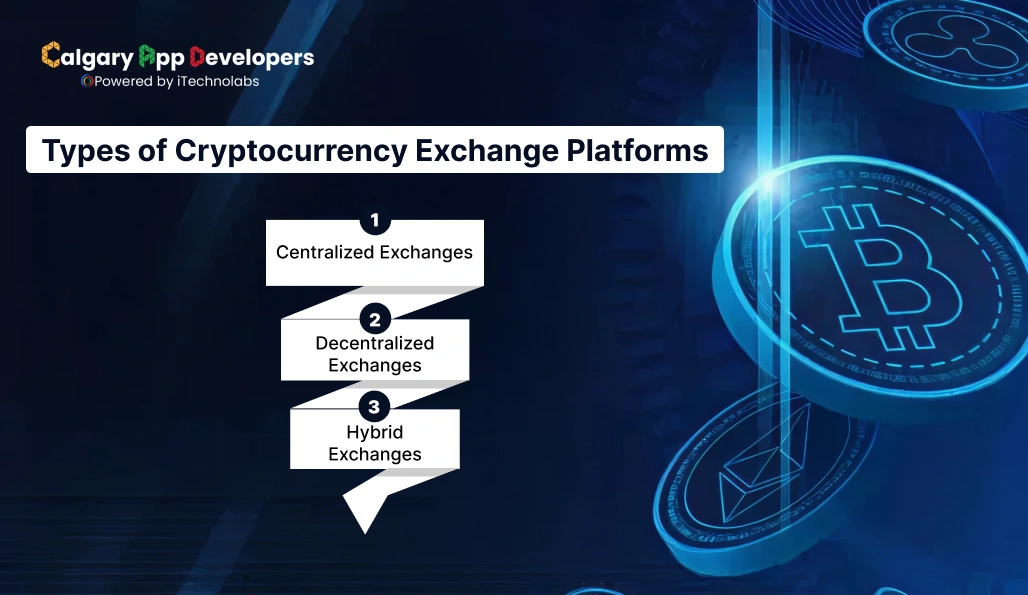
Choosing the right exchange model is one of the first strategic decisions in cryptocurrency exchange app development. The architecture, compliance requirements, liquidity structure, and user experience vary significantly depending on the type of platform you build. Broadly, cryptocurrency exchanges fall into three categories: centralized, decentralized, and hybrid.
1. Centralized Exchanges
Centralized exchanges operate under a single governing authority or company. The platform manages user accounts, holds custody of funds, processes trades through an internal matching engine, and oversees compliance requirements.
These exchanges are known for:
- High liquidity and fast trade execution
- Advanced trading features such as margin and derivatives
- Fiat integration through banking partnerships
- Structured customer support
However, because they hold user funds, centralized platforms require strong security infrastructure and regulatory compliance. Most large-scale cryptocurrency exchange app development projects today are based on the centralized model due to its scalability and mainstream adoption.
2. Decentralized Exchanges
Decentralized exchanges operate without a central authority. Instead of holding user funds, they rely on smart contracts to execute trades directly between users. Transactions are recorded on the blockchain, and users retain control of their private keys.
Key characteristics include:
- Non-custodial trading
- Enhanced user control and privacy
- Smart contract-based order execution
- Reduced reliance on intermediaries
While decentralized platforms improve transparency and reduce custody risk, they may face challenges related to liquidity, transaction speed, and complex user interfaces. Cryptocurrency exchange app development in this category demands deep blockchain expertise and smart contract auditing.
3. Hybrid Exchanges
Hybrid exchanges aim to combine the strengths of both centralized and decentralized models. They typically use centralized order matching for speed while allowing users to retain greater control over asset custody.
Hybrid platforms focus on:
- Faster execution similar to centralized systems
- Improved security through partial decentralization
- Enhanced user transparency
- Balanced regulatory flexibility
This model is still evolving, but it represents a forward-looking direction in cryptocurrency exchange app development. For businesses seeking both performance and trust, hybrid architecture offers a strategic middle ground.
Selecting the right exchange type depends on your business goals, target audience, compliance strategy, and technical capabilities. Each model carries distinct operational and development implications.
Security Frameworks and Compliance Requirements
Security and regulatory compliance are the foundation of any successful cryptocurrency exchange platform. In cryptocurrency exchange app development, these elements cannot be treated as add-ons. They must be embedded into the architecture from day one. Exchanges operate in a high-risk environment where cyber threats, fraud attempts, and regulatory scrutiny are constant realities.
A well-structured security framework protects user assets, preserves platform credibility, and ensures long-term operational continuity.
1. KYC and AML Regulations
Most jurisdictions require the implementation of Know Your Customer (KYC) regulations together with Anti Money Laundering rules. The exchanges need to confirm user identities before they can grant users complete trading privileges. The process normally requires three steps, which consist of document verification and biometric checks together with transaction monitoring.
AML systems track unusual trading patterns, large fund movements, and suspicious behavior. Automated risk scoring tools help flag high-risk accounts in real time. Strong compliance implementation reduces regulatory penalties and builds trust with banking and institutional partners.
2. Data Encryption and Wallet Protection
Exchanges handle sensitive user data and high-value digital assets. Encryption protocols such as SSL and advanced cryptographic standards protect data during transmission and storage.
Wallet security requires a layered approach. Most exchanges use a combination of hot wallets for daily liquidity and cold wallets for offline asset storage. Multi-signature authorization, hardware security modules, and access control mechanisms reduce the risk of unauthorized withdrawals. Regular penetration testing and security audits further strengthen the platform.
3. Smart Contract Security
For platforms integrating decentralized features, smart contract security is critical. Vulnerabilities in contract code can lead to irreversible financial losses.
Secure cryptocurrency exchange app development involves rigorous code reviews, automated vulnerability scanning, and third-party smart contract audits. Developers must follow secure coding practices and maintain upgrade mechanisms where possible to address emerging risks.
A secure exchange is not defined by a single feature but by an integrated framework that combines compliance, encryption, monitoring, and proactive risk management. Without this foundation, long-term sustainability becomes extremely difficult in the competitive crypto market.
Also Read: What is MPC Wallet? Brief Guide to Multi-Party Computation
Step-by-Step Guide to Cryptocurrency Exchange App Development
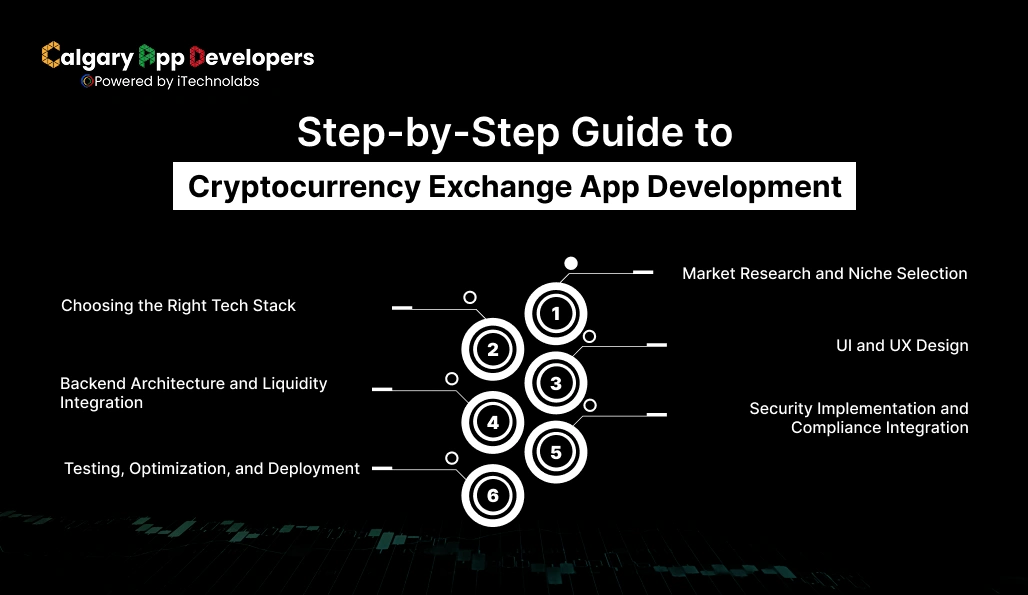
Building a cryptocurrency exchange is a multidisciplinary effort that combines finance, cybersecurity, distributed systems engineering, and regulatory compliance. Successful cryptocurrency exchange app development requires a structured roadmap that aligns business objectives with technical execution. Each stage plays a critical role in determining whether the platform can operate securely, scale efficiently, and compete in a demanding market.
Below is a comprehensive breakdown of the full development lifecycle.
1. Market Research and Niche Selection
Every successful exchange begins with strategic clarity. Entering the market without a defined niche leads to diluted positioning and pricing pressure.
- Conduct detailed competitor analysis to evaluate fee models, supported trading pairs, geographic focus, and unique value propositions.
- Identify underserved segments such as derivatives traders, regional markets, institutional clients, or tokenized asset platforms.
- Assess regulatory requirements across jurisdictions where you plan to operate. Licensing obligations vary significantly by region.
- Define your revenue model early, whether transaction fees, listing fees, margin interest, or staking services.
- Create financial projections that account for liquidity costs, infrastructure expenses, compliance overhead, and marketing investment.
This stage shapes the business model and determines the architectural direction of the exchange.
2. Choosing the Right Tech Stack
The technology stack determines performance, scalability, and long-term maintainability. In cryptocurrency exchange app development, infrastructure decisions directly affect transaction speed, system stability, and security resilience.
- Select backend technologies that support high-frequency transaction processing, such as Node.js, Go, or Python.
- Choose reliable blockchain networks based on transaction speed, ecosystem maturity, and integration flexibility.
- Use secure databases capable of handling real-time data updates and high concurrency.
- Implement a cloud infrastructure that supports horizontal scaling during peak trading activity.
- Integrate APIs for liquidity providers, payment gateways, and market data feeds.
Below is a structured overview of a typical technology stack used in cryptocurrency exchange app development.
| Layer | Recommended Technologies | Purpose |
| Frontend | React.js, Angular, Vue.js | Builds responsive trading dashboards and user interfaces |
| Backend | Node.js, Go, Python | Handles business logic, order processing, and API management |
| Matching Engine | Custom engine in Go or C++ | Executes buy and sell orders with low latency |
| Blockchain Integration | Ethereum, BNB Chain, Solana, Bitcoin | Processes deposits, withdrawals, and on-chain validation |
| Database | PostgreSQL, MongoDB, Redis | Stores user data, order books, and transaction records |
| Cloud Infrastructure | AWS, Google Cloud, Microsoft Azure | Enables scalable hosting and traffic management |
| Security Tools | SSL encryption, HSM modules, multi-signature wallets | Protects user data and digital assets |
| Liquidity Integration | FIX APIs, REST APIs | Connects to liquidity providers and external exchanges |
A carefully selected stack ensures the platform can scale efficiently, maintain system integrity under high traffic, and adapt to evolving market and regulatory requirements.
3. UI and UX Design
User trust is built through clarity, speed, and intuitive design. Even the most technically sound exchange can fail if users struggle to navigate it.
- Design a structured onboarding process with transparent verification steps.
- Develop a real-time trading dashboard displaying order books, market depth, price charts, and trade history.
- Optimize layouts for both beginner and advanced traders.
- Ensure responsive performance across web and mobile platforms.
- Incorporate visual trust indicators such as secure session markers and clear transaction confirmations.
Thoughtful design increases retention, reduces user errors, and strengthens platform credibility.
4. Backend Architecture and Liquidity Integration
The backend is the operational engine of the exchange. It must handle thousands of concurrent requests while maintaining data integrity.
- Develop a high-performance matching engine capable of executing orders within milliseconds.
- Build wallet infrastructure that separates hot and cold storage for enhanced asset protection.
- Implement real-time balance reconciliation and transaction tracking systems.
- Integrate external liquidity providers to maintain competitive spreads and minimize slippage.
- Deploy automated risk management systems that flag suspicious activity and abnormal trade patterns.
- Establish logging and monitoring tools to detect anomalies before they escalate into failures.
This stage defines the exchange’s operational reliability and market competitiveness.
5. Security Implementation and Compliance Integration
Security cannot be treated as a final checklist item. It must be embedded across every development layer.
- Integrate KYC and AML verification tools within the onboarding workflow.
- Use end-to-end encryption for data transmission and storage.
- Conduct smart contract audits for decentralized components.
- Implement multi-factor authentication and withdrawal whitelisting.
- Schedule regular penetration testing and third-party security assessments.
Strong compliance and security architecture protects both user assets and the platform’s long-term viability.
6. Testing, Optimization, and Deployment
Before public launch, the platform must undergo rigorous validation.
- Perform functional testing for all trading, wallet, and compliance workflows.
- Conduct load testing to simulate high traffic and volatility scenarios.
- Run stress tests on the matching engine to evaluate performance under peak conditions.
- Validate failover systems and disaster recovery plans.
- Launch in controlled stages, such as beta release,s before full production deployment.
After launch, continuous monitoring, security updates, and performance tuning remain essential. Cryptocurrency exchange app development does not end at deployment. Ongoing optimization determines whether the platform can adapt to regulatory changes, new trading features, and expanding user demand.
A disciplined step-by-step approach reduces operational risk, improves investor confidence, and lays the foundation for a sustainable and scalable exchange platform.
Read Also: How Much Does It Cost to Build a Cryptocurrency Exchange App like Coinbase?
How Much Does It Cost to Build a Cryptocurrency Exchange App?
The cost of cryptocurrency exchange app development typically ranges from $50,000 to $300,000+, depending on the platform complexity, security requirements, compliance scope, and scalability expectations.
Estimated Cost Breakdown
| Development Phase | Estimated Cost Range | Scope of Work |
| Market Research and Planning | $5,000 to $15,000 | Feasibility study, competitor analysis, compliance planning |
| UI and UX Design | $8,000 to $25,000 | Wireframes, dashboards, and trading interface design |
| Backend Development | $25,000 to $80,000 | API development, business logic, wallet management |
| Matching Engine Development | $15,000 to $60,000 | High-speed trade execution system |
| Blockchain Integration | $10,000 to $40,000 | Deposit and withdrawal logic, smart contract integration |
| Security Implementation | $10,000 to $50,000 | Encryption, multi-factor authentication, wallet security |
| Liquidity Integration | $5,000 to $20,000 | External liquidity providers, market depth management |
| Compliance Integration | $8,000 to $30,000 | KYC and AML systems, transaction monitoring |
| Testing and QA | $7,000 to $20,000 | Load testing, security audits, performance validation |
| Deployment and Cloud Setup | $5,000 to $15,000 | Infrastructure configuration and production launch |
Key Factors That Influence the Cost of Cryptocurrency Exchange App Development
The investment required for cryptocurrency exchange app development is shaped by technical scope, regulatory exposure, security depth, and geographic execution. A clear understanding of these variables helps businesses allocate budget strategically rather than reactively.
Below are the most critical cost drivers.
- Platform Complexity and Feature Scope
The broader the functionality, the higher the development effort.
- A basic spot trading platform costs significantly less than one offering margin trading, derivatives, staking, or lending.
- Advanced charting tools, algorithmic trading APIs, and portfolio analytics require additional engineering layers.
- Multi-currency wallet management increases backend complexity.
- Admin dashboards, reporting systems, and real-time analytics add development hours.
An MVP built for early market entry will cost far less than a fully featured global exchange.
- Security Architecture
Security is one of the largest cost components in cryptocurrency exchange app development.
- Multi-layer encryption and secure key management systems require specialized expertise.
- Hot and cold wallet infrastructure demands careful configuration and testing.
- Multi-factor authentication, withdrawal controls, and fraud detection systems increase implementation time.
- Regular penetration testing and third-party audits add additional budget.
A security-first architecture increases upfront cost but reduces long-term operational risk.
- Regulatory and Compliance Requirements
Compliance obligations vary widely depending on the jurisdictions targeted.
- KYC and AML integration requires identity verification tools and transaction monitoring systems.
- Licensing fees differ by region and can significantly impact the total investment.
- Legal consultation and documentation preparation add professional service costs.
- Reporting and audit readiness features must be built into the platform architecture.
Exchanges targeting multiple countries will naturally require higher compliance budgets.
- Team Composition and Expertise
Who builds the exchange significantly influences cost.
- Senior engineers command higher rates but reduce architectural risk.
- Specialized blockchain developers increase budget due to niche expertise.
- In-house teams require overhead costs such as infrastructure and benefits.
- Outsourced teams may reduce hourly cost but require strong project governance.
Balancing quality and cost is critical in financial platform development.
- Geographic Location of Development
Development rates vary widely across global tech hubs. Below is a high-level comparison of estimated total project budgets for a mid-complexity exchange platform.
| Location | Estimated Total Project Cost |
| Calgary, Canada | 50,000 to 160,000 USD |
| San Francisco, USA | 200,000 to 500,000 USD |
| New York, USA | 180,000 to 450,000 USD |
| London, UK | 150,000 to 400,000 USD |
| Eastern Europe | 60,000 to 180,000 USD |
| South Asia | 40,000 to 120,000 USD |
| Lowest Offshore Average | 30,000 to 100,000 USD |
While quality and expertise remain critical in financial platform development, Calgary offers a strong balance between technical capability and cost efficiency. The region is supported by initiatives such as the Opportunity Calgary Investment Fund and Innovate Calgary, which provide funding access, mentorship programs, and structured startup support. These initiatives strengthen the local technology landscape and create a stable environment for innovation.
Understanding these cost drivers allows businesses to design a development roadmap that aligns with both financial capacity and long-term vision. The right investment decisions at the planning stage directly influence scalability, compliance readiness, and overall market competitiveness.
Also Read: OTC Crypto Exchange Development: Benefits, Features, Process & Costs
Monetization Models for Crypto Exchange Platforms
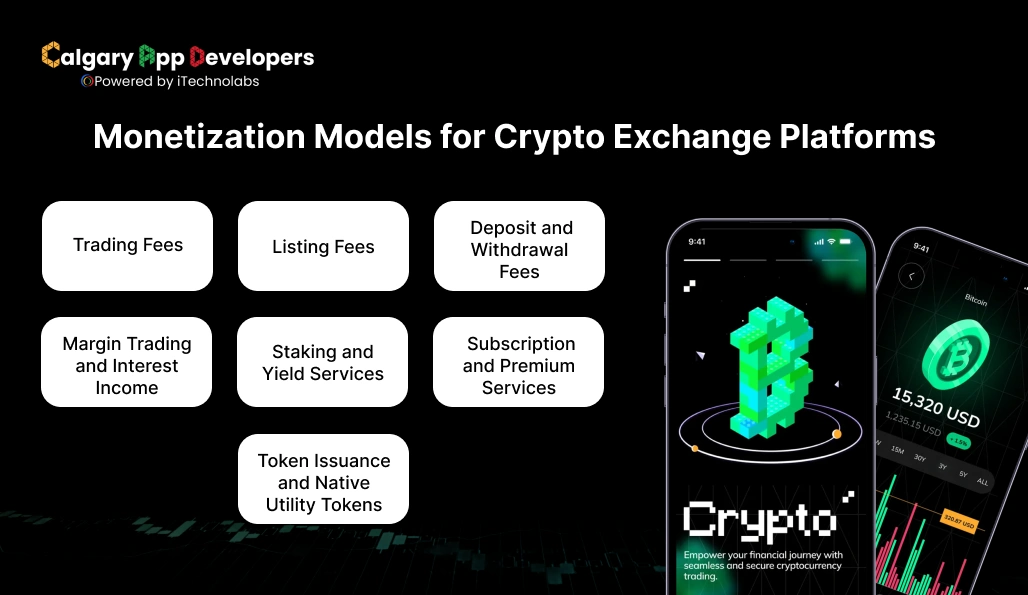
A sustainable revenue strategy is central to successful cryptocurrency exchange app development. While trading activity drives volume, long-term profitability depends on diversified income streams. Modern exchanges rarely rely on a single source of revenue. Instead, they combine multiple monetization models to maximize stability and growth.
Below are the primary revenue models used by leading platforms.
- Trading Fees
Trading fees are the core revenue engine for most exchanges.
- Makers and takers are charged a percentage of each transaction.
- Fee structures may vary based on trading volume tiers.
- Advanced traders often receive discounted rates to encourage higher activity.
This model scales naturally as user volume increases.
- Listing Fees
Projects pay exchanges to list their tokens.
- Fees vary depending on token popularity and market demand.
- Due diligence and security reviews are typically included in the listing process.
- Strategic listings can attract new users and increase trading activity.
Listing revenue can be significant during high market cycles.
- Deposit and Withdrawal Fees
Exchanges may charge fees for transferring assets.
- Crypto withdrawal fees often reflect blockchain network costs.
- Fiat deposit or withdrawal fees may apply through payment processors.
- Some platforms subsidize deposits to attract new users.
These fees create steady operational income.
- Margin Trading and Interest Income
Margin trading allows users to borrow funds for leveraged trades.
- Exchanges earn interest on borrowed capital.
- Liquidation fees may apply when positions are forcibly closed.
- Higher risk trading generates additional revenue opportunities.
This model requires strong risk management systems.
- Staking and Yield Services
Many exchanges offer staking services for supported cryptocurrencies.
- Users lock tokens to earn rewards.
- The platform retains a percentage of staking rewards as commission.
- Yield-based services increase user retention and asset custody duration.
This creates recurring passive income for the platform.
- Subscription and Premium Services
Some exchanges provide advanced tools through subscription models.
- Professional charting tools and analytics dashboards.
- API access for algorithmic traders.
- Institutional grade reporting features.
Subscription revenue adds predictable recurring income.
- Token Issuance and Native Utility Tokens
Exchanges may launch their own utility tokens.
- Token holders may receive discounted trading fees.
- Native tokens can support ecosystem rewards and loyalty programs.
- Token value appreciation strengthens brand visibility and liquidity.
This model integrates monetization with ecosystem growth.
In cryptocurrency exchange app development, the revenue strategy should be aligned with target users and regulatory requirements. A well-structured monetization framework not only ensures profitability but also supports liquidity, user retention, and long-term platform sustainability.
Read Also: How Much Does It Cost to Create Crypto Trading App Like Swyftx?
Post Launch Strategy: Maintenance, Updates, and Scaling
Launching the platform is only the beginning. In cryptocurrency exchange app development, long-term success depends on continuous monitoring, proactive upgrades, and strategic scaling. Crypto markets operate around the clock, which means your exchange must maintain performance, security, and reliability at all times.
A structured post-launch strategy ensures operational stability and sustained growth.
- Continuous Security Monitoring
Security threats evolve constantly. Exchanges must remain proactive.
- Monitor transactions in real time to detect suspicious activity.
- Conduct routine penetration testing and vulnerability assessments.
- Update encryption standards and wallet security protocols regularly.
- Implement automated alerts for abnormal withdrawal patterns.
Security maintenance protects both user assets and platform reputation.
- Performance Optimization
As trading volume increases, infrastructure must adapt.
- Monitor server load and response times.
- Optimize matching engine performance to reduce latency.
- Scale cloud resources dynamically during peak market volatility.
- Refine database indexing for faster order book updates.
Performance improvements directly influence user retention and trading frequency.
- Regulatory Updates and Compliance Management
Regulatory landscapes shift frequently in the crypto sector.
- Update KYC and AML workflows to meet new compliance standards.
- Maintain accurate reporting systems for audits.
- Monitor jurisdiction-specific licensing requirements.
- Implement geo restrictions where necessary.
Compliance alignment prevents operational disruptions.
- Feature Expansion and Product Enhancement
User expectations evolve quickly.
- Introduce new trading pairs based on market demand.
- Add advanced features such as staking, derivatives, or portfolio analytics.
- Improve dashboard usability based on user feedback.
- Integrate additional payment methods to expand accessibility.
Strategic feature upgrades strengthen competitive positioning.
- Infrastructure Scaling
Growth requires scalable architecture.
- Expand server clusters to handle increasing transaction loads.
- Implement a microservices architecture for modular expansion.
- Optimize liquidity integrations to maintain tight spreads.
- Prepare disaster recovery and backup systems for high availability.
Scalability planning ensures that growth does not compromise stability.
- User Support and Community Engagement
Trust is reinforced through responsiveness.
- Maintain dedicated support channels for dispute resolution.
- Provide educational content to guide new traders.
- Monitor user feedback to identify improvement opportunities.
- Build community engagement through transparent communication.
Strong support systems improve retention and brand credibility.
Effective cryptocurrency exchange app development extends beyond the launch milestone. Continuous refinement, adaptive scaling, and structured governance transform an exchange from a technical product into a sustainable financial platform capable of competing in a dynamic global market.
Also Read: Role of Blockchain in Cross-Border Payments: A Complete Guide
Our Experience in Cryptocurrency Exchange App Development
Our approach to cryptocurrency exchange app development is shaped by practical execution, not theory. We have worked with fintech founders, trading firms, and growth-stage startups to design, build, and scale secure exchange ecosystems. Each engagement required a balance between performance engineering, regulatory alignment, and long-term scalability.
Due to NDA obligations, we cannot disclose client names, but the impact and technical depth of these engagements reflect our hands-on expertise.
Case Example 1: Calgary-Based Fintech Startup
A Calgary-based startup approached us with a vision to build a regulated spot trading platform focused on regional retail investors. Their goal was to create a secure exchange with simplified onboarding and strong compliance controls.
Our role included:
- Designing the complete system architecture with a high-performance matching engine.
- Integrating KYC and AML workflows aligned with Canadian compliance requirements.
- Building a secure wallet framework with hot and cold storage segregation.
- Integrating external liquidity providers to ensure competitive spreads.
- Conducting load testing to prepare for peak trading cycles.
The platform launched successfully with a phased rollout strategy. Within the first year, it achieved stable user growth while maintaining strong operational uptime and security performance.
Case Example 2: U.S. Based Derivatives Exchange Platform
A U.S. based client sought to develop a derivatives-focused cryptocurrency exchange targeting active traders. The platform required advanced order types, leverage management, and real-time risk monitoring.
Our contribution involved:
- Developing a low-latency matching engine optimized for high-volume trading
- Implementing automated liquidation systems to manage leveraged positions.
- Integrating multi-asset wallet management across several blockchain networks.
- Designing a professional trading interface with advanced charting tools.
- Establishing monitoring systems for fraud detection and abnormal trade activity.
The exchange was engineered for scalability from the start, allowing it to handle traffic spikes during high volatility periods without system disruption.
At Calgary App Devlopers, our approach to cryptocurrency exchange app development focuses on security-first architecture, compliance readiness, and scalable infrastructure. Each project reinforces our belief that a successful exchange is built not only on code, but on strategic planning, disciplined execution, and long-term technical foresight.
Conclusion
Cryptocurrency has evolved from a speculative asset class into a foundational component of the digital financial ecosystem. As adoption continues to expand across retail users, institutions, and emerging markets, the demand for secure and scalable trading platforms will only intensify. This shift creates a clear opportunity for businesses ready to invest in structured, well-executed cryptocurrency exchange app development.
Building a successful exchange is not simply a technical exercise. It requires strategic market positioning, regulatory awareness, performance-driven architecture, and uncompromising security standards. From selecting the right exchange model to designing a high-speed matching engine and implementing compliance workflows, every decision influences long-term viability.
Cost considerations, monetization strategy, and post-launch scalability planning further determine whether the platform can compete in a fast-moving market. Exchanges that prioritize security, liquidity management, and user experience from the beginning are far more likely to earn user trust and sustain growth.
The path from idea to launch demands expertise, discipline, and ongoing refinement. With the right planning and execution, cryptocurrency exchange app development can transform a business vision into a resilient financial infrastructure positioned for long-term success.
FAQs
- What is the process for developing a cryptocurrency exchange application?
Developing a cryptocurrency exchange application involves a structured approach that begins with market research and regulatory analysis. Once the business model is defined, the next steps include selecting the technology stack, designing the user interface, building the matching engine, integrating blockchain networks, and implementing wallet infrastructure. Security layers such as encryption, multi-factor authentication, and compliance systems must be embedded early. Rigorous testing, load simulation, and security audits are conducted before launch. Successful cryptocurrency exchange app development continues beyond deployment through monitoring, updates, and infrastructure scaling.
- How do you build a crypto exchange platform similar to Coinbase?
Building a Coinbase-style platform requires a strong focus on compliance, security, and user experience. The process includes developing a high-performance backend, integrating fiat payment gateways, implementing strict KYC and AML verification systems, and ensuring secure custody solutions. A simple onboarding process and intuitive dashboard design are equally important. Regulatory licensing in target markets is critical. To match enterprise-level performance, the exchange must support scalable cloud infrastructure and maintain continuous monitoring for fraud prevention and system stability.
- What is the estimated cost of developing a cryptocurrency exchange app?
The cost of cryptocurrency exchange app development typically ranges from $50,000 to $300,000 or more. A basic exchange with essential trading functionality falls at the lower end, while a fully featured platform with advanced trading tools, liquidity integrations, and multi-jurisdiction compliance can exceed that range. Security architecture, infrastructure scalability, and regulatory requirements significantly impact the final budget. Ongoing operational expenses such as hosting, licensing, and maintenance should also be factored into total investment planning.
- How long does it take to develop a cryptocurrency exchange platform?
The development timeline usually ranges from 4 to 9 months, depending on platform complexity. A minimum viable product with limited features may be completed within a shorter timeframe, while a fully compliant and feature-rich exchange requires more extensive backend engineering, security testing, and regulatory preparation. Additional time may be needed for licensing approvals in certain jurisdictions. Careful planning and experienced development teams help streamline timelines without compromising security or performance.
- What security measures are essential for a cryptocurrency exchange platform?
Security is foundational in cryptocurrency exchange app development. Essential measures include end-to-end encryption, secure key management systems, hot and cold wallet segregation, multi-factor authentication, and real-time fraud monitoring. Regular penetration testing and third-party audits strengthen platform defenses. For exchanges offering decentralized features, smart contract audits are critical. A layered security framework protects user funds, maintains compliance, and preserves trust in an environment where cyber threats are constant.


Pankaj Arora is a seasoned technology leader and the Founder of Calgary App Developer, with 10+ years of expertise in crafting high-performance digital solutions. His core competencies include full-stack app development, cloud-native architecture, API integration, and agile product delivery. Under his leadership, Calgary App Developers has empowered startups and enterprises alike with scalable mobile applications, secure web platforms, and AI-driven SaaS products.