







Enterprise Mobile App Development: Strategy, Benefits & Cost
Consider how much of your workday currently operates on apps already. You read emails from your phone before you even sit down at your desk. You monitor projects through collaboration software. You might even approve invoices or track sales from an app while on the road. This change isn’t about convenience; it’s about the way businesses do business today.
That is where enterprise mobile app development enters the picture. These apps are not another app store download. They are designed to automate internal processes, unify teams, protect data, and frequently, to provide a serious competitive edge to businesses. Whether it is enabling a sales team to close deals quicker, providing managers with real-time information, or simplifying onboarding for new hires, enterprise mobile apps have become the backbone of contemporary business operations.
In this guide, we’ll break down what enterprise mobile apps are, the different types you can build, the features that actually matter, and the process of creating one from scratch. By the end, you’ll have a clear picture of how enterprise mobile app development works and why it’s one of the smartest investments a company can make today.
- Enterprise mobile apps streamline operations, improve productivity, and support real-time decision-making.
- Development costs vary based on complexity, integrations, and scale, typically ranging from $40,000 to $250,000.
- Security, usability, and scalability are critical to long-term success.
- Strategic planning reduces risk and ensures higher adoption across teams.
- Enterprise mobile applications are custom-built tools designed to automate workflows, unify teams, and protect sensitive business data.
- Businesses adopt enterprise apps to improve efficiency, enable faster communication, and gain real-time visibility into operations.
- Common enterprise app types include employee-level, department-level, and company-wide applications, each serving distinct operational needs.
- Core features such as strong security, system integrations, offline access, and scalable architecture define effective enterprise apps.
- Development costs are influenced by app complexity, feature set, design depth, integrations, team location, and ongoing maintenance.
- Successful enterprise apps follow a structured process that includes strategy, architecture planning, user-focused design, testing, and continuous improvement.
What is an Enterprise Mobile Application
An enterprise mobile application is a custom-built app designed specifically for businesses and their internal or external needs. Unlike consumer apps that focus on entertainment or daily tasks, enterprise apps are created to solve complex business problems. They can manage workflows, automate repetitive tasks, support collaboration, or give employees access to critical company data anytime, anywhere.
These applications are usually tailored to a company’s structure, security policies, and long-term goals. That’s why enterprise mobile app development often involves detailed planning, specialized integrations, and ongoing updates to ensure the app grows with the business.
Why Businesses Need Them
Here’s the thing: businesses today can’t rely only on emails and spreadsheets to keep operations running smoothly. Teams need faster communication, managers need real-time insights, and customers expect quicker responses. Enterprise mobile applications deliver exactly that.
They improve productivity by cutting down on manual work, give employees tools they can access on the go, and strengthen decision-making through data-driven insights. On top of that, they offer a higher level of security compared to off-the-shelf solutions, which is crucial when sensitive company information is involved.
What this really means is that enterprise mobile app development isn’t just about keeping up with technology. It’s about making businesses more agile, more connected, and better equipped to grow in a competitive environment.
Also Read: How to Choose the Best Company for Calgary Mobile App Development
Popular Enterprise Mobile App Examples
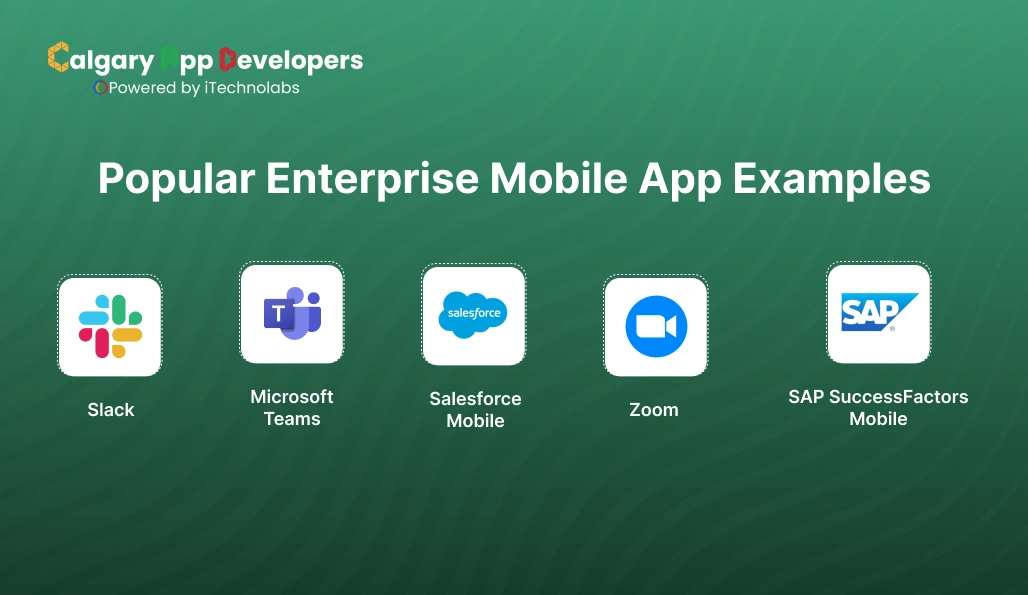
When we talk about enterprise mobile app development, it helps to look at the success stories that already power global businesses. These apps show how tailored solutions can transform productivity, communication, and growth.
| Name | Launch Date | Application | Revenue (Approx) |
| Slack | 2013 | Team communication and collaboration platform | $1.6B (2024) |
| Microsoft Teams | 2017 | Workplace chat, meetings, and collaboration | Part of Microsoft’s $67B Office revenue (2024) |
| Salesforce Mobile | 2007 | CRM and sales management on mobile | $34.9B (2024) |
| Zoom | 2011 | Video conferencing and remote collaboration | $4.5B (2024) |
| SAP SuccessFactors Mobile | 2011 | HR and employee management solution | Part of SAP’s $33B revenue (2024) |
- Slack: Slack is one of the most recognized enterprise apps, used by teams worldwide to streamline communication. It simplifies workplace collaboration through channels, file sharing, and integrations with hundreds of other tools.
- Microsoft Teams: Part of Microsoft’s Office ecosystem, Teams combines chat, video conferencing, and file collaboration in one place. It’s become a go-to enterprise mobile app for organizations managing hybrid or remote teams.
- Salesforce Mobile: Salesforce Mobile extends the world’s leading CRM platform to smartphones. It allows sales teams to access customer data, manage leads, and close deals directly from their devices.
- Zoom: While many know Zoom as a consumer video tool, its enterprise version powers large-scale meetings, webinars, and integrations. For companies, Zoom’s mobile app is essential for connecting distributed teams.
- SAP SuccessFactors Mobile: This enterprise app is built for human resources and workforce management. It helps companies with performance tracking, employee engagement, and HR workflows on the go.
What these examples show is that enterprise mobile app development isn’t limited to one function. From sales to HR to communication, businesses are investing in mobile apps that address their most critical operations.
Types of Enterprise Mobile Applications
- Employee-Level Applications
These apps are built to simplify everyday tasks for employees. They often include features like attendance tracking, leave management, training modules, and access to company resources. For businesses, employee-level apps reduce paperwork, improve communication, and make processes more transparent. In enterprise mobile app development, these are usually the foundation since they directly improve workplace efficiency at the individual level.
- Department-Level Applications
Department-specific apps are created to meet the unique needs of a team such as sales, finance, HR, or logistics. For instance, a sales department might use a CRM app to manage leads, while HR could use an app for onboarding and performance reviews. Enterprise mobile app development in this category ensures that specialized workflows are optimized, saving time and boosting team productivity.
- Company-Level Applications
These apps are designed to connect the entire organization on one platform. They often integrate multiple departments, handle enterprise-wide data, and provide unified dashboards for decision-making. Examples include ERP systems and large-scale communication apps like Microsoft Teams. Enterprise mobile app development at this level is complex but highly impactful, as it ensures every department works in sync and the company operates more cohesively.
Read Also: How Mobile App Development Is Evolving in Calgary
Key Features Every Enterprise App Should Have
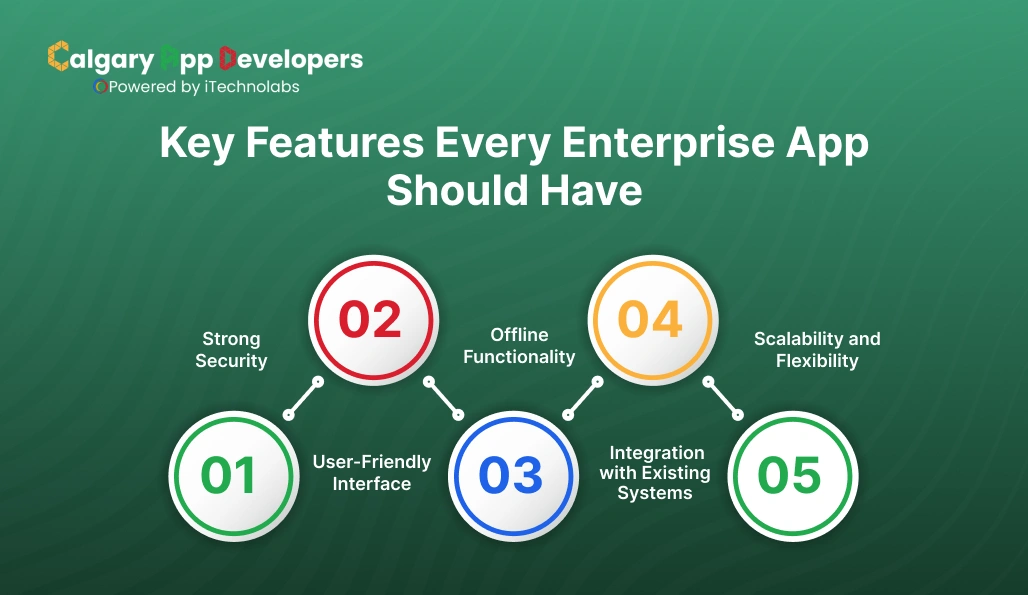
Enterprise mobile app development is successful only when the app solves business problems while staying secure, user-friendly, and scalable. Here are the essential features every enterprise app should include.
- Strong Security
Security is non-negotiable in enterprise apps because they often deal with sensitive company data. Features like multi-factor authentication, role-based access, and data encryption protect against breaches. In enterprise mobile app development, prioritizing security ensures compliance with industry standards while building trust among employees and stakeholders who use the app daily.
- User-Friendly Interface
No matter how powerful an app is, employees won’t use it if it feels clunky. A clean design, intuitive navigation, and minimal learning curve are critical. Enterprise mobile app development must focus on creating interfaces that allow employees to complete tasks quickly without confusion, leading to higher adoption rates and better productivity across the organization.
- Offline Functionality
Employees often work in areas with limited or no internet connectivity, especially in industries like logistics, construction, or field services. Offline functionality lets them continue working without interruption, syncing data once they’re online again. For enterprise mobile app development, this feature is vital to ensure continuous operations regardless of network availability.
- Integration with Existing Systems
Enterprise apps rarely work in isolation. They need to connect with CRM, ERP, HRMS, or other internal systems. Seamless integration ensures data flows across platforms, reducing duplication and errors. In enterprise mobile app development, integration capabilities are what make the app valuable, as they tie together the different tools a business already depends on.
- Scalability and Flexibility
As businesses grow, their needs change. A well-built enterprise app should scale easily to handle more users, departments, and features without performance issues. Enterprise mobile app development should plan for long-term flexibility so the app can evolve with the company instead of becoming obsolete after a few years.
How to Build an Enterprise Mobile Application
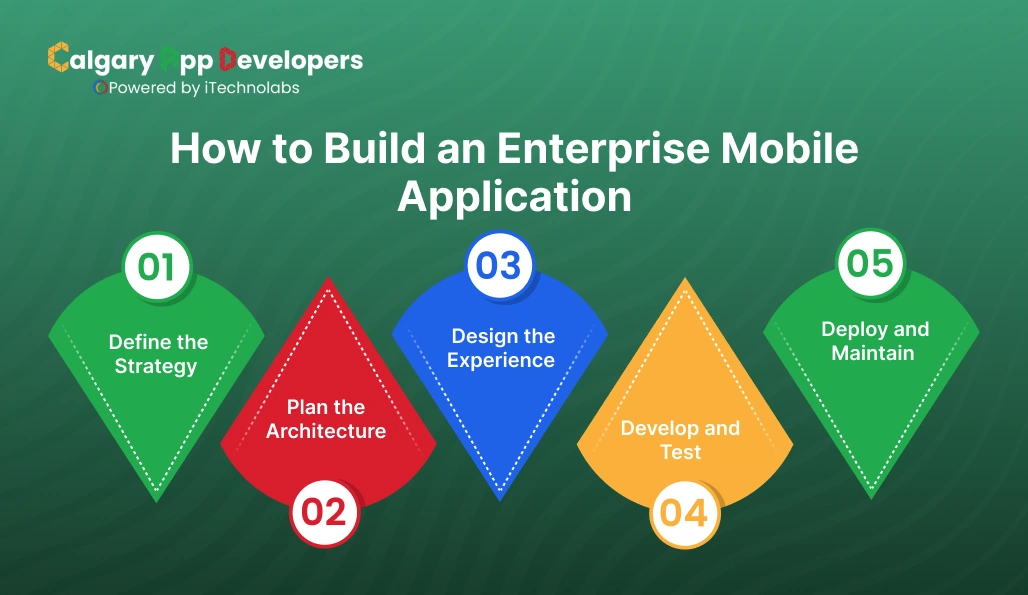
Enterprise mobile app development is not a one-step task. It’s a journey that blends strategy, design, technology, and ongoing improvements. Skipping or rushing through any stage can result in an app that looks good on paper but fails in practice. To build an application that genuinely supports business growth, here are the five stages you need to follow in detail.
Step 1: Define the Strategy
Before a single line of code is written, you need clarity on why this app should exist. Start by identifying the exact business problems you want to solve. Is the goal to improve team communication, automate processes, or give managers better access to real-time data? Define your target users and list the outcomes you expect to achieve.
This stage should also include competitor research and an evaluation of current solutions in the market. In enterprise mobile app development, a strong strategy prevents wasted investment on features that employees don’t need and ensures that the app supports long-term business objectives instead of just short-term fixes.
Step 2: Plan the Architecture
With the strategy in place, the next step is designing the technical blueprint. This involves deciding on the feature set, choosing the right technology stack, and building a roadmap for development. Security planning is critical here, since enterprise apps handle sensitive data and must comply with strict regulations.
Architecture planning also considers integration with existing company systems such as ERP, CRM, or HR platforms. A well-structured plan ensures the app will scale with business growth and remain compatible with future upgrades. In enterprise mobile app development, this step determines whether the app will be reliable and sustainable in the long run.
Step 3: Design the Experience
An enterprise app is only as strong as its usability. If employees find it confusing or time-consuming, they won’t adopt it, no matter how advanced the features are. This stage focuses on creating wireframes, prototypes, and interface designs that are simple, consistent, and intuitive.
User experience in enterprise mobile app development should minimize the learning curve and make workflows feel effortless. This might include clear navigation menus, personalized dashboards, and accessibility options for different devices. The goal is to design an app that not only works but also becomes a tool employees rely on every day.
Step 4: Develop and Test
Once the design is finalized, developers bring the app to life. This involves coding the core functionalities, building integrations with other platforms, and setting up databases. Development is usually done in phases, often using agile methods, so feedback and improvements happen continuously instead of waiting until the very end.
Testing runs alongside development and is just as important. Performance tests, security checks, and user acceptance testing help catch bugs before launch. In enterprise mobile app development, this stage ensures that the app is not only functional but also stable, secure, and ready for large-scale usage.
Step 5: Deploy and Maintain
Deployment marks the official release of the app, but it’s far from the finish line. After launch, companies need to track usage metrics, gather employee feedback, and monitor system performance. Maintenance is about rolling out regular updates, fixing issues quickly, and adding new features as business needs evolve.
In enterprise mobile app development, ongoing support is what keeps an app valuable over time. Without maintenance, even the most well-built application can quickly become outdated. Continuous monitoring and improvement ensure the app grows alongside the business and remains a vital part of daily operations.
Also Read: Top Mobile App Development Platforms
Cost of Developing an Enterprise Mobile App from Scratch
On average, the cost of enterprise mobile app development ranges between $40,000 and $250,000, depending on the complexity, features, and scale of the project. Smaller internal apps may fall on the lower end, while company-wide integrated solutions with advanced features can reach the higher bracket.
Estimated Cost Breakdown
| Component | Cost Range (USD) |
| Strategy & Planning | $5,000 – $15,000 |
| UI/UX Design | $10,000 – $40,000 |
| Development (Front-end & Back-end) | $20,000 – $120,000 |
| Integration with Existing Systems | $10,000 – $50,000 |
| Testing & Quality Assurance | $8,000 – $25,000 |
| Deployment & Maintenance (Yearly) | $5,000 – $20,000 |
Total Estimated Range: $40,000 – $250,000
Factors Affecting the Cost of Enterprise Mobile App Development
The actual cost depends on several key factors. Let’s break them down one by one.
- App Complexity
The more complex the app, the higher the development costs. A simple employee-level app with basic features is far cheaper than a company-wide ERP solution.
| Complexity Level | Features Included | Approx. Cost Range |
| Basic | Login, dashboards, notifications, simple data storage | $40,000 – $80,000 |
| Medium | Integrations, offline mode, advanced UI, security protocols | $80,000 – $150,000 |
| Advanced | Multi-level integrations, AI features, analytics, role-based access | $150,000 – $250,000+ |
- Features and Functionalities
Every additional feature adds to cost. For example, chat, AI-driven analytics, or offline access require extra design and testing.
| Feature Example | Cost Impact (USD) |
| Real-time chat | +$5,000 – $15,000 |
| Advanced analytics | +$10,000 – $25,000 |
| Offline functionality | +$8,000 – $20,000 |
| Multi-language support | +$7,000 – $15,000 |
- Design and User Experience
An intuitive, user-friendly interface is critical for adoption but also adds cost. Highly customized designs with animations and branded experiences require more design hours compared to simple layouts.
| Design Approach | Cost Range |
| Basic templates | $10,000 – $20,000 |
| Custom UI/UX | $20,000 – $40,000 |
| Advanced visuals (animations, micro-interactions) | $30,000 – $50,000 |
- Integration with Existing Systems
Most enterprise apps need to connect with CRMs, ERPs, HR platforms, or other internal tools. The number and complexity of these integrations directly impact development costs.
| Number of Integrations | Cost Range |
| 1–2 integrations | $10,000 – $20,000 |
| 3–5 integrations | $20,000 – $40,000 |
| 6+ integrations | $40,000 – $60,000+ |
- Development Team Location and Expertise
Hiring costs vary significantly by region. A U.S.-based development agency will charge more compared to a team in India, Eastern Europe, or Calgary. However, expertise and experience often balance the trade-off.
| Region | Hourly Rate (USD) | Approx. Project Cost |
| North America | $80 – $150/hr | $150,000 – $250,000 |
| Western Europe | $60 – $120/hr | $100,000 – $200,000 |
| Eastern Europe | $40 – $70/hr | $60,000 – $120,000 |
| India/Asia | $25 – $50/hr | $40,000 – $90,000 |
| Calgary | $20 – $40/hr | $35,000 – $70,000 |
Calgary has quickly become one of the most affordable and reliable locations for enterprise mobile app development, offering skilled talent at highly competitive rates without compromising on quality.
- Maintenance and Updates
Enterprise apps are never one-and-done. Regular updates, bug fixes, and server maintenance are necessary to keep the app secure and functional.
| Maintenance Activity | Cost (Yearly) |
| Bug fixes & updates | $3,000 – $10,000 |
| Server hosting & monitoring | $2,000 – $5,000 |
| Adding new features | $5,000 – $15,000+ |
The cost of enterprise mobile app development depends on how ambitious your project is. A small HR app may only cost around $50,000, while a company-wide system with AI, analytics, and global integrations could easily cross $200,000. The best approach is to start with a clear roadmap, prioritize essential features, and scale the app over time.
Read Also: The Future of Mobile App Development in Western Canada
Challenges in Enterprise Mobile App Development
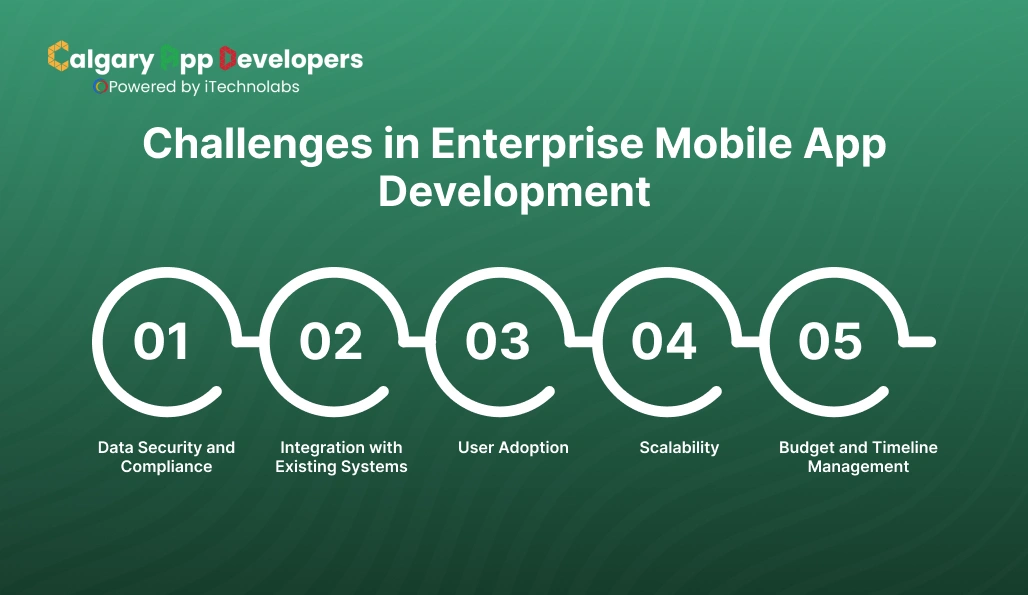
Building an enterprise app is rewarding, but it comes with its own set of hurdles. Understanding these challenges in advance helps businesses prepare better and avoid costly mistakes. Here are the most common obstacles in enterprise mobile app development.
- Data Security and Compliance
Enterprise apps often handle sensitive business data, financial records, or employee information. Protecting this data from breaches while also meeting compliance standards like GDPR or HIPAA is a major challenge. In enterprise mobile app development, security must be planned from day one with measures like encryption, access controls, and regular audits.
- Integration with Existing Systems
Most companies already rely on CRMs, ERPs, or HR management systems. Ensuring that a new app works seamlessly with these platforms is rarely straightforward. Poor integration can lead to data silos, duplicate work, and frustrated employees. Enterprise mobile app development requires careful planning to connect new tools with legacy systems without breaking workflows.
- User Adoption
Even the most powerful app can fail if employees don’t use it. Resistance often comes from poor design, lack of training, or the perception that the app adds extra work. In enterprise mobile app development, the real challenge is not just building the app but making it intuitive, accessible, and supported with proper onboarding so teams actually embrace it.
- Scalability
A small pilot project may work smoothly for a few dozen employees, but scaling it to thousands of users across multiple departments can expose weaknesses in performance and infrastructure. Enterprise mobile app development must plan for growth, ensuring the app can handle increased demand, larger data volumes, and evolving business requirements.
- Budget and Timeline Management
Enterprise apps are rarely cheap or quick to build. Unexpected costs can arise from feature changes, longer development cycles, or complex integrations. Keeping projects on budget and on schedule is often a balancing act. In enterprise mobile app development, setting realistic expectations and working with experienced teams can prevent overruns and delays.
Tips for Building a Successful Enterprise App
A great enterprise app isn’t just about strong coding; it’s about creating a tool that employees actually use and businesses can rely on. Here are some proven tips to guide successful enterprise mobile app development.
- Start with a Clear Objective: Define the problem the app is meant to solve and the outcomes you expect. Apps without a clear purpose often become cluttered with unnecessary features. In enterprise mobile app development, clarity at the start saves time and ensures the app delivers measurable business value.
- Involve End Users Early: Employees are the people who will use the app every day, so their input matters. Collect feedback during the planning and design stages to understand their pain points. In enterprise mobile app development, early involvement leads to higher adoption rates and prevents wasted effort on features that don’t matter to users.
- Prioritize Security: Since enterprise apps often deal with sensitive data, security should be built into the foundation. Multi-factor authentication, encryption, and role-based access controls are must-haves. Strong security in enterprise mobile app development not only protects data but also builds trust across the organization.
- Focus on Simplicity and Usability: A complex app that requires lengthy training will be ignored. Keep the interface clean, workflows simple, and navigation intuitive. The most successful enterprise mobile app development projects prioritize ease of use, which directly boosts productivity and user satisfaction.
- Test Thoroughly Before Launch: Testing should cover not just bugs, but also performance, usability, and scalability. Pilot the app with a smaller group of employees and refine it before a full rollout. In enterprise mobile app development, thorough testing ensures a smoother launch and fewer issues down the line.
- Plan for Continuous Improvement: Launching the app is not the finish line. Gather feedback, track usage analytics, and release regular updates. Enterprise mobile app development is an ongoing process, and continuous improvement is what keeps the app relevant as business needs evolve.
Also Read: Top-Rated Custom App Development Agency, Calgary
Benefits of Enterprise Mobile App Development
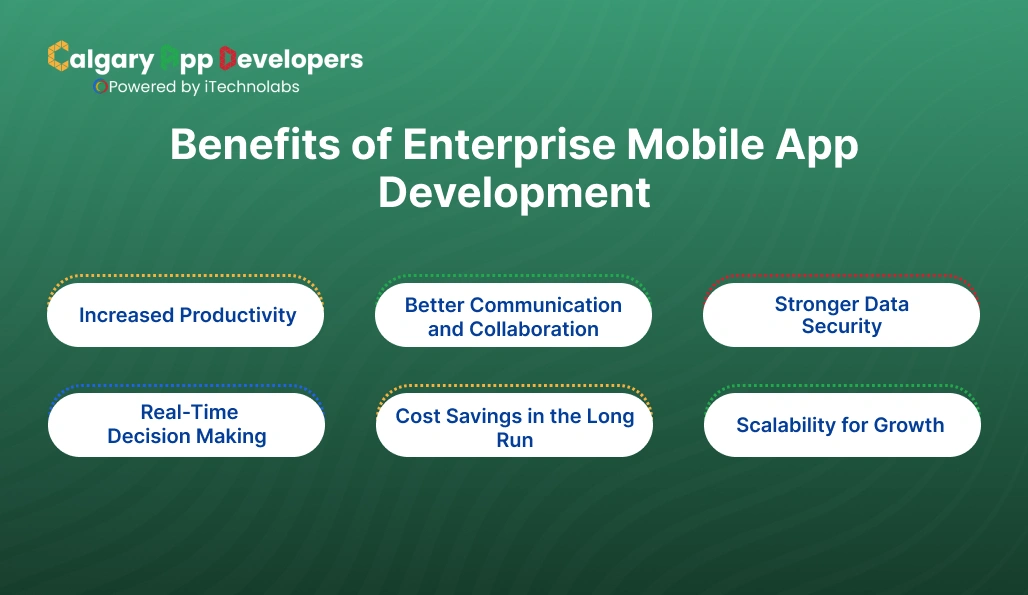
Enterprise mobile app development is more than just building a digital tool. It creates long-term value for businesses by improving efficiency, security, and decision-making. Here are the key benefits explained in detail.
- Increased Productivity
Enterprise apps cut down on repetitive manual work by automating common tasks like approvals, reporting, and workflow management. Employees no longer need to switch between multiple systems or wait for updates from different departments. With one central mobile app, teams get instant access to the tools they need, which significantly boosts productivity and reduces wasted time.
- Better Communication and Collaboration
Strong communication is the backbone of any business, and enterprise apps make it faster and more reliable. Features like instant messaging, video calls, and integrated project dashboards keep employees connected wherever they are. This reduces email overload and prevents delays caused by miscommunication. Enterprise mobile app development ensures collaboration is smooth and accessible across all devices.
- Stronger Data Security
Data breaches can damage a company’s reputation and finances. Enterprise mobile app development focuses on advanced security features such as data encryption, role-based access, and compliance with global regulations like GDPR or HIPAA. These measures ensure that sensitive business data is protected at all times, giving both management and employees confidence in using the app daily.
- Real-Time Decision Making
Business leaders need accurate information to make quick decisions. Enterprise apps provide real-time access to performance metrics, customer data, and sales numbers through mobile dashboards and analytics tools. This allows managers to respond immediately to issues or opportunities. Enterprise mobile app development gives decision-makers the insights they need without delays, improving agility and competitiveness.
- Cost Savings in the Long Run
While building an enterprise app requires an upfront investment, the long-term savings are significant. Apps reduce errors caused by manual processes, lower dependency on multiple third-party tools, and streamline operations across departments. Over time, these efficiencies lead to lower operational costs and higher profitability. Enterprise mobile app development ultimately pays for itself by cutting unnecessary expenses.
- Scalability for Growth
As businesses expand, their software needs also grow. Enterprise apps are designed with scalability in mind, meaning they can handle more users, larger databases, and new features without crashing or slowing down. Enterprise mobile app development ensures that the app remains effective even as the organization evolves, supporting sustainable growth and long-term success.
Marketing Your Enterprise Mobile App
Building an app is only half the journey. For it to deliver value, people need to know about it, understand its benefits, and be motivated to use it. A smart marketing plan ensures your investment in enterprise mobile app development actually reaches the right audience and drives adoption. Here are some effective strategies.
- Define Your Target Audience
Before you start marketing, know exactly who the app is for. Is it designed for employees across departments, managers, or even external partners? Clear segmentation allows you to craft messages that highlight the most relevant features. In enterprise mobile app development, understanding the audience ensures higher adoption and smoother communication.
- Create a Strong Value Proposition
People won’t use an app just because it exists. They need to see how it improves their workday. Whether it’s saving time, reducing errors, or streamlining communication, highlight those benefits clearly. A strong value proposition is the heart of any marketing campaign and essential for successful enterprise mobile app development.
- Leverage Internal Communication Channels
For apps designed for employees, internal marketing is crucial. Use company newsletters, intranet announcements, onboarding sessions, and team meetings to spread awareness. Demonstrations and walkthroughs help employees see real value quickly. Enterprise mobile app development must be supported by clear communication so employees understand how the app will make their jobs easier.
- Offer Training and Support
Even the best apps can face resistance if users don’t know how to use them. Provide training sessions, video tutorials, and easy-to-access FAQs. This builds confidence and encourages adoption. Enterprise mobile app development becomes more effective when paired with strong support systems that guide users through the transition phase.
- Use Feedback to Drive Engagement
Encourage users to share feedback after launch and act on it quickly. When employees or customers see their input reflected in updates, they feel more invested in the app’s success. In enterprise mobile app development, using feedback as a marketing tool not only improves the app but also strengthens trust and engagement.
Read Also: Avail Right Calgary IT Support for Your App Development Needs
Real-World Apps We’ve Built and Scaled
Real experience shows up in how an app solves problems in everyday use, not just in how it looks on a pitch deck. Over the years, our team at Calgary App Developers has designed and delivered apps that simplify complex workflows, improve decision-making, and fit naturally into users’ daily routines. Two standout examples of this approach are Magic Well Planned and My Doormat.
Magic Well Planned
Itinerary Planning App
Magic Well Planned was built for travelers who want structure without rigidity. The goal was to remove the stress of trip planning and replace it with clarity, flexibility, and confidence. The app helps users plan trips intelligently while still leaving room for discovery.
Key highlights of Magic Well Planned
- Smart itinerary creation that organizes travel plans by day, location, and activity.
- Real-time schedule adjustments that help users adapt plans without starting over.
- Location-based recommendations that surface relevant places, dining, and experiences.
- Calendar integration that keeps travel plans aligned with personal schedules.
- Clean and focused design that makes planning feel simple, not overwhelming.
What this really means is that Magic Well Planned turns travel planning from a time-consuming task into a guided, intuitive experience. It shows how thoughtful app design can reduce friction while still giving users full control.
My Doormat
Property Tracking and Management App
My Doormat was created to simplify property management for owners, landlords, and managers who need visibility without complexity. The app centralizes property data and makes tracking assets, tasks, and updates far easier than juggling spreadsheets or disconnected tools.
Key highlights of My Doormat
- Centralized property records that keep all details accessible in one place.
- Task and maintenance tracking that helps users stay ahead of issues.
- Clear timelines and status updates for better property oversight.
- Scalable structure that supports single properties or growing portfolios.
- User-friendly interface designed for clarity and fast decision-making.
The strength of My Doormat lies in how it turns property management into a predictable, organized process. It reflects our ability to take complex operational needs and translate them into apps people actually enjoy using.
Together, these projects highlight how strategy, technology, and user-focused thinking come together in our work. Whether the goal is planning a trip or managing property assets, our approach stays the same. Build apps that solve real problems, respect users’ time, and deliver long-term value.
Final Thoughts:
Enterprise mobile app development is no longer a luxury. It has become a necessity for companies that want to improve productivity, strengthen security, and stay competitive in a digital-first world. From planning the strategy to designing, testing, and maintaining the app, every step matters if you want your investment to deliver real results.
The journey may look complex, but with the right guidance and expertise, building a powerful enterprise app becomes achievable. This is where Calgary App Developers can help. Our team specializes in creating affordable, scalable, and secure enterprise mobile apps that fit your business needs perfectly.
If you’re ready to transform your operations and give your teams the tools they need to succeed, Calgary App Developers is your trusted partner in turning ideas into enterprise-ready solutions.
FAQ’s For Enterprise Mobile App Development
1. What is enterprise mobile app development?
Enterprise mobile app development is the process of creating mobile applications tailored for businesses rather than individual consumers. These apps focus on improving productivity, streamlining workflows, enhancing communication, and ensuring data security. They can be designed for employees, managers, or entire organizations, making them powerful tools for supporting day-to-day operations and long-term business growth.
2. How much does it cost to develop an enterprise app?
The cost of developing an enterprise app depends on its complexity, features, integrations, and the region of your development team. On average, enterprise mobile app development can range between $40,000 and $250,000. A simple internal app might cost on the lower end, while a large-scale company-wide solution with advanced features could be at the higher end.
3. What is enterprise application development?
Enterprise application development refers to the broader process of building and deploying large-scale software solutions for organizations. Unlike consumer apps, enterprise apps are designed to support critical business functions such as HR, finance, communication, and project management. Enterprise mobile app development is one branch of this, focusing specifically on mobile-first solutions that give teams accessibility anytime, anywhere.


Pankaj Arora is a seasoned technology leader and the Founder of Calgary App Developer, with 10+ years of expertise in crafting high-performance digital solutions. His core competencies include full-stack app development, cloud-native architecture, API integration, and agile product delivery. Under his leadership, Calgary App Developers has empowered startups and enterprises alike with scalable mobile applications, secure web platforms, and AI-driven SaaS products.