











Building Canadian Startup on Budget: Tips for New Founders

Starting fresh in a new country takes courage, and many New Canadians channel that same drive into entrepreneurship. They bring unique perspectives, resilience, and a willingness to tackle problems with creative solutions. This blend often sparks innovative businesses that reflect both global experiences and local needs. It’s why New Canadian founders play such a powerful role in shaping the next wave of Canadian startups.
The thing is, there are too many founders who believe that securing investment is the ultimate milestone. But money alone doesn’t guarantee success. Without confirming that customers actually want what you’re building, funding only accelerates failure. Validation ensures you’re solving a real problem, not just pursuing an idea you happen to love. By testing demand early, founders protect their time, energy, and money while building a foundation that investors respect.
- New Canadian founders should validate demand before building or raising capital.
- Early customer conversations and MVP testing reduce risk and save money.
- Pre-selling and traction attract investors more effectively than pitch decks.
- Lean execution helps founders grow sustainably without overspending.
- Funding does not guarantee success, and building without proof often leads to wasted time and capital.
- Market validation requires direct conversations with potential customers to confirm real pain points and willingness to pay.
- A Minimum Viable Product allows founders to test assumptions quickly and refine their solution before full-scale development.
- Pre-selling is one of the strongest indicators of demand because it proves customers are willing to commit financially.
- Lean testing, early traction, and real-world feedback reduce risk and make startups more attractive to investors.
- Sustainable growth comes from disciplined validation, strategic iteration, and solving genuine problems rather than chasing hype.
The Early Pitfalls New Founders Face
A common trap for Canadian founders is believing that funding equals success. The thinking goes: if investors are willing to put money behind the idea, the business must be solid. But here’s the reality. Investors often bet on potential, not proof. If the product isn’t solving a real problem, no amount of money can save it.
Founders who chase investment too early end up spending months in meetings, writing pitch decks, and polishing presentations instead of talking to potential customers. Even when they do raise money, they often build the wrong product, burn through the cash, and face the painful truth that customers simply don’t care.
The smarter path is to flip the order. First, prove that people want what you’re offering. Then, use that traction to attract investors. This way, the funding fuels growth instead of covering mistakes.
The second major pitfall is jumping straight into building. Many Canadian founders hire developers, design full products, and even recruit teams before they know whether there’s demand. This approach looks like progress but usually leads to waste.
Here’s what happens:
- Time gets lost building features no one needs.
- Money gets drained on marketing campaigns that don’t convert.
- Energy gets spent trying to sell something the market never asked for.
For new entrepreneurs, especially those adjusting to life in Canada, these costs add up quickly. Most don’t have unlimited resources or networks to fall back on. That’s why validation matters so much. Even a few early customer interviews or a simple test like a landing page can save months of wasted effort.
The difference between successful and struggling founders often comes down to this one question: did you prove demand before you built?
Also Read: How to Build MVP for Startup: From Idea to Successful Launch
Are You Solving a Real Problem or Just Guessing?
Most Canadian founders fall in love with their ideas. That excitement is important, but excitement doesn’t guarantee customers. The only way to know if an idea is worth building is to validate it with the people you hope to serve.
A few questions can quickly reveal if you’re on the right track:
- Have you spoken to at least 50 potential customers to understand their real pain points?
- Would those same people pay for your solution if it existed today?
- Have you run any small tests to measure genuine interest before investing serious time and money?
If the answer to any of these is no, you’re still guessing. And guessing is expensive.
Passion alone isn’t enough, although it drives Canadian founders to work late nights, take risks, and push through setbacks. But passion alone doesn’t pay the bills. Customers don’t care how much you love your idea. They care about whether it solves a problem they actually have.
Too many founders mistake personal enthusiasm for market validation. They assume that because the solution excites them, it must excite others too. The truth is, you can be deeply passionate and still be building something no one wants.
Passion is fuel, but validation is the steering wheel. Without both, a startup either burns out or heads in the wrong direction. Canadian founders who ground their passion in real-world feedback are the ones who build companies that last.
The Lean Startup Way: Test Before You Build
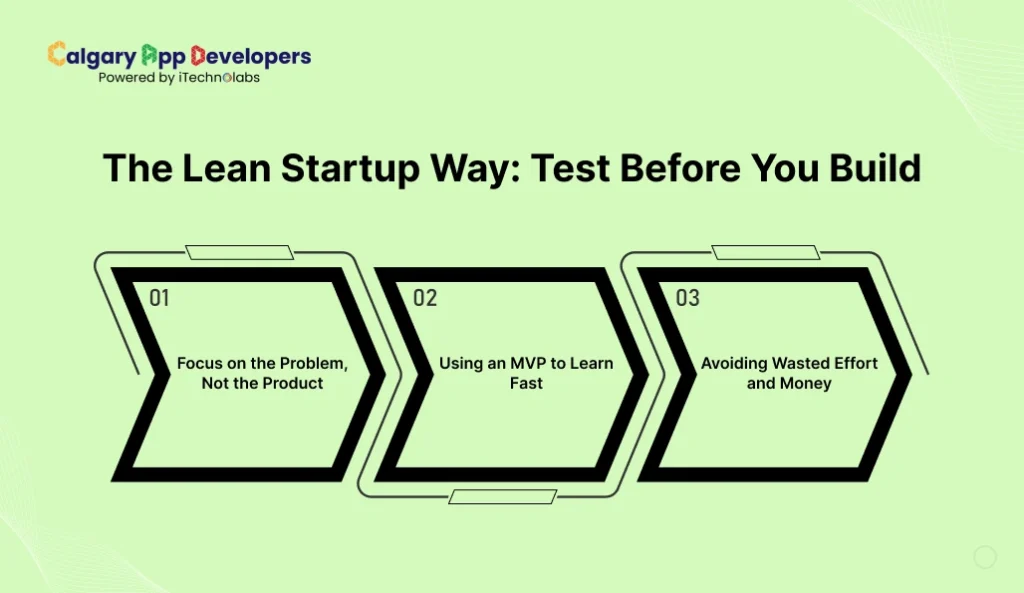
Starting a company can feel like a race. Many founders believe they need to launch fast, build fast, and raise fast. But speed without direction usually ends in failure. The Lean Startup approach flips this thinking. Instead of rushing to build, it asks you to slow down and test. For Canadian founders, this mindset can mean the difference between wasting resources and creating something that customers genuinely need.
1. Focus on the Problem, Not the Product
The foundation of any successful business is a real, pressing problem. Too often, founders get attached to the product they want to build rather than the issue they want to solve. A beautifully designed app or platform is worthless if it doesn’t address a pain point people care about.
Customers don’t wake up wanting your product. They wake up wanting solutions. By putting the problem first, you ensure that whatever you create is aligned with real demand.
2. Using an MVP to Learn Fast
This is where MVP development comes in. An MVP, or Minimum Viable Product, is the stripped-down version of your idea designed to test assumptions quickly. Think of it as a low-cost experiment rather than a finished product.
Examples of MVP development include:
- A simple landing page to gauge sign-ups before building a full platform.
- A prototype with limited features to test usability.
- A manual, service-based version of your idea that simulates the product experience.
The goal is speed and learning. Each test helps you answer critical questions: Will customers pay for this? What features matter most? Is the problem as urgent as I think?
3. Avoiding Wasted Effort and Money
Skipping validation and diving straight into full-scale building drains resources fast. Development costs pile up, marketing campaigns flop, and founders are left with an expensive product no one uses.
By starting lean, you reduce this risk. Every iteration of your MVP tells you whether to pivot, refine, or move forward. Instead of burning cash on guesswork, you invest strategically in what customers actually want.
Read Also: MVP Development Services for Startups in Canada
How to Validate Your Idea on a Budget
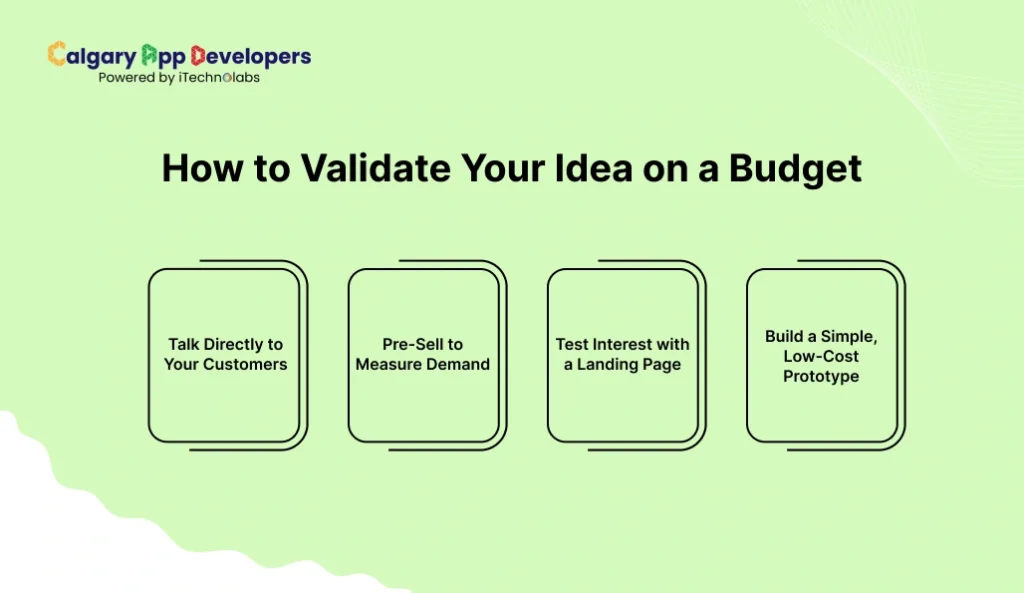
Every founder dreams of building something big, but here’s the truth: validation doesn’t have to be expensive. You don’t need a massive team or endless resources to prove that your idea has legs. For Canadian founders, especially those working with limited savings in a new environment, validating smartly can be the single biggest advantage. It keeps costs low, reduces risk, and gives you confidence that your time and money are being spent in the right place.
- Talk Directly to Your Customers
The cheapest and most powerful way to validate is through conversation. Pick up the phone, send messages, or meet people face-to-face. Ask them about their challenges, frustrations, and what they wish existed to solve those problems. Avoid pitching your idea right away. Instead, listen carefully.
For Canadian founders, this step also helps you learn cultural nuances, local buying behaviors, and gaps in the Canadian market that you may not have spotted otherwise.
- Pre-Sell to Measure Demand
Pre-selling is the ultimate proof of interest. If people are willing to pay before the product even exists, you know the demand is real. This could look like offering early-bird pricing, lifetime deals, or a small pilot program.
Instead of asking for opinions, ask for commitment. Opinions are free. Money is validation.
- Test Interest with a Landing Page
A simple landing page can tell you a lot about whether people care. Create a one-page website explaining your idea, run a small ad campaign, and measure how many visitors sign up. If no one clicks or subscribes, it’s a clear signal to refine your offer.
For Canadian founders, this approach is especially useful because it helps you test your idea with a specific local audience before spending big.
- Build a Simple, Low-Cost Prototype
A prototype doesn’t have to be fancy. It could be a mockup, a clickable demo, or even a manual version of your service that you run behind the scenes. The goal is to give customers something they can see, touch, or use, then watch how they respond.
This stage of MVP development lets you collect feedback and identify what really matters before building a full product. It saves you from wasting resources on features nobody needs.
Read Also: Why Startups in the U.S. Are Hiring Fractional Dev Teams
Case Study: DoorDash’s Validation Journey
DoorDash is one of the best examples of how smart validation can lead to massive success. The founders didn’t start with a full-scale delivery app, fleets of drivers, or a polished platform. They started with a simple question: do local restaurants and customers actually want this service?
To find out, they created a basic landing page with a phone number where people could place delivery orders. When an order came in, the founders themselves picked up food from the restaurant and delivered it to the customer. It wasn’t high-tech. It wasn’t scalable. But it was enough to prove the demand was real.
By running this manual version of their idea, the team learned what restaurants cared about, what customers expected, and where the real challenges were in delivery logistics. That early insight shaped how they built their technology and scaled the business.
The lesson for Canadian founders is simple. You don’t need to build the perfect product from day one. What you need is proof that people want what you’re offering. DoorDash became a billion-dollar company not because they started big, but because they started small, validated quickly, and built based on what they learned.
Key Lessons for Smart Founders
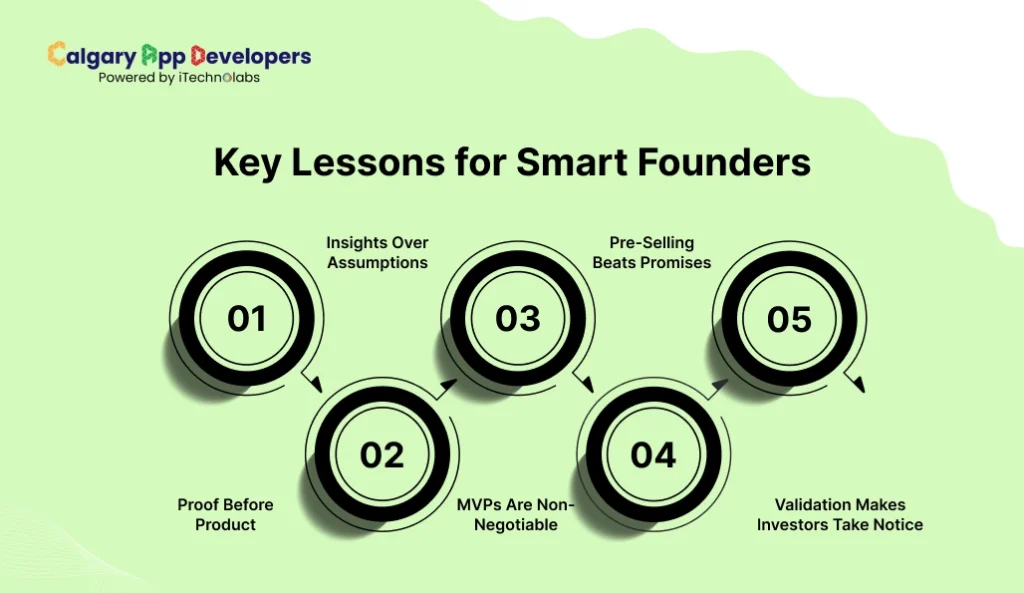
Successful startups are not built on luck. They are built on discipline, proof, and a willingness to learn before scaling. Here are the most important lessons every founder should take seriously.
-
Proof Before Product
The biggest mistake new founders make is believing that building fast is the same as building smart. A product without proof is a gamble. Before spending months on design, development, or hiring, you need to show that there is real demand. Proof can come in the form of sign-ups, pre-orders, or customer commitments. This evidence becomes your foundation and ensures that when you do build, you are solving a problem that actually matters.
-
Insights Over Assumptions
Assumptions feel safe because they come from your own belief in the idea. The problem is that customers rarely behave the way you expect. Insights, on the other hand, come from conversations, surveys, tests, and real-world feedback. Canadian founders who take time to gather insights avoid the trap of creating features no one wants. The lesson is simple: do not confuse your passion with proof.
-
MVPs Are Non-Negotiable
Every successful product begins with a Minimum Viable Product. An MVP is a lean version of your idea designed to test the market quickly and cheaply. It is not about cutting corners; it is about learning fast. This is why MVP development services are so valuable. They help founders design small, testable versions of their product that validate assumptions without wasting resources. Treating the MVP as optional usually leads to wasted time and money. Treating it as essential puts you on the path to building something that works.
-
Pre-Selling Beats Promises
Ideas are easy to share, and most people will nod politely when you tell them about your startup. But the real question is whether they will pull out their wallet. Pre-selling forces that decision. By offering early sign-ups, deposits, or pilot programs, you move past opinions and into proof. If customers pay before the product exists, you have a powerful signal that the market is ready.
-
Validation Makes Investors Take Notice
Investors are not in the business of gambling. They are in the business of reducing risk. When a founder shows traction, paying customers, and lessons learned through MVP testing, the conversation changes. Instead of convincing investors with promises, you attract them with results. Validation proves that you are not guessing. It shows you have evidence that the market wants what you are building.
Also Read: Why Most Calgary Startups Fail: Missing These Key Mobile App Features
Final Thoughts:
The journey of building a startup is full of challenges, but the path to success is clear for Canadian founders who prioritize validation. Rushing into product development or chasing investment without proof only increases the risk of failure. By focusing on solving real problems, testing assumptions, and leveraging tools like MVP development, founders can build with confidence and efficiency.
Smart Canadian founders start small, learn fast, and iterate constantly. They talk to real customers, pre-sell where possible, and use early experiments to guide bigger decisions. This approach conserves resources, reduces risk, and creates a solid foundation that attracts both users and investors.
At the end of the day, the companies that succeed are not those that move fastest; they are the ones that move smartest. For Canadian founders, validation is not just a strategy. It is the difference between chasing a dream and building a business that lasts.
FAQ’s About Startup Growth Strategy:
- What does “market validation” really mean for a startup?
Market validation is the process of confirming that real customers want and are willing to pay for your solution. It involves testing assumptions, gathering feedback, and measuring demand before building a full product. Validation ensures you’re solving a real problem and reduces the risk of wasting time, money, and effort on ideas that won’t succeed. - How many people should I speak to before validating my idea?
There is no exact number, but most founders start by talking to 30–50 potential customers. The goal is to gather enough feedback to spot patterns in pain points, willingness to pay, and interest. It’s about quality and diversity of insights rather than quantity; these conversations reveal whether your idea resonates with your target audience. - What if I don’t have a tech background to build an MVP?
Not having a tech background isn’t a barrier. You can create a simple MVP using no-code tools, mockups, landing pages, or manual services that simulate the product experience. Alternatively, you can partner with a developer or use professional MVP development services to bring your idea to life quickly and test it with real customers before investing heavily. - Can I skip validation if I already have investors on board?
No. Funding does not guarantee product-market fit. Investors fund potential, but customers pay for solutions. Skipping validation risks wasting resources on a product that may fail. Canadian founders who validate first reduce risk, build smarter, and show traction to investors, which ultimately increases credibility and the likelihood of future funding or scaling successfully. - How did DoorDash validate their business idea before building the app?
DoorDash started with a simple, manual approach. Founders created a basic landing page, took orders by phone, and personally delivered food from restaurants to customers. This low-cost, small-scale experiment confirmed real demand, helped refine the service, and provided insights that shaped their full app. It’s a classic example of testing before building.


Pankaj Arora is a seasoned technology leader and the Founder of Calgary App Developer, with 10+ years of expertise in crafting high-performance digital solutions. His core competencies include full-stack app development, cloud-native architecture, API integration, and agile product delivery. Under his leadership, Calgary App Developers has empowered startups and enterprises alike with scalable mobile applications, secure web platforms, and AI-driven SaaS products.