








How to Build MVP for Startup: From Idea to Successful Launch

Let’s say you’ve just developed a startup concept that’s too good to pass up. You already envision the app in users’ hands or the service revolutionizing the way something gets done. Enthusiasm is high, but so are the questions. Should you commit fully and develop the complete product? What if the market doesn’t behave as you anticipate? What if you work for months to get it perfect, only to discover people desired it in a more straightforward manner all along?
That’s where a minimum viable product, or MVP development, comes into play. It’s like the first real test drive for your product. Rather than investing time and money into a fine-tuned final version, you produce a lean one that only includes the bare essentials of what makes it tick. It’s not cheating; it’s showing your concept works in the real world before you escalate it.
This approach has helped countless startups validate ideas, attract investors, and find early adopters without burning through resources. In this guide, we’ll walk through how to build an MVP step by step, from shaping your initial concept to turning it into a product that sets the stage for long-term success.
- The blog explains why building an MVP first is the smartest way to reduce risk and validate startup ideas
- It breaks down a clear step-by-step MVP development process from idea to launch and beyond
- Real app examples show how MVPs evolve into fully scaled products after testing
- The focus stays on speed, validation, and user growth rather than overbuilding
- An MVP helps startups test core ideas with real users before committing to full-scale development, saving time and budget.
- MVP development focuses on solving one clear problem with essential features instead of building everything upfront.
- Early user feedback guides product decisions, helping teams refine features based on actual behavior rather than assumptions.
- A structured, phase-wise approach allows products to launch quickly and scale only after validation.
- Real-world app examples demonstrate how MVPs transition into mature systems once market demand is proven.
- Avoiding common MVP mistakes like feature overload and delayed launches increases the chances of long-term success.
What a Minimum Viable Product Really Is?
A minimum viable product is the bare-bones version of your product that still provides real value to users. It’s not a prototype that is going to languish in a pitch deck, and it’s not a half-baked version that leaves individuals scratching their heads. An MVP is useable, working, and with only the most essential features aimed at delivering the primary solution your target audience has.
The concept is straightforward. Rather than develop everything you envision all at once, you boil it down to bare essentials and give it to actual users. In this manner, you can test assumptions, receive feedback, and observe how people engage with your concept before investing serious capital in full-scale development.
What this actually translates to is that an MVP development isn’t about doing less. It’s about working smarter. By prioritizing the most critical features, you’re not wasting your time on things that might not be important to your users. You’re also building a solid foundation that you can expand upon as your product develops and your market becomes clearer.
Why Startups Choose to Build an MVP
Starting up is always a risk. You might take months creating what you believe is the ideal product only to discover that customers never actually wanted it. That is why most founders opt to begin with a minimum viable product.
An MVP development breaks the concept down to basics. Rather than invest in all the features, startups invest in the most important function that fixes an actual issue. By doing this, they can test the waters without exhausting time, money, and energy.
The real advantage lies in speed. Using an MVP development, a startup can get a working version in front of users as quickly as possible. Feedback starts flowing early, and that feedback shapes what comes next. Rather than guessing what customers want, founders get clear signals on what direction they need to take.
There is also lower risk. If the idea tanks, loss is contained. If it works, the team already has evidence that the idea does work, and thus they can more easily bring in investors and scale with confidence.
In summary, startups opt for MVPs because they synergize speed, validation, and more intelligent resource utilization. It is not a matter of building less. It is a matter of building smart and learning quickly.
Also Read: MVP Development Services for Startups in Canada
The Key Advantages of MVP Development
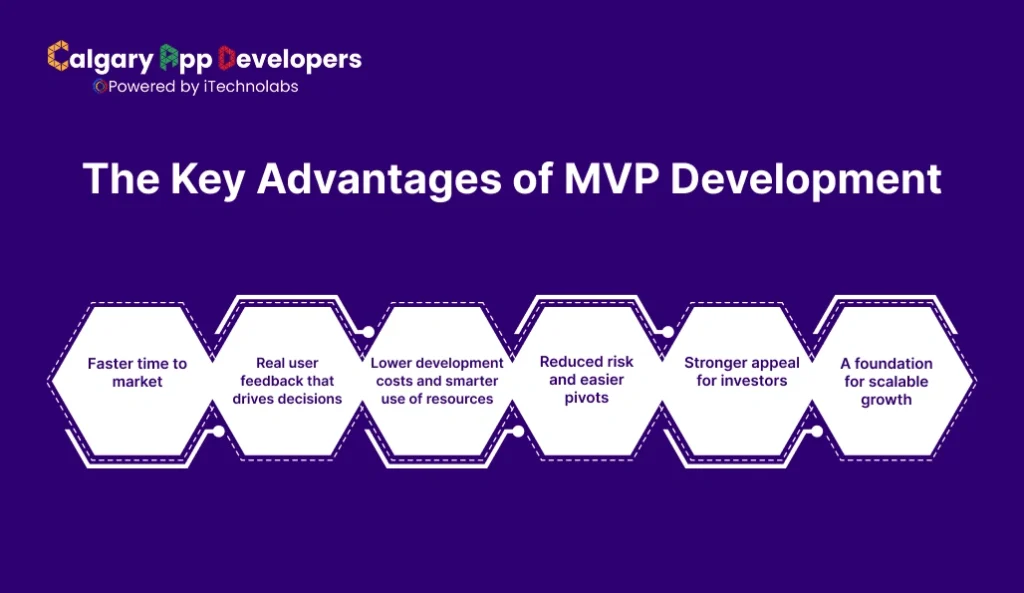
Building a minimum viable product is not cutting corners. It’s identifying the brightest path to bringing something to life without investing resources on speculation. Startups that adopt this method reap a number of significant benefits that can define their entire lifespan.
- Faster time to market
Speed is of the essence in the startup ecosystem. An MVP prevents founders from spending years in the development phase and directly releases something functional to users in a short span. This initial release provides a competitive advantage, generates hype, and establishes a foothold in the market before the competition has a chance to develop similar offerings. - Real user feedback that drives decisions
Concepts might sound wonderful on paper, but the ultimate test occurs when users utilize the product. An MVP enables startups to gain actual feedback from early adopters. This feedback identifies what is working, what is frustrating customers, and what actually matters. With this improved understanding, the team can focus on making improvements rather than developing features nobody requested. - Lower development costs and smarter use of resources
Startups typically have limited budgets. Building a complete product with all the features one can think of will be very costly, particularly if there is no assurance of market reception. An MVP development confines the investment to the necessities, preserving finances in the short term while leaving space for expansion once the idea is proven. - Reduced risk and easier pivots
Every startup faces uncertainty, and not every idea will hit the mark on the first try. An MVP lowers that risk by providing early signals about whether the concept resonates with users. If it does not, the team can pivot without the heavy losses that come from building a complete product that nobody wants. - Stronger appeal for investors
Investors prefer to invest in startups that are able to demonstrate traction rather than potential. MVP development proves the concept has potential in the real world, that people are ready to use it and even pay for it. Fundraising talks are thereby simpler and more persuasive. - A foundation for scalable growth
An MVP is not the final destination. It becomes the starting point for continuous development. Once the core concept is validated, new features can be added, the design can be refined, and the product can grow into something far more sophisticated. This step-by-step progress ensures that growth happens with purpose instead of blind expansion.
What this really means is that MVP development gives startups clarity, confidence, and control. Instead of gambling on assumptions, they learn directly from their users, spend wisely, and create a product that is ready to evolve as demand grows.
Also Check: Why Startups in the U.S. Are Hiring Fractional Dev Teams
Estimating the Cost of an MVP for Your Startup
The cost of MVP development for startups typically ranges between $5,000 and $50,000, depending on the type of MVP, features, and technology choices. Knowing this range helps you plan your budget realistically and avoid surprises. Here’s a breakdown of typical MVP types and their estimated costs:
| MVP Type | Description | Estimated Cost (USD) |
| Landing Page MVP | Simple webpage to validate idea and collect user interest | $500 – $2,000 |
| Prototype MVP | Clickable design or wireframe showing basic product flow | $1,000 – $5,000 |
| Functional MVP | Basic working product with core features | $5,000 – $20,000 |
| Advanced MVP | Product with multiple features, integrations, and support | $20,000 – $50,000 |
Our Step-by-Step MVP Development Process
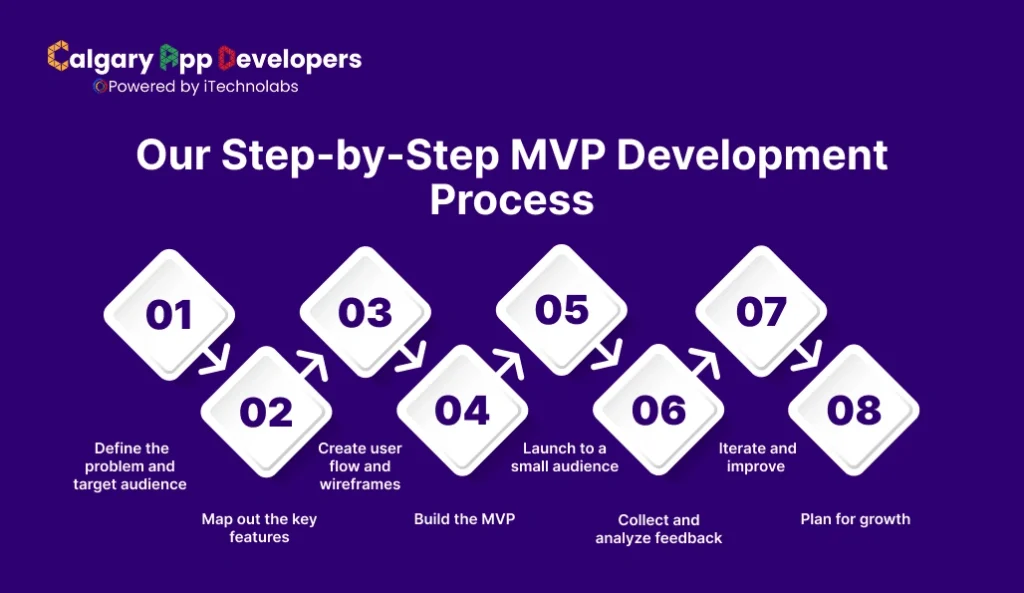
Creating an MVP is not just about putting together a stripped-down product. It is a systematic process that takes an idea from a rough concept to a tested version in the hands of real users. Every step is designed to validate assumptions, minimize risk, and set the foundation for growth. Here is how we approach it:
- Define the problem and target audience
- The beginning is always clarity. We try to find out what the root issue is that the product is trying to resolve.
- At the same time, we pinpoint the target audience. Who are they, what problems do they have, and why would they go for this solution compared to what already exists?
- Without this, even the greatest product will fall short.
- Map out the key features
- After we’ve grasped the issue, we brainstorm all possible features.
- Then we cut the list back to bare minimums, eliminating anything that doesn’t directly help solve the problem.
- This prevents scope creep and keeps development lean and efficient.
- Create user flow and wireframes
- After we’ve got the list of features sorted out, we plan out how users will actually navigate through the product.
- User flows demonstrate step-by-step what the customer will go through.
- Wireframes make those flows real, providing a visible outline of the product before writing one line of code.
- Build the MVP
- Development starts with just the essential features.
- The objective is not to produce a refined, perfect product but rather a functional, stable, and easy-to-test product.
- This phase usually applies agile development techniques, with rapid iterations to have a working version ready sooner.
- Launch to a small audience
- Rather than rolling out the MVP to the whole market, we send it to a small audience of early adopters.
- Such an audience tends to be more willing to experiment with incomplete products and more likely to offer valuable feedback.
- Making the launch small allows us to easily track performance and collect insights without getting buried under data.
- Collect and analyze feedback
- Feedback is the heart of the MVP development process. We gather both qualitative data (surveys, interviews, comments) and quantitative data (analytics, usage patterns).
- This helps identify what features delight users, where they struggle, and whether the product truly solves their problem.
- Iterate and improve
- Based on the feedback, we refine the MVP.
- This may mean improving usability, adding a missing feature, or even pivoting the concept in a new direction.
- Each cycle of testing and iteration brings the product closer to something the market actually wants.
- Plan for growth
- Once the MVP is showing strong validation, it serves as the base for scaling.
- Now we increase development, implement secondary features, refine the design, and get the product ready for broader release.
- With traction behind us, it is also simpler to bring in investors and partners for sustainable growth.
This process ensures startups are not building in the dark. Instead of sinking months or years into a fully loaded product that may not succeed, they move step by step, learning directly from their audience and adjusting as they go. The end result is not just a product, but a product that has already earned its place in the market.
Also Read: Why Most Calgary Startups Fail: Missing These Key Mobile App Features
The Most Common Mistakes to Avoid
Building an MVP can open doors for startups, but only if it is done right. Many founders rush the process or overlook key details, which often leads to wasted time and missed opportunities. Here are the mistakes to watch out for:
- Trying to build too many features at once
- An MVP is meant to be minimal. Loading it with every possible feature defeats the purpose.
- Too many features hamstring development and make it more difficult to receive useful feedback.
- Ignoring the target audience
- Certain startups create what they believe others will want rather than engaging with their users.
- Lacking knowledge of the audience, the MVP stands a high chance of solving the wrong problem.
- Skipping proper validation
- Relying only on intuition or assumptions can be dangerous.
- A successful MVP needs real-world testing and validation before scaling further.
- Poor user experience
- Even a minimal MVP has immense usability.
- If your early adopters have trouble with cumbersome design or awkward navigation, they will leave without offering any quality feedback.
- Treating the MVP as the final product
- An MVP is merely a launchpad. Some founders deploy it and hope it will work in its current form.
- The actual worth lies in ongoing improvement through user feedback.
- Ignoring feedback or data
- Gathering feedback is just half the battle. Failing to act upon it is one of the largest blunders.
- Data and user input must inform each iteration and choice.
- Delaying launch for perfection
- Numerous teams will continue to refine their MVP, waiting until it feels perfect.
- This holds up learning and risks the startup being too late to market.
The fact is, MVP creation is not about preventing flaws at all. It is preventing the wrong ones. Flaws such as feature overloading, ignoring customer feedback, or perfectionism can bring the process down. A successful MVP development remains lean, user-centric, and flexible.
What Comes After Your MVP Launch
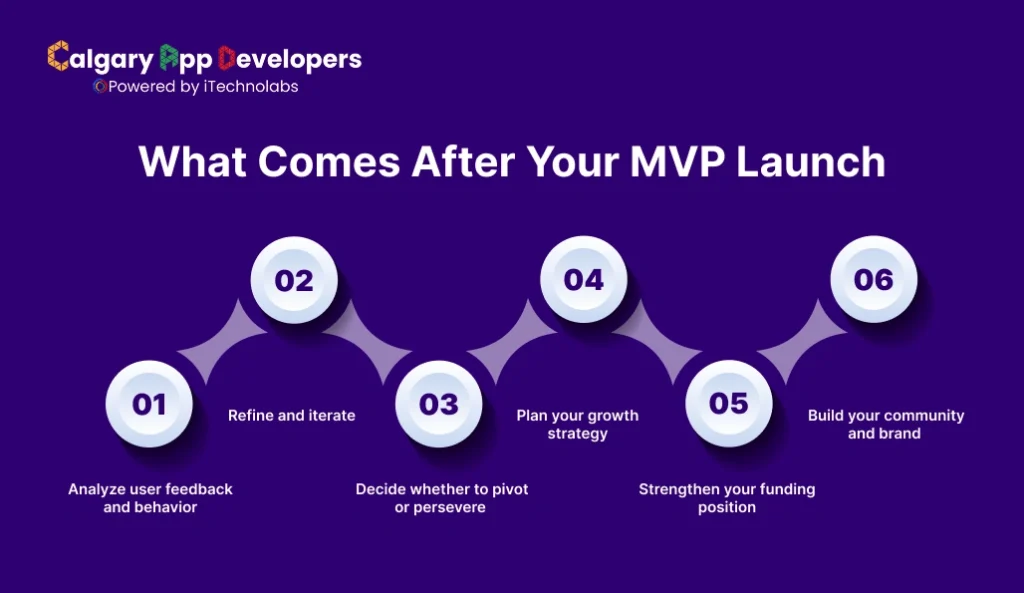
Releasing an MVP is a milestone but not the end goal. In most respects, it is the beginning of creating a product that will thrive and expand in the actual market. How you proceed after launch decides whether or not your concept becomes a successful venture or disappears.
- Analyze user feedback and behavior
- Collect direct feedback from early users and analytics data.
- Seek out patterns in how users interact with the product, where they fall off, and what they care about most.
- This analysis informs you if the MVP actually fixes the problem you went out to fix.
- Refine and iterate
- Use the insights to improve the product step by step.
- Simplify confusing flows, fix pain points, and enhance features that users find most valuable.
- Each iteration should bring the product closer to what the market actually wants.
- Decide whether to pivot or persevere
- Sometimes feedback shows that the original idea needs a major change. This is the moment to pivot.
- Other times, the core idea is strong, and the focus should be on refining and scaling.
- Making this decision early saves resources and sets a clearer path forward.
- Plan your growth strategy
- Once the MVP shows traction, it is time to prepare for scaling.
- This means adding secondary features, improving design and performance, and getting ready for a wider launch.
- At this stage, building a roadmap for product evolution becomes essential.
- Strengthen your funding position
- With actual data and user adoption, your startup has better proof to attract investors.
- An MVP that demonstrates market demand is easier to raise funds from, as it lowers the risk in the minds of prospective supporters.
- Build your community and brand
- Connect with your early adopters. They are not simply testers; they can be word-of-mouth supporters.
- Begin producing content, tuning your brand voice, and creating a community around your product.
In brief, the next step after the MVP is learning, iteration, and growth. Launch is just the starting point. Success really lies in how well you translate insights into actions and the speed at which you are able to pivot to what you’re hearing from the market.
Read Also: Top MVP Development Companies Best for Startups
Our App Development Experience Built Around MVP First, Scale Second
Our experience in app development is shaped by a clear belief. Products succeed when they are validated in the real world before they are fully built. Instead of starting with a heavy, feature-packed system, we follow a phase-wise development model that allows ideas to prove themselves early and evolve with confidence.
Each project begins with an MVP designed to test the core value of the app. Once real users confirm that value through adoption, feedback, and engagement, we expand the product into a fully fledged system. This approach reduces risk, saves cost, and ensures that growth is driven by actual user behavior rather than assumptions.
Below is how this process played out across our key app projects.
1. Lumaflo
Basketball Data Analysis Platform for Skill Improvement
MVP Phase
The initial version of Lumaflo was designed to answer one question. Can performance data genuinely help players improve? The MVP focused only on collecting essential basketball metrics and presenting them in a way players and coaches could immediately understand and use.
MVP delivery highlights:
- Core player performance data capture
- Basic analytics for shooting and movement
- Simple dashboards tailored for athletes and coaches
- Validation of data accuracy and training relevance
This phase allowed us to test usability on the court and ensure insights were actionable, not just technical.
Scaled Product Phase
Once validated, Lumaflo expanded into a full performance intelligence platform.
- Post-validation enhancements:
- Advanced analytics and performance trends
- Deeper skill development insights over time
- Enhanced visualization for coaching decisions
- Scalable infrastructure to support larger teams and leagues
2. Heartly IBP
Blood Pressure Tracking and Stress Management App
MVP Phase
Heartly IBP launched as a focused health tracking MVP. The goal was to confirm whether users would consistently log data and trust the app with sensitive health information.
MVP delivery highlights:
- Simple blood pressure logging
- Basic stress indicators and daily tracking
- Clean interface designed for routine use
- Secure handling of personal health data
This stage helped validate daily engagement and long-term usability.
Scaled Product Phase
With consistent user adoption, Heartly IBP evolved into a more complete wellness solution.
- Post-validation enhancements:
- Advanced stress management tools
- Long-term health trend analysis
- Improved insights and reporting
- More refined user experience for sustained engagement
3. WallStreet
Stock Trading Simulation and Gaming Platform
MVP Phase
WallStreet began as a controlled MVP to test whether gamification could make stock market learning engaging. The early version stripped trading down to its essentials.
MVP delivery highlights:
- Simulated trading environment
- Core market logic and scoring
- Gamified mechanics for learning
- Engagement and retention testing
This allowed us to measure how users interacted with financial concepts without overwhelming them.
Scaled Product Phase
After strong engagement signals, WallStreet was expanded into a more immersive platform.
- Post-validation enhancements:
- More realistic trading logic and simulations
- Competitive features and leaderboards
- Improved performance and stability
- Expanded progression and reward systems
4. Camcloud
White Label Cloud Video Monitoring Platform
MVP Phase
The Camcloud MVP was built to validate simplicity and reliability. The focus was on enabling users to securely access and manage cameras remotely without complexity.
MVP delivery highlights:
- Secure cloud-based camera access
- Live viewing and basic playback
- Simple device and account management
- White label readiness for partners
This phase confirmed demand from both home users and small businesses.
Scaled Product Phase
Once validated, Camcloud matured into a full camera management ecosystem.
Post-validation enhancements:
- Greater scalability across multiple devices
- Enhanced performance and uptime reliability
- Advanced remote monitoring features
- Support for broader residential and commercial use cases
This phased approach allows us to reduce risk, control costs, and ensure every app grows based on real user behavior, not assumptions. By validating first and scaling second, we help transform early ideas into reliable, market-ready applications built for long-term success.
Conclusion
Starting a startup is never a linear path, but developing an MVP is one of the best ways to work through the ambiguity. An MVP development allows you to test your idea in a hurry, validate it with actual users, and iterate based on feedback before you sink a ton of money into full-fledged development. Rather than speculating, you learn. Rather than overspending, you build with intention and direction.
The actual takeaway is not complicated. Your MVP is not a leaner version of your product. It is a time-saving, risk-reducing strategy that provides you with the clarity to proceed confidently.
If you are ready to take your idea from concept to market, our team at Calgary App Developers is here to help. We specialize in building MVPs that balance speed, quality, and user experience, giving startups the foundation they need to succeed. Whether you are just shaping your idea or preparing to scale, we can guide you through every step of the process.
Your product deserves the chance to prove itself. Let’s build that opportunity together.
FAQ’s About MVP Development for Startups
1. Is MVP suitable only for startups?
Not at all. While MVPs are popular among startups because of limited budgets and high uncertainty, established businesses also use them. Larger companies often launch MVPs to test new products, explore untapped markets, or validate innovative ideas without committing massive resources upfront. In both cases, the purpose is the same: reduce risk, learn faster, and build what users actually want.
2. What successful businesses started with MVP development?
Some of today’s biggest companies began with very simple MVPs. Dropbox first tested its idea with a short demo video before building the product, which helped validate demand. Airbnb started by renting out an apartment to see if people would pay to stay in someone’s home. Even Uber began with a basic app limited to black car services in San Francisco. These examples show how small, lean experiments can grow into global platforms.
3. How to find a reliable MVP development team?
Choosing the right MVP development team is critical. Look for developers who not only write code but also understand business strategy and product design. A good MVP partner will:
- Focus on identifying your core features instead of pushing for unnecessary add-ons
- Have experience working with early-stage products and startups
- Communicate clearly, keeping you involved throughout the process
- Share case studies or references that prove their track record
- Emphasize speed and validation over perfection
If you are searching for a trusted partner, Calgary App Developers offers end-to-end MVP development services. From refining your idea to launching a market-ready product, we guide you through every stage with a focus on efficiency, user experience, and long-term growth.


Pankaj Arora is a seasoned technology leader and the Founder of Calgary App Developer, with 10+ years of expertise in crafting high-performance digital solutions. His core competencies include full-stack app development, cloud-native architecture, API integration, and agile product delivery. Under his leadership, Calgary App Developers has empowered startups and enterprises alike with scalable mobile applications, secure web platforms, and AI-driven SaaS products.