



On Demand Delivery App Development Guide 2026
Every time you tap a button and dinner shows up, that’s an on-demand delivery app in action. The world’s hooked on it, and markets are responding. The global on-demand delivery industry was estimated at around USD 180 billion in 2024 and could swell to about USD 555 billion by 2033, growing at roughly 17 percent annually. That is not just hype; it is a clear sign that people expect things now, not later, and businesses are racing to keep up.
Behind this growth is a surge in on demand delivery app development. Businesses across food, grocery, pharmacy, retail, and logistics are investing in smarter digital platforms that connect customers, merchants, and delivery partners in real time. Speed, transparency, and convenience are no longer competitive advantages. They are basic expectations.
If you have ever thought, “Could I launch something like this without writing a single line of code?” you are in the right place. This guide breaks down how on demand delivery app development works, how to build an app without coding, the must-have features, best practices and a real example of Calgary app developers bringing an on-demand delivery app called Yummi Runs to life. We will wrap it up with a checklist that makes launching your own app feel achievable, not overwhelming.
- On-demand delivery apps are transforming industries by meeting the growing demand for speed and convenience.
- The market is expanding rapidly, creating strong opportunities for new entrants.
- You can build an app using no-code tools or custom development, depending on scale and goals.
- Success depends on core features, user experience, scalability, and operational efficiency.
- The global on-demand delivery market is growing at a strong annual rate, reflecting sustained consumer demand for instant services.
- On-demand delivery apps operate by connecting customers, service providers, and delivery partners through real-time digital platforms.
- Industries such as food, groceries, healthcare, logistics, retail, and home services are actively adopting this model to improve accessibility and speed.
- Entrepreneurs can launch a delivery app using no-code platforms for faster entry or invest in custom development for long-term scalability.
- Essential features include real-time tracking, secure payments, smart search, notifications, ratings, and a centralized admin dashboard.
- A clear niche, strong user journey, data security, and reliable performance are critical factors that determine long-term success.
What is an on-demand delivery app?
An on-demand delivery app is a platform that connects customers with products or services almost instantly. Instead of waiting days, users get what they need within hours or even minutes. At its core, this model works by linking buyers and businesses through a simple mobile interface where orders can be placed, tracked, and completed in real time.
When we talk about on-demand delivery app development, the idea is to build digital solutions that make this instant access possible. Think of three common examples:
- Food delivery app: Hungry customers browse menus, place an order, and have their meal delivered hot and fresh without calling a restaurant.
- Grocery delivery app: Families get essentials like fruits, vegetables, and household supplies delivered the same day, often within an hour.
- Pickup and delivery app: From sending documents across the city to getting laundry dropped at your doorstep, these apps simplify daily tasks by matching couriers with customers.
On-demand delivery app development is not tied to one industry. It is about creating a flexible system that adapts to different sectors and user needs while keeping speed and convenience at the center.
Key Industries Using On-Demand Delivery Apps
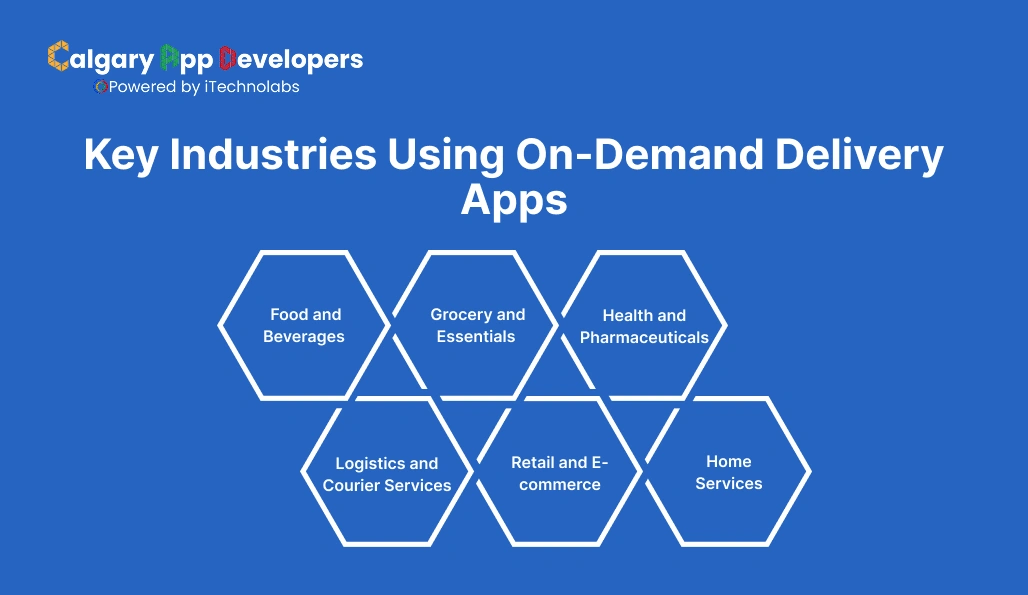
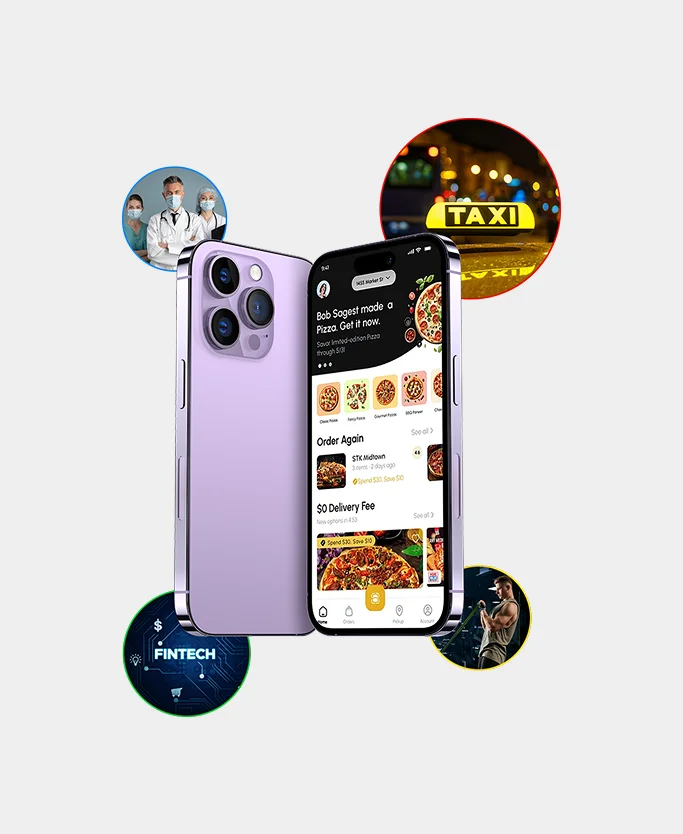
The rise of the on-demand delivery app has transformed not just how people order food but how entire industries operate. By putting speed, accessibility, and convenience at the center, businesses in multiple sectors are rethinking customer experiences. Let’s look at the main industries where this model has made a lasting impact.
- Food and Beverages:
Food delivery is the face of the on-demand economy.
- Customers can explore menus, customize orders, pay digitally, and track their delivery all within minutes.
- Restaurants and cloud kitchens depend on these apps to expand reach beyond walk-ins.
Global examples: Uber Eats (USA and Europe), Swiggy and Zomato (India), Deliveroo (UK), and Meituan (China).
This sector thrives because eating is a daily need, and customers now expect the option to order whenever they like without compromising on quality.
- Grocery and Essentials:
Online grocery shopping is growing at record speed as busy households turn to apps for daily essentials.
- On-demand grocery apps provide same-day or even 15-minute delivery windows.
- They often include subscription features for repeat orders like milk or bread.
Global examples: Instacart (USA), BigBasket and Blinkit (India), Ocado (UK), and Gorillas (Germany).
This sector shows how convenience drives loyalty, as customers value not having to carry heavy bags or stand in checkout lines.
- Health and Pharmaceuticals:
Healthcare has embraced the on-demand model to improve accessibility.
- Apps allow patients to upload prescriptions, consult doctors, and order medicines for doorstep delivery.
- They also support urgent needs like late-night deliveries of fever medicine or diabetic supplies.
Global examples: PharmEasy (India), Capsule (USA), and LloydsDirect (UK).
This industry proves that on-demand delivery apps can go beyond convenience to actually improve quality of life.
- Logistics and Courier Services
On-demand courier apps solve one of the most common urban challenges: fast and reliable parcel delivery.
- Businesses use these services to move documents, packages, and goods across cities.
- Features like real-time tracking, instant notifications, and cashless transactions add transparency.
Global examples: Postmates (USA), Lalamove (Hong Kong, Southeast Asia), and Porter (India).
This sector highlights how delivery apps are not just for consumers but also for businesses that need quick logistics solutions.
- Retail and E-commerce
The rise of online shopping has pushed retailers to invest in faster delivery models.
- On-demand delivery apps allow same-day or next-day shipping for everything from clothing to electronics.
- Smaller retailers use these apps to compete with giants like Amazon.
Global examples: Walmart Express Delivery (USA), Zalando (Europe), and Flipkart Quick (India).
For retail, the delivery speed often determines customer satisfaction and loyalty.
- Home Services
The idea of convenience now extends to household chores and repairs.
- Customers book cleaners, handymen, beauticians, or laundry pickup through on-demand apps.
- Features include upfront pricing, professional ratings, and flexible time slots.
Global examples: Urban Company (India), TaskRabbit (USA), and Helpling (Europe).
This category shows that the on-demand model isn’t just about products; it is also about services delivered at the customer’s doorstep.
On-demand delivery apps are not a passing trend. They are reshaping industries worldwide by setting new benchmarks for speed, personalization, and reliability.
Also Read: How to Create a Food Delivery App
How to Create an On-Demand Delivery App Without Coding
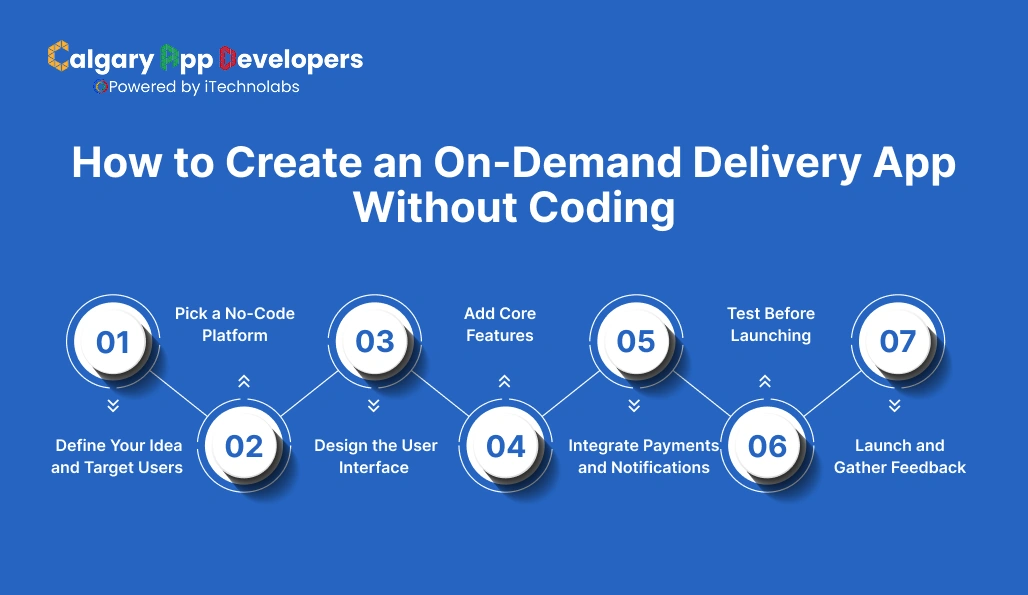
Building a mobile app used to mean hiring developers, writing thousands of lines of code, and spending months on design and testing. That has changed. Today, no-code platforms & vibe coding-like concepts let entrepreneurs and businesses create a fully functional on-demand delivery app without writing a single line of code. The key is understanding the process and using the right tools.
- Define Your Idea and Target Users
Every app starts with clarity. Decide what problem your delivery app will solve.
- Is it food delivery, groceries, medicine, or local courier services?
- Who is your primary customer, like students, families, or small businesses?
A clear target audience helps you choose features and design a better user journey.
- Pick a No-Code Platform
There are multiple tools that allow drag-and-drop app creation. Popular options include:
- Glide and Thunkable for lightweight apps with simple interfaces
- Adalo and Bubble for more customizable user experiences
- Appgyver and Zoho Creator for scalable business apps
Choose a platform that supports payments, GPS tracking, push notifications, and multi-user roles since these are crucial for on-demand delivery apps.
- Design the User Interface
Customers expect a simple, clean interface. Focus on:
- Easy onboarding and sign-up
- Quick search and order placement
- Live order tracking
- A smooth checkout and payment flow
Most no-code builders offer templates for delivery apps, so you don’t need to start from scratch.
- Add Core Features:
Your app should have separate user roles:
- Customer panel: browse, order, pay, and track
- Delivery partner panel: accept tasks, navigate, and update status
- Business admin panel: manage orders, menus, pricing, and analytics
Even without coding, these features can be added through plug-ins and integrations on no-code platforms.
- Integrate Payments and Notifications:
Payment gateways like Stripe, Razorpay, or PayPal can be connected easily. Push notifications for order updates, promotions, or delays keep users engaged and informed.
- Test Before Launching:
No-code platforms allow you to preview the app in real time. Test order flows, payment processes, and delivery tracking before publishing to app stores.
- Launch and Gather Feedback:
Release a beta version to a small group of users. Collect their feedback and improve. Because you’re using a no-code platform, making changes is quick and doesn’t require expensive developers.
Creating an on-demand delivery app without coding is not only possible but also cost-effective and fast. Instead of waiting months, businesses can go live within weeks and adapt as they grow.
Read Also: How Much Does It Cost To Develop A Delivery App
Best Practices for Building an On-Demand Delivery App
- Keep the User Journey Simple
A successful on-demand delivery app should feel effortless. From sign-up to checkout, the process must take as few steps as possible. Use clean layouts, intuitive icons, and clear calls to action. If customers struggle to place an order or make a payment, they are unlikely to return. A smooth user journey directly improves retention and positive reviews. - Ensure Speed and Reliability
No one likes waiting for an app to load or crash mid-order. Your delivery app should be built for fast performance and be able to handle sudden surges in traffic. Scalability is essential during weekends or holiday seasons when order volume spikes. Prioritizing speed ensures that customers do not abandon their carts and delivery partners can manage orders without delays. - Focus on Real-Time Tracking
Transparency is key in delivery services. Customers want to see their order progress from confirmation to pickup and final delivery. Real-time GPS tracking creates trust and reduces the need for customer support inquiries. For delivery partners, accurate navigation tools make routes easier to follow. A strong tracking system keeps both sides engaged and improves the overall experience. - Offer Flexible Payment Options
Different markets demand different payment preferences. Some regions still rely on cash, while others lean toward wallets and cards. By offering a wide range of secure options like credit, debit, UPI, wallets, or PayPal, you remove friction at checkout. The more flexibility your on-demand delivery app provides, the higher the chance of completed transactions and repeat orders. - Support Delivery Partners Effectively
Delivery partners are the backbone of any on-demand platform. An app that makes their work easier will always perform better. Features like task acceptance, real-time navigation, and one-tap status updates help partners complete orders quickly. When partners are satisfied with the tools provided, delivery times improve and customers receive better overall service. - Prioritize Data Security and Compliance
Users share sensitive data such as addresses, payment details, and sometimes medical information. Protecting that data should be a top priority. Following security standards like PCI DSS and regional laws such as GDPR builds trust and prevents costly breaches. A secure on-demand delivery app not only safeguards customers but also strengthens your brand reputation in a competitive market.
Core Features Every On-Demand Delivery App Needs
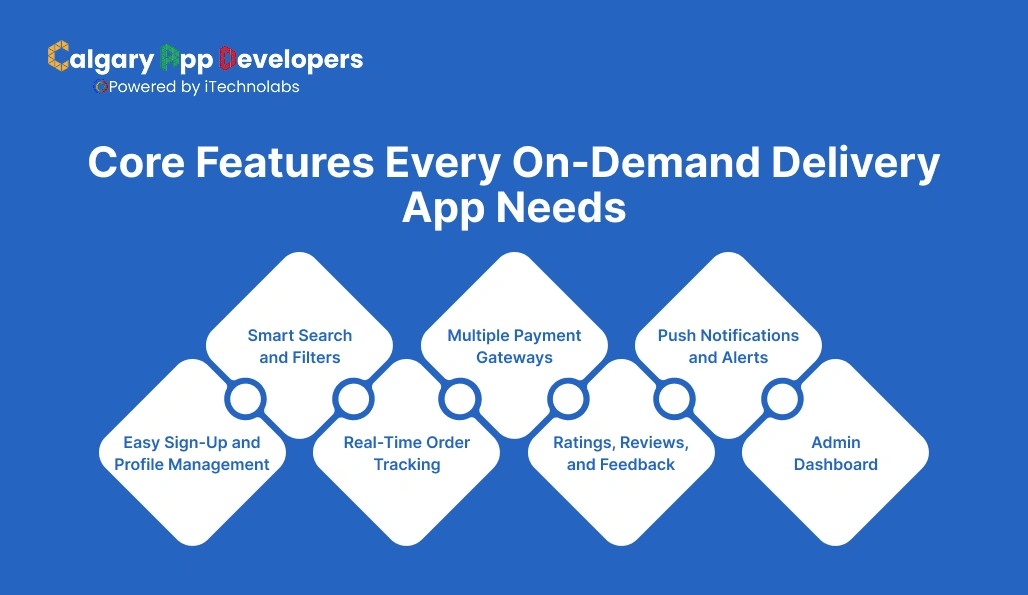
An on-demand delivery app is only as good as the features it provides. Customers expect speed, delivery partners need efficiency, and businesses require visibility. To meet all three, your app should include the following core features.
- Easy Sign-Up and Profile Management: The journey starts with onboarding. Users should be able to sign up quickly through email, phone number, or social accounts. Profiles let them save addresses, track past orders, and manage preferences. Delivery partners also need dedicated profiles with verification and documentation for trust and compliance.
- Smart Search and Filters: Customers expect to find products or services instantly. A smart search bar, category filters, and personalized recommendations make the process faster. Whether it is a food delivery app, grocery delivery, or courier service, navigation should feel intuitive so users can place orders without frustration.
- Real-Time Order Tracking: This is the heartbeat of every on-demand delivery app. GPS tracking keeps customers informed from the moment they place an order until it reaches their door. Live updates like “order confirmed,” “out for delivery,” and “arriving soon” build trust and reduce support calls. For delivery partners, in-app maps make routes more accurate and efficient.
- Multiple Payment Gateways: Secure and flexible payment is essential. Your app should support cards, UPI, wallets, and in some regions, cash-on-delivery. A smooth and fast checkout process improves conversion rates. Features like payment receipts and saved methods add convenience while maintaining security.
- Ratings, Reviews, and Feedback: Feedback loops keep the platform accountable. Customers can rate delivery speed, product quality, and overall service. Businesses and delivery partners can also rate customers to maintain professionalism. These reviews help improve performance and boost credibility for new users.
- Push Notifications and Alerts: Updates at the right time keep customers engaged. Notifications for order status, estimated delivery times, offers, and discounts ensure customers stay connected to your app. Delivery partners also receive instant alerts for new tasks or urgent changes, improving efficiency.
- Admin Dashboard: Behind the scenes, businesses need control. A strong admin panel allows owners to manage menus, products, pricing, delivery zones, and promotions. It also provides analytics on sales, peak hours, and customer behavior, giving businesses data-driven insights to improve services.
An on-demand delivery app is more than a tool for transactions. These core features create a complete ecosystem where customers, delivery partners, and businesses interact seamlessly. Leaving out any of them risks losing trust and lowering adoption rates.
Also Read: Custom On-Demand App Development Guide
Case Study: How Calgary App Developers Built the On-Demand Delivery App Yummi Runs
Food delivery apps have become a daily habit for millions, but not all of them manage to stand out. Calgary App Developers partnered with Yummi Runs to create an on-demand delivery app that connects people with their favorite local restaurants in the most convenient way possible. The goal was simple: make ordering food effortless while giving customers a personalized and reliable experience.
Seamless Ordering Experience
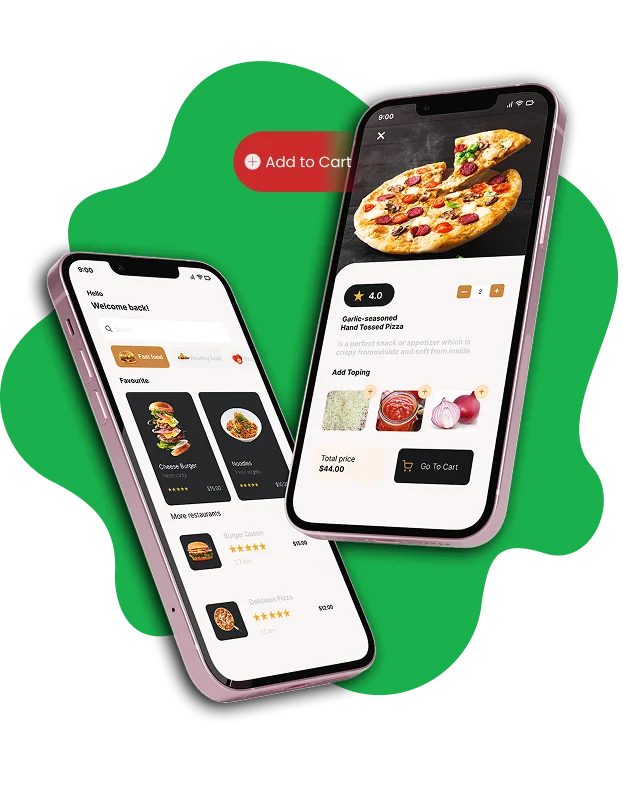
The team focused on simplicity. Users can browse menus, customize dishes, and leave special instructions with just a few taps. The interface was designed to be intuitive, reducing friction at every step so customers could place an order in under a minute.
Real-Time Tracking
Transparency was another priority. Calgary App Developers integrated real-time GPS tracking so customers know exactly when their food is being prepared, picked up, and delivered. This feature eliminated the guessing game and gave users peace of mind during the wait.
Personalized Recommendations
To make the app feel smarter, advanced recommendation algorithms were added. These suggestions help customers discover new restaurants and dishes that match their taste preferences, creating more opportunities for restaurants to be discovered while keeping customers engaged.
Secure Payments
Trust is everything in food delivery. The app supports multiple payment methods with advanced encryption, giving users confidence in every transaction. Smooth checkout and instant confirmations made the process both safe and hassle-free.
Order History and Reordering
Customer convenience was elevated with a simple order history tool. Users can quickly reorder their favorite meals, saving time and ensuring they never forget a dish they loved.
Results and Impact
Yummi Runs quickly gained traction by combining reliable delivery with a customer-first approach. The app did more than bring meals to doorsteps. It created a smoother, more personal food delivery experience. By focusing on usability, transparency, and personalization, Calgary App Developers helped turn Yummi Runs into a trusted part of people’s everyday routine.
Development Checklist for On-Demand Delivery Apps
Building an on-demand delivery app requires careful planning and attention to detail. A checklist helps ensure you do not miss critical elements during development. Here are the key steps to keep in mind:
- Define Your Target Market and Niche: Decide whether your app will focus on food, groceries, medicine, or multi-service delivery. Understanding your audience early shapes the features, design, and overall business model.
- Choose the Right Technology or No-Code Platform: Select a development approach that matches your budget and growth goals. No-code platforms work for quick launches, while custom coding is better for scaling. Make sure the chosen platform supports GPS tracking, payments, and notifications.
- Design a User-Friendly Interface: Keep the interface clean and intuitive. Customers should be able to register, search, order, and pay within minutes. Delivery partners should also find it easy to accept and complete tasks without confusion.
- Integrate Core Features: Essential features include order placement, real-time tracking, secure payments, push notifications, and ratings. Without these, an on-demand delivery app struggles to gain customer trust or repeat usage.
- Set Up Secure Payment Gateways: Support multiple payment options such as cards, wallets, and UPI. Security and convenience must go hand in hand to encourage customers to complete transactions confidently.
- Build a Strong Admin Dashboard: Businesses need visibility into orders, users, payments, and analytics. A centralized dashboard ensures smooth operations and helps with data-driven decision-making.
- Test Across Devices and Scenarios: Thorough testing ensures your app works on different phones, networks, and operating systems. Simulate real-world conditions such as high order volumes and delayed connections to catch issues early.
- Plan a Pilot Launch: Release a beta version to a small audience first. Gather feedback, track performance, and make improvements before a wider launch. This step reduces risks and improves user satisfaction.
- Prepare Ongoing Support and Updates: An on-demand delivery app is never finished at launch. Plan regular updates, fix bugs, and add new features based on customer feedback. Consistent improvement keeps users engaged and loyal.
Conclusion
The demand for fast, reliable, and user-friendly services has made the on-demand delivery app one of the most powerful tools for modern businesses. From food and groceries to healthcare and logistics, these apps have redefined convenience for customers and created new opportunities for companies to grow.
If you are ready to build your own on-demand delivery app, having the right on demand delivery app development company makes all the difference. At Calgary App Developers, we specialize in creating apps that are intuitive, scalable, and built to perform in competitive markets. Whether you want to launch quickly with no-code solutions or develop a fully customized platform, our team can help bring your vision to life.
Your idea has the potential to shape the future of delivery. Let Calgary Mobile App Developers turn that idea into a reality.
FAQ’s About On Demand Delivery App Development
1. How much does it cost to build an on-demand delivery app?
A no-code on-demand delivery app typically costs between USD 2,000 and USD 10,000, depending on features and integrations. A custom-built app with real-time tracking, payment gateways, admin dashboards, and scalable backend infrastructure usually ranges from USD 25,000 to USD 100,000 or more, depending on complexity, platform coverage, and long-term scalability requirements.
2. How long does it take to develop an on-demand delivery app?
A no-code app can be developed and launched within 2 to 6 weeks. A custom-built on-demand delivery app generally takes 3 to 6 months, depending on features, integrations, testing cycles, and whether you are building for both iOS and Android platforms. More advanced enterprise solutions may take longer.
3. What are the essential features every on-demand delivery app must have?
Core features include user registration, smart search, order placement, real-time tracking, multiple payment options, push notifications, ratings and reviews, and an admin dashboard. Separate panels for customers, delivery partners, and administrators are also essential. These elements ensure smooth operations, transparency, and a reliable user experience.
4. Can I build an on-demand delivery app without coding experience?
Yes. No-code platforms allow entrepreneurs to create functional delivery apps using drag-and-drop tools. These platforms support payments, notifications, and user roles without programming knowledge. However, for advanced customization, scalability, and performance optimization, working with experienced developers may provide better long-term results.
5. How do on-demand delivery apps make money?
Revenue models vary. Common approaches include charging delivery fees, service fees, subscription plans for businesses, commission on transactions, or premium placement for vendors. Some apps also use advertising or loyalty memberships. Choosing the right monetization model depends on your target market and competitive positioning.
6. What industries benefit most from on-demand delivery apps?
Food and beverages, groceries, healthcare, logistics, retail, and home services are among the strongest adopters. Any industry that values speed and convenience can benefit. The model works especially well in urban markets where customers prioritize quick access and real-time tracking.
7. How can I ensure my delivery app stands out in a competitive market?
Focus on speed, reliability, and user experience. Offer real-time tracking, flexible payment options, strong customer support, and an intuitive design. Personalization, loyalty programs, and consistent performance under high demand also help differentiate your app. Building trust through transparency and data security is equally important for long-term growth.


Pankaj Arora is a seasoned technology leader and the Founder of Calgary App Developer, with 10+ years of expertise in crafting high-performance digital solutions. His core competencies include full-stack app development, cloud-native architecture, API integration, and agile product delivery. Under his leadership, Calgary App Developers has empowered startups and enterprises alike with scalable mobile applications, secure web platforms, and AI-driven SaaS products.