











How To Create A Crypto Exchange: A Brief Guide

The cryptocurrency exchange space stands at a pivotal moment. Platforms that enable the buying and selling of digital assets play a central role in making crypto accessible to both retail and institutional participants. Based on our direct experience building and scaling multiple cryptocurrency exchange platforms, we have seen firsthand how robust technology, stringent compliance frameworks, and thoughtful user experience define success in this sector.
The global market for cryptocurrency exchanges is on track for significant growth. Estimates put the size of the crypto exchange market at about $85.75 billion in 2026 and project it expanding to over $314 billion by 2033. This growth reflects rising adoption of digital assets across borders and use cases in financial services and commerce.
With an expanding user base and evolving regulatory expectations, launching a cryptocurrency exchange today demands clarity of purpose and execution excellence. This guide will walk you through how to approach the process with the insights we have gained from real-world development and deployment.
- Starting a cryptocurrency exchange requires strategic planning, regulatory compliance, and secure infrastructure.
- Choosing the right exchange model directly impacts scalability, liquidity, and legal obligations.
- Development costs typically range from $150,000 to $500,000, depending on complexity and jurisdiction.
- Long-term success depends on security, performance, and continuous operational monitoring.
- A cryptocurrency exchange functions as a digital marketplace that enables users to buy, sell, and trade digital assets through a structured trading engine and wallet system.
- Selecting between centralized, decentralized, and hybrid models determines custody responsibility, compliance exposure, and liquidity strategy.
- Comprehensive market research and business planning are essential to define revenue models, target audiences, and regulatory pathways before development begins.
- Building a cryptocurrency exchange involves structured phases, including scope definition, architecture design, core module development, testing, deployment, and ongoing maintenance.
- Regulatory compliance, including licensing, KYC, and AML frameworks, is critical to ensuring operational legitimacy and long-term sustainability.
- The total cost of launching a crypto exchange depends on feature complexity, jurisdictional requirements, security standards, liquidity integration, and post-launch operations.
What Is a Crypto Exchange and How It Works
A crypto exchange is a digital platform that allows users to buy, sell, and trade cryptocurrencies such as Bitcoin, Ethereum, and other digital assets. It acts as a marketplace where buyers and sellers meet, similar to a stock exchange, but designed specifically for blockchain-based assets.
A crypto exchange provides pricing data, order execution, wallet integration, and security systems that enable users to transact with confidence. Depending on the model, it may operate as a centralized platform that manages custody and transactions, or as a decentralized protocol that allows peer-to-peer trading without an intermediary.
How It Works
- Users create an account and complete identity verification if required.
- Funds are deposited into a secure wallet on the platform.
- Users place buy or sell orders at market or limit prices.
- The matching engine pairs orders based on price and availability.
- Once matched, the transaction is executed, and balances are updated instantly.
Also Check: Best Cold Wallet for Crypto: Ultimate Security Guide
Types of Cryptocurrency Exchanges
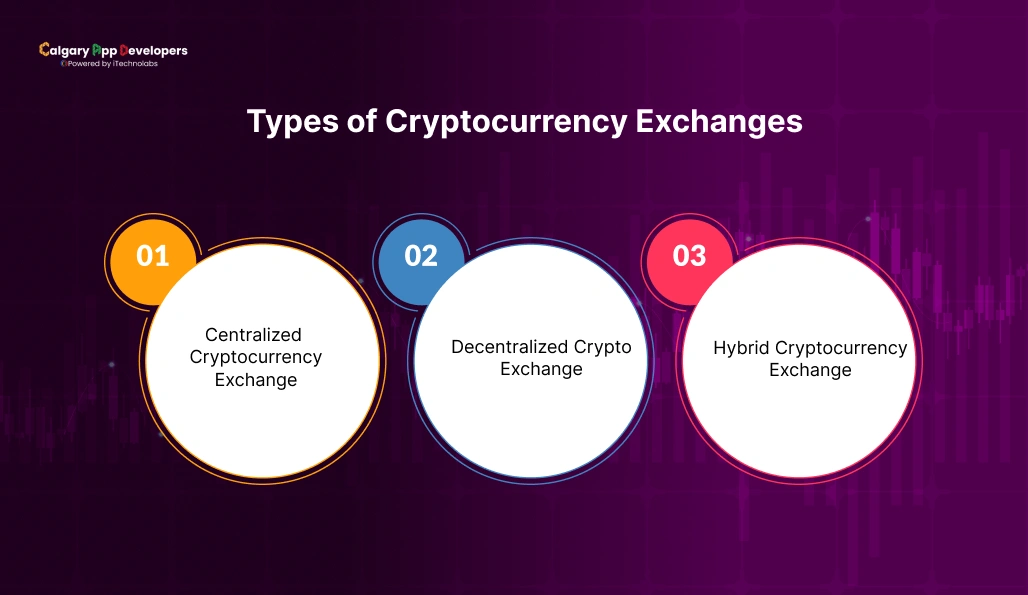
Choosing the right cryptocurrency exchange model is one of the most important strategic decisions in platform development. Each type operates differently in terms of control, liquidity, compliance, and user experience. The structure you select directly impacts scalability, security responsibilities, and regulatory exposure.
- Centralized Cryptocurrency Exchange
A centralized cryptocurrency exchange operates under a governing organization that manages user accounts, order matching, custody of funds, and compliance processes. These platforms typically offer high liquidity, faster transaction speeds, advanced trading tools, and customer support.
Users deposit funds into exchange-controlled wallets, and trades are executed within the platform’s internal system. While centralized exchanges deliver efficiency and convenience, they also require strong security frameworks and regulatory adherence to protect user assets.
- Decentralized Crypto Exchange
A decentralized crypto exchange functions without a central authority. Transactions are executed through smart contracts on a blockchain network, allowing users to trade directly from their wallets.
This model enhances transparency and reduces custody risk since users retain control of their private keys. However, liquidity depth, transaction speed, and user experience can vary depending on the underlying blockchain infrastructure.
- Hybrid Cryptocurrency Exchange
A hybrid cryptocurrency exchange combines elements of centralized and decentralized systems. It aims to offer the liquidity and performance of centralized platforms while preserving the security and asset control advantages of decentralized models.
Hybrid exchanges seek to balance efficiency with autonomy, making them an emerging option for platforms that want flexibility without compromising performance.
The choice of cryptocurrency exchange model defines the operational backbone of your platform. It influences compliance obligations, user trust, liquidity strategy, and long-term scalability. Understanding the structural differences between centralized, decentralized, and hybrid models allows you to align your exchange with your target audience, risk appetite, and growth vision.
Read Also: Cryptocurrency Exchange App Development: An Ultimate Guide
Market Research and Business Planning for a Crypto Exchange
Launching a crypto exchange without structured research is a costly mistake. The market is competitive, regulation-driven, and highly sensitive to trust. A clear understanding of user demand, geographic opportunities, and competitor positioning is essential before development begins.
Start by identifying your target audience. Retail traders, institutional investors, and niche communities such as derivatives traders each require different features and liquidity depth. Analyze leading exchanges to understand fee models, token listings, security practices, and user experience standards.
Business planning should define your revenue model, whether through trading fees, listing fees, margin trading, staking services, or premium features. Regulatory considerations must also shape your strategy, especially when selecting a jurisdiction for operations.
A well-structured plan transforms a crypto exchange from a technical project into a scalable financial platform with long-term viability.
Steps to Build a Cryptocurrency Exchange
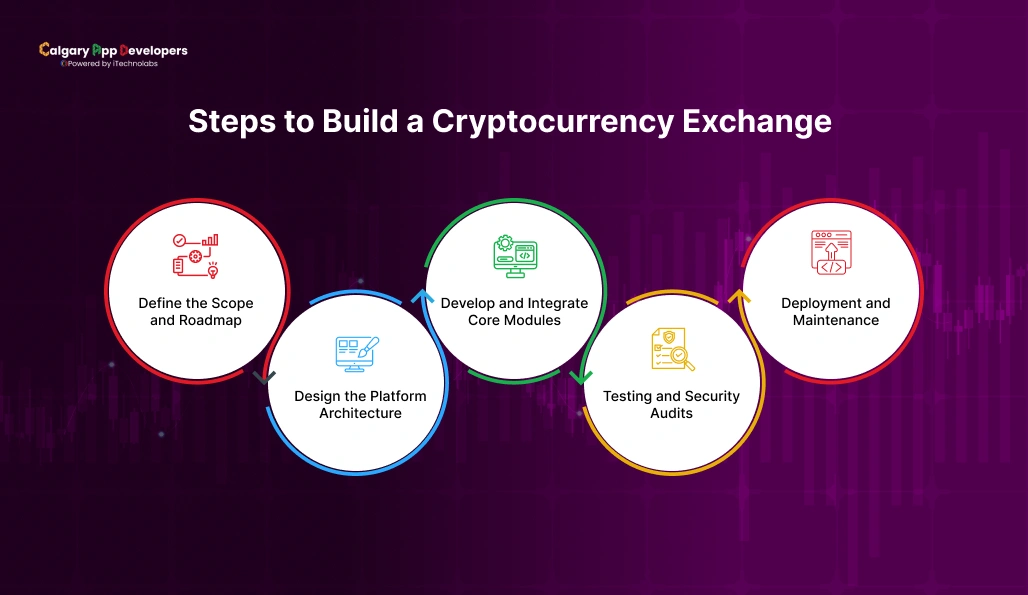
Developing a cryptocurrency exchange is not just a software project. It is the creation of a financial infrastructure that must operate with precision, speed, security, and regulatory discipline. Every stage requires careful coordination between business strategy, technical architecture, compliance planning, and risk management. The following framework outlines the critical phases involved in building a reliable and scalable platform.
1. Define the Scope and Roadmap
Clarity at the beginning determines efficiency throughout the build cycle. This phase establishes direction, budget alignment, and measurable objectives.
- Define the exchange structure, centralized, decentralized, or hybrid, based on operational control and compliance strategy.
- Identify primary and secondary target markets, including geographic regions and user segments.
- Select supported cryptocurrencies, trading pairs, derivatives, or margin trading features if applicable.
- Determine liquidity strategy, whether internal market making or external liquidity provider integration.
- Outline regulatory obligations, licensing pathways, KYC and AML frameworks, and reporting standards.
- Create a phased product roadmap covering MVP launch, feature expansion, and scaling milestones.
A detailed scope ensures that technical development supports long-term business goals rather than short-term experimentation.
2. Design the Platform Architecture
Architecture defines performance, resilience, and scalability. A cryptocurrency exchange must process thousands of transactions per second without latency or downtime.
- Engineer a high-performance matching engine capable of executing orders in milliseconds.
- Design wallet infrastructure separating hot wallets for active transactions and cold storage for asset protection.
- Implement distributed databases to maintain accurate trade history, order books, and user balances.
- Integrate load-balancing systems to manage traffic spikes during volatile market conditions.
- Apply end-to-end encryption, role-based access controls, and multi-factor authentication mechanisms.
- Establish backup systems and disaster recovery protocols to ensure business continuity.
Strong architecture protects both system integrity and user trust.
3. Develop and Integrate Core Modules
With architecture in place, development focuses on building interconnected modules that operate seamlessly across the platform.
- Develop the trading engine, order book management, and real-time price feeds.
- Build user onboarding flows with secure authentication and identity verification integration.
- Create administrative dashboards for transaction monitoring, compliance oversight, and liquidity management.
- Integrate blockchain nodes or third-party custody providers for asset deposits and withdrawals.
- Implement fiat integration through banking partners or payment gateways where required.
- Enable advanced features such as staking, futures, lending, or API access for institutional users.
Each module must be rigorously tested to ensure synchronization across all system layers.
4. Testing and Security Audits
Financial platforms cannot tolerate instability. Testing must be exhaustive and systematic.
- Conduct functional testing across trading scenarios, including market orders, limit orders, and withdrawals.
- Perform stress testing to evaluate system behavior under peak trading volumes.
- Execute vulnerability assessments and penetration testing to identify security gaps.
- Audit smart contracts independently if decentralized components are included.
- Validate compliance processes to ensure regulatory reporting accuracy and data protection standards.
- Simulate real-world attack scenarios such as phishing attempts and API misuse.
Thorough testing minimizes financial, operational, and reputational risk before launch.
5. Deployment and Maintenance
Deployment transitions the cryptocurrency exchange from development to live financial infrastructure. Operational discipline becomes the priority.
- Launch in a secure production environment with continuous monitoring systems.
- Track trading performance metrics, including liquidity depth, slippage, and execution speed.
- Maintain active cybersecurity monitoring and incident response procedures.
- Release scheduled updates for feature improvements and security enhancements.
- Monitor regulatory developments and adapt compliance frameworks accordingly.
- Continuously gather user feedback to refine experience and platform stability.
Building a cryptocurrency exchange is an ongoing commitment. Sustained monitoring, security upgrades, and strategic evolution ensure the platform remains competitive in a fast-moving digital asset ecosystem.
Building a cryptocurrency exchange is a structured process that demands strategic clarity, technical depth, and ongoing operational discipline. Each stage, from planning and architecture to deployment and continuous monitoring, contributes to the platform’s reliability and long-term credibility. When executed methodically, these steps transform a concept into a secure, scalable, and competitive exchange ready to operate in a high-velocity digital asset market.
Also Read: Blockchain Wallet Development: An Ultimate Guide
Technology Stack for Crypto Exchange Development
The technology stack behind a cryptocurrency exchange directly influences performance, scalability, security, and long-term maintainability. Since exchanges process high-frequency transactions and manage sensitive financial data, the underlying infrastructure must support low-latency execution, strong encryption standards, and horizontal scalability.
Selecting the right technologies is not about trends. It is about stability, ecosystem maturity, security track record, and integration flexibility. Below is a structured overview of the core technologies typically used in cryptocurrency exchange development.
| Layer | Technologies Commonly Used |
| Frontend Development | React, Angular, Vue.js |
| Backend Development | Node.js, Python, Go, Java |
| Matching Engine | C++, Go, Rust |
| Database | PostgreSQL, MongoDB, Redis |
| Blockchain Integration | Web3.js, Ethers.js, Bitcoin Core, Ethereum Nodes |
| Wallet Infrastructure | Multi-signature wallets, Hardware security modules |
| Security | SSL encryption, Two-factor authentication, AES encryption |
| Cloud Infrastructure | AWS, Google Cloud, Microsoft Azure |
| DevOps and CI CD | Docker, Kubernetes, Jenkins |
| Monitoring and Analytics | Prometheus, Grafana, ELK Stack |
Legal and Regulatory Requirements for a Cryptocurrency Exchange
Regulation is one of the most critical pillars of a successful cryptocurrency exchange. Operating without a proper legal structure exposes the platform to shutdown risks, financial penalties, and loss of user trust. Regulatory expectations vary by region, but compliance is no longer optional in most active markets.
1. Licensing and Registration
Most jurisdictions require a cryptocurrency exchange to obtain specific licenses or register as a financial services provider.
- Apply for virtual asset service provider registration where mandated.
- Secure money transmitter or digital asset trading licenses, depending on the region.
- Establish a legally registered corporate entity.
- Maintain proper financial reporting and audit processes.
Licensing demonstrates legitimacy and enables access to banking partnerships and payment providers.
2. KYC and AML Compliance
Know Your Customer and Anti Money Laundering frameworks are core compliance requirements.
- Implement identity verification procedures during onboarding.
- Monitor transactions for suspicious activity.
- Maintain transaction records for regulatory review.
- Integrate automated compliance monitoring tools.
Strong compliance systems protect the platform from financial crime exposure and regulatory action.
3. Jurisdiction Selection
Choosing the right jurisdiction influences taxation, regulatory complexity, and operational flexibility.
- Evaluate crypto-friendly regulatory environments.
- Consider licensing costs and processing timelines.
- Assess corporate tax structures and reporting obligations.
- Review banking accessibility and financial infrastructure.
A strategic jurisdiction decision provides operational clarity and reduces future legal friction.
Careful attention to legal and regulatory requirements builds credibility and positions a cryptocurrency exchange for sustainable global growth.
Read Also: How Much Does It Cost to Build a Cryptocurrency Exchange App like Coinbase?
Key Features of a Successful Cryptocurrency Exchange
The strength of a cryptocurrency exchange depends on its ability to deliver essential features that make the platform usable for its customers. Traders require platforms to deliver their services with fast execution times, full market visibility, safe operations, and constant market availability. A successful platform must deliver on all fronts while maintaining performance under high trading volumes.
Below are the essential features that define a competitive cryptocurrency exchange.
- High Performance Matching Engine: The matching engine is the core of the platform. It must execute trades in milliseconds, handle high transaction throughput, and maintain accurate order book synchronization during volatile market conditions.
- Advanced Order Types: Beyond basic market and limit orders, modern exchanges support stop loss, take profit, margin trading, and conditional orders. These tools allow traders to manage risk and execute sophisticated strategies.
- Strong Security Infrastructure: Security is non-negotiable. Essential measures include multi-factor authentication, encrypted communication, cold wallet storage, withdrawal confirmation protocols, and real-time threat monitoring.
- Liquidity Management: Deep liquidity ensures minimal slippage and stable pricing. Exchanges often integrate external liquidity providers or deploy internal market-making strategies to maintain order book depth.
- User-Friendly Interface: The platform must balance advanced trading tools with intuitive navigation. Real-time charts, clear order placement flows, and responsive design improve user retention.
- Wallet Integration: Secure deposit and withdrawal systems with blockchain confirmation tracking are essential. Efficient wallet management builds trust and operational stability.
- Compliance and Reporting Tools: Built-in KYC processes, transaction monitoring, and regulatory reporting features protect the exchange from compliance risks and build institutional credibility.
- API Access: Providing API endpoints enables algorithmic trading and third-party integrations, expanding the platform’s ecosystem and liquidity channels.
A successful cryptocurrency exchange combines technical precision, security discipline, and user-centric design. When these features work together, the platform becomes a trusted marketplace rather than just a trading interface.
Also Read: How Much Does It Cost to Create Crypto Trading App Like Swyftx?
Cost to Start a Crypto Exchange
The cost to start a crypto exchange typically ranges from $150,000 to $500,000, depending on platform complexity, regulatory jurisdiction, security standards, and feature scope.
The total investment is influenced by development scope, licensing obligations, liquidity arrangements, infrastructure selection, and long-term operational planning. A basic exchange with limited trading pairs and essential compliance systems will require significantly less capital than a full-scale platform offering derivatives, margin trading, staking, and institutional APIs.
Total Cost Estimation
| Cost Component | Estimated Cost Range |
| Business Registration and Licensing | $20,000 to $100,000 |
| Legal and Compliance Setup | $15,000 to $60,000 |
| UI and UX Design | $15,000 to $40,000 |
| Backend and Matching Engine Development | $50,000 to $150,000 |
| Wallet and Blockchain Integration | $20,000 to $60,000 |
| Security Infrastructure and Audits | $25,000 to $80,000 |
| Liquidity Integration | $20,000 to $70,000 |
| Cloud Infrastructure and DevOps | $10,000 to $40,000 |
| Testing and Quality Assurance | $10,000 to $30,000 |
| Marketing and Launch Budget | $15,000 to $50,000 |
Factors Affecting the Cost of a Crypto Exchange
The total investment required to launch a crypto exchange is shaped by multiple strategic and technical decisions. Understanding these variables helps founders allocate capital efficiently and avoid underestimating long-term commitments.
- Exchange Model: A centralized platform generally requires higher investment in custody systems, compliance infrastructure, and operational staffing. A decentralized model may reduce custody liability but increase smart contract development and blockchain integration costs. Hybrid models combine both complexities.
- Regulatory Jurisdiction: Licensing fees, legal advisory costs, and compliance obligations vary significantly by country. Some jurisdictions require substantial capital reserves, ongoing reporting, and local representation, all of which increase overall expenditure.
- Feature Complexity: Basic spot trading costs less to implement than advanced features such as derivatives, margin trading, staking, lending, or institutional APIs. Each additional module increases development, testing, and security expenses.
- Security Standards: Investment in cold storage systems, penetration testing, encryption layers, and third-party audits directly impacts cost. Higher security standards require greater upfront and ongoing expenditure.
- Liquidity Strategy: Partnering with liquidity providers, integrating market-making services, or building internal liquidity pools adds to operational and technical costs.
- Technology Infrastructure: Scalable cloud hosting, distributed databases, load balancing systems, and monitoring tools increase reliability but also raise infrastructure spending.
- Development Approach: Building a cryptocurrency exchange from scratch demands a higher initial investment compared to white-label solutions, but it offers greater customization and long-term control.
- Post Launch Operations: Ongoing costs include compliance monitoring, cybersecurity updates, customer support teams, infrastructure scaling, and marketing. These recurring expenses must be factored into the total financial plan.
A clear understanding of these factors ensures that cost projections remain realistic and aligned with business objectives.
Read Also: Role of Blockchain in Cross-Border Payments: A Complete Guide
Our Expertise in Building Secure and Scalable Crypto Exchange Platforms
Building a secure and scalable crypto exchange demands more than development capability. It requires architectural discipline, regulatory awareness, liquidity planning, and continuous performance optimization. Our work in cryptocurrency exchange development reflects a structured approach that balances compliance, security, and growth readiness.
Due to NDA obligations, specific platform names cannot be disclosed. However, the following examples illustrate the scope and complexity of our engagements.
Case Example 1: Regulated Crypto Exchange in Canada
We partnered with a fintech group in Canada, aiming to launch a fully compliant cryptocurrency exchange targeting retail and institutional traders. The project required alignment with Canadian regulatory standards and strong custody controls.
Key deliverables included:
- High-performance matching engine capable of handling large order volumes
- Integrated KYC and AML framework aligned with Canadian compliance requirements
- Secure wallet architecture with cold storage separation
- Liquidity integration to ensure stable order book depth
- Real-time transaction monitoring and reporting systems
The platform successfully launched with a scalable cloud infrastructure capable of supporting regional expansion.
Case Example 2: Multi-Asset Crypto Exchange in the United States
In another engagement, we supported a US-based fintech startup operating from Texas that sought to build a multi-asset cryptocurrency exchange with advanced trading features.
Project scope included:
- Development of spot and margin trading modules
- API infrastructure for algorithmic traders
- Institutional-grade security framework with multi-factor authentication
- Infrastructure scaling for high volatility market conditions
- Integration of fiat on-ramp services through banking partnerships
The result was a robust cryptocurrency exchange platform engineered for performance, compliance readiness, and long-term growth.
These projects demonstrate our ability to design and deliver crypto exchange platforms that meet regulatory expectations while maintaining operational excellence and technical resilience.
Final Words
Launching a cryptocurrency exchange requires more than technical execution. It demands regulatory clarity, secure infrastructure, liquidity planning, and a long-term operational strategy. From selecting the right exchange model to building a high-performance matching engine and implementing strict compliance systems, every decision directly impacts platform stability and market credibility.
The cryptocurrency market continues to mature, and users expect exchanges that are fast, secure, and fully compliant. A well-structured development roadmap, supported by experienced engineering and strategic planning, transforms a concept into a trusted financial platform.
At Calgary App Developers, we specialize in building secure, scalable, and regulation-ready cryptocurrency exchange platforms. Our approach combines technical precision with industry insight to deliver solutions engineered for performance and long-term growth. If you are planning to enter the digital asset market, partnering with the right development team can define your competitive edge from day one.


Pankaj Arora is a seasoned technology leader and the Founder of Calgary App Developer, with 10+ years of expertise in crafting high-performance digital solutions. His core competencies include full-stack app development, cloud-native architecture, API integration, and agile product delivery. Under his leadership, Calgary App Developers has empowered startups and enterprises alike with scalable mobile applications, secure web platforms, and AI-driven SaaS products.