







How to Hire AI Developer: A Complete Guide
Hiring the right AI developer will define the success of your next big tech initiative. Not every programmer can turn complex data and algorithms into solutions that improve performance, efficiency, or growth. If your aim is to drive real business value with intelligent systems, you need someone who understands machine learning, model deployment, and data strategy at a deep level.
AI job listings are exploding, with postings growing more than 70 percent year-over-year as companies push forward with automation and intelligent products. Demand for roles like ML engineer and AI engineer is among the fastest growing in the global job market, even as general hiring slows.
This guide breaks down exactly how to hire AI developer in 2026, from defining project goals and writing clear job criteria to evaluating candidates and onboarding them successfully. Follow this roadmap, and you’ll know how to identify, attract, and retain the talent that will bring your AI ambitions to life.
TL;DR
- Hiring an AI developer requires specialized skills beyond standard software development.
- Clear hiring criteria reduce risk and prevent misaligned AI projects.
- Strong AI hires connect technical work directly to business outcomes.
- A structured process leads to faster and more reliable results.
Key Points
- AI developers must understand machine learning fundamentals, data pipelines, and model evaluation, not just programming languages or frameworks.
- Defining project goals and success metrics before hiring ensures the developer’s expertise aligns with real business needs.
- Effective screening should evaluate problem-solving ability, past AI project impact, and the candidate’s ability to explain complex ideas clearly.
- AI work is iterative, and developers must be comfortable testing, refining, and deploying models over time rather than delivering instant results.
- Investing in the right AI talent upfront reduces long-term costs, improves solution quality, and increases the likelihood of sustainable AI success.
The Harsh Truth About Hiring AI Developers
Hiring AI talent is not the same as hiring general software developers. Many companies make the mistake of assuming that any skilled programmer can handle AI projects. What this really means is projects often stall, budgets balloon, and expected outcomes fall short.
The challenge is twofold. First, AI development requires a mix of advanced technical skills, problem-solving ability, and domain knowledge. Second, the market for skilled AI developers is competitive, which makes attracting the right talent difficult. Companies that rush the hiring process or settle for candidates who check only some of the boxes often face delays, subpar results, and costly mistakes.
If you want to succeed, you need to hire an AI developer who not only understands algorithms and data models but also knows how to implement solutions that align with your business objectives. Recognizing this reality is the first step toward building an AI team that delivers real value.
Also Read: Top Sites to Hire AI Developers | Best AI Engineers for Hire
Why Hiring Any Developer Won’t Cut It for AI Projects
Not all developers are equipped to handle the complexities of AI. While a general software developer may excel at building apps or managing databases, AI projects require specialized skills in machine learning, data modeling, and algorithm optimization. Simply put, hiring a regular developer for an AI project is a risk you can’t afford.
AI development is more than writing code. It involves understanding large datasets, designing models that can learn and adapt, and integrating solutions that deliver measurable business outcomes. A developer without this expertise may produce code that runs but fails to achieve the intended impact, costing time and resources.
Here’s what separates a qualified AI developer from a general software developer:
- Deep knowledge of machine learning algorithms and frameworks
- Experience with data preprocessing, modeling, and evaluation
- Ability to translate business problems into AI solutions
- Familiarity with cloud platforms and AI deployment pipelines
- Strong problem-solving and analytical skills tailored to AI projects
This is why it is crucial to hire AI developer who can bridge the gap between technical capability and business strategy. By focusing on candidates with proven AI experience, you increase the likelihood of building systems that are not just functional but genuinely transformative.
What Sets a Great AI Developer Apart
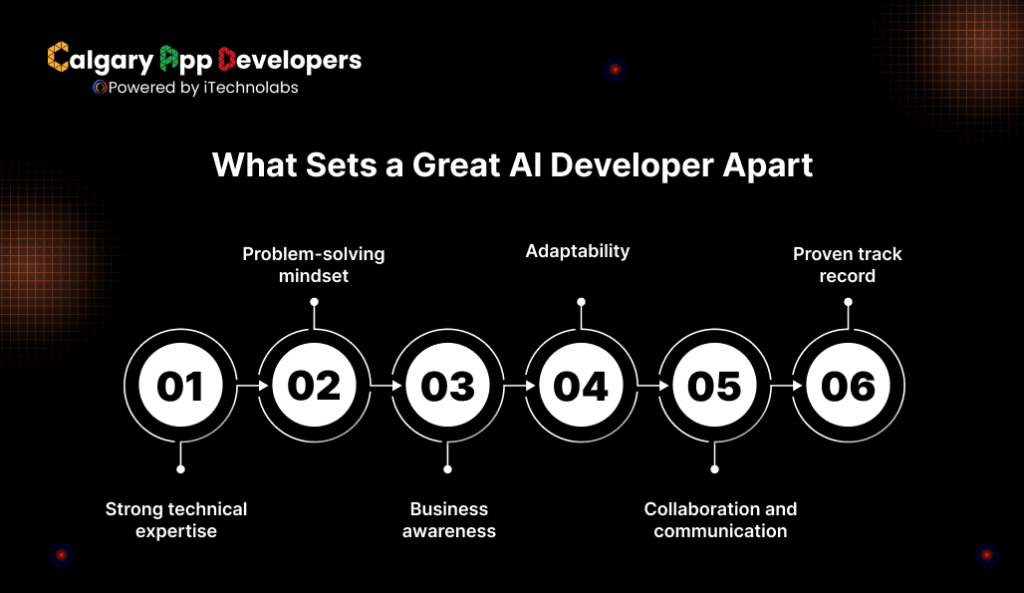
Hiring an AI developer is not just about checking technical skills off a list. The best AI developers combine expertise, creativity, and strategic thinking to turn complex problems into practical solutions. Understanding what sets top talent apart helps you make a confident hiring decision and ensures your AI projects deliver real value.
Key qualities to look for when you hire AI developer include:
- Strong technical expertise: Proficiency in machine learning algorithms, neural networks, natural language processing, and data engineering.
- Problem-solving mindset: Ability to approach challenges creatively, optimize models, and troubleshoot issues efficiently.
- Business awareness: Understanding how AI solutions align with business goals and can drive measurable results.
- Adaptability: Comfort with learning new tools, frameworks, and techniques as AI technology evolves.
- Collaboration and communication: Skill in working with cross-functional teams and explaining complex AI concepts in clear, actionable terms.
- Proven track record: Demonstrated success with previous AI projects, from ideation to deployment.
The right AI developer does more than write code. They become a strategic partner who can shape your AI initiatives, reduce risks, and accelerate outcomes. Hiring someone with these qualities ensures your AI investments are set up for success.
Also Read: How to Create an AI
Understanding the Real Cost of Hiring an AI Developer
Hiring an AI developer can cost anywhere between 2,000 and 7,000 USD per month, depending on experience, skill set, and project complexity. Understanding the true cost goes beyond salary; it includes recruitment, onboarding, tools, and infrastructure required to make your AI project successful.
Here’s a breakdown of the total cost estimation:
| Cost Component | Estimated Range (USD) | Notes |
| Base Salary | 2,000 – 7,000/month | Depends on experience and expertise in AI/ML. |
| Recruitment & Hiring Fees | 250 – 1,500 | Includes job postings, agency fees, and screening costs. |
| Onboarding & Training | 200 – 700 | Time and resources spent integrating the developer into your team and tools. |
| Software & Tools | 100 – 700 | AI frameworks, cloud services, data storage, and analytics platforms. |
| Infrastructure & Hardware | 700 – 3,000 | High-performance machines, GPUs, and servers for AI workloads. |
| Miscellaneous | 100–400 | Additional costs such as certifications, workshops, or team activities. |
The total monthly cost of hiring a skilled AI developer can range from around 3,000 to 13,000 USD when all factors are considered. Many companies underestimate these costs, which often leads to budget overruns or delayed projects.
By understanding the full cost picture, you can make informed decisions and ensure your AI projects are adequately supported.
If you want to hire AI developer within your budget without compromising on quality, connect with Calgary App Developers today. We offer a free consultation to help you find the right talent and plan your AI hiring strategy efficiently.
Also Read: AI Development Cost
Your Step-by-Step Guide to Hiring the Right AI Developer
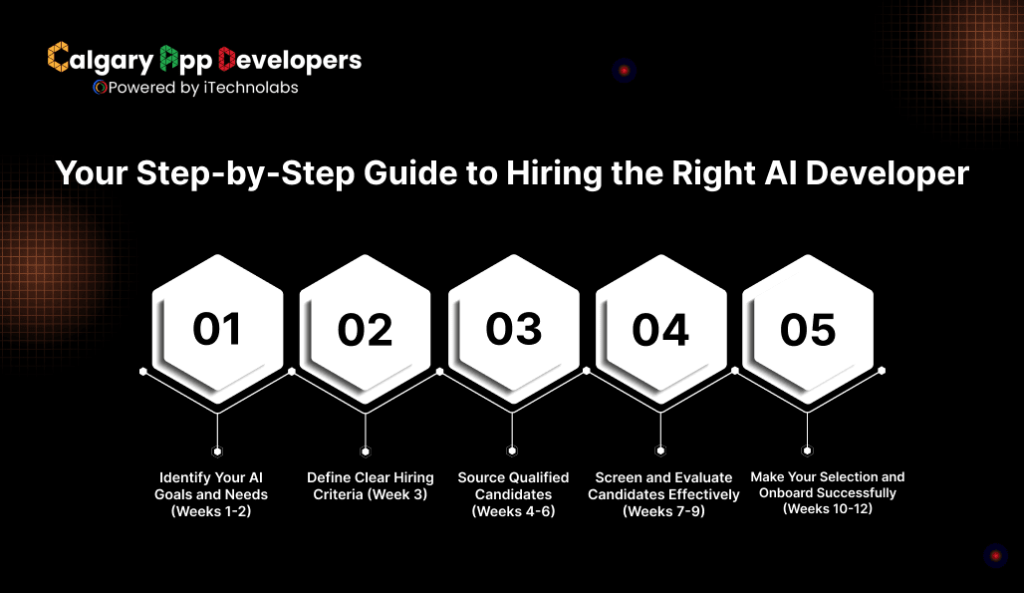
Hiring an AI developer is a critical investment in your company’s future. Unlike general software roles, AI projects require a unique blend of technical expertise, analytical thinking, and strategic insight. Following a structured roadmap ensures you attract the right talent, reduce hiring risks, and set your AI initiatives up for success.
Phase 1: Identify Your AI Goals and Needs (Weeks 1-2)
Before you hire AI developer, you need to define exactly what you want to achieve with AI. This phase is about clarity and alignment. Ask yourself:
- What specific problems are we trying to solve with AI?
- Do we need predictive analytics, recommendation systems, natural language processing, or computer vision capabilities?
- What data do we already have, and what additional data will we need to collect?
- How will success be measured, and what metrics will indicate progress?
For example, if your goal is to implement a customer support chatbot, you need a developer experienced in natural language processing and conversational AI rather than someone who specializes in predictive analytics. A clear understanding of your goals ensures that the candidate you hire can deliver tangible results rather than just code.
Phase 2: Define Clear Hiring Criteria (Week 3)
With goals in place, the next step is to create a precise profile of the AI developer you need. This includes both technical and soft skills:
- Technical expertise: Proficiency in machine learning, deep learning frameworks like TensorFlow or PyTorch, data pipelines, and algorithm optimization.
- Experience: Proven track record of handling projects similar in size, scope, or domain. Past projects are the best indicator of ability.
- Problem-solving and analytical thinking: Ability to approach complex challenges methodically and propose efficient solutions.
- Collaboration and communication: Must be able to explain technical concepts to non-technical stakeholders and work effectively in a team.
- Adaptability: AI is constantly evolving. A strong developer is comfortable learning new tools, frameworks, and approaches as the technology advances.
Clear criteria prevent wasted time evaluating unqualified candidates and ensure that when you hire AI developer, you are targeting the right skill set.
Phase 3: Source Qualified Candidates (Weeks 4-6)
Finding top AI talent requires a strategic approach rather than relying on standard job postings. Consider multiple sourcing channels:
- Specialized job boards and platforms: Sites dedicated to AI, machine learning, and data science roles attract candidates with relevant expertise.
- Recruitment agencies: Agencies focused on tech and AI talent can help identify candidates who are not actively searching but are open to opportunities.
- Networking and events: Conferences, webinars, and AI meetups are excellent sources of high-quality candidates.
- Freelance or contract talent: For short-term or highly specialized projects, freelancers can provide immediate value while you continue your full-time search.
At this stage, the goal is to create a strong, diverse pool of candidates to maximize your chances of finding the ideal hire.
Phase 4: Screen and Evaluate Candidates Effectively (Weeks 7-9)
Screening is where you separate candidates who can write code from those who can deliver AI solutions. A thorough evaluation should include:
- Technical assessments: Coding challenges or project simulations relevant to your AI use case. For example, a candidate for a predictive analytics project might be asked to build a regression model using sample data.
- Portfolio review: Examine past AI projects, noting complexity, creativity, and business impact.
- Structured interviews: Assess problem-solving, strategic thinking, and ability to explain technical concepts clearly. Include scenario-based questions that reflect real challenges they might face.
- Cultural and team fit: AI developers work closely with cross-functional teams. Evaluate whether the candidate’s work style aligns with your company’s environment.
This step ensures you hire AI developer who not only meets technical requirements but also integrates smoothly into your team and contributes to long-term success.
Phase 5: Make Your Selection and Onboard Successfully (Weeks 10-12)
After identifying the right candidate, focus on a structured onboarding process to ensure early productivity:
- Finalizing the offer: Negotiate compensation and benefits transparently to secure commitment.
- Onboarding materials: Provide access to project documentation, data sources, tools, and development environments.
- Mentorship and support: Assign a mentor or project lead to guide the new hire through the first few weeks.
- Setting objectives: Define short-term goals to align expectations and measure early contributions.
A structured onboarding process ensures your AI developer can quickly adapt, contribute effectively, and start delivering measurable results for your AI initiatives.
Hiring AI developer is not just about filling a position; it’s about making a strategic investment. Following this roadmap reduces risk, saves time, and increases the likelihood of building AI solutions that truly add value to your business.
Also Read: AI Integration Services
Red Flags to Watch for When Hiring AI Developers
Hiring an AI developer is a significant investment, and making the wrong choice can cost time, money, and project momentum. Being aware of common warning signs helps you avoid costly mistakes and ensures you bring on talent capable of delivering results.
- Lack of Relevant AI Experience
One of the biggest red flags is a candidate who has general software experience but limited exposure to AI or machine learning projects. Writing code is one thing, but understanding algorithms, model evaluation, and data pipelines is entirely different. If a candidate cannot provide clear examples of AI projects they’ve completed, proceed with caution.
- Overemphasis on Tools Over Fundamentals
A strong AI developer understands the principles behind algorithms and models, not just how to operate a specific framework or library. Candidates who focus solely on tools like TensorFlow or PyTorch without explaining underlying concepts may struggle to solve complex, real-world problems.
- Poor Problem-Solving Skills
AI projects are rarely straightforward. A candidate who cannot demonstrate structured problem-solving or creative thinking may find it difficult to handle the inevitable challenges in model design, data preprocessing, or deployment.
- Inability to Communicate Complex Concepts
AI developers often need to collaborate with non-technical stakeholders. If a candidate struggles to explain technical concepts in plain language or fails to convey how a model delivers business value, this can signal potential collaboration issues.
- Unrealistic Promises
Be cautious of candidates who guarantee perfect results or overly ambitious timelines. AI is inherently iterative, and even experienced developers must experiment and refine models to achieve optimal outcomes. Overconfidence can lead to misaligned expectations and project delays.
- Limited Curiosity or Adaptability
AI is a rapidly evolving field. Candidates who show little interest in learning new algorithms, frameworks, or techniques may quickly become outdated, limiting their long-term value to your team.
Hiring AI developer requires careful evaluation beyond resumes and technical tests. By spotting these red flags early, you increase your chances of hiring a developer who can handle complex challenges, work collaboratively, and drive meaningful results.
Read Also: How to Build an AI App?
Strategies to Attract Top AI Talent
Hiring AI developer is not just about posting a job and waiting for applications. Top AI professionals are in high demand, and attracting them requires a strategic approach that emphasizes opportunity, challenge, and growth.
- Craft a Clear and Compelling Job Description
Your job posting should go beyond listing technical requirements. Highlight the impact the AI developer will have on your business, the type of projects they will work on, and the technologies they will use. Clear goals and exciting challenges make your role more attractive to top talent.
- Highlight Learning and Growth Opportunities
AI professionals are driven by curiosity and a desire to learn. Emphasize opportunities for skill development, exposure to new algorithms and frameworks, and chances to work on cutting-edge projects. Showing that your organization invests in professional growth can set you apart from competitors.
- Take Advantage of Professional Networks and Communities
Join AI communities, online communities, and professional networks. LinkedIn, GitHub, Kaggle, and specialized AI forums are excellent platforms to find talented developers and make connections prior to recruitment. Attending AI conferences and meetups also enhances your visibility among the most talented professionals.
- Offer Competitive Compensation and Benefits
High-quality AI developers command premium compensation. While salary is important, additional benefits such as flexible work arrangements, access to cloud computing resources, and support for research or certifications can make your offer more appealing.
- Showcase Your Company’s AI Vision
Talented AI professionals want to work on meaningful projects. Communicate your organization’s AI strategy, long-term goals, and the potential impact of their work. Candidates are more likely to join a company where they see an opportunity to innovate and make a difference.
- Simplify the Hiring Process
A lengthy or unclear hiring process can discourage top candidates. Provide clear timelines, communicate consistently, and respect the candidate’s time. An efficient and transparent process demonstrates professionalism and increases the likelihood of securing the best talent.
To successfully hire AI developer, focus on presenting a compelling opportunity, supporting growth, and engaging candidates through multiple channels. By positioning your organization as a place where AI professionals can thrive, you increase your chances of attracting the talent needed to deliver transformative AI solutions.
Also Read: Top Sites To Hire Freelance AI Developers
Choosing the Best AI Developer for Your Custom Project
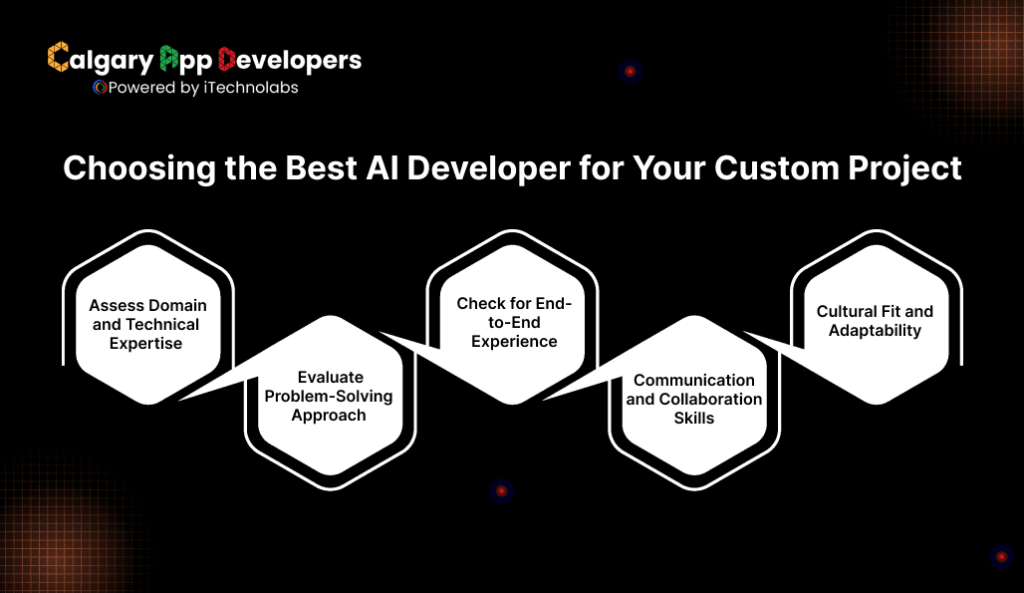
Hiring AI developer for a custom project is different from filling a standard role. Custom AI projects often involve unique data sets, specific business objectives, and specialized models, which means the candidate’s skills and experience must closely match the project’s requirements.
1. Assess Domain and Technical Expertise
The first step is evaluating whether the candidate has the technical skills and domain knowledge relevant to your project. For instance, a project focused on predictive maintenance in manufacturing requires experience with time-series data and anomaly detection, while a customer behavior analytics project might require expertise in recommendation systems or natural language processing. Look for developers who have successfully executed similar projects in your industry.
2. Evaluate Problem-Solving Approach
Custom AI projects rarely follow a predefined path. A top AI developer should demonstrate a structured approach to problem-solving, including:
- Understanding the business problem thoroughly
- Designing appropriate AI models or pipelines
- Testing, iterating, and refining solutions
- Handling challenges such as noisy data or limited datasets
Ask candidates to walk through examples of past projects and explain their decision-making process, model choices, and trade-offs.
3. Check for End-to-End Experience: A skilled AI developer should not only build models but also know how to deploy, monitor, and maintain them in production. End-to-end experience ensures that the solution will be practical, scalable, and deliver measurable business results.
4. Communication and Collaboration Skills: Custom AI projects often involve collaboration with data engineers, product managers, and business stakeholders. The ability to communicate complex technical concepts clearly and work effectively in a team is crucial for successful project execution.
5. Cultural Fit and Adaptability: Finally, consider how well the developer will integrate with your team and adapt to evolving project needs. AI projects are iterative and require flexibility as requirements shift or data challenges emerge.
Also Read: Cost to Hire an AI Developer
Special Considerations for Custom AI Projects
Custom AI projects come with challenges and opportunities that differ from standard implementations. When you hire AI developer for a specialized project, keeping these considerations in mind ensures smoother execution and better outcomes.
1. Data Quality and Availability: Custom projects often rely on proprietary or domain-specific data. Before hiring, assess the quality, volume, and accessibility of your datasets. A skilled AI developer should be able to handle incomplete, noisy, or unstructured data and design models that perform reliably despite these challenges.
2. Project Scope and Flexibility: Custom AI initiatives tend to evolve as insights emerge. Clearly define your initial objectives but maintain flexibility for iterative development. The developer you hire should be comfortable adjusting models, experimenting with new approaches, and refining solutions based on ongoing feedback.
3. Integration with Existing Systems: Many custom AI solutions must work alongside existing software, databases, or platforms. When hiring, ensure the candidate has experience with system integration, API development, and deployment strategies that align with your infrastructure.
4. Scalability and Future-Proofing: A custom project may start small but should be designed to scale. The AI developer should build solutions with future growth in mind, considering factors such as model retraining, data storage, and increasing user demand.
5. Intellectual Property and Security: Custom AI projects often involve sensitive data or proprietary algorithms. When you hire AI developer, ensure they understand best practices for data security, confidentiality, and IP protection. This includes secure coding, access control, and compliance with relevant regulations.
6. Clear Communication and Documentation: Documenting assumptions, model design, and results is crucial for long-term success. The developer should provide clear documentation and regular updates, ensuring that knowledge is retained within your organization and that future team members can maintain or enhance the solution.
Custom AI projects require careful planning, flexibility, and attention to technical and operational details. Hiring an AI developer who understands these considerations ensures your project runs smoothly, delivers actionable results, and provides a foundation for future growth.
Read Also: Best AI Cloud Business Tools for Smarter Management
The Advantages of Hiring the Right AI Developer
Hiring AI developer is more than filling a position; it is a strategic investment that can significantly impact your organization’s innovation, efficiency, and competitive advantage. The right developer brings technical expertise, problem-solving ability, and strategic insight, ensuring your AI initiatives deliver measurable results.
1. Accelerated Project Delivery: Experienced AI developers understand how to design, train, and deploy models efficiently. Their expertise reduces trial-and-error, accelerates project timelines, and ensures that AI solutions move from concept to production faster.
2. High-Quality, Reliable Solutions: The right developer builds models that are robust, accurate, and aligned with business objectives. They apply best practices in data handling, model evaluation, and testing, which minimizes errors and ensures long-term reliability.
3. Cost Efficiency Over Time: While hiring an expert may seem costly upfront, it reduces risks associated with mistakes, project delays, or low-performing models. Efficient, well-designed AI solutions save resources and provide a higher return on investment over the long term.
4. Innovation and Competitive Advantage: A skilled AI developer brings creativity and advanced knowledge of algorithms and technologies. They can identify novel approaches to business challenges, uncover new insights from data, and create solutions that give your company a competitive edge.
5. Strategic Alignment with Business Goals: Top AI developers do more than write code; they understand your business objectives and design AI solutions that directly support them. This ensures that AI initiatives are not only technically sound but also contribute meaningfully to organizational goals.
6. Scalability and Future-Proofing: The right developer builds solutions with scalability in mind. They design models and infrastructure that can handle growing data volumes, evolving business needs, and future technological advancements, ensuring your AI investment continues to pay off.
Implementation Timeline: What to Expect Once You Hire AI Developer
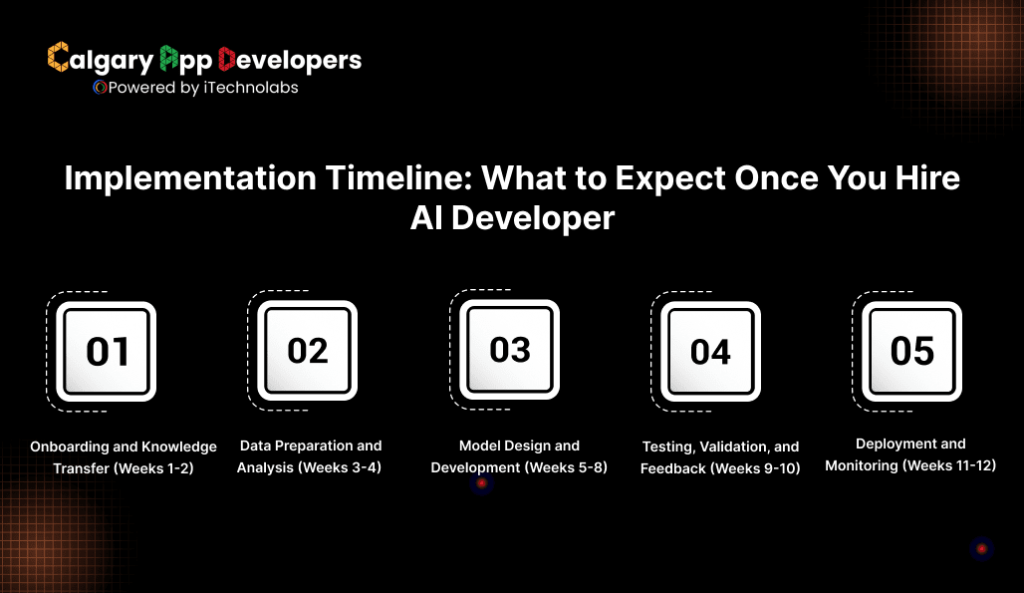
Hiring AI developer is just the beginning. Once on board, a structured timeline ensures your project progresses efficiently and delivers measurable results. Understanding typical phases and milestones helps set realistic expectations for both management and the development team.
Phase 1: Onboarding and Knowledge Transfer (Weeks 1-2)
During the first two weeks, the focus is on integrating the developer into your team and familiarizing them with your business and data environment. Key activities include:
- Introducing company goals, project objectives, and existing data infrastructure
- Providing access to necessary tools, platforms, and datasets
- Conducting initial knowledge transfer sessions with stakeholders or previous teams
- Setting short-term objectives to guide early contributions
A smooth onboarding process lays the foundation for productivity and alignment with project goals.
Phase 2: Data Preparation and Analysis (Weeks 3-4)
High-quality AI solutions rely on clean, well-structured data. This phase typically involves:
- Assessing existing datasets for completeness, consistency, and relevance
- Cleaning, labeling, and preprocessing data for model training
- Identifying gaps or additional data requirements
- Collaborating with data engineers or analysts to ensure infrastructure readiness
Proper data preparation ensures that models can be trained effectively and produce reliable results.
Phase 3: Model Design and Development (Weeks 5-8)
With data in place, the AI developer begins designing and building models:
- Selecting appropriate algorithms and frameworks for the project
- Training initial models and testing their performance
- Iterating to refine accuracy, efficiency, and scalability
- Documenting design choices and development progress
This phase is critical to achieving functional, high-performing AI solutions.
Phase 4: Testing, Validation, and Feedback (Weeks 9-10)
Before deployment, models must be rigorously tested:
- Validating model outputs against business objectives and benchmarks
- Conducting stress tests and evaluating performance under various conditions
- Gathering feedback from stakeholders to ensure alignment with expectations
- Making necessary adjustments to improve reliability and usability
Thorough testing minimizes risks and ensures the solution meets both technical and business standards.
Phase 5: Deployment and Monitoring (Weeks 11-12)
The final phase focuses on putting the AI solution into production and establishing monitoring practices:
- Deploying models to the live environment or integrating with existing systems
- Setting up monitoring tools to track performance, accuracy, and anomalies
- Planning for ongoing maintenance, retraining, and scalability
- Conducting post-deployment reviews to identify lessons learned and future improvements
Also Read – AI Business Solutions
Making the Decision: Setting Your AI Strategy in Motion
Hiring AI developer is more than a staffing choice; it is a pivotal step in shaping your organization’s AI strategy and long-term growth. The decisions you make now will determine how effectively your company leverages AI to drive innovation, efficiency, and competitive advantage.
1. Assess Your Readiness and Objectives
Before moving forward, ensure your organization has clearly defined AI goals, has identified the challenges you want to solve, and understands the resources required. This clarity allows you to hire AI developer whose skills and experience align precisely with your strategic objectives.
2. Recognize the Impact of the Right Hire
The right AI developer brings more than technical expertise. They contribute strategic insight, improve project efficiency, and ensure your AI initiatives deliver measurable value. Conversely, a misaligned hire can lead to delays, increased costs, and underperforming models.
3. Take Action with Confidence
Once your goals, criteria, and budget are defined, it’s time to act. Engaging the right talent, following a structured hiring and onboarding process, and aligning the developer with your business objectives sets the stage for successful AI deployment.
4. Build a Foundation for the Future
AI is not a one-off project; it is an evolving capability. By hiring the right AI developer now, you create a foundation for ongoing innovation, scalable solutions, and data-driven decision-making that will serve your organization for years to come.
Conclusion
Hiring AI developer is a strategic decision that can define the success of your AI initiatives. From clearly defining your goals and establishing hiring criteria to sourcing top talent, evaluating candidates, and managing onboarding, every step plays a critical role in building solutions that deliver real business value.
The right AI developer brings technical expertise, problem-solving skills, and strategic insight, ensuring your projects are efficient, scalable, and aligned with organizational objectives. Conversely, a misaligned hire can lead to delays, increased costs, and underwhelming results.
By following a structured approach, understanding costs, and paying attention to red flags, you can hire AI developer who not only executes projects effectively but also contributes to innovation and long-term growth. Taking action now positions your organization to leverage AI for competitive advantage, operational efficiency, and meaningful business impact.
FAQ’s About Hire AI Developer
1. How do I know if my business actually needs an AI developer?
If your product or operations rely on large data sets, predictions, automation, personalization, or pattern detection, you likely need an AI developer. If the task can be solved with basic rules or standard software logic, AI may be unnecessary. The decision should be driven by business outcomes, not trends.
2. What skills should an AI developer have in 2026?
An AI developer should understand machine learning fundamentals, data preprocessing, model evaluation, and deployment. Practical experience with real-world data matters more than tool familiarity alone. Strong problem-solving skills and the ability to connect models to business goals are equally important as technical expertise.
3. Is it better to hire a full-time AI developer or a contractor?
It depends on scope and duration. Long-term AI initiatives benefit from full-time developers who understand your systems and data deeply. Short-term or highly specialized projects often work better with contractors. The key is matching the hiring model to project complexity and long-term AI plans.
4. How long does it take to see results after hiring an AI developer
Initial progress usually appears within the first one to two months through data analysis and early models. Production-ready results typically take three to four months, depending on data quality and scope. AI work is iterative, so measurable improvements often continue well beyond the first deployment.
5. What are the common mistakes companies make when hiring AI developers?
The most common mistakes include hiring based on tools instead of fundamentals, ignoring business alignment, rushing the process, and underestimating data challenges. Another frequent issue is expecting perfect results immediately. AI development requires iteration, testing, and realistic expectations to succeed.
6. How can I evaluate an AI developer without deep technical knowledge?
Focus on outcomes and reasoning. Ask candidates to explain past projects in simple terms, including the problem, approach, and results. Look for clarity, structure, and business impact. A strong AI developer can explain complex ideas clearly and justify decisions without hiding behind technical jargon.


Pankaj Arora is a seasoned technology leader and the Founder of Calgary App Developer, with 10+ years of expertise in crafting high-performance digital solutions. His core competencies include full-stack app development, cloud-native architecture, API integration, and agile product delivery. Under his leadership, Calgary App Developers has empowered startups and enterprises alike with scalable mobile applications, secure web platforms, and AI-driven SaaS products.