











iPhone / iOS App Development Cost in Canada | Complete Guide

The first step that all businesses need to take when they plan to create a digital product in Canada involves understanding the iOS app development cost. The need for clear cost exists because it determines the business strategies that both startups and established companies use to develop their digital operations.
iOS remains a premium ecosystem. Users expect high performance, strong security, intuitive design, and flawless functionality. Meeting those expectations requires thoughtful planning, experienced developers, and a structured development process. The cost of building an iOS app is not a flat number. It reflects complexity, features, integrations, compliance requirements, and the level of customization involved.
Based on our hands-on experience delivering iOS applications across industries, we have seen how early planning decisions directly impact budgets. From feature prioritization to architecture choices, each step shapes the final investment. This guide breaks down what influences iOS app development cost in Canada in 2026, what businesses should realistically expect, and how to plan effectively without compromising quality.
If you are evaluating the financial scope of your next iOS project, this guide will give you a practical, experience-driven perspective.
TL;DR
- iOS app development cost in Canada ranges from $45,000 to $250,000 CAD, depending on complexity and scope.
- App features, technology stack, design depth, and developer location directly influence total cost.
- Ongoing expenses such as maintenance, hosting, and security must be planned from the start.
- Strategic planning and phased development help control costs without compromising quality.
Key Points
- The iOS app development cost in Canada varies based on application complexity, with basic apps starting around $45,000 CAD and enterprise platforms exceeding $250,000 CAD.
- Developer location impacts total investment, as hourly rates differ across Canadian cities due to market demand and operational costs.
- Feature scope, backend infrastructure, UI and UX design, and technology stack decisions significantly influence development timelines and budgets.
- Hidden costs such as maintenance, App Store compliance, third-party services, infrastructure scaling, and marketing must be factored into long-term planning.
- Building a Minimum Viable Product and investing in scalable architecture are effective ways to optimize iOS app development cost while ensuring sustainable growth.
The iOS App Market Key Statistics and Trends for 2026
The iOS ecosystem continues to grow and shape the mobile economy in 2026. Metrics on downloads, revenue, and active apps show sustained expansion. This context matters when you consider iOS app development cost, because a larger market drives higher demand for quality, performance, and ongoing support.
- Annual downloads on the App Store are projected to reach 38 billion in 2026, and the total number of active iOS devices worldwide runs into the billions. This trend points to a large and engaged user base willing to explore new apps.
- Revenue figures show the platform remains a leader in monetization. The App Store generated tens of billions of dollars in consumer spending, driven by in-app purchases, subscriptions, and premium downloads. In many regions, iOS still delivers higher per-user spend than other mobile platforms.
- Growth does not stop with the number of apps and downloads. Developers are publishing new iOS apps at a rapid pace, with nearly 2,000 new titles appearing on the App Store each day.
These trends matter for iOS app development cost because they show where demand is headed. A large, monetized ecosystem makes it more important for businesses to deliver refined apps that meet user expectations. That expectation in turn affects cost planning, technology decisions, design quality, and long-term support strategies.
How Much Does iOS App Development Cost in Canada?
iOS app development cost in Canada typically ranges from $45,000 to $250,000 CAD, depending on complexity, features, design, and integrations.
Below is a realistic cost breakdown for a complete iOS development process in Canadian dollars.
Total Cost Estimation Table
| Development Stage | Description | Estimated Cost (CAD) |
| Discovery and Planning | Requirements gathering, user research, and feature prioritization | $5,000 to $12,000 |
| UX and UI Design | Wireframes, visual design, prototypes | $8,000 to $25,000 |
| Backend Development | Server setup, APIs, database | $10,000 to $40,000 |
| iOS Frontend Development | Native Swift development, screens, navigation | $15,000 to $60,000 |
| Quality Assurance | Manual and automated testing | $5,000 to $18,000 |
| Deployment | App Store submission, compliance checks | $1,500 to $4,000 |
| Project Management | Coordination, communication, and sprint planning | $4,000 to $20,000 |
| Post Launch Support | Bug fixes, updates, minor feature changes | $5,000 to $25,000 per year |
| Total Estimated Cost | From Planning to Post Launch | $45,000 to $250,000 |
These figures reflect industry standards in 2026 based on our project experience and market data. This cost overview should help you align your budget expectations with your project goals before starting the development process.
Also Read: How to Develop an iOS App: iOS App Development Guide
iOS App Development Cost Breakdown by App Type & Complexity
The iOS app development cost in Canada varies significantly based on the complexity of the application. Feature depth, integrations, backend architecture, security requirements, and scalability directly influence the final investment. Below is a structured breakdown to help you understand how complexity impacts the budget.
Estimated iOS App Development Cost by Complexity
| App Complexity | Typical Features | Estimated Cost (CAD) | Estimated Timeline |
| Basic App | Limited screens, simple UI, minimal backend | $45,000 to $70,000 | 2 to 3 months |
| Moderate App | API integrations, user accounts, and dashboards | $70,000 to $140,000 | 3 to 6 months |
| Complex App | Real-time features, advanced backend, custom architecture | $140,000 to $250,000+ | 6 to 12 months |
These ranges reflect standard development rates in Canada in 2026 and include design, development, testing, and deployment.
- Basic iOS Applications
Basic applications typically cost between $45,000 and $70,000 CAD and are ideal for startups validating an idea or businesses launching a focused digital product with limited functionality.
Key Features
- Static or semi-dynamic content
- Simple navigation structure
- Basic user authentication
- Minimal third-party integrations
- Standard UI components
- Limited backend logic
These apps are faster to build and require smaller development teams. The lower iOS app development cost at this level is due to reduced infrastructure and minimal integration complexity.
- Moderate Complexity Applications
Moderate apps generally range from $70,000 to $140,000 CAD and are feature-rich products built for growing businesses that require solid data management and external integrations.
Key Features
- User registration and profile management
- Payment gateway integration
- Push notifications
- API integrations with third-party services
- Admin dashboard
- Cloud-based backend
- Analytics and reporting
This level of complexity increases development time and architecture planning. Security implementation and scalable database design contribute to a higher iOS app development cost compared to basic apps.
- Complex or Enterprise Level Applications
Complex applications usually start around $140,000 and can exceed $250,000 CAD, involving custom engineering, high-performance systems, and advanced scalability planning for enterprise platforms, fintech apps, healthcare solutions, and marketplace ecosystems.
Key Features
- Real-time data synchronization
- Custom backend architecture
- Advanced encryption and compliance standards
- AI or machine learning integrations
- Multi-role user systems
- High volume transaction handling
- Advanced performance optimization
- Cross-platform ecosystem integration
The iOS app development cost at this level reflects deeper technical expertise, larger development teams, longer timelines, and ongoing infrastructure planning.
Choosing the right complexity level depends on business objectives, market positioning, and long-term scalability plans. Investing in the appropriate scope from the start helps prevent costly rebuilds and ensures sustainable growth.
Read Also: Best iOS App Development Tools For Developers
Key Factors That Influence iOS App Development Cost
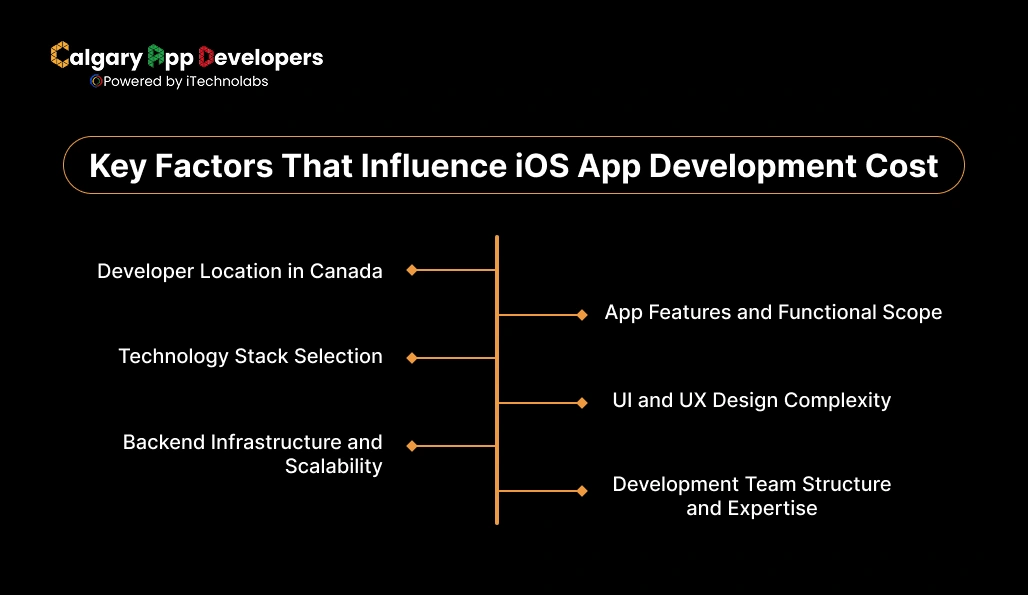
The iOS app development cost is shaped by multiple strategic and technical decisions. Budget accuracy depends on understanding how these elements interact. Below is a refined breakdown of the key factors, presented in a structured sequence.
- Developer Location in Canada
Geography plays a measurable role in total development investment. Hourly rates vary based on local market demand, operational expenses, and talent availability.
Average iOS Developer Hourly Rates in Major Canadian Cities
| City | Average Hourly Rate (CAD) |
| Toronto | $110 to $160 |
| Vancouver | $100 to $150 |
| Calgary | $75 to $110 |
| Montreal | $90 to $130 |
| Ottawa | $85 to $120 |
Calgary continues to offer one of the most competitive rate structures in Canada while maintaining strong technical expertise. For organizations seeking cost efficiency within the Canadian market, Calgary presents a financially strategic option.
- App Features and Functional Scope
Feature selection has the most direct impact on iOS app development cost. Each additional feature increases design, development, testing, and validation effort.
Scope variables that influence cost
- Multi-role user systems
- Real-time chat or tracking features
- Subscription and payment gateways
- Advanced search logic
- Data-heavy dashboards
- Offline functionality
A clearly defined Minimum Viable Product helps control initial investment and reduces unnecessary complexity during early stages.
- Technology Stack Selection
Technology choices influence scalability, security, and long-term maintenance. Native development remains the preferred approach for high-performance iOS applications.
Common iOS Technology Stack and Cost Impact
| Technology Component | Options | Cost Influence |
| Programming Language | Swift | Industry standard for native apps |
| UI Framework | SwiftUI, UIKit | Custom UI systems increase development time |
| Backend | Node.js, .NET, Django | Custom backend architecture increases cost |
| Database | Firebase, PostgreSQL, MongoDB | Structured data models require setup effort |
| Cloud Hosting | AWS, Google Cloud, Azure | Enterprise-level configuration adds infrastructure expense |
| Integrations | Stripe, Twilio, Analytics tools | Each integration requires testing and validation |
Advanced architecture decisions may increase initial iOS app development cost but reduce technical debt and future rebuild expenses.
- UI and UX Design Complexity
User experience directly impacts adoption and retention. Higher design standards require more time and specialized expertise.
Design elements affecting cost
- Custom interface components
- Micro interactions and animations
- Interactive prototypes
- Accessibility compliance
- Multi-device optimization
A well-designed interface improves engagement but increases frontend development hours.
- Backend Infrastructure and Scalability
Infrastructure planning determines how the app performs under growth conditions.
Infrastructure cost drivers
- Custom API development
- Scalable cloud configuration
- Database architecture
- Real-time synchronization
- Load balancing for traffic spikes
Apps built for scale require stronger backend engineering, which increases total iOS app development cost.
- Development Team Structure and Expertise
Team composition influences efficiency, quality, and project stability.
Team-related variables
- Senior versus mid-level developers
- Dedicated QA engineers
- Project management oversight
- DevOps support
- Ongoing maintenance resources
Experienced teams may charge higher rates, but they often reduce long-term costs through cleaner architecture and fewer post-launch issues.
Understanding these factors allows businesses to estimate iOS app development costs with greater accuracy and make informed investment decisions aligned with long-term growth objectives.
Also Read: Best iOS App Development Companies in Calgary, Canada
Hidden iOS App Development Costs You Should Plan For
When estimating iOS app development cost, most businesses focus on design and development. However, several indirect expenses often emerge during or after launch. Planning for these early prevents budget overruns and operational disruption.
Below are the hidden costs that should be factored into your financial roadmap.
- App Store Fees and Compliance: Publishing requires an annual Apple Developer membership fee and strict adherence to App Store guidelines. Policy updates, review feedback, and compliance adjustments may require additional development time, adding incremental costs beyond the initial launch budget.
- Ongoing Maintenance and Updates: Apps require continuous updates for new iOS versions, device compatibility, performance improvements, and bug fixes. Annual maintenance typically ranges between 15 and 25 percent of the original iOS app development cost, depending on complexity and user growth.
- Third Party Services and Licensing: Payment gateways, cloud hosting, analytics tools, and communication APIs involve recurring subscription or usage-based fees. As user activity increases, these operational expenses scale, directly influencing the long-term financial commitment of the application.
- Infrastructure Scaling: As user traffic grows, additional server capacity, database optimization, and monitoring systems become necessary. Without a scalable architecture, businesses may face restructuring costs, which significantly increase the overall iOS app development cost over time.
- Security Audits and Testing: Regular security testing, vulnerability assessments, and compliance audits are essential for protecting user data. These recurring evaluations ensure regulatory alignment and safeguard brand reputation, but they require dedicated financial allocation each year.
- Marketing and User Acquisition: User acquisition demands consistent investment in App Store Optimization, paid advertising, and promotional campaigns. Even a technically strong product requires marketing spend to gain visibility, which can match or exceed initial development expenses.
Accounting for these hidden expenses provides a realistic view of the total iOS app development cost. A well-planned financial strategy extends beyond launch and ensures sustainable growth without unexpected financial strain.
Ways to Reduce iOS App Development Cost Without Compromising Quality
The process of controlling iOS app development costs requires businesses to make informed decisions that protect their product quality while they seek to maximize their financial returns. The correct approach will deliver results according to product requirements while maintaining system performance and adhering to financial restrictions.
Below are practical approaches that reduce cost without weakening performance or user experience.
- Start with a Clearly Defined Scope: Ambiguity increases revisions, delays, and budget overruns. Define user personas, core features, and business objectives before development begins. A documented scope minimizes mid-project changes and keeps engineering efforts aligned with measurable goals.
- Build a Minimum Viable Product First: Instead of launching with every planned feature, focus on essential functionality. An MVP allows market validation with a lower initial iOS app development cost. Once user feedback is collected, enhancements can be introduced in structured phases.
- Prioritize Native Development with Modern Frameworks: Using Swift with frameworks like SwiftUI accelerates development while maintaining performance standards. Modern native tools reduce debugging time and ensure long-term compatibility with iOS updates, lowering maintenance expenses.
- Reuse Proven Components and APIs: Not every feature requires custom engineering. Integrating reliable third-party services for payments, authentication, analytics, or messaging reduces development time and testing cycles. This approach lowers upfront cost while maintaining operational reliability.
- Invest in Scalable Architecture from the Start: Poor architecture leads to expensive rebuilds. Designing scalable backend systems during the initial phase prevents restructuring costs when user numbers grow. Early infrastructure planning reduces long-term iOS app development costs significantly.
- Choose the Right Development Location: Hourly rates vary across Canadian cities. Selecting a cost-efficient market such as Calgary can reduce total project expenditure while maintaining technical quality. Location strategy plays a measurable role in optimizing development budgets.
- Maintain Transparent Communication: Regular sprint reviews and milestone tracking prevent scope creep. When stakeholders remain aligned, unnecessary feature expansion is avoided. Clear communication reduces rework, which directly lowers development hours and overall cost.
Reducing iOS app development cost is not about limiting ambition. It is about building strategically, validating early, and scaling intelligently. A disciplined approach ensures financial efficiency without compromising product excellence.
Read Also: Hire iPhone (iOS) App Developers: Top Sites to Hire
Our Proven Experience in iOS App Development
Our portfolio at Calgary App Developer reflects practical execution across social networking and wellness-driven platforms. Each product was built with performance, scalability, and long-term user engagement in mind. Below are two iOS applications that demonstrate our capability in delivering feature-rich, market-ready solutions.
1. DormHub
DormHub is a dynamic social networking application designed to help users connect with friends and communities in a personalized environment. The platform focuses on identity expression, interaction, and shared interests.
Core Features Delivered
- Customizable user profiles with top friends list
- Integrated music player for personal profile personalization
- Direct messaging functionality
- Community-based group participation
- Content sharing within peer networks
Technical Highlights
- Real-time messaging architecture
- Media streaming optimization
- Scalable backend for growing communities
- Secure authentication and user data protection
DormHub demonstrates our ability to build socially interactive ecosystems that balance performance with engaging user experience.
2. Music Medicine
Music Medicine is a wellness-focused iOS application delivering curated healing music, meditations, and therapeutic sound experiences for all age groups. The platform integrates subscription-based access with structured content organization.
Core Features Delivered
- Subscription model with monthly and yearly plans
- Categorized playlists for meditation, relaxation, and emotional support
- Family-friendly sections, including lullabies and children’s content
- Guided Fibonacci affirmations and meditative tracks
- Nature sound libraries for relaxation sessions
Technical Highlights
- Secure Apple in-app subscription integration
- Audio streaming and content management system
- Scalable architecture for expanding media libraries
- Privacy and compliance integration
The application reflects our expertise in building media-intensive platforms with subscription billing, performance-optimized streaming, and structured content ecosystems.
Why Choose Us for iOS App Development in Canada
At Calgary App Developer, we combine technical depth with practical business thinking. Building an app is not only about writing code. It is about creating a scalable product that performs reliably, meets market expectations, and delivers measurable results.
- AI-Powered iOS Development: We integrate AI where it delivers real business value, not as a buzzword. From intelligent automation and predictive analytics to personalized user experiences, our AI-powered approach helps iOS apps work smarter. What this really means is better engagement, faster decision-making, and features that evolve with user behavior instead of staying static.
- Native iOS Expertise: Our team of experienced iOS developers in Calgary builds using Swift and modern Apple frameworks to deliver performance, security, and long-term compatibility. Native development ensures optimized speed, stability, and smooth integration within the Apple ecosystem.
- Transparent Cost Structure: We provide detailed project estimates with defined milestones and deliverables. Clear documentation and sprint-based tracking prevent scope creep and maintain financial control throughout the development lifecycle.
- Scalable Architecture: Our engineering approach focuses on long-term growth. Whether you are launching an MVP or an enterprise platform, we design backend systems that scale with user demand and evolving business requirements.
- Dedicated Project Management: Each project includes structured communication, milestone reviews, and consistent progress reporting. This ensures alignment between technical execution and business goals at every stage.
- Free App Consultation in Calgary: Choosing the right iOS development path starts with clarity. We offer a free app consultation in Calgary to help businesses evaluate ideas, validate feasibility, and understand cost implications before committing to development. This session focuses on practical guidance, realistic timelines, and clear next steps so decisions are made with confidence, not assumptions.
Choosing the right iOS app development company determines the long-term success of your application. At Calgary App Developer, our focus remains on building reliable, scalable, and commercially viable iOS solutions tailored to Canadian businesses.
Conclusion
Understanding iOS app development cost requires more than reviewing a price range. It demands clarity around scope, technology decisions, design depth, infrastructure planning, and long-term maintenance. Each element directly influences the overall investment and the sustainability of the product.
In Canada, development costs vary based on complexity and location, but strategic planning remains the strongest cost control mechanism. A clearly defined feature set, scalable architecture, and an experienced team, such as our skilled iOS developers in Calgary, help prevent unnecessary revisions and expensive rebuilds.
Businesses that treat app development as a structured investment rather than a one-time expense achieve stronger returns. When cost planning aligns with product vision, the result is a high-performing iOS application that supports growth, user engagement, and long-term profitability.
FAQ’s
- What is the average iOS app development cost in Canada in 2026?
The average iOS app development cost in Canada ranges from $45,000 to $250,000 CAD. The final price depends on app complexity, feature depth, backend infrastructure, integrations, and design standards. Basic applications fall on the lower end, while enterprise-level platforms with advanced functionality require significantly higher investment.
- How long does it take to develop an iOS app?
Development timelines typically range from 2 to 12 months. A basic application may take 8 to 12 weeks, while moderate and complex apps require several development phases. Timeline depends on feature scope, custom design requirements, backend complexity, and testing cycles.
- Why does iOS app development cost vary between cities in Canada?
Hourly development rates differ based on local market demand, operating costs, and talent availability. Cities like Toronto and Vancouver generally have higher rates, while markets such as Calgary offer more competitive pricing. Location directly influences total project cost, especially for long-term development engagements.
- What factors increase iOS app development cost the most?
The largest cost drivers include feature complexity, real-time functionality, custom backend architecture, advanced security implementation, and third-party integrations. Applications that require scalability planning, compliance standards, or subscription systems naturally require more engineering effort and increase overall investment.
- Are there ongoing costs after launching an iOS app?
Yes. Ongoing expenses include maintenance, performance updates, hosting fees, third-party service subscriptions, security audits, and Apple Developer membership renewal. Annual maintenance typically ranges between 15 and 25 percent of the original iOS app development cost.
- Is it possible to reduce iOS app development cost without lowering quality?
Yes, strategic planning can reduce costs without compromising performance. Launching a Minimum Viable Product, defining a clear feature scope, using reliable third-party services, and selecting a cost-efficient development location help control expenses while maintaining technical standards.
- How do I get an accurate estimate for my iOS app idea?
An accurate estimate requires detailed requirement analysis, feature mapping, user flow documentation, and technical architecture planning. Sharing clear objectives, expected integrations, target audience details, and scalability plans allows a development team to provide a realistic and structured cost proposal.


Pankaj Arora is a seasoned technology leader and the Founder of Calgary App Developer, with 10+ years of expertise in crafting high-performance digital solutions. His core competencies include full-stack app development, cloud-native architecture, API integration, and agile product delivery. Under his leadership, Calgary App Developers has empowered startups and enterprises alike with scalable mobile applications, secure web platforms, and AI-driven SaaS products.