







MVP App Development Services for Startups in Canada
Launching a startup often comes with the pressure to build something flawless from the start. Many founders fall into the trap of overbuilding, adding features and refinements before knowing whether the market truly needs them. In reality, most successful startups began with something far simpler: a Minimum Viable Product.
MVP development for startups focuses on building a lean, functional version of your product that addresses one clear problem for a specific audience. Instead of chasing perfection, you focus on validation. You test your idea with real users, gather meaningful feedback, and refine the product based on actual demand rather than assumptions.
This guide walks you through the MVP journey step by step, helping you transform your concept into a practical, testable product that reaches the market faster and smarter.
- MVP development helps startups validate ideas before investing heavily in full-scale products.
- A focused, lean product reduces risk, saves resources, and speeds up time to market.
- Real user feedback drives smarter iterations and stronger product–market fit.
- Strategic planning, budgeting, and execution determine MVP success.
- MVP development for startups is a strategic approach that prioritizes solving one clear problem with essential features rather than building a fully polished product from day one.
- Startups benefit from MVPs by reducing financial risk, validating demand early, and making data-driven decisions based on real user behavior.
- Common early-stage challenges such as limited budgets, uncertain market demand, and feature overload can be addressed effectively through a structured MVP strategy.
- The cost of building an MVP typically ranges from $5,000 to $50,000, depending on complexity, platform choice, design quality, and development team location.
- A successful MVP follows a clear process that includes market research, user validation, feature prioritization, prototyping, development, launch, and continuous iteration.
- Real-world examples demonstrate that focusing on core functionality first allows startups to refine their roadmap, improve usability, and attract investor interest through measurable traction.
Understanding MVP and Its Purpose
MVP is short for Minimum Viable Product, but it is not simply an early draft of your concept. It is a strategic instrument that enables startups to validate their idea in real life using minimal time and resources. It is not aiming to produce a half-built product but to concentrate on the bare minimum feature that solves an actual problem for your users.
MVP development for startups is all about efficiently testing ideas. Rather than investing months into a feature-rich product, you create a lean version, see how the users react to it, and use their input to determine your next move. This keeps development reality-based and avoids wasting money and time on features that might never get used.
The actual worth of an MVP is in its clarity. It makes you define the core problem your product addresses and prioritize those solutions most critical. Once out with users, the feedback you get forms the basis of future enhancements, whether through added features, pivoting the strategy, or optimizing the product as a whole.
In principle, MVP development for startups is not a shortcut. It is an intentional approach to validate assumptions, mitigate risk, and create a product that actually addresses market needs.
Common Challenges Every Startup Faces in the Initial Phase
Building a startup is exciting, but it comes with real obstacles. Many founders underestimate how quickly resources can drain when direction is unclear. Here are the most common challenges startups face:
- Limited Budget and Resources: Startups operate with tight funding. Overspending on unnecessary features or full-scale development too early can exhaust capital before the product finds traction.
- Uncertain Market Demand: An idea may look promising on paper, but without real user validation, there is no guarantee customers will adopt it.
- Feature Overload and Scope Creep: Founders often try to build everything at once. Adding too many features increases development time, complexity, and costs.
- Delayed Time to Market: Spending months perfecting a product can mean missing market opportunities or giving competitors an advantage.
- Lack of User Feedback Early On: Building in isolation leads to assumptions. Without early user input, startups risk solving the wrong problem.
- Difficulty Attracting Investors: Investors want proof of demand. Without a working product or early traction, securing funding becomes harder.
Why Startups Benefit from MVP Development
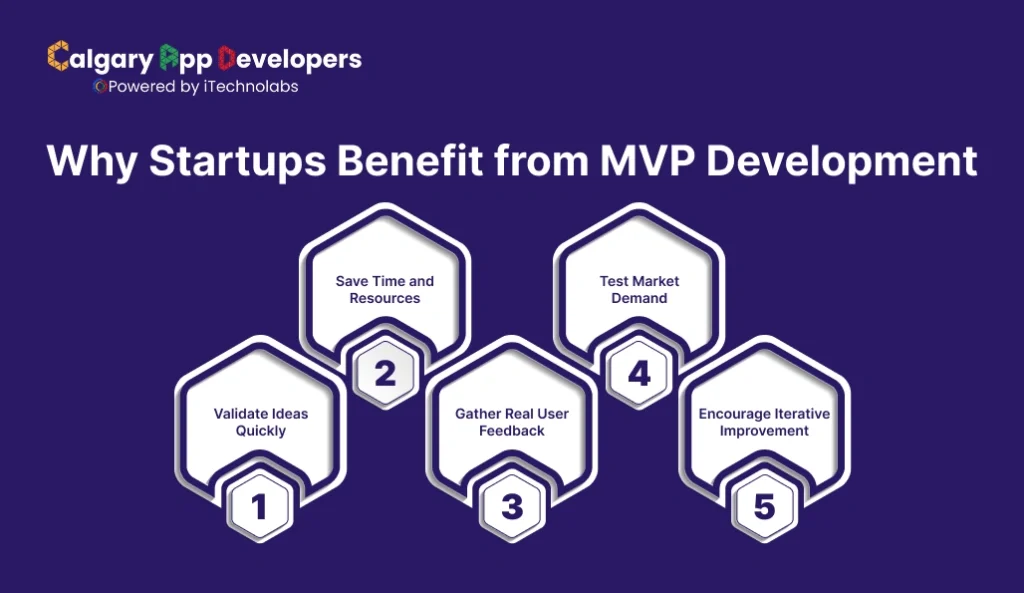
Choosing MVP development is not about cutting corners. It is about making calculated decisions that protect your startup while moving it forward with purpose.
- Validate Ideas Quickly: MVP development for startups allows founders to test their core concept without building a full-scale product. By launching a simplified version, you can see if your idea resonates with users and gain early insights. This approach reduces the risk of investing heavily in a product that might not meet market needs.
- Save Time and Resources: Developing a full-featured product requires significant time, money, and effort. MVP development for startups focuses only on essential features, allowing you to bring a functional product to market faster. This efficiency helps startups manage limited resources while still delivering value to early users.
- Gather Real User Feedback: An MVP provides direct insights from users interacting with your product. MVP development for startups emphasizes learning from real behavior rather than assumptions. Feedback helps refine features, improve the user experience, and prioritize updates based on what truly matters to your audience.
- Test Market Demand: Before scaling, startups need to know if there is genuine demand. MVP development for startups offers a way to gauge interest in your product and identify target customers. Early validation reduces the risk of launching a product that the market does not want.
- Encourage Iterative Improvement: An MVP is a starting point, not the final product. MVP development for startups promotes an iterative approach, allowing founders to enhance features based on data and user feedback. This flexibility ensures the product evolves to better meet user needs and market trends.
For startups operating in uncertain environments, MVP development brings structure and focus. It turns abstract ideas into testable solutions and transforms risk into informed decision-making. Instead of betting everything on a perfect launch, you build intelligently, learn continuously, and grow strategically.
Also Read: How to Build MVP for Startup: From Idea to Successful Launch
Estimating the Cost of an MVP for Your Startup
The cost of MVP development for startups typically ranges between $5,000 and $50,000, depending on the type of MVP, features, and technology choices. Knowing this range helps you plan your budget realistically and avoid surprises. Here’s a breakdown of typical MVP types and their estimated costs:
| MVP Type | Description | Estimated Cost (USD) |
| Landing Page MVP | Simple webpage to validate idea and collect user interest | 500 – 2,000 |
| Prototype MVP | Clickable design or wireframe showing basic product flow | 1,000 – 5,000 |
| Functional MVP | Basic working product with core features | 5,000 – 20,000 |
| Advanced MVP | Product with multiple features, integrations, and support | 20,000 – 50,000 |
Factors Affecting the Cost of an MVP
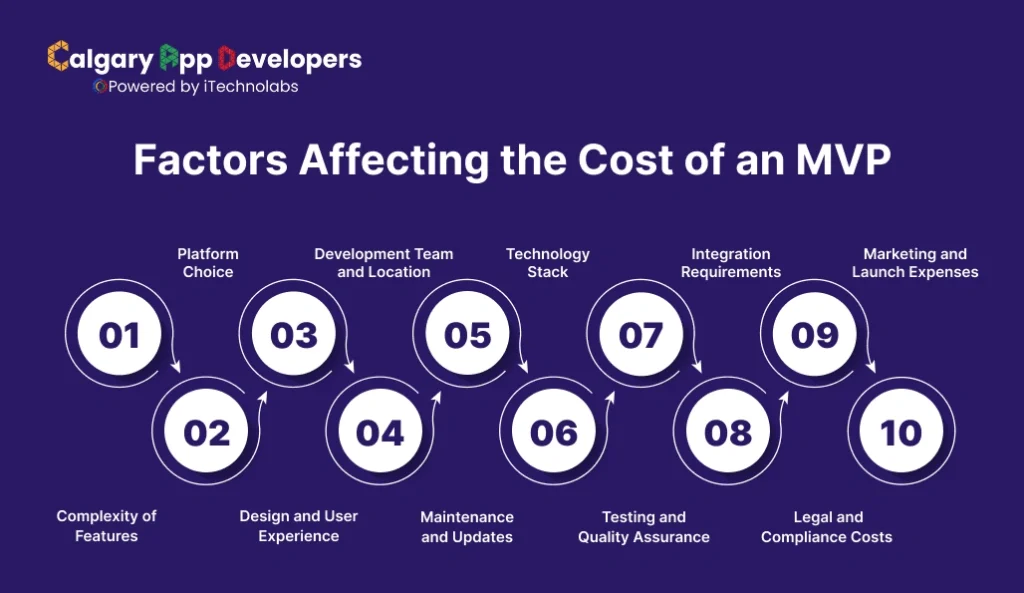
The total cost of MVP development for startups is influenced by multiple elements. Understanding these factors helps founders make informed decisions and optimize their budget without compromising quality.
- Complexity of Features
The features you select determine your MVP cost and scope. Your MVP could be just login, core functionality, and very basic design. Features such as payment gateways, social login, chat support, analytics dashboards, or strong security just add more development time and testing. Prioritize the features that directly address the user’s primary issue and leave non-essential features for future phases. - Platform Choice
Where your MVP will be used impacts both development and maintenance costs. Options include:
- Web-based MVP: Faster to build and accessible across devices; ideal for initial validation.
- Mobile app (iOS or Android): Provides a native experience but increases cost due to separate development efforts.
- Cross-platform apps: Tools like Flutter or React Native allow one codebase for multiple platforms, reducing cost but may have minor performance trade-offs.
Choosing the right platform depends on your target audience and where they are most likely to interact with your product.
- Design and User Experience
Design quality affects user engagement and conversion rates. Custom designs enhance branding but take more time and money. Pre-built templates or basic UI can save costs while validating core functionality. Consider investing more in the design if your MVP depends heavily on first impressions, like consumer-facing apps or marketplaces. - Development Team and Location
Team selection is a strong cost driver. Experience of developers, location, and team composition all affect pricing. Examples:
| Location | Hourly Rate (USD) | Notes |
| Calgary | 25 – 50 | Affordable, skilled developers with a strong startup ecosystem |
| USA/Canada | 50 – 150 | High-quality teams, higher cost due to local living expenses |
| Europe | 30 – 80 | Reliable quality, moderate cost, varies by country |
| India | 20 – 50 | Very affordable, but timezone and communication may require more management |
Calgary stands out for startups looking for quality work at a reasonable price, combining talent, cost-effectiveness, and a supportive tech community.
- Maintenance and Updates
An MVP does not come as a one-time expense. Servers, bug patches, and minor feature releases are recurring costs. Even basic MVPs need maintenance to run smoothly, manage user feedback, and keep preparing for scaling. Budget overruns are avoided by planning for post-launch expenses. - Technology Stack
The programming languages, frameworks, and third-party services you choose affect development time and costs. Open-source stacks are generally cheaper and more flexible, while proprietary tools or complex integrations can increase expenses. Selecting the right stack early ensures scalability without overspending. - Testing and Quality Assurance
Thorough testing is essential for a functional MVP. Costs vary based on the type of testing:
- Manual testing: Simple and affordable for small MVPs.
- Automated testing: Useful for larger products or repeated testing, slightly higher cost upfront but saves time in the long run.
- Device and platform coverage: Testing across multiple devices or browsers adds to the cost but ensures a consistent user experience.
- Integration Requirements
If your MVP needs to connect with other platforms, services, or APIs (like payment processors, analytics tools, or cloud services), these integrations add complexity and cost. Some APIs are free, but others require subscriptions or licensing fees. - Legal and Compliance Costs
For certain industries, MVPs may require legal compliance, privacy policies, or security certifications. While these costs are often overlooked, they can significantly impact your total budget and should be factored in during planning. - Marketing and Launch Expenses
Even a simple MVP needs users to test and validate your idea. Initial marketing campaigns, landing pages, or beta program incentives add to the overall cost but are essential for gathering meaningful feedback.
Read Also: Why Startups in the U.S. Are Hiring Fractional Dev Teams
Step-by-Step Guide to Building an MVP
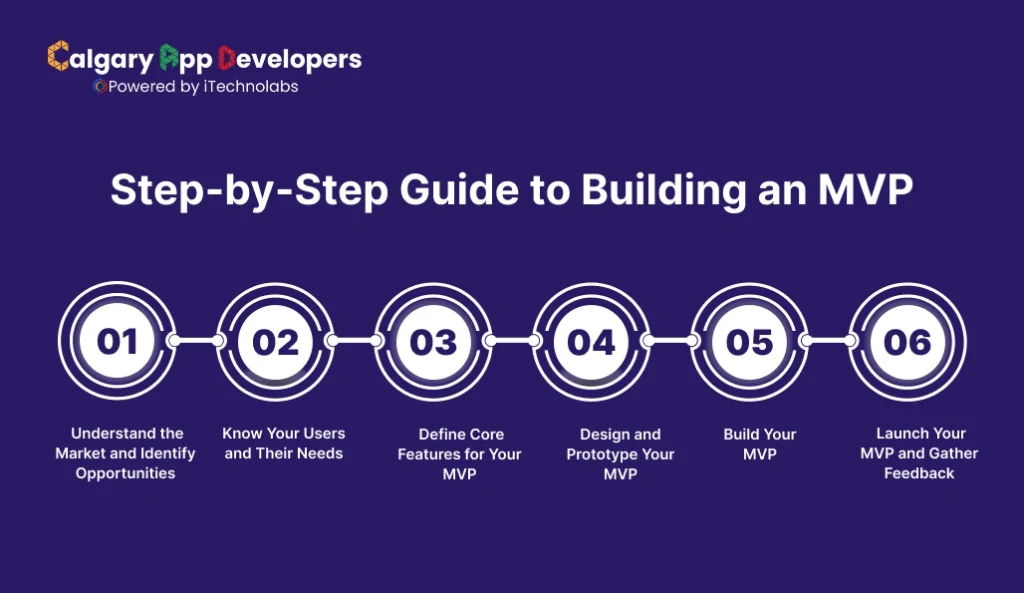
Building an MVP requires a structured approach that balances speed, usability, and learning from real users. MVP development for startups focuses on creating a product that tests core assumptions without overinvesting in features. Here’s a step-by-step guide to get it right:
Step 1. Understand the Market and Identify Opportunities
Before creating any product, it’s essential to understand the market landscape. Market research helps you identify trends, competitors, and potential gaps where your product can provide value.
Sub-points:
- Analyze competitors: Study similar products and note their strengths, weaknesses, and user feedback.
- Identify market gaps: Look for pain points that existing solutions don’t fully address.
- Assess demand: Use surveys, social media trends, and industry reports to estimate interest.
What this really means for startups is that MVP development starts with clarity about what problem you are solving and whether there is a real audience willing to engage with your solution.
Step 2. Know Your Users and Their Needs
Understanding your users is critical to building an MVP that resonates. This step ensures your product solves a real problem for real people.
Sub-points:
- Create user personas: Identify target audiences, their demographics, habits, and pain points.
- Conduct interviews and surveys: Direct feedback helps validate assumptions and uncover insights you may have missed.
- Map the user journey: Understand how your users interact with existing solutions and where your product fits.
By prioritizing user understanding, MVP development for startups focuses on building features that matter most, rather than guessing what users might want.
Step 3. Define Core Features for Your MVP
Once you understand the market and users, the next step is deciding what your MVP will include. Focus on the essential features that address the main problem.
Sub-points:
- Identify the must-have functionality: Limit the MVP to features that solve the core problem.
- Avoid “feature creep”: Resist adding bells and whistles until you validate the product.
- Prioritize scalability: Ensure features can be improved or expanded after testing.
MVP development for startups is most effective when it starts small but scalable, enabling you to gather feedback and refine the product efficiently.
Step 4. Design and Prototype Your MVP
Design and prototyping give your MVP a tangible form, allowing you to visualize the user experience and test the concept before full development.
Sub-points:
- Create wireframes: Map out screens, workflows, and user interactions in a simple visual format.
- Develop a clickable prototype: Tools like Figma or Adobe XD allow users to interact with the design without coding.
- Gather early feedback: Show prototypes to potential users and stakeholders to refine usability and design choices.
Prototyping is a crucial step in MVP development for startups because it minimizes wasted development time and ensures the product is intuitive from day one.
Step 5. Build Your MVP
With a validated design, you can start the actual development of your MVP. This step involves translating your prototype into a functional product with core features.
Sub-points:
- Choose a development approach: Decide between in-house teams, freelancers, or development agencies based on budget and expertise.
- Use an appropriate technology stack: Select programming languages and frameworks that balance speed, cost, and scalability.
- Focus on quality: Build a product that works reliably even if it’s minimal in features.
MVP development for startups emphasizes speed and functionality over perfection. The goal is to get a usable product into users’ hands quickly.
Step 6. Launch Your MVP and Gather Feedback
Launching your MVP is not the end; it’s the beginning of the learning process. Gathering user feedback helps shape the next iterations of your product.
Sub-points:
- Set up analytics: Track usage patterns, feature engagement, and user behavior.
- Collect qualitative feedback: Use surveys, interviews, and support channels to understand pain points.
- Iterate and improve: Update features based on feedback, prioritize fixes, and plan enhancements.
MVP development for startups is iterative. Launching early allows you to learn fast, reduce risk, and evolve your product based on real user insights rather than assumptions.
Also Check: Why Most Calgary Startups Fail: Missing These Key Mobile App Features
Our Experience in MVP Development for Startups
Over the years, we have worked with early-stage founders across industries to transform raw ideas into validated, market-ready MVPs. Our focus is not just on building software. It is on helping startups test assumptions, reduce risk, and move from concept to traction with clarity and speed.
Many of the products we have supported are protected by NDA agreements, so we cannot disclose company names. However, the outcomes and lessons from these collaborations demonstrate the depth of our experience in MVP development for startups.
Example 1: On-Demand Service Marketplace MVP
A North American startup approached us with an idea for a location-based on-demand service platform connecting users with vetted local professionals. The founder had strong domain knowledge but needed technical validation before seeking seed funding.
We began by narrowing the scope to three core features: user registration, service booking, and real-time request management. Instead of building a full marketplace ecosystem with ratings, messaging systems, and complex payment logic, we focused on validating demand and booking behavior.
Within 10 weeks, we launched a functional web-based MVP. Early user testing revealed two key insights:
- Users preferred instant booking over scheduled requests.
- Providers needed clearer job notifications and simplified onboarding.
Based on real user data, the startup refined its product roadmap and successfully used MVP traction metrics to secure early-stage investor interest.
Example 2: B2B SaaS Workflow Automation MVP
In another case, a startup targeting mid-sized enterprises wanted to automate internal approval workflows using a cloud-based dashboard. The original plan included advanced reporting, third-party integrations, and role-based access controls.
We restructured the approach. Instead of building a feature-heavy system, we designed a lean MVP centered on:
- Workflow creation
- Task assignment
- Basic reporting
- Email notifications
The first version launched in under three months. Pilot customers were onboarded through a controlled beta program. Usage analytics showed that automation efficiency mattered more than advanced reporting. As a result, the startup prioritized performance optimization and UX clarity before expanding feature depth.
This data-driven approach allowed the company to refine its positioning and move into paid subscriptions faster than originally planned.
In both cases, the goal was the same: build only what is necessary to validate real market demand. Our approach to MVP development for startups combines strategic scoping, rapid execution, and iterative improvement. By focusing on measurable outcomes rather than feature volume, we help founders launch smarter and scale with confidence.
Conclusion
MVP development for startups is not just a way to launch a product; it’s a strategy to test ideas, gather feedback, and build something users truly want. By focusing on core features, validating assumptions, and iterating based on real-world insights, startups can save time, reduce costs, and increase their chances of success.
If you’re ready to bring your idea to life, Calgary App Developers can help, offering best MVP development services. With experience in creating efficient, user-focused MVPs, we guide startups through every step from research and prototyping to launch and iteration, ensuring your product reaches the market faster and smarter.
FAQs on MVP development for startups
1. What is an MVP?
An MVP, or Minimum Viable Product, is a simplified version of a product that focuses on core features to solve a specific problem for users. It allows startups to test ideas quickly, gather real user feedback, and validate market demand without investing heavily in full-scale development.
2. What are the benefits of building an MVP for startups?
Building an MVP helps startups validate their idea, save time and resources, and reduce the risk of failure. It allows founders to learn from real users, improve the product iteratively, and test market demand before scaling. MVPs ensure startups invest in features that truly matter to their audience.
3. How do I build an MVP for my startup?
To build an MVP, start by researching your market and users, define the core features that solve the main problem, design and prototype your solution, and then develop a basic working version. Launch it, collect feedback, and iterate based on insights to improve the product efficiently.


Pankaj Arora is a seasoned technology leader and the Founder of Calgary App Developer, with 10+ years of expertise in crafting high-performance digital solutions. His core competencies include full-stack app development, cloud-native architecture, API integration, and agile product delivery. Under his leadership, Calgary App Developers has empowered startups and enterprises alike with scalable mobile applications, secure web platforms, and AI-driven SaaS products.