










OTC Crypto Exchange Development: Benefits, Features, Process & Costs
The cryptocurrency market has developed beyond traditional exchanges. Traders with higher volumes, institutions, and highly knowledgeable investors have opted for a more discreet and flexible method to buy and sell crypto assets. This is the point at which development for OTC crypto exchange occurs.
An OTC exchange removes the volatility and price slippage often seen in public markets. It allows direct, high-value transactions without exposing orders to the open order book. Building such a platform calls for a solid mix of security, liquidity, transparency, and user trust.
In this article, we’ll provide the full rundown on everything you need to know about OTC crypto exchange development, including the benefits, the main features, the necessary steps, and the development costs to take your project from initial concept to launch.
- OTC crypto exchanges make it possible to conduct private and huge trades of digital assets outside the public visibility of the order books.
- The cost of development is in a huge range from $80,000 to $250,000+, which is mainly determined by the complexity and level of customization.
- Success of any OTC platform relies on security, liquidity, and compliance.
- The choice between white-label and custom development is based on the budget, control, and scalability objectives.
- OTC crypto exchange development aims to provide secure trading platforms for retail and institutional traders who enjoy anonymity while trading and require stable prices.
- The OTC model totally takes away market volatility since it permits direct, negotiated trades between buyers and sellers.
- Establishing an OTC exchange involves numerous phases like planning, design, core development, third-party integration, and compliance testing.
- The essential features of the system will be real-time RFQ, deep liquidity integration, strong KYC/AML, and transparent reporting tools.
- The proposed tech stack should be such that it supports the requirements of performance, scalability, and data protection through modern frameworks, blockchain APIs, and secure infrastructure.
- White-label solutions are quicker and cheaper than custom development, which, on the other hand, gives full control, flexibility, and long-term growth potential.
- All the ongoing maintenance, updating, and compliance practices are going to make it hard for user trust and market relevance to fade away.
Overview of OTC Crypto Exchanges
When we talk about otc crypto exchange development, we begin with understanding what OTC crypto exchanges are. In simple terms an over-the-counter (OTC) crypto exchange allows parties to trade cryptocurrencies directly outside of public order books and standard exchanges.
Let me explain with an example: A prominent investor, a financial institution, or a wealthy individual intends to trade a substantial amount of cryptocurrency. The public exchange’s trading might influence the market price, disclose the trade in the order book, and result in slippage. The parties can still negotiate privately with an OTC desk or broker, and the agreement could be on terms, quietly exchange large volumes, and often benefit from deeper liquidity and customized settlement options.
Why is this relevant for the development of an OTC crypto exchange? Because when you build a platform targeted at that use case, you must address aspects such as large-volume trades, settlement flexibility (crypto-to-fiat, crypto-to-crypto), privacy of counterparties, and minimal market impact.
Current landscape and future outlook
What this really means is the OTC segment of the crypto market is growing fast and is becoming a more significant part of infrastructure around digital assets. For example, one recent review of the crypto OTC market found that volumes grew 106 % year-on-year in 2024 and that crypto-to-crypto OTC trades rose by ~5.4× over the same period.
Another projection suggests that the global market specific to OTC crypto exchange activity could reach around USD 264.32 billion by 2030, with a compound annual growth rate (CAGR) of around 27.8 % from 2022.
So if you put all your efforts into the development of the OTC crypto exchange, it means you are opening up to a high-growth segment with specific needs already.
Key differentiators
Compared to a regular exchange, the OTC model has these attributes:
- Privacy: The trades are done off the public order book and thus large orders do not at once give a signal to the market.
- Reduced market impact: Since the trade is a cut rather than placed openly, market volumes are less likely to trigger price changes or slippage.
- Flexible settlement and pricing: Clients frequently negotiate conditions, decide how and when to settle, and may avail themselves of customized services.
- Deep liquidity requirement: An OTC platform has to collect or give access to deep liquidity in order to effectively execute large trades without negatively affecting the price.
If you’re planning otc crypto exchange development, you’ll need to address infrastructure aspects that differ from a standard retail crypto exchange. For example, you’ll need to support high-value accounts, manage settlement across fiat and crypto, build or integrate deep liquidity pools, ensure confidentiality of counterparties, and provide robust reporting and compliance capabilities.
To sum it up, the OTC crypto exchange segment is not a small corner; it is already transforming into a critical part of the entire crypto ecosystem. The companies that are brave enough to construct a platform in this area might enjoy the fruits of their labor by catering to institutional and high-net-worth clients instead of the mass retail market only.
Also Check: Top Cold Crypto Wallets: Ultimate Security Guide
What’s Driving the Rise of OTC Crypto Trading
The growing demand for privacy, liquidity, and control is reshaping how large investors trade digital assets. That’s the core reason behind the rise of OTC crypto trading. As the market matures, traders are shifting from public exchanges to private trading environments that offer efficiency, confidentiality, and flexibility.
Here’s what’s fueling that momentum.
1. Institutional Capital Entering the Market
Institutional investors are now a significant force in crypto. Hedge funds, family offices, and corporate treasuries prefer OTC because it allows them to implement high-value transactions without triggering volatility. Due to institutional inflows, OTC has been relegated from a nicely funded option in crypto liquidity to the base level of crypto liquidity.
2. Growing Focus on Price Stability and Discreet Execution
When large orders are placed on a traditional exchange, they often move the market and reduce profit margins. OTC platforms solve that problem by enabling direct peer-to-peer trades with negotiated prices. This gives traders the advantage of executing significant transactions quietly while maintaining predictable pricing.
3. Advancements in Regulation and Compliance
The regulators in the major jurisdictions across the globe are clarifying their frameworks for trading digital assets. This clarity has facilitated compliant OTC businesses that can comply with institutional frameworks. Today’s OTC platforms incorporate automated KYC, AML tracking, and reporting of transactions to satisfy both the client and the regulators.
4. Liquidity Depth and Customization
Unlike retail exchanges, OTC desks are built for flexibility. They can accommodate multiple fiat currencies, cross-chain settlements, and custom deal structures. High liquidity ensures smoother execution, while personalized service helps institutions manage risk efficiently.
5. Expansion of Crypto Products and Market Infrastructure
The rise of tokenized assets, stablecoins, and crypto derivatives has added depth to OTC activity. Traders are no longer limited to spot transactions; they can now negotiate structured trades and tailored financial products privately. This evolution positions OTC trading as the foundation of large-scale crypto finance.
In essence, the rise of OTC trading reflects how the crypto market is maturing. Investors are looking for sophisticated infrastructure, compliant frameworks, and professional-grade execution. For developers and entrepreneurs, otc crypto exchange development represents not just a business opportunity but a chance to shape the next generation of digital asset markets.
Also Read: Blockchain Wallet Development: An Ultimate Guide
Step-by-Step Cost Breakdown for Building an OTC Crypto Exchange Platform
The total estimated development cost for an operational OTC crypto exchange varies from $80,000 to $250,000+. The wide range correlates to the complexity of the operations, whether it was built from the foundation stage or involved white-labeling, and the size and geographical location and expertise of whoever builds it.
Total Cost Estimation Overview
| Development Phase | Estimated Cost Range | Key Cost Influencers |
| Planning & Design | $8,000 – $25,000 | Scope detailing, UX/UI design complexity, regulatory compliance research |
| Platform Development | $50,000 – $180,000 | Core trading engine, admin panel, user dashboards, security features |
| Third-Party Services | $10,000 – $30,000 | KYC/AML integrations, custody solutions, payment gateways, cloud infrastructure |
| Testing & Deployment | $7,000 – $15,000 | Security auditing, performance testing, and production setup |
| Total Estimated Cost | $80,000 – $250,000+ | Influenced by customization, compliance scope, and technology stack |
Step-by-Step Development Process and Associated Costs
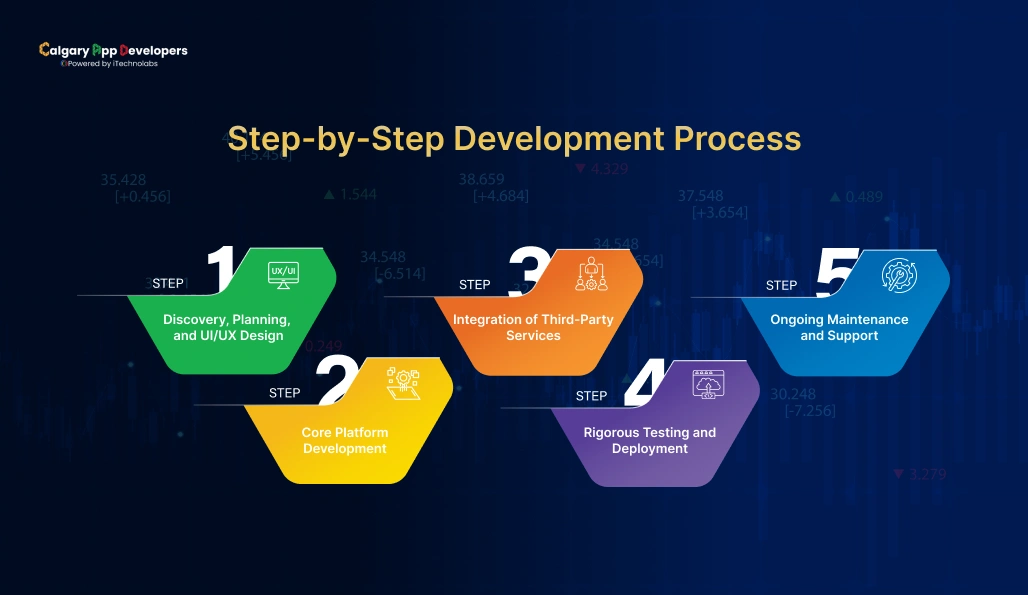
Step 1: Discovery, Planning, and UI/UX Design
This stage builds the foundation for the overall project. You will decide on the business goals, target users, compliance range, and operational workflows. Clear documentation at this stage will save development headaches later. In the UI/UX you will focus on easy navigation and trading workflows that create efficiency not only for you as an administrator but your traders will also feel they are working in a trustworthy and efficient environment.
- Primary Activities: Market research, feature specification, workflow mapping, wireframing, prototyping, and interface design.
- Cost Range: $8,000 – $25,000
- Justification: Costs increase with design complexity and the number of supported platforms (web, iOS, Android).
Step 2: Core Platform Development
This is the most resource-intensive stage of otc crypto exchange development. It includes both the back-end trading logic and the front-end interface.
- Primary Activities:
-
- Back-end: Building the RFQ engine, order execution logic, wallet management, and admin dashboard.
- Front-end: Developing the user portal, trader dashboard, and trade management interfaces.
- Cost Range: $50,000 – $180,000
- Justification: White-label frameworks sit at the lower end. A custom-built, high-performance exchange with multi-currency and institutional-grade security drives the cost upward.
Step 3: Integration of Third-Party Services
Professional-grade OTC platforms depend on external services to ensure compliance, liquidity, and secure settlement.
- Primary Activities: KYC and AML verification, integration with custody solutions, fiat gateways, and cloud hosting setup.
- Cost Range: $10,000 – $30,000+ (Initial setup; operational fees billed separately)
- Justification: Using premium third-party providers increases upfront and ongoing expenses but ensures reliability and compliance with financial regulations.
Step 4: Rigorous Testing and Deployment
Before public release, every system component undergoes functional, performance, and security testing. This phase ensures reliability under heavy load and prevents exploits or downtime during trading.
- Primary Activities: Security penetration testing, end-to-end validation, performance testing, and deployment to live servers.
- Cost Range: $7,000 – $15,000
- Justification: Penetration testing and vulnerability scans by certified security firms significantly raise quality and trustworthiness.
Step 5: Ongoing Maintenance and Support
Once the exchange goes live, regular maintenance ensures smooth operation, continuous compliance, and protection against evolving cyber threats.
- Primary Activities: System updates, bug fixes, customer support, server monitoring, and feature enhancements.
- Cost Range: Typically 15% to 20% of the total initial development cost per year
- Justification: Continuous improvement keeps the platform competitive and reliable for institutional clients and large-volume traders.
Investing in otc crypto exchange development is not merely about the creation of trading software; instead, it involves the establishment of a reliable financial infrastructure that merges compliance, security, and scalability. The combination of a detailed development roadmap and a realistic budget is the key to a successful launch and a long-term market presence.
Read Also: How Much Does It Cost to Build a Cryptocurrency Exchange App like Coinbase?
Must-Have Features of a Successful OTC Crypto Exchange Platform
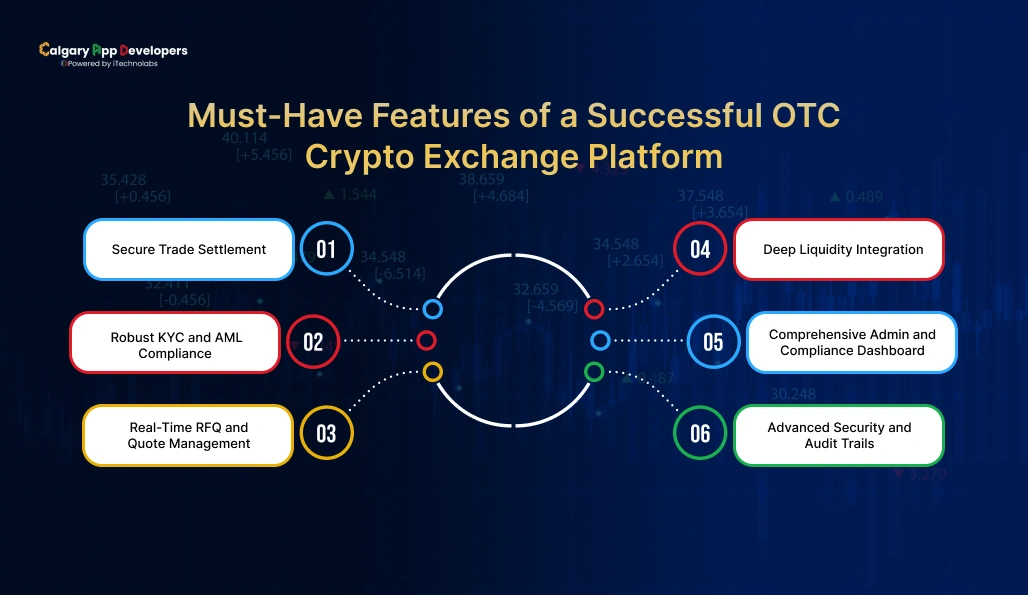
The development of otc crypto exchanges in terms of features is a critical deciding factor in whether the platform will gain trust and accordingly maintain high-volume trading. An ideal OTC scenario gives top priority to security, liquidity, and transparency but at the same time keeps the trading experience easy for both institutions and individual investors. Following is a list of essential features for every successful OTC platform.
- Secure Trade Settlement
The ability to safely settle large trades is the first and foremost thing to be provided by any OTC Exchange. This requires the use of multi-signature or MPC wallets, secure custody integrations, and automated escrow mechanisms ensuring that both parties receive funds without risk. Transparent settlement flows can also help in fulfilling regulatory and audit requirements.
- Robust KYC and AML Compliance
Institutional and corporate traders call for verified and compliant environments. The Know Your Customer (KYC) and Anti-Money Laundering (AML) systems integrated into the platform help the platform comply with both local and international financial regulations. User trust is augmented through automated screening, document verification, and continuous transaction monitoring, and at the same time, regulatory exposure is reduced.
- Real-Time RFQ and Quote Management
OTC trading thrives on negotiation and flexibility. A Request-for-Quote (RFQ) engine enables traders to request, receive, and accept custom quotes instantly. This feature allows brokers and dealers to execute large trades privately, maintaining pricing discretion while ensuring smooth liquidity flow.
- Deep Liquidity Integration
Liquidity is the mainstay of the OTC markets. The platform should interface with various liquidity sources, internal order books, and institutional market makers. Being able to tap into aggregated liquidity results in better pricing and quick execution even for large transactions.
- Comprehensive Admin and Compliance Dashboard
In order to be efficient, the administrators must view all activity, total trading volumes, risk alerts, and compliance metrics. An in-depth back-office dashboard simplifies account approvals, management, and trading oversight. A single control point minimizes manual oversight while increasing operational efficiency.
- Advanced Security and Audit Trails
Security is non-negotiable in OTC crypto exchange development. End-to-end encryption, DDoS protection, cold wallet storage, and continuous audit logs are essential. Every user action and trade must be traceable without exposing sensitive data, ensuring accountability across the platform.
The different features that are positioned well above the others in an OTC platform will together form a single flourishing ecosystem. The outcome will be a trading atmosphere where institutions as well as individual traders can feel professional, trustworthy, and efficient.
Also Read: What is MPC Wallet? Brief Guide to Multi-Party Computation
Choosing the Right Tech Stack for OTC Exchange Development
The creation of an OTC crypto exchange is primarily reliant on the technology stack being used. Using the right combination of tools, frameworks, and infrastructure can get security, scalability, and performance even during loads of transactions. A dependable stack is going to have to handle quick quote execution, real-time data processing, and rock-solid compliance all at the same time without being too slow or insecure.
Here’s how to structure a professional-grade tech foundation for your OTC platform.
Recommended Tech Stack
| Component | Technology Options | Purpose |
| Frontend (Client Interface) | React, Angular, or Vue.js | Builds responsive trading dashboards and user portals for traders, brokers, and admins. |
| Backend (Core Engine) | Node.js, Python (Django/Flask), Go, or Java (Spring Boot) | Handles trade logic, RFQ engine, wallet operations, and server-side processing. |
| Database | PostgreSQL, MongoDB, Redis | Stores user data, trade history, and pricing information with fast access and redundancy. |
| Blockchain Integration | Web3.js, Ethers.js, Bitcoin Core, Ethereum APIs | Connects to supported blockchains for wallet, transaction, and settlement management. |
| Security Layer | JWT, OAuth 2.0, TLS, HashiCorp Vault, AWS KMS | Manages authentication, data encryption, and secure key storage. |
| Liquidity & Market Data | FIX Protocol, REST APIs, WebSocket Streams | Enables live market feeds, RFQ pricing, and liquidity aggregation. |
| KYC/AML & Compliance Tools | Sumsub, Onfido, Chainalysis, Elliptic | Automates verification, AML screening, and blockchain transaction monitoring. |
| Cloud Infrastructure | AWS, Google Cloud, Azure, DigitalOcean | Provides scalable hosting, automated backups, and global availability zones. |
| DevOps & CI/CD | Docker, Kubernetes, Jenkins, GitLab CI | Ensures continuous deployment, high uptime, and containerized environments. |
| Monitoring & Analytics | Prometheus, Grafana, ELK Stack | Tracks performance, error logs, and system health for smooth operations. |
Key Considerations When Selecting Your Stack
- Performance and Scalability: An OTC platform must handle large transactions without delay. Use asynchronous programming and event-driven architectures to support high concurrency. Choosing scalable cloud infrastructure prevents downtime during trading peaks.
- Security First Approach: End-to-end encryption, hardware security modules, and regular penetration testing should be integrated from the start. Protecting wallets, private keys, and customer data is central to trust in any trading platform.
- Regulatory Compliance Integration: Select APIs and services that meet FATF, GDPR, and regional crypto regulations. Real-time reporting, data privacy, and transaction traceability are not optional; they’re mandatory for institutional clients.
- Modular and Future-Proof Design: The crypto landscape evolves fast. A modular architecture lets you add new assets, liquidity sources, or blockchain integrations without rewriting core components. This flexibility reduces long-term development costs.
- High Availability and Disaster Recovery: Trading downtime directly impacts client confidence. Redundant cloud environments, automated backups, and failover systems guarantee continuous operation, even under network or system failures.
A carefully chosen tech stack defines the performance and resilience of your OTC platform. When planned strategically, otc crypto exchange development can deliver a scalable and secure infrastructure ready to handle institutional-grade trading from day one.
Important Factors to Keep in Mind During OTC Crypto Exchange Development
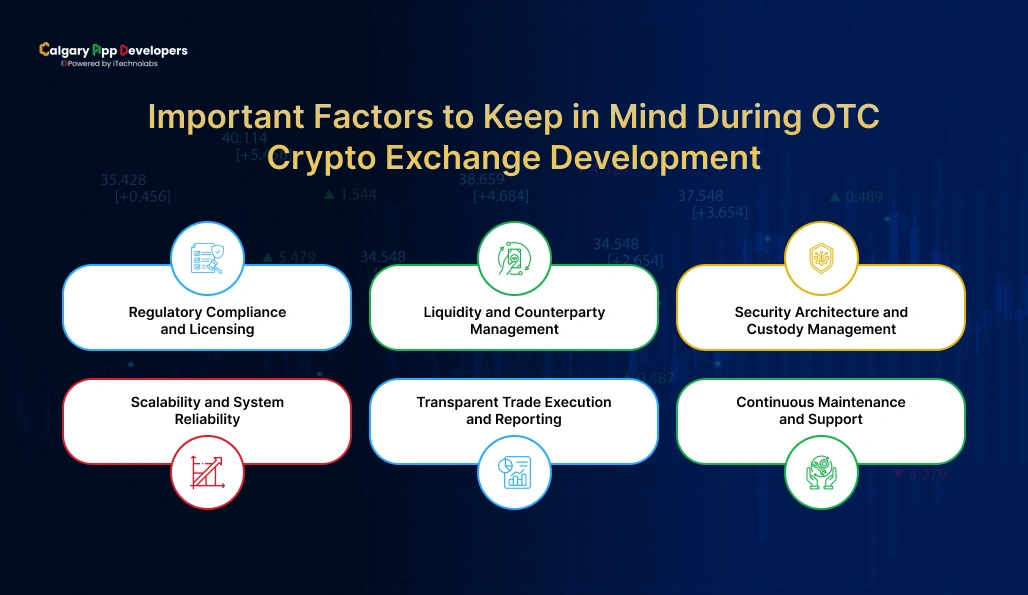
Building a reliable OTC trading platform is not just about writing clean code. It’s about balancing performance, compliance, and trust at every layer of the system. Whether you’re designing architecture, integrating liquidity, or managing settlement workflows, every decision impacts how smoothly trades are executed and how safely assets are held. In otc crypto exchange development, precision and foresight make all the difference.
Here are the key factors to keep in mind during development.
- Regulatory Compliance and Licensing
Every region has its own digital asset regulations, and non-compliance can stop your operations before they begin. Ensure your platform complies with KYC, AML, and data privacy rules. Early consultation with legal experts helps you determine licensing needs, reporting obligations, and partner eligibility across jurisdictions.
- Liquidity and Counterparty Management
Liquidity drives trading volume and client confidence. Integrate multiple liquidity providers and institutional counterparties to maintain consistent trade execution. For institutional clients, counterparty verification and pre-trade checks reduce default risks and ensure operational transparency.
- Security Architecture and Custody Management
Security must be built, not added later. Use multi-layered encryption, MPC or multi-signature wallets, and regular third-party audits. Protect private keys in hardware modules and segregate client funds from operational wallets. Strong custody controls assure clients that their assets are safe from internal and external threats.
- Scalability and System Reliability
As trading volume grows, the platform should perform consistently under pressure. Design for horizontal scalability using containerized services and microservice architecture. Cloud-based auto-scaling ensures smooth operations even during volatile market conditions or high RFQ activity.
- Transparent Trade Execution and Reporting
Trust is the currency of OTC trading. Incorporate audit trails, trade confirmations, and detailed transaction logs. Real-time reporting tools help both clients and administrators track settlements and compliance metrics, ensuring complete transparency throughout the process.
- Continuous Maintenance and Support
The post-launch phase is as critical as development itself. Regular updates, performance tuning, and security patching protect the platform against new vulnerabilities. A dedicated support team ensures clients get timely help, reinforcing reliability and brand reputation.
Successful otc crypto exchange development demands a disciplined approach that aligns technology with trust, security, and compliance. Each decision, from architecture to liquidity integration, contributes to creating a stable environment where institutional traders can operate with confidence and efficiency.
How to Stay Ahead in the Competitive OTC Crypto Market
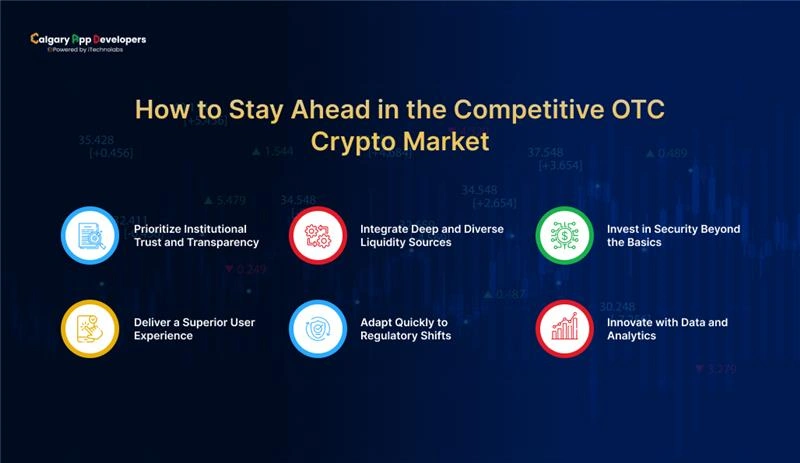
Competition in the OTC crypto landscape is intense, and only platforms that combine reliability, innovation, and client trust manage to lead. The core of otc crypto exchange development lies in creating a product that delivers unmatched privacy, liquidity, and speed while maintaining compliance and security. Success depends not only on technology but also on how you differentiate your platform in a maturing market.
Here’s how to stay ahead.
- Prioritize Institutional Trust and Transparency
Institutional traders expect professionalism and predictability. Build transparent trade execution systems with clear settlement reports and verifiable records. Offer custom agreements and service-level commitments that reflect the standards of traditional finance. The more transparent and structured your processes are, the stronger your client retention will be.
- Integrate Deep and Diverse Liquidity Sources
Liquidity depth defines your competitiveness. Partner with top-tier market makers, custodians, and liquidity aggregators to ensure tight spreads and high trade volumes. Supporting both crypto and fiat settlements widens your appeal and makes your platform suitable for global institutional clients.
- Invest in Security Beyond the Basics
Security cannot be a checklist item. Go beyond standard encryption and audits by deploying continuous monitoring systems, intrusion detection, and blockchain analytics to detect suspicious activity. Periodic third-party penetration tests and bug bounty programs help maintain trust in a market where one breach can end a reputation overnight.
- Deliver a Superior User Experience
Even institutional clients value ease of use. Streamlined onboarding, intuitive dashboards, and instant support enhance engagement. A responsive and minimal interface that performs flawlessly across web and mobile ensures traders can act fast without distractions or delays.
- Adapt Quickly to Regulatory Shifts
Crypto regulations evolve rapidly. Maintain flexibility in your compliance architecture so that new jurisdictions or updated frameworks can be integrated without major redevelopment. Having an in-house or partner compliance team helps you anticipate policy changes and maintain uninterrupted operations.
- Innovate with Data and Analytics
Data-driven platforms outperform static systems. Add analytics dashboards for clients that provide insights into trading patterns, risk exposure, and market depth. Internally, use analytics to optimize liquidity management, pricing models, and client segmentation for smarter decision-making.
The future of otc crypto exchange development belongs to platforms that blend technology, trust, and adaptability. Staying competitive means being proactive constantly improving infrastructure, anticipating regulatory changes, and responding to trader needs before they become demands. The goal is simple: to build an OTC exchange that not only executes trades but also earns lasting confidence in every transaction.
White-Label vs Custom OTC Crypto Exchange Development: Finding the Better Fit
Choosing between a white-label and a custom-built platform is one of the most important strategic decisions in otc crypto exchange development. Both approaches have distinct advantages and trade-offs depending on your budget, timeline, and long-term vision.
A white-label solution offers speed and cost-efficiency, making it ideal for startups or firms entering the market quickly. Custom development, on the other hand, provides full control, scalability, and long-term differentiation for enterprises that want to own every aspect of their infrastructure.
Comparison Between White-Label and Custom OTC Exchange Development
| Criteria | White-Label OTC Exchange | Custom OTC Exchange |
| Development Time | 1 to 3 months | 6 to 12 months or more |
| Initial Cost | $30,000 to $80,000 | $100,000 to $250,000+ |
| Customization Level | Limited, predefined features and UI | Fully customizable features, workflows, and branding |
| Ownership and Control | Platform controlled by vendor | Complete ownership of codebase and infrastructure |
| Security and Compliance | Relies on vendor’s built-in security | Full control over security design and compliance integration |
| Scalability | Moderate; dependent on vendor infrastructure | High; designed to scale with custom architecture |
| Maintenance and Updates | Managed by the vendor | Managed in-house or through dedicated support team |
| Ideal For | Startups and MVP testing | Enterprises and long-term institutional platforms |
When to Choose a White-Label Solution
A white-label approach works best when your goal is to enter the market quickly and validate your business model before investing heavily. It allows you to launch a branded platform without spending months on core development. However, customization options are often limited, and you depend on the vendor for updates, scalability, and compliance changes.
Best for: Early-stage businesses, proof-of-concept platforms, and regional OTC desks focusing on speed over deep customization.
When to Choose Custom Development
A custom-built OTC exchange provides complete flexibility and long-term independence. You control every component from the RFQ engine to custody workflows and reporting modules. While the upfront investment and timeline are higher, the result is a scalable, secure, and fully branded product that can evolve with your business needs.
Best for: Institutions, established crypto businesses, and enterprises seeking to build proprietary infrastructure that can handle complex liquidity, compliance, and trading requirements.
In otc crypto exchange development, your choice between white-label and custom solutions should align with your business strategy. If time-to-market and lower upfront costs are priorities, white-label development makes sense. If your goal is long-term control, scalability, and differentiation, custom development is the stronger investment.
Final Thoughts
The future of digital asset trading is moving toward privacy, security, and efficiency, which is exactly what OTC exchanges deliver. Investing in otc crypto exchange development means building more than just a trading platform; it’s about creating a trusted bridge between institutional finance and blockchain innovation. A well-designed OTC exchange should combine liquidity depth, transparent settlement, and strong compliance to earn long-term credibility.
Whether you start with a white-label base or pursue a fully custom build, success depends on aligning technology with user confidence and regulatory clarity. As the market expands and institutions continue adopting digital assets, OTC platforms will become the preferred trading infrastructure for large-scale transactions and strategic investments across global markets.
FAQs:
- What is an OTC crypto exchange, and how does it work?
An OTC crypto exchange allows traders to buy and sell large volumes of digital assets directly, outside public order books. Instead of matching buyers and sellers through open markets, transactions are privately negotiated. This approach minimizes price slippage, protects trade confidentiality, and ensures faster settlement for institutions and high-net-worth individuals.
- Why should I choose Calgary App Developers for OTC crypto exchange development?
Calgary App Developers offers end-to-end expertise in otc crypto exchange development, from design to deployment. The team builds secure, scalable, and regulation-ready platforms equipped with advanced liquidity systems, RFQ engines, and institutional-grade security. With proven blockchain experience and a strong delivery record, Appinventiv ensures your exchange is both technologically advanced and compliant with global standards.
- What are the advantages of over-the-counter crypto trading?
OTC crypto trading offers deep liquidity, price stability, and confidentiality for high-volume transactions. It eliminates market volatility caused by large trades on public exchanges. Institutions prefer OTC trading for its personalized service, flexible settlement options, and faster execution, making it ideal for managing large digital asset portfolios with minimal market exposure.
- What risks are associated with crypto OTC trading?
While OTC trading provides privacy and liquidity, it carries counterparty and security risks. Without reliable escrow or custody mechanisms, traders could face settlement delays or losses. Regulatory uncertainties and inconsistent compliance practices can also affect reliability. Choosing a well-audited, compliant, and secure OTC platform helps minimize these risks effectively.
- How long does it take to build an OTC crypto exchange platform?
The development timeline for an OTC crypto exchange usually ranges from three to nine months, depending on features, compliance needs, and customization. A white-label platform may launch within a few months, while a custom-built exchange with advanced security and liquidity integrations can take longer but delivers greater scalability and control.
- How is an over-the-counter crypto exchange different from a normal exchange?
A normal crypto exchange matches trades through public order books where prices fluctuate based on supply and demand. In contrast, an OTC exchange facilitates direct transactions between parties privately. This structure ensures stability, eliminates slippage on large trades, and provides tailored settlement terms suited for institutional and high-value investors.


Pankaj Arora is a seasoned technology leader and the Founder of Calgary App Developer, with 10+ years of expertise in crafting high-performance digital solutions. His core competencies include full-stack app development, cloud-native architecture, API integration, and agile product delivery. Under his leadership, Calgary App Developers has empowered startups and enterprises alike with scalable mobile applications, secure web platforms, and AI-driven SaaS products.