










Taxi Booking App Development Guide 2026

Getting a ride was once as simple as standing at the roadside, flagging down cabs, and hoping one would pull over. Now, it takes just a couple of taps on your screen to get someone to come to your doorstep in minutes. That revolution wasn’t an accident. It was the product of clever concepts being developed into influential apps that transformed the way cities move.
Taxi booking app development has become one of the most sought-after areas in tech because people want convenience, speed, and reliability. For entrepreneurs, it’s no longer just about building an app. It’s about creating a solution that keeps riders happy, helps drivers earn more, and adapts to a competitive market.
As of 2025, the global ride-hailing market is valued at approximately $331 billion and is projected to reach $978.37 billion by 2034, growing at a compound annual growth rate (CAGR) of 12.65%. This explosive growth underscores the immense opportunity for businesses to tap into the evolving urban mobility landscape.
This guide breaks down everything you need to know if you’re considering building your own taxi booking app in 2026. From the must-have features to the latest technologies, cost insights, and future trends, you’ll walk away with a clear picture of how to bring your idea to life.
TL;DR
- Taxi booking app development is a high-growth opportunity driven by rising global demand for ride-hailing services.
- A successful taxi app requires the right feature set, scalable technology, and a clear revenue model.
- Development costs vary based on complexity, platform choice, and integrations.
- AI, automation, and multi-service expansion are shaping the future of taxi platforms in 2026 and beyond.
Key Points
- The global ride-hailing market is expanding rapidly, creating strong opportunities for businesses entering the taxi booking app space.
- Choosing the right app model, whether ride-hailing, carpooling, corporate, luxury, or local, directly impacts your feature requirements and business strategy.
- Core features such as real-time tracking, secure payments, ride scheduling, ratings, and an admin dashboard are essential for building a reliable platform.
- The development process includes market research, planning, UI and UX design, backend and frontend development, testing, deployment, and ongoing maintenance.
- Taxi booking app development costs typically range from eighteen thousand to sixty thousand dollars, depending on complexity, platform selection, feature depth, and integrations.
- Revenue can be generated through commission per ride, subscriptions, surge pricing, advertising, upselling services, and corporate partnerships.
- Artificial intelligence and machine learning improve route optimization, demand forecasting, pricing strategies, fraud detection, and overall operational efficiency.
- Future trends such as electric vehicles, multi-modal mobility integration, enhanced safety systems, and voice-enabled booking will continue to shape the evolution of taxi apps.
Why Taxi Booking Apps Continue to Shape Urban Mobility
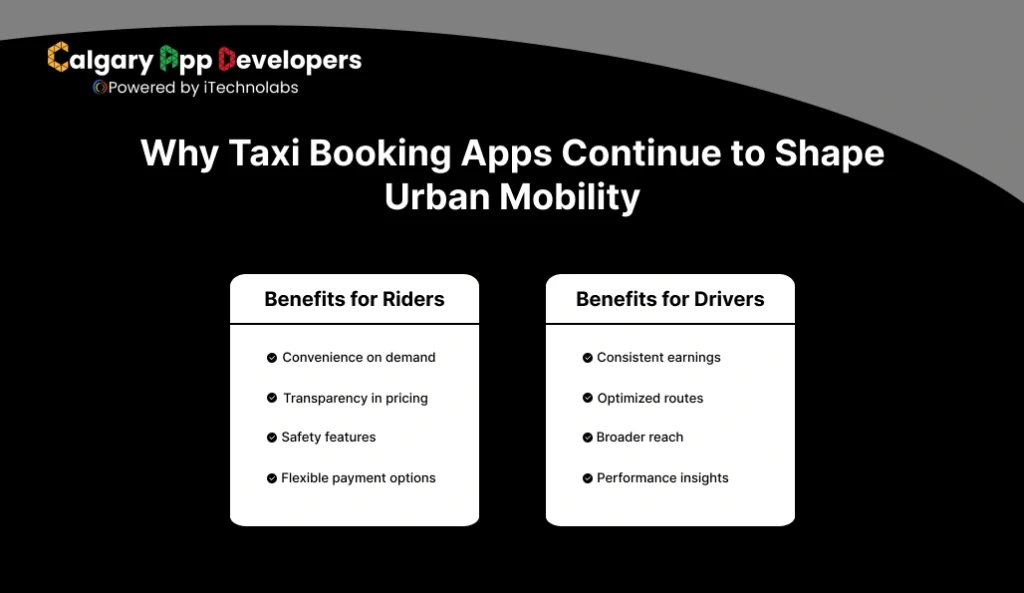
Urban life moves fast, and transportation is at the heart of it. The reason taxi booking apps remain central to city mobility is simple: they solve real problems for both riders and drivers. With every passing year, taxi booking app development keeps evolving, but the core value stays the same. It is all about making travel easier, quicker, and more reliable.
Benefits for Riders
- Convenience on demand: Riders can book a trip anytime without waiting on the street or calling multiple cab services.
- Transparency in pricing: Apps display the fare upfront, helping people avoid the uncertainty of traditional taxis.
- Safety features: GPS tracking, driver details, and ride-sharing options add a layer of security for passengers.
- Flexible payment options: From cash to digital wallets, riders choose the method that works best for them.
Benefits for Drivers
- Consistent earnings: With a steady flow of ride requests, drivers no longer depend only on chance or location.
- Optimized routes: Built-in navigation helps drivers save time and fuel, making trips more profitable.
- Broader reach: Drivers can connect with more passengers than they ever could with traditional street hailing.
- Performance insights: Ratings, reviews, and trip analytics give drivers useful feedback to improve service.
Taxi booking app development is not just about creating a digital platform. It is about bridging two sides of urban mobility. Riders want reliable transport, drivers want consistent income, and the right app brings both together.
Also Check: How Much Money Can You Make if You Own an App?
Key Challenges Taxi Drivers and Taxi Businesses Face
Running a taxi operation is more complex than most people realize. Behind every completed ride is a driver balancing fuel costs, waiting time, regulations, and customer expectations. Taxi businesses face the same pressures at scale, where small inefficiencies quickly turn into lost revenue.
Here are the most pressing challenges shaping the industry today.
- Unpredictable Demand and Idle Time: Ride requests fluctuate throughout the day. Drivers experience long waiting periods followed by sudden rush hours, making income inconsistent. For fleet operators, uneven vehicle usage reduces overall efficiency and profitability.
- Rising Operating Expenses: Fuel, maintenance, insurance, and licensing costs continue to climb. Independent drivers carry these expenses directly, while taxi companies manage them across entire fleets, tightening already thin margins.
- Growing Competitive Pressure: Digital ride-hailing platforms have raised customer expectations. Riders now expect instant booking, fare transparency, and live tracking. Traditional services without modern tools struggle to keep up.
- Weak Customer Retention: Phone bookings and street pickups rarely create repeat customers. Without loyalty programs or structured feedback systems, businesses lose opportunities to build long-term relationships.
- Payment and Settlement Complications: Cash transactions increase the risk of disputes and accounting errors. Tracking commissions, daily earnings, and reconciliations manually adds an administrative burden for taxi operators.
- Compliance and Safety Risks: Regulations frequently change, creating constant administrative work. At the same time, both drivers and riders worry about safety. Without proper tracking systems, resolving disputes becomes difficult.
Addressing these challenges requires more than traditional dispatch methods. It demands smarter systems that improve efficiency, transparency, and trust across the entire operation.
How a Taxi Booking App Helps Solve These Challenges
Technology does more than digitize booking. It restructures how drivers earn and how taxi businesses operate. Here’s how a well-built taxi app directly addresses these pain points.
- Predictable Ride Flow Through Smart Matching
- AI-driven ride allocation reduces idle time by connecting drivers with nearby passengers instantly. Demand forecasting tools help drivers position themselves in high-demand areas.
- For businesses, better dispatch logic increases fleet utilization and overall revenue per vehicle.
- Transparent and Automated Payments
- Integrated digital payments eliminate cash dependency. Automated invoicing and real-time earnings dashboards give drivers clarity on income.
- Taxi businesses benefit from accurate commission tracking and simplified financial reporting.
- Data Driven Cost Optimization
- Route optimization reduces fuel consumption and travel time. Analytics help drivers understand peak earning hours and profitable zones.
- Fleet owners can track vehicle performance, driver activity, and maintenance schedules through centralized dashboards.
- Stronger Customer Retention
- Built-in rating systems improve service quality. Loyalty programs, discounts, and subscription models encourage repeat usage.
- Push notifications and promotions keep riders engaged without manual marketing efforts.
- Improved Safety and Accountability
- Real-time GPS tracking creates transparency for both riders and drivers. Emergency alert features and verified user profiles increase trust.
- Disputes can be resolved quickly using ride history and trip data stored in the system.
- Competitive Market Positioning
- A digital platform allows local taxi businesses to compete with global players by offering similar convenience.
- Features like ride scheduling, fare estimation, and multiple payment options meet modern customer expectations.
- Operational Control for Taxi Businesses
- An admin dashboard provides full visibility into bookings, driver performance, revenue, and cancellations.
- Business owners can adjust pricing rules, monitor demand patterns, and scale operations based on real-time insights.
Taxi drivers want a steady income and safer working conditions. Taxi businesses want predictable revenue and operational efficiency.
A taxi booking app aligns both goals. It turns fragmented operations into a structured, data-driven system. Instead of relying on chance, drivers and operators work within a platform designed to increase efficiency, trust, and profitability.
That shift is what separates struggling fleets from scalable mobility businesses in 2026.
Different Types of Taxi Apps
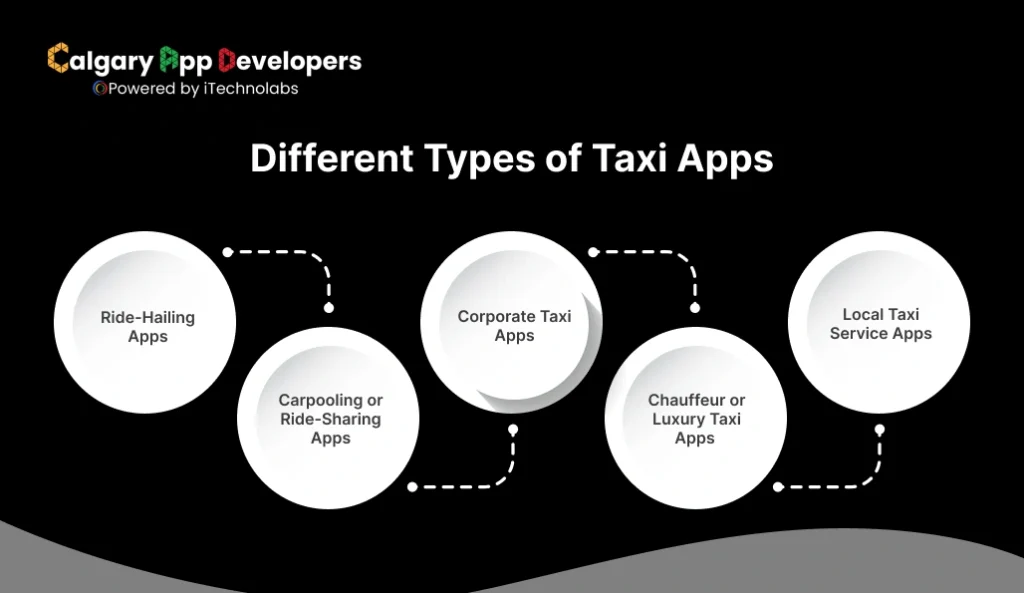
Not all taxi apps are created equal. When it comes to taxi booking app development, choosing the right type of app can determine the success of your business. Each model addresses different user needs and comes with unique features, benefits, and challenges. Understanding these types helps you make informed decisions before investing in development.
- Ride-Hailing Apps
Ride-hailing apps are the most popular and commonly used model. They enable users to order a cab instantly via the app while drivers near them receive the request. Uber and Lyft have become the benchmark for this category. Speed and convenience are the prime focus of these apps with real-time tracking, estimation of fares, and varied payment options. Developers would need a strong backend to handle live bookings, GPS integration, and dynamic pricing in this model.
- Carpooling or Ride-Sharing Apps
Carpooling apps connect riders traveling in the same direction, allowing them to share a ride. This model reduces transportation costs for users and maximizes income for drivers. It also appeals to environmentally conscious consumers since fewer cars on the road mean lower emissions and less traffic congestion. Implementing a ride-sharing feature during taxi booking app development involves advanced matching algorithms to pair riders efficiently and safely.
- Corporate Taxi Apps
Business taxi applications are designed for businesses and organizations that have the necessity to operate employee transport. They usually offer bulk booking features, planned trips, cost tracking, and top-priority customer support. The app is often integrated with business systems and permits in-depth reporting to track the cost of travel. Corporate clients require a trustworthy, on-time update and observance of safety standards, which must be considered while developing taxi booking applications.
- Chauffeur or Luxury Taxi Apps
These apps target high-end customers looking for luxurious cars and skilled drivers. The target users are business travelers, executives, and people who book rides for events. Ride scheduling, driver ratings, car choice, and loyalty plans are essential features. Chauffeur app development is all about providing a smooth, quality user experience, with an emphasis on comfort, safety, and exclusivity.
- Local Taxi Service Apps
Local taxi apps are created for regional or small taxi businesses to challenge the world giants. They are localized for a particular region or city and offer stable, community-oriented service. Local apps may have the following features: easy booking, loyalty programs, and payments using local options. Creating a local taxi app involves considerations of operational effectiveness, streamlined driver onboarding, and robust marketing towards local users.
Choosing the right type of app during taxi booking app development is essential. The model you select determines your feature set, technology requirements, and business strategy. Understanding the target audience, market demand, and potential competition will guide the development process and improve the chances of building a successful taxi app.
Essential Features of a Taxi Booking App
A successful taxi booking app is based on its functionality. In planning for taxi booking app development, it is essential to incorporate functionalities catering to both riders and drivers, with the experience being seamless and trustworthy. An effective app works by balancing ease with sophistication, with users being able to book rides with ease and drivers being able to have an easy time handling trips.
- User Registration and Profiles: A simple sign-up process using email, phone numbers, or social media accounts is essential. Users should be able to manage their profiles, view ride history, and store payment information securely. For drivers, profile verification, including license and vehicle details, adds trust to the platform.
- Geo-Location and Real-Time Tracking: GPS integration allows riders to see nearby cabs and drivers to find passengers quickly. Real-time tracking of rides builds transparency and helps both parties estimate arrival and travel times accurately.
- Ride Booking and Scheduling: Users should be able to book rides instantly or schedule them for later. The app should provide options for different vehicle types and calculate fares in real time. Scheduling features are especially important for business users and premium services.
- Multiple Payment Options: Flexible payment methods enhance convenience. Taxi booking app development should support digital wallets, credit and debit cards, net banking, and cash payments. Automated invoicing and receipts add professionalism.
- Ratings and Reviews: Feedback mechanisms allow riders to rate drivers and drivers to rate passengers. This promotes accountability, improves service quality, and helps the platform maintain high standards.
- Push Notifications and Alerts: Notifications keep users informed about booking confirmations, driver arrival, ride cancellations, promotions, and other important updates. Timely alerts improve engagement and reduce confusion.
- Trip History and Reports: A clear record of past trips, payments, and invoices is useful for both riders and drivers. It allows users to track spending and helps drivers monitor their performance and earnings.
- In-App Chat and Support: Direct communication between drivers and riders resolves issues quickly. Integrated customer support features ensure users can report problems, ask questions, or request assistance without leaving the app.
- Admin Dashboard: For taxi booking app development, a comprehensive admin panel is essential. It allows the management team to monitor rides, manage users, track payments, generate reports, and oversee driver activity efficiently.
- Advanced Features (Optional): To stay competitive in 2026, apps can include AI-based route optimization, predictive ride demand analytics, loyalty programs, and voice-enabled booking. These features enhance the experience and help the platform scale effectively.
Including these essential features ensures that your taxi booking app development project addresses the needs of both riders and drivers while providing a reliable, engaging, and secure service.
Also Check: How Much Does It Cost to Maintain an App?
Top Technologies Used in Taxi Booking App Development
Technology forms the backbone of any successful taxi booking app. Choosing the right tools and frameworks during taxi booking app development ensures reliability, scalability, and a smooth user experience. From app platforms to backend frameworks, each component plays a critical role in making the app responsive and secure.
Key Technologies
| Category | Technology | Purpose in Taxi Booking App Development |
| Mobile Platforms | iOS (Swift, Objective-C), Android (Kotlin, Java), Cross-platform (Flutter, React Native) | Builds the app for multiple devices while maintaining performance and user experience |
| Backend Development | Node.js, Django, Ruby on Rails, Laravel | Handles server-side logic, database management, and integration with APIs |
| Database | MySQL, PostgreSQL, MongoDB, Firebase | Stores user data, ride details, driver profiles, and payment history securely |
| Geolocation & Maps | Google Maps API, Mapbox, OpenStreetMap | Provides GPS tracking, route optimization, and real-time navigation |
| Payment Gateway | Stripe, PayPal, Razorpay, Braintree | Enables secure in-app payments, supports multiple payment methods, and manages transactions |
| Cloud & Hosting | AWS, Google Cloud, Microsoft Azure | Ensures scalability, uptime, and fast performance for the app and backend services |
| Push Notifications | Firebase Cloud Messaging, OneSignal | Sends real-time updates about ride status, offers, and alerts to users |
| AI & Machine Learning | Python libraries, TensorFlow, Scikit-learn | Powers predictive ride demand, route optimization, and personalized recommendations |
| Analytics & Reporting | Google Analytics, Mixpanel, Amplitude | Tracks user behavior, app performance, and generates insights for improvement |
| Security | SSL/TLS, OAuth 2.0, JWT | Protects user data, ensures safe authentication, and secures transactions |
Using these technologies strategically during taxi booking app development allows you to build a platform that is fast, reliable, and capable of handling high volumes of rides without compromising on user experience.
Step-by-Step Process of Taxi Booking App Development
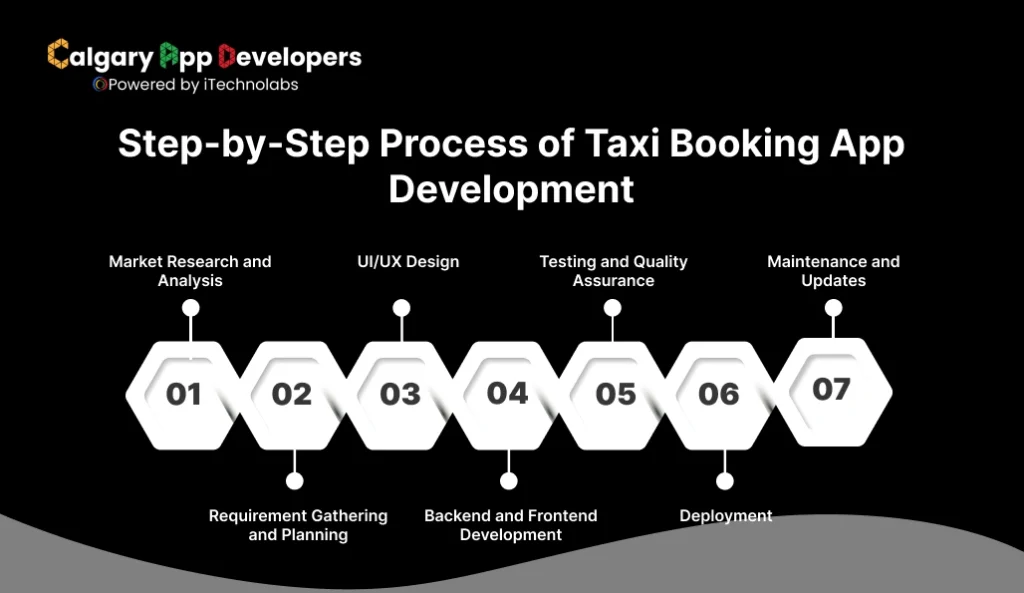
Building a taxi booking app requires careful planning, execution, and testing. Following a structured approach ensures the app is reliable, scalable, and user-friendly. Here is a step-by-step breakdown of the taxi booking app development process.
Step 1: Market Research and Analysis
- Understand target audience: Identify riders, drivers, and corporate users you plan to serve.
- Analyze competitors: Study successful apps in your region to understand features, pricing, and user expectations.
- Define USP: Determine what will make your app stand out, whether it’s pricing, premium services, or AI-driven features.
Step 2: Requirement Gathering and Planning
- Feature list: Decide on essential and advanced features for riders, drivers, and admin dashboards.
- Platform selection: Choose whether the app will be native (iOS/Android), cross-platform, or hybrid.
- Technology stack: Finalize backend, frontend, database, cloud services, and APIs to be used.
Step 3: UI/UX Design
- Wireframes and mockups: Create layouts for the app screens and user flow.
- User experience focus: Ensure booking, tracking, and payment processes are intuitive and seamless.
- Branding elements: Design a logo, color palette, and app theme that resonate with the target audience.
Step 4: Backend and Frontend Development
- Backend development: Build servers, databases, APIs, and admin panels to manage rides, users, and payments.
- Frontend development: Implement the user interface for riders, drivers, and administrators.
- Integration: Connect payment gateways, GPS services, push notifications, and third-party APIs.
Step 5: Testing and Quality Assurance
- Functional testing: Ensure all features work correctly across devices and platforms.
- Performance testing: Test load handling, response times, and app stability under heavy usage.
- Security testing: Verify user data protection, payment security, and authentication mechanisms.
- User acceptance testing: Get feedback from beta users to identify usability issues.
Step 6: Deployment
- App store submission: Launch the app on the Google Play Store and Apple App Store.
- Server deployment: Ensure backend servers and databases are live and optimized.
- Monitoring setup: Implement analytics and crash reporting to track app performance.
Step 7: Maintenance and Updates
- Bug fixes and performance improvements: Regularly update the app to ensure smooth functioning.
- Feature enhancements: Add new features based on user feedback and market trends.
- Security updates: Keep the app secure against new vulnerabilities.
Following this structured approach ensures that taxi booking app development is efficient and results in a high-quality app that meets user expectations, drives engagement, and supports scalable growth.
Also Read: How Long Does it Take to Develop an App?
Cost of Developing a Taxi Booking App
The cost of taxi booking app development typically ranges between $18,000 and $60,000 depending on complexity, platform, and features. The final price depends on multiple factors, including the type of app, design complexity, backend infrastructure, and advanced functionalities.
Estimated Cost Breakdown
| Component | Cost Range (USD) | Description |
| UI/UX Design | 2,400–6,000 | Wireframes, mockups, and user interface design for riders, drivers, and admin panels |
| Frontend Development | 4,800–12,000 | Development of iOS, Android, or cross-platform apps with interactive features |
| Backend Development | 6,000–14,400 | Server-side logic, database management, APIs, and admin dashboard |
| Geolocation & Maps Integration | 1,200–2,400 | GPS, route tracking, and navigation services |
| Payment Gateway Integration | 1,200–2,400 | Secure payment processing with multiple payment options |
| Testing and QA | 1,200–3,600 | Functional, performance, and security testing |
| Deployment | 600–1,200 | App store submission and server deployment |
| Maintenance & Updates (Annual) | 2,400–6,000 | Bug fixes, feature upgrades, and performance improvements |
Factors Affecting Taxi Booking App Development Cost
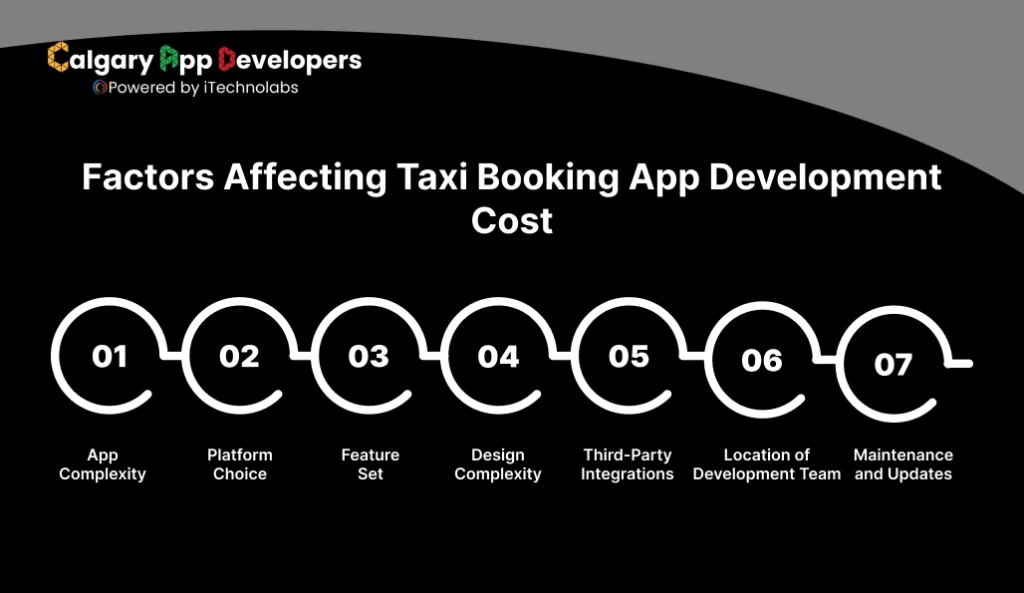
Several factors influence the total cost of taxi booking app development. Understanding these factors helps businesses plan budgets accurately.
- App Complexity
- Basic App: Simple ride booking with minimal features. Cost: $18,000–24,000
- Medium Complexity: Includes multiple vehicle options, scheduled rides, and basic analytics. Cost: $30,000–42,000
- Advanced App: AI-powered features, ride sharing, loyalty programs, and real-time analytics. Cost: $48,000–60,000
| Complexity Level | Key Features | Approx. Cost (USD) |
| Basic | Standard ride booking, GPS, payments | 18,000–24,000 |
| Medium | Ride scheduling, multiple vehicle types, analytics | 30,000–42,000 |
| Advanced | AI-based route optimization, predictive pricing, loyalty programs | 48,000–60,000 |
- Platform Choice
- Single Platform (iOS or Android): Lower cost but limits reach.
- Cross-Platform: Slightly higher initial investment but covers multiple devices.
- Native iOS & Android: Highest cost but best performance and user experience.
| Platform | Cost Impact |
| iOS Only | Medium |
| Android Only | Medium |
| iOS + Android | High |
| Cross-Platform | Medium-High |
- Feature Set:
The features you include determine both functionality and development time. Advanced features like real-time tracking, multiple payment options, in-app chat, and AI-based recommendations require additional coding, testing, and backend support. More features enhance user experience but significantly increase the cost and complexity of taxi booking app development.
- Design Complexity:
Design complexity affects user engagement and app appeal. Custom graphics, animations, and premium UI designs demand more design and development hours compared to standard templates. High-quality, intuitive designs improve retention and user satisfaction, but they increase both initial development costs and ongoing maintenance for a taxi booking app.
- Third-Party Integrations:
Third-party integrations add essential functionality but also cost. Services like Google Maps, payment gateways, chat systems, and analytics tools require proper setup, configuration, and testing. Each integration adds to development time, maintenance, and sometimes subscription fees, directly impacting the total cost of taxi booking app development.
- Location of Development Team
Choosing the right development team location can have a significant impact on the cost and quality of taxi booking app development. While offshore teams can reduce costs, local expertise ensures better communication, faster iteration, and high-quality results. Calgary stands out as an affordable option for businesses seeking professional app development without compromising on quality.
| City | Average Hourly Rate (USD) | Notes |
| Calgary | 35–50 | High-quality development at a competitive rate, making it one of the cheapest options for North American standards |
| Bangalore | 20–40 | Offers cost-effective development but may require more coordination due to time zone differences |
| New York | 80–120 | Premium rates with top-tier talent, but significantly higher costs |
| London | 70–110 | High-quality developers, but pricing is steep |
| Toronto | 60–90 | Excellent talent pool, moderate cost compared to New York and London |
| Kyiv | 25–45 | Affordable development, popular for outsourcing, but remote coordination required |
Calgary combines the benefits of local expertise, English-speaking teams, and cost-efficiency, making it an ideal choice for businesses looking to develop a taxi booking app in 2026.
- Maintenance and Updates:
Regular updates, bug fixes, and new feature integration are essential for app longevity. Annual maintenance costs typically account for 15–20% of the initial development cost.
By carefully analyzing these factors, businesses can create a realistic budget for taxi booking app development while ensuring that the app meets both user expectations and operational goals.
Read Also: How to Choose the Best Company for Calgary Mobile App Development
Revenue Models for Taxi Booking App Development
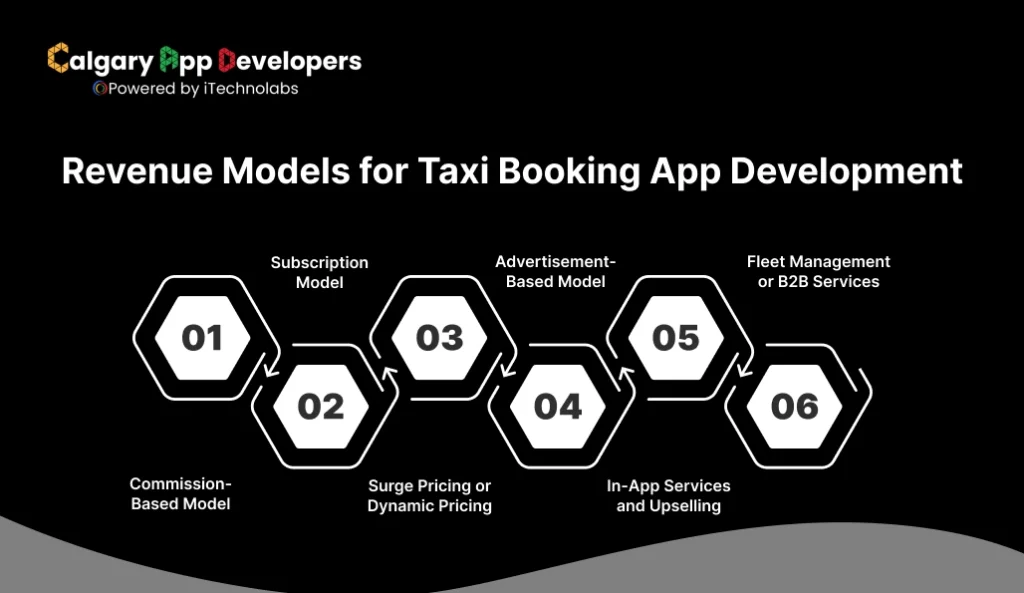
Generating revenue is a crucial part of taxi booking app development. A well-planned revenue model ensures sustainability and profitability while providing value to both riders and drivers. Several models are commonly used in the industry, and many apps combine multiple approaches for maximum earnings.
- Commission-Based Model
The most popular revenue approach. The platform takes a percentage of every ride fare.
- Typically ranges from 10% to 25% per ride.
- Encourages the app to maintain active drivers and frequent bookings.
- Subscription Model
Drivers or riders pay a fixed fee for premium features or priority access.
- Can include benefits like higher visibility for drivers or discounted fares for riders.
- Provides predictable monthly revenue for the platform.
- Surge Pricing or Dynamic Pricing
Prices increase during peak hours, high demand, or special events.
- Encourages drivers to work during busy periods.
- Increases revenue per ride while balancing supply and demand.
- Advertisement-Based Model
Integrating ads within the app can generate additional revenue.
- Ads can be shown to riders while waiting for rides.
- Partnerships with local businesses or events can provide targeted promotions.
- In-App Services and Upselling
Offering add-ons such as premium rides, luggage assistance, or priority pick-up.
- Helps diversify revenue streams beyond basic ride fares.
- Encourages users to upgrade for convenience and a better experience.
- Fleet Management or B2B Services
Some taxi apps provide corporate or fleet management solutions.
- Businesses pay for employee transport or logistics services.
- Offers stable, long-term revenue and strengthens market presence.
Choosing the right combination of these revenue models is essential during taxi booking app development. It not only impacts profitability but also shapes user experience, driver incentives, and market competitiveness.
What is a White-Label or Ready-Made Taxi Booking Solution
A white-label or ready-made solution is a pre-built taxi booking platform that can be quickly customized and launched under your brand. Instead of developing an app from scratch, businesses use these solutions to save time, reduce costs, and accelerate taxi booking app development.
Key Benefits
- Faster Time-to-Market: Pre-built solutions are already developed, tested, and ready for deployment, allowing businesses to launch quickly.
- Cost Efficiency: Avoids high initial development costs, making it ideal for startups and small businesses.
- Customization Options: Branding, UI design, and certain features can be modified to match business needs.
- Proven Technology: Ready-made platforms come with established frameworks and tested functionalities, minimizing technical risks.
- Scalability: Many solutions support multiple cities, vehicles, and users, allowing the app to grow with demand.
How It Works
- Purchase the Solution: Choose a provider offering a white-label taxi app compatible with your requirements.
- Customize: Add your brand name, logo, and colors, and select essential features.
- Launch: Deploy the app on iOS, Android, and web platforms.
- Manage: Use the admin dashboard to handle rides, drivers, and payments.
Why It Matters
For businesses looking to enter the taxi booking market quickly, a white-label or ready-made solution reduces development time, lowers costs, and ensures reliable performance. It is a strategic choice in taxi booking app development for those aiming to focus on marketing, customer acquisition, and operational efficiency rather than building an app from scratch.
Also Check: Top 10 Business Mobile App Features to Scale Your Business
Role of AI and Machine Learning in Taxi Booking App Development
Artificial Intelligence and Machine Learning are transforming taxi booking app development by making rides more efficient, personalized, and profitable. These technologies allow apps to analyze data, predict patterns, and automate decision-making, enhancing both rider and driver experiences.
Key Applications of AI and Machine Learning
- Predictive Ride Demand: AI analyzes historical data, traffic trends, and local events to forecast high-demand areas. This helps drivers position themselves effectively and reduces passenger wait times.
- Dynamic Pricing: Machine learning algorithms adjust fares in real time based on demand, traffic conditions, and ride availability, ensuring optimal revenue for the platform.
- Route Optimization: AI-powered navigation suggests the fastest and least congested routes, saving time and fuel for drivers while improving service reliability for riders.
- Personalized Recommendations: Machine learning analyzes user behavior to offer personalized ride options, promotions, and loyalty rewards, enhancing user engagement.
- Fraud Detection and Safety: AI detects unusual patterns in payments or ride requests, helping prevent fraud and ensuring passenger and driver safety.
- Driver Performance Analytics: Platforms use AI to monitor driver behavior, ratings, and ride history to provide actionable feedback and improve service quality.
Integrating AI and machine learning into taxi booking app development not only improves operational efficiency but also creates a smarter, more responsive platform. This results in satisfied riders, motivated drivers, and higher profitability for the business.
Leading Taxi Booking Apps in the Market Today
Taxi booking app development has reshaped urban mobility, and certain apps stand out as global leaders. Here’s a snapshot of the five top taxi apps:
| App Name | Launch Date | Launched By | Key Highlights |
| Uber | 2009 | Travis Kalanick & Garrett Camp | Pioneered the ride-hailing model with global reach and features like dynamic pricing and ride-sharing |
| Lyft | 2012 | Logan Green & John Zimmer | Focused on North America, offering a user-friendly interface, in-app tipping, and sustainability initiatives |
| DiDi Chuxing | 2012 | Cheng Wei | Dominates China with AI-driven ride matching, multi-mobility options, and large-scale operations |
| Grab | 2012 | Anthony Tan & Tan Hooi Ling | Southeast Asia leader integrating ride-hailing, payments, and delivery services in one platform |
| Bolt (formerly Taxify) | 2013 | Markus Villig | Strong in Europe and Africa, emphasizing competitive pricing and local market adaptability |
Uber:
Uber transformed urban transport with its innovative ride-hailing model. The app combines real-time tracking, dynamic pricing, and ride-sharing, offering both convenience and efficiency. Uber’s global expansion demonstrates the scalability of taxi booking app development and its ability to integrate advanced features that enhance user experience and driver profitability.
Lyft:
Lyft focuses on North America, prioritizing rider comfort and community-friendly services. With features like in-app tipping, eco-friendly ride options, and seamless booking, Lyft has created a loyal user base. Its success highlights the importance of local market understanding in taxi booking app development.
DiDi Chuxing:
DiDi dominates the Chinese market through AI-powered ride matching, multiple transport options, and extensive user data analysis. Its integration of taxis, carpooling, and other mobility services makes it a versatile platform. DiDi’s model emphasizes how intelligent algorithms improve efficiency in taxi booking app development.
Grab:
Grab has grown into Southeast Asia’s leading mobility platform by combining ride-hailing, payments, and delivery services. Its all-in-one ecosystem enhances convenience for users and provides multiple revenue streams for the company, showcasing how taxi booking app development can extend beyond traditional rides.
Bolt (formerly Taxify):
Bolt offers competitive pricing and localized services across Europe and Africa. By focusing on efficient operations, driver incentives, and adapting to regional markets, Bolt illustrates how taxi booking app development can balance cost, scalability, and user experience effectively.
Future Trends in Taxi Booking App Development
The taxi booking app development landscape continues to evolve rapidly, driven by technological innovation, changing user expectations, and urban mobility challenges. Staying ahead of trends ensures apps remain competitive and relevant in 2026 and beyond.
- AI and Machine Learning Integration: Future apps will rely heavily on AI to optimize routes, predict demand, and offer personalized experiences. Machine learning can improve driver allocation, reduce waiting times, and dynamically adjust pricing based on real-time data.
- Electric and Autonomous Vehicles: With sustainability gaining priority, taxi apps will increasingly integrate electric vehicles. Autonomous or self-driving vehicles are also expected to play a significant role, reducing operational costs and reshaping driver involvement.
- Multi-Modal Mobility Solutions: Apps will offer combined transportation options, including bikes, scooters, ride-sharing, and public transit integration. This allows users to plan end-to-end trips seamlessly within a single platform.
- Advanced Safety and Health Features: Enhanced safety features, such as real-time SOS alerts, biometric verification, and contactless ride options, will become standard. Health-conscious users will continue to expect hygiene-focused and secure travel experiences.
- Blockchain for Payment and Data Security: Blockchain technology can provide secure, transparent payment processing and protect sensitive user data. This trend will help build trust and minimize fraud in taxi booking app development.
- Voice and Smart Device Integration: Voice-enabled booking through smartphones or smart devices will simplify ride requests and improve accessibility. Integration with smart assistants can create a seamless, hands-free user experience.
- Subscription and Loyalty Programs: Subscription-based models and reward programs will grow, offering discounts, priority rides, or bundled services. This helps retain loyal customers and increases predictable revenue streams.
- Hyperlocal Customization: Apps will offer features tailored to local traffic patterns, regulations, and user preferences, allowing better engagement and adoption in different cities or regions.
Embracing these trends in taxi booking app development ensures platforms remain innovative, efficient, and user-centric. Businesses that adapt to emerging technologies and evolving user needs are more likely to stay ahead in the competitive mobility market.
Why Choose Calgary App Developers for Your Taxi Booking App Development
Choosing the right development partner is critical to the success of your taxi booking app development project. Calgary App Developers combines expertise, affordability, and a deep understanding of market trends to deliver apps that meet both business goals and user expectations.
Key Advantages of Calgary App Developers
- Proven Expertise: Our team has extensive experience in building scalable, secure, and feature-rich taxi booking apps tailored to diverse markets.
- Cost-Effective Solutions: Calgary App Developers offers competitive rates without compromising quality, helping businesses maximize ROI.
- End-to-End Development: From concept and UI/UX design to backend infrastructure, AI integration, and app deployment, we manage the entire development process.
- Customization and Flexibility: We create apps that align with your brand, target audience, and unique business requirements.
- Timely Delivery: Leveraging streamlined development processes and agile methodologies, we ensure projects are completed on schedule.
- Post-Launch Support: Our services include maintenance, updates, and feature enhancements to keep your taxi booking app relevant and competitive.
- Local Advantage with Global Standards: Being based in Calgary, we combine local accessibility with global development standards, ensuring seamless collaboration and high-quality output.
Partnering with Calgary App Developers for taxi booking app development ensures your project benefits from technical expertise, innovative solutions, and reliable support. Our focus is on delivering apps that not only meet industry standards but also provide a superior experience for riders and drivers alike.
Our Proven Experience in Building High-Performance Taxi Booking Platforms
Successful taxi booking app development is not just about connecting riders and drivers. It is about building a real-time ecosystem that performs under pressure, scales with demand, and delivers a consistent experience every time someone books a ride.
Our team has designed and launched multiple taxi booking platforms that combine strong backend architecture, intuitive design, transparent pricing models, and operational control. Below are three standout projects that reflect our expertise.
1. Zefir: Fast, Transparent Ride-Hailing
Zefir was built around a simple but powerful promise: order a ride with one tap and get picked up by a top-rated driver within minutes. The core focus was transparency, reliability, and speed.
Project Focus:
Create a seamless on-demand ride-hailing experience with fair and predictable pricing.
Key Capabilities Delivered:
- One-tap ride requests with intelligent driver matching
- Upfront fare calculation with no hidden fees
- Real-time GPS tracking for complete ride visibility
- Secure in-app payments with multiple payment options
- Driver ratings and quality monitoring system
- Centralized admin dashboard for ride, driver, and revenue management
Business Outcome:
By prioritizing fair and transparent pricing, Zefir built user trust quickly. Riders always see the cost before confirming, which increased booking confidence and improves repeat usage rates.
2. Reserve ARC: Reliable Scheduled and On-Demand Transport
Reserve ARC was developed to support both instant bookings and scheduled rides, with a strong emphasis on punctuality and structured operations. The platform is well-suited for airport transfers, corporate travel, and pre-planned trips.
Project Focus:
Deliver dependable, time-sensitive transportation with strong scheduling controls.
Key Capabilities Delivered:
- Instant and advanced ride scheduling
- Automated booking confirmations and ride reminders
- Driver availability management and dispatch system
- Optimized route navigation for efficiency
- Detailed ride history and digital invoicing
- Analytics dashboard for fleet and performance tracking
Business Outcome:
Reserve ARC improved operational predictability and driver utilization. The scheduling functionality created a stable flow of bookings while strengthening customer retention through reliable service delivery.
3. Cruxe: Scalable Taxi Platform Built for Growth
Cruxe was engineered as a scalable taxi booking solution capable of handling high ride volumes without performance issues. The focus was on clean design, operational control, and long-term scalability.
Project Focus:
Develop a flexible and performance-driven ride platform ready for expansion.
Key Capabilities Delivered:
- Streamlined rider and driver onboarding
- Live ride tracking with optimized route suggestions
- Integrated multi-payment gateway support
- Configurable surge pricing management
- Driver performance tracking and rating analytics
- Comprehensive admin control panel for full platform oversight
Business Outcome:
Cruxe demonstrates how strong backend engineering and thoughtful UX design can support consistent performance even during peak demand. The scalable infrastructure positions the platform for multi-city expansion.
Across these projects, we consistently deliver:
- Real-time ride matching and GPS precision
- Transparent fare calculation systems
- Secure and flexible payment integrations
- Scalable cloud-based backend architecture
- Advanced admin dashboards for operational control
- Data-driven performance insights
Our experience in taxi booking app development enables us to create platforms that are not only functional but also commercially viable. Each solution is built with long-term growth, user trust, and operational efficiency in mind.
Conclusion
Taxi booking app development has transformed the way cities move, offering convenience for riders, opportunities for drivers, and growth potential for businesses. From understanding market trends and selecting the right app type to integrating advanced features, AI, and secure payment systems, each step shapes the success of the platform.
Whether you choose a custom-built solution or a white-label platform, focusing on user experience, scalability, and innovative technology is essential. With the right development partner, such as Calgary Mobile App Developers, businesses can launch efficient, reliable, and profitable taxi apps that stand out in a competitive market.
Investing in a thoughtfully developed taxi booking app ensures long-term growth, satisfied users, and a sustainable presence in the evolving urban mobility landscape.
FAQ’s About Taxi Booking App Development
1. How much does it cost to develop a taxi booking app?
The cost of taxi booking app development typically ranges from $18,000 to $60,000, depending on factors like app complexity, platform choice, features, design, and third-party integrations. Advanced apps with AI, real-time tracking, and multi-service options may cost more, while white-label or ready-made solutions can reduce development expenses and time to market.
2. How to create a travel booking app?
Creating a travel booking app involves defining your target audience, deciding on core features like search, booking, payment, and itinerary management, and choosing the right technology stack. Design intuitive UI/UX, develop the backend and frontend, integrate APIs for hotels, flights, and payments, test thoroughly, and deploy on mobile platforms. Post-launch maintenance ensures smooth performance.
3. How to build a taxi app like Uber?
Building a taxi app like Uber requires market research, defining rider and driver features, and selecting a tech stack. Core features include ride booking, real-time tracking, payments, ratings, and notifications. Add backend infrastructure for data management, admin controls, and analytics. Testing, deployment, and continuous updates are essential for scalability and a seamless user experience.
4. Is the taxi app profitable?
Yes, taxi booking apps can be highly profitable if properly executed. Revenue comes from commissions per ride, surge pricing, subscription models, advertisements, and corporate partnerships. Profitability depends on app quality, user base, market demand, and operational efficiency. Integrating AI, multi-service options, and loyalty programs can further enhance revenue streams.


Pankaj Arora is a seasoned technology leader and the Founder of Calgary App Developer, with 10+ years of expertise in crafting high-performance digital solutions. His core competencies include full-stack app development, cloud-native architecture, API integration, and agile product delivery. Under his leadership, Calgary App Developers has empowered startups and enterprises alike with scalable mobile applications, secure web platforms, and AI-driven SaaS products.