










Warehouse Management System Application: Benefits & Features
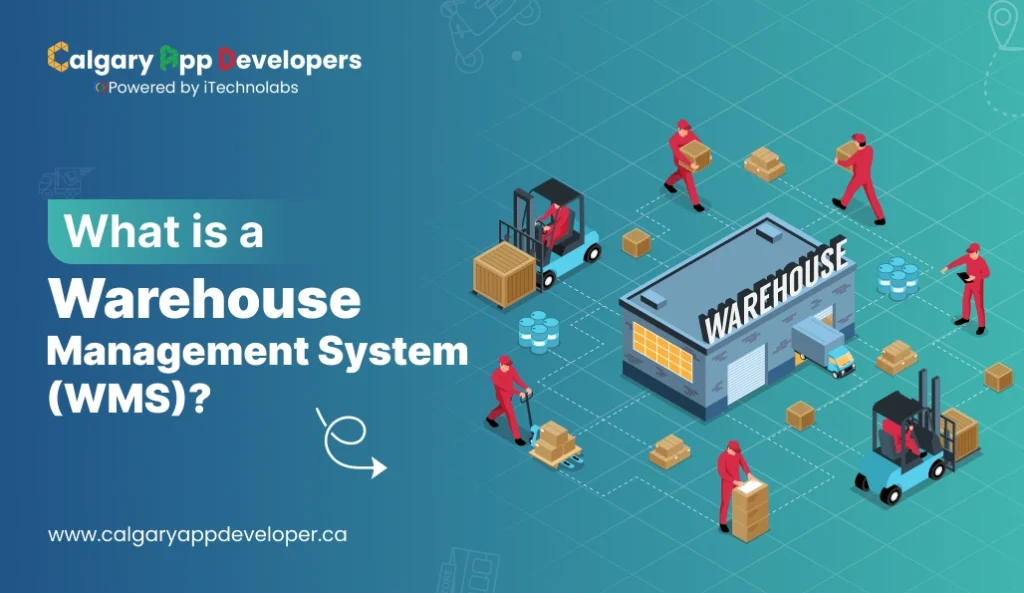
A Warehouse Management System (WMS) is a software solution, and more than that, it is the backbone of logistics in modern times. It handles the complicated flow of inventory, orders, and shipments with precision, thus making sure that goods move smoothly from the suppliers to the customers. In the present scenario, where fast delivery and precision are the two most important factors, a WMS is the invisible power that leads to excellence in the operations.
The worldwide WMS market is growing at a fast pace. It is estimated that it will be worth USD 4.04 billion by the year 2025 and the compound annual growth rate (CAGR) over the next 5 years will be 18.26%, thus nearly a USD 10 billion market by 2030.
The main reason for this growth is the growing need for real-time inventory tracking, automation and the flexibility provided by the cloud-based solutions.
The WMS market in Canada is going to be very big. By the year 2030, it is expected to be at USD 189.3 million, which is a 16.6% CAGR from 2025 to 2030. This increase shows that the industry is widely adopting the trend of automation and integration of real-time data in warehouses.
The need for advanced warehouses is driving companies to implement the technologies and invest in them as well. Companies are using technologies such as Automated Guided Vehicles (AGVs) and robotic systems are used more and more to improve their processes and reduce the labor force.
Whether you are a small business or a large enterprise, a WMS will adapt and transform your warehouse operations to become agile and responsive to market demand.
- A Warehouse Management System (WMS) is software that streamlines inventory, order, and warehouse operations for efficiency and accuracy.
- Modern WMS integrates with ERP, TMS, automation devices, and e-commerce platforms to provide real-time visibility and operational control.
- Cloud-based and AI-driven WMS solutions offer scalability, flexibility, and improved decision-making.
- Implementing a WMS reduces errors, optimizes labor and space, and supports long-term growth.
- A WMS manages all warehouse activities, including receiving, storage, picking, packing, shipping, and reporting, transforming warehouses into organized, efficient operations.
- Integration with ERP, transportation management, supply chain, e-commerce, and automation systems ensures seamless workflows and accurate data across the organization.
- Cloud-based WMS allows remote access, automatic updates, scalability, and better cybersecurity compared to on-premise systems.
- Advanced WMS solutions use AI, machine learning, robotics, IoT, and predictive analytics to optimize operations and support data-driven decision-making.
- WMS implementation requires clear objectives, careful process assessment, staff training, and continuous monitoring for successful adoption.
- Key benefits include improved inventory accuracy, faster order fulfillment, optimized space and labor, reduced costs, and enhanced scalability.
- Businesses can choose from standalone, integrated, cloud-based, or on-premise WMS depending on operational complexity, budget, and growth plans.
- A custom-built WMS can provide tailored workflows, deeper automation, and competitive advantages for unique warehouse requirements.
Understanding Warehouse Management Systems
A Warehouse Management System (WMS) is a software application that takes care of and supervises all warehouse operations, thereby maximizing their efficiency. The main function of the system is to show the current stock in the warehouse, control and track the flow of products, and manage the order processing in the most efficient way. Actually, a WMS makes a warehouse a live organization rather than a dead storage place.
The daily operation of a warehouse entails a lot of activities like receiving shipments, storing the items, picking, packing, and shipping orders. If there is no organized system, mistakes such as lost inventory, delayed shipments, and inefficient use of space may occur very quickly. A WMS system resolves these issues by unifying and organizing the workflows, directing the workers through what they have to do and providing them with accurate inventory records.
Nowadays WMS solutions offer more functions than just taking inventory. They connect with enterprise resource planning systems, shipping carriers, and other supply chain technologies to produce a seamless ecosystem. By having this integration, businesses are able to quickly adapt to shifts in demand, make the best use of labor and storage resources, and thus realize the whole operational efficiency improvement.
A WMS brings measurable benefits. Advanced warehouse management system users report diminished order processing errors, shorter lead times, and more accurate inventories. A WMS achieves these results through process standardization and automation, thereby granting warehouses accuracy, scalability, and transparency in operations.
How Warehouse Management Systems Operate
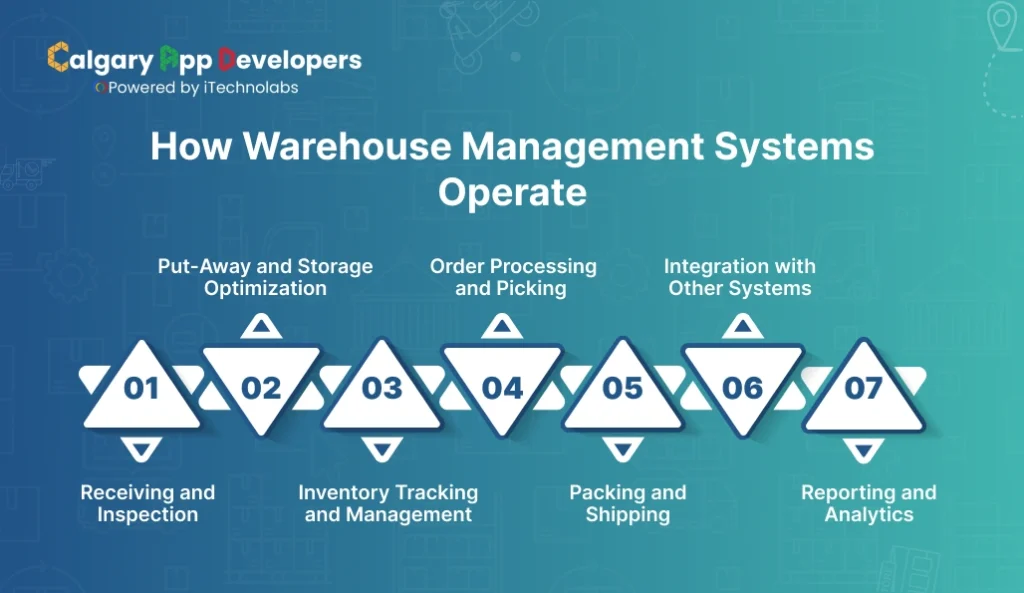
A Warehouse Management System manages the whole warehouse operation and guarantees accuracy, efficiency, and real-time visibility. Here’s the step-by-step process:
Step 1: Receiving and Inspection
When goods arrive at the warehouse, the WMS records each shipment, verifies it against purchase orders, and checks for damage or discrepancies. This ensures only accurate and quality inventory enters the warehouse.
Step 2: Put-Away and Storage Optimization
The most effective location for each item is determined by the system based on its size, demand, and turnover rates. Thus, space utilization is optimized, and quick access is provided when items are required.
Step 3: Inventory Tracking and Management
The WMS is always keeping an eye on stock levels, places and movements. Lot numbers, expiration dates, and product conditions are tracked to avert stockouts, overstocks, and wrongly located items.
Step 4: Order Processing and Picking
The moment an order is placed, the WMS comes up with efficient picking routes for the workers or automated machines. It walks them through picking the right items and quantities, thus cutting down on errors and increasing speed.
Step 5: Packing and Shipping
The WMS lets items be packed according to the order specs and it also produces shipping labels. It might even link with the carriers to organize pickups, so tracking deliveries becomes possible, thus giving end-to-end visibility.
Step 6: Integration with Other Systems
Today’s WMS solutions can interact with ERP systems, transportation management and supplier networks. The communication that is created across the supply chain due to this integration is very effective and supports improved planning, procurement, and distribution.
Step 7: Reporting and Analytics
The warehouse provides continuous reports regarding the operation through the aforementioned system, such as real-time analysis of inventory, orders and performance.
By following these steps, a Warehouse Management System transforms warehouse operations into a highly organized, efficient, and scalable process.
Also Read: Top 20 Software Companies in Calgary, Alberta
Key Benefits of Using a Warehouse Management System
A Warehouse Management System provides measurable benefits that enhance the efficiency, accuracy, and overall operational performance. The following are the main advantages that businesses can look forward to:
- Enhanced Inventory Accuracy: Manual tracking of inventory is susceptible to errors, which leads to either misplaced stock or overstocking. A WMS is capable of giving real-time visibility of the inventory, which will result in knowing the exact stock levels and thus lessening discrepancies.
- Quicker Order Completion: It is by means of a Warehouse Management System that picking routes are optimized and staff is directed in their picking, packing, and shipping, whereby the whole process becomes faster, leading to shorter lead times as well as higher customer satisfaction.
- Space Utilization Optimized: A WMS conducts a study of the storage layouts and proposes optimal locations for each product. This ensures that warehouse space is not just occupied and has no clutter and that the items in demand have quick access.
- The Labor Force Is More Productive: The WMS records the labor force activity, divides the tasks according to the best way, and then cuts down on idle time. By directing personnel to the areas of most need, a warehouse can achieve more without having to pay more for the workers.
- Better Decision-Making Through Analytics: Modern Warehouse Management Systems are responsible for producing reports that provide the managers information about inventory levels, order fulfillment rates, and operational performance. The managers can then make use of these insights to spot problems, streamline workflows, and base their decisions on data.
- Reduced Operational Costs: The combination of automation and optimized workflows makes it easy to detect errors, reduces human labor, and completely avoids overstocking. The savings in operational costs are a direct result of these efficiencies.
- Scalability and Flexibility: A WMS can adapt to increased inventory, more orders, and additional warehouse locations without sacrificing efficiency as businesses grow or market demand changes.
- Integration Across the Supply Chain: A WMS has no problem linking up with ERP, supplier, and transportation management systems. Such integration is the backbone of unified operations across the supply chain that are more responsive and less prone to delays.
Essentially, a Warehouse Management System is more than just an inventory tracking tool-it is a strategic lever for operational excellence for lowering costs and enabling warehouses to respond accordingly to the various evolving business demands.
Challenges in Warehouse Management
Even though warehouses are using modern tools, production still faces a long list of various challenges that can affect efficiency, accuracy, and overall performance. A Warehouse Management System helps to solve these issues but it is necessary to know the pain points it generally covers.
- Inventory Inaccuracy
The manual inventory control usually causes stock loss, overstocking, or stockout. These mistakes can prolong the order delivery period and thus raise the costs of operation. The WMS gives the user an updated view of the current status thus eliminating mistakes and keeping accurate inventory records.
- Inefficient Space Utilization
The space that is poorly arranged in a warehouse is generally considered wasted; thus, it would take more time and require more people to retrieve the items. The WMS suggests the proper storage layout by calculating the best location for each item according to its size, demand, and turnover rate.
- Complex Order Fulfillment
Hot demand for products may be due to varied customer requirements, which contribute to a complex picking and packing process. The WMS aids this process by creating optimized picking routes and helping the personnel on how to locate the items.
- Limited Visibility Across Operations
Without centralized data, managers struggle to monitor inventory levels, order status, or workforce performance. A Warehouse Management System consolidates information, providing real-time dashboards and actionable insights.
- Labor Management and Productivity Challenges
If tasks are assigned manually, the result could be inefficient usage of labor and delays. WMS records the workforce’s daily activities, distributes work in a timely fashion, and points out where the delay is, thus ensuring more productivity.
- Integration with Supply Chain Systems
Procurement, shipping, and ERP are some of the functions that are usually supported by separate systems. Lack of integration makes the communication slow and sometimes leads to delays in operations. Modern WMS platforms can seamlessly integrate with the supply chain systems that warehouses depend on.
- Adapting to Market Changes
Fluctuating demand, seasonal spikes, and rapid growth can strain warehouse operations. A Warehouse Management System offers scalability and flexibility, allowing warehouses to adapt quickly to changes in demand without compromising efficiency.
By addressing these challenges, a Warehouse Management System ensures warehouses operate with greater accuracy, efficiency, and responsiveness. It transforms operational hurdles into manageable workflows, enabling businesses to meet customer expectations consistently.
Read Also: Top Software Companies Near Me
Exploring Different Types of Warehouse Management Systems
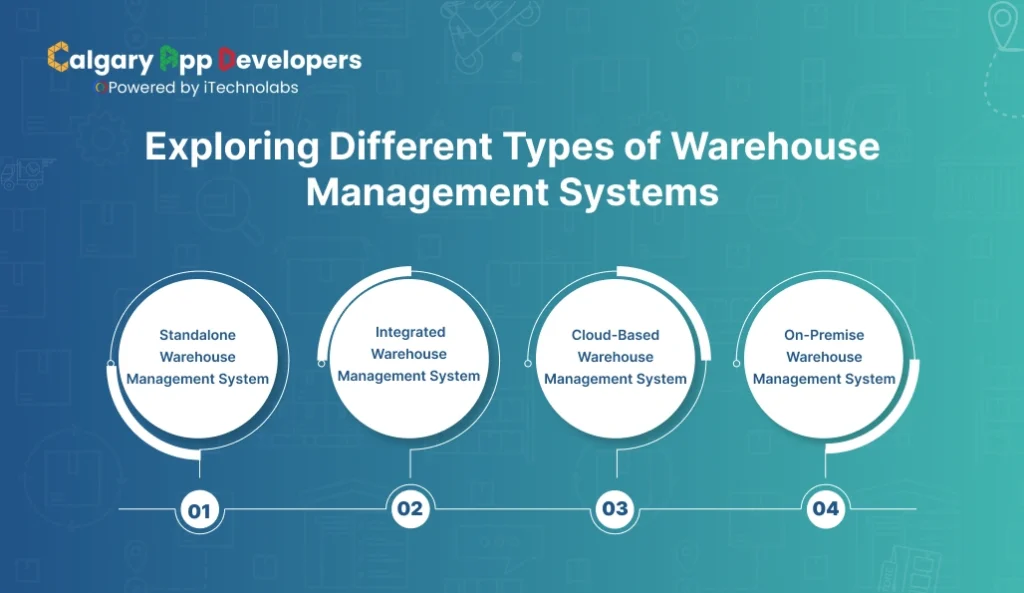
Warehouse Management Systems come in different types, each designed to meet specific operational needs. Understanding the distinctions helps businesses choose a system that aligns with their warehouse size, complexity, and strategic goals.
1. Standalone Warehouse Management System
A standalone WMS is an independent software solution that focuses solely on warehouse operations, without integrating with other business systems.
| Pros | Cons |
| Easy to implement and use | Limited integration with ERP or other systems |
| Lower upfront cost | May not scale well for larger operations |
| Focused functionality for inventory and order management | Lacks advanced analytics and reporting features |
2. Integrated Warehouse Management System
An integrated WMS is built as part of a larger enterprise system, such as an ERP, allowing seamless communication across departments.
| Pros | Cons |
| Full visibility across supply chain | Higher implementation costs |
| Real-time data sharing with other systems | Complexity can require more training |
| Easier to manage financial and operational reporting | Updates may be slower due to system-wide dependencies |
3. Cloud-Based Warehouse Management System
A cloud-based WMS operates entirely online, allowing remote access and scalability without heavy on-premise infrastructure.
| Pros | Cons |
| Accessible from anywhere with internet | Dependence on reliable internet connectivity |
| Scalable to support growth | Potential security concerns if not properly managed |
| Lower upfront hardware costs | Ongoing subscription fees |
4. On-Premise Warehouse Management System
An on-premise WMS is installed locally on company servers, providing full control over data and system customization.
| Pros | Cons |
| Complete control over data security | Higher upfront hardware and software costs |
| Can be highly customized | Requires IT staff for maintenance |
| No dependence on internet for core operations | Less flexible for scaling or remote access |
Choosing the right type of Warehouse Management System depends on factors like budget, integration needs, scalability, and operational complexity. Standalone solutions are ideal for smaller warehouses, while cloud-based and integrated systems offer greater flexibility and real-time insights for larger or multi-location operations.
Why Choose a Cloud-Based Warehouse Management System
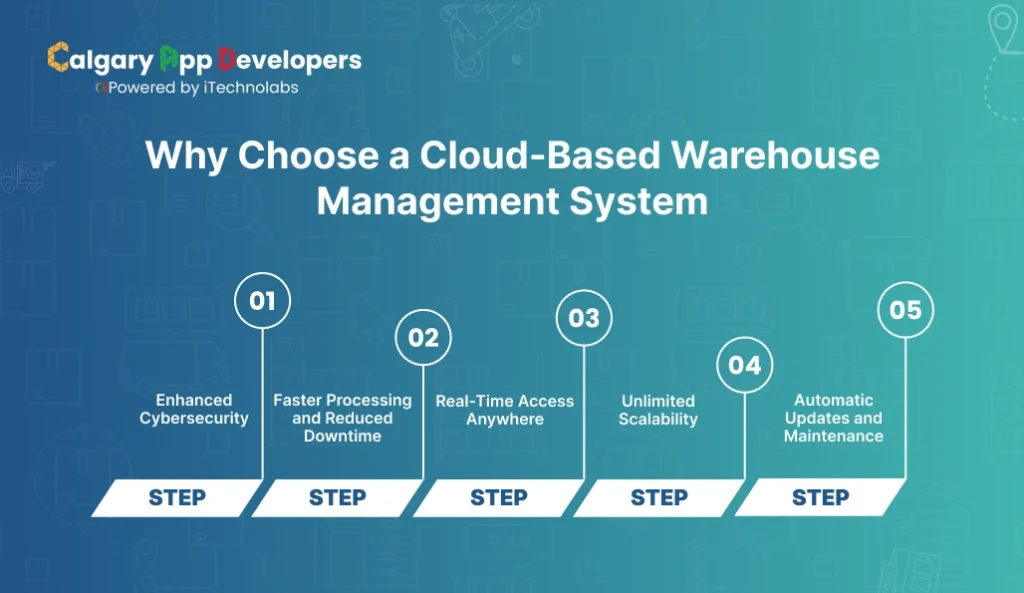
A cloud-based Warehouse Management System is becoming the preferred choice for modern warehouses due to its scalability, accessibility, and efficiency. Unlike traditional on-premise systems, cloud-based WMS solutions allow businesses to manage operations in real time, streamline processes, and reduce IT overhead. Here’s why adopting a cloud-based system makes sense for your warehouse.
1. Enhanced Cybersecurity
Cybersecurity remains a critical concern for any warehouse handling sensitive inventory and customer data. Cloud-based Warehouse Management Systems provide robust security protocols without requiring businesses to invest heavily in hardware or cybersecurity teams. This ensures data protection while maintaining customer trust and operational integrity.
2. Faster Processing and Reduced Downtime
Cloud-based systems leverage scalable computing resources, enabling faster processing of warehouse tasks. This speed minimizes downtime, ensuring that order processing, picking, and shipping operations continue smoothly. For businesses in e-commerce or high-demand sectors, even minor delays can impact customer satisfaction, making speed a critical advantage.
3. Real-Time Access Anywhere
One of the major advantages of a cloud-based Warehouse Management System is its accessibility. Managers and staff can monitor inventory, shipments, and order status from anywhere, using any device with an internet connection. This real-time visibility improves decision-making and allows teams to respond quickly to operational changes.
4. Unlimited Scalability
Traditional warehouse systems often struggle to handle an increasing number of SKUs or growing order volumes. A cloud-based WMS offers virtually unlimited scalability, allowing warehouses of any size to expand their operations without bottlenecks. Whether you are adding new product lines or managing seasonal demand, the system grows with your business.
5. Automatic Updates and Maintenance
Cloud-based Warehouse Management Systems receive automatic updates from the provider, ensuring that your software is always current. This eliminates the need for manual upgrades or additional IT resources, letting your team focus on warehouse operations rather than software maintenance.
Top Reasons to Invest in a Custom-Built Warehouse Management System
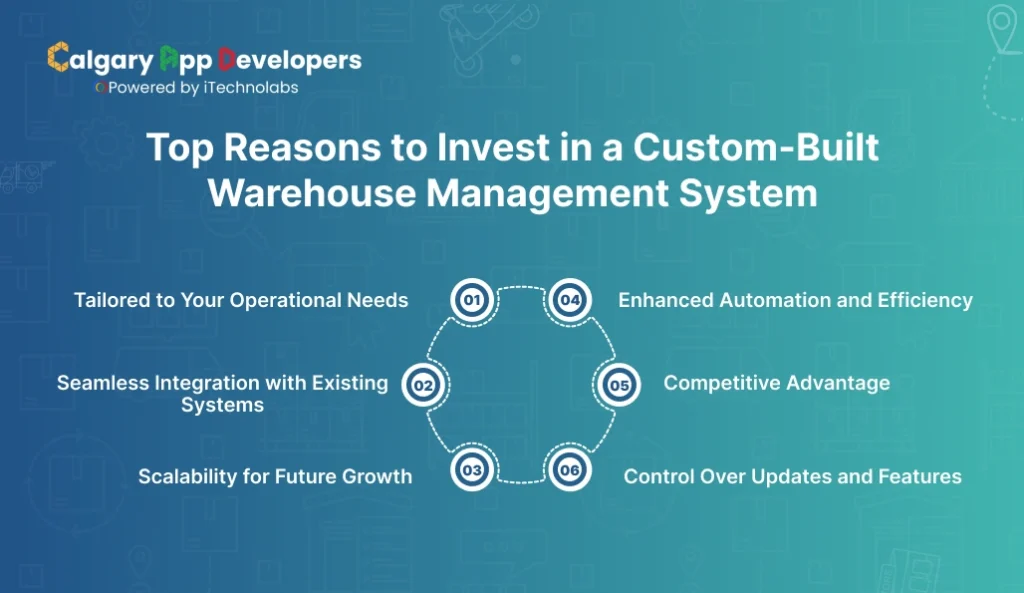
While off-the-shelf Warehouse Management Systems can meet basic operational needs, a custom-built solution offers tailored capabilities designed to match the unique requirements of your warehouse. Investing in a custom WMS can deliver long-term efficiency, flexibility, and competitive advantage. Here’s why businesses consider custom solutions.
1. Tailored to Your Operational Needs
Every warehouse operates differently, with unique workflows, inventory types, and order fulfillment processes. A custom-built Warehouse Management System can be designed to align perfectly with your operations, ensuring that your specific requirements are addressed without unnecessary features or compromises.
2. Seamless Integration with Existing Systems
Many warehouses rely on multiple software platforms for accounting, transportation, or supply chain management. A custom WMS can be built to integrate smoothly with your existing systems, providing real-time data synchronization and eliminating operational silos.
3. Scalability for Future Growth
Unlike generic systems, a custom Warehouse Management System can be designed with your growth in mind. Whether you plan to expand product lines, add more SKUs, or open additional locations, a custom solution can scale without the limitations of standard software.
4. Enhanced Automation and Efficiency
Custom solutions allow you to incorporate advanced automation tailored to your workflows, from automated picking routes to integration with robotics and conveyors. This increases operational efficiency, reduces manual errors, and accelerates order processing.
5. Competitive Advantage
A custom-built WMS enables unique capabilities that competitors may not have, such as specialized reporting, proprietary workflows, or advanced analytics. This gives your warehouse an edge in efficiency, accuracy, and customer service.
6. Control Over Updates and Features
With a custom system, you decide which features to implement and when. This allows you to prioritize functionalities that deliver the most value while avoiding unnecessary updates that don’t fit your business model.
In short, investing in a custom-built Warehouse Management System transforms warehouse operations into a highly efficient, scalable, and adaptable environment. For businesses looking to optimize performance, reduce operational bottlenecks, and gain a strategic advantage, a tailored WMS is an investment that pays off in both productivity and long-term growth.
Also Read: Top Software Developers Calgary: 15 Best Sites to Hire
Integration with Other Systems
The WMS (Warehouse Management System) functions are not only limited to the WMS when it is integrated into the core of the company’s entire technical environment. The WMS streams data to and fro with the other business systems through the integration made, allowing for better cooperation and visibility across the whole supply chain.
1. Integration with ERP Systems
The merging of a Warehouse Management System with an ERP (Enterprise Resource Planning) system results in a heightened level of transparency over the whole business process. The WMS is linked up with the ERP system; thus, all the data that has to do with inventory, purchasing, and finance is brought together to do away with manual processes and cut down on the number of errors that result from data being entered more than once. When linking, the information on the stock status, sales orders, and purchase orders is precise and uniform among the various departments.
2. Integration with Transportation Management Systems (TMS)
The linking of a WMS and TMS (Transport Management System) establishes a tight connection between the warehousing process and the logistics department. Operations like carrier selection, shipment tracking, and delivery scheduling will become easier due to the integration. Consequently, a quicker shipping process, reduced transportation costs, and, in turn, enhanced visibility of the entire order fulfillment process are the benefits from the integration.
3. Integration with Order Management and E-commerce Platforms
Businesses with various sales channels, integrating a Warehouse Management System with an order management or e-commerce platform such as Shopify, Amazon, or WooCommerce is critical for businesses to update an order automatically, sync inventory, or provide real-time visibility on inventory across sales channels to eliminate overselling or backorders.
4. Integration with Supply Chain and Procurement Systems
A WMS that connects with supply chain and procurement systems helps businesses forecast more accurately and restock efficiently. In short, it allows materials and products to flow to warehouse shelves from suppliers seamlessly and without delay.
5. Integration with Accounting and Financial Software
Connecting the Warehouse Management System to accounting software simplifies invoicing, payment tracking, and financial reporting. It also provides real-time monitoring of costs and makes budgets more manageable as well as making assessing profitability from warehouse operations easier.
6. Integration with Automation and IoT Devices
Today’s warehouses are increasingly using automation technologies like barcode scanning, RFID systems, and robotic picking tools. A WMS that connects to these automation devices provides real-time data capture, reduces errors, and makes basic processes faster.
Cost Considerations for Implementing a Warehouse Management System
Investing in a Warehouse Management System provides a strong long-term return in terms of efficiency, speed, accuracy, and scalability. However, before implementing a WMS system, it is necessary to consider the costs. The total costs to implement a Warehouse Management System very much depend on multiple dimensions that factor in WMS Types, Users, Customization and Integration Complexity. Here’s a breakdown of those details.
Key Factors Influencing WMS Costs
- Type of System
Cloud-based WMS are generally going to have a lower upfront cost but will have ongoing subscription fees as recurring costs. In contrast, with On-premise WMS systems, there are higher upfront costs in terms of hardware and implementation but reduced ongoing costs, if any at all.
- Business Size and Complexity
Smaller warehouses with simple added value will benefit from WMS system minimum features, while larger, established or multi-location warehouses may require additional expensive capabilities, mobile devices, and access to integration points.
- Customization and Integration Needs
Custom-Built Warehouse Management Systems will always have increased costs for development and implementation, as they are built outside of a product’s standard configurations and will depend on different stakeholder considerations.
- Training and Support
Training for your staff requires additional investment commitment, onboarding to a facility itself, and the maintenance of software with ongoing technical support, which is essential to the successful implementation process itself to ensure ongoing reliability.
Estimated Cost Breakdown
| Cost Component | Description | Estimated Range (USD) |
| Software Licensing / Subscription | For cloud-based WMS, usually billed monthly or annually | $3,000 – $15,000 per year |
| Implementation & Setup | Installation, configuration, and initial data migration | $10,000 – $50,000 |
| Customization & Integration | Tailoring the system to fit unique workflows or linking with other systems | $5,000 – $40,000 |
| Hardware (if on-premise) | Servers, barcode scanners, handheld devices, and related infrastructure | $10,000 – $25,000 |
| Training & User Onboarding | Employee training and system adoption support | $2,000 – $10,000 |
| Ongoing Support & Maintenance | Updates, technical support, and troubleshooting | $1,000 – $5,000 annually |
Cloud-Based vs On-Premise Cost Comparison
| Category | Cloud-Based WMS | On-Premise WMS |
| Upfront Cost | Low | High |
| Ongoing Fees | Subscription-based | Minimal after setup |
| Maintenance | Managed by provider | Managed in-house |
| Scalability | High flexibility and quick scaling | Limited without additional investment |
| Infrastructure Needs | Minimal hardware | Requires physical servers and IT support |
| Updates | Automatic and frequent | Manual and less frequent |
Long-Term ROI
Although the initial costs may seem high, the benefits of a Warehouse Management System translate into a return on investment in terms of reduced labor costs, lower inventory inaccuracies, faster order processing, and improved customer satisfaction. Many organizations are able to recoup their WMS investment within 12-24 months following the successful implementation because of an improvement to operational efficiency.
Determining the most appropriate Warehouse Management System has to take into account all aspects of the cost to implement, scalability, and the needs of your organization. Knowing the costs of each element ensures your investment creates optimal value and helps with long-term productivity.
Read Also: What is Commercial-Off-the-Shelf (COTS) Software
Trends in Warehouse Management
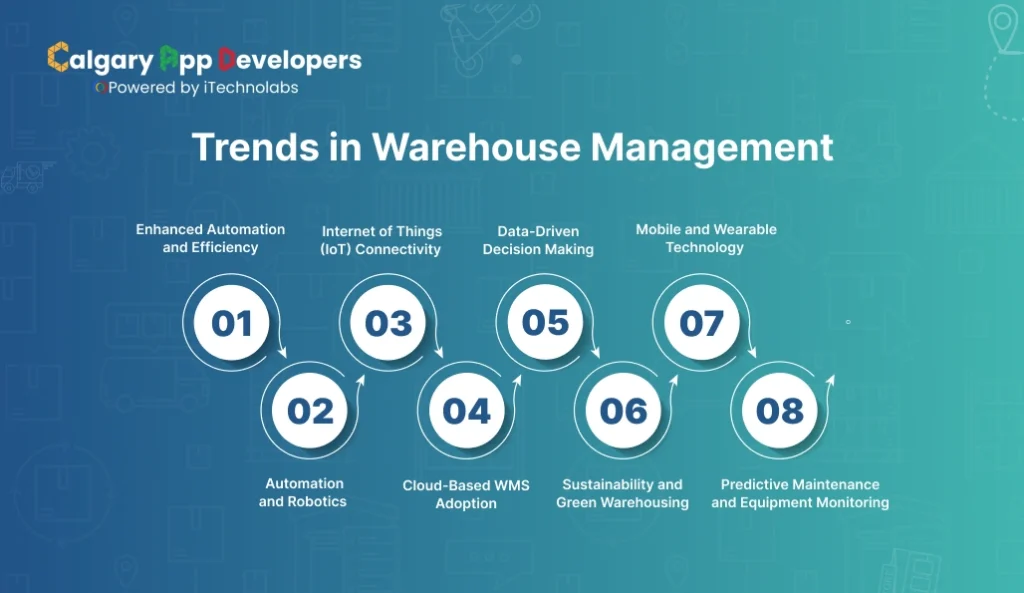
The warehousing industry is going through a rapid transformation, mainly due to technology, data, and the changing demands of customers. The present-day warehouses have ceased to be just places for storing goods but have become active and innovative centers that focus on efficiency. A Warehouse Management System is now integral to all these changes and the competitiveness of the operations. Below are the trends that have the greatest impact on warehouse management in the current time.
1. Artificial Intelligence and Machine Learning
AI has become one of the essential components of the modern Warehouse Management Systems. AI tools built on historical data predict demand, optimize the picking routes, and more. Machine learning continuously works to improve system accuracy and efficiency, bringing about better decision-making in operations.
2. Automation and Robotics
Automation is a game changer in the warehousing sector. The introduction of robotic picking, AGVs, and conveyor sorting has all contributed to a substantial reduction in human error as well as faster workflows. A Warehouse Management System that interfaces with such automated devices performs the synchronization of movement and distribution of tasks and keeps everyone informed of the activities going on through real-time visibility.
3. Internet of Things (IoT) Connectivity
The use of machines, such as sensors, RFID tags, and smart scanners connected through the Internet, enables immediate tracking of stock, machinery, and changes in the environment. A Warehouse Management System that is interconnected uses the information to improve accuracy, keep an eye on the performance, and detect potential in the areas where there is a potential issue, which in turn leads to more reliability and efficiency.
4. Cloud-Based WMS Adoption
Cloud-based Warehouse Management Systems are still the leading choice in the market due to the fact that they are easy to use, able to grow with the business and remotely accessible. They allow the central management of multiple locations by warehouse staff from any place, provide automatic software updates, etc.
5. Data-Driven Decision Making
Data analytics is now essential for warehouse success. Advanced WMS platforms provide dashboards and reports that track performance indicators like order accuracy, turnaround time, and inventory turnover. This allows managers to make informed decisions that improve operations and profitability.
6. Sustainability and Green Warehousing
Sustainability is not just a trend; it is an obligation. Today’s versions of Warehouse Management Systems facilitate energy-efficient processes via packing optimization for storage and shipping, reduced usage of paper-based documentation via electronic documentation, and assistance in compliance practices for managing recyclable packaging. Not only does this help keep costs down, but it also helps your company work toward global aims related to the environment.
7. Mobile and Wearable Technology
Mobile capabilities for WMS platforms have also allowed staff to receive information, scan barcodes, and update order statuses using mobile devices. Some warehouses are also using wearable technology examples such as smart glasses and voice-picking systems to relate to speed and accuracy for a blend of technology.
8. Predictive Maintenance and Equipment Monitoring
IoT sensors are incorporated with predictive analytics for monitoring the health of assets like conveyor and forklift systems. The Warehouse Management System (WMS) integrates the information to perform maintenance scheduling to enhance preventative maintenance after incidents that cost money and time for a business.
Implementation Best Practices
Implementing a Warehouse Management System is a critical step that can transform warehouse operations when executed correctly. However, success depends on careful planning, strategic execution, and continuous evaluation. Below are the best practices to ensure a smooth and effective WMS implementation.
-
Define Clear Objectives
Before introducing a Warehouse Management System, establish clear goals. Identify what you aim to achieve, whether it’s improving order accuracy, reducing fulfillment times, enhancing visibility, or optimizing storage. Clear objectives guide configuration and help measure success after implementation.
-
Conduct a Detailed Process Assessment
Evaluate your current warehouse operations to identify inefficiencies, redundancies, and gaps. Understanding existing workflows helps determine which WMS features are essential and how the new system can align with your processes instead of forcing unnecessary changes.
-
Choose the Right WMS Solution
Selecting the right Warehouse Management System is crucial. Consider factors such as scalability, integration capabilities, user-friendliness, and cost. Cloud-based systems are ideal for flexibility and remote access, while on-premise solutions offer more control over data and customization.
-
Plan Data Migration Carefully
Accurate data is the foundation of a successful WMS. Clean and organize your existing inventory data before migration to ensure there are no discrepancies. Inaccurate data can lead to tracking errors and operational delays once the system goes live.
-
Involve Key Stakeholders Early
Implementation affects multiple departments, including inventory, logistics, finance, and IT. Involving stakeholders from the beginning ensures better alignment, smoother communication, and faster decision-making throughout the process.
-
Provide Comprehensive Training
A Warehouse Management System is only as effective as the people using it. Train warehouse staff, supervisors, and managers thoroughly on system navigation, reporting, and troubleshooting. Hands-on training sessions and simulations can help build user confidence and minimize resistance to change.
-
Test Before Full Deployment
Run pilot tests to verify that the system performs as expected. Testing helps uncover potential configuration errors, integration issues, or workflow mismatches before full-scale deployment. This step reduces risk and ensures smoother adoption.
-
Monitor and Optimize Continuously
Implementation doesn’t end at go-live. Regularly monitor system performance, track key performance indicators (KPIs), and gather feedback from users. Use this information to fine-tune processes and introduce updates that enhance performance over time.
-
Partner with an Experienced Vendor
Choose a vendor with proven experience in Warehouse Management System implementation. A reliable vendor can provide technical guidance, support, and upgrades, ensuring your WMS remains effective and up-to-date.
Essential Features to Look for in a Warehouse Management System
Choosing the right Warehouse Management System is not just about software—it’s about selecting a tool that aligns with your operational goals and drives long-term efficiency. The best systems go beyond inventory tracking to offer automation, real-time insights, and scalability. Here are the essential features every modern WMS should have.
- Real-Time Inventory Tracking: A Warehouse Management System must provide complete visibility into inventory levels at any time. Real-time tracking helps monitor stock movement, prevent overstocking or stockouts, and improve order accuracy. With barcode or RFID integration, inventory data updates instantly, ensuring reliability and speed in decision-making.
- Order and Fulfillment Management: Efficient order management is at the heart of warehouse operations. A WMS should automate order picking, packing, and shipping while synchronizing data across sales channels. This reduces human error, shortens fulfillment cycles, and ensures customers receive the right products on time.
- Advanced Reporting and Analytics: Data-driven decisions make warehouses smarter. Look for a system with detailed reporting dashboards that track KPIs like picking accuracy, inventory turnover, and order processing time. Analytics tools within the WMS can identify trends, forecast demand, and highlight areas for cost optimization.
- Integration Capabilities: A Warehouse Management System should easily integrate with other business platforms such as ERP, TMS, accounting, and e-commerce systems. Integration ensures smooth data flow across departments and eliminates the need for manual data entry. This unified environment enhances both accuracy and collaboration.
- Mobile and Cloud Accessibility: Modern warehouses require mobility and flexibility. A cloud-based WMS allows users to access real-time information from any location, while mobile compatibility lets workers update inventory or process orders on the floor. This increases productivity and enables faster responses to operational changes.
- Labor Management Tools: Optimizing workforce productivity is a major advantage of a WMS. Labor management features track employee performance, task completion time, and workload distribution. This data helps managers plan shifts better and reward high-performing staff based on accurate metrics.
- Automation Support: Automation is becoming essential for modern warehousing. A WMS that supports robotics, conveyor systems, and automated storage and retrieval systems (AS/RS) reduces manual tasks and boosts accuracy. Integration with automation ensures seamless coordination between human workers and machines.
- Slotting and Space Optimization: Warehouse space is valuable. A WMS should include slotting optimization tools that suggest the best storage locations for items based on their demand and size. This reduces travel time for pickers and increases overall warehouse efficiency.
- Security and Compliance Management: With data at the core of warehouse operations, security is vital. A reliable WMS should offer multi-level access controls, data encryption, and compliance support for industry standards like ISO and GDPR. Secure systems protect both business data and customer trust.
- Scalability and Customization: As your business grows, so should your system. A scalable Warehouse Management System can handle more SKUs, locations, and users without major disruption. Customizable workflows and modules allow businesses to adapt the system to their specific operational needs.
Wrapping Up:
A Warehouse Management System has become an essential component of efficient, scalable, and responsive warehouse operations. It is no longer just a tool for tracking inventory; it is the backbone that coordinates every aspect of the supply chain, from receiving goods to shipping orders.
By implementing a WMS, warehouses gain real-time visibility, accurate inventory control, and streamlined workflows. Modern systems integrate with other business platforms, support automation, and provide actionable analytics, enabling managers to make informed decisions quickly. These capabilities help reduce errors, improve order fulfillment, and optimize labor and space utilization.
The adoption of cloud-based solutions, AI-driven analytics, and robotics integration is reshaping how warehouses operate. A Warehouse Management System not only meets current operational demands but also equips businesses to scale and adapt to future growth and evolving market trends.
Ultimately, a well-chosen Warehouse Management System transforms a warehouse into a highly organized, agile, and data-driven operation. It empowers businesses to deliver faster, more accurate service, reduce costs, and maintain a competitive edge in a rapidly changing logistics landscape.
FAQ’s About Warehouse Management System Application:
1. What does WMS stand for in warehousing?
WMS stands for Warehouse Management System. It is software designed to streamline and automate warehouse operations. From receiving inventory to shipping orders, a WMS monitors and manages day-to-day activities, ensuring accuracy, efficiency, and real-time visibility. It serves as the central platform for inventory tracking, task management, and workflow optimization.
2. What is the concept of warehouse management?
Warehouse management involves organizing, monitoring, and optimizing all activities within a warehouse. It covers inventory receipt, storage, picking, packing, and shipping. The goal is to ensure smooth operations, minimize errors, and maximize efficiency. Effective warehouse management enhances inventory visibility, reduces operational costs, and supports timely order fulfillment, helping businesses maintain productivity and customer satisfaction.
3. What does the warehouse management system do?
A Warehouse Management System manages all warehouse operations by providing real-time control over inventory and workflows. It tracks stock movement, streamlines picking and packing, automates documentation, and integrates with other business systems. By centralizing processes, a WMS improves operational accuracy, enhances productivity, and ensures efficient resource allocation, helping warehouses meet modern logistics demands.
4. What are the functions of the warehouse management system?
A Warehouse Management System performs key functions such as receiving and tracking inventory, managing picking, packing, and shipping, enabling paperless documentation, and generating reports and analytics. These functions optimize warehouse workflows, reduce errors, improve order accuracy, and provide actionable insights for management. They allow businesses to efficiently control operations and make data-driven decisions.
5. What are the types of warehouse management systems?
Warehouse Management Systems are available in multiple types to suit different business needs. Common types include standalone WMS, cloud-based WMS, supply chain management systems, and ERP-integrated systems. Each type varies in scalability, integration capability, and customization options, enabling businesses to select a solution that aligns with their operational complexity and long-term growth strategy.
6. Why would we need a warehouse management system?
A Warehouse Management System is essential for controlling inventory, tracking stock movement, and improving customer service. It enhances productivity by streamlining warehouse workflows, reducing errors, and optimizing labor and storage. By providing real-time visibility and data-driven insights, a WMS helps businesses maximize efficiency and achieve a greater return on investment through accurate and timely order fulfillment.
7. What’s the difference between warehouse management and inventory management?
Warehouse management is a comprehensive approach covering all warehouse operations, including storage, picking, packing, and shipping. Inventory management focuses narrowly on tracking stock levels and movements. While inventory management ensures items are available, warehouse management optimizes workflows, labor, space, and order fulfillment, providing a holistic solution for operational efficiency and scalability.
8. What are the best warehouse management systems?
Some of the leading Warehouse Management Systems include NetSuite WMS, Fishbowl Inventory, 3PL Warehouse Manager, Softeon, Infor SCM, HighJump, Astro WMS, and Bright Warehouse. These platforms vary in functionality, scalability, and integration capabilities, but all are designed to enhance inventory accuracy, streamline operations, support multi-channel fulfillment, and provide real-time analytics for efficient warehouse management.
9. How to build WMS software?
Building a Warehouse Management System involves defining operational requirements, designing workflows, and developing features for inventory tracking, order management, and reporting. Integration with ERP, TMS, and automation tools is critical. The software must include real-time data capture, mobile access, and security measures. Testing, staff training, and continuous optimization are essential for successful deployment and operational efficiency.


Pankaj Arora is a seasoned technology leader and the Founder of Calgary App Developer, with 10+ years of expertise in crafting high-performance digital solutions. His core competencies include full-stack app development, cloud-native architecture, API integration, and agile product delivery. Under his leadership, Calgary App Developers has empowered startups and enterprises alike with scalable mobile applications, secure web platforms, and AI-driven SaaS products.