







How Much Money Can You Earn if You Own an App?
So you’ve got an app idea and you’re wondering what it could actually earn. Are we talking a few dollars a week or something big enough to quit your job over?
Here’s the truth. Owning an app in 2026 can still be wildly profitable. Some apps with just a few thousand active users are pulling in steady income every single month. Others are scaling to six or even seven figures a year.
But not every app makes money. Most don’t. The difference comes down to strategy. The apps that earn well are not always the flashiest or most downloaded. They’re the ones built with the right monetization model and a clear focus on what users actually want.
In this guide, we’ll break down what a profitable app really looks like, how much you can expect to make, and what it takes to get there.
TL;DR
- App income in 2026 ranges from almost nothing to millions per year, depending on execution and strategy.
- Most profitable apps focus on retention, clear value, and smart monetization rather than downloads alone.
- Subscriptions, in-app purchases, and freemium models drive the most consistent revenue.
- Small, well-targeted apps can earn meaningful income without massive user bases.
Key Points
- App ownership can generate steady or high income, but most apps fail due to poor retention, unclear value, or weak monetization strategies.
- Revenue potential depends more on user engagement and problem solving than on total download numbers.
- Subscriptions offer predictable, recurring revenue and work best for apps that provide ongoing value.
- In-app purchases and freemium upgrades succeed when payments feel optional and clearly beneficial.
- Advertising can generate income at scale but requires high daily usage to be effective.
- App profitability is strongly influenced by retention metrics such as Day 7 and Day 30 engagement.
- Successful app builders launch lean, iterate quickly, and treat growth and monetization as ongoing systems rather than one-time decisions.
Can You Actually Make Money From an App?
The short answer: Absolutely Yes, though the odds aren’t always in your favor. The app market in 2026 is huge, but most apps earn only a little or nothing at all.
What the Numbers Reveal
- In 2026, revenue is expected to peak at $613.4B, more than tripling since 2017, showcasing the industry’s resilience and innovation.
- Despite that, 23% of apps earn between $500 and $50,000 per month, while just 0.5% exceed $1 million annually.
Real-World Example
MonopolyGo! is a standout case. With over 150 million downloads, the game surpassed $5 billion in gross bookings by April 2025, earning more than $200 million a month at its peak
An independent Reddit developer shared this:
“I net more than $5,000 a month with four apps and now work full time on them”
That aligns with a trend where lean utility or niche apps, often built fast and marketed via short-form content, can pull in thousands per month even without millions of users
What This Really Means
Yes, making money from an app is still realistic. But success requires clear strategy and smart execution. Most apps don’t earn much, but when you get the monetization, retention, and user fit right, even small apps can generate serious income, from a few thousand to tens of thousands per month.
Whether you build for scale, niche utility, or viral momentum, understanding where apps succeed will help you aim your effort more effectively.
Also Read: How to Find a Trustworthy App Developer & Protect Your App Idea?
How Much Can a Single App Earn?
An app can earn almost nothing, or it can bring in more than a full-time salary every month. It all depends on what you build, how you launch it, and how well it connects with users.
Most apps start small. They’re launched with a basic version, a few hundred downloads, and a goal to learn what works. That early stage is about watching how users behave, improving fast, and building momentum. The money comes later.
Some apps pull in a few dollars a day from ads or one-time purchases. Others earn thousands a month through subscriptions or in-app purchases. A well-performing app with around 100,000 active users can bring in anywhere from five thousand to twenty thousand monthly if monetized correctly.
The key is staying user-focused. The more people use your app and find real value in it, the easier it becomes to turn that attention into steady revenue.
App Size and Earning Potential
| App Type | Downloads | Monthly Revenue | Monetization Style | Typical Examples |
| Small Utility | 1,000 | $10 to $50 | Simple ads or paid download | Niche tools |
| Early Traction | 10,000 | $500 to $2,000 | Freemium or in-app upgrades | Habit trackers, note apps |
| Growing App | 100,000 | $5,000 to $20,000 | Subscriptions or purchases | Fitness, learning, wellness apps |
| Established | 1 million | $100,000 and beyond | Mixed strategies with premium tiers | Games, health, productivity |
| Market Leaders | 10 million+ | Multiple millions yearly | Everything at scale | Spotify, Duolingo |
The takeaway is simple. A single app can absolutely make real money, but success comes from understanding your users, improving what matters, and choosing a revenue model that fits how they use your app.
What the Top-Earning Apps Are Doing Right in 2026
The highest-earning apps in 2026 are not just popular. They are designed to make money without losing users. They succeed because they get the core things right: how the app works, how it grows, and how it makes money. Let’s look at what they all have in common.
- They Keep Users Coming Back
Top apps don’t just get downloads. They earn attention every day. This is called retention, and it’s the single most important metric that drives long-term revenue.
These apps guide users with clear onboarding. They make it easy to take the first step and build small habits that stick. Push notifications are well-timed, not spammy. Updates are useful, not just decorative. Over time, the app becomes part of the user’s routine.
Why this matters
The more often users open your app, the more chances you have to earn from them. That can be through ads, subscriptions, purchases, or all three.
- Their Monetization Feels Natural
People don’t mind paying for apps that deliver real value. The best apps in 2026 offer upgrades, features, and plans that feel like a smart choice, not a forced one.
They give users a taste of the core value before asking for money. Free features hook them. Paid features deepen the experience. Nothing feels blocked or annoying. Payment feels like a way to unlock more of what’s already working.
Why this matters
Users are far more likely to pay when the app has already proven its value.
- They Evolve Based on Real Data
Top apps don’t rely on guesswork. They track how users behave inside the app. Where they click. Where they drop off. What they love. What they ignore.
Every update is driven by real usage. Every feature that sticks has already been tested. Features that don’t work get removed. These apps are quick to adjust, and they never stop improving.
Why this matters
You build a better app when you listen to what your users are actually doing, not just what they say.
- They Solve Daily Problems
The most profitable apps are useful, not just fun. They solve real problems that people face often, tracking sleep, learning languages, budgeting money, and managing health.
If an app becomes part of someone’s day, it earns trust. With trust comes repeat use. With repeat use comes steady income.
Why this matters
Solving something small but frequent often leads to bigger long-term revenue than chasing one-time hype.
- They Treat Growth Like a System
Top apps don’t grow by accident. They use paid ads, influencer partnerships, app store optimization, and strong referral programs. They know exactly what channels bring the most users and what those users do once they arrive.
Why this matters
Even the best product needs attention. Growth is not luck. It’s a process.
Read Also: Steps to Choose the Best Mobile App Developers for Your Project
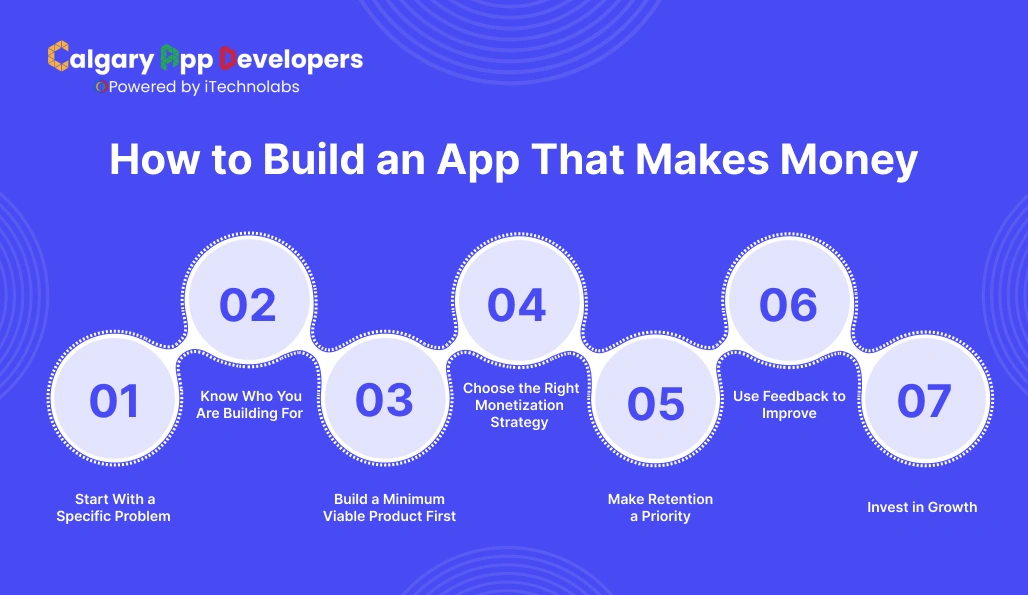
How to Build an App That Makes Money
Building an app is one thing. Making money from it is a different game entirely. Success comes from combining smart planning with user-focused design and a clear monetization path. Here is how to do it right from the start.
- Start With a Specific Problem
Every profitable app starts by solving one problem clearly. Do not try to be everything at once. Pick one pain point or one need your target user faces and build around that. The more specific the problem, the easier it is to attract early users.
Example
Headspace started as a simple guided meditation app for beginners. Today it earns millions a month.
- Know Who You Are Building For
Before writing a single line of code, define your audience. What do they care about? What apps do they already use? What frustrates them? This helps you design features that actually matter and avoid wasting time on extras no one wants.
- Build a Minimum Viable Product First
Keep the first version lean. Just include the core features needed to solve the main problem. This version is not about perfection. It is about launching fast, learning quickly, and improving based on real feedback.
Why it matters
The faster you launch, the sooner you learn what people actually want.
- Choose the Right Monetization Strategy
How you earn depends on your app type and your users. Pick a model that fits naturally into the user experience.
- Subscriptions work best for ongoing services like fitness, language, or wellness apps
- In-app purchases are great for games and productivity tools
- Ads can work if your app gets high daily usage
- Freemium gives users basic access and charges for premium features
Choose one main strategy and test it early.
- Make Retention a Priority
Downloads mean nothing if users don’t come back. Design your app to build habits. Use onboarding flows that are short and clear. Add reminders, progress trackers, and real benefits to coming back daily or weekly.
Pro tip
Track your Day 1, Day 7, and Day 30 retention rates. They are strong indicators of long-term revenue potential.
- Use Feedback to Improve
Your users are your best product testers. Listen to reviews, track behavior, and ask questions inside the app. Every complaint or suggestion is a chance to improve something that affects your earnings.
- Invest in Growth
You cannot make money if no one knows your app exists. Use app store optimization, run small ad campaigns, partner with creators, and create referral incentives. A strong marketing system multiplies the impact of every feature you build.
Also Read: Why Startups in the U.S. Are Hiring Fractional Dev Teams
Proven App Monetization Models
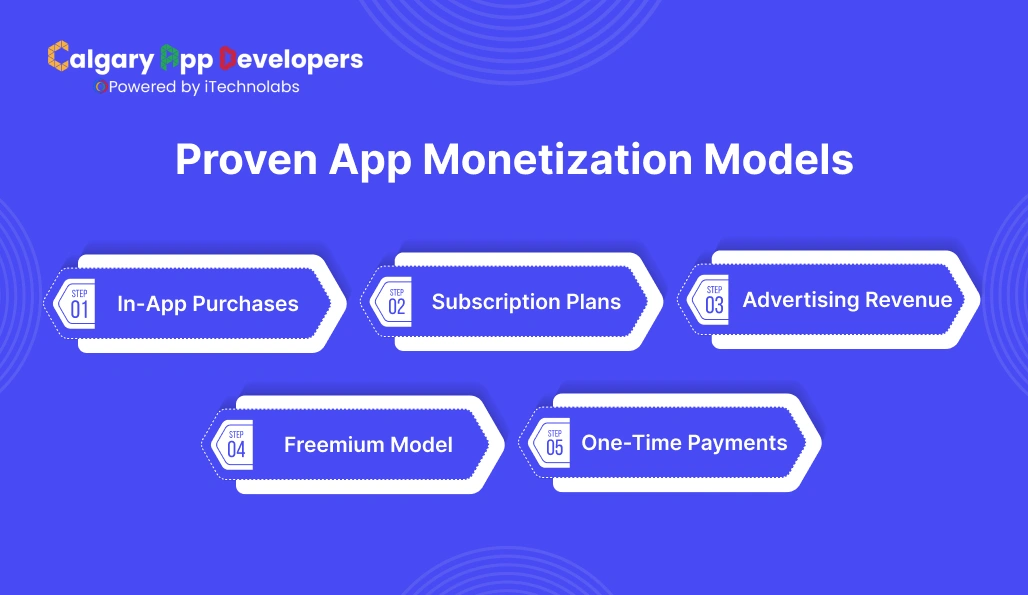
Making money from an app comes down to how well you match your revenue model with your user base. Each strategy has pros, limitations, and different earning potential. Here’s a breakdown of the five most used models and how they work when done right.
- In-App Purchases
This model is built for apps that offer added value through upgrades, digital goods, or unlockable tools. The key is making purchases optional but genuinely useful.
- Example
A language learning app might sell grammar packs or pronunciation boosters. Users still get the basics for free but can choose to buy specific tools they need. - Realistic Earning
With 100,000 downloads, if 3 percent spend $3, that’s $9,000 in revenue without forcing anyone to pay.
- Subscription Plans
This model works best when your app delivers ongoing value; think new content, updates, or services users rely on regularly.
- Example
A guided workout app could offer daily training plans and live coaching for a monthly fee. The free version might include basic routines, while the subscription unlocks more variety and personal guidance. - Realistic Earning
If 7 percent of 50,000 users pay $12 per month, that’s $42,000 in monthly recurring revenue.
- Advertising Revenue
Ads are ideal when you have lots of users but don’t want to charge them. Revenue comes from impressions or clicks, not direct payments.
- Example
A free daily trivia app shows short ads between questions. Users keep playing, and the app earns without charging anything upfront. - Realistic Earning
With 200,000 monthly active users and modest engagement, you could see $3,000 to $5,000 per month from ads.
- Freemium Model
Start free. Charge later. Freemium works when your app is valuable enough to attract a wide audience but powerful enough to convert some users into paying customers.
- Example
A budgeting app could offer basic expense tracking for free and unlock features like advanced reports or goal setting for premium users. - Realistic Earning
With 75,000 downloads and just 4 percent upgrading to a $15 monthly plan, you’re looking at $45,000 per month.
- One-Time Payments
This model suits tools with niche value and clear functionality. It works when people are willing to pay once to own something that solves a problem without recurring costs.
- Example
A minimalist writing app might charge a flat fee for distraction-free writing features. No upgrades. No subscriptions. Just a clean tool people pay for once. - Realistic Earning
At $8 per download and 15,000 buyers, that’s $120,000 in lifetime revenue without ongoing upkeep.
What Drives App Profitability?
An app becomes profitable when three things align: it solves a real problem, users stick around, and there’s a strategy in place to turn usage into revenue. Let’s break down the specific drivers that make an app not just survive but thrive.
- Most Profitable App Categories
Some categories are simply better suited for high earnings. Here’s where the money tends to flow:
- Gaming apps dominate with in-app purchases and ads. Think of simple puzzle games or battle royale games with virtual upgrades.
- Health and fitness apps see strong subscription revenue because they offer long-term value, from guided workouts to progress tracking.
- Education and language learning apps monetize well through monthly plans and feature-based upsells.
- Finance and productivity tools often use a freemium model that converts serious users into paying subscribers.
Apps in these categories have two things in common: repeat usage and clear incentives to upgrade.
- Why Retention and Engagement Matter
Profit doesn’t come from downloads. It comes from users who keep opening your app week after week.
If 100,000 people install your app but only 10 percent use it after the first week, your revenue potential is already limited. On the other hand, if you have 30 percent retention after 30 days, your app is performing well.
Engagement metrics like session length, daily active users, and in-app actions all lead directly to more ad views, more purchases, and more subscriptions.
- How User Growth Impacts Revenue
More users generally means more money, but growth without strategy can burn resources. The key is scalable growth, where new users cost less to acquire and are more likely to convert.
Here’s a quick way to look at it:
- 10,000 users with a 5 percent conversion rate and a $10 subscription equals $5,000 per month
- 100,000 users with the same setup multiplies that to $50,000
The takeaway is simple. Growth must be paired with retention and monetization. That’s how you move from break-even to profit.
Read Also: How Long Does it Take to Develop an App?
Real Challenges in the App Market
Here’s the reality. Over 100,000 new apps are submitted to the Apple App Store every month. On Google Play, that number is even higher. That means you’re not just building an app. You’re trying to earn attention in one of the most competitive digital spaces on the planet.
The first challenge is visibility. Your app might be great, but if it doesn’t show up in search results or get recommended, most users will never see it. This is why App Store Optimization (ASO) is just as important as development. Your name, icon, screenshots, and keywords all influence whether someone taps download.
The second challenge is retention. Many apps lose 80 percent of users within the first week. That’s because users download out of curiosity but don’t return unless your app gives them a reason to.
You’re also competing on performance. If your app crashes, loads slowly, or feels clunky, it’ll be deleted within seconds. Users expect instant results and a smooth experience every time.
Then there’s the matter of trust. Data privacy, security, and user permissions have become big concerns. If your app looks shady or asks for too much access too soon, users won’t hesitate to uninstall.
And finally, monetization is tricky. You have to earn revenue without making the app feel like it’s constantly asking for money. Ads can annoy. Paywalls can push people away. The balance is delicate.
In short, getting users is hard. Keeping them is harder. Making money while doing both is the real challenge. But knowing these obstacles is the first step to solving them.
What It Actually Costs to Build an App
The average cost to build a mobile app in 2026 ranges from $10,000 to over $300,000. The final number depends entirely on what you’re building, who’s building it, and how fast you want it done.
Estimated Total App Development Cost
| App Type | Features | Cost Range |
| Simple App | Basic UI, no backend, static content | $10,000 to $30,000 |
| Mid-Level App | User accounts, APIs, basic backend | $30,000 to $100,000 |
| Complex App | Real-time sync, payments, custom backend | $100,000 to $300,000+ |
| Scalable Enterprise App | Multiple platforms, advanced logic, large-scale use | $300,000 and above |
What Affects the Cost of Building an App?
- App Complexity: This is the biggest factor. A simple to-do list app will cost far less than a social networking platform with chat, video calls, and notifications. Features like real-time updates, GPS, and payment gateways require much more time and technical depth.
- Design and User Experience: Basic layout design is cheap. But if you’re aiming for a polished, intuitive, and branded experience with animations, transitions, and responsive behavior, it takes a skilled UI/UX designer. Great design helps with engagement and retention, so it’s usually worth the investment.
- Platforms You’re Targeting: Are you building for Android, iOS, or both? Native development for each platform takes more time because each version is built separately. Cross-platform tools like Flutter or React Native can reduce this cost but may come with performance trade-offs for very complex apps.
- Backend Development and Database: Apps that require user logins, data syncing, cloud storage, or admin panels need a backend system. Think of this as the engine running behind the scenes. It takes time to plan, build, test, and secure. The more logic and integration required, the higher the cost.
- Third-Party Services and APIs: If your app integrates with tools like Stripe for payments, Firebase for notifications, Google Maps, or any analytics services, those services often come with usage-based costs and require extra dev time for integration.
- Developer Rates by Region: Hiring a US-based developer can cost $100 to $200 per hour, while Eastern Europe or South Asia may offer $25 to $75 per hour for similar work. In Calgary, mobile app developer rates are generally competitive, often ranging from $70 to $120 per hour, giving you access to skilled local talent without the high costs of major US tech hubs. Calgary also benefits from strong tech communities and reliable project management, making it an attractive option for both on-site and hybrid development teams.
- Maintenance and Updates: Your app will need regular updates, compatibility fixes, security patches, and improvements. This is often overlooked but adds ongoing expenses. Most apps spend 15 to 20 percent of their initial build cost every year just to maintain and improve the product.
- Project Management and QA: Larger projects require proper coordination. Project managers, QA testers, and documentation add to the total cost, but they also reduce risk and ensure a smooth development process. Skipping this step usually costs more in the long run.
Also Read: How to Choose the Best Company for Calgary Mobile App Development
Your Chances of Success With an App
Let’s be honest. Most apps don’t make it. But that doesn’t mean yours can’t. You just need to understand what you’re up against.
The Reality Check
According to recent industry data, over 99 percent of consumer apps fail to become financially successful. The app stores are flooded with millions of options, and only a small percentage ever reach serious profitability.
But here’s the thing: failure is rarely because the idea was bad. It’s usually because of poor execution, weak marketing, or building features nobody wanted.
Your Odds by the Numbers
- Over 65 percent of apps are abandoned after the first 30 days
- Only 1 in 200 apps earns more than $10,000 per month
- Around 20 percent of apps are deleted after a single use
So yes, the odds are tough, but they’re not impossible. Founders who take a lean approach, launch fast, and iterate based on feedback tend to outperform those who spend months building without talking to users.
What Improves Your Chances
Here’s what sets successful apps apart from the rest:
- Clear Problem Solving: The app solves a specific need that real users care about
- Strong Onboarding: First-time users understand what the app does and how it helps
- Retention Focus: Features are designed to keep users coming back
- Smart Monetization: Revenue model matches the app’s audience and usage behavior
- Continuous Updates: Feedback loops drive regular improvements and bug fixes
If you treat your app like a growing product instead of a one-time project, your chances of success improve dramatically.
Start small, ship fast, and listen closely. That’s how winning apps are built.
Final Thoughts
Building an app in 2026 is still one of the most accessible and scalable ways to generate income. Whether you’re a solo founder, a startup, or a business looking to expand, the opportunity is real. But here’s the catch: profit doesn’t come from just having a cool idea. It comes from smart execution, understanding your users, and choosing the right monetization strategy.
Apps that make money are the ones built with intention. They solve specific problems, keep users coming back, and turn engagement into revenue through well-planned models like subscriptions, in-app purchases, or premium features.
If you’re serious about building an app that earns, focus on user value first, growth second, and monetization third. Get those three right, and you’re not just building an app, you’re building a business.
FAQs
1. Can a small app really make money, or do you need millions of users?
Yes, a small app can absolutely make money without massive scale. Many niche apps earn steady income with only a few thousand active users by solving a specific problem well. Subscriptions, premium features, or targeted in-app purchases allow smaller apps to monetize effectively when users see clear, ongoing value.
2. How long does it usually take for an app to start making money?
Most apps do not make meaningful money immediately after launch. It often takes several months to refine the product, improve retention, and test monetization. Apps that focus on learning from early users, improving onboarding, and fixing friction points tend to see revenue growth within six to twelve months of consistent iteration.
3. Which monetization model is best for first time app owners?
There is no single best model, but subscriptions and freemium models are often the most reliable for first time founders. They create recurring revenue and allow users to experience value before paying. The right choice depends on how often users return and whether your app delivers ongoing or one time value.
4. Do free apps actually make money?
Free apps can make money, but only when paired with a clear revenue strategy. Advertising works best at scale with high daily usage, while freemium upgrades convert a smaller group of engaged users into paying customers. A free app without a plan to monetize attention usually struggles to generate sustainable income.
5. What are the biggest mistakes that stop apps from earning revenue?
Common mistakes include launching without a clear target audience, adding too many features too early, ignoring retention, and forcing monetization too soon. Many apps fail because they focus on downloads instead of engagement. Revenue comes from repeat usage and trust, not from install numbers alone.
6. Is it better to build one app or multiple smaller apps?
Both approaches can work, but many independent developers succeed by building multiple small apps instead of one large product. This spreads risk and increases the chance that one app finds traction. Smaller apps are faster to launch, cheaper to test, and easier to pivot based on real user feedback.
7. How important is marketing compared to the app itself?
Marketing and product quality matter equally. Even a great app will fail without visibility, while strong marketing cannot save a poor experience. Successful apps treat growth as a system that includes app store optimization, content, referrals, and paid campaigns, all supported by a product users actually want to keep using.
8. How much money do apps make per download?
There is no fixed amount an app makes per download. Earnings depend on the app’s monetization model, user location, engagement, and category.
- Free apps with ads may earn anywhere from $0.01 to $0.10 per active user per day.
- Freemium apps earn money through in-app purchases, with only a small percentage of users paying.
- Paid apps earn directly from the purchase price, minus platform fees.
In general, downloads alone don’t generate income, active users and monetization strategy matter more than total downloads.
9. How much does playstore pay for 1 million downloads?
The Google Play Store does not pay developers per download. Instead, developers earn through app sales, ads, and in-app purchases.
Here’s what 1 million downloads can mean in practice:
- Ad-based apps may earn anywhere from $1,000 to $50,000 or more, depending on user activity, ad type, and geographic location.
- Paid apps priced at $1 per download would generate $1,000,000 in revenue, but Google takes a 15–30% commission, leaving developers with $700,000–$850,000.
- Subscription or in-app purchase apps can earn significantly more if users continue spending over time.
Ultimately, revenue from 1 million downloads varies widely and depends on how well the app is monetized and how engaged its users are.


Pankaj Arora is a seasoned technology leader and the Founder of Calgary App Developer, with 10+ years of expertise in crafting high-performance digital solutions. His core competencies include full-stack app development, cloud-native architecture, API integration, and agile product delivery. Under his leadership, Calgary App Developers has empowered startups and enterprises alike with scalable mobile applications, secure web platforms, and AI-driven SaaS products.