









AI Product Development: The Complete Guide for Canadian Businesses
Canada is entering a new phase of digital business. It is no longer enough to launch a website, mobile app, or internal tool and hope it keeps pace. Customers now expect products that learn preferences, automate routine tasks, predict needs, and deliver faster support. That shift is why AI product development has moved from a future concept to a current growth strategy for Canadian businesses in 2026.
The numbers tell the story. Gartner forecasts worldwide AI spending will reach $2.52 trillion in 2026, up 44 percent year over year, showing just how quickly companies are investing in AI powered products, infrastructure, and services.
At the same time, Grand View Research estimates the global AI market will grow to $539.45 billion in 2026 and could surpass $3.49 trillion by 2033, signaling that this is still the early stage of a much larger transformation.
For Canadian businesses, this creates a major opportunity. Organizations are using AI to build smarter products that improve efficiency, increase retention, and unlock new revenue streams.
This guide is built from our hands-on experience in AI product development, where we have helped businesses turn ideas into practical AI solutions that users actually adopt. We understand what works beyond the hype, what slows projects down, and how to build AI products that are scalable, compliant, and commercially valuable.
In this complete guide, we will break down how Canadian businesses can plan, build, and launch successful AI products in 2026 and beyond.
- AI product development helps Canadian businesses build faster, reduce costs, and improve product quality through smarter workflows.
- Success depends on choosing practical use cases, strong data foundations, and clear business outcomes.
- Canadian companies must account for privacy laws, bilingual user needs, and available government funding.
- Teams that adopt AI strategically in 2026 can gain a lasting competitive advantage.
- AI product development applies artificial intelligence across research, planning, design, coding, testing, launch, and post-launch improvement.
- The most useful AI categories for product teams include machine learning, natural language processing, generative AI, predictive analytics, agentic AI, computer vision, and retrieval-based systems.
- AI can significantly reduce time to market by accelerating requirements gathering, prototype creation, code generation, and quality assurance.
- Businesses often see better product quality because AI helps identify bugs earlier, test more scenarios, and improve decision-making with real data.
- Canadian businesses need to consider compliance with privacy laws such as PIPEDA when AI systems collect or process user information.
- Serving both English and French-speaking users is an important product consideration for many Canadian companies building AI-powered experiences.
- Canada offers funding opportunities such as SR&ED tax credits, IRAP, and digital adoption programs that can lower development costs.
- AI product development costs in Canada can range from modest MVP budgets to large-scale enterprise investments, depending on complexity, infrastructure, and custom model requirements.
- Local development teams may offer stronger regulatory understanding, market context, and easier collaboration, while offshore teams may reduce hourly costs.
- The future of product development will likely include AI agents, continuous optimization, stronger governance standards, and deeper AI integration across teams.
What is AI Product Development?
AI product development involves using artificial intelligence throughout all steps of product development, from opportunity identification to product launch and subsequent improvements. The system functions as more than a single software solution because it encompasses a complete framework for team operations.
The traditional product development process requires human labor for every project phase because analysts need to analyze spreadsheet data to discover patterns, while designers create their designs through hand-drawn sketches, and developers construct their programs by writing every single line of boilerplate code, and QA teams execute their testing procedures through duplicated test cases. The technology eliminates the need for certain tasks because it allows workers to concentrate on their critical responsibilities.
For a Canadian business, this has very practical implications. You’re often working with smaller teams, tighter budgets, and a need to compete against much larger players, sometimes including US-based companies with 10 times your engineering headcount. AI product development is one of the few ways a focused team can genuinely close that gap.
The key distinction worth making early: AI in product development isn’t the same as building an AI product. You might be using AI to help build a logistics app, a patient intake system, or an e-commerce platform, none of which are ‘AI products’ in the traditional sense. The AI is in your process, not necessarily in your deliverable, though it can certainly be both.
Also Check: Top AI Companies in Canada to Know
Types of AI That Drive Product Development
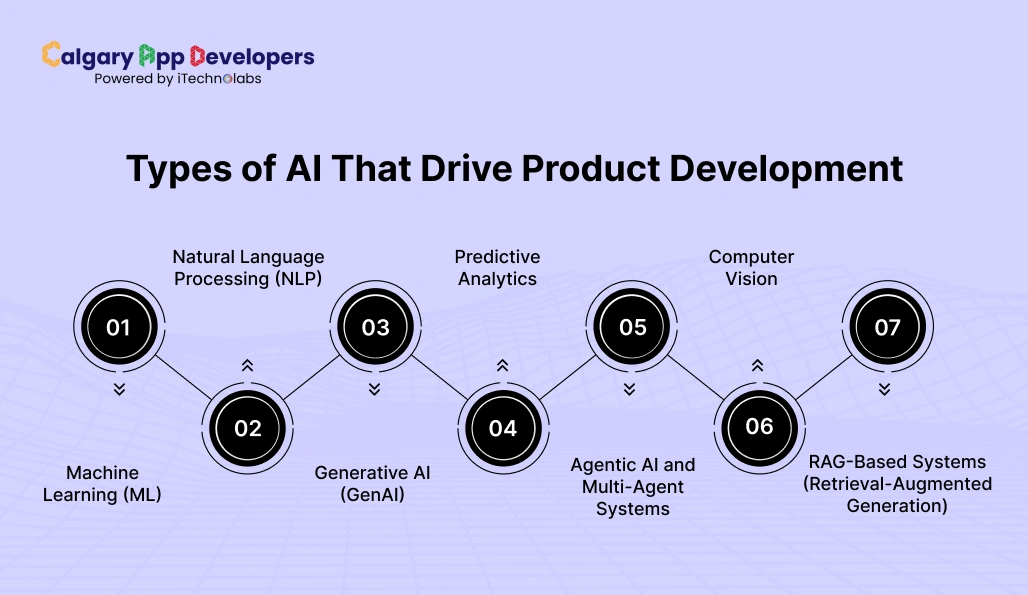
Not all AI is the same, and understanding which type does what will save you from expensive misalignment between tools and problems. Here’s what’s actually relevant to product teams.
1. Machine Learning (ML)
ML systems learn from historical data to recognize patterns and make predictions. The product development process needs to forecast user demand while detecting defects through QA, optimizing feature prioritization according to usage data, and identifying customer segments that will most likely churn. Intelligent product analytics systems depend on this technology as their fundamental component.
2. Natural Language Processing (NLP)
NLP enables systems to comprehend and produce human language. The product teams use it to handle customer support tickets and reviews throughout their entire operation, while they create themes from user interviews, produce requirements documentation from their original notes, and develop conversational interfaces. Canadian businesses that want to reach both English and French-speaking customers need to use NLP as the essential technology for developing bilingual product experiences.
3. Generative AI (GenAI)
GenAI creates new content, code, images, and designs based on patterns in training data. Tools like GitHub Copilot, Claude, and GPT-4 help developers write and review code faster. Midjourney and similar platforms compress UI concept design from days to hours. GenAI is probably the most visible AI capability in product teams right now, and also the most commonly misused.
4. Predictive Analytics
Predictive analytics combines statistical modeling with data to anticipate future outcomes. It helps teams make proactive decisions: which features to build next, when a system is likely to fail, which user segments are growing fastest. The approach enables your organization to use product data for proactive problem prevention instead of reactive data response.
5. Agentic AI and Multi-Agent Systems
Agentic AI represents the latest major development in artificial intelligence. AI agents possess the ability to complete complicated tasks through automated processes, which require only minimal human involvement. They have the capability to read documentation, compose and execute computer programs, manage project tasks, and return to their original state after a system breakdown. For product teams, AI provides more than writing support. The system now operates as an entry-level team member who can complete assigned tasks.
6. Computer Vision
Machines use computer vision technology to understand and process visual information. Product development uses this technology for three applications: automated UI testing, which identifies visual defects, and manufacturing defect detection and accessibility audits, which identify design mockup issues. The majority of digital product teams fail to implement this system, which creates significant business advantages for organizations that successfully use it.
7. RAG-Based Systems (Retrieval-Augmented Generation)
RAG integrates language models with your organization’s data assets, which include product documentation and customer information, code repositories, and all internal knowledge bases. Your team receives responses that derive from your specific context instead of receiving standard AI responses. RAG enables Canadian companies in regulated sectors such as healthcare and financial services to develop trustworthy AI systems through its capacity to ensure safe and precise AI performance.
Also Read: How to Make an AI in 7 Simple Steps
How AI Transforms Every Stage of the Product Lifecycle
The real leverage of AI in product development comes from applying it consistently across every phase, not just dropping it into one stage and hoping it compounds. Here’s what that looks like end-to-end.
1. Research and Market Discovery
ML algorithms can analyze social media behavior, competitor pricing changes, app store reviews, and search trend data to surface opportunities your team would never find manually. What used to take weeks of desk research and analyst time now takes hours. For Alberta companies specifically, this kind of market intelligence can identify emerging needs in oil and gas tech, agri-tech, and healthcare before competitors notice them.
2. Requirements Gathering and Documentation
Natural Language Processing tools use customer interviews and support ticket histories together with user feedback to create structured requirement documents. GenAI transforms unstructured stakeholder notes into complete user stories, which include their acceptance criteria. Product teams spend their time in this phase because they need to conduct multiple meetings while working with unclear specifications. AI decreases the required time for output, which results in reduced expenses that arise from mismatched project requirements.
3. Architecture and Technical Design
AI tools can analyze earlier project designs to identify suitable design patterns that match your performance requirements, your cost constraints, your security requirements, and your scalability needs. Generative design tools enable users to create UI/UX mockups through short descriptions, which stakeholders can evaluate by viewing prototypes instead of reading text requirements. Teams that still hand-draw wireframes before any validation are leaving time on the table.
4. Development and Intelligent Coding
AI code assistants such as GitHub Copilot, Cursor, and Codeium perform three main functions which include handling standard code elements, providing code completion recommendations, and identifying coding errors through automatic code testing. Research indicates that artificial intelligence can complete between 40 and 70 percent of standard programming activities through effective usage. Your developers have to accomplish the same workload because their total development capacity increases without any need to reduce their work quality.
5. Testing and Quality Assurance
AI testing tools create test cases through automated processes while they verify edge cases, which human testers typically overlook, and they identify visual defects across different browsers and devices, and they forecast potential defect locations based on historical code modification data. The quality assurance process has always functioned as a production delay that prevents product releases. AI testing does not resolve the production delay problem, but it succeeds in reducing test completion time.
6. Launch and Go-to-Market
ML algorithms can monitor early user interactions and detect anomalies the moment a product goes live. NLP summarizes customer sentiment from support tickets and reviews as they come in. This means your team isn’t waiting for a monthly analytics report to know something is wrong. You know the day you ship.
7. Post-Launch Iteration
Post-launch is where most product teams underinvest in AI. Predictive analytics can flag which users are at risk of churning before they do. Behavioral analysis tools identify which features drive retention and which drive abandonment. AI can close the feedback loop between what users do and what your roadmap prioritizes. Products that use this loop systematically improve much faster than those relying on periodic user surveys.
Read Also: AI Integration Calgary Services: Smarter Business Solutions
Key Benefits of AI in Product Development
The case for AI in product development isn’t theoretical anymore. Here are the concrete benefits teams are seeing in practice, plus a few that competitors tend to undervalue.
1. Faster Time to Market
PwC estimates AI can cut physical product development lifecycles by up to 50%. For software products, the effect is even more pronounced because AI’s strongest leverage points, requirements, code generation, and testing, are all core to the software SDLC. A process that took 12 months before can realistically run in 6 to 8 months with AI properly integrated.
2. Higher Product Quality
AI quality tools catch bugs earlier, simulate more edge cases than manual testing ever could, and standardize code quality across your team. The result is fewer post-launch incidents, lower support costs, and products that hold up under real-world use.
3. Significantly Reduced Costs
Less rework. Fewer expensive late-stage defects. Shorter development cycles mean lower burn rates. Predictive analytics prevents overbuilding features nobody uses. The ROI compounds quickly when AI is applied to the right problems.
4. Better Decision-Making
Teams making product decisions from AI-synthesized data rather than gut feel consistently make better calls about what to build, in what order, and for whom. Algorithmic project selection models pick winning projects more than 8 times out of 10, according to Stage-Gate International research on EU manufacturers.
5. Increased Sustainability
AI models can analyze material choices, energy costs, and infrastructure configurations to optimize for environmental impact alongside performance. For Canadian companies with ESG commitments, this is a genuine advantage, not a checkbox.
6. Competitive Intelligence at Scale
AI can monitor competitor releases, app store rankings, pricing changes, and customer sentiment across dozens of sources simultaneously. Most SMBs don’t have a dedicated competitive intelligence function. AI gives them one.
7. Team Productivity and Satisfaction
Developers who spend less time on boilerplate and more time on architecture and problem-solving are more satisfied and more productive. AI removes the parts of the job that skilled people find most draining.
8. Investor Confidence
For startups seeking Canadian venture funding, demonstrating an AI-augmented development process signals operational efficiency and modernity. It’s increasingly part of the technical due diligence conversation.
9. Faster Validation of New Ideas
GenAI tools can produce functional prototypes from a brief in days rather than weeks. That means you can test market fit with real users before committing significant budget to full development. This is especially valuable for Calgary and Canadian startups operating lean.
Also Read: How to Develop an AI App: A Breif Guide
Real Risks of AI Product Development (And How to Manage Them)
There’s a version of this conversation that only sells you on the upside. That’s not useful. Here are the real risks your team will face, and practical ways to manage each one.
1. Overconfidence in AI Outputs
GenAI generates polished-looking artifacts fast. That polish can mask serious problems: designs that can’t actually be built, code that passes tests but fails in production, market analysis based on outdated or biased training data. You need experienced people reviewing every significant AI output, not just shipping what the tool produces.
2. Biased and Inaccurate Outputs
AI systems reflect the biases in their training data. If your product is designed to serve diverse Canadian users and your AI tools were trained predominantly on US or non-representative data, your product decisions will carry those biases into the design. This isn’t abstract: it has real consequences for accessibility, cultural relevance, and equity.
3. PIPEDA Compliance for Canadian User Data
This is the gap that none of the global competitors writing about AI product development mention because they’re not operating in Canada. If your AI system processes personal information about Canadian users, you’re operating under PIPEDA (Personal Information Protection and Electronic Documents Act). That means purpose limitation, consent requirements, and data residency considerations. Every AI tool you use in your product development process that touches user data needs to be evaluated against these obligations. Building this in from day one is far cheaper than retrofitting it later.
4. Model Drift and Performance Degradation
AI models trained on last year’s data can become unreliable as user behavior evolves. A product that uses ML to make recommendations or predictions needs a plan for ongoing model monitoring and retraining. Without it, the AI that worked beautifully at launch will quietly become less accurate over time.
5. Over-Reliance on AI and Loss of Human Judgment
The teams that get into trouble are the ones that stop questioning AI outputs. Human judgment matters most for the decisions AI can’t fully evaluate: ethical tradeoffs, cultural nuance, strategic positioning, and situations that fall outside the training distribution. Define clear boundaries for where AI assists and where humans decide.
6. Security and Data Privacy in the Development Process
Using AI tools in your development pipeline often means sending code, requirements documents, or user data to third-party systems. That creates data exposure risks. Understand what your AI vendors do with your inputs. For sensitive industries, financial services, healthcare, oil and gas infrastructure, this isn’t optional due diligence.
7. IP Ownership Ambiguity
Who owns the code, the designs, or the product concepts that AI helped generate? This is legally unsettled territory in Canada, as in most jurisdictions. Your contracts with developers, your AI tool terms of service, and your client agreements all need to address this explicitly. Leaving it vague creates disputes.
8. Skill Gaps in Your Existing Team
AI augments skilled people. It doesn’t replace the need for skill. Teams without the engineering or product management fundamentals to evaluate AI outputs critically don’t get the benefits. They make fast-moving mistakes. Invest in training alongside tooling.
Read Also: Best AI Cloud Business Tools for Smarter Management
AI Product Development in Canada: What’s Different Here
Most guidance around AI product development is written with a global or US lens. That overlooks a few realities Canadian businesses face every day. Regulations are stricter, funding opportunities are stronger, and market expectations are different. Ignoring these factors early often leads to rework, delays, or missed advantages.
1. Privacy and Compliance Come First
In Canada, privacy is not something you layer on later. It shapes how your product is designed from day one.
The Personal Information Protection and Electronic Documents Act governs how businesses collect, use, and store personal data in commercial activities. If your AI system touches user data in any way, whether through analytics, personalization, or model training, you need to account for consent, purpose limitation, and data handling practices upfront.
At the provincial level, regions like Alberta enforce additional laws such as the Personal Information Protection Act. What this really means is simple. Building compliance into your architecture early is far cheaper and far safer than fixing it later.
2. Government Funding Can Offset a Significant Portion of Costs
Canada offers one of the strongest funding environments for AI innovation, yet many businesses underuse it.
Programs like the Scientific Research and Experimental Development provide tax credits ranging from 15% to 35% on eligible R and D expenses. For AI product development, that can translate into substantial savings.
Other initiatives, such as the Canada Digital Adoption Program and the Industrial Research Assistance Program, offer grants, advisory support, and funding for technology-driven projects.
Here is the key point. If you plan your project with these programs in mind, your effective development cost can drop significantly.
3. Industry Opportunities Are Highly Concentrated
AI adoption in Canada is not evenly distributed. Some sectors are moving much faster than others, and they present the strongest opportunities.
Energy, oil, and gas companies are using AI for predictive maintenance and operational optimization. Agri-tech businesses are building intelligent crop monitoring and supply chain systems. Healthcare organizations are investing in AI-driven diagnostics and patient workflows, although they operate under strict regulatory oversight. Real estate platforms are applying AI to pricing, forecasting, and tenant management.
If your product serves any of these industries, AI is not just an enhancement. It often becomes the core of your value proposition.
4. Bilingual Experience Is a Product Requirement
Serving a national audience in Canada often means supporting both English and French from the start.
This affects more than just translation. NLP models, voice interfaces, chat systems, and even automated content generation behave differently across languages. Designing for bilingual functionality after development creates friction and added cost.
Canada creates a unique mix of constraints and advantages. Teams that account for privacy, funding, industry focus, and bilingual needs early tend to move faster and spend less over time.
Also Check: How Much Does It Cost to Hire an AI Developer?
How Much Does AI Product Development Cost in Canada?
AI product development in Canada typically ranges from $35,000 to $400,000+ CAD, depending on the scope, level of AI integration, and product complexity.
| Project Type | Description | Estimated Cost (CAD) |
| AI-assisted MVP | Core product with limited features using GenAI for faster design and build | $35,000 to $80,000 |
| Mid-level AI product | Scalable product with some custom AI features and integrations | $80,000 to $150,000 |
| Advanced AI product | Full-featured solution with ML models, automation, and data pipelines | $120,000 to $400,000+ |
What Impacts the Cost?
The final cost depends less on the idea and more on how you build it. Here are the key drivers.
- Data complexity and infrastructure: If your product relies on large datasets, real-time processing, or custom pipelines, costs increase quickly. Clean, structured data reduces effort and spending.
- Custom AI model development: Training models on proprietary data takes time, computing power, and expertise. Using existing foundation models instead can significantly reduce costs.
- Compliance and regulations: Products handling sensitive data must meet standards like PIPEDA or healthcare regulations. Compliance adds both development and legal overhead.
- Platform and scalability requirements: Building for web, mobile, and multiple environments increases cost. High-availability systems with minimal downtime also require more investment.
- Scope clarity and planning: Well-defined requirements keep budgets under control. Poorly scoped projects lead to rework, delays, and rising costs.
- Team experience and tech choices: An experienced team using proven tools and cloud-native architecture can avoid unnecessary complexity and reduce development time.
Cost Optimization Insight
If your project qualifies under Canada’s SR&ED tax credit program, you can recover 15% to 35% of eligible development costs. This can significantly reduce your effective investment, especially for AI-heavy builds.
How to Successfully Integrate AI Into Your Product Development Process
This is the step most guides rush through. Here’s a framework that actually works in practice, not just in theory.
Step 1: Define Your Outcomes First
Don’t start by evaluating AI tools. Start by identifying the three to five biggest drags on your current development process. Are you slow on requirements? Spending too much on QA cycles? Struggling to predict which features users will value? Every AI investment should map directly to a measurable problem. Teams that start here get ROI. Teams that start with tools get demos.
Step 2: Audit Your Data Readiness
AI is only as good as the data it learns from. Before adopting ML or predictive analytics tools, assess the quality and structure of your existing data. Do you have clean, labeled historical data? Is it stored in a format that AI tools can access? Is it PIPEDA-compliant? This step is unsexy, but skipping it causes most AI implementations to underperform.
Step 3: Prioritize Use Cases Using an Impact-Feasibility Matrix
Map potential AI use cases by two axes: expected business impact and implementation feasibility. Focus your first investments on high-impact, high-feasibility use cases. Leave the complex, lower-certainty cases for later, once your team has built AI fluency with lower-risk applications. Classic high-impact, high-feasibility starting points include automated test generation, AI-assisted code review, and NLP-based requirements documentation.
Step 4: Select Tools That Fit Your Team, Not Just Your Use Case
There are hundreds of AI tools in the development ecosystem right now. The ones you choose need to integrate with your existing stack, match your team’s current skill level, and be scalable as your use grows. A tool your developers won’t actually use is worth zero, regardless of how impressive the demo is.
Step 5: Build the Right Team Structure
AI augments skilled people. You need engineers who can evaluate AI outputs critically, product managers who understand both user needs and AI limitations, and, at a minimum, one person who understands data pipelines and model behavior. Consider whether to hire in-house, partner with a Canadian AI development firm, or use a hybrid model. Each approach has tradeoffs covered in the next section.
Step 6: Pilot on a Contained, Real Project
Don’t test AI capabilities on side projects or demos. Run your pilot on a real, bounded problem with clear success metrics. A two-to-four-week sprint applying AI tools to a genuine product challenge tells you more than months of evaluation. Measure the results honestly. What improved? What didn’t? What needs to change?
Step 7: Measure ROI and Iterate
Track metrics that map to the outcomes you defined in Step 1: development velocity, defect rate, requirements rework frequency, and time-to-first-prototype. Share results across the team. AI adoption inside organizations follows the same product dynamics as the products you build. Early wins create momentum. Transparent measurement builds trust.
Read Also: How AI is Revolutionizing Mobile App Development
Local vs. Offshore AI Product Development: An Honest Comparison
At first glance, offshore development looks like the obvious cost saver. Rates around $40 CAD per hour compared to $130 to $175 CAD per hour for Canadian teams can make the decision feel straightforward. The gap is real, but it does not tell the full story.
Local vs Offshore Comparison
| Factor | Local Canadian Team | Offshore Team |
| Hourly Cost | $130 to $175 CAD | Around $40 CAD |
| Regulatory Knowledge | Strong understanding of Canadian laws and PIPEDA | Limited exposure to Canadian compliance standards |
| Market Understanding | Familiar with local industries and users | Limited context of the Canadian market needs |
| Communication | Real-time collaboration | Delays due to timezone differences |
| Responsiveness | Immediate support during business hours | Slower response to critical issues |
| Project Risk | Lower due to alignment and accountability | Higher risk of rework and misalignment |
| Total Cost of Ownership | Predictable and controlled | Can increase due to rework and delays |
What Offshore Pricing Does Not Show
Lower hourly rates often come with hidden tradeoffs. Offshore teams may not be familiar with the Personal Information Protection and Electronic Documents Act or provincial regulations. If compliance is missed early, fixing it later can be expensive and time-consuming.
Market understanding is another gap. Building for Alberta energy companies or Quebec healthcare systems requires local context. Without it, product decisions can drift away from actual user needs.
Timezone differences also create friction. Delays in communication slow down feedback cycles, and small issues take longer to resolve. When something breaks during your business hours, waiting for a response is not ideal.
Why Local Teams Cost More and Why It Often Pays Off
A Canadian development partner brings more than execution. You get built-in regulatory awareness, industry familiarity, and real-time collaboration. These factors reduce misunderstandings and keep the project moving efficiently.
The result is fewer delays, less rework, and better alignment with your business goals. In many cases, once you factor in these elements, the total cost difference between local and offshore becomes much smaller than it appears upfront.
The Hybrid Approach That Works Best
Many teams land on a hybrid model for a reason. Keep strategy, architecture, and key product decisions with a local partner. Use a trusted offshore team for execution support where appropriate.
This approach balances cost efficiency with accountability. You maintain control over critical decisions while still optimizing your development budget.
Also Check: Top AI Trends: Transforming Businesses Across Industries
The Future of AI Product Development: What to Watch
The pace of change here is fast enough that any specific tool mentioned today might be obsolete or superseded in 18 months. Instead of chasing tools, watch these structural trends.
Agentic AI Will Change What ‘Developer’ Means
AI agents that can autonomously execute multi-step development tasks are moving from research labs to production tools faster than most expected. Teams that learn to orchestrate AI agents rather than just prompt them will have a structural productivity advantage within two to three years.
AI-Native Product Teams Will Become the Norm
Right now, AI adoption in product development is a differentiator. In five years, not having AI deeply integrated in your development process will be like not having version control. Start building AI literacy across your team now, while you still get a competitive advantage from it.
Ethical AI Frameworks Will Become Mandatory
Regulatory and institutional pressure on AI ethics, transparency, and explainability is growing globally and in Canada specifically. The Office of the Privacy Commissioner of Canada is actively developing guidance on AI and PIPEDA. Companies that build ethical AI practices into their product development process now won’t be scrambling to retrofit them when regulation arrives.
Continuous AI-Driven Product Improvement
The future of product development isn’t a series of discrete launches. It’s a continuous loop where AI monitors user behavior, surfaces insights, suggests improvements, and helps teams ship incremental updates constantly. Products with this capability will improve faster than those that don’t, and the gap will compound over time.
The Bottom Line on AI Product Development
AI product development isn’t a future capability. It’s the current standard for teams that ship quickly, iterate intelligently, and compete effectively. The question for Canadian businesses in 2026 isn’t whether to integrate AI into your development process. It’s how fast you can do it without sacrificing quality or compliance.
The businesses that get this right share a few traits. They start with outcomes, not tools. They invest in the data infrastructure that makes AI reliable. They stay grounded in real user needs even when AI can generate impressive-looking alternatives. And they take PIPEDA and the Canadian regulatory context seriously, because building products that Canadians can trust is what builds businesses that last.
If your team is ready to build faster, smarter, and more cost-effectively, we’d like to be part of that conversation. Calgary App Developer works with Canadian businesses to design and build AI-powered products tailored to the Canadian market. Visit calgaryappdeveloper.ca to start the conversation.
FAQ’s About AI Product Development
1. What is AI product development, and how is it different from regular product development?
AI product development integrates artificial intelligence tools and capabilities across every stage of the product lifecycle, from research and requirements through design, coding, testing, and post-launch iteration. Traditional product development relies on manual effort at most stages. AI product development automates the repetitive and data-intensive parts of each stage so human teams can focus on judgment, creativity, and decisions that require context. The practical difference is speed, quality, and the ability to operate with a smaller team without sacrificing output.
2. How long does AI product development take compared to traditional approaches?
Timelines vary by product complexity, but well-implemented AI-assisted development typically reduces time-to-market by 30 to 50% compared to traditional approaches. An MVP that would have taken 4 to 6 months manually can often be delivered in 8 to 12 weeks with AI tools integrated throughout. That acceleration comes from faster prototyping, automated testing, and AI-assisted code generation. The caveat: AI doesn’t speed up poorly defined projects. Clear requirements and a focused scope matter as much as the tools.
3. How much does AI product development cost for a Canadian business?
A focused MVP with AI tools integrated throughout typically ranges from $35,000 to $80,000 CAD for a local or blended team. A full-featured product with custom AI capabilities runs $120,000 to $400,000 CAD or more, depending on complexity and infrastructure needs. Canadian businesses should also factor in SR&ED tax credits, which can recover 15 to 35% of qualifying development expenditure,s and meaningfully reduce the effective cost. The right investment depends on your market opportunity, not just your current budget.
4. Do I need to comply with PIPEDA when building an AI product for Canadian users?
Yes, if your AI product collects, uses, or discloses personal information about Canadian users in commercial activities. PIPEDA requires meaningful consent, purpose limitation (only using data for the reasons users agreed to), and appropriate safeguards. AI systems that train on user data, make decisions about users, or process behavioral data all fall within PIPEDA’s scope. Alberta businesses also need to comply with PIPA. The practical advice: get privacy counsel involved during architecture design, not after launch.
5. What AI tools are most useful for product development teams right now?
The most broadly useful categories are AI code assistants (GitHub Copilot, Cursor, Codeium) for development, GenAI tools (Claude, GPT-4o) for requirements documentation and user research synthesis, automated testing platforms with AI-generated test cases, and product analytics tools with ML-powered behavioral analysis. Specific tools change rapidly. Choosing categories based on your workflow gaps, then selecting the best tool in that category, is more durable than chasing specific tool recommendations.
6. Should I hire an internal AI team or work with an external partner?
For most Canadian SMBs and startups, a hybrid model makes the most sense. An external partner with AI product development experience can move faster, bring existing tooling and frameworks, and doesn’t require the time and cost of building internal AI capability from scratch. Once you’ve shipped a product and understand your AI needs better, you can hire internal talent for the capabilities that are most core to your business. A local Canadian partner also brings PIPEDA and industry knowledge that global offshore firms typically don’t have.
7. Can AI replace product managers or designers in the development process?
No. AI replaces the repetitive, data-processing parts of those roles, not the roles themselves. A product manager who uses AI to synthesize user research, generate initial roadmap options, and analyze competitive data is dramatically more productive than one who doesn’t. But the decisions about what to build, for whom, and why still require human judgment, market intuition, and an understanding of your specific business context that no AI currently provides. The teams that treat AI as an amplifier of human expertise consistently outperform those that use it as a replacement.
8. What Canadian government funding is available for AI product development?
The SR&ED program is the most significant, offering federal investment tax credits of 15% for large corporations and up to 35% for Canadian-controlled private corporations on eligible R&D expenditures. Many AI product development projects qualify. IRAP (Industrial Research Assistance Program) provides advisory services and financial support through the National Research Council. Alberta Innovates and other provincial programs also exist, depending on your sector and location. Consulting with an SR&ED specialist before you start budgeting can meaningfully change your financial model.


Pankaj Arora is a seasoned technology leader and the Founder of Calgary App Developer, with 10+ years of expertise in crafting high-performance digital solutions. His core competencies include full-stack app development, cloud-native architecture, API integration, and agile product delivery. Under his leadership, Calgary App Developers has empowered startups and enterprises alike with scalable mobile applications, secure web platforms, and AI-driven SaaS products.