








Mobile Banking App Development: An Ultimate Guide
Remember when you last visited a bank branch. For most, it has been years or even months. Mobile banking apps revolutionized the way we manage money. From balancing accounts with morning coffee to making instant payments, banking is now at your fingertips.
For entrepreneurs and companies, this transition is not simply about convenience. It is an opportunity to forge deeper customer connections, streamline financial transactions, and create new income streams. That is where mobile banking app development is involved. Developing a banking app in today’s world is not simply about piling on features. It is about creating a safe, seamless, and forward-looking platform that consumers will actually enjoy using.
Here, we will step-by-step guide you through all that you have to learn about developing a mobile banking app that is both good for your users and your company.
- Finance mobile apps require a balance of security, clarity, and usability.
- Effective financial planning apps help users move from tracking to informed decision-making.
- Thoughtful design turns complex financial data into actionable insights.
- Trust and long-term engagement depend on secure, user-focused development.
- Finance mobile app development demands strong security practices to protect sensitive financial data while maintaining smooth performance.
- Financial planning platforms work best when they present income, expenses, and goals in a clear, unified view.
- Smart budgeting and goal-based planning features help users build consistent financial habits over time.
- Visual insights and simple navigation reduce friction and make complex financial information easier to understand.
- Successful finance apps focus on long-term usability and trust, not just feature volume.
A Quick Look at the Banking App Market
Mobile banking is not only on the rise; it’s revolutionizing the way individuals handle money.
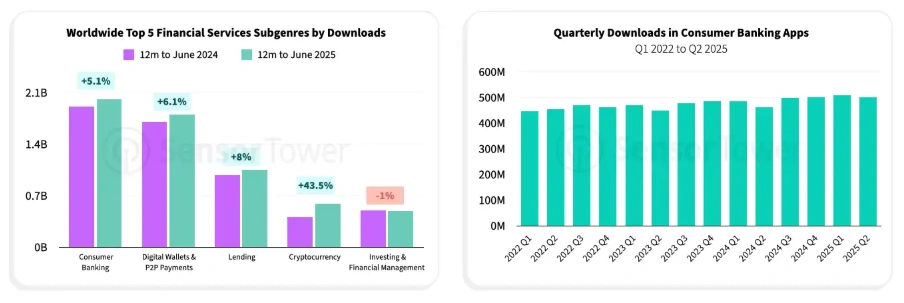
Source: Sensor Tower
- In 2025, around 2.17 billion people worldwide are using mobile banking services, a 35% jump since 2020.
- In the U.S. alone, 72% of adults now use mobile banking apps, up from 52% just a few years ago.
- In Europe, mobile banking penetration hit 76%, with some countries reporting rates above 87%.
- Asia-Pacific is seeing massive activity too. Transaction volumes surged 34% in 2025, thanks to e-commerce, QR code payments, and instant-payment systems like UPI.
- On the business side, consumer banking apps crossed 2 billion downloads in 2025, up 5% from the previous year, with over half a billion installs every quarter.
Mobile banking is not a niche anymore. It’s a mainstream, global method of banking. And it’s only accelerating.
Types of Mobile Banking Apps Businesses Can Use
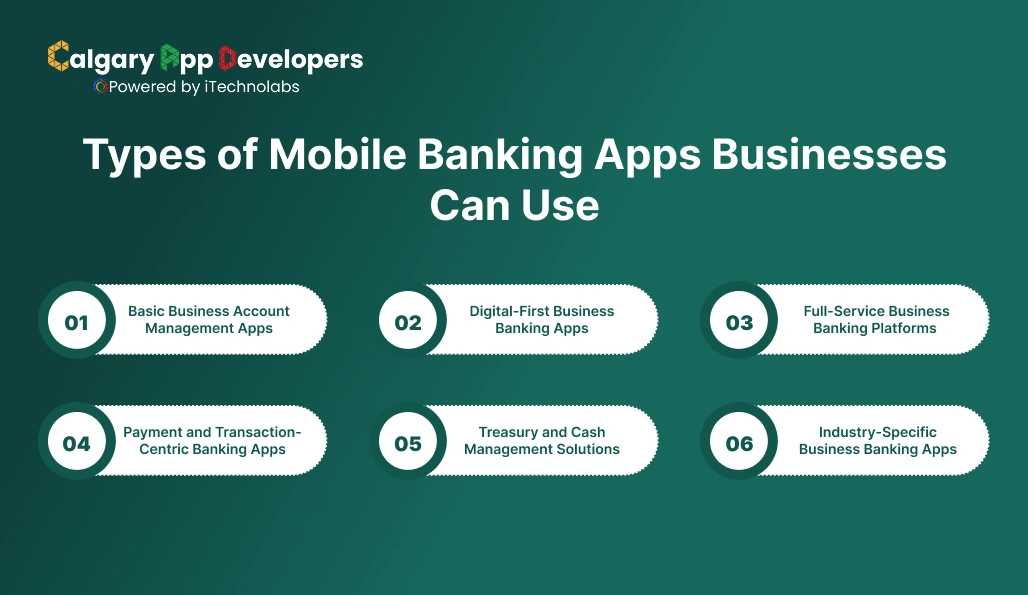
Not all mobile banking apps are created to serve the same functions. Some are intended for standard account management, while others manage heavy-duty financial activities for big companies. Selecting the right kind is the initial step in successful mobile banking app development.
- Basic Business Account Management Apps
These are the most basic types of business banking apps. Their main aim is to assist users in managing common chores without a branch visit. Features frequently include:
- Seeing account balances in real time
- Accessing recent transaction history
- Downloading account statements
- Making simple fund transfers
They are ideal for small firms that do not require sophisticated tools but would like the benefits of mobile banking.
- Digital-First Business Banking Apps
These apps are designed for businesses that wish to work entirely online. They eliminate the need for paper forms, physical verification, or branch banking. Typical features include:
- Opening accounts through digital onboarding
- Uploading documents and verifying identity inside the app
- Access to instant customer support via chat or video
- Integration with digital signatures for faster approvals
This type of mobile banking app development is ideal for startups and growing businesses that value speed, flexibility, and a paperless experience.
- Full-Service Business Banking Platforms
These are end-to-end platforms that include all primary banking activities in one location. They are frequently employed by medium- to large-scale enterprises that wish to simplify all financial activities within a single app.
Features can range from:
- Essential core banking operations such as transfers and bill payments
- Loan requests and management of credit lines
- Exchanging currencies and foreign transactions
- Business investment facilities and insurance products
They are basically a single-stop shop for every financial requirement, and hence a good option for companies with varied operations.
- Payment and Transaction-Centric Banking Apps
They are centered around speed, security, and the capacity to process high volumes of transactions. They are generally employed by firms that receive payments from several customers on a daily basis. Common features include:
- Instant processing of payments
- Multi-payment support, including QR code and payment link
- Recurring payment setup for retainers or subscriptions
- Automatic reconciliation and detailed transaction reporting
E-commerce firms, subscription businesses, and large-volume retailers gain the most from this type of mobile banking app development.
- Treasury and Cash Management Solutions
They are sophisticated tools that are intended for enterprises and corporations with intricate financial arrangements. They assist in managing cash for companies, minimizing financial risks, and projecting long-term investment. Some of the key features might include:
- Real-time cash flow forecasting
- Management of money in multiple accounts and currencies
- Integration with ERP and accounting systems
- Risk management and investment portfolio management
They are particularly useful for firms with international operations or extensive capital flows.
- Industry-Specific Business Banking Apps
Certain industries possess distinctive financial processes that generic banking apps are not well-suited to manage. Industry-specific apps solve those needs directly. Some examples are:
- Construction firms employing milestone-based payment tracking
- Healthcare providers with built-in insurance claim processing
- Point-of-sale integrated retail chains for immediate settlement
By making the app conform to an industry’s needs, this kind of mobile banking app development is more efficient and minimizes third-party tool requirements.
Also Read: How to Choose the Best Company for Calgary Mobile App Development
Why Mobile Banking App Development is Good for Businesses
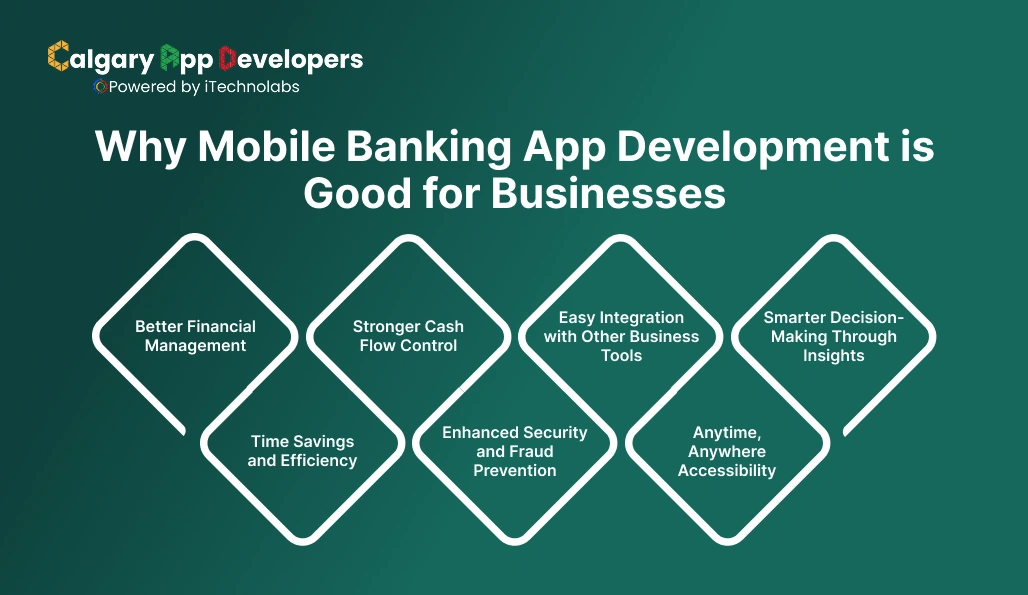
Mobile banking app development is no longer an optional luxury. It is becoming central to how money is managed by businesses, how they interact with financial institutions, and how they keep things operating effectively. Through the delivery of secure, immediate, and convenient access to banking functionality, these apps can revolutionize the way businesses operate. Below is a closer examination of why they are important.
- Better Financial Management:
Having all financial data in one central platform gives businesses a clear view of their money at all times. Instead of juggling between paper statements, spreadsheets, and multiple logins, a mobile banking app offers instant access to balances, transaction histories, and reports. This makes it easier to track expenses, monitor cash reserves, and plan budgets with accuracy. Over time, better financial oversight reduces waste and strengthens profitability.
- Time Savings and Efficiency:
In conventional banking, activities such as fund transfers, cheque deposits, and payment to vendors are all about queues or waiting in line for hours. With a mobile banking app, these processes can be executed within minutes on a phone or tablet. Approvals are possible on the move, payroll can be sent without any delay, and bills can be paid instantly. The consequence is quicker operations and more time to think about growth and not paperwork.
- Stronger Cash Flow Control:
Cash flow issues are among the top causes for businesses to stress out and fall behind. The main benefit of a mobile banking app is that it gives you real-time confirmation of money flow in your account, whether it be in or out. Armed with this immediate knowledge, a finance team can find and deal with delayed payments, respond to customers, and manage spending to mitigate cash flow blockages. The predictive software contained in the app can warn you about impending cash flow shortages weeks and even months in advance, allowing a business time to manage seasonalities, delayed sales, and unanticipated events.
- Enhanced Security and Fraud Prevention:
Financial transaction security is very important. Mobile banking app development contains a number of advanced protection options such as biometric ID verification, transaction alerts, and AI-based fraud alerts. The system allows for immediate notification of unusual activity, giving a business time to respond before incurring large losses. You can also generate confidence with your stakeholders and customers.
- Easy Integration with Other Business Tools:
Most contemporary smartphone banking applications interface directly with accounting packages, stock management systems, and customer relationship management solutions. This provides a seamless exchange of information between systems without the necessity of re-entering data. For instance, payments made in the bank’s app can automatically be carried over into the accounting ledgers, with accuracy and the avoidance of administrative time being ensured.
- Anytime, Anywhere Accessibility:
One of the greatest benefits of mobile banking app development is mobility. Owners, managers, and finance teams can authorize transactions, check accounts, and transfer funds anywhere in the world. The flexibility is particularly useful for businesses with remote teams, high travel requirements, or a presence in several different regions.
- Smarter Decision-Making Through Insights:
Mobile banking apps now do more than simply process transactions. They are able to examine data so that they can supply sharp insights into spending, revenue, and operating expenses. Companies are then able to use these insights in order to reduce unneeded expenses, identify profitable opportunities, and invest in high-growth areas. This makes financial data a strategic tool and not only for record-keeping.
Read Also: How Long Does it Take to Develop an App?
Key Business Use Cases for Mobile Banking App Development
Mobile banking app development is revolutionizing the way companies manage daily operations. From onboarding clients to global cash management, there are solutions by these apps that save time, avoid errors, and enhance financial control. The following are the most significant use cases.
- Digital Onboarding for New Clients
Rather than needing a visit in person to create an account, companies can walk customers through an entirely online process. The app extracts personal information, submits identification documents, and authenticates credentials by automated verification. This accelerates account setup, eliminates paperwork, and enhances the customer experience from the initial contact.
- Real-Time Transaction and Cash Flow Tracking
With real-time transaction updates, businesses know exactly where their money is at any moment. Owners and finance teams can monitor incoming payments, track expenses, and identify unusual activity instantly. This visibility helps avoid overdrafts, missed payments, and budget mismanagement.
- AI-Powered Credit Pre-Approvals
Artificial intelligence can analyze a client’s profile, transaction history, and creditworthiness within seconds. Businesses offering financial services can use this to provide instant credit approvals or tailored loan offers. This removes the wait time associated with traditional reviews and opens new revenue opportunities.
- Remote Payroll and Vendor Payments
Payroll processing and vendor settlements are no longer a desk-bound process. Mobile banking allows approved users to schedule payrolls, make mass payments, and transfer money to suppliers remotely. This maintains the operations running despite remote working or heavy traveling by the employees.
- Multi-Account and Role-Based Access Controls
For businesses with multiple bank accounts or a large finance team, role-based access ensures the right people have the right permissions. A finance manager may approve payments, while an accountant only views statements. This balance between accessibility and control protects sensitive information while streamlining workflows.
- Embedded Treasury and Cash Management
Large enterprises and multinational companies often deal with complex cash movements. An app with embedded treasury features enables real-time liquidity tracking, fund transfers between accounts, and currency management. These tools allow businesses to make informed decisions about investments, payments, and operational costs without relying on multiple platforms.
Essential Features Every Mobile Banking App Needs
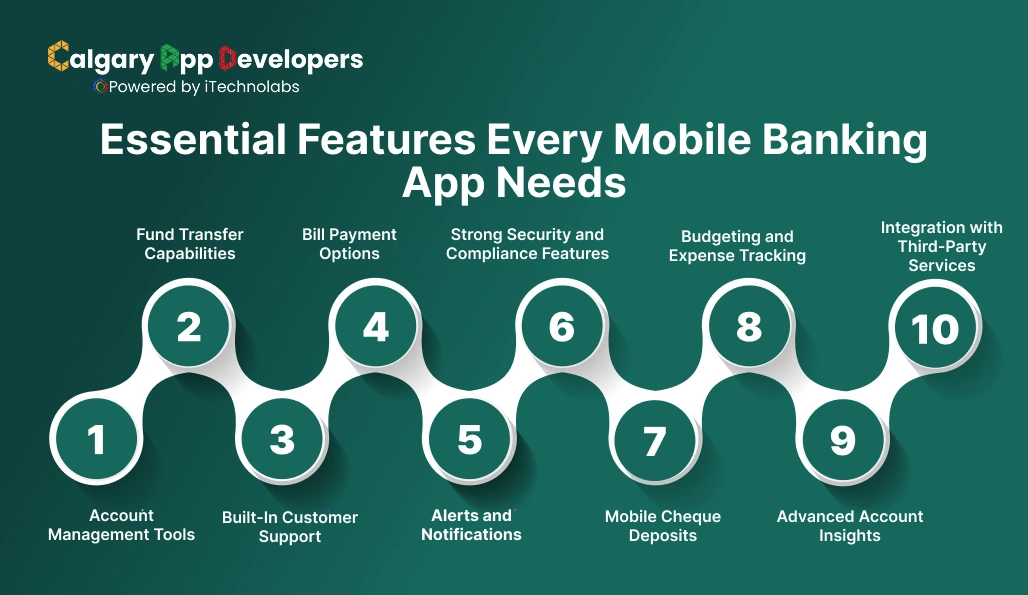
Strong mobile banking app development starts with a solid foundation of essential features. These are the core elements that make the app reliable, secure, and useful for everyday financial tasks. Without them, even the most advanced add-ons will not be enough to keep users engaged.
- Account Management Tools
This is the core of any banking app. Customers must be able to see balances, view detailed histories of transactions, and download statements immediately. Business accounts would benefit from added features of viewing multiple accounts simultaneously, giving nicknames to accounts, and filtering transactions by date or category to make money tracking easier.
- Fund Transfer Capabilities
An app must enable smooth and secure money transfers. This includes moving funds between a user’s own accounts, sending payments to suppliers, and supporting peer-to-peer transfers. Multiple transfer options, such as instant payments, QR code scanning, and scheduled transfers, ensure flexibility for different user needs.
- Built-In Customer Support
Banking problems can be solved very quickly. Weave-in support in the app may incorporate live chat, video calls, and AI-powered virtual assistants. Searchable FAQs and self-help guides provide users immediate responses without having to wait for an agent. In businesses, this component can cut downtime due to unsolved banking problems.
- Bill Payment Options
Direct app payment is convenient and energy- and time-saving. The facility must encompass vendor bills, credit cards, taxes, and utilities. Recurrent payment scheduling prevents overdue deadlines, and confirmation receipts improve record maintenance.
- Alerts and Notifications
Real-time alerts keep users aware of significant account activity. This covers transaction confirmations, low balance notices, and reminders for future bill payments. There must be customization involved—users should have the option to select the types of alerts they want to receive in order to prevent notification fatigue.
- Strong Security and Compliance Features
Security is a hard and fast requirement in the case of mobile banking app development. Initial safeguards are biometric authentication through fingerprint or face recognition, multi-factor authentication, and cryptography. Compliance with local banking regulations ensures the app remains reliable and compliant.
- Mobile Cheque Deposits
By allowing customers to deposit cheque by just snapping a picture, this feature renders visits to the physical branch unnecessary. Instant verification of images ensures that deposits are approved quickly and correctly. This proves useful for businesses that still accept paper checks from collaborators or customers.
- Budgeting and Expense Tracking
Financial planning features integrated into these tools assist users in knowing where their money is spent. Features can categorize expenses, allow for monthly budgets, and offer visual summaries of spending. Department-level expense tracking for companies can make budget management easy across various teams.
- Advanced Account Insights
Beyond mere statements, advanced insights examine income trends, expenditure habits, and forecasted cash flows. The analytics enable individuals to make better personal finance choices and provide companies with the information they require to invest, save costs, and best manage liquidity.
- Integration with Third-Party Services
Smooth integration with other tools, like accounting software, point-of-sale software, or payment gateways, simplifies workflows and minimizes the need for manual data entry. The integration ensures financial records stay accurate and consistent across all company systems.
Also Read: How Much Money Can You Make if You Own an App?
Advanced Features of Mobile Banking App Development
Once the basic features are covered, the real opportunity lies in adding advanced tools that go beyond routine transactions. These features not only enhance the customer experience but also give businesses more ways to strengthen relationships, increase engagement, and generate revenue.
- Unified Payments Interface (UPI)
UPI has transformed digital payments by allowing instant transfers between accounts using only a mobile number or virtual payment address. There is no need for account details, and transactions work around the clock. For businesses, UPI is a cost-effective payment solution that improves settlement speed and customer convenience.
- Credit Score Tracking
Giving users access to their credit score directly in the app empowers them to manage their financial health proactively. When paired with tips and recommendations, this feature can help users improve their score over time. For lenders, it increases transparency and makes customers more confident about credit-based products.
- AI-Driven Analytics
Artificial intelligence can process large volumes of financial data to deliver personalized insights. For individuals, AI can suggest savings strategies, identify unusual spending, or recommend investment options. For businesses, it can forecast cash flow, analyze expenses, and spot opportunities to reduce costs.
- QR Code Payments
QR code payment capability allows users to complete transactions quickly by scanning a code at checkout. It works well for retail, restaurants, events, and even informal business settings. Businesses benefit from faster transactions, reduced hardware costs, and the ability to accept payments anywhere.
- Bill Splitting Tools
Bill splitting makes shared expenses easier to manage. The app calculates each person’s share and enables quick settlements. This is especially useful for group dining, travel, rent sharing, or collaborative projects. It adds convenience for both personal and professional transactions.
- Cryptocurrency Payments and Exchange
Integrating cryptocurrency functionality lets users buy, sell, and store digital assets within the same app they use for traditional banking. Businesses can attract a wider audience and tap into emerging markets where crypto transactions are growing in popularity. Security and regulatory compliance are key for this feature.
- Cardless Cash Withdrawals
This feature allows users to withdraw money from ATMs without a physical card by generating a secure code in the app. It improves security, reduces the risk of card theft, and is especially helpful when users forget their wallet but have their phone.
- Peer-to-Peer Lending Integration
Peer-to-peer lending platforms inside a banking app connect people who want to invest their money with those who need to borrow. It gives users more financial options while enabling the bank to earn revenue through transaction fees or interest-sharing arrangements.
- Augmented Reality for Location-Based Services
Augmented reality can overlay digital information on a phone’s camera view to guide users to nearby ATMs, bank branches, or partner outlets. It can also provide interactive instructions for using banking facilities.
- Personal Financial Management (PFM)
PFM tools offer a complete overview of a user’s finances by combining accounts, tracking expenses, setting savings goals, and sending bill reminders. For businesses, similar tools can be used to track budgets, monitor cash flow, and plan investments.
Next-Gen Mobile Banking App Features Shaping FinTech
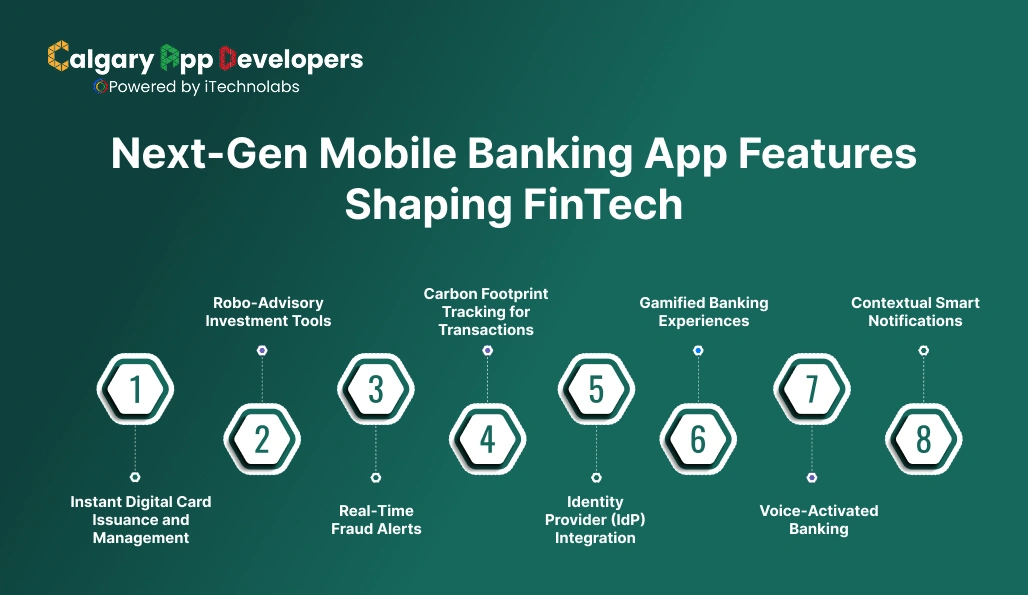
The financial technology space is evolving fast, and mobile banking app development is at the heart of that transformation. Next-generation features are not just about convenience—they are about creating personalized, secure, and future-ready banking experiences that keep customers engaged and loyal.
- Instant Digital Card Issuance and Management
Instead of waiting days for a physical debit or credit card, users can receive a digital card instantly within the app. They can start making online purchases, set spending limits, and freeze or unfreeze the card at any time. This helps banks onboard customers faster and reduces the cost of card distribution.
- Robo-Advisory Investment Tools
Robo-advisors use algorithms to provide automated, personalized investment recommendations. They analyze a user’s risk tolerance, financial goals, and market trends to suggest the best portfolio. This gives users access to expert-level investment guidance without the high fees of traditional advisors.
- Real-Time Fraud Alerts
Fraud detection tools in modern apps analyze every transaction as it happens. If suspicious activity is detected, the app sends instant alerts so users can confirm or block the transaction immediately. This real-time protection builds trust and prevents potential financial losses.
- Carbon Footprint Tracking for Transactions
Sustainability-conscious users appreciate tools that calculate the environmental impact of their purchases. By tracking the carbon footprint of each transaction, the app can help customers make greener spending choices. For banks, this feature aligns the brand with eco-friendly values and opens the door to sustainability-linked products.
- Identity Provider (IdP) Integration
IdP integration allows users to log in securely using trusted authentication services such as Google, Apple, or government-approved identity platforms. This strengthens security while simplifying access, especially for customers who want to avoid creating yet another password.
- Gamified Banking Experiences
Gamification brings elements like challenges, badges, and progress tracking into banking. Users might earn rewards for hitting savings goals, completing financial education modules, or paying bills on time. It makes financial management more engaging and can increase customer loyalty.
- Voice-Activated Banking
Voice commands allow users to check balances, transfer funds, or get spending insights without touching their screen. This hands-free experience is especially valuable for multitasking users and improves accessibility for visually impaired customers.
- Contextual Smart Notifications
Rather than sending generic alerts, smart notifications are triggered by user behavior and context. For example, if a bill is due, the app might suggest paying it directly from the notification. If spending in a certain category spikes, it could prompt a budget check. This creates a proactive and helpful banking experience.
Read Also: How Much Does It Cost to Maintain an App?
How Much Does Mobile Banking App Development Cost
The cost of mobile banking app development typically starts around 25,000 USD and can go up to 300,000 USD or more depending on complexity, features, and development approach. This wide range exists because building a secure, compliant, and feature-rich app involves multiple components and specialized expertise.
Estimated Cost Breakdown
| Development Stage | Description | Estimated Cost (USD) |
| Discovery and Planning | Market research, requirement gathering, and project roadmap | 5,000 – 15,000 |
| UI/UX Design | User interface creation, prototypes, and experience mapping | 8,000 – 25,000 |
| Core Development | Backend setup, APIs, core banking functions | 40,000 – 100,000 |
| Feature Implementation | Security features, integrations, and advanced tools | 30,000 – 80,000 |
| Testing and QA | Functional, security, and performance testing | 10,000 – 30,000 |
| Compliance and Security Audits | Ensuring regulatory compliance and high-level data protection | 5,000 – 15,000 |
| Deployment and Launch | App store submission, server setup, and go-live support | 5,000 – 10,000 |
| Post-Launch Support | Updates, bug fixes, and feature enhancements | 2,000 – 8,000 per month |
The right budget for mobile banking app development depends on your business goals and the level of innovation you want to deliver. A basic app with essential features can be built on the lower end of the range, while a highly advanced solution with AI, analytics, and multi-platform support will cost significantly more. Viewing this as a long-term investment rather than a one-time expense helps in building a sustainable and competitive product.
What Influences Mobile Banking App Development Costs
When it comes to mobile banking app development, the final price tag depends on a combination of technical, design, and operational choices. Understanding these factors helps you make informed decisions and avoid unexpected expenses.
- Scope and Complexity of Features
The more features you include, the higher the cost. Basic apps with simple account management are faster and cheaper to build, while apps with AI analytics, multi-currency support, and advanced security protocols require more time and specialized skills.
| Feature Level | Description | Estimated Impact on Cost |
| Basic | Core banking functions like balance check and transfers | Low |
| Moderate | Includes bill payments, UPI, alerts, and budgeting tools | Medium |
| Advanced | AI analytics, PFM, crypto payments, multi-account support | High |
- Platform Choice
Building for a single platform (iOS or Android) is cheaper than creating a cross-platform solution. Cross-platform development may save time in the long run, but it often needs a higher initial investment for optimization.
- Security and Compliance Requirements
Banking apps must follow strict financial regulations such as PCI DSS and GDPR. Adding encryption, biometric authentication, and fraud detection increases cost but is non-negotiable for user trust and legal compliance.
- Design and User Experience
A clean, intuitive design improves adoption and reduces churn. However, creating a polished and user-friendly interface requires skilled UI/UX designers, usability testing, and iteration cycles that can increase development time and cost.
- Integration with External Systems
If the app needs to integrate with payment gateways, CRM platforms, accounting software, or other third-party APIs, development becomes more complex. Each integration must be tested for performance, security, and compatibility.
- Development Team Location and Expertise
The country where your development team operates has a direct effect on your mobile banking app development budget. Costs vary widely due to differences in labor rates, living expenses, and local expertise.
| Country | Average Hourly Rate (USD) |
| Canada | 90 – 140 |
| United States | 100 – 150 |
| United Kingdom | 80 – 130 |
| Germany | 75 – 120 |
| Poland | 45 – 80 |
| Ukraine | 40 – 75 |
| India | 25 – 50 |
| Pakistan | 25 – 45 |
| Bangladesh | 20 – 40 |
If you want a balance between quality and cost, consider working with experienced mobile app developers in Calgary for close collaboration or skilled teams in subcontinental countries like India, Pakistan, or Bangladesh for competitive pricing without compromising quality.
- Maintenance and Future Updates
Ongoing updates, bug fixes, security patches, and feature enhancements require continuous investment. Neglecting this can result in security vulnerabilities and outdated features.
Also Read: How to Develop an iOS App
Step-by-Step Process to Mobile Banking App Development
Developing a mobile banking app is more than just coding an interface. It is a carefully sequenced journey where every stage ensures the app is functional, secure, compliant, and user-friendly. Here is how the process unfolds in practice.
- Step 1: Requirement Gathering and Analysis
Everything starts with clarity. The development team works with stakeholders to define exactly what the app must achieve. This includes identifying the primary audience, listing essential features such as fund transfers or account tracking, and deciding on advanced capabilities like AI-based spending insights. Competitor research is also carried out to see what works well in existing apps and where there is room for innovation. The outcome of this stage is a comprehensive requirement document that serves as the project blueprint.
- Step 2: Wireframing and UI/UX Design
Once the requirements are set, designers create wireframes to map the app’s layout and navigation flow. These wireframes act like a visual skeleton, showing where each element will go and how users will move between screens. The UI/UX team then transforms these wireframes into polished designs with an emphasis on simplicity, readability, and intuitive interaction. The aim is to make the banking experience smooth for first-time users while still efficient for power users.
- Step 3: Development and Backend Integration
This is the stage where the app starts to take shape technically. Front-end developers build the parts of the app users interact with, ensuring the design looks and works exactly as planned. Backend developers handle the heavy lifting behind the scenes, connecting the app to the bank’s servers, databases, and APIs. This integration enables secure account access, transaction handling, and data updates in real time.
- Step 4: Security Implementation
Security in mobile banking app development is never an afterthought. At this point, advanced safeguards like data encryption, tokenization, biometric authentication, and multi-factor verification are added. Secure coding practices and regular code reviews are also followed to ensure that vulnerabilities are eliminated before the app goes live. This step is critical to protecting both customer trust and regulatory compliance.
- Step 5: Meeting Compliance and Legal Standards
Financial apps operate under strict rules. The app must meet standards such as PCI DSS for secure payment processing and comply with local and global data protection laws like GDPR. Country-specific banking regulations are also factored in. This compliance stage not only prevents legal issues but also reassures users that the app meets professional and industry-approved standards.
- Step 6: Quality Assurance and Testing
Before launch, the app undergoes an intense testing phase. This includes functional testing to verify every feature works as intended, performance testing to ensure smooth operation under heavy load, and security testing to block cyber threats. Usability testing with real users helps identify areas where the interface can be improved for clarity or convenience. Only once the app passes all these checks is it ready for release.
- Step 7: Launch and Deployment
With all testing complete, the app is prepared for public release. This involves uploading it to app stores, setting up server infrastructure for live operation, and running initial user onboarding campaigns. The launch phase often includes close technical monitoring to quickly address any unexpected performance issues or bugs.
- Step 8: Ongoing Support and Updates
A successful mobile banking app is never “finished.” After launch, the focus shifts to ongoing maintenance. This includes regular security updates, feature enhancements based on user feedback, and compatibility upgrades for new devices or operating system versions. Continuous improvement keeps the app relevant in a fast-evolving digital banking landscape.
Challenges in Mobile Banking App Development
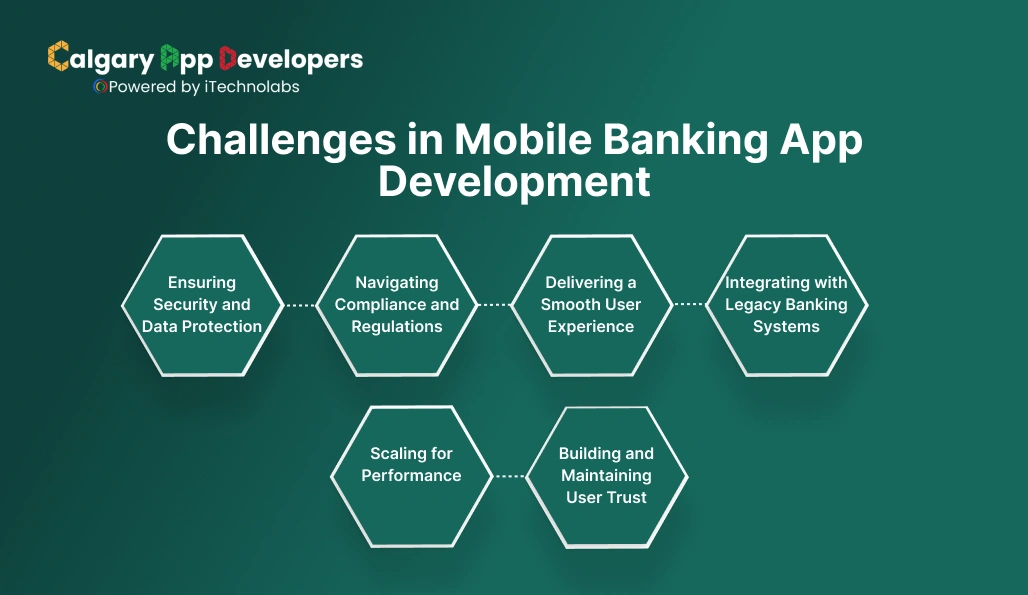
Developing a mobile banking app is not merely about developing features. It is about ensuring high levels of security, performance, and usability when working in a heavily regulated sector. Below are the primary challenges companies encounter in doing so.
- Ensuring Security and Data Protection
Security is the biggest solo concern of developing mobile banking apps. Apps holding and processing confidential financial data, like banking apps, are targets for cyber threats. App developers need to incorporate end-to-end encryption, biometric login, secure session handling, and real-time fraud protection. A single breach can do irreparable harm to the company and its reputation so security measures have to be stringent and continuous.
- Navigating Compliance and Regulations
Financial services run according to draconian legal regulations. Every geography has compliance standards, e.g., PCI DSS for payments, GDPR for privacy, and other geographically specific banking regulations. Non-compliance will lead to draconian fines and litigation. Developers will need to collaborate very closely with legal and compliance professionals so that all aspects of the app are compliant from day one.
- Delivering a Smooth User Experience
It may have all the features in the right place and still not work if it can’t be used quickly and easily. User experience in mobile banking app development has to work so that account management, transferring funds, and making payments all can be done in a few steps. It should be easy to use for beginners, yet still provide advanced functionality for power customers. Optimization for performance is imperative so that everything responds instantly and predictably.
- Integrating with Legacy Banking Systems
Most banks continue to work on legacy core banking systems that were not designed for app integration in the current times. It is a challenging process, time-consuming, and expensive to integrate a new mobile banking app with such old systems. The developers have to create stable middleware solutions or APIs to enable seamless communication between the old infrastructure and the new application without affecting the day-to-day banking activities.
- Scaling for Performance
As the customer base grows, the app must handle higher transaction volumes, more concurrent users, and expanding data storage needs. This requires scalable architecture and cloud-based infrastructure capable of adjusting resources on demand. Without proper scalability planning, users may experience slowdowns or downtime during peak periods, damaging the bank’s credibility.
- Building and Maintaining User Trust
Trust is the mobile banking currency. Even minor issues like delayed updates of transactions or ambiguous error messages can give customers pause. Communication transparency, excellent customer service, and regular security patches are the key to sustaining trust. Whether money and data are secured for customers will be the determining factor for the long-run success of the app.
Read Also: How Much Does it Cost to Hire App Developers in Canada?
Banking App Trends, Businesses Should Watch
Mobile banking app development is occurring rapidly, and those businesses that are ahead of the curve with innovative trends will have a definitive edge. These are the breakthroughs that are currently transforming how bank apps are designed and utilized.
1: AI and Machine Learning for Personalization
Artificial intelligence is now at the forefront of making banks’ apps smarter. AI can suggest customized financial products based on spending behaviors, income streams, and saving patterns. AI can spot suspicious behavior and offer budgeting advice forecasted ahead. Machine learning drives chatbots that resolve sophisticated customer inquiries in a fraction of a second and analytical tools that can find the most suitable investments for every user.
2: Blockchain for Security and Transparency
Blockchain brings trust and traceability to mobile banking app development. Its decentralized structure ensures transactions are recorded securely and cannot be altered without consensus. This improves fraud prevention, enables faster cross-border payments without multiple intermediaries, and allows the creation of smart contracts that automatically execute based on set conditions.
3: Open Banking with API Integrations
Open banking allows third-party developers to access a bank’s data safely, providing customers with a greater number of services without ever having to leave the app. What this allows is for customers to see all their accounts in one spot, integrate with accounting or payroll software, and enjoy new products created outside of the normal banking channels.
4: Real-Time Payments and Instant Transfers
Waiting days for funds to clear is becoming a thing of the past. Real-time payments allow instant transfers, whether it is paying suppliers, sending salaries, or splitting a bill with friends. This trend not only improves customer satisfaction but also supports smoother cash flow for businesses.
5: Mobile-First, User-Focused Design
As mobile devices dominate daily banking, design has shifted to prioritize accessibility and ease of use. Modern banking apps now feature layouts optimized for one-handed navigation, intuitive icons, and fast-loading pages. Accessibility for visually impaired users and simple workflows for quick transactions are becoming standard expectations.
6: RegTech for Compliance Automation
Regulatory technology is assisting banks in fulfilling legal obligations without hampering operations. Computerized solutions can identify suspicious transactions in real time, create compliance reports in a matter of moments, and revise processes when laws are modified. This eliminates human error without compromising on efficiency and security.
7: Embedded Finance Capabilities
Embedded finance incorporates banking functionality into non-bank platforms. A consumer app can provide buy-now-pay-later functionality, a ride-hailing platform can instantaneously pay drivers via the app, and e-commerce sites can offer instant lending for purchases. This increases reach and convenience without having to use distinct banking logins.
8: Green and Sustainable Banking
Consumers are more and more attracted by sustainable financial services. Now, banking apps can monitor carbon impact on spending, provide the choice of investing in green funds, and cut paper usage with digitally handled processes. Sustainability is turning into a differentiator in mobile banking app design.
9: Cloud Infrastructure for Scalability
Cloud technology enables banks to scale up services rapidly and affordably. It supports high availability in periods of peak demand, quicker rollouts of new capabilities, and minimum downtime. Banks can keep up with the growth in users without the expense of physical servers through cloud-based infrastructure.
Our Expertise in Finance Mobile App Development
Finance apps demand more than clean interfaces and smart features. They require accuracy, security, and absolute trust from users. Our experience in finance mobile app development is rooted in building platforms that help people make better financial decisions while keeping complexity under control. Aposyro Mobile is a strong example of how we approach this balance.
Aposyro Mobile
Finance Planning Platform
Aposyro Mobile was designed to help users move from reactive money management to intentional financial planning. The goal was to give individuals and families a clear, structured way to understand their finances, plan ahead, and stay in control without feeling overwhelmed.
Key highlights of Aposyro Mobile
- Financial planning tools that help users map income, expenses, savings, and future goals in one place.
- Smart budgeting features that categorize spending and highlight patterns users often miss.
- Goal-based planning that allows users to set milestones for savings, debt reduction, and major life events.
- Clear visual insights that turn complex financial data into easy-to-understand summaries.
- Secure architecture designed to protect sensitive financial information while maintaining smooth performance.
Aposyro Mobile helps users see the full picture of their financial health instead of isolated numbers. The platform encourages better habits by making planning feel manageable and progress visible.
Through Aposyro Mobile, we demonstrated how thoughtful strategy, finance-focused UX, and secure development practices come together to create a product users can rely on daily. It reflects our ability to build finance mobile apps that are not just functional but genuinely useful in helping people plan, decide, and move forward with confidence.
Conclusion
Mobile banking app development is no longer a choice for financial services companies. It has emerged as the window to provide quicker services, better security, and more customized customer experiences. With the right vision, companies can design banking apps that not only facilitate transactions but also establish long-term trust and loyalty.
This is where Calgary App Developers can assist you in developing your idea into a product that sells in the market. Our specialists are experts in mobile banking app development, creating secure, compliant, and customer-centric banking apps that satisfy business objectives and consumer demands. From idea to launch, we manage each process with diligence and imagination so that you can remain competitive in a rapidly evolving financial world.
If you are ready to turn your banking app concept into reality, join forces with Calgary App Developers and begin crafting the future of money today.
FAQ’s For Mobile Banking App Development
1. How much does mobile banking application development cost?
The development cost for a mobile banking app typically begins at 40,000 USD for a bare minimum and may be more than 300,000 USD for an enterprise-grade platform with all features. The actual cost varies with features, tech stack, complexity of design, compliance, and the development location.
2. Can developing an MVP for a mobile banking app reduce the overall costs?
Yes. Building a Minimum Viable Product (MVP) allows you to launch with only essential features. This approach reduces initial development expenses and helps you validate your idea in the market before committing to a larger investment. You can then add advanced features based on user feedback.
3. What are the latest trends in mobile application development for banking?
Trends include AI and machine learning for personalized recommendations, blockchain for secure and transparent transactions, real-time payments, open banking with API integrations, green banking initiatives, and cloud infrastructure for scalability. Businesses that adopt these trends early gain a competitive advantage.
4. How can businesses make their banking app compatible with all devices and platforms?
Choosing a cross-platform development approach ensures the app works on both Android and iOS devices. This can be achieved using frameworks like Flutter or React Native. Responsive design principles and extensive device testing further ensure a consistent experience across smartphones and tablets.
5. How can we ensure the security of your banking app?
Security in mobile banking app development requires multiple layers of protection. This includes strong encryption, multi-factor authentication, biometric logins, secure APIs, and regular vulnerability testing. Compliance with industry standards such as PCI DSS and local financial regulations is also essential.
6. How can banks use AI and machine learning to personalize their app services?
AI can analyze customer transaction history, spending patterns, and preferences to offer tailored product recommendations, smarter budgeting tools, and real-time fraud alerts. Machine learning can also enhance credit scoring models and improve chatbot assistance for instant customer support.
7. What analytics and reporting features should a modern banking app include?
A modern banking app should provide transaction summaries, spending categorization, trend analysis, income and expense comparisons, savings goal tracking, and detailed downloadable reports. These features help customers make informed financial decisions while enabling banks to track engagement and improve services.
8. How can businesses boost user engagement and retention through their app?
Gamification elements, personalized offers, real-time notifications, and loyalty rewards can keep users engaged. Regular updates with new features, smooth performance, and responsive customer support also play a critical role in keeping users loyal to the app.


Pankaj Arora is a seasoned technology leader and the Founder of Calgary App Developer, with 10+ years of expertise in crafting high-performance digital solutions. His core competencies include full-stack app development, cloud-native architecture, API integration, and agile product delivery. Under his leadership, Calgary App Developers has empowered startups and enterprises alike with scalable mobile applications, secure web platforms, and AI-driven SaaS products.