









How to Develop an AI App: A Breif Guide 2026

Imagine opening an app that understands user intent before a button is tapped, adapts in real time, and improves with every interaction. That is no longer a novelty. It is the practical advantage businesses are building today with AI powered applications.
AI isn’t a futuristic dream anymore. In 2024, 78% of organizations said they use AI in at least one business function, up sharply from 55% in 2023. This represents a compound annual growth rate of approximately 6.8%. As per our prediction, if adoption continues at this pace, nearly 100% of organizations could be leveraging AI by 2030.
Globally, AI tools are changing how companies do marketing, sales, operations, and product development. The momentum isn’t slowing.
If you are exploring how to build an AI app, you are not early and you are not late. You are right on time. The opportunity lies in building something useful, scalable, and grounded in real business needs. This guide is written from our hands-on experience developing AI applications for real world use cases. It breaks down the process clearly, from choosing the right features and models to understanding costs, risks, and long term potential, so you can move forward with confidence and clarity.
- AI apps are now a practical business tool, not an experimental technology.
- Successful AI applications are built on clear goals, quality data, and scalable architecture.
- Costs, features, and timelines vary widely based on complexity and data requirements.
- Long-term value comes from continuous monitoring, iteration, and alignment with business outcomes.
- Building an AI app starts with defining a clear business problem and measurable success metrics to avoid building technology without real impact.
- AI applications are composed of multiple layers such as machine learning, deep learning, NLP, and computer vision, each serving a specific purpose.
- Industries like healthcare, finance, retail, manufacturing, and logistics are already using AI apps to improve efficiency, accuracy, and personalization.
- A structured development process, from data strategy and prototyping to deployment and monitoring, is essential for production-ready AI systems.
- Key AI features such as personalization, predictive analytics, automation, and real-time insights determine usability and long-term value.
- The cost of building an AI app depends on model complexity, data availability, team expertise, infrastructure, and ongoing maintenance needs.
- Measuring ROI requires linking AI performance to business metrics like cost savings, revenue growth, productivity, and customer satisfaction.
What Makes Up an AI Application
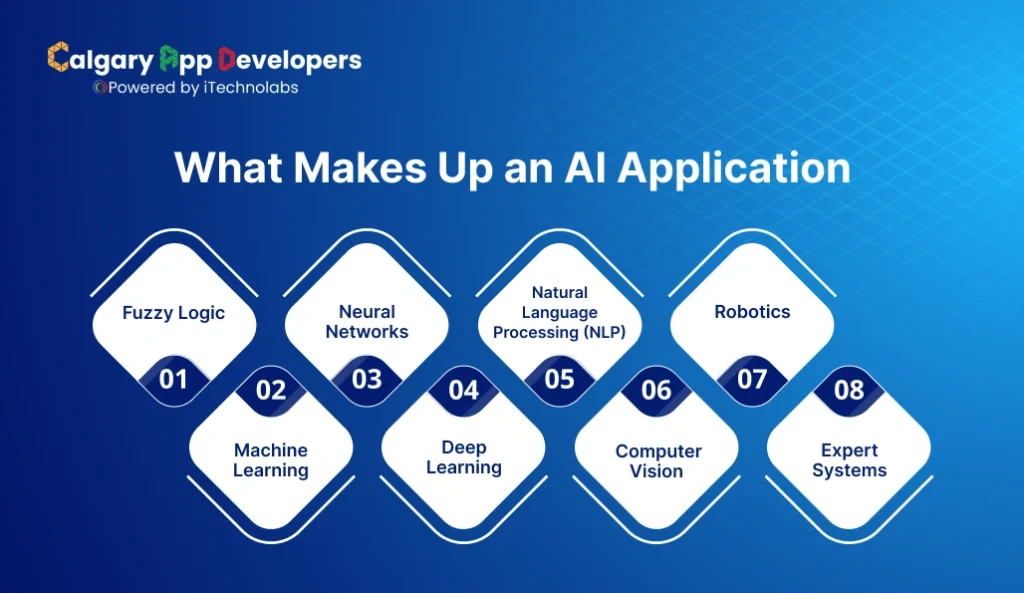
AI apps don’t rely on a single piece of technology. They are layered systems built with multiple components that each play a different role. Together, these components give AI the power to learn, adapt, and act intelligently.
- Fuzzy Logic
Fuzzy logic is used when problems don’t have a clear yes or no answer. Instead of forcing a rigid decision, it allows machines to weigh possibilities and reach outcomes that feel more natural. For example, a smart thermostat doesn’t just decide between hot and cold. It adjusts the temperature based on comfort levels, humidity, and time of day. In AI apps, fuzzy logic is often applied in control systems, medical diagnoses, and risk assessments where human-like reasoning is essential. - Machine Learning
Machine learning is what allows AI applications to improve as they go. By studying large datasets, algorithms detect patterns and adjust their behavior over time. This is what powers product recommendations on e-commerce platforms, predictive text on your phone, or fraud detection in banking apps. Instead of writing hundreds of explicit rules, developers train models to learn from examples, making AI apps adaptable to new data without starting from scratch. - Neural Networks
Neural networks are designed to mimic how the human brain processes information. They consist of layers of nodes, often called neurons, that pass data along and learn to identify patterns. For instance, a neural network can learn to tell the difference between a cat and a dog by analyzing thousands of images. Each layer focuses on different features, from edges and shapes to textures and details. Neural networks are the foundation for technologies like speech recognition, handwriting analysis, and even game-playing AI. - Deep Learning
Deep learning is a specialized type of neural network with many hidden layers. The “deep” in its name refers to how much information it can process at once. This allows AI to perform extremely complex tasks, such as identifying faces in a crowded photo, understanding natural speech, or driving a car through city traffic. Deep learning thrives on massive datasets and high computing power, which is why it has become so central in cutting-edge AI applications across industries. - Natural Language Processing (NLP)
NLP gives machines the ability to understand, interpret, and generate human language. It’s the reason why virtual assistants like Siri, Alexa, and ChatGPT can respond in a way that feels conversational. NLP involves breaking down language into parts, analyzing grammar, recognizing intent, and even picking up on sentiment. For businesses, NLP makes chatbots smarter, enables real-time translation, and allows AI apps to read and analyze customer feedback at scale. - Computer Vision
Computer vision enables AI to process and interpret visual information from the world around it. By analyzing images and video, computer vision can identify objects, detect movements, and even recognize emotions on faces. It’s used in medical imaging to detect early signs of disease, in manufacturing to spot defects during quality checks, and in security systems for facial recognition. For AI apps, computer vision brings visual intelligence, opening up possibilities for healthcare, retail, and automation. - Robotics
When AI is combined with robotics, it bridges the gap between digital intelligence and physical action. Robotics enables machines to perform tasks that would otherwise require human effort, from assembling cars in factories to assisting surgeons in operating rooms. AI-powered robots use sensors, machine learning, and computer vision to adapt to their surroundings, navigate spaces, and handle objects with precision. In AI apps, robotics integrations often support logistics, smart homes, and industrial automation. - Expert Systems
Expert systems are designed to replicate the knowledge and reasoning of human specialists. They rely on vast databases of facts combined with rule-based decision-making. A classic example is a medical diagnosis system that helps doctors analyze symptoms and recommend treatments based on proven knowledge. Unlike machine learning models, which adapt from data, expert systems are built on structured logic and predefined knowledge bases, making them reliable for fields like healthcare, law, and engineering, where precision is critical.
Also Read: AI App Development: Build Intelligent Solutions
Why Businesses Should Invest in AI Apps
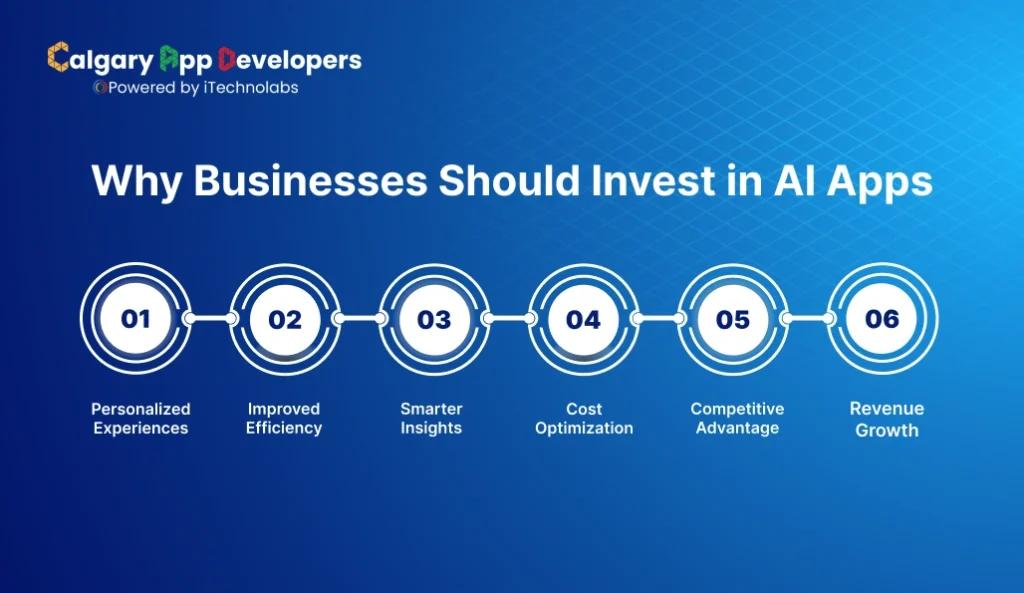
Artificial intelligence is becoming a core driver of business growth. Companies across industries are adopting AI-powered applications to streamline processes, improve decision-making, and deliver better customer experiences. Building an AI app allows organizations to operate more intelligently and stay competitive in a rapidly changing market.
- Personalized Experiences
AI applications analyze customer behavior and preferences to deliver tailored interactions. From recommending relevant products to providing timely assistance, these applications enhance customer satisfaction and encourage stronger brand loyalty. Personalized services often result in higher engagement levels and repeat business, making them a valuable asset for long-term growth.
- Improved Efficiency
Building an AI app enables businesses to automate routine and repetitive tasks such as data entry, scheduling, and customer support. This reduces the risk of human error, saves valuable time, and allows teams to focus on strategic activities. As a result, operations become more streamlined and productivity increases across departments.
- Smarter Insights
AI-powered apps process large volumes of data and identify meaningful patterns that might otherwise go unnoticed. Businesses can leverage these insights to forecast demand, optimize resources, and refine strategies. Data-driven decision-making reduces uncertainty and ensures that leaders act with greater confidence and accuracy in a competitive business environment.
- Cost Optimization
By automating workflows and reducing manual errors, AI apps help organizations control operational expenses. Efficiency gains translate into lower costs for processes such as customer service and reporting. Over time, these savings contribute to stronger financial performance, proving that AI is not only an innovative choice but also a cost-effective one.
- Competitive Advantage
Companies that build an AI app position themselves as innovators within their industries. Intelligent features, predictive tools, and advanced analytics differentiate them from competitors who rely on traditional systems. Early adoption of AI also demonstrates adaptability, which is increasingly important for businesses aiming to stay relevant in evolving markets.
- Revenue Growth
AI applications create opportunities for new revenue streams through advanced services, subscription-based features, and improved customer experiences. By adding measurable value to end users, businesses can strengthen their market presence and scale more effectively. Revenue growth driven by AI reflects both improved efficiency and enhanced customer relationships.
Real-World Use Cases Across Industries
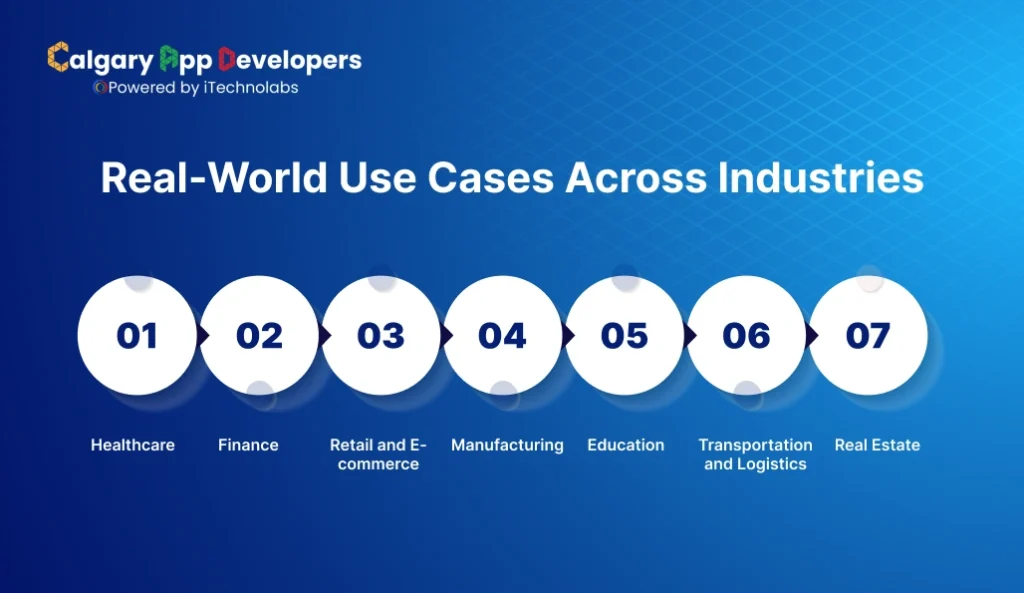
AI applications are transforming industries worldwide. Companies that build an AI app gain the ability to automate processes, analyze data at scale, and deliver smarter services. Here’s how different sectors are putting AI into action, with examples and key features that make these applications valuable.
1. Healthcare
AI in healthcare improves diagnostic accuracy, treatment personalization, and patient engagement. For instance, IBM Watson Health has been used to support doctors in analyzing medical records and suggesting treatment options. AI-powered platforms like PathAI assist pathologists by identifying disease patterns in slides.
Key Features
- Medical image analysis
- AI-driven chatbots for patient support
- Predictive analytics for early diagnosis
- Virtual health assistants for remote care
2. Finance
Financial institutions use AI apps to enhance security, improve decision-making, and create personalized services. JP Morgan’s COIN platform automates document review, saving thousands of hours annually. PayPal relies on AI algorithms to detect and prevent fraudulent transactions in real time.
Key Features
- Fraud detection and prevention
- AI-driven credit scoring and risk analysis
- Personalized financial advice
- Automated loan processing
3. Retail and E-commerce
Retailers build AI apps to improve customer journeys and optimize operations. Amazon sets the global benchmark with its recommendation engine, which drives a significant portion of sales. Sephora uses an AI chatbot and virtual try-on features to create immersive shopping experiences.
Key Features
- Personalized product recommendations
- Virtual assistants for customer support
- Dynamic pricing based on demand
- Smart inventory and supply chain management
4. Manufacturing
Manufacturers use AI for quality control, predictive maintenance, and process efficiency. General Electric (GE) uses AI-powered predictive maintenance to reduce equipment downtime. Siemens leverages AI to optimize production processes and improve product reliability.
Key Features
- Predictive maintenance of equipment
- Computer vision for defect detection
- Process optimization with real-time analytics
- Robotics integration for automated assembly
5. Education
AI enhances learning by making it personalized and accessible. Duolingo uses AI algorithms to adjust lessons to each learner’s pace and progress. Coursera applies AI for personalized course recommendations and automated grading.
Key Features
- Adaptive learning platforms
- AI-driven tutors and assistants
- Automated grading and feedback
- Data-driven insights for educators
6. Transportation and Logistics
Logistics and transportation companies build AI apps to improve efficiency and reduce costs. UPS uses its AI-powered ORION system to optimize delivery routes, saving millions of gallons of fuel annually. Tesla employs deep learning for autonomous driving technologies.
Key Features
- Route optimization and traffic prediction
- Autonomous driving capabilities
- Predictive analytics for supply chain demand
- Smart fleet and warehouse management
7. Real Estate
In real estate, AI apps analyze markets and improve customer interactions. Zillow uses its Zestimate tool, powered by machine learning, to predict home values. Compass, a US-based real estate platform, leverages AI to match buyers with properties that suit their needs.
Key Features
- Property valuation models
- AI-driven virtual assistants for buyers
- Predictive market analysis
- Smart property search and recommendations
Read Also: Best AI Business Solutions Driving Business Growth
Step-by-Step Guide to AI App Development
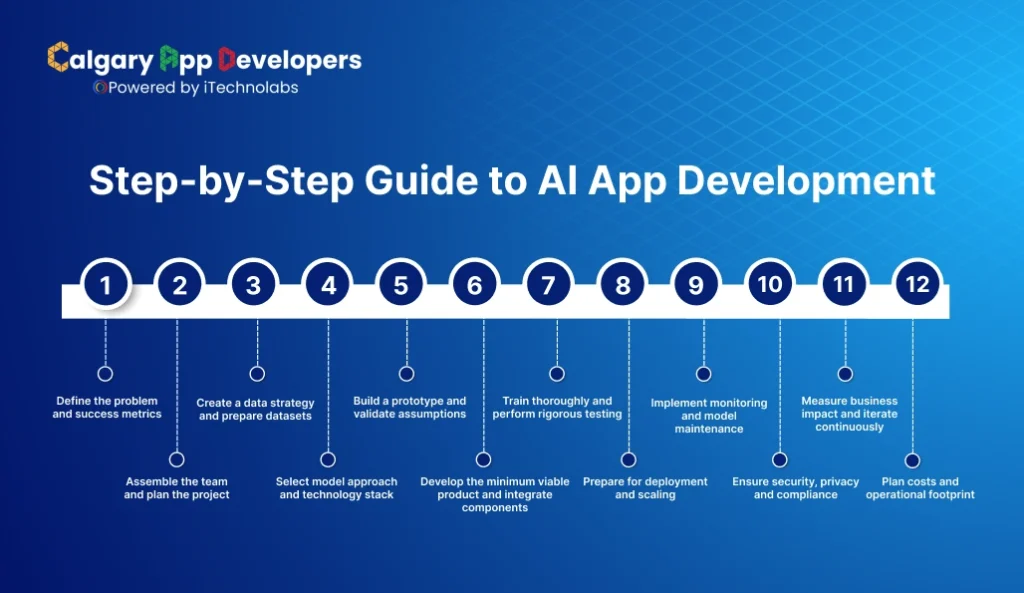
This guide explains the practical steps to build an ai app, from concept and data to deployment and ongoing operations. Each step describes core activities, typical outputs, and key questions to answer so teams can move from an idea to a production system with clear goals and manageable risks.
Step 1: Define the problem and success metrics:
Begin by specifying the business problem the app will solve and the measurable outcomes you expect. This keeps technical work focused on value rather than novelty.
- Core activities include stakeholder interviews, user persona definition, and mapping the user journey.
- Key questions cover who benefits, what business metric will change, and what constraints exist.
- Deliverables are a concise problem statement, target metrics, and a prioritized feature list.
Step 2: Assemble the team and plan the project:
Confirm roles, responsibilities, and a realistic project plan before building models. The right mix of skills reduces rework later.
- Typical roles include product manager, data engineer, ML engineer, backend and frontend developers, QA, and MLOps specialist.
- Planning items include minimum viable product scope, milestones, and required datasets.
- Deliverable is a project plan that aligns people, data, and engineering expectations.
Step 3: Create a data strategy and prepare datasets:
Data quality determines the ceiling on model performance. Define sources, collection methods, labeling, and governance up front.
- Activities include inventorying internal and external data sources, designing annotation guidelines, and building ingestion pipelines.
- Must cover privacy, consent, and retention policies to meet legal requirements.
- Deliverables are dataset specifications, sample data, and a roadmap for ongoing data collection.
Step 4: Select model approach and technology stack:
Choose a modeling approach that matches your objectives and constraints rather than chasing the newest technique. Consider latency, accuracy, and maintainability.
- Decide between classical ML, deep learning, or pretrained models based on data size and problem complexity.
- Evaluate frameworks and platforms for training and serving, and choose cloud or edge deployment as required.
- Deliverable is an architecture diagram and a technology stack that supports development and production needs.
Step 5: Build a prototype and validate assumptions:
Rapid prototyping proves core assumptions and identifies technical blockers before full investment. Focus on the smallest scope that demonstrates value.
- Implement a simple end-to-end flow with a lightweight UI and model trained on a representative sample.
- Validate accuracy, speed, and user acceptance with real or synthetic users.
- Deliverable is a proof of concept with metrics and go/no-go recommendations.
Step 6: Develop the minimum viable product and integrate components
Production integration requires more than a trained model. Build APIs, data pipelines, and the user interface while keeping the system modular.
- Key tasks include model serialization, API endpoints, authentication, logging, and frontend integration.
- Address data versioning, model versioning, and feature stores during this phase.
- Deliverable is a deployable MVP ready for internal testing and limited user trials.
Step 7: Train thoroughly and perform rigorous testing:
Training at scale and robust testing reveal issues that prototypes miss. Test for accuracy, bias, robustness, and edge cases.
- Use cross validation, holdout tests and performance metrics relevant to business goals.
- Run fairness checks, adversarial tests, and stress tests for latency and throughput.
- Deliverable is a validated model accompanied by test reports and known limitations.
Step 8: Prepare for deployment and scaling:
Design the serving layer so it meets performance, cost and reliability targets. Plan for traffic spikes and model updates.
- Choose model serving technology and an autoscaling strategy, and implement caching where appropriate.
- Use rollout strategies such as canary testing and A/B experiments to compare versions safely.
- Deliverable is a deployment plan with rollback procedures and monitoring hooks.
Step 9: Implement monitoring and model maintenance:
Production systems require continuous observation. Monitor inputs, predictions and business metrics to detect drift and degradation.
- Track data drift, model accuracy, latency and system errors, and set alert thresholds.
- Define retraining triggers and a schedule for model refresh, with reproducible pipelines.
- Deliverable is an observability dashboard and an operational runbook.
Step 10: Ensure security, privacy and compliance:
Protecting data and meeting regulations is mandatory. Incorporate security practices from design through deployment.
- Apply access controls, encrypt data in transit and at rest, and anonymize or pseudonymize where needed.
- Document compliance needs such as GDPR or sector-specific regulations and run periodic audits.
- Deliverable is a compliance checklist and implemented security controls.
Step 11: Measure business impact and iterate continuously:
Tie technical metrics to business outcomes and prioritize improvements that move the needle. Use data to guide product decisions.
- Define KPIs that include both model performance and business results, for example conversion, retention or cost per transaction.
- Run experiments, gather user feedback and update the roadmap based on measured impact.
- Deliverable is a performance report and a prioritized backlog for the next iteration.
Step 12: Plan costs and operational footprint
Understand total cost of ownership before scaling. Model hosting, data storage, labeling and inference costs add up quickly.
- Estimate compute costs for training and serving, storage for datasets, and ongoing costs for annotation and monitoring.
- Consider trade-offs such as model complexity versus inference cost and cloud versus on-premise hosting.
- Deliverable is a cost model and a breakeven analysis to inform scaling decisions.
Follow these steps to build an ai app that delivers measurable business value and is ready for production demands.
Also Read: How to Make an AI in 7 Simple Steps
Key Features That Make an AI App Stand Out
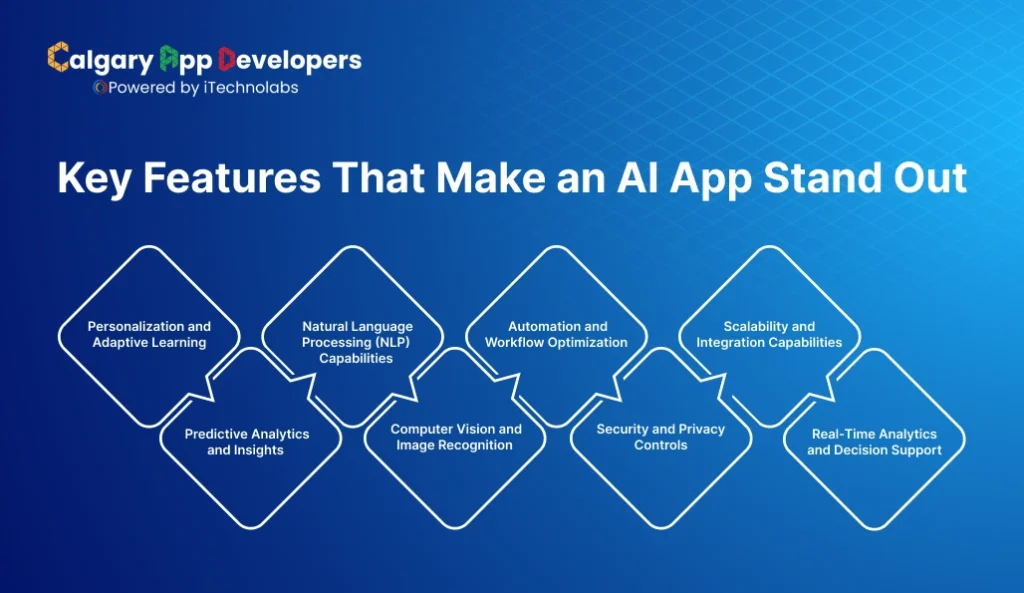
When businesses decide to build an AI app, the features they include determine its effectiveness, usability, and long-term value. A well-designed AI app combines intelligent functionality with seamless user experience, delivering solutions that are both practical and innovative. Below are the key features that make an AI application truly impactful.
- Personalization and Adaptive Learning
One of the most valuable features of AI apps is the ability to provide personalized experiences. The app learns from user behavior, preferences, and interactions to offer recommendations, adaptive content, or customized workflows. For example, e-commerce platforms like Amazon use AI to suggest products based on browsing and purchase history, enhancing engagement and customer satisfaction.
Key Elements
- Dynamic content or product recommendations
- Personalized notifications and alerts
- Adaptive interfaces based on usage patterns
- Predictive Analytics and Insights
AI apps excel at predicting trends and identifying patterns in large datasets. Predictive analytics helps businesses anticipate customer needs, forecast demand, and optimize operations. Financial apps like PayPal detect fraudulent transactions before they occur, while logistics platforms like UPS optimize routes using predictive algorithms.
Key Elements
- Forecasting customer behavior or demand
- Risk detection and anomaly identification
- Actionable insights for decision-making
- Natural Language Processing (NLP) Capabilities
NLP enables AI apps to understand and respond to human language, making interactions intuitive and human-like. Virtual assistants, chatbots, and customer support applications rely on NLP to interpret queries, provide solutions, and even detect sentiment. Companies like Duolingo use NLP to assess language learning progress and adapt lessons accordingly.
Key Elements
- Conversational interfaces and chatbots
- Sentiment analysis
- Multilingual support and language translation
- Computer Vision and Image Recognition
Computer vision allows AI apps to interpret visual information from images or video, enabling applications such as facial recognition, object detection, and quality inspection. Healthcare apps like PathAI use computer vision to detect disease in medical scans, while retail apps enhance visual search for products.
Key Elements
- Real-time image or video analysis
- Object, face, and pattern recognition
- Integration with augmented reality (AR) features
- Automation and Workflow Optimization
AI apps reduce manual work and increase operational efficiency by automating repetitive tasks. This can include document processing, scheduling, inventory management, and more. For example, AI-driven enterprise solutions like UiPath streamline business processes across departments, saving time and reducing errors.
Key Elements
- Task automation and process orchestration
- Intelligent notifications and alerts
- Integration with existing enterprise systems
- Security and Privacy Controls
AI apps handle sensitive data, making robust security and privacy essential. Features like data encryption, user authentication, and anonymization ensure compliance and build trust. Applications in finance, healthcare, and logistics rely heavily on these safeguards to protect user and business information.
Key Elements
- Data encryption in transit and at rest
- Role-based access controls
- Privacy compliance with regulations like GDPR and HIPAA
- Scalability and Integration Capabilities
A successful AI app is designed to grow with business needs. Scalability allows handling of increased users or data volume without compromising performance. Integration with other systems, APIs, and cloud services ensures the app fits seamlessly into existing technology ecosystems.
Key Elements
- Cloud-ready architecture for scaling
- API integrations with third-party services
- Modular design for feature expansion
- Real-Time Analytics and Decision Support
AI apps provide actionable insights instantly, allowing businesses to respond quickly to changing circumstances. Real-time analytics enable smarter operational decisions, such as adjusting marketing campaigns, inventory, or customer engagement strategies on the fly.
Key Elements
- Dashboards for monitoring key metrics
- Alerts for anomalies or important events
- Real-time reporting for strategic decision-making
When businesses choose to build an AI app with these features, they create applications that are not just functional but also strategic assets. Each feature adds a layer of intelligence, efficiency, and value, helping companies stay competitive and deliver superior experiences to users.
Read Also: AI App Development Cost Breakdown: From Idea to Launch
Cost Breakdown of Building an AI App
The cost to build an AI app typically ranges between $30,000 and $250,000 depending on complexity, features, and scope. Below is an estimated breakdown of major cost components for a medium-complexity AI app.
| Cost Component | Estimated Range (USD) | Description |
| Requirement Analysis & Planning | $2,000 – $10,000 | Defining objectives, project scope, and success metrics |
| UI/UX Design | $3,000 – $15,000 | Designing user-friendly interfaces and interactive prototypes |
| Backend & Frontend Development | $10,000 – $80,000 | Building app architecture, database, APIs, and user interface |
| AI/ML Model Development | $8,000 – $70,000 | Data preprocessing, model training, testing, and optimization |
| Data Collection & Annotation | $2,000 – $20,000 | Gathering datasets, labeling, and ensuring quality |
| Testing & QA | $3,000 – $15,000 | Functional, performance, and security testing |
| Deployment & Cloud Setup | $2,000 – $15,000 | Cloud infrastructure, server setup, and initial deployment |
| Maintenance & Updates | $2,000 – $25,000 | Ongoing support, model retraining, and feature updates |
Factors Affecting the Cost of an AI App
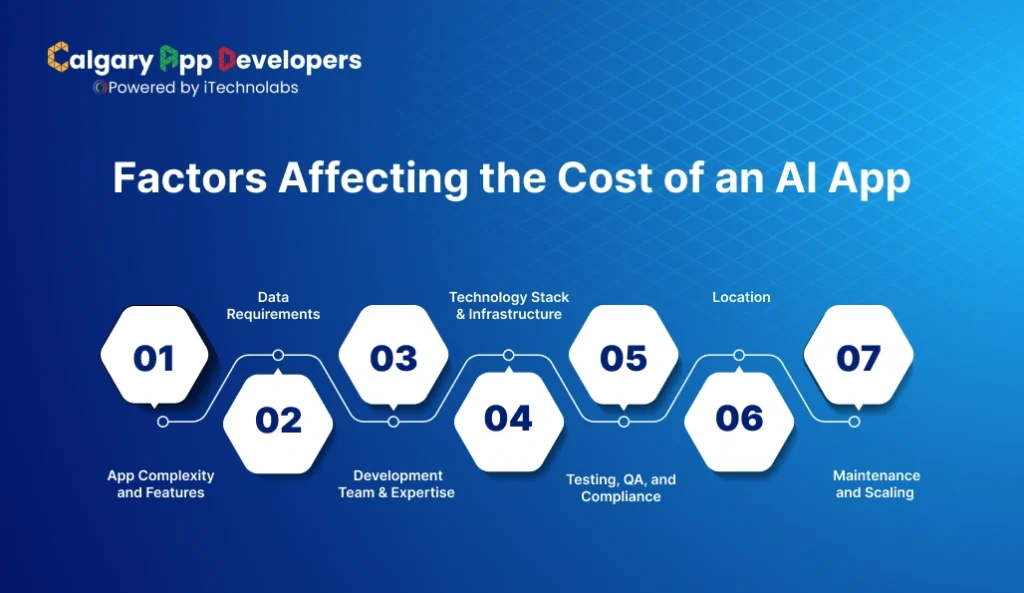
Several factors influence the final cost. Understanding these helps businesses plan effectively before they decide to build an AI app.
- App Complexity and Features
| Complexity Level | Example Features | Development Time | Estimated Cost Impact |
| Low | Basic automation, simple recommendation system | 4–8 weeks | Low ($30k–$50k) |
| Medium | Predictive analytics, NLP chatbots | 8–16 weeks | Medium ($50k–$120k) |
| High | Computer vision, deep learning, autonomous decision-making | 16+ weeks | High ($120k–$250k) |
More advanced AI features increase development and testing time. Higher complexity also requires more maintenance and robust infrastructure.
- Data Requirements
- High-quality datasets are critical for AI performance. Costs rise if data needs to be purchased, collected, or manually annotated.
- Cleaning and preprocessing data for AI models is time-consuming but essential for accuracy.
- Development Team & Expertise
| Role | Average Hourly Rate (USD) | Contribution to Cost |
| AI/ML Engineer | $50–$150 | Model development, training |
| Data Scientist | $60–$160 | Feature engineering, preprocessing |
| Frontend/Backend Developer | $40–$120 | UI, API, integration |
| QA & Testing | $30–$80 | Functional and performance testing |
| Project Manager | $50–$120 | Planning, coordination |
Experienced AI professionals demand higher salaries. A larger, skilled team speeds development but increases overall cost.
- Technology Stack & Infrastructure
- Using cloud services, AI frameworks, or pre-trained models can reduce development time but may have recurring subscription costs.
- On-premise solutions require investment in servers, storage, and security measures.
- Testing, QA, and Compliance
- Extensive testing ensures the AI app works reliably across devices and conditions.
- Industries like healthcare, finance, and education require compliance checks, adding to cost.
- Location
| Location | Approx. Cost Factor | Notes |
| Calgary | Affordable, high-quality talent | Ideal for cost-effective AI app development |
| US – Major Cities | Higher labor costs | Skilled workforce but more expensive |
| India | Moderate labor cost, large talent pool | Budget-friendly, flexible development options |
| Western Europe | Higher rates | Strong expertise but costly |
Development costs vary significantly by location. Cities like Calgary offer a balance of quality and affordability, making them an attractive choice for businesses planning to build an AI app.
- Maintenance and Scaling
- AI apps require ongoing model updates, bug fixes, and infrastructure scaling.
- More complex models or large user bases increase long-term costs.
By understanding these cost components and factors, businesses can make informed decisions about budgeting and strategy before deciding to build an AI app.
Also Check: AI Integration Services: Smarter Business Solutions
Monetization Models for AI Applications
Building an AI app is not just about technology; it is also a business decision. Choosing the right monetization model determines how your app generates revenue, attracts users, and scales sustainably. Below are the most common approaches used by businesses worldwide.
- Subscription-Based Model
Users pay a recurring fee, monthly or annually, for access to the AI app’s features. This model ensures predictable revenue and encourages developers to continually update and improve the application. Examples include AI-driven productivity tools like Grammarly or AI analytics platforms like Tableau.
Key Points
- Recurring revenue stream
- Encourages continuous feature improvements
- Ideal for SaaS and B2B AI applications
- Freemium Model
The app is offered for free with limited features, while premium features are unlocked via paid plans. This model helps attract a large user base and converts engaged users into paying customers over time. AI photo editing apps and language learning tools often follow this approach.
Key Points
- Large initial user base
- Incentivizes upgrades to premium features
- Suitable for consumer-facing AI apps
- Pay-Per-Use Model
Users are charged based on usage volume or specific AI-powered actions, such as the number of API calls, predictions, or data processed. Cloud AI services like AWS AI tools and some AI analytics platforms use this method to match revenue directly with value delivered.
Key Points
- Users pay only for what they use
- Scales well with enterprise adoption
- Encourages efficient use of AI resources
- Licensing Model
Companies can license AI technology to other businesses, charging either one-time fees or recurring royalties. This is common for proprietary AI models, such as image recognition engines or natural language processing algorithms.
Key Points
- Generates revenue from B2B partnerships
- Protects intellectual property
- Works well for highly specialized AI solutions
- Advertising and Lead Generation
AI apps can generate revenue by delivering targeted ads or collecting leads based on user behavior. Platforms like AI-powered recommendation engines or content curation apps often use this approach. The AI ensures that ads are personalized, increasing engagement and revenue.
Key Points
- Monetizes user data without charging directly
- Personalized AI-driven recommendations improve ad effectiveness
- Requires careful attention to privacy regulations
- Hybrid Models
Many AI apps combine multiple monetization strategies to optimize revenue. For instance, a platform might offer a freemium version, charge for premium features, and include optional pay-per-use API services.
Key Points
- Maximizes revenue streams
- Flexible for different user segments
- Allows experimentation to find optimal pricing
Challenges in AI App Development and How to Overcome Them
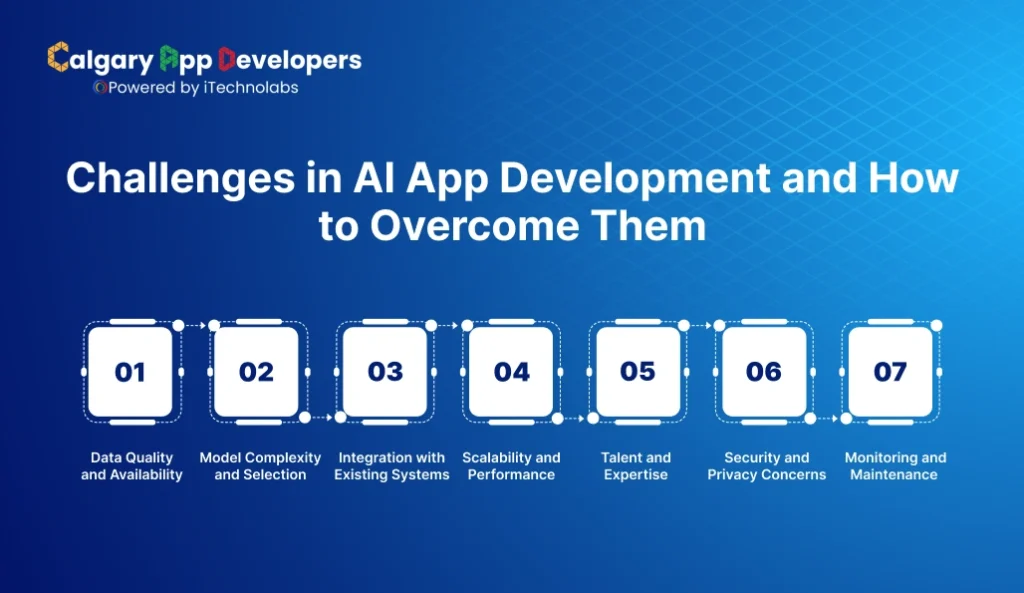
Building an AI app offers significant advantages, but it also comes with unique challenges that can affect timelines, costs, and overall success. Identifying these obstacles early and adopting strategies to overcome them is essential for delivering a reliable, high-performing application.
- Data Quality and Availability
High-quality, relevant data is the foundation of any AI app. Poor or insufficient data can lead to inaccurate predictions and reduced app performance.
How to Overcome
- Invest in data collection, cleaning, and preprocessing pipelines.
- Use data augmentation techniques or synthetic datasets when real data is limited.
- Leverage open-source datasets or third-party data providers where applicable.
- Model Complexity and Selection
It may be difficult to choose the correct algorithm or model, particularly for sophisticated AI features such as computer vision or NLP. If the wrong model is chosen, then there could be underperformance or prohibitive computing costs.
How to Overcome
- Start with simpler models and progressively increase complexity as needed.
- Conduct experiments to compare different algorithms using validation datasets.
- Consider pre-trained models or transfer learning to save time and improve accuracy.
- Integration with Existing Systems
Many AI apps must connect with legacy software or enterprise systems. Poor integration can lead to inefficiencies or data silos.
How to Overcome
- Plan system architecture carefully and use APIs or middleware for smooth integration.
- Test data flows between systems to ensure consistency.
- Maintain modular code to allow flexibility and updates without breaking connections.
- Scalability and Performance
AI apps may require significant computing power, especially as user numbers grow or data volume increases. Slow response times or crashes can frustrate users.
How to Overcome
- Use cloud infrastructure that allows horizontal and vertical scaling.
- Optimize model size and inference speed.
- Implement caching, batch processing, and asynchronous operations where possible.
- Talent and Expertise
Building an AI app requires skilled developers, data scientists, and ML engineers. Hiring and retaining the right talent can be expensive and competitive.
How to Overcome
- Build a balanced team with complementary skills.
- Consider outsourcing or collaborating with AI development firms in cost-effective locations like Calgary, which offers high-quality talent at competitive rates.
- Invest in continuous training to keep your team updated on AI trends.
- Security and Privacy Concerns
AI apps handle sensitive data, and breaches can have legal and reputational consequences. Compliance with data protection regulations is critical.
How to Overcome
- Encrypt data at rest and in transit.
- Implement role-based access controls and anonymization techniques.
- Stay updated on regulations such as GDPR, HIPAA, or local data privacy laws.
- Monitoring and Maintenance
AI models degrade over time due to changing data patterns, leading to “model drift” and reduced accuracy.
How to Overcome
- Set up continuous monitoring for model performance and data quality.
- Schedule regular retraining and updates based on new data.
- Implement robust logging and alert systems to catch anomalies early.
Read Also: How Much Does It Cost to Hire an AI Developer?
Data Collection, Privacy, and Model Training Concerns
When businesses decide to build an AI app, handling data responsibly is critical. Data collection, privacy, and model training pose unique challenges that directly impact the performance, reliability, and compliance of the application. Addressing these concerns early ensures that the app is both effective and trustworthy.
- Data Collection Challenges
High-quality data is essential for training AI models, but collecting it can be complicated. Incomplete, inconsistent, or biased data reduces model accuracy.
Key Considerations
- Identify the right sources of data relevant to the app’s purpose.
- Use standardized formats and protocols to maintain consistency.
- Consider leveraging public datasets, IoT devices, or synthetic data when real data is limited.
- Privacy and Regulatory Compliance
AI apps often handle sensitive information such as personal, financial, or health data. Mishandling this data can result in legal penalties and damage trust.
Best Practices
- Comply with regulations like GDPR, HIPAA, and local privacy laws.
- Implement data anonymization or pseudonymization to protect user identities.
- Establish clear data usage policies and gain explicit consent from users.
- Bias and Fairness in Model Training
AI models learn from historical data, which may contain biases. Unchecked, these biases can result in unfair or inaccurate outputs.
How to Address
- Audit datasets to detect and correct imbalances or skewed representations.
- Use fairness-aware algorithms that mitigate bias during training.
- Continuously monitor outputs for unexpected disparities in results.
- Model Training Challenges
Training AI models requires computational resources, quality data, and expert oversight. Insufficient resources or poor model design can lead to underperforming apps.
Solutions
- Choose the right algorithms based on data size, complexity, and application needs.
- Optimize models for efficiency to reduce training time and computational costs.
- Consider pre-trained models or transfer learning to accelerate development without compromising performance.
- Security During Training and Deployment
Data breaches or tampering during model training can compromise the AI app. Securing data and models is crucial for trustworthy operations.
Recommendations
- Encrypt datasets and model checkpoints during storage and transfer.
- Implement access control measures to limit who can modify data or models.
- Monitor for anomalies in training data and outputs to detect potential tampering.
When businesses build an AI app with attention to data quality, privacy, and secure model training, they create a reliable and compliant product. Addressing these concerns upfront reduces risks, improves accuracy, and builds user trust, which is essential for long-term success.
Also Check: Top Sites to Hire AI Developers
Measuring the ROI of an AI App
When businesses decide to build an AI app, understanding its return on investment (ROI) is essential for evaluating whether the project delivers measurable value. ROI helps quantify financial benefits, operational efficiency, and strategic advantages relative to the time, resources, and costs spent developing, deploying, and maintaining the application.
- Define Clear Objectives
The first step in measuring ROI is identifying what the AI app is intended to achieve. This could include increasing revenue, reducing operational costs, improving customer satisfaction, or enhancing productivity. Setting clear objectives ensures that the evaluation focuses on tangible outcomes rather than abstract benefits.
Example: An AI-powered chatbot may aim to reduce support ticket response time by 50 percent while improving customer satisfaction scores.
- Quantify Cost Savings
AI apps can automate repetitive or time-consuming tasks, reducing labor costs and minimizing errors. These savings can be calculated by comparing operational costs before and after the AI app implementation.
Example: A predictive maintenance AI app in manufacturing could prevent machine downtime, saving thousands of dollars in lost production each month.
- Measure Revenue Impact
Some AI applications directly drive revenue through personalization, predictive recommendations, or optimized pricing. Tracking new sales or increased conversion rates attributable to the AI app provides a clear revenue-based metric for ROI.
Example: An AI recommendation engine in an e-commerce app could increase average order value by suggesting complementary products.
- Evaluate Productivity Gains
AI apps often free employees from manual work, allowing them to focus on higher-value tasks. Measuring productivity improvements can include faster task completion, reduced workload, or higher output per employee.
Example: Automating data entry with AI reduces hours spent on routine work, enabling teams to dedicate more time to analysis and strategy.
- Calculate Total Investment
To get an accurate ROI, consider all costs related to the AI app, including:
- Development and design costs
- Data acquisition and cleaning
- Cloud infrastructure or on-premise hardware
- Salaries for data scientists, engineers, and project managers
- Ongoing maintenance and feature updates
This total investment provides the baseline for calculating returns.
- ROI Formula
A simple formula to calculate ROI is:
ROI (%) = (Financial Gains – Total Investment) ÷ Total Investment × 100
Example: If an AI app generates $120,000 in savings and revenue over a year, and the total investment was $80,000, the ROI would be 50 percent.
- Continuous Monitoring and Adjustment
AI apps are dynamic; performance can change as data patterns evolve or user behavior shifts. Regular monitoring ensures the app continues to deliver value. Update models, improve features, and optimize workflows to maximize ROI over time.
Example: Monitoring a recommendation engine allows businesses to refine suggestions based on changing trends and customer preferences, increasing conversion rates and revenue over time.
Future Trends in AI Application Development
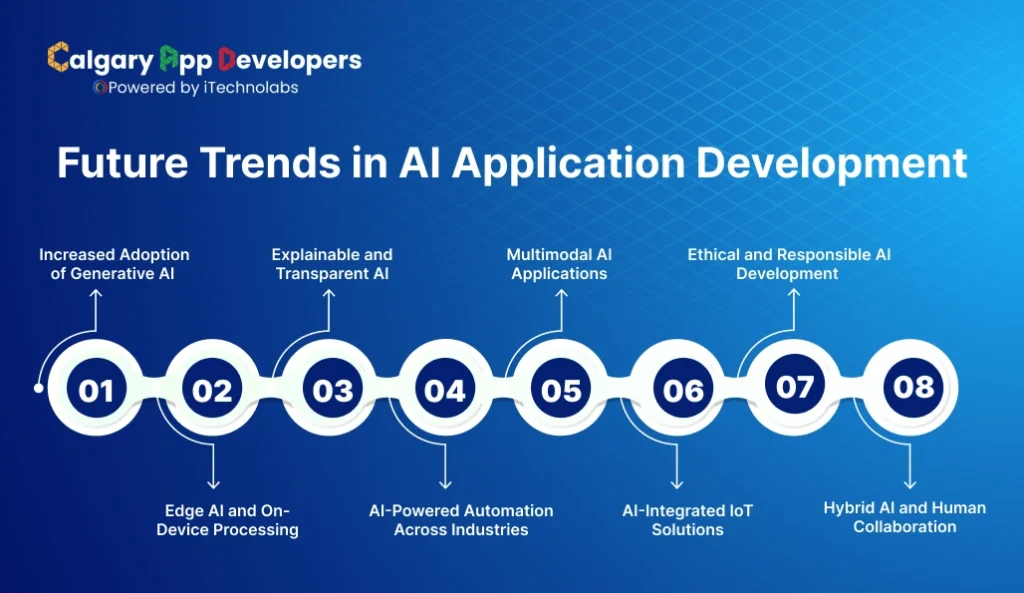
When businesses decide to build an AI app, staying ahead of emerging trends is essential for creating competitive and forward-looking solutions. AI technology is evolving rapidly, and understanding these developments helps ensure that applications remain innovative, scalable, and impactful.
- Increased Adoption of Generative AI
Generative AI models, capable of creating content such as text, images, audio, and code, are becoming mainstream. Businesses building AI apps can leverage these models to automate creative processes, generate marketing content, or assist in software development.
Tools like ChatGPT, DALL-E, and Codex demonstrate how AI can generate human-like outputs for diverse business needs.
- Edge AI and On-Device Processing
Edge AI allows AI models to run directly on devices rather than relying solely on cloud servers. This reduces latency, improves privacy, and enables real-time decision-making. Businesses building AI apps can deliver faster, more responsive applications without heavy cloud dependence.
AI-powered smart cameras and wearable devices use edge computing for instant object recognition and health monitoring.
- Explainable and Transparent AI
As AI adoption grows, businesses and regulators increasingly demand transparency in decision-making. Explainable AI (XAI) ensures that predictions and recommendations can be understood and trusted by users. Incorporating XAI enhances credibility and reduces risks when building AI apps for sensitive industries like healthcare or finance.
AI models in credit scoring provide interpretable results so that both banks and customers understand approval decisions.
- AI-Powered Automation Across Industries
Automation will continue expanding beyond repetitive tasks to complex workflows. Businesses building AI apps can integrate AI into operations like supply chain optimization, predictive maintenance, and intelligent customer service, driving efficiency at scale.
AI-driven logistics platforms predict demand and optimize delivery routes in real time, reducing costs and improving service.
- Multimodal AI Applications
Multimodal AI combines multiple types of data, such as text, images, and audio, to make more accurate predictions or provide richer user experiences. Apps that integrate multimodal AI can offer advanced capabilities like interactive virtual assistants or AI-based diagnostics.
Healthcare AI apps analyze medical images alongside patient records to support faster and more accurate diagnoses.
- AI-Integrated IoT Solutions
The convergence of AI and the Internet of Things (IoT) enables smarter devices that collect, analyze, and act on data autonomously. Businesses building AI apps can leverage this synergy to create intelligent environments, from smart factories to connected homes.
AI-enabled sensors in manufacturing detect anomalies in real time, preventing costly machine breakdowns.
- Ethical and Responsible AI Development
Ethical AI and governance frameworks are becoming central to AI adoption. Developers must focus on fairness, bias mitigation, privacy protection, and environmental sustainability when building AI apps. Compliance and responsible AI practices will influence user trust and regulatory approval.
AI apps for recruitment are now designed to reduce bias and ensure equal opportunity by auditing algorithms for fairness.
- Hybrid AI and Human Collaboration
AI will increasingly augment human decision-making rather than replace it. Businesses building AI apps can combine human expertise with AI insights to create applications that enhance creativity, strategy, and operational efficiency.
AI-assisted design tools suggest options, while human designers make final decisions, improving creativity and productivity.
What Sets Our AI App Development Approach Apart
Businesses choose Calgary App Developer for AI app development because we focus on building intelligence that delivers real outcomes, not experiments that look impressive but fail in production. Our approach is rooted in practical engineering, data driven design, and clear business alignment so AI solutions are useful, scalable, and reliable from day one.
- Outcome Driven AI Strategy: We design AI applications around specific business problems, not generic use cases. Every model, workflow, and automation is tied to measurable goals such as efficiency gains, cost reduction, user engagement, or revenue growth. This ensures AI adds value where it matters.
- Production Ready AI Systems: Our experience comes from deploying AI apps that operate in real environments with real users. We focus on performance, accuracy, and stability so models work consistently under load and improve over time instead of breaking at scale.
- Expertise Across Core AI Capabilities: We work across key AI domains including natural language processing, computer vision, predictive analytics, and intelligent automation. This allows us to build diverse AI apps, from conversational systems to generative and decision support platforms, using the right technology for each problem.
- Transparent Cost and Scope Planning: AI development can become expensive when scope is unclear. We provide realistic cost estimates, clear feature prioritization, and phased delivery plans so businesses understand where investment goes and can control budgets without surprises.
- Scalable and Future Ready Architecture: Every AI app we build is designed to evolve. We use modular architectures that support model updates, data growth, and feature expansion without requiring full rebuilds. This keeps long term maintenance and scaling costs predictable.
- Clear Communication and Ownership: Clients work with a dedicated team that takes ownership of outcomes, not just tasks. Regular updates, milestone reviews, and plain language explanations ensure alignment between technical decisions and business expectations throughout the project.
- Strategic AI Consultation Before Development: We help businesses validate AI ideas before committing resources. This includes feasibility analysis, data readiness assessment, feature planning, and cost modeling. The goal is clarity early so AI projects start with the right foundation.
Our goal is to help businesses build AI applications that are practical, dependable, and ready for long term adoption. At Calgary App Developer we focus on turning artificial intelligence into a real business capability, not a buzzword.
Our Hands On Experience in AI Development
Our AI app development experience is grounded in shipping products that work reliably in real environments, not prototypes that look impressive in demos. We focus on AI systems that are practical, scalable, and aligned with clear business outcomes. From intelligent automation to creative AI, our work reflects a balance between innovation and usability.
1. AI Splasher
AI Splasher is a text to image generation application built to turn natural language prompts into high quality visual outputs quickly and accurately. The core objective was to make AI driven creativity accessible without technical complexity.
What we delivered
- Natural language prompt processing optimized for creative accuracy
- High performance image generation with fast rendering times
- Clean, intuitive user flows designed for non technical users
- Scalable backend architecture to support growing creative demand
The result is an AI application that feels responsive, reliable, and ready for production scale, not an experimental tool.
2. TBIO AI Chatbot
TBIO is an intelligent AI chatbot designed for meaningful, context aware conversations. Instead of rule based replies, the focus was on adaptive dialogue that improves with usage.
What we delivered
- Natural language understanding for accurate intent detection
- Context retention to maintain continuity across conversations
- Response optimization for clarity, relevance, and speed
- Architecture designed to learn and improve from interactions
TBIO demonstrates how conversational AI can move beyond basic automation and become a dependable interface for user engagement and support.
Across both applications, our approach remains consistent. We design AI systems around real user needs, ensure performance under load, and build architectures that can evolve as data and usage grow. This hands-on experience allows us to help businesses develop AI apps that are stable, useful, and ready for long term adoption rather than short lived experiments.
Conclusion
Building an AI app is no longer a futuristic concept; it is a strategic move that can transform businesses, enhance efficiency, and deliver meaningful value to users. From understanding core components, and selecting the right features to manage costs, privacy, and ROI, every step matters in creating a successful AI application.
What this really means is that businesses that plan carefully and stay aligned with emerging trends can create AI apps that are scalable, reliable, and competitive. Whether it’s predictive analytics, automation, or AI-driven personalization, the potential for impact is enormous.
If you are looking to build an AI app that meets your business goals and exceeds user expectations, Calgary App Developers offers expert guidance and end-to-end AI development services. Our team combines technical expertise with a deep understanding of market needs, helping you create intelligent, future-ready applications efficiently and cost-effectively.
Partnering with Calgary App Developers ensures that your AI app is not only technically sound but also strategically positioned to deliver maximum business value.
FAQ’s About How to Develop An AI App:
- What are the benefits of AI application development?
AI application development helps businesses automate tasks, enhance decision-making, and deliver personalized experiences. It improves efficiency, reduces errors, and uncovers actionable insights from data. Companies can optimize operations, boost customer engagement, and create competitive advantages. Building an AI app also allows organizations to scale intelligently and respond quickly to evolving market demands. - How to manage privacy, security, and compliance challenges in AI development?
Managing privacy and security in AI involves implementing strong encryption, access controls, and anonymization techniques for sensitive data. Compliance with regulations such as GDPR, HIPAA, or local laws is essential. Regular audits, secure data storage, and monitoring AI outputs help ensure ethical use and reduce risks while building an AI app that users can trust. - What is the cost and timeline to build an AI application?
The cost to build an AI app typically ranges from $30,000 to $250,000, depending on complexity, features, and data requirements. Timelines vary from a few weeks for simple apps to several months for complex solutions with predictive analytics, NLP, or computer vision. Proper planning, prototyping, and iterative development can optimize both cost and delivery time. - How is AI app development reshaping the tech industry?
AI app development is transforming the tech industry by enabling smarter automation, predictive analytics, and personalized user experiences. It accelerates innovation across sectors, from healthcare and finance to retail and logistics. Businesses are now leveraging AI apps to reduce operational costs, improve decision-making, and introduce entirely new services, setting new industry standards. - How to integrate AI into an app?
Integrating AI into an app requires a clear understanding of business goals, relevant datasets, and the AI models to be used. Developers can use APIs, SDKs, or cloud AI services to incorporate features like recommendation engines, chatbots, or predictive analytics. Testing, monitoring, and iterative updates ensure seamless performance and accuracy within the app. - How to build an app with AI?
Building an AI app starts with defining the problem, identifying key features, and collecting quality data. Next, select the right AI models and technology stack, develop a prototype, and conduct rigorous testing. Deployment, monitoring, and continuous updates ensure scalability and reliability. Careful planning and expert guidance are key to creating a successful AI application.


Pankaj Arora is a seasoned technology leader and the Founder of Calgary App Developer, with 10+ years of expertise in crafting high-performance digital solutions. His core competencies include full-stack app development, cloud-native architecture, API integration, and agile product delivery. Under his leadership, Calgary App Developers has empowered startups and enterprises alike with scalable mobile applications, secure web platforms, and AI-driven SaaS products.