





How To Build Restaurant App For Food Ordering Business
As a restaurant owner, you’re not just managing kitchens and tables anymore; you’re now competing in a digital dining era where mobile ordering, delivery and in-app loyalty are just as important as ambience and menu presentation. What it actually means is that building a personalized restaurant app isn’t a luxury; it is a strategic way to build more loyalty to your patrons and increase their visit frequency and order values well beyond the eat-in business on the premises.
Here’s the industry perspective: in 2024, the global online food delivery industry was valued at about US $380.43 billion and is expected to have a projected valuation of approximately US $618.36 billion by 2030, and the compound annual growth rate (CAGR) is about 9 percent from 2025 on.
With such growth underway, your restaurant app can become a powerful channel to reach, personalise and retain customers rather than rely solely on third-party platforms.
In this blog, we’ll move through the developmental process of the app from strategy, design and technology launch development so that you can have an amazing opportunity to present a truly personalized guest experience that both showcases your brand and serves your guests well.
- A restaurant application customized to the users’ needs assists in gaining engagement, loyalty, and sales by providing the clients with the kind of dining experience they wish to have.
- Planning, UI/UX design, and personalization features are the three main components in building a good one.
- The price for development depends on the complexity and ranges from USD 25,000 to USD 150,000.
- The real-life applications of Starbucks, Domino’s, and Chipotle show that personalization is the major factor leading to customer loyalty in the long run.
- Personalization remains the prime factor for the success of modern-day restaurants. The apps that will recommend dishes, rewards, and experiences according to the preferences of the customers will not only create stronger emotional bonds with them but will also encourage them to place orders more frequently.
- The main characteristics of an app will greatly influence the satisfaction of users. Easy onboarding, real-time tracking, secure payments, loyalty programs, and easy navigation are the steps on which every successful restaurant app is constructed.
- Design and usability are the two main factors that cause users to engage. A clean, easy-to-use interface builds up trust and lets customers confidently explore the menus, customize their dishes, and perform their booking.
- Every stage of the development process is predefined. From the moment the objectives are identified and the technology is chosen, the whole process through testing and to the launch stage will make sure the app is functional as well as scalable.
- Prices are dependent on the scale and the features that will be included. The lower prices are for the smaller applications with limited functionalities, and the higher ones are for those with AI-based personalization, analytics, and loyalty systems incorporated.
- Testing and maintenance are performed non-stop. The app will have to get regular updates, bug fixes, and performance monitoring to stay secure, fast, and relevant.
- Proven global examples demonstrate the worthiness. Brands like Domino’s, Starbucks, McDonald’s, Chipotle, and KFC are good examples of how personalized restaurant apps can change the customers’ experience and the brand loyalty.
- The ultimate aim is digital interaction. A well-designed restaurant app not only connects the customers with the brand through convenience but also allows them to experience the brand’s personality.
Understanding the Core of a Restaurant App
Before getting into personalization, let’s briefly look at what makes for a good restaurant app. A good app is more than an online representation of your restaurant’s menu; it is a way to improve your customers’ interaction with your restaurant, the experience of the act of dining, and the added value to your business with every interaction.
A restaurant app is a combination of convenience and connection. It allows your customers to discover, order from, or engage with your brand when they want to do that. And you will have data to help you improve every connection to improve the experience and the convenience.
Here’s what forms the foundation of a great restaurant app:
- Smooth User Experience: Users are motivated through their interaction with the site all the way from the beginning till the end thanks to the fast loading, the clear navigation and the simple checkout processes.
- Smart Menu Design: Ordering is made very easy and also attractive by the interactive menus with high-quality images, filters, and suggestions.
- Secure Payments: The wide range of payment methods, including digital wallets and UPI will help you trust the site and thus, more orders will be placed.
- Real-Time Order Tracking: Silence is not an option when it comes to customers. They want to be in the loop and live order status updates are a great way to keep them informed while at the same time minimizing the number of support inquiries.
- Personalized Offers: Customized promotions and loyalty programs make the users feel that their presence is valuable and they are receiving a reward.
- Push Notifications: Alerts about discounts, the creation of new dishes, or events at a suitable time have the effect of keeping the user engaged without the risk of the user’s being inundated.
- Feedback and Ratings: The availability of direct feedback channels makes it easier for the company to understand customer satisfaction and the quality of service.
- Data Analytics: Through the study of consumer behavior, you will be able to modify your menu, marketing, and offers in such a way that they are very much aligned with the needs of the customers.
If a restaurant app is developed with the above core principles, it will not just take care of the orders but will also actively engage your brand with users in a world where digital is the primary mode of dining.
Also Check: 10 Best Food Ordering App for Restaurants
Popular Personalized Restaurant Apps:
| Restaurant Apps | Launch Date (first major version) | Approximate Annual Revenue* |
| Domino’s Pizza | 2011 (mobile-ordering app widely cited) | US $19.1 billion (global retail sales 2024) |
| Starbucks | 2009 (Starbucks Card Mobile / MyStarbucks app) | US $36.18 billion (2024 revenue) |
| Chipotle | November 6, 2017 | US $11.3 billion (2024 revenue) |
| McDonald’s | 2015 US rollout | System-wide sales > US $130 billion (2024) |
| KFC | April 2013 | US $74.8 billion approx. for parent company |
1. Domino’s Pizza:
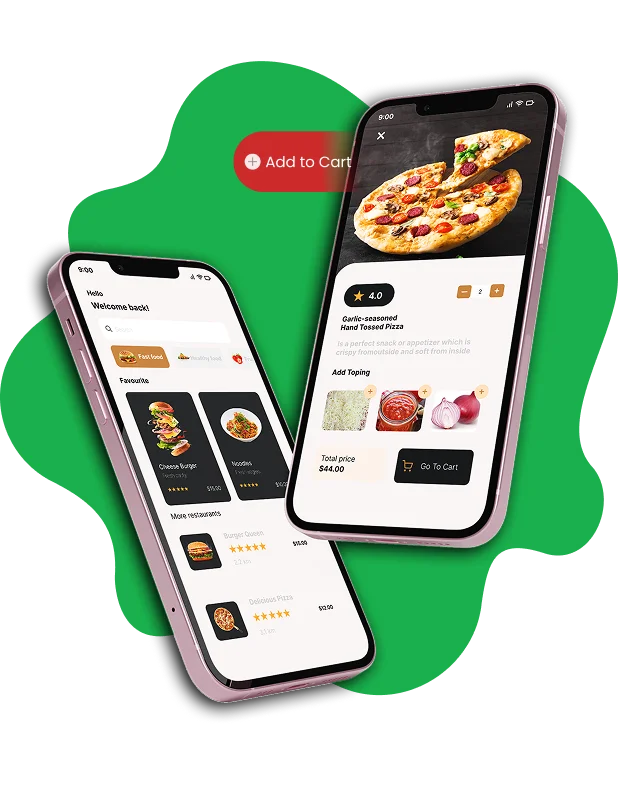
By enabling the order process to take just a few taps at most, Domino’s revolutionized the app for restaurants. Users can personalize their pizzas, choose their favorite combinations, and see where their orders are up to by the minute with the help of the app. Furthermore, the voice ordering, GPS delivery, and strong rewards program all add up to the fact that the Domino’s app has become the epitome of convenience and speed in food delivery.
2. Starbucks:
The Starbucks app marries perfectly the functionalities of personalization and loyalty. Users can make their drinks to their liking, pre-order, and collect Stars on an everyday basis. The app keeps track of user preferences, makes recommendations for the new items, and has mobile payments embedded in it for smooth transactions. Moreover, its gamified loyalty and exclusive offers programs are very effective in keeping customers engaged and at the same time making them feel close to the.
3. Chipotle:
The food service app by Chipotle prioritizes personalization and interaction. Customers are empowered to craft their burritos, bowls, and tacos according to their specifications and set their most loved combinations for easy repeat orders. The app consists of a loyalty program, contact-free collection, and shipment tracking. Thus, by mixing personalization with simplicity, Chipotle has made fast-casual dining a data-driven, customer-centric experience.
4. McDonald’s:
The McDonald’s app is a direct way of providing personal treatment to customers of this global brand. Customers are granted personalized promotions that depend on their buying behavior and position, along with the possibility to get their orders ready in advance or to use the drive-thru pickup service. The app allows for different types of payment, combines with a loyalty program, and increases interaction through its gamified offers and seasonal promotions that are individually customized for each user.
5. KFC:
KFC’s mobile application stays on the personalization and convenience trail mainly. Clients have the opportunity to see the local menus, modify their orders, and collect points with each purchase. The use of personalized coupons, special offers, and digital loyalty schemes increases the chances of customers returning. With the smooth user interface and order status notifications, the KFC app offers a brand experience that is customized and beneficial at the same time.
Also Read: How To Build Restaurant App For Food Ordering Business
Must-Have Features in a Restaurant App
An excellent restaurant app is not only that it operates perfectly; it is also that it is very fluent, very personal, and very rewarding. The right features alone can convert the ones who temporarily visit into loyal customers and can also assist your business in becoming the one that gets noticed in the crowded market. Let’s go through the must-have ones:
- Simple Onboarding and Easy Navigation: The user’s first experience is of great importance. The users should be able to register themselves, look at the menus, and make their first order without any mix-up. Simple designs and fast access to the main actions, such as ordering or reserving a table, keep a user engaged.
- Interactive Digital Menu: The menu with lots of pictures and deep information about the ingredients, along with the alterations, will be the best bait for customers to place their orders. The users will be even more delighted with the features that the filters applied for dietary preferences or spice levels have set for control and satisfaction.
- Personalized Recommendations: Let the customers see what their favorite is. Employ the past purchases and browsing to propose dishes, combos, or promos that would be up the customers’ street. Personalization brings about a bond and increases the average order value.
- Fast and Secure Payment Options: Put at the customers’ disposal a variety of payment methods such as UPI, credit cards, wallets, or cash on delivery. Security should be prioritized to a maximum height in order to gain the customers’ confidence and keep the transactions repeating.
- Order Tracking and Real-Time Updates: Customers expect visibility once an order is made. Tracking their orders in real-time through the various stages of cooking, packing, and delivering gets rid of the uncertainty and the need to call customer service.
- Loyalty and Rewards Programs: Old customers are to be acknowledged at all times. Customers who can earn points, upgrade their memberships, or receive exclusive offers are less likely to switch to other brands and more likely to come back for more.
- Notifications and Promotions: Customers are kept engaged through timely, personalized notifications regarding offers, new dishes, or events. The widget is not irritating to the customer’s phone but gives value instead.
- Reservations and Pre-Orders: For dine-in restaurants, the combination of reservations and pre-order options is not only the way to go but also the best for the customers regarding convenience and operational efficiency.
- Feedback and Reviews from Customers: Let the users of the app drop their comments and opinions straight in the app. It is a trust-building exercise and at the same time, you get valuable information about what works and what does not so you can improve.
- Analytics Dashboard for Owners: In the background, analytics enable restaurant owners to observe how their business is performing, keep a lookout on the order trends, and gain insights into customer behavior for better decision-making in relation to the business.
The most successful restaurant apps integrate these features together with great design and reliable technology. Consider your app as a digital counterpart of your restaurant that is always open, knows your customers, remembers their favorites, and makes them come back again.
Read Also: Restaurant Management Software Development Guide
Step-By-Step Process Of Restaurant App Development
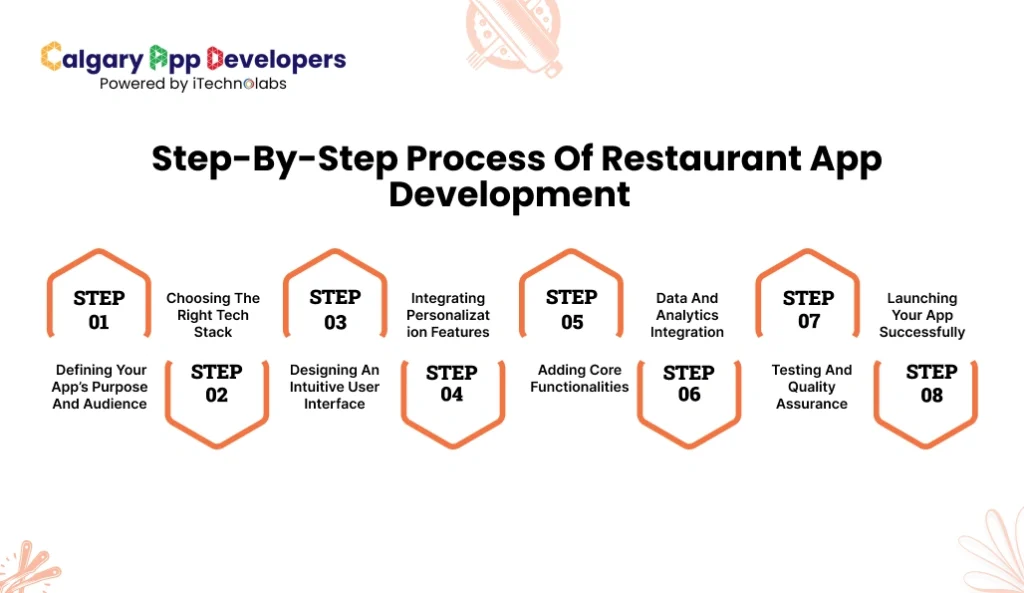 Creating a restaurant application is more than simply programming. It is a systematic method that changes your idea into a marketable platform. Here’s an organized, stage-by-stage breakdown for you to successfully plan, design, develop and launch your restaurant app.
1. Defining Your App’s Purpose And Audience:
First, determine your goal and target audience very clearly before the app development process for the restaurant has even started. The purpose and audience definitions will guide the design, features, and marketing strategy to align with actual customer needs. Ponder on these points:
- Identify your target users, such as dine-in guests, delivery customers, or loyal members.
- Define the main goal like boosting sales, improving engagement, or streamlining operations.
- Research user behavior, dining preferences, and spending habits.
- Study competitors to find market gaps your restaurant app can fill.
2. Choosing The Right Tech Stack:
The selection of the appropriate tech stack for your restaurant app is vital, not only for performance but also for scalability and maintenance from the future perspective. The tech you choose is what decides your app’s speed, security, and, most importantly, how well it is able to grow along with your business. Concentrate on trustworthy frameworks, compatibility across platforms, and instruments that allow for real-time updates for orders and tracking.
| Component | Recommended Technologies | Purpose |
| Frontend | React Native, Flutter | Build responsive, cross-platform user interfaces |
| Backend | Node.js, Django, Laravel | Manage data, APIs, and server logic |
| Database | PostgreSQL, MongoDB, Firebase | Store menus, orders, and user data |
| Payment Gateway | Stripe, Razorpay, PayPal | Secure and fast transaction processing |
| Cloud Hosting | AWS, Google Cloud, Azure | Reliable and scalable infrastructure |
| Push Notifications | Firebase Cloud Messaging, OneSignal | Send real-time updates and offers |
| Analytics | Google Analytics, Mixpanel | Track user behavior and app performance |
3. Designing An Intuitive User Interface:
The user interface (UI) design would either make or break your restaurant app if it is poorly done. It must be straightforward, attractive, and very intuitive. Creating a scenario where the users can perceive the items, make the order, and pay all without any misunderstanding or additional steps. That is your objective. Keep the accessibility and the beauty of the app in proportion for a seamless journey for the customer.
- Use clean layouts with clear icons and readable typography.
- Highlight key actions like “Order Now” or “Reserve a Table.”
- Keep color schemes consistent with your restaurant branding.
- Ensure quick navigation between the menu, cart, and checkout.
- Test interface flow to reduce friction and drop-offs.
4. Integrating Personalization Features:
Personalization is a factor that can make a restaurant application go from being just functional to becoming unforgettable. When the user gets each and every interaction personalized, that user feels the app is offering something relevant and thoughtful. Every aspect of personalization, starting from food recommendations to loyalty rewards, keeps the customers involved and on top of that, it motivates them to come back more often.
- Use data to recommend dishes based on past orders.
- Offer custom deals aligned with user preferences.
- Greet users by name and remember their favorites.
- Adjust notifications based on behavior and timing.
- Create dynamic home screens showing relevant offers or events.
5. Adding Core Functionalities:
Core functionalities are what make a restaurant app basically the skeleton. These are the features that take the app to a level where it can be considered practical, user-friendly, and up to the point of everyday use. What we aim for is to make the whole process of ordering, paying, and communicating less complicated but at the same time very reliable and fast. Each and every function implemented should be there to address a customer’s real need and, moreover, facilitate smooth operations for your team.
| Functionality | Description | Purpose |
| Menu Management | Add, update, and categorize dishes | Keeps content fresh and organized |
| Ordering System | Allows users to place and modify orders | Simplifies the buying process |
| Payment Integration | Supports secure online payments | Builds trust and ensures convenience |
| Delivery Tracking | Shows real-time order status | Enhances transparency and engagement |
| Loyalty Programs | Rewards repeat customers | Encourages retention and brand loyalty |
| Notifications | Sends timely updates and promotions | Maintains consistent user engagement |
6. Data And Analytics Integration:
Integrating data and analytics into your restaurant app helps you understand customer behavior, track performance, and make smarter business decisions. With real-time insights, you can refine menus, improve marketing strategies, and personalize offers that truly resonate with users. Data turns every interaction into an opportunity to grow and optimize your restaurant’s digital presence.
7. Testing And Quality Assurance:
Testing and quality assurance ensure your restaurant app performs flawlessly before reaching users. Every feature, from ordering to payments, must be tested for functionality, speed, and security. A well-tested app reduces glitches, builds trust, and provides a consistent experience across devices.
- Conduct functional testing to verify all features work as intended.
- Perform usability testing to assess ease of navigation.
- Test load performance during high traffic periods.
- Ensure payment and data security compliance.
- Fix bugs promptly and retest before launch.
8. Launching Your App Successfully:
A successful launch sets the stage for your restaurant app’s growth. Before going live, ensure your app is optimized, tested, and ready for users. Build excitement through social media teasers, email campaigns, and loyalty offers. Monitor early feedback closely to fix issues quickly and keep the first wave of customers satisfied and engaged.
Building a restaurant app is a journey that blends strategy, creativity, and precision. Each step brings you closer to an app that not only functions well but also delivers a personalized, rewarding experience your customers will return to again and again.
Also Read: How to Create Restaurant Inventory Tracking Software
How Much Does It Cost to Build a Restaurant App
The cost of developing a restaurant app typically ranges from USD 25,000 to USD 150,000, depending on the app’s complexity, features, and target platforms. Factors like design quality, integrations, and ongoing maintenance can significantly influence the overall budget. A basic app with standard features will cost less, while an advanced app with real-time tracking, personalization, and loyalty programs will require a higher investment.
Here’s a breakdown of the estimated cost across each development stage:
| Development Stage | Description | Estimated Cost (USD) |
| Research & Planning | Market research, competitor analysis, and defining app goals | 2,000 – 5,000 |
| UI/UX Design | Wireframes, user interface design, and user flow testing | 3,000 – 10,000 |
| Frontend Development | Building the user-facing app for iOS and Android | 8,000 – 40,000 |
| Backend Development | Server setup, database, and API integration | 10,000 – 35,000 |
| Core Features Integration | Ordering, payments, tracking, loyalty, and notifications | 5,000 – 25,000 |
| Testing & QA | Performance, functionality, and usability testing | 2,000 – 8,000 |
| Deployment | App Store and Play Store submission, optimization | 1,000 – 3,000 |
| Maintenance & Updates (annual) | Regular updates, bug fixes, and feature enhancements | 3,000 – 15,000 per year |
Total Estimated Cost: USD 25,000 to USD 150,000+
The final cost depends on factors like app scale, design depth, integrations (such as payment gateways or delivery APIs), and whether you choose native or cross-platform development. A well-planned approach helps you control costs while building a restaurant app that feels professional, fast, and customer-focused.
Factors Affecting the Cost of Developing a Restaurant App
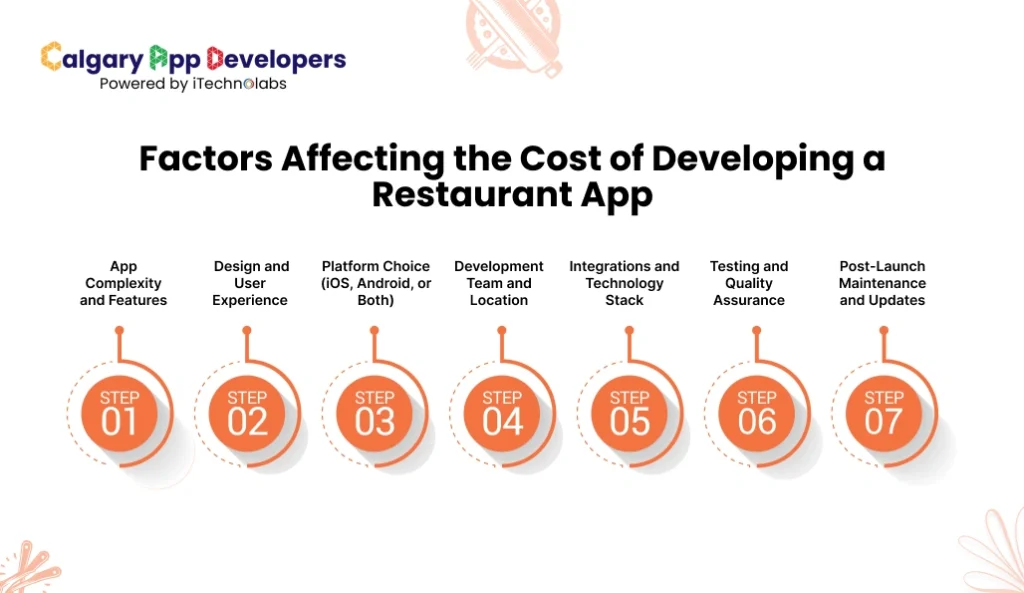
- App Complexity and Features
The more advanced your restaurant app, the higher the cost. A simple app with basic ordering and payments is affordable, but adding advanced features like personalization, AI-based recommendations, or real-time delivery tracking increases both development time and technical effort.
Key cost drivers include:
- Number of features (menu, loyalty, delivery tracking, etc.)
- Custom feature development versus pre-built integrations
- Complexity of third-party API integrations
| Type | Feature Scope | Approx. Cost (USD) |
| Basic | Menu, cart, and payments | 25,000 – 40,000 |
| Moderate | Loyalty, notifications, and analytics | 40,000 – 80,000 |
| Advanced | AI personalization, tracking, CRM | 80,000 – 150,000+ |
- Design and User Experience
Design defines how users feel when using your restaurant app. A clean, intuitive layout with smooth navigation requires more design time and higher costs. Professional UI/UX design also includes prototyping, user testing, and multiple revisions to ensure usability across devices.
What impacts cost:
- Number of screens and user flows
- Level of visual customization and animations
- Need for interactive prototypes and usability testing
A minimal design may work for startups, while high-end restaurants often invest in premium, brand-aligned designs that elevate the digital experience.
- Platform Choice (iOS, Android, or Both)
Developing for one platform costs less but limits reach. Building for both iOS and Android doubles development time unless you use cross-platform frameworks like Flutter or React Native. Native apps deliver smoother performance, while hybrid apps save time and money.
| Approach | Pros | Cons | Cost Impact |
| Native | Best performance and reliability | Higher development cost | High |
| Cross-Platform | Faster and cheaper to build | Slightly less optimized | Moderate |
| Web App | Runs on browsers, cheaper | Limited offline features | Low |
- Development Team and Location
| Region | Average Hourly Rate (USD) | Typical Project Cost (USD) | Overall Value for Money |
| North America | 100 – 180 | 80,000 – 150,000+ | High quality, high cost |
| Western Europe | 80 – 150 | 70,000 – 130,000 | Strong expertise, premium pricing |
| Eastern Europe | 40 – 80 | 45,000 – 85,000 | Reliable, affordable mid-tier |
| India & Southeast Asia | 25 – 60 | 25,000 – 60,000 | Most affordable, fast delivery |
| Calgary, Canada | 30 – 55 | 28,000 – 65,000 | Cost-effective with North American standards |
If you’re looking for balanced pricing, skilled developers, and dependable communication, Calgary is one of the most budget-friendly choices for restaurant app development. It offers North American quality at a cost closer to offshore markets, making it an attractive option for startups and established restaurants alike.
- Integrations and Technology Stack
Integrating multiple systems adds cost but also boosts functionality. Payment gateways, loyalty systems, delivery APIs, and analytics tools require setup, testing, and security compliance. The backend infrastructure (servers, databases, and cloud services) also contributes to overall cost.
Examples of integrations:
- Payment: Stripe, Razorpay, PayPal
- Delivery: Google Maps API, Shiprocket, DoorDash API
- Analytics: Google Analytics, Mixpanel
More integrations mean better functionality, but they also require more time for configuration and testing.
- Testing and Quality Assurance
Quality assurance ensures your app runs smoothly under all conditions. Skipping testing leads to higher costs later due to bugs and crashes. Testing involves usability checks, device compatibility, load testing, and security validation.
Testing methods include:
- Manual and automated testing
- Cross-device compatibility checks
- Security and performance testing
A restaurant app that’s stable and bug-free earns user trust and prevents expensive post-launch fixes.
- Post-Launch Maintenance and Updates
Even after launch, costs continue. Regular updates, server maintenance, bug fixes, and feature enhancements keep your restaurant app relevant and reliable. Neglecting maintenance can result in downtime and poor user experience.
Ongoing expenses include:
- Hosting and server costs
- App Store and Play Store updates
- Security patches and feature upgrades
Expect to spend 15–20% of your initial development cost annually for maintenance and optimization.
Also Read: Top 20 Best Restaurant Management Software
Our Experience Crafting High-Performing Restaurant Apps
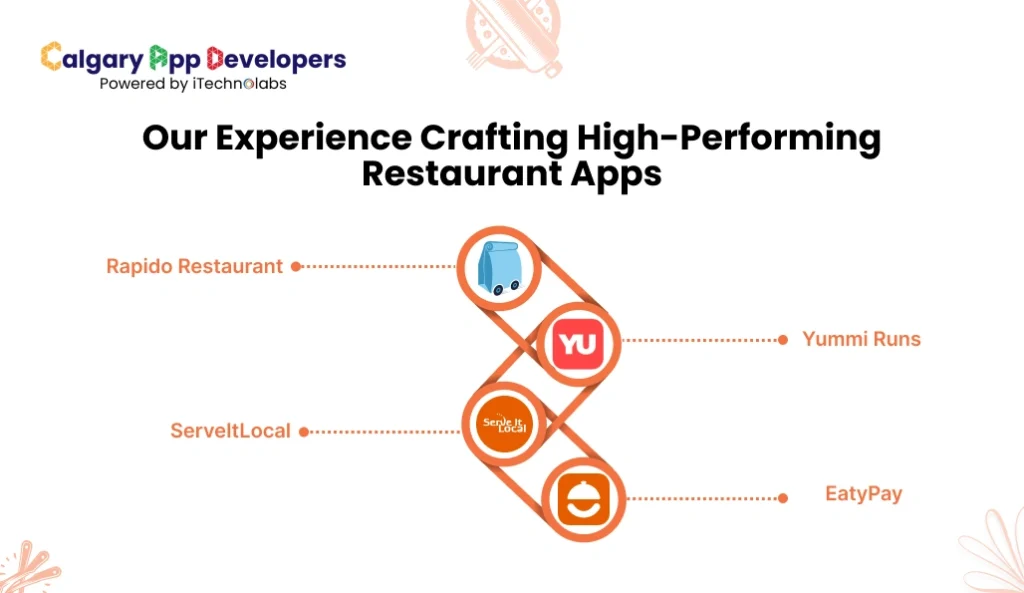
We’ve built restaurant apps that simplify operations, enhance customer experiences, and bring brands closer to their audiences. Each project reflects our focus on functionality, design, and reliability. Here’s a look at some of our standout work and what makes each app unique.
1. Rapido Restaurant:
Rapido Restaurant needed a powerful tool to manage their order flow and empower their staff. We delivered a robust backend management app that transformed their operational workflow.
The Challenge: To create an intuitive, real-time system for staff to manage orders efficiently without confusion or delays.
Our Solution: A clean, purpose-built application that puts control directly in the hands of the restaurant team.
Key Features We Delivered:
- Live Order Dashboard: A centralized view of all incoming orders from various channels.
- Dynamic Order Management: Instantly accept, reject, or update the status of ongoing orders with a single tap.
- Real-Time Status Updates: Keep the entire team synchronized, from the kitchen to the front-of-house, ensuring timely preparation and service.
- Performance Analytics: Track order volume, preparation times, and staff responsiveness.
2. Yummi Runs:
Yummi Runs aimed to become a top-tier food delivery platform by focusing on user convenience and personalization. We built a customer-facing app that makes ordering food a delight.
The Challenge: To develop a competitive delivery app that stands out through a superior user experience and smart features.
Our Solution: A feature-rich, intuitive platform that connects users with their favorite local restaurants seamlessly.
Key Features We Delivered:
- Seamless Ordering & Customization: A user-friendly interface that makes browsing menus and customizing orders effortless.
- Live Real-Time Tracking: Users can follow their order from the kitchen to their doorstep, eliminating uncertainty.
- AI-Powered Personalization: Our intelligent recommendation engine suggests new restaurants and dishes based on individual user preferences and order history.
- Integrated Secure Payments: A hassle-free checkout process with multiple, trusted payment options.
- Smart Order History: One-click reordering for favorite meals, saving time and encouraging repeat business.
3. ServeItLocal:
ServeItLocal had a visionary concept: to connect people with chefs for authentic, cultural dining experiences at home. We brought this unique marketplace to life.
The Challenge: To create a two-sided platform that serves both adventurous food lovers and talented local chefs, facilitating everything from discovery to booking.
Our Solution: A beautifully designed app that emphasizes storytelling, discovery, and community.
Key Features We Delivered:
- Chef & Experience Discovery: A powerful search and filter system to find chefs based on cuisine, location, and service type (meal delivery or in-home chef).
- Rich Chef Profiles: Chefs can showcase their story, culture, and culinary expertise through photos, bios, and menus.
- Flexible Booking System: Users can easily book a meal delivery slot or a personalized in-home chef experience.
- Cultural Journey Focus: The app is designed to highlight the narrative behind each dish and chef, making every order more than just a meal.
- Community & Reviews: A built-in review system helps build trust and a sense of community among users.
4. EatyPay:
EatyPay wanted to modernize the dine-in experience, giving patrons control and flexibility from their smartphones. We developed an innovative QR-code powered solution.
The Challenge: To reduce friction in the traditional dining model, freeing up staff and enhancing customer satisfaction.
Our Solution: A sleek, efficient app that empowers diners and streamlines restaurant operations.
Key Features We Delivered:
- QR Code Integration: Diners simply scan a table-side QR code to instantly access the full digital menu.
- At-Table Ordering & Payment: Customers can place orders directly from their phone and pay at their convenience, splitting the bill easily.
- Waiter Call Button: A discreet feature to request assistance without waving or waiting.
- Pay-Later Flexibility: A unique option that allows guests to savor their meal and settle the bill on their own time, perfect for leisurely dining.
- Digital Menu Management: Restaurants can update menus, prices, and specials in real time, instantly syncing across all tables.
Final Words:
Building a personalized restaurant app is more than a digital project; it’s a way to strengthen customer relationships, simplify operations, and elevate your brand’s presence in a competitive market. From concept and design to launch and long-term growth, success lies in creating an app that blends functionality with a tailored experience your customers will love.
At Calgary App Developers, we specialize in crafting restaurant apps that drive engagement, boost sales, and deliver real business results. Our team has proven experience designing, developing, and optimizing custom restaurant solutions for every scale, from local cafés to global chains.
If you’re ready to turn your idea into a high-performing restaurant app that reflects your brand and delights your customers, Calgary App Developers is the partner you can trust to make it happen.
FAQ’s About Restaurant App Development
1. How can I create an app for my restaurant?
To create a restaurant app, define your target audience and goals first. Choose the right technology stack and design an intuitive, user-friendly interface. Incorporate key features such as personalized menus, secure payments, real-time order tracking, loyalty programs, and push notifications. Thoroughly test the app before launch and plan for ongoing updates to enhance customer experience and engagement.
2. How much does it cost to develop a restaurant app?
Developing a restaurant app typically costs between USD 25,000 and 150,000, depending on complexity, features, and platforms chosen. Basic apps with standard ordering and payment cost less, while advanced apps with AI-based personalization, analytics, and loyalty programs require a higher budget. Maintenance and updates may add 15-20% of development costs annually.
3. How do restaurant apps make money?
Restaurant apps generate revenue through direct food orders, delivery fees, service charges, and loyalty-driven repeat purchases. Some apps also earn through in-app promotions, featured listings, subscription models, or partnerships with payment providers. A personalized app increases average order value by recommending add-ons and upsells, while reducing reliance on third-party platforms and commission fees.
4. How does a mobile app help a restaurant business?
A mobile app strengthens customer relationships, increases repeat orders, and improves operational efficiency. It enables direct ordering, personalized promotions, real-time tracking, and loyalty programs that boost retention. Restaurants also gain access to valuable customer data, which helps refine menus and marketing strategies. Overall, it creates a direct sales channel and improves long-term profitability.
5. How long does it take to develop an app for a restaurant?
Developing a restaurant app typically takes between 3 to 6 months, depending on complexity. A basic app with ordering and payment features may take around 10 to 12 weeks. More advanced apps with personalization, loyalty systems, analytics, and delivery tracking can extend development to 5 or 6 months, including testing and deployment.


Pankaj Arora is a seasoned technology leader and the Founder of Calgary App Developer, with 10+ years of expertise in crafting high-performance digital solutions. His core competencies include full-stack app development, cloud-native architecture, API integration, and agile product delivery. Under his leadership, Calgary App Developers has empowered startups and enterprises alike with scalable mobile applications, secure web platforms, and AI-driven SaaS products.