







20 Best AI Cloud Business Tools for Smarter Management
As of 2026, AI cloud business solutions – once limited to innovative tools used in mostly niche environments – are now critical business tools for companies trying to remain relevant in the current environment. The AI cloud market is expected to exceed $174.1 billion by the end of the year, with an annualized growth rate of 25% up to 2030. The growth of the market reflects an overall systemic change within business: AI is no longer a buzzword; it is an integral part of how businesses operate.
AI cloud business tools are now created to increase efficiencies, assist business or operational decision-making, and enhance innovative impacts; and whether your organization is a startup or an established business, each tool offers significant improvements to overall business efficiency and productivity.
In this blog we will examine the most used AI cloud business tools in use today, highlight the critical functionalities of these tools, and provide assistance on identifying the right business tool for your organization. Let’s look at how these tools can transform your overall business operations.
TL;DR
- AI cloud business tools are a must for today’s businesses, as they offer improvements in productivity, decision-making, and scaling the growth of the organization.
- These tools carry out manual processing, give predictive insights, and work with already-existing business systems.
- The way to pick the right platform is to assess the criteria of integration, security, scalability, usability, and cost.
- The use of AI tools across all business functions leads to performance enhancement in sales, marketing, production, HR, and finance.
Key Points
- AI cloud business tools open up a whole new way of doing things for the business world by allowing them to automate the boring and repetitive stuff, cutting down on mistakes, and letting the team focus on the planning and other important work.
- Moreover, they offer real-time data analysis and predictive insights, which act like the brain to support the decision-making process by making it smarter and quicker.
- On the other hand, cloud solutions could be characterized as a type of resource that is not limited by space and that can grow with your business or quiet down when your business needs are reduced.
- Security and compliance features are like the policemen that not only protect sensitive data but also make sure that the rules are followed.
- Moreover, integration capabilities ensure that AI cloud business tools can look and behave like they are part of the existing software and enterprise systems if they have the right features.
- Furthermore, the models that are cost-effective include subscription or pay-as-you-go plans, which allow companies of all sizes to benefit from advanced tools.
- In fact, the use of the tools is not limited to one specific area; they can be applied in various functions throughout the business, such as sales, marketing, customer support, HR, finance, and operations.
- The selection process of the right platform is just like a seesaw where one side is weighed down by the business objectives, usability, and technical support, and the other side by the expected return on investment.
Understanding AI Cloud Tools for Business
AI cloud business tools are a software solution that empowers machine intelligence to carry out automation, analyze data, and increase decision-making. The tools let businesses obtain access to powerful computing without the significant cost of large on-site infrastructure. This means that a business is able to quickly scale its operations, effectively manage its resources, and derive meaningful insight from massive amounts of data.
Modern forms of these tools use many functional capabilities, such as predictive analytics, workflow automation, and customer engagement, that make them necessary for organizations that want to increase productivity and competitiveness. With cloud algorithms available to businesses, key operations can be automated, human error reduced, and more time spent on strategic growth opportunities rather than day-to-day operations and administrative tasks.
Advantages of Using AI Cloud Solutions
Today’s companies have to deal with enormous pressure to run their operations smoothly and make wise decisions at the same time. To help businesses overcome this pressure, AI cloud business tools have been developed. These tools are characterized by a combination of automation, data insights, and scalability, all brought together in one platform. Below is a list of the benefits these tools can provide.
- Boosted Operational Efficiency: Amazingly, the AI cloud business tools are able to present the above-mentioned through the automation of their repetitive tasks and the reduction of their manual effort. Huffing and puffing, the employees are no longer the riskiest link in the organizational chain. Thus, with quicker completion of projects and a more uniform output across departments, the organizations look brighter and more productive in the eyes of customers and competitors alike.
- Data-Driven Decision Making: The tools in question sift through and scrutinize huge data to discover the underlying regularities and the emerging directions. Business making is supported by insights in the areas of better forecasting, strategy development, and operational planning. Besides, through real-time analysis, the decisions are made to the tune of the changing market conditions.
- Scalability and Flexibility: Cloud solutions are capable of giving the companies that have the characteristics of rapid growth and are going through the temporary period of downsizing the possibility of increasing or decreasing their resources without going through the costly infrastructure investments that lead to a no-win situation. This kind of support of flexibility fosters not only the pace of growth but also the mastering of the new challenges or fast changes of the new opportunities.
- Cost Efficiency: The access on the basis of subscription, along with the pay-as-you-go pricing models, cuts down the need for the often rather expensive on-site hardware as well as its maintenance. Thus, the said technology can be made available to different-sized businesses without the risk of an overdose of their budgets.
- Improved Customer Experience: With the help of these tools, companies not only get to know the customers better and act upon the knowledge but also avail themselves of the benefits of customer loyalty. The understanding of customer preferences and behavior previously gained through analysis is being put to good use through the provision of personalized services, thus leading to the enhancement of engagement and positive feelings.
Artificial intelligence cloud business tools help organizations make their operations more efficient, their decisions more informed, and their relationships with customers better. These are ways in which businesses can use AI tools to be agile and maintain their competitive advantage as the world shifts to complex and fast-changing environments.
Also Read: Best AI Business Solutions Driving Business Growth
Core Features of Top Cloud-Based AI Platforms
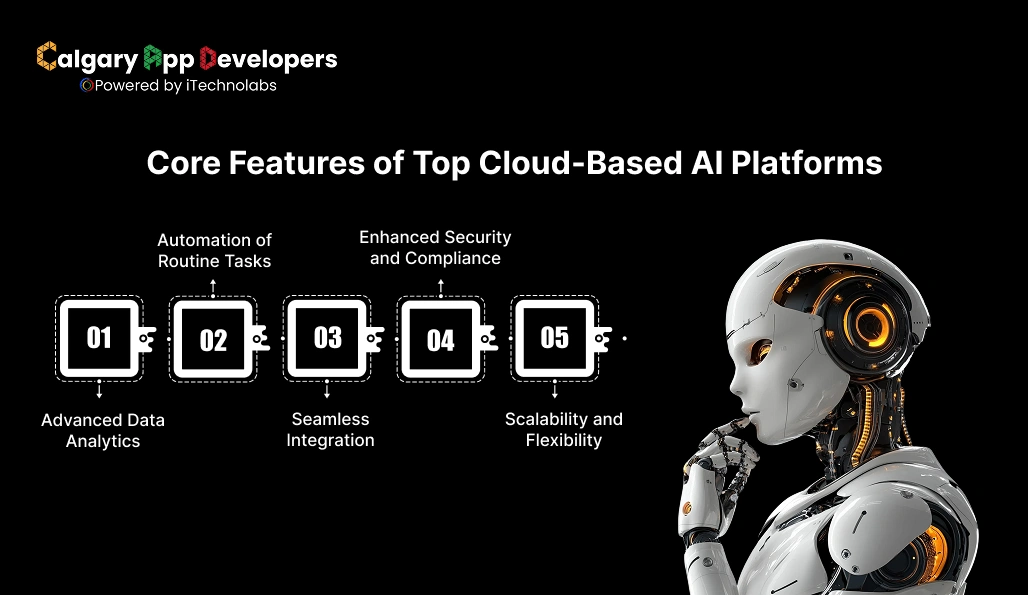
Selecting the right AI cloud business tools requires understanding the features that drive real business value. These platforms are designed to streamline operations, provide actionable insights, and support growth. The following capabilities define the most effective tools:
- Advanced Data Analytics
AI cloud business tools can process vast amounts of data quickly and efficiently. They transform raw information into actionable insights, helping organizations identify trends, predict customer behavior, and make informed strategic decisions. Real-time reporting ensures leaders have the information they need to adapt quickly to market changes.
- Automation of Routine Tasks
Repetitive and time-consuming activities, such as scheduling, reporting, and basic customer communications, can be handled automatically. This reduces human error, saves valuable time and allows employees to focus on higher-value tasks, improving overall efficiency and productivity across departments.
- Seamless Integration
Leading platforms offer APIs and prebuilt connectors to integrate with existing enterprise software. This ensures data flows smoothly between systems, enabling unified workflows and reducing the need for manual data entry. Businesses can maintain consistency across departments while leveraging multiple tools simultaneously.
- Enhanced Security and Compliance
AI cloud business tools prioritize data protection. Encryption, access controls, and audit capabilities ensure sensitive information is secure. Compliance features also help businesses adhere to regulatory standards, reducing risk and providing peace of mind when handling critical operational and customer data.
- Scalability and Flexibility
Cloud-based platforms allow companies to adjust storage, processing capacity, and functionality according to demand. This flexibility supports growth without the need for costly infrastructure upgrades, making these tools suitable for businesses of all sizes and enabling rapid adaptation to changing market conditions.
The combination of analytics, automation, integration, security, and scalability makes AI cloud business tools essential for modern organizations. Leveraging these features helps businesses optimize operations, improve decision-making, and maintain a competitive edge.
How We Evaluated the Best AI Cloud Business Tools for 2026
With hundreds of AI platforms competing for attention, selection requires more than feature comparison. We evaluated each tool through a business lens, focusing on measurable value, operational reliability, and long-term scalability. The goal was simple. Highlight platforms that genuinely improve how organizations operate, not just how they experiment with AI.
Here is the framework used to assess every solution in this guide.
- Measurable Business Outcomes: We prioritized tools that deliver clear impact across revenue growth, cost reduction, workflow efficiency, or productivity gains. Platforms had to demonstrate practical use cases in real business environments rather than theoretical AI capabilities.
- Depth of AI Capability: Not all AI tools offer the same intelligence. We examined model maturity, predictive accuracy, automation logic, generative AI performance, and support for advanced analytics. Solutions that move beyond surface-level automation and provide strategic insight ranked higher.
- Enterprise Scalability and Cloud Reliability: AI systems must perform under real workloads. We assessed infrastructure stability, global availability, multi-cloud support, uptime performance, and the ability to handle growing datasets and expanding teams without performance degradation.
- Integration Across Business Systems: AI becomes powerful when connected. We evaluated API strength, compatibility with CRM, ERP, HR, finance, analytics, and collaboration platforms, and the ease of syncing structured and unstructured data. Tools that eliminate data silos and unify workflows received stronger consideration.
- Security, Governance, and Compliance Readiness: Security standards were a core requirement. We reviewed encryption practices, identity and access management, audit capabilities, compliance certifications, and governance frameworks. Enterprise-grade security was non-negotiable for inclusion.
- Usability and Adoption Potential: Even advanced AI fails without adoption. We assessed user interface clarity, onboarding support, documentation quality, low-code capabilities, and training resources. Platforms that balance technical sophistication with practical usability scored higher.
- Customization and Flexibility: Businesses rarely operate in identical ways. We examined how easily each tool allows workflow customization, model fine-tuning, deployment configuration, and role-based access control. Flexible platforms that adapt to different industries and company sizes ranked higher.
- Transparency in Pricing and Long Term ROI: We evaluated pricing clarity, scalability of cost structures, hidden usage fees, and overall return on investment potential. Tools offering predictable pricing models with strong performance gains were prioritized over platforms with unclear or volatile cost structures.
- Cross-Functional Value: AI tools were assessed on how well they support multiple departments such as sales, marketing, HR, finance, customer service, operations, and product development. Platforms that create organization-wide impact rather than isolated efficiency gains ranked higher.
- Future Readiness and Innovation Momentum: Finally, we examined how well each platform aligns with evolving AI trends. This includes generative AI integration, intelligent agents, workflow automation, multi-model support, and responsible AI practices. Solutions demonstrating sustained innovation and roadmap clarity were given preference.
This framework ensures the list reflects tools that are reliable, scalable, secure, and strategically valuable. Whether your focus is automation, analytics, generative AI, or enterprise transformation, the platforms featured here meet the standards required for modern AI-driven business management.
20 Leading AI Cloud Business Tools to Boost Business Efficiency:
| Tool Name | Launch Date | Pros | Cons |
| Salesforce Einstein | 2016 | • Seamless integration with Salesforce CRM
• Automates sales, service, and marketing tasks • Provides predictive analytics |
• High cost
• Requires Salesforce ecosystem • Learning curve for new users |
| H2O.ai | 2012 | • Open-source platform
• Supports multiple machine learning algorithms • Strong community support |
• Requires technical expertise
• Limited out-of-the-box integrations |
| Moveworks | 2016 | • Automates IT and HR support tasks
• Integrates with Slack and Microsoft Teams • Improves employee productivity |
• Integration limits with non-ServiceNow platforms
• May not handle complex issues effectively |
| Amazon SageMaker | 2017 | • End-to-end machine learning lifecycle support
• Scalable infrastructure • Extensive documentation |
• Complex for beginners
• Pricing can be difficult to estimate |
| Jasper AI | 2021 | • Supports 30+ languages
• User-friendly interface • Generates marketing and SEO content |
• Struggles with complex topics
• Occasional content repetition |
| Zoho Zia | 2017 | • Integrates with 100+ Zoho apps
• Automates workflows • Provides sales and marketing insights |
• Limited to Zoho ecosystem
• Fewer advanced features than competitors |
| Google Cloud AI Platform | 2018 | • Broad AI and ML services
• Integrates with Google Cloud products • Strong analytics capabilities |
• Higher cost
• Integration with non-Google products can be challenging |
| Anthropic Claude API | 2023 | • Advanced language understanding
• Suitable for coding and complex workflows • Enterprise-ready |
• Limited handling of some tasks
• Access restrictions in certain regions |
| Oracle AI | 2020 | • Embedded in Oracle Cloud apps
• Automated insights and anomaly detection • Enterprise-grade |
• Best suited for Oracle users
• Limited non-Oracle integrations |
| Dialpad AI | 2020 | • Real-time transcription
• Sentiment analysis • Call coaching features |
• Limited advanced features
• Focused mainly on communication tasks |
| DataRobot | 2012 | • Automated machine learning • Model interpretability
• Scalable infrastructure |
• Can be expensive
• Technical expertise needed |
| SAP Business AI | 2020 | • Integrates with SAP ERP
• Intelligent automation • Predictive analytics |
• Best suited for SAP users
• Limited non-SAP integrations |
| Microsoft Azure AI | 2018 | • Wide AI service range
• Integrates with Microsoft products • Strong security • Scalable |
• Can be complex for beginners
• Pricing can be confusing |
| C3 AI | 2009 | • Suite of AI applications
• Accelerates digital transformation • Industry-ready |
• High cost
• Primarily for large enterprises |
| Google Gemini Enterprise | 2025 | • Integrates with Google Workspace, Microsoft 365, Salesforce, SAP
• Context-aware responses • Workflow automation |
• New platform
• Limited adoption and support |
| Salesforce Agentforce 360 | 2025 | • Automates Salesforce tasks
• Connects humans, AI agents, and data • Boosts productivity |
• Limited to Salesforce ecosystem
• May require customization |
| Amazon Q Business Suite | 2025 | • Integrates AWS tools like QuickSight
• Streamlines BI and AI workflows • Enhances productivity |
• New platform
• Limited adoption and support |
| Morpheus Data | 2014 | • Multi-cloud orchestration
• Simplifies complex cloud management • Increases infrastructure efficiency |
• Requires technical expertise
• Best for large enterprises |
| IBM Watsonx | 2023 | • Enterprise-grade AI platform
• Tools for building and deploying AI models • Integrates with IBM Cloud |
• High cost
• Limited non-IBM integration |
| Alviss AI | 2020 | • Predictive analytics and marketing mix modeling
• Helps solve complex business problems • Data-driven insights |
• Requires technical expertise
• Best suited for marketing and analytics |
1. Salesforce Einstein

Salesforce Einstein embeds intelligence directly into the Salesforce CRM, helping businesses automate sales, service, and marketing tasks. It delivers predictive insights and recommendations, allowing teams to make data-driven decisions without leaving the CRM interface. It is particularly valuable for organizations looking to improve customer engagement and operational efficiency.
Key Features:
- Predictive analytics for sales and marketing
- Automated workflow recommendations
- Native integration with Salesforce ecosystem
2. H2O.ai

H2O.ai provides an open-source machine learning platform for building predictive models and analyzing large datasets. It supports a wide range of algorithms and is popular among data scientists for its flexibility and strong community support. Enterprises use it to accelerate AI adoption without heavy infrastructure costs.
Key Features:
- Open-source machine learning platform
- Multiple algorithm support
- Scalable and flexible deployment
3. Moveworks

Moveworks automates IT and HR support tasks, providing instant resolutions to employee issues through natural language understanding. Its platform integrates with collaboration tools like Slack and Microsoft Teams, improving productivity and reducing response times for internal support tickets.
Key Features:
- Automated IT and HR support
- Integrates with collaboration platforms
- Real-time issue resolution
Read Also: How to Make an AI
4. Amazon SageMaker

Amazon SageMaker offers a fully managed service for building, training, and deploying machine learning models. It supports the entire ML lifecycle and integrates seamlessly with other AWS services, providing scalability and high-performance infrastructure for data-intensive projects.
Key Features:
- End-to-end machine learning lifecycle
- Scalable infrastructure
- Integration with AWS ecosystem
5. Jasper AI

Jasper AI is a content generation platform that assists businesses in creating marketing copy, blog posts, and other written material. It supports multiple languages and uses advanced language models to produce high-quality content efficiently, making it a popular choice for digital marketing teams.
Key Features:
- Multilingual content generation
- User-friendly interface
- Supports marketing and SEO tasks
6. Zoho Zia

Zoho Zia is an AI-powered assistant integrated into the Zoho CRM suite. It automates workflows, provides sales predictions, analyzes customer sentiment, and delivers actionable insights. Businesses use Zia to streamline CRM tasks, improve customer engagement, and enhance team productivity without switching between multiple tools.
Key Features:
- Workflow automation within Zoho apps
- Predictive analytics for sales and marketing
- Customer sentiment analysis
7. Google Cloud AI Platform

Google Cloud AI Platform offers a comprehensive suite of tools for building, training, and deploying machine learning models at scale. It integrates seamlessly with other Google Cloud products and provides strong analytics capabilities, making it suitable for businesses seeking high-performance cloud-based AI solutions.
Key Features:
- End-to-end ML model development and deployment
- Integration with Google Cloud services
- Robust analytics and data processing
Also Read: AI App Development: Build Intelligent Solutions
8. Anthropic Claude API

Anthropic Claude API provides advanced natural language understanding for businesses. It is used for coding assistance, workflow automation, and complex language tasks. Its enterprise-ready design allows companies to integrate language intelligence into applications efficiently, enhancing productivity and decision-making.
Key Features:
- Advanced natural language processing
- Workflow automation capabilities
- Enterprise-ready API integration
9. Oracle AI

Oracle AI is embedded within Oracle Cloud applications, offering automated insights, anomaly detection, and predictive analytics. It helps businesses optimize processes, improve decision-making, and leverage enterprise data effectively. It is ideal for organizations already using Oracle’s cloud ecosystem.
Key Features:
- Predictive analytics and anomaly detection
- Automated insights for enterprise data
- Seamless Oracle Cloud integration
10. Dialpad AI

Dialpad AI integrates intelligence into communication tools, providing real-time transcription, sentiment analysis, and coaching during calls. It is designed to enhance customer interactions, support sales teams, and improve internal communications efficiency across enterprises.
Key Features:
- Real-time transcription and call insights
- Sentiment analysis for customer interactions
- Integrated coaching and support tools
11. DataRobot

DataRobot is an enterprise AI platform that automates the building, deployment, and management of machine learning models. It provides tools for model interpretability, scalability, and integration with multiple data sources, helping organizations make data-driven decisions efficiently.
Key Features:
- Automated machine learning model building
- Scalable infrastructure for enterprise needs
- Model interpretability and monitoring
12. SAP Business AI

SAP Business AI integrates intelligence into SAP’s enterprise resource planning solutions. It delivers predictive analytics, workflow automation, and intelligent insights, helping businesses optimize operations, improve forecasting, and enhance decision-making within the SAP ecosystem.
Key Features:
- Predictive analytics and business insights
- Workflow automation within SAP applications
- Integration with SAP ERP solutions
Also Check: Vibe Coding: Smart Guide For Vibe Coding Tools & Platforms
13. Microsoft Azure AI

Microsoft Azure AI provides a wide range of AI services, including vision, speech, language, and decision-making tools. It integrates seamlessly with other Microsoft products and offers scalable infrastructure, making it suitable for enterprises of all sizes.
Key Features:
- Wide array of AI services for enterprise needs
- Integration with Microsoft ecosystem
- Scalable infrastructure and strong security features
14. C3 AI

C3 AI develops pre-built applications for various industries such as healthcare, manufacturing, and oil & gas. It stands out for its rapid implementation of AI use cases, often requiring little custom development due to its templated approach. With high-performance AI cloud platforms, it’s widely adopted by large enterprises needing scalable solutions.
Key Features:
- Industry-specific AI use cases
- Scalable deployment
- Strong AI consulting support
15. Google Gemini Enterprise

Google Gemini Enterprise is designed to enhance productivity by embedding intelligence into business workflows. It integrates with Google Workspace, Microsoft 365, Salesforce, and SAP, providing context-aware responses, task automation, and improved collaboration across platforms.
Key Features:
- Workflow automation and context-aware responses
- Integration with multiple enterprise platforms
- Enhances productivity and collaboration
16. Salesforce Agentforce 360

Salesforce Agentforce 360 automates routine tasks across Salesforce’s suite of cloud-based tools. It connects human agents, AI-driven workflows, and enterprise data, enhancing productivity and enabling faster, data-driven decision-making within sales and service operations.
Key Features:
- Automation of Salesforce tasks
- Integration of human and AI workflows
- Boosts productivity and efficiency
17. Amazon Q Business Suite

Amazon Q Business Suite integrates AWS tools like QuickSight and Q Apps, providing unified business intelligence and AI capabilities. It enables organizations to streamline analytics, improve decision-making, and enhance collaboration across applications such as Salesforce and Outlook.
Key Features:
- Unified business intelligence and AI capabilities
- Integration with multiple enterprise tools
- Streamlines analytics and reporting workflows
18. Morpheus Data

Morpheus Data is a cloud management platform that enables multi-cloud orchestration, helping organizations manage complex cloud environments efficiently. It improves infrastructure visibility, reduces operational overhead, and accelerates deployment of cloud applications.
Key Features:
- Multi-cloud orchestration and management
- Infrastructure visibility and control
- Streamlines cloud application deployment
19. IBM Watsonx

IBM Watsonx provides tools to build, deploy, and manage enterprise-grade AI models. It focuses on scalability, security, and integration with IBM Cloud, enabling organizations to leverage advanced intelligence for analytics, automation, and decision support.
Key Features:
- Enterprise-grade AI model management
- Scalable and secure deployment
- Integration with IBM Cloud ecosystem
20. Alviss AI

Alviss AI is designed for predictive analytics and marketing mix modeling, helping organizations optimize campaigns and make data-driven business decisions. It delivers actionable insights and improves operational efficiency for marketing and analytics teams.
Key Features:
- Predictive analytics for business decisions
- Marketing mix modeling capabilities
- Data-driven insights and optimization
Also Read: AI Integration Services: Smarter Business Solutions
How to Pick the Right AI Cloud Solution
Selecting the right AI cloud business tools requires careful consideration to ensure maximum impact and efficiency. Here’s a detailed approach for making the right choice:
- Define Your Business Objectives
Clearly identifying the problems your business wants to solve is the first step. Whether the goal is automating workflows, improving customer engagement, or gaining predictive insights, knowing your objectives ensures the tools you choose align with desired outcomes. This clarity also helps prioritize features and functionality effectively. - Assess Integration Capabilities
Integration with existing software and data sources is critical for smooth operations. AI cloud business tools that connect seamlessly reduce manual effort, prevent data silos, and maintain workflow consistency. Assessing API availability, prebuilt connectors, and compatibility with your current ecosystem ensures faster adoption and less disruption during implementation. - Evaluate Scalability
Business needs evolve, and your chosen platform must grow with you. Scalable tools handle increased data volumes, more users, and higher operational complexity without requiring costly infrastructure changes. This flexibility ensures that as your organization expands, AI cloud business tools continue to support performance and efficiency without limitations. - Consider Usability and Support
A user-friendly interface is key to adoption and productivity. Teams should be able to navigate the platform with minimal training. Strong vendor support, documentation, and training resources further reduce implementation challenges, allowing employees to leverage AI cloud business tools effectively and focus on achieving business goals rather than troubleshooting technical issues. - Prioritize Security and Compliance
Data protection and regulatory compliance are non-negotiable. Platforms should offer encryption, access controls, auditing, and compliance with industry standards. Selecting tools with strong security features ensures sensitive information is safeguarded, builds trust with stakeholders, and protects the organization from potential legal or financial risks. - Analyze Cost vs. ROI
Pricing should reflect both affordability and business value. Evaluate subscription, pay-as-you-go, or tiered pricing against the expected efficiency gains, productivity improvements, and long-term ROI. Choosing AI cloud business tools with a clear balance between cost and measurable benefits ensures sustainable investment and operational success.
Common Applications Across Business Functions
AI cloud business tools are increasingly being applied across various business functions to enhance efficiency, accuracy, and decision-making. Understanding these applications helps organizations identify where intelligence can create the most value.
- Sales and Marketing
AI cloud business tools help businesses analyze customer behavior, predict purchasing trends, and personalize marketing campaigns. Sales teams can prioritize leads based on predictive scoring, while marketing teams can optimize content and messaging for engagement, resulting in higher conversion rates and better customer targeting. - Customer Support
Intelligent platforms can automate routine inquiries, provide real-time chat support, and analyze customer sentiment. This reduces response times, improves service consistency, and allows support teams to focus on complex cases, enhancing overall customer satisfaction and loyalty. - Human Resources
These tools streamline HR processes such as recruitment, onboarding, and employee engagement. Predictive analytics help identify talent gaps, monitor performance trends, and optimize workforce planning, enabling HR teams to make informed decisions and improve operational efficiency. - Finance and Accounting
AI cloud business tools assist with financial forecasting, anomaly detection, and automating repetitive accounting tasks. This increases accuracy, reduces errors, and provides actionable insights for budgeting and investment decisions, improving overall financial management. - Operations and Supply Chain
Intelligent platforms optimize inventory management, demand forecasting, and logistics planning. Businesses can predict supply chain disruptions, reduce costs, and enhance operational efficiency by leveraging data-driven insights across production and distribution processes. - Product Development and R&D
AI cloud business tools accelerate research, design, and testing processes. They help analyze large datasets, simulate scenarios, and identify patterns, allowing teams to innovate faster and develop products that better meet customer needs.
Integrating AI cloud business tools across business functions enhances efficiency, accuracy, and strategic decision-making. Organizations that leverage these applications gain a competitive advantage by improving performance across sales, support, operations, and more.
Read Also: How to Build an AI App?
What to Consider in Cloud Management Platforms
Selecting the right cloud management platform is crucial for maximizing the benefits of AI cloud business tools. The right platform ensures efficient operations, scalability, and security while supporting strategic business goals.
- Integration and Compatibility are the first considerations. The platform should connect seamlessly with existing software, databases, and enterprise systems. Tools that offer APIs, prebuilt connectors, and standardized protocols reduce implementation time and prevent workflow disruptions.
- Scalability and Flexibility are equally important. Organizations need platforms that can handle growing workloads, increased user numbers, and expanding data volumes. Scalable platforms allow businesses to adapt quickly without significant infrastructure changes or excessive costs.
- Security and Compliance cannot be overlooked. Cloud platforms should provide encryption, access controls, activity auditing, and adherence to industry regulations. Protecting sensitive information is essential for maintaining trust and avoiding legal or financial penalties.
- User Experience and Support matter for adoption. A platform with an intuitive interface accelerates onboarding, while robust vendor support and comprehensive documentation reduce downtime and troubleshooting challenges.
- Cost and Return on Investment should guide the final choice. Subscription-based or pay-as-you-go models offer flexibility, but it is critical to evaluate the platform’s potential benefits relative to its cost.
By considering integration, scalability, security, usability, and cost, businesses can choose cloud management platforms that fully leverage AI cloud business tools, improving efficiency, insights, and operational performance.
Conclusion
AI cloud business tools are transforming the way organizations operate, enabling smarter management, enhanced efficiency, and data-driven decision-making. From sales and marketing to operations and finance, these platforms offer solutions that streamline workflows, provide actionable insights, and support scalable growth. By understanding the core features and applications, businesses can identify the tools that best align with their strategic objectives.
Selecting the right platform requires careful consideration of integration, scalability, security, usability, and cost. Organizations that make informed choices can maximize return on investment, improve operational performance, and maintain a competitive edge in an increasingly digital business environment. Embracing these tools is no longer optional for forward-looking businesses; it is essential for achieving sustainable growth and staying ahead in a rapidly evolving market.
FAQs:
- What is the best AI cloud platform for startups
For startups, leading AI cloud business tools like Google Cloud, AWS, and Microsoft Azure provide scalable infrastructure, prebuilt AI services, and flexible pricing. Google Cloud offers credits for early-stage startups, while AWS and Azure have extensive documentation and support. Choosing depends on your tech stack, budget, and the types of AI workloads you plan to run. - Can I use multiple AI tools in my cloud environment
Yes, businesses can deploy and integrate multiple AI cloud business tools within a single environment. Effective orchestration, robust APIs, and centralized data management are key to ensuring tools work together seamlessly. This approach allows organizations to combine different AI capabilities, optimize workflows, and gain comprehensive insights without switching between multiple platforms. - How do I ensure data security in AI cloud platforms
Data security is critical when using AI cloud business tools. Implement encryption for data at rest and in transit, define strict access controls, monitor usage continuously, and follow compliance standards relevant to your industry. Regular audits and strong governance policies reduce the risk of breaches and protect sensitive business and customer data effectively. - What are common AI use cases in business
AI cloud business tools are widely used across sales, marketing, customer support, finance, HR, and operations. Common applications include predictive analytics, workflow automation, customer segmentation, anomaly detection, and product recommendation engines. These applications improve efficiency, enhance decision-making, and provide actionable insights to help organizations stay competitive and data-driven. - Are there tools that support LLM model deployment
Yes, tools like LangChain, LangGraph, and AutoGen enable deployment, orchestration, and management of large language models (LLMs) within cloud environments. They integrate with existing APIs, allow multi-agent workflows, and support stateful applications, making it easier for businesses to leverage LLM capabilities for tasks like content generation, code assistance, and automated decision-making. - Do I need to hire AI developers to use these tools
Not necessarily. Many AI cloud business tools are designed with user-friendly interfaces and prebuilt models, allowing non-technical users to implement them. However, for advanced custom models, integrations, or scaling complex AI workloads, having developers or data scientists on board can help maximize the platform’s potential and ensure robust deployment. - Are these tools expensive
Costs vary depending on the platform, features, and usage levels. Many AI cloud business tools offer pay-as-you-go or subscription models, making them accessible for startups and SMEs. While enterprise-grade solutions can be costly, smaller organizations can often access scalable capabilities without heavy upfront investment, ensuring value for money relative to the efficiency and insights gained.


Pankaj Arora is a seasoned technology leader and the Founder of Calgary App Developer, with 10+ years of expertise in crafting high-performance digital solutions. His core competencies include full-stack app development, cloud-native architecture, API integration, and agile product delivery. Under his leadership, Calgary App Developers has empowered startups and enterprises alike with scalable mobile applications, secure web platforms, and AI-driven SaaS products.