










How Much Does It Cost to Build a Cryptocurrency Exchange App like Coinbase?

As the world continues to shift to digital assets, cryptocurrency exchanges are arguably the most influential platforms in finance today. Building a cryptocurrency exchange application like Coinbase is no longer simply a technical challenge. It is now also a strategic investing opportunity that marries highly specialized software engineering, security, and regulatory compliance.
Recent market data shows the scale of opportunity. The crypto exchange platform market is valued at around USD 48.8 billion in 2025 and is projected to reach USD 167.3 billion by 2035, growing at a compound annual rate of nearly 13%.
Recent research has indicated the extent of the opportunity. The value of the crypto exchange platform industry was USD 48.8 billion in 2025 and is projected to be around USD 167.3 billion by 2035, growing at a compound annual growth/decline rate of almost 13%.
The above figures indicate the depth of opportunity and also the level of difficulty in entering the market. Creating a platform that can handle real-time transactions, safeguard assets, and comply with multiple jurisdictions requires significant expertise and a well-thought-out budget.
In this blog, we will explore the general cost of developing a cryptocurrency exchange application like Coinbase. You will discover how the budget will be broken down into core features, security architecture, development team and ongoing support, and what is driving those costs in 2026 and beyond.
- The cost of creating a cryptocurrency exchange app similar to Coinbase lies between USD 60,000 and 180,000, with scaling and features being the major factors.
- The procedure entails design, backend development, wallet integration, security, and compliance systems.
- Architecture, team location, and feature complexity are some of the main factors that heavily influence total cost.
- Exchanges that are ready for the future are concentrating on AI, DeFi integration, cross-chain trading, and security infrastructure enhancement.
- The development of crypto exchange apps is a market that is growing rapidly, and the projections of reaching USD 167.3 billion by 2035 are a clear manifestation of the high potential for new entrants.
- The main development costs consist of UI/UX, trading engine, wallet integration, compliance modules, and ongoing maintenance.
- Among the different types of exchanges, centralized ones are the least expensive to build, while hybrid and decentralized ones require advanced blockchain integration and have higher budgets.
- Security and compliance measures, including encryption, KYC/AML systems, and DDoS protection, account for a large portion of the development investment.
- Successful exchange apps offer seamless trading, real-time analytics, liquidity management, and excellent user experience design.
- Future development will be powered by automation, AI-based fraud detection, regulatory technology, and tokenization of real-world assets.
Cost to Develop a Cryptocurrency Exchange App like Coinbase
Typically, a crypto exchange app can cost from USD 60,000 to USD 180,000, depending on several factors: the level of functionality on the app, the technology stacks employed, and compliance aspects.
If it is a minimum version with core trading and wallet features, it will stay toward the lower end of that range; however, if it is a complete version with all features, better security and scalability, as well as fiat integrations and liquidity modules, it will move toward the higher end of that range.
Here are estimated costs for development based on major components and scope.
| Component | Estimated Cost (USD) | Description |
| UI/UX Design | 4,000 – 7,000 | Wireframing, interface design, and user journey flow for web and mobile. |
| Frontend Development | 8,000 – 15,000 | Development of trading dashboards, charts, and responsive layouts. |
| Backend Development | 15,000 – 40,000 | Core logic, APIs, order matching, and data management. |
| Wallet Integration | 6,000 – 10,000 | Secure crypto wallet integration with multi-currency support. |
| Security Implementation | 5,000 – 12,000 | Two-factor authentication, encryption, and anti-fraud systems. |
| KYC/AML Compliance Module | 4,000 – 8,000 | Identity verification and compliance checks. |
| Payment Gateway Integration | 3,000 – 7,000 | Fiat-to-crypto and crypto-to-fiat transaction modules. |
| Testing & Quality Assurance | 5,000 – 8,000 | Security audits, performance tests, and usability reviews. |
| Deployment & Maintenance | 10,000 – 20,000 | Server setup, monitoring, and post-launch support. |
Factors Affecting the Cost of Coinbase like Crypto Exchange App Development
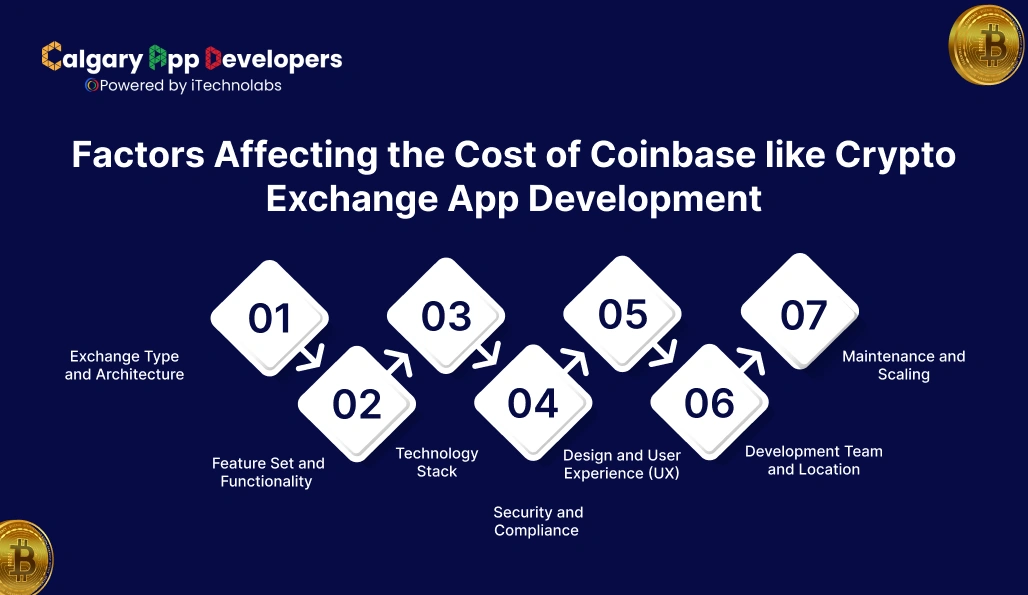
The total cost of crypto exchange app development is shaped by several key factors, each influencing not only the budget but also how efficiently the platform performs once it goes live. Let’s break them down in detail.
- Exchange Type and Architecture
The structure you choose, whether it is centralized, decentralized, or hybrid, defines the technical stack and cost complexity.
| Exchange Type | Description | Cost Impact |
| Centralized Exchange (CEX) | Managed by a single entity. Easier to build, maintain, and scale. | Moderate cost |
| Decentralized Exchange (DEX) | Smart contract-based, no central control. Complex blockchain integration. | High cost |
| Hybrid Exchange | Combines control of CEX and privacy of DEX. Ideal for advanced users. | Highest cost |
- Feature Set and Functionality
Every new feature adds to both development time and security complexity.
The fundamental characteristics of user authentication, wallet integration, and trading engines are vital, while the additional features such as analytics dashboards or staking modules only serve to increase the expenses.
| Feature Category | Examples | Cost Level |
| Essential | Login, KYC, trading pairs, wallets | Low–medium |
| Advanced | Margin trading, staking, APIs, multi-currency | Medium–high |
| Premium | Liquidity aggregation, AI-driven bots, NFT integration | High |
- Technology Stack
The selection of backend frameworks, the blockchain networks, and the database systems also directly affect the price.
For instance, the combination of Node.js with MongoDB provides good cost-effectiveness and the aspect of scalability, whereas the integration of solidity smart contracts or multi-chain support would extensively complicate the process.
| Stack Type | Examples | Cost Range (USD) |
| Basic Stack | Node.js, React, PostgreSQL | 10,000 – 20,000 |
| Advanced Stack | Solidity, Web3.js, AWS, Firebase | 20,000 – 40,000 |
- Security and Compliance
Security layers form a major cost driver in crypto exchange app development.
Compliance with KYC/AML, two-factor authentication, and encryption protocols, as well as DDoS protection and cold storage systems, not only reinforces the trust but also inflicts an increase on the development cost.
Skipping advanced security may save short-term budget but often leads to costly vulnerabilities later.
- Design and User Experience (UX)
A clean, intuitive interface helps attract and retain traders.
The extensive testing and design precision for complex dashboards, real-time charts, and multi-device compatibility make UI/UX a significant cost element.
Simple layouts save money early but may limit user satisfaction long-term.
- Development Team and Location
The location of your development team can be a major factor in the total cost of the development of a crypto exchange app. Different factors such as labor rates, expertise availability, and local tax policies will all contribute to your final budget.
| Region | Average Hourly Rate (USD) | Typical Quality |
| Calgary, Canada | 20 – 40 | Cost-effective, skilled blockchain professionals |
| India | 25 – 50 | Affordable, experienced full-stack teams |
| Eastern Europe | 40 – 70 | Advanced blockchain development talent |
| Western Europe / USA | 80 – 150 | Enterprise-grade service and premium support |
Calgary is one of the most economical cities for blockchain and fintech development. The gradual local tech development and the availability of experienced programmers make it a great choice for startups looking to execute their projects in a reliable yet cost-effective manner.
- Maintenance and Scaling
Server management, updates, and compliance revisions are the main post-launch expenses that usually constitute 15–25% of total development cost annually.
When there is an increase in user activity, database optimization, load balancing, and API scaling will also add to operating expenses.
The cost of crypto exchange app development entirely depends on how grand your platform vision is. By offering only basic trading, wallet, and security features in the first version, you will be able to launch the product at a lower price while keeping the option for future scalability and feature enlargement open.
Also Check: Top Cold Crypto Wallets: Ultimate Security Guide
Key Features to Include in an App like Coinbase
Building a successful crypto exchange app goes beyond just trading. It’s about creating a secure, intuitive, and scalable platform that earns user trust from day one. The following features form the foundation of reliable crypto exchange app development and define how well your platform performs in a competitive market.
- User Registration and Verification: A seamless onboarding process with secure identity verification (KYC) ensures both compliance and user confidence. Automated KYC checks, biometric authentication, and document verification speed up account approvals while keeping data safe.
- Multi-Currency Wallet Integration: An integrated wallet that supports multiple cryptocurrencies like Bitcoin, Ethereum, and stablecoins is essential. Users should be able to deposit, withdraw, and store assets securely with hot and cold wallet options for maximum protection.
- Trading Engine: This is the core of every exchange. The trading engine handles order matching, transaction execution, and real-time price updates. A well-optimized engine ensures low latency, accurate order books, and smooth trade execution even during high-volume spikes.
- Advanced Charting and Analytics: Real-time charts, market trends, and technical indicators help traders make informed decisions. Integrating APIs from providers like TradingView can add professional-grade analytics without heavy in-house development costs.
- Payment Gateway Integration: A secure payment system allows users to buy or sell crypto using credit cards, bank transfers, or e-wallets. Reliable fiat-to-crypto conversion with instant settlement is key for user retention.
- Security Protocols: End-to-end encryption, two-factor authentication, DDoS protection, and cold wallet storage are non-negotiable. Implementing AML/KYC compliance and anti-phishing measures helps prevent fraud and maintain platform integrity.
- Push Notifications and Alerts: Real-time alerts for price changes, order executions, and security events improve user engagement. They help traders react instantly to market movements and strengthen retention rates.
- Admin Dashboard: An admin control panel gives the management team full visibility into trading activities, liquidity levels, and user analytics. Admins can monitor system health, resolve disputes, and ensure compliance in real time.
- Liquidity Management: Integrating liquidity APIs or partnering with existing exchanges ensures users can trade without slippage or delays. Better liquidity translates to smoother transactions and a more trustworthy platform experience.
- Customer Support Module: Offering live chat, AI chatbots, and ticket-based support ensures users receive quick help. Responsive support builds credibility, especially for newcomers to crypto trading.
These features form the backbone of any modern exchange platform. When planned thoughtfully, they not only lower long-term operational costs but also enhance reliability and trust, two elements that define the success of every crypto exchange app development project.
Steps to Build a Cryptocurrency Exchange App like Coinbase
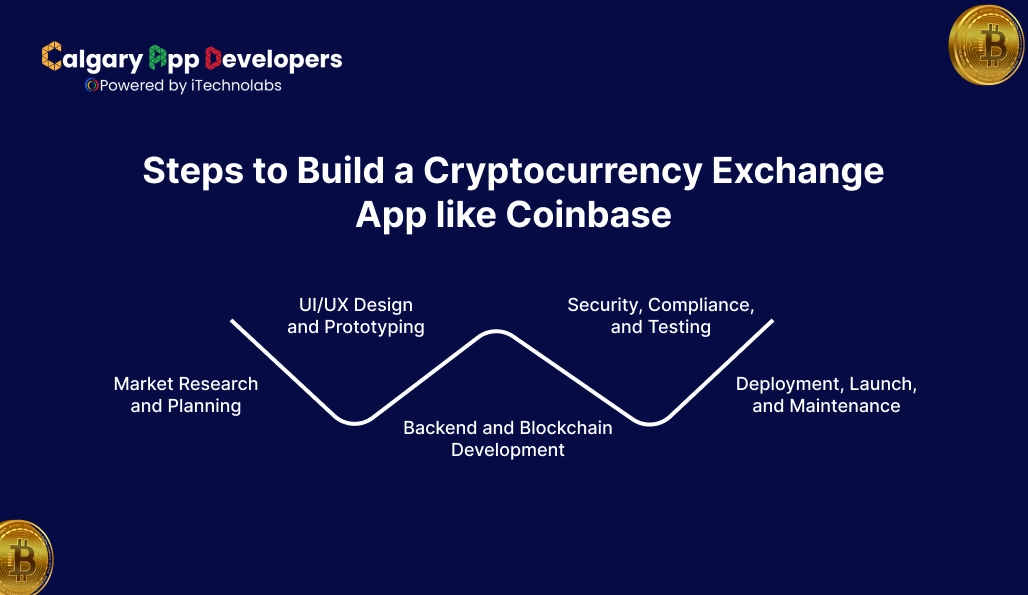
Developing a high-quality crypto exchange app requires a clear roadmap from ideation to launch. Each stage in crypto exchange app development demands careful planning, technical precision, and regulatory awareness. Here’s a step-by-step breakdown of the five key phases involved.
Step 1: Market Research and Planning
Before any coding begins, define your product’s purpose, audience, and value proposition. This stage sets the foundation for every decision that follows.
- Identify your target users: Traders, investors, institutions, or beginners.
- Study competitors: Examine Coinbase, Binance, and other exchanges to understand their strengths and weaknesses.
- Define your USP: Decide whether you’ll focus on lower fees, better UI, or niche tokens.
- Assess compliance needs: Review KYC/AML and crypto licensing requirements for your target regions.
- Create a business model: Include revenue streams such as trading fees, spreads, or staking commissions.
Step 2: UI/UX Design and Prototyping
A smooth interface keeps users trading longer. Focus on intuitive navigation and security transparency.
- Wireframe the app: Sketch the trading screens, wallets, and dashboards.
- Design a clear layout: Keep charts visible and menus simple.
- Prioritize mobile usability: Optimize for both Android and iOS.
- Add trust elements: Show verified seals, secure icons, and status indicators to increase user confidence.
Step 3: Backend and Blockchain Development
This is the technical core of the platform, where most of the crypto exchange app development budget is spent.
- Build the trading engine: Handle order matching, transaction execution, and price feeds.
- Integrate the blockchain layer: Connect to major networks like Bitcoin, Ethereum, or Polygon.
- Set up wallets: Implement hot wallets for quick transactions and cold wallets for long-term security.
- Develop APIs: For trading, liquidity, and data exchange between systems.
- Use scalable architecture: Ensure the platform can handle thousands of transactions per second.
Step 4: Security, Compliance, and Testing
Crypto exchanges operate in a trust-sensitive environment. Robust testing and security checks are essential before launch.
- Implement AML/KYC modules: Automate identity verification.
- Use multi-layer encryption: Protect data, wallets, and communications.
- Add DDoS and anti-phishing tools: Guard against external attacks.
- Run performance testing: Stress-test servers under high trading loads.
- Audit smart contracts: If DEX or hybrid elements exist.
Step 5: Deployment, Launch, and Maintenance
Once the app is stable, it’s time to deploy and scale responsibly.
- Deploy on reliable cloud servers: Use AWS, Google Cloud, or Azure.
- Launch beta testing: Allow select users to report issues before full release.
- Gather user feedback: Improve functionality based on real usage.
- Plan marketing and partnerships: List new coins, announce referral programs, and onboard liquidity providers.
- Schedule ongoing maintenance: Regular updates, bug fixes, and compliance revisions to keep the app secure and competitive.
A structured approach to crypto exchange app development ensures you build more than just a trading interface; you create a trustworthy financial platform. By following these five steps, you’ll move from concept to launch with a strong foundation for long-term success.
Read Also: Blockchain Wallet Development: An Ultimate Guide
Challenges in Building a Cryptocurrency Exchange App like Coinbase
Creating a crypto exchange application is a complicated process and involves many different variables. The market opportunity is large, but so too are the technical, legal, and operational demands placed on developers and investors. By being aware of the challenges presented to developers and investors now, they can make smarter plans while thinking of and avoiding unnecessary and expensive pitfalls down the road.
- Regulatory Compliance and Licensing
Every region has different crypto regulations. Some countries require strict financial licenses, while others operate under more flexible frameworks.
- Obtaining necessary licenses such as MSB (Money Services Business) or VASP (Virtual Asset Service Provider) can take months.
- Non-compliance can lead to hefty fines, restricted access to banking, or forced shutdowns.
- Keeping up with evolving global laws around taxation, KYC, and AML adds continuous workload.
- Security Threats and Data Protection
Security remains the backbone of any exchange. A single vulnerability can destroy credibility and lead to irreversible losses.
- Exchanges face constant risks like DDoS attacks, phishing, and data breaches.
- Balancing user convenience with strict security measures (multi-signature wallets, cold storage) requires precise design.
- Regular third-party audits are essential but add to recurring expenses.
- Liquidity and Market Depth
Without adequate liquidity, even the most polished platform struggles to retain traders.
- Attracting enough trading volume early on can be difficult for new exchanges.
- Partnerships with liquidity providers or market makers are often needed to maintain smooth order books.
- Thin liquidity causes price volatility and slippage, damaging user trust.
- Scalability and Performance
Crypto markets move fast, and trading platforms must keep up.
- High traffic during market surges can overload servers if infrastructure isn’t optimized.
- The backend must handle thousands of orders per second while maintaining millisecond execution speed.
- Scaling costs rise significantly when user numbers and transaction volumes increase rapidly.
- User Trust and Platform Reputation
New exchanges compete not only on features but also on credibility.
- Users prefer platforms with a history of reliability and transparency.
- Any downtime, withdrawal delays, or unclear policies can drive traders to competitors.
- Building brand trust takes time through consistent communication, prompt support, and proven security performance.
- Continuous Maintenance and Upgrades
Launching the app is only half the journey. Keeping it functional, secure, and compliant is an ongoing task.
- Regular updates, feature upgrades, and compliance patches are mandatory.
- Maintenance typically consumes 15–25% of annual development costs.
- Skipping updates risks exposing the platform to vulnerabilities and technical debt.
The challenges in crypto exchange app development go far beyond technical coding. They involve navigating laws, managing liquidity, ensuring bulletproof security, and building lasting user confidence. Addressing these areas from the start gives your platform a far better chance to stand alongside established players like Coinbase.
Also Read: What is MPC Wallet? Brief Guide to Multi-Party Computation
Future Trends in Cryptocurrency Exchange App Development
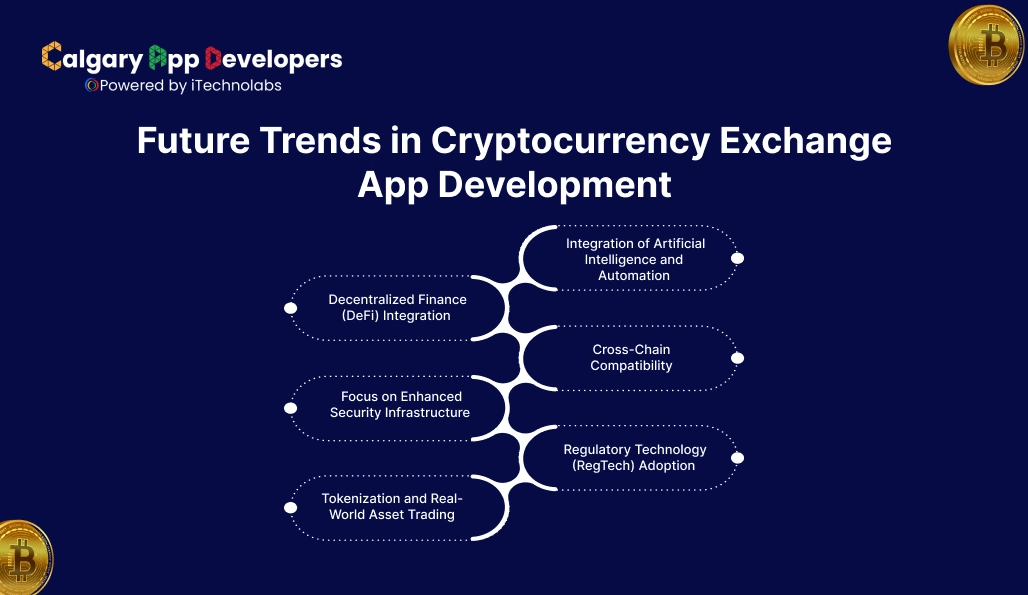
The landscape of crypto exchange app development is expanding fast, with new technologies reshaping how trading platforms operate, secure assets, and serve users. These upcoming trends are driving smarter, faster, and more transparent exchanges that match the expectations of a maturing global market.
- Integration of Artificial Intelligence and Automation
AI is becoming a key driver in crypto trading platforms. From detecting fraud to automating KYC and customer support, AI tools improve precision and reduce manual workload. Predictive algorithms also help traders anticipate market movements, making exchanges more intelligent, efficient, and user-focused than ever before.
- Decentralized Finance (DeFi) Integration
DeFi features are extending beyond standalone platforms and entering mainstream exchanges. Users can now stake, lend, or earn yield directly within the app. Smart contracts automate transactions securely, eliminating intermediaries and empowering users with more control over their financial activities and asset management.
- Cross-Chain Compatibility
The future of crypto exchange app development lies in interoperability. Cross-chain technology enables users to trade and transfer assets across multiple blockchains without friction. This flexibility reduces barriers between ecosystems like Ethereum, Solana, and Bitcoin, offering a unified, convenient experience for traders and investors alike.
- Focus on Enhanced Security Infrastructure
As crypto adoption grows, so does the need for uncompromising security. Exchanges are implementing multi-party computation, hardware-level encryption, and biometric verification to protect user assets. Regular security audits, penetration testing, and zero-knowledge proofs are also becoming standard to reinforce trust and minimize vulnerabilities.
- Regulatory Technology (RegTech) Adoption
With governments tightening crypto regulations, RegTech solutions are now essential. Automated compliance systems perform real-time KYC and AML checks, reducing risks of penalties or shutdowns. Blockchain-based digital identity tools streamline user verification while maintaining security, allowing exchanges to stay compliant without slowing user onboarding.
- Tokenization and Real-World Asset Trading
Exchanges are expanding beyond digital currencies by introducing tokenized real-world assets. Investors will soon trade tokenized stocks, real estate, and commodities in a single app. This creates more inclusive access to global investments and transforms exchanges into multi-asset platforms bridging traditional and digital finance.
Conclusion
Building a cryptocurrency exchange app like Coinbase is no small feat. It demands deep technical skill, rigorous security protocols, and ongoing compliance with global regulations. But the rewards are just as significant: access to a rapidly growing financial market and a loyal base of active traders.
The real key to success lies in partnering with an experienced team that understands every stage of crypto exchange app development, from design and blockchain integration to security and scalability. That’s where Calgary App Developers makes the difference. Our team delivers affordable, high-performing, and regulation-ready crypto exchange solutions tailored to your business vision.
If you’re ready to launch your own digital exchange or upgrade an existing platform, Calgary App Developers can help you move from concept to market with confidence. Let’s build the future of trading together.
Frequently Asked Questions (FAQs)
- How much does it cost to develop an app like Coinbase?
The cost of developing an app like Coinbase depends on the scale, features, and level of customization you want. On average, crypto exchange app development ranges from USD 60,000 to USD 180,000 for a secure, production-ready platform. A basic MVP with trading, wallet, and KYC modules can be built affordably, while adding advanced tools like margin trading, liquidity integration, or AI analytics will increase costs. Partnering with an experienced firm like Calgary App Developers ensures you get a high-quality app within your budget.
- How long does it take to build a cryptocurrency exchange app?
The timeline varies depending on the app’s complexity. A basic exchange platform typically takes 4 to 6 months, covering design, backend development, wallet integration, and testing. More feature-rich exchanges with advanced compliance systems, custom trading engines, and real-time analytics may require 8 to 12 months. Calgary App Developers uses an agile development process to shorten build time while maintaining top-tier performance and security standards.
- How to build a secure crypto exchange app like Coinbase?
To build a truly secure exchange platform, focus on layered protection and best development practices at every stage:
- Use multi-layer authentication such as two-factor (2FA) and biometric verification to prevent unauthorized access.
- Encrypt all data, including user credentials, API keys, and transaction details, using strong cryptographic algorithms.
- Integrate cold wallet storage to keep most assets offline, minimizing exposure to hacking attempts.
- Implement KYC/AML verification to comply with global financial regulations and prevent illicit activities.
- Conduct regular security audits and penetration testing to identify and fix vulnerabilities early.
- Adopt DDoS and anti-phishing protection to defend against external network attacks.
- Host on secure cloud infrastructure with strong firewall configurations and real-time monitoring.
- Partner with a trusted developer like Calgary App Developers, who specialize in building regulation-ready, high-security crypto exchange apps built for long-term reliability and user trust.


Pankaj Arora is a seasoned technology leader and the Founder of Calgary App Developer, with 10+ years of expertise in crafting high-performance digital solutions. His core competencies include full-stack app development, cloud-native architecture, API integration, and agile product delivery. Under his leadership, Calgary App Developers has empowered startups and enterprises alike with scalable mobile applications, secure web platforms, and AI-driven SaaS products.