











Impact of Canadian Accelerators & Incubators on Mobile App Innovation

Canada has quickly become one of the most active technology ecosystems that exists worldwide at present. Canadian cities, including Toronto, Vancouver, Montreal, and Calgary, have developed strong innovation systems that enable their startups to achieve rapid growth, while most people focus on Silicon Valley and other famous innovation centers. Mobile technology drives this growth because entrepreneurs across the nation create applications that meet needs in both local and global markets.
A key force behind this progress is the strong network of accelerators and incubators operating nationwide. These programs provide structured mentorship, early-stage capital access, strategic guidance, and critical industry connections that help mobile app startups move from concept to commercialization with clarity and confidence. Their influence extends beyond funding. They shape product direction, refine business models, and accelerate time to market.
This article examines how Canadian accelerators and incubators contribute to mobile app innovation, the advantages they offer to founders, and the measurable impact they are creating within the national tech landscape.
For entrepreneurs ready to translate ideas into scalable digital products, partnering with experienced technology experts can make a decisive difference. Alongside accelerator support, access to trusted mobile app development services in Canada can help transform a validated concept into a high-performance, market-ready application built for long-term growth.
Key Points
- Canada has developed a strong startup ecosystem supported by regional innovation hubs in cities such as Toronto, Vancouver, Montreal, and Calgary.
- Accelerators and incubators serve distinct purposes, with incubators nurturing early-stage ideas and accelerators driving rapid scaling and investment readiness.
- Government initiatives such as SR&ED, IRAP, and the Strategic Innovation Fund reduce innovation risk and provide financial and advisory support to technology-driven startups.
- Leading organizations across Alberta, British Columbia, Ontario, and Quebec provide structured mentorship, capital access, and enterprise connections for mobile app founders.
- Accelerators strengthen app scalability through technical mentorship, infrastructure guidance, investor preparation, and structured market validation opportunities.
- Despite strong ecosystem support, mobile app startups in Canada face challenges related to growth stage funding, talent competition, regulatory compliance, and user acquisition costs.
- Combining ecosystem support with disciplined product development and scalable architecture increases the likelihood of long-term commercial success.
Understanding Accelerators and Incubators
Accelerators and incubators play an essential role in Canada’s startup ecosystem, though they serve different purposes. Incubators support early-stage founders who are still refining their idea or business model. They provide mentorship, workspace, and industry access within a flexible timeline that allows startups to develop steadily and validate their product.
Accelerators focus on startups that already have a validated concept or minimum viable product. These programs are structured and time-limited, offering intensive mentorship, investor exposure, and strategic direction aimed at rapid growth and fundraising readiness.
For mobile app founders, the choice depends on stage and goals. Incubators build strong foundations, while accelerators help scale promising products efficiently.
Key Differences Between Accelerators and Incubators
| Criteria | Incubators | Accelerators |
| Stage of Startup | Idea stage or early concept development | Post-validation or MVP stage |
| Program Duration | Flexible and long-term | Fixed term, typically 3 to 6 months |
| Focus | Product development and business model refinement | Rapid scaling and investor readiness |
| Funding Structure | May not provide direct funding | Often provide seed capital in exchange for equity |
| Mentorship Intensity | Ongoing and advisory-based | Structured and intensive |
| Outcome Goal | Sustainable foundation building | Market traction and fundraising |
For Canadian mobile app entrepreneurs, choosing between an incubator and an accelerator is not about which is better. It is about timing. Early-stage founders may benefit from the structured guidance of an incubator, while startups ready to scale often gain momentum through an accelerator program. Understanding this distinction allows founders to align their growth strategy with the right support system.
Also Check: How Canadian Businesses Can Plan App Launches at Major Tech Events
The Canadian Startup Ecosystem at a Glance
Canada’s startup ecosystem continues to earn global attention for its strong talent base, research excellence, and structured support systems. Cities such as Toronto, Vancouver, Montreal, and Calgary have developed into active technology hubs where founders can access capital, skilled professionals, and innovation-focused networks.
Growth is reinforced by federal and provincial programs, academic partnerships, and an expanding accelerator landscape that helps transform ideas into scalable ventures. Beyond consumer apps, innovation also spans artificial intelligence, health technology, and deep tech. In 2024, Canadian startups collectively raised approximately US $8.2 billion in venture funding, reflecting strong investor interest in innovation-led companies.
Government-backed initiatives play a central role by providing funding, advisory support, and commercialization pathways. This support strengthens startups at every stage of development and enhances Canada’s appeal as a competitive market for technology entrepreneurship.
Federal and National Support Programs in Canada
- Innovate Calgary: Academic partnered innovation hub that offers funding opportunities, mentoring, and programming for startups and researchers progressing toward commercialization.
- Alberta Scaleup and Growth Accelerator Program: Designed to help Alberta-based startups bridge the gap between early-stage growth and global expansion with advisory support and scaling resources.
- Strategic Innovation Fund: Provides funding to high-potential, transformative projects across technology sectors and helps companies bring innovations to market at scale.
- Industrial Research Assistance Program (IRAP): Offers advisory services, funding, and technical support to help startups and SMEs innovate and grow.
- BizPaL: An online service that simplifies the process of identifying necessary permits and licences across federal, provincial, and municipal levels, reducing regulatory barriers for new businesses.
Government-backed programs and private accelerators work together to strengthen Canada’s startup ecosystem, giving mobile app founders funding access, expert mentorship, reduced risk, and stronger opportunities to scale and compete globally.
Leading Accelerators and Incubators Across Canada
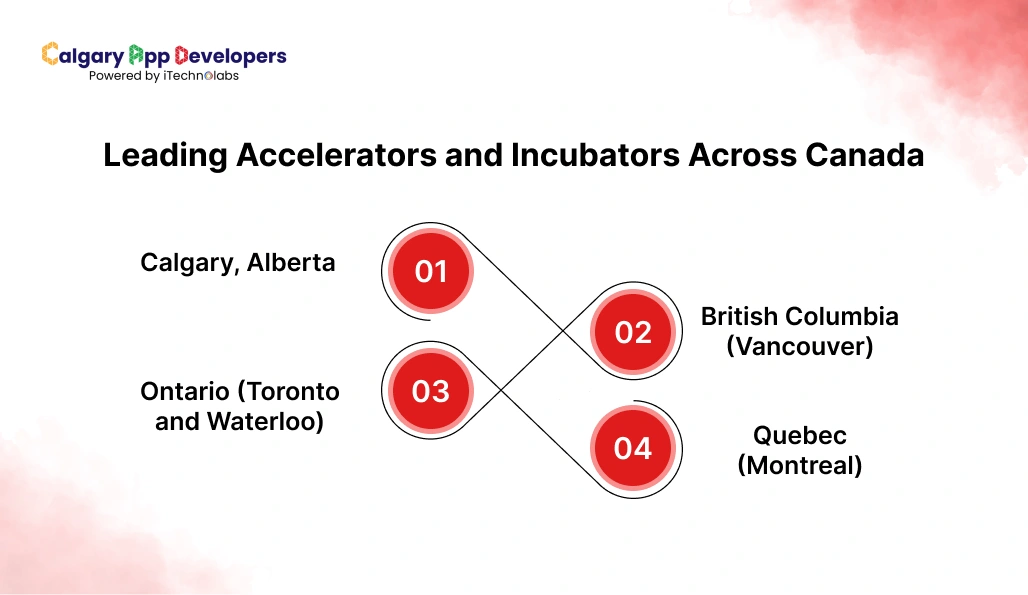
Canada’s regional innovation hubs each host a range of respected accelerators and incubators that support technology-driven ventures. These programs provide mentorship, networking, capital access, and structured growth pathways for early-stage founders and scaling startups. Below are some of the most active organizations in major provinces across the country.
Calgary, Alberta
- Platform Calgary: A central hub for Calgary’s tech ecosystem, providing programming, workspace, and capital connections. Companies within Platform Calgary’s network have contributed to Alberta startups raising over CAD $1.4 billion in venture capital since 2018, reflecting the city’s growing innovation momentum.
- Opportunity Calgary Investment Fund: The Opportunity Calgary Investment Fund supports local SMEs through targeted capital programs. In partnership with the Government of Alberta, it invested CAD 3.5 million through OCIF Express, backing 23 companies and enabling over 150 jobs. It also committed CAD 2.75 million to launch AgSphere, advancing agrifood innovation nationally.
- UCeed (Innovate Calgary): Focused on early-stage investment and commercialisation support for companies emerging from university research.
- Advanced Technology Centre: Offers incubation services for growth-stage technology companies to navigate expansion challenges.
- Roynat Capital (Calgary): Founded in 1962, Roynat Capital is a private equity firm based. As of January 2026, it holds a portfolio of 42 companies across 36 funding rounds and 7 acquisitions. Its broader portfolio track record includes 3 IPOs and 24 acquisitions, with notable companies such as LifeSpeak, John Deere, and Recochem.
Also Read: The Rise of Calgary App Makers: Innovation in Canada’s Tech Scene
British Columbia (Vancouver)
- Launch Academy: One of Western Canada’s prominent startup hubs, Launch Academy reports that it has incubated more than 6,000 entrepreneurs from over 100 different countries and raised over $2.5 Billion in funding across various technology sectors.
- entrepreneurship@UBC: UBC-affiliated startups supported through entrepreneurship@UBC programs have raised over CAD $4 billion in investment capital, reflecting strong commercialization outcomes from academic innovation.
- Innovate BC: As a provincial innovation agency, Innovate BC has supported thousands of companies. BC tech companies collectively raised over CAD $9.2 billion in venture funding between 2020 and 2023, with many supported through Innovate BC programs.
- Yaletown (Vancouver): Founded in 2001, Yaletown remains an active investor with 56 portfolio companies as of September 2025, including 2 new investments in the past 12 months. Its portfolio performance includes 2 IPOs and 19 acquisitions, with companies such as Tasktop, good natured Products, and Redlen Technologies.
Ontario (Toronto and Waterloo)
- DMZ (Toronto Metropolitan University): DMZ has supported more than 2,600 startups globally. Alumni companies have raised over CAD $2.95 billion in capital, positioning it among the top university-based incubators worldwide.
- Creative Destruction Lab (CDL): CDL operates across multiple Canadian cities and internationally. Companies graduating from CDL programs have collectively raised over CAD $35 billion in equity capital.
- Accelerator Centre (Waterloo): Provides programs, funding guidance, and community support to help startups refine and scale their business models.
- Relay Ventures (Toronto): Established in 2008, Relay Ventures has invested in 105 companies as of December 2024. Its portfolio outcomes include 2 unicorns, 3 IPOs, and 50 acquisitions, featuring companies such as ecobee, Paymentus, and Workday Adaptive Planning.
Quebec (Montreal)
- District 3 Innovation Centre: Based at Concordia University, this hub connects founders with mentors and industry partners as they commercialise innovative ventures.
- FounderFuel: FounderFuel portfolio companies have raised over CAD $500 million in follow-on funding since inception, with strong performance in SaaS and digital technology ventures.
These accelerators and incubators represent just a segment of Canada’s vibrant support landscape for founders. Each offers unique strengths suited to different stages of startup growth, from ideation through to market scaling and investment readiness.
Read Also: Why Startups in the U.S. Are Hiring Fractional Dev Teams
How Canadian Accelerators and Incubators Drive Mobile App Innovation
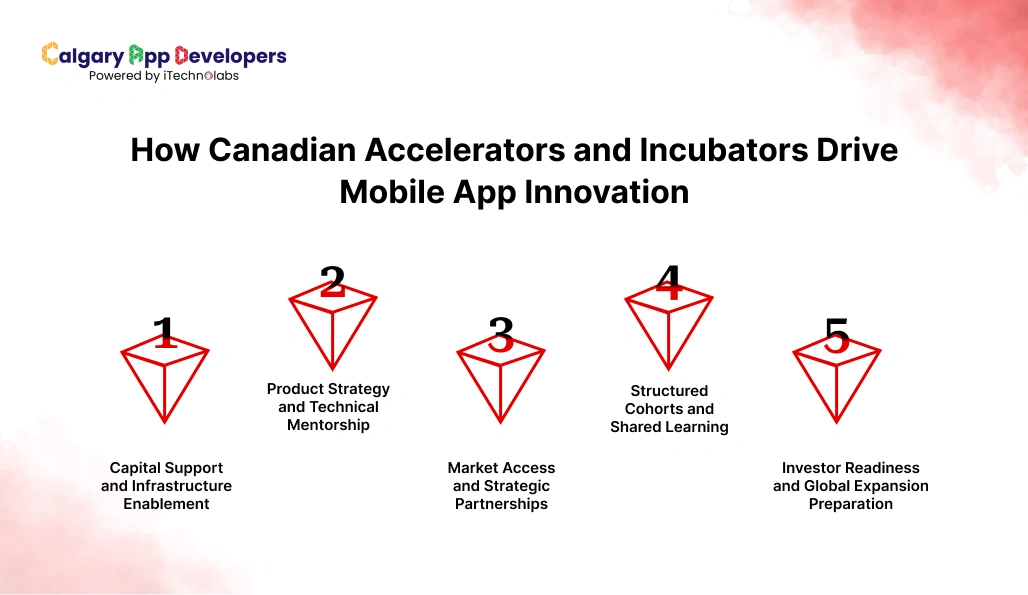
Canadian accelerators and incubators influence far more than startup funding cycles. They actively shape how mobile applications are conceived, built, tested, positioned, and scaled. Their contribution spans capital access, product refinement, market validation, and ecosystem integration. Below are the core ways these programs strengthen mobile app innovation across Canada.
- Capital Support and Infrastructure Enablement
Early-stage mobile app startups often face financial pressure before reaching product-market fit. Canadian accelerators reduce this strain through seed funding, equity investments, grants, and structured introductions to investors.
Beyond direct funding, many programs provide operational support that lowers development costs. Startups frequently receive cloud credits, development tools, cybersecurity advisory, data infrastructure access, and testing environments. These resources allow founders to:
- Build and launch refined minimum viable products
- Run structured beta testing cycles
- Analyze user behaviour through advanced analytics
- Refine pricing and monetization frameworks
Access to financial runway and technical infrastructure enables founders to prioritize product quality and long-term scalability rather than short-term survival decisions.
- Product Strategy and Technical Mentorship
Mobile app founders may possess strong technical skills or creative ideas, yet lack experience in scaling architecture, compliance standards, data governance, or growth strategy. Accelerators address these gaps through curated mentorship networks.
Experienced founders, engineers, growth strategists, UI and UX experts, and investors provide structured guidance throughout the program lifecycle. Support often includes:
- Defining scalable backend architecture
- Choosing between native and cross-platform development approaches
- Strengthening data privacy and security practices
- Refining user experience design for higher retention
- Improving app store visibility and conversion rates
- Structuring revenue models for subscription or transactional growth
This hands-on mentorship reduces costly redevelopment cycles and ensures that applications are technically sound, commercially viable, and aligned with user expectations.
- Market Access and Strategic Partnerships
Accelerators function as gateways into broader innovation networks. They connect startups with enterprise partners, academic institutions, public sector bodies, and venture capital firms.
For mobile app companies, these connections often translate into:
- Pilot opportunities with enterprise clients
- Early revenue through institutional partnerships
- Strategic integrations with established digital platforms
- Investor introductions for seed and Series A funding
- Access to industry-specific advisory boards
In Canada’s diverse economy, partnerships across healthcare, fintech, energy, logistics, and retail create opportunities for app startups to solve real operational challenges. Successful pilot deployments often evolve into scalable commercial contracts.
- Structured Cohorts and Shared Learning
Cohort-based program models foster collaboration among founders navigating similar challenges. This environment encourages transparency, shared problem-solving, and peer accountability.
Mobile app startups benefit from exchanging insights on:
- User acquisition cost management
- Engagement and retention metrics
- Performance optimization across devices
- Feature prioritization frameworks
- Managing user feedback and public reviews
Collective learning reduces isolation and accelerates decision-making. It also builds lasting professional networks that continue beyond the formal program.
- Investor Readiness and Global Expansion Preparation
Many Canadian accelerators culminate in demo days or investor showcases. These milestones push founders to clarify their value proposition, financial projections, and growth strategy.
Startups receive coaching on pitch refinement, financial modeling, valuation positioning, and due diligence preparation. For mobile app ventures with global potential, accelerators also guide cross-border compliance, international market entry, and strategic partnerships abroad.
This structured preparation increases investor confidence and strengthens the startup’s ability to compete in both domestic and international markets.
Collectively, Canadian accelerators and incubators create an ecosystem where mobile app innovation is not left to chance. They provide structured development pathways, expert insight, and strategic connections that transform promising ideas into scalable, investment-ready digital products.
Also Read: How to Find Mobile App Investors
Funding, Mentorship, and Market Access for App Startups
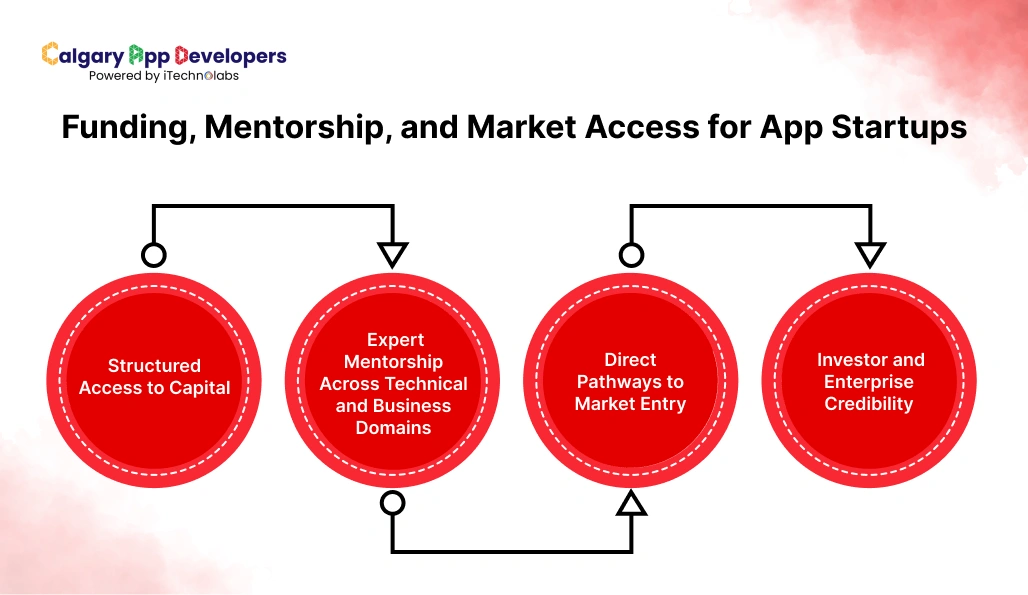
Canadian accelerators and incubators provide structured support that directly impacts how mobile app startups grow, validate, and scale. Their value is most visible across three interconnected areas: capital access, expert mentorship, and market entry opportunities.
- Structured Access to Capital
Canadian accelerators help mobile app startups secure early funding through seed investments, investor introductions, and guidance on government grants. They also support financial planning and valuation strategy, enabling founders to build strong funding cases. This financial stability allows startups to focus on refining their product and achieving market traction without constant operational pressure.
- Expert Mentorship Across Technical and Business Domains
Mentorship connects founders with experienced entrepreneurs, engineers, and growth strategists. Guidance spans scalable architecture, user experience design, data security, monetization models, and customer acquisition strategies. This structured support helps startups avoid costly mistakes, strengthen product performance, and align technical development with clear commercial goals.
- Direct Pathways to Market Entry
Accelerators create access to enterprise partners, pilot programs, and industry networks that help startups validate their apps in real environments. Early market exposure provides user feedback, initial revenue opportunities, and stronger positioning for expansion. These structured connections reduce time to market and increase long-term scalability.
- Investor and Enterprise Credibility
Being part of a recognized program strengthens a startup’s credibility with investors and corporate partners. Founders receive support in refining pitch decks, defining growth metrics, and presenting scalable business models. This preparation improves fundraising outcomes and builds confidence among stakeholders, evaluating long-term investment potential.
Through integrated funding pathways, expert mentorship, and structured market access, Canadian accelerators and incubators create a foundation that enables mobile app startups to grow with confidence and strategic clarity.
Read Also: How to Find a Trustworthy App Developer & Protect Your App Idea?
Key Challenges Faced by Mobile App Startups in Canada
While Canada offers a supportive innovation environment, mobile app startups still face significant operational and strategic challenges. Understanding these barriers is essential for founders aiming to build scalable and competitive digital products.
- Access to Growth Stage Capital: Early-stage funding is often accessible through grants and seed programs, but securing larger Series A and growth-stage investment can be more competitive. Many startups struggle to attract substantial capital without proven traction or international expansion potential.
- Talent Competition and Retention: Canada has a strong technical workforce, yet startups frequently compete with established tech firms and multinational companies for skilled developers, product managers, and AI specialists. Retaining talent can be difficult, especially for early-stage ventures with limited compensation flexibility.
- Market Size and Scalability Constraints: Canada’s domestic market is relatively smaller compared to the United States. Mobile app startups often need to plan for international expansion early, which introduces additional regulatory, marketing, and operational complexity.
- High User Acquisition Costs: The mobile app space is highly competitive. Acquiring and retaining users requires sustained investment in digital marketing, performance campaigns, and brand positioning. Without efficient growth strategies, customer acquisition costs can quickly outweigh revenue.
- Regulatory and Data Compliance Requirements: Startups operating in sectors such as fintech, health, or data-driven services must navigate privacy laws and compliance standards. Meeting federal and provincial regulations demands legal clarity and technical safeguards, which can increase development timelines and costs.
- Monetization and Revenue Model Uncertainty: Many mobile apps struggle to convert user engagement into consistent revenue. Choosing between subscription models, in-app purchases, advertising, or enterprise licensing requires careful validation and market testing.
- Technology Scalability and Performance Optimization: As user bases grow, technical infrastructure must scale accordingly. Poor backend architecture, inefficient codebases, or limited cloud planning can lead to performance issues that affect retention and brand credibility.
Addressing these challenges requires strategic planning, strong technical foundations, and access to experienced advisors. For Canadian mobile app startups, aligning with the right support ecosystem can significantly reduce risk and accelerate sustainable growth.
Also Read: How Vibe Coding Helps Startups Turn Ideas into Prototypes
Government Support and Policy Influence
Canada’s policy framework is intentionally structured to encourage innovation, reduce financial risk, and support commercialization. For mobile app startups, these programs influence everything from early-stage product development to international expansion.
- Scientific Research and Experimental Development Tax Incentive Program (SR&ED)
The Scientific Research and Experimental Development program, commonly known as SR and ED, is one of Canada’s most significant innovation incentives. It provides tax credits for eligible research and development activities, including software experimentation, algorithm development, and technical problem solving.
For mobile app startups building new features, improving performance, or developing proprietary technology, eligible R and D expenses such as developer salaries and contractor costs can be partially recovered. Refundable credits are particularly valuable for early-stage companies that are not yet profitable.
- National Research Council Industrial Research Assistance Program
The National Research Council Industrial Research Assistance Program, known as IRAP, provides both financial support and advisory services to small and medium-sized technology companies. Beyond funding, IRAP connects startups with Industrial Technology Advisors who offer strategic guidance on commercialization, technical development, and growth planning.
Funding may cover a portion of employee salaries or technical project costs related to innovation. For mobile app founders, this reduces the financial burden of building advanced technical capabilities or expanding development teams.
- CanExport Innovation
CanExport Innovation supports Canadian companies seeking to expand into international markets. The program provides financial assistance for activities such as forming global partnerships, attending international innovation events, and validating technology in foreign markets.
For mobile app startups planning cross-border expansion, this support can offset costs tied to market research, partnership development, and early international commercialization efforts.
- Canada’s Intellectual Property Strategy
Canada’s Intellectual Property Strategy is designed to help businesses protect and leverage their innovations. It includes educational resources, funding programs, and advisory services aimed at improving IP awareness and management.
Mobile app startups benefit by learning how to secure trademarks, protect proprietary software elements, and build defensible competitive advantages. Strong IP positioning is often critical during fundraising and acquisition discussions.
- Startup Canada Policy Advocacy
Startup Canada operates as a national voice for entrepreneurs, engaging directly with policymakers to address regulatory challenges and promote innovation-friendly reforms. Through advisory councils and public consultations, founders can influence policy decisions affecting taxation, talent mobility, and digital regulation.
Collectively, these initiatives create a policy environment that lowers barriers to innovation, encourages research investment, and strengthens Canada’s position as a competitive destination for mobile technology ventures.
How Our App Development Expertise Supports Canadian Startups
Building a successful mobile app requires more than a strong idea. It demands technical precision, strategic clarity, and a deep understanding of user behavior. Our team at Calgary App Developer works closely with Canadian startups to transform validated concepts into scalable, high-performance mobile applications built for long-term growth.
We collaborate with founders at different stages, from MVP development to post-launch optimization. By aligning product vision with market expectations, we help startups avoid costly redevelopment cycles and accelerate time to market. Our approach focuses on building secure, scalable architectures that can support rapid user growth while maintaining performance and reliability.
Our support includes:
- End-to-end iOS and Android app development
- Cross-platform solutions for faster deployment
- Scalable backend infrastructure design
- UI and UX design focused on retention and engagement
- App store optimization and launch strategy
- Ongoing maintenance and performance enhancement
For startups participating in accelerators or incubators, we complement mentorship and funding with execution excellence. By combining technical expertise with strategic insight, we help Canadian founders launch applications that are not only functional but also commercially competitive and investment-ready.
Wrapping Up
Canada’s accelerators and incubators play a defining role in shaping the future of mobile app innovation. By combining capital access, structured mentorship, strategic partnerships, and government-backed support, they create an environment where startups can move from concept to commercialization with confidence. These programs do more than fund ideas. They refine business models, strengthen technical foundations, and prepare founders for investor scrutiny and market expansion.
At the same time, success in the mobile app space demands disciplined execution. Startups must navigate competitive user acquisition landscapes, regulatory requirements, and evolving technology standards. Those that align the right support systems with strong product development capabilities are better positioned to scale sustainably.
As Canada continues to strengthen its innovation infrastructure, mobile app startups have unprecedented opportunities to build globally competitive digital products. With the right ecosystem, technical expertise, and growth strategy, founders can transform ambitious ideas into lasting market impact.
FAQ’s
- How do Canadian accelerators contribute to mobile app innovation?
Canadian accelerators support mobile app innovation by providing structured funding, mentorship, and investor access within a defined growth program. They help founders refine product strategy, strengthen technical architecture, and validate market demand. Through demo days and enterprise introductions, accelerators also increase visibility, enabling startups to secure partnerships and scale more efficiently.
- What impact do incubators have on early-stage mobile app startups in Canada?
Incubators focus on nurturing early-stage ideas before rapid scaling begins. They provide workspace, advisory support, technical guidance, and business model refinement over flexible timelines. For mobile app founders, this environment allows careful product validation, user testing, and feature development without the pressure of immediate fundraising milestones.
- Why is Canada becoming a strong hub for mobile app innovation?
Canada’s rise as a mobile app innovation hub is driven by skilled talent, research institutions, venture capital growth, and supportive public policy. Cities across the country host active accelerator networks and technology clusters. Government programs such as SR&ED and IRAP further reduce innovation risk, making the ecosystem attractive for digital product development.
- How do accelerators strengthen app scalability and market readiness?
Accelerators guide startups through performance optimization, scalable backend planning, compliance preparation, and monetization strategy development. Mentors help founders avoid technical bottlenecks while preparing for investor scrutiny. Structured timelines encourage disciplined execution, ensuring the application is technically stable, commercially viable, and ready for broader market expansion.
- Can established businesses benefit from Canadian accelerators and incubators?
Yes. Many programs support not only startups but also growing technology companies seeking innovation partnerships or product expansion. Established firms can access pilot opportunities, collaborative research initiatives, and connections to emerging tech talent. Participating in these ecosystems fosters innovation, accelerates digital transformation, and opens new market opportunities.


Pankaj Arora is a seasoned technology leader and the Founder of Calgary App Developer, with 10+ years of expertise in crafting high-performance digital solutions. His core competencies include full-stack app development, cloud-native architecture, API integration, and agile product delivery. Under his leadership, Calgary App Developers has empowered startups and enterprises alike with scalable mobile applications, secure web platforms, and AI-driven SaaS products.