






Top App Development Trends in North America
Mobile applications are more than just an application in 2026 – they are a lifestyle. Whether it is logging in to order your morning coffee, checking your bank accounts, or planning your weekend plans, there is an application to assist with everything.
As we learn and grow, and as technology progresses, businesses must learn to adapt ahead of the expectations of the users. In major locations, like mobile app development Calgary, Silicon Valley, New York City, and Toronto, developers are creating and adapting to new trends and updating their offerings. Developers are creating smarter, faster, and easier-to-engage apps.
In this blog, we are going to look at the top app development trends in North America impacting 2026 and how we are paving the way for the next generation of innovation.
- AI-driven personalization and automation are defining modern mobile experiences in 2026.
- Cross-platform development and API-first architecture are accelerating speed and scalability.
- Privacy, security, and compliance have become strategic priorities across North America.
- Emerging technologies such as 5G, edge computing, AR, and PWAs are reshaping performance and engagement standards.
- Artificial intelligence is transforming mobile apps through personalized recommendations, predictive insights, and real-time adaptation across industries like healthcare, finance, and retail.
- Cross-platform frameworks enable businesses to reduce development costs while maintaining consistent user experiences across iOS and Android.
- 5G and edge computing are improving speed, reducing latency, and enabling real-time features such as immersive media, telemedicine, and IoT integration.
- Privacy-first development aligned with regulations such as CCPA and PIPEDA is essential for maintaining user trust and minimizing legal risk.
- Progressive Web Apps are expanding rapidly, offering fast, app-like experiences without the friction of traditional app store downloads.
- API-first and microservices architecture support long-term scalability, resilience, and faster feature deployment.
- The North American developer market remains highly competitive, with strong demand for AI, cloud, cybersecurity, and full-stack expertise.
AI-Powered Features and Personalization
AI is revolutionizing mobile app experiences across Canada and the United States, and it is making significant inroads into essential segments such as healthcare, financial services, and retail. In various innovation centers – Calgary, Silicon Valley, Toronto, and New York – app developers are leveraging AI to create rich and highly personalized journeys that enhance engagement and delight users.
How AI Enhances Personalization
- Data-Driven Insights: AI examines huge quantities of user information—from behavior and interests to real-time activity—so that apps can customize content and services for every user individually.
- Adaptive Experiences: Machine learning algorithms learn and update constantly, optimizing recommendations and app performance to match changing user needs.
Industry Applications
- Healthcare: Apps personalize treatment plans, wellness tips, and medication reminders based on the user’s individual health data.
- Finance: AI assists the user in managing their money by providing personalized budgeting and investing suggestions based on goals and preferences and alerts about possible fraud.
- Retail: Shopping apps offer personalized recommendations about products and deals most aligned with an individual’s buying behaviors and preferences.
Benefits for Users and Businesses
- Users: Experience time-saving, satisfying app interactions that are highly relevant and meaningful.
- Businesses: Enjoy increased user engagement and customer loyalty, and outperform competition in competitive markets.
For mobile application developers, implementing AI-powered personalization is no longer creativity—it’s a business necessity. This is a journey that defines app futures in terms of app intelligence and app intuitivity and that is genuinely user-centric.
Also Read: Top Reasons to Hire a Calgary App Developer for Your Next Project
Rise of Cross-Platform Development
As the demand for mobile apps rises in North America, companies want to reach users on both Android and iOS without doubling their development time and cost. Cross-platform development is now the go-to solution, allowing developers to write one codebase that will run on all of these platforms.
Cross-platform tools such as React Native, Flutter and Xamarin allow developers to develop faster, maintain easier, and create more consistent experiences. This is important, especially in fast-moving tech hubs where speed-to-market determines if a product lives or dies.
Over 42% of developers globally prefer using cross-platform tools for app development, as stated by a 2024 report published by Statista, showing an overall increase year by year. This indicates how common and reliable cross-platform solutions are becoming for effectively deploying apps without sacrificing quality.
Advantages for Developers and Businesses
- Cost Savings: Developing one app for several platforms eliminates development and maintenance expenses.
- Faster Time-to-Market: Deploy apps quickly on iOS and Android without duplicating effort.
- Consistent User Experience: Across-device consistent UI and features reinforce brand identity and user happiness.
For app developers in major North American markets, adopting cross-platform development is the key to remaining agile and competitive. With increasingly more businesses looking for fast, affordable options, this trend will only increase in 2026 and beyond.
5G and Edge Computing Transforming App Performance
The deployment of 5G networks coupled with the emergence of edge computing is transforming the way mobile applications behave and offer experiences. Both technologies significantly lower latency, improve data rates, and process in real time, making apps faster, smarter, and more responsive than ever.
How 5G and Edge Computing Work Together
- 5G Networks increase internet speeds and connection reliability, enabling uninterrupted video calls, easier and instantaneous downloads, and uninterrupted streaming even during peak congested timeframes.
- Edge Computing allows the processing of data to occur closer to the user’s device, rather than relying on the cloud entirely. This reduces the time required and allows the application to run more advanced operations locally.
Impact on Mobile Apps
- Enhanced Real-Time Experiences: Live data-driven applications, including gaming, Augmented Reality (AR) and telemedicine, can benefit from near-instant responses and real-time engagement with negligible lag.
- Increased IoT Integration: Internet of Things (IoT) enables devices to exchange information and respond quickly, creating new opportunities in smart homes, wearables and industrial control.
- Improved Offline Performance: Because edge computing allows applications to perform essential functions even with intermittent connectivity, it enhances the continuity for mobile users.
Users get to enjoy smoother, more engaging app experiences with quicker load times and less buffering. Businesses experience increased user satisfaction, increased engagement, and new ways to innovate with newer features that were previously impossible to achieve due to network limitations.
As 5G networks grow and edge computing technology becomes more advanced, app developers will be challenging what is possible—bringing quicker, smarter, and more context-aware apps into everyday life.
Increased Demand for Privacy-First and Compliant Apps
With consumers becoming increasingly conscious of how their personal information is being gathered and used, privacy has emerged as an utmost priority in app creation. Business houses from North America are responding to this by creating privacy-first apps that are user-respectful and regulatory-compliant with local legislation such as California’s CCPA and Canada’s PIPEDA.
Understanding the Regulations
- CCPA (California Consumer Privacy Act):
Provides Californian citizens greater control over their data, including a right to know what personal information is being collected, a right to request deletion of that information, and a right to request opting out of the sale of that data.
- PIPEDA (Personal Information Protection and Electronic Documents Act):
Canada’s federal privacy law governs how private-sector organizations collect, use, and disclose personal data in the course of commercial activities.
What Developers Are Doing
To comply with these requirements, app developers are incorporating robust data protection features such as:
- Clear privacy policies and simple-to-read user consent documents.
- Data storage and encryption practices that protect data.
- Capabilities to let users edit, access, and remove their personal information.
- Regular monitoring and updating to remain compliant with changing legislation.
Why It Benefits Users and Businesses
- Users feel secure in the knowledge that their privacy is being kept and their information is safe.
- Companies minimize legal risks, establish trust, and stand out in an ever-more data-security-conscious market.
The Bigger Picture
Privacy-first development is no longer merely about compliance—it’s a competitive edge. As privacy laws constrict and users’ expectations rise, apps that put data protection and transparency first will be the ones to dominate in earning user loyalty and achieving long-term success.
Read Also: Top Reasons USA Firms Choose Calgary App Developers
Progressive Web Apps (PWAs) Gaining Ground
Progressive Web Apps (PWAs) are a formidable force to be reckoned with, now challenging conventional mobile apps as the best of web and native in one. Fast and light, and easily accessed directly from a browser, PWAs are making waves throughout North America—particularly among businesses seeking to increase reach at minimal native app development expense.
What Makes PWAs So Appealing?
- No App Store Needed: Users can access PWAs directly through a URL and install them on their devices without involving app stores.
- Offline Capability: PWAs cache content, enabling users to surf and engage with the app even offline.
- Fast Load Times: PWAs are performance-optimized, providing fast load times that improve user experience.
- Cross-Device Support: One PWA can work across desktop, tablet, and mobile, simplifying development.
The Numbers Tell the Story
According to recent market analysis, the global Progressive Web App (PWA) market is projected to grow at a 31 % compound annual growth rate (CAGR) from 2025 to 2034, driven largely by North America’s strong adoption and demand for fast, reliable, app-like web experiences. North America is expected to maintain a leading share of this market growth through the forecast period.
Benefits for Users and Businesses
- Users: Get fast access, seamless performance, and a native-like experience without significant downloads.
- Businesses: Engage more audiences, minimize development and maintenance costs, and enhance engagement metrics.
As user behavior trends towards speed and convenience, PWAs are increasingly a strategic option for innovative companies. In 2026, anticipate more brands in North America embracing PWAs to provide quality digital experiences with fewer frictions.
Sustainable and Ethical App Development
As ethical consumerism and climate awareness grow, sustainability is a growing concern in the way apps are designed and utilized. By 2026, users are not just considering what an app does but also how it’s created. From energy efficiency to accessible design, app developers in North America are adopting more sustainable and morally responsible approaches.
What Sustainable and Ethical Development Looks Like
- Energy-Efficient Code: Applications are being optimized to use less energy, particularly for power-intensive features such as background syncing or GPS.
- Green Hosting Solutions: Increasing apps are being hosted on cloud servers that are powered by renewable sources in an effort to minimize carbon footprints.
- Ethical Data Practices: Only gathering necessary data, being transparent with users, and refraining from manipulative design patterns (such as dark patterns).
- Inclusive Design: Designing for accessibility as a default—enabling screen readers, having text resizing, and designing with color contrast to make apps accessible to everyone.
Industry Movement and Accountability
- Major app stores are starting to highlight apps that adhere to ethical design principles.
- Certifications and badges (such as “Green Software Foundation” membership) are becoming trust markers for users.
- Businesses are establishing internal ESG (Environmental, Social, and Governance) targets and linking digital products to such objectives.
Benefits for Everyone
- Customers feel more connected to brands that reflect their values and therefore feel more trusting and loyal.
- Companies future-proof products, save on operational expenses, and differentiate themselves in a market increasingly driven by social and environmental responsibility.
Ethical and sustainable app development is no longer a niche consideration—it’s a competitive edge. In 2026 and the future, the most successful apps will be those that not only deliver what users need but do so with a sense of conscience.
Also Read: Outsourcing to Calgary: A Smart Move for U.S. Businesses
No-Code/Low-Code Development Platforms
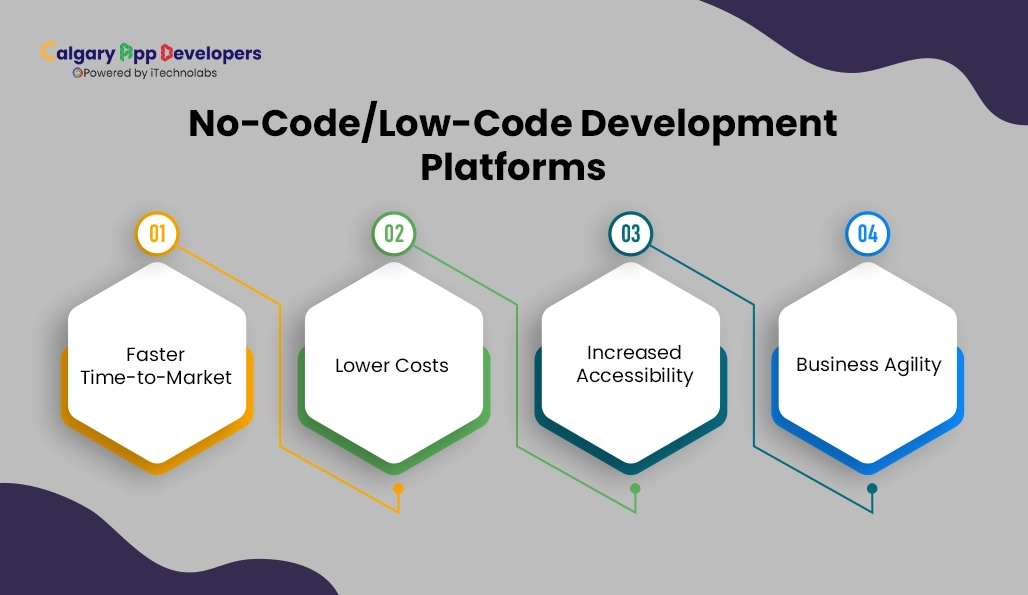
The demand for faster and easier ways to create applications is fueling the growth of no-code and low-code platforms. These tools allow non-coders and small teams to create attractive, working applications without a high-level coding background—in some cases making application development reproducible and quicker across North America.
What Are No-Code and Low-Code Platforms?
- No-Code Platforms can provide you with the ability to create applications through visual drag-and-drop-like interfaces that allow end-users with minimal technical experience to put something together with ease.
- Low-Code Platforms offer the same ease of use as no-code platforms while providing you with the ability to add custom code as required, allowing quicker development without sacrificing functionality or complicated features.
Why They’re Booming in 2026
- Faster Time-to-Market: Businesses can prototype and deploy apps in days or weeks rather than months.
- Lower Costs: Reduces the need for large development teams, saving time and resources.
- Increased Accessibility: Opens up app creation to marketers, entrepreneurs, and other non-technical professionals.
- Business Agility: Enables rapid experimentation and iteration, which is especially useful in fast-moving industries like retail, education, and logistics.
Popular platforms such as OutSystems, Bubble, Mendix, and Glide are being adopted by startups and enterprises alike for internal tools, customer-facing apps, and MVPs.
Use Cases Across North America
- Retailers are developing personalized loyalty apps.
- Healthcare professionals are designing scheduling and telehealth platforms.
- SMBs are making internal tools for operations and project management.
As these platforms further develop with AI and enhanced scalability, no-code/low-code development is turning into the backbone of digital transformation. In 2026, anticipate even more organizations embracing these solutions to innovate at speed, lessen reliance on conventional development cycles, and facilitate empowerment of cross-functional teams.
The Rise of Super Apps and Industry-Specific Solutions
In 2026, companies are moving away from scattered digital tools to single, purpose-designed solutions. Super apps—applications that merge several services into one user experience—are remaking the way companies think about mobile solutions. Meanwhile, there is increasing demand for industry-specific applications that address specialized problems with customized functionality.
What Are Super Apps?
Super apps combine many features, including messaging, payments, e-commerce, booking, and help, in one single, unified interface. Super apps were initially accepted in Asia and are starting to gain traction in North America—particularly amongst businesses trying to streamline user journeys and fight app fatigue.
In addition to super apps, vertical-specific platforms are also flourishing. If it is an app for patient engagement for healthcare organizations, a delivery coordination app for logistics companies, or an inventory management app for retailers—businesses are now looking for bespoke apps designed specifically to suit their industry requirements.
Driving Factors
- Need for Customization: No longer do industry-specific challenges find solutions in one-size-fits-all platforms.
- Efficiency in Operations: Bespoke apps optimize workflows and fit in more seamlessly with current systems.
- User Expectations: B2B and B2C users alike now demand strong, one-stop-shop solutions with user-friendly design and smooth operation.
As this movement continues to grow, organizations are increasingly looking to regional specialists who possess an understanding of both the technology and the local business realities. For instance, custom app development Calgary has exploded as businesses seek nimble, scalable solutions that accommodate their specific workflows and market realities.
Super apps and vertical-specific platforms will remain on top of the app development scene in North America. Businesses that embrace these solutions first can look forward to greater customer loyalty, more efficient operations, and a competitive advantage in their segment.
Read Also: The Future of Mobile App Development in Western Canada
Developer Market Trends in North America (USA & Canada Focus)
Understanding where the developer market is headed through 2026 helps businesses make informed hiring and strategic decisions. Demand for skilled developers remains strong in both the United States and Canada, driven by digital transformation, cloud adoption, AI integration, cybersecurity, and mobile technologies.
Employment Growth & Demand Projections
- According to updated U.S. government projections, employment for software developers, quality assurance analysts, and testers is expected to grow about 15 percent from 2024 to 2034, much faster than the average for all occupations, reflecting the continued need for technical talent.
- Overall, software engineering roles in the U.S. tech job market are also forecast to increase significantly through 2033, with approximately 327,900 new jobs added, illustrating persistent demand for digital skills.
High Demand for Skilled Developers
- In Canada, nearly half of technology employers plan to increase hiring through 2026, with 48 percent indicating growth in IT and tech roles and 41 percent increasing contract hiring, while around 50 percent report greater difficulty finding skilled tech talent compared to a year ago.
- Advanced skills such as AI, cybersecurity, cloud engineering, and data analytics are especially in demand as employers prioritize digital transformation across sectors.
Top In-Demand Developer Skills
Companies across North America are focusing hiring on the following areas:
- Full-Stack & Web Development with frameworks like React, Node.js, and Python.
- Cloud Engineering with AWS, Azure, and Google Cloud expertise.
- Mobile Development using Flutter, Kotlin, and Swift.
- AI/ML & Data Science for intelligent features and automation.
- Cybersecurity & DevSecOps to secure digital infrastructure.
- AI Integration Skills, including generative AI workflows, shaping both technical and cross-functional roles.
Salary & Compensation Trends
Remote and regional salary data for software engineers in North America shows competitive compensation, with average North American developer salaries around USD 82,757 annually and senior roles significantly higher, indicating sustained value for experienced talent.
Market Outlook and Size
The global software market continues expanding rapidly. Projections indicate the software industry’s value will grow from around USD 823.92 billion in 2025 to over USD 921.14 billion in 2026, with an expected long-term expansion toward USD 2.47 trillion by 2035. North America contributes a major share of this growth.
Top In-Demand Skills in 2026
- Full-Stack Development (React, Node.js, Python)
- Cloud Engineering (AWS, Azure, Google Cloud)
- Mobile Development (Flutter, Kotlin, Swift)
- AI/ML & Data Science
- Cybersecurity & DevSecOps
The rise of generative AI is also influencing job roles, with developers expected to integrate AI features into apps or work alongside no-code/AI-assisted platforms.
Post-pandemic, flexibility remains a major factor in hiring and retention. Companies offering remote or hybrid roles are tapping into talent pools across borders. Nearshoring and remote collaborations between U.S. and Canadian firms are becoming more common due to cultural alignment and timezone advantages.
What This Means for Businesses
- Increased Competition for Talent: Businesses must offer more than just good pay—flexibility, purpose, and upskilling opportunities are key.
- Growing Role of Developer Partners: Many companies are collaborating with agencies and dedicated development teams to meet project timelines without compromising quality.
- Focus on Retention: With rising developer turnover rates, employer branding and long-term career development plans are more important than ever.
North America’s developer market is evolving quickly. To stay competitive, companies must adapt their hiring strategies, embrace diverse talent models, and invest in strong technical partnerships.
Immersive Experiences with AR, VR, and Spatial Computing
Immersive technology is no longer experimental. In 2026, augmented reality, virtual reality, and spatial computing will become practical tools for engagement, training, and commerce across North America. As devices improve and 5G networks mature, immersive app experiences are moving into the mainstream.
Why This Trend Is Accelerating
- Improved Hardware Adoption: Smart glasses, AR-enabled mobile devices, and advanced headsets are becoming more accessible. This lowers the barrier for businesses to experiment with immersive features.
- Consumer Expectation for Interactivity: Users now expect richer, more interactive digital experiences. Static interfaces are being replaced by visual, layered, and spatial interactions.
- Enterprise Use Cases Expanding: Beyond gaming, AR and VR are being used in healthcare training, remote equipment diagnostics, retail visualization, and real estate walkthroughs.
Real-World Applications
- Retail: Customers can visualize furniture in their homes or try on products virtually before purchasing, reducing return rates and increasing purchase confidence.
- Healthcare: Medical training apps use AR overlays to simulate procedures, while rehabilitation apps guide patients through therapy sessions in immersive environments.
- Manufacturing and Field Services: Technicians use spatial apps for remote assistance, receiving step-by-step guidance overlaid directly onto physical equipment.
Business Impact
Immersive features increase engagement time, improve decision-making confidence, and differentiate brands in competitive markets. In 2026, immersive app capabilities are becoming a strategic investment rather than a marketing experiment.
API-First and Microservices Architecture Becoming Standard
Behind every high-performing mobile app in 2026 is a flexible architecture. API-first design and microservices are replacing traditional monolithic systems across North America, allowing companies to scale and innovate faster.
What This Means
- API-First Development: Apps are designed with integration in mind from day one. Core services are exposed through APIs, making it easier to connect with payment systems, AI tools, CRMs, and analytics platforms.
- Microservices Structure: Instead of building one large codebase, applications are divided into smaller, independent services. Each service handles a specific function and can be updated without affecting the entire system.
Why Businesses Are Adopting This Model
- Faster Feature Deployment: Teams can release updates to specific services without downtime or major disruptions.
- Improved Scalability: If one feature experiences heavy usage, it can scale independently without affecting other parts of the app.
- Stronger Resilience: If one service fails, the entire application does not collapse. This improves uptime and reliability.
- Easier Technology Evolution: Companies can adopt new technologies gradually without rebuilding their entire platform.
Strategic Advantage in 2026
Businesses operating in fintech, healthcare, retail, and logistics require flexibility. API-driven systems allow rapid experimentation, faster integrations with AI capabilities, and easier expansion into new markets. This architectural shift supports long-term growth and reduces technical debt.
Conclusion
As the North American tech landscape continues to evolve, staying ahead of mobile app development trends is no longer optional—it’s essential. From AI-powered personalization and cross-platform efficiency to ethical design and privacy-first frameworks, 2026 demands innovation that’s smart, secure, and sustainable. Businesses that embrace these shifts not only future-proof their digital products but also deepen user trust and engagement.
Whether you’re an enterprise seeking tailored solutions or a startup bringing bold ideas to life, aligning with forward-thinking developers can make all the difference. If you’re exploring reliable and strategic mobile app development Calgary or tech-forward cities like Toronto, Vancouver, Austin, or San Francisco, now is the perfect time to tap into local expertise that blends innovation with a deep understanding of North American market needs.
FAQ’s About Latest Mobile Application Development Trends
- What are the most important app development trends in North America for 2026?
The most significant trends include AI-powered personalization, cross-platform development, 5G and edge computing integration, privacy-first app design, Progressive Web Apps, and API-first architecture. Immersive technologies such as AR and spatial computing are also gaining traction. Together, these trends focus on speed, scalability, intelligence, security, and improved user experience.
- Why is AI becoming essential in mobile app development?
AI enhances personalization, automates decision-making, and improves user engagement through predictive insights. From fraud detection in finance to customized recommendations in retail and healthcare monitoring, AI allows apps to adapt in real time. In 2026, businesses leveraging AI-driven features gain competitive advantage by delivering smarter, more intuitive digital experiences.
- Is cross-platform development replacing native app development?
Cross-platform development is not replacing native development entirely, but it is becoming the preferred approach for many businesses. It enables faster deployment across iOS and Android using a single codebase, reducing cost and time-to-market. Native development remains valuable for performance-intensive applications requiring deep hardware integration or complex system access.
- How are privacy regulations influencing app development in North America?
Privacy laws such as CCPA in the United States and PIPEDA in Canada are pushing developers to prioritize transparent data collection, encryption, and user control. Businesses must integrate compliance from the design stage to reduce legal risks and build trust. Privacy-first development has shifted from optional compliance to a strategic competitive advantage.
- What skills are most in demand for developers in 2026?
Full-stack development, cloud engineering, AI and machine learning, cybersecurity, and mobile development remain highly sought after. Additionally, expertise in generative AI integration and API-driven systems is becoming increasingly important. As companies accelerate digital transformation, developers with scalable architecture and security-focused skills are especially valuable.
- How should businesses prepare for evolving app development trends?
Businesses should adopt flexible architectures, invest in AI capabilities, prioritize security and compliance, and consider cross-platform strategies to reduce cost and speed deployment. Partnering with experienced development teams and focusing on long-term scalability ensures adaptability. Proactive planning allows companies to stay competitive as technology and user expectations continue evolving.


Pankaj Arora is a seasoned technology leader and the Founder of Calgary App Developer, with 10+ years of expertise in crafting high-performance digital solutions. His core competencies include full-stack app development, cloud-native architecture, API integration, and agile product delivery. Under his leadership, Calgary App Developers has empowered startups and enterprises alike with scalable mobile applications, secure web platforms, and AI-driven SaaS products.