









Avail Right Calgary IT Support for Your App Development Needs
Imagine you’re building the next must-have app — but the real challenge isn’t code, it’s finding the right IT support to bring it to life. In Calgary’s rising tech ecosystem, that challenge actually feels more like an opportunity. Why? Because this city is not just surviving—it’s thriving.
In 2025, Calgary’s tech scene is now worth a solid $6.7 billion, marking a 13 % increase since 2023. And, with a staggering 78 % surge in tech jobs over the past five years, Calgary has quietly become North America’s fastest-growing hub for talent.
What does that mean for you as an app developer? It means access to a deep pool of skilled IT support—with teams that understand the pace and scale of your vision. In this blog, we’ll guide you through how to choose the perfect Calgary-based IT partner, whether you’re prototyping MVPs or gearing up for global scale. Let’s make sure your app isn’t just built—but built smart.
Understanding Your App Development Goals
Choosing the right IT support partner begins not with a Google search, but with self-reflection. Before you talk to any Calgary-based developer or tech firm, you need clarity on your vision. Why? Because your goals define the direction, timeline, cost, and success of your entire project.
A solid foundation prevents wasted time, miscommunication, and scope creep—three of the most common causes of failed app projects.
Here’s how to break down your goals effectively:
- Define the “Why” Behind Your App
What motivated you to build this app? Are you trying to:
- Launch a new digital product?
- Improve operational efficiency for your business?
- Serve an underserved niche in the Calgary market or beyond?
This isn’t just a philosophical question—it informs your features, tech stack, and the kind of expertise your IT partner must bring to the table.
- Understand Your Target Users
A successful app is built for the user, not just for the founder. Start by outlining:
- Who your primary users are (age, tech-savviness, behavior)
- What pain point your app solves for them
- When and how often they’ll use the app
For instance, if you’re targeting busy professionals, the app must be quick, intuitive, and mobile-first. If you’re serving field technicians, it may need offline mode and GPS.
- Identify Key Features
All apps can’t do everything—at least not at once. Be brutally honest about what you need now vs. what can wait.
Break your features into:
- Core Features (must-haves for your MVP)
- Secondary Features (can be added in later phases)
- Stretch Features (nice-to-haves if budget and time allow)
Example:
If you’re building a restaurant ordering app, core features might include menu browsing, ordering, and payment integration. A loyalty program or delivery tracking could come later.
- Decide on the Tech Approach
This is where an IT partner can guide you—but you should still know the basics:
- Will your app be iOS, Android, or cross-platform?
- Do you prefer a native feel or quicker development using Flutter or React Native?
- Does your project need a backend dashboard or admin panel?
This decision impacts everything from cost to launch time.
- Set Timelines That Match Reality
Ask yourself:
- Do you need to launch by a specific event or season?
- Do you have time for testing, iteration, and feedback?
- Are you okay with launching an MVP first and scaling?
Be realistic. Rushed timelines often lead to half-baked apps and poor user retention.
- Be Transparent About Your Budget
Your budget sets the boundaries. Calgary has a thriving tech sector with options for every price range—but IT firms need to know your financial ceiling to recommend the right approach. A tight budget might mean:
- Fewer features to start
- Leaner tech stack
- A phased rollout
Being upfront saves everyone time and sets the relationship up for success.
- Plan for What Comes After Launch
Many businesses forget: building the app is only Phase One. You’ll also need:
- Ongoing support and maintenance
- Regular updates based on user feedback
- Marketing and user onboarding
Talk to IT support providers about long-term collaboration. This is especially relevant for firms offering app development Calgary businesses rely on, where local expertise often includes post-launch support and user analytics.
When your goals are vague, your development path will be rocky. But when your goals are crystal clear, everything else—timelines, budgets, hiring IT support—falls into place.
Also Read: How Mobile App Development Is Evolving in Calgary
Key Qualities to Look for in Calgary IT Support Providers
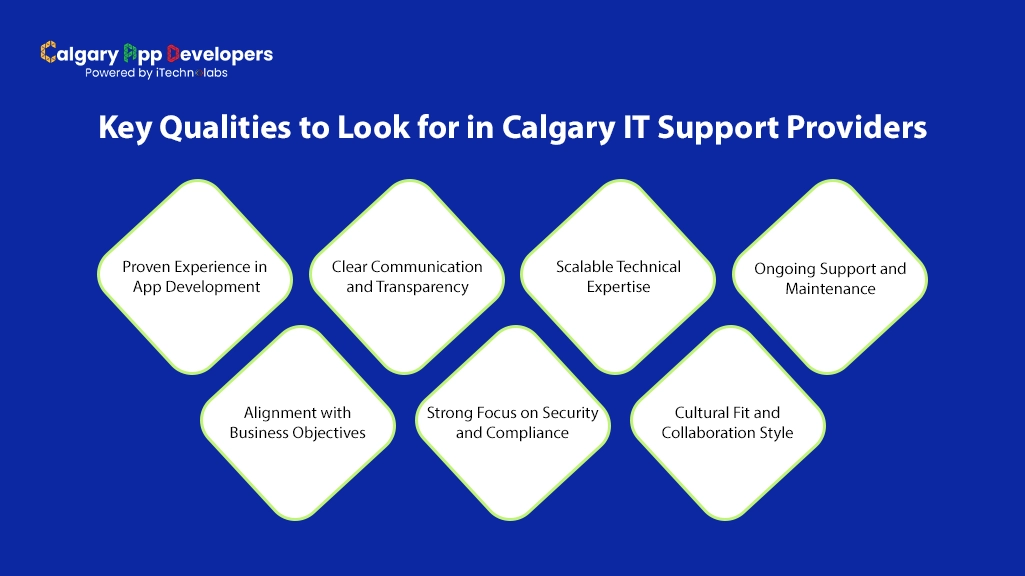
When you’re investing in a mobile or web app, choosing the right IT support partner can make or break your project. It’s not just about who offers the lowest quote — it’s about who has the expertise, communication, and long-term vision to bring your product to life and help it grow.
In Calgary’s evolving tech ecosystem, there are many promising firms, but knowing exactly what to look for helps you find a partner, not just a provider. Here’s what sets top Calgary IT Support providers apart:
- Proven Experience in App Development
Experience matters — especially in tech. An IT provider with a strong background in mobile or web app development will have already navigated common development hurdles like app store approvals, third-party integrations, scalability planning, and UX optimization.
Don’t just look for general IT support — look for teams with:
- A portfolio of successful apps (ask for demos or links)
- Experience across platforms (iOS, Android, cross-platform)
- Case studies that show problem-solving, not just coding
This ensures they have real-world insight and won’t be learning at your expense.
- Clear Communication and Transparency
Poor communication is one of the biggest risks in software development. The best IT partners:
- Keep you updated at every stage (planning, design, development, testing)
- Offer realistic timelines and deliverables
- Are upfront about costs, limitations, and potential risks
Avoid teams that overpromise or are vague. Clarity now prevents scope creep, hidden fees, and missed deadlines later. A transparent process builds trust and gives you visibility into the progress of your app.
- Scalable Technical Expertise
Many projects start small but grow quickly. Your IT support provider should be capable of growing with your product without needing to be replaced. This means they should offer a full-stack skill set, including:
- Frontend and backend development
- API integrations
- Database design and management
- DevOps and cloud infrastructure (e.g., AWS, Azure, Google Cloud)
- QA testing and automation
This holistic expertise ensures your app isn’t just functional at launch — it’s ready to scale efficiently as your user base grows.
- Ongoing Support and Maintenance
An often-overlooked factor is what happens after launch. Every app needs updates to fix bugs, respond to user feedback, improve security, and adapt to new OS versions.
Your IT partner should offer:
- Ongoing maintenance plans
- Emergency support (especially for downtime or critical issues)
- A proactive update cycle for software libraries and platform dependencies
Ask how they manage support tickets, turnaround times, and performance monitoring. Ongoing support is essential for long-term success — not just a nice-to-have.
- Alignment with Business Objectives
A great IT provider does more than follow instructions — they understand why you’re building the app. When your partner understands your business goals, they can make better decisions about:
- Prioritizing features for your MVP vs. long-term roadmap
- Selecting technologies that fit your budget and future plans
- Suggesting UX or feature improvements based on user needs
For example, if your goal is rapid user acquisition, they might recommend lightweight infrastructure and analytics integrations to help you iterate quickly. A team that thinks strategically becomes an extension of your business, not just a vendor.
- Strong Focus on Security and Compliance
Security should be built into your app from day one — not added as an afterthought. Whether you’re handling user data, processing payments, or collecting analytics, your IT provider must ensure:
- Data is encrypted in transit and at rest
- Secure coding practices are followed
- Authentication systems (OAuth, 2FA) are implemented
- Compliance with privacy laws like PIPEDA (Canada), GDPR (EU), or HIPAA (US) where relevant
Ask about their security protocols, and how they handle audits, vulnerability assessments, and breach response. Trust is everything in today’s digital economy.
- Cultural Fit and Collaboration Style
Technical skill is important, but so is how your IT partner works with you. Collaboration, mutual respect, and responsiveness can dramatically impact how smooth and enjoyable the development process is.
Look for:
- Teams that respect your input but bring their own ideas
- Flexibility in project management (Agile, Scrum, etc.)
- A collaborative mindset that treats your success as their own
Ideally, you want a partner who’s proactive, not passive — who identifies opportunities and challenges before you even notice them.
Not all IT support teams are created equal. When you’re building something as important as a mobile app, you need more than just coders — you need a strategic partner who understands technology, your users, and your long-term goals.
The best Calgary IT Support providers bring a rare blend of experience, transparency, technical versatility, and business insight. Choosing the right one means your app will be built faster, maintained better, and positioned for real growth.
Read Also: Top Tech Companies in Calgary | Best IT & Software Firms
Evaluating Service Offerings
Once you’ve identified potential Calgary IT Support providers, the next critical step is to evaluate what they actually offer — and how well those offerings align with your app development needs. Not all services are created equal, and a mismatch here can lead to delays, cost overruns, or even the need to switch providers mid-project.
Here’s how to evaluate service offerings with clarity and confidence:
- Assess the Full Development Lifecycle Support
Look beyond basic coding. A high-quality IT partner should provide end-to-end services across the entire app lifecycle, such as:
- Strategy & Discovery: Do they offer business analysis, user research, or technical feasibility assessments?
- UI/UX Design: Can they design intuitive, user-friendly interfaces tailored to your audience?
- Development: Are they equipped to build scalable, secure apps across platforms (iOS, Android, or web)?
- Testing & QA: Do they have dedicated testers or automated testing processes to ensure reliability?
- Deployment & App Store Submission: Will they help you publish, configure servers, and manage launches?
- Maintenance & Updates: Do they offer structured support post-launch?
The more complete their offerings, the more seamless your journey will be — especially if you’re looking for a long-term partnership.
- Look for Customization, Not One-Size-Fits-All Packages
Your project is unique — your service plan should be too. Be cautious of firms that offer fixed “packages” without understanding your specific goals. A good IT provider will:
- Tailor their services to your needs
- Offer flexibility in scope and timelines
- Suggest practical phases (like MVP first, full app later)
Customization ensures you’re not paying for services you don’t need or missing out on features critical to your success.
- Review Technical Capabilities Within Their Offerings
Even if a provider promises “mobile app development,” dig deeper into the how:
- Do they use up-to-date frameworks (like Flutter, React Native, Swift, Kotlin)?
- Are their back-end solutions scalable (Node.js, Python, serverless, etc.)?
- Do they offer CI/CD pipelines for faster testing and releases?
- Can they handle API integrations, cloud hosting, or complex logic?
Match their technical offerings with your app’s required complexity. For example, if you’re building a data-heavy, real-time application, basic development services won’t be enough.
- Ask About Their Approach to Collaboration and Project Management
How will you work together? A strong offering includes not just what they do, but how they do it. Look for:
- Agile methodology or sprint-based planning
- Weekly or biweekly check-ins
- Task tracking through tools like Jira, Trello, or Asana
- Access to staging environments or beta versions
The more structured and transparent their workflow, the more control and clarity you’ll have throughout the project.
- Evaluate Long-Term Value, Not Just Short-Term Delivery
Some IT teams will build your app and move on. Others position themselves as partners — offering proactive updates, optimization suggestions, and data insights over time. Consider:
- Do they provide regular performance reviews?
- Will they support future feature rollouts?
- Is there an option to scale their involvement as you grow?
Think beyond launch — the best service offerings support the long haul.
Also Read: Why Startups in the U.S. Are Hiring Fractional Dev Teams
The Role of IT Support in App Architecture, Deployment, Security, and Maintenance
IT support plays a far more critical role in app development than many realize. While developers write the code and designers craft the interface, it’s often the IT support team that ensures the app is stable, secure, scalable, and sustainable. Their involvement spans every phase of the app lifecycle — from initial architecture to long-term maintenance.
Here’s how expert IT support contributes to each key area:
- App Architecture: Laying the Foundation Right
A well-structured app starts with a solid technical foundation. IT support teams contribute to:
- Designing scalable infrastructure that handles growth in traffic and usage
- Selecting appropriate frameworks, databases, and backend services
- Structuring code and APIs to allow for modular development and future enhancements
By making the right architectural choices early, IT support helps prevent performance issues, bottlenecks, and costly rebuilds down the line.
- Deployment: Smooth, Stable, and Secure Launches
Deployment is not just about “going live.” It involves preparing the app for real-world usage across devices, networks, and platforms. IT support ensures:
- Proper CI/CD (Continuous Integration/Continuous Deployment) pipelines are in place
- Server configurations, load balancing, and hosting environments are optimized
- The app is submitted and approved smoothly in app stores (if applicable)
- Any backend infrastructure (cloud services, APIs, databases) is correctly integrated and secure
They also manage version control, rollback procedures, and environment testing to ensure a stable launch.
- Security: Protecting Data, Users, and Business Integrity
With increasing data regulations and user expectations, security is a non-negotiable priority. IT support teams are responsible for:
- Implementing secure authentication systems (e.g., OAuth, 2FA)
- Encrypting data in transit and at rest
- Ensuring compliance with standards like PIPEDA, GDPR, or HIPAA (depending on industry)
- Running vulnerability scans and security audits
They also monitor for threats post-launch, apply patches, and help your team respond quickly to any potential breach.
- Maintenance: Keeping the App Healthy Long After Launch
Post-launch, the real work begins. A reliable IT support provider will:
- Monitor server uptime, app performance, and crash analytics
- Apply regular updates and bug fixes
- Optimize performance as user traffic scales
- Ensure compatibility with OS and device updates (iOS, Android, browsers)
- Manage backups, recovery systems, and long-term scalability planning
Consistent maintenance helps you retain users, reduce downtime, and adapt to market or user feedback over time.
Read Also: Top App Development Trends in North America
Questions to Ask Before Partnering
Before signing a contract with an IT support provider, it’s essential to ask the right questions — not just to confirm their technical skills, but to understand how they work, communicate, and solve problems. A strong partnership is built on transparency, shared expectations, and mutual trust.
Here are the most important questions to ask before committing to a partnership:
- What experience do you have with projects similar to ours?
This helps you gauge whether they’ve worked in your industry, understand your users, or have dealt with similar technical challenges. Ask for specific examples or case studies that demonstrate relevant experience.
- What is your approach to project planning and management?
Understand how they structure the development process. Do they follow Agile? Waterfall? A hybrid approach? Find out how they plan sprints, manage timelines, track progress, and keep you informed.
- Who will be on our team, and what are their roles?
Ask about the composition of your project team — developers, designers, testers, project managers — and how involved each person will be. Consistency in team members is also important for maintaining momentum and quality.
- How do you handle changes in scope or unexpected challenges?
Scope changes are common in software projects. A good IT partner will have a clear process for managing them. Look for structured change management, clear documentation, and a flexible but disciplined approach to adjustments.
- What communication channels and cadence do you use?
Regular and structured communication is key. Ask:
- How often will we meet?
- Will we use tools like Slack, Zoom, Trello, or Jira?
- Will we have access to project dashboards?
This gives you visibility into progress and builds accountability.
- What does your post-launch support include?
A great IT provider doesn’t walk away after the app goes live. Ask:
- Do you offer maintenance plans or on-demand support?
- How do you handle bug fixes and security updates?
- Is there a service-level agreement (SLA) in place?
- How do you ensure app security and data protection?
Security is non-negotiable. Ask about their data protection practices, including:
- Secure coding standards
- Data encryption
- Compliance with regulations like GDPR or PIPEDA
- User authentication methods
- What happens if we need to scale the project or bring on more resources?
Your needs may change — fast. Ask how easily they can ramp up development resources or expand the scope without affecting quality or stability.
- Can you walk us through a recent challenge and how your team resolved it?
This gives insight into their problem-solving approach, team dynamics, and accountability. It’s one of the most telling questions you can ask.
- What’s your process for measuring success?
A strong partner should track key performance indicators (KPIs) such as load times, crash rates, user retention, and feature usage. Ask how they gather and share these insights post-launch.
Don’t hesitate to dig deep. A reliable IT provider will appreciate your thoroughness — it shows you’re serious about building something that lasts. Asking these questions helps ensure that you choose a team that’s aligned with your goals, communication style, and long-term vision.
Also Read: The Future of Mobile App Development in Western Canada
Budgeting and Cost Transparency
One of the most critical — and often most misunderstood — aspects of choosing an app development calgary is budgeting. Without clear cost structures and expectations, what starts as a well-planned project can quickly become a financial drain. That’s why budgeting and cost transparency should be a top priority from day one.
Here’s how to approach it the right way:
- Understand the Pricing Model
IT providers typically offer one of the following:
- Fixed-price: Best for well-defined, smaller projects with a clear scope.
- Time and materials: Flexible and ideal for evolving or long-term projects, billed based on hours worked.
- Dedicated team: Suitable for ongoing partnerships where you need a full or part-time team assigned to your project.
Ask which model fits your needs and request detailed cost breakdowns.
- Request an Itemized Proposal
A trustworthy provider will give you a clear, line-by-line estimate covering:
- Design and development
- Project management
- Testing and QA
- Third-party tools or APIs
- Maintenance and support (if included)
This breakdown helps you identify where your money is going and plan accordingly.
- Clarify What’s Included — and What’s Not
Some services may be excluded from the initial quote, such as:
- Hosting or cloud infrastructure
- App store publishing fees
- Ongoing support or updates
- Licensing for third-party tools
Ask for full transparency on what is and isn’t covered to avoid hidden costs later on.
- Discuss Flexibility in Budget Scope
Your needs may change mid-project. Ask how the provider handles scope changes and whether they offer flexible billing or phased delivery. Understanding this upfront helps you avoid financial surprises.
- Plan for the Long-Term
Budgeting isn’t just about launch. Consider:
- Maintenance and security updates
- Future feature enhancements
- User support or analytics tools
- Marketing integrations
Make sure your budget includes a post-launch phase, so your app can evolve and stay competitive.
Read Also: How to Find App Developers in Calgary: A Comprehensive Guide
Red Flags to Watch Out For
Not every Calgary IT Support provider will be the right fit — and some could put your project at serious risk. Spotting early warning signs can save you time, money, and unnecessary frustration. Here are the most common red flags to watch for when evaluating potential partners:
- Vague Proposals or Undefined Scope
If a provider can’t give you a clear, detailed proposal — including deliverables, timelines, and cost — proceed with caution. A lack of structure early on usually leads to confusion, delays, and surprise expenses later.
- Overpromising Without Evidence
Be wary of teams that claim they can do everything faster and cheaper than others without showing how. Promises without case studies, references, or a proven track record are often too good to be true.
- Poor Communication or Delayed Responses
Slow replies, missed calls, or unclear answers during the initial discussions are a preview of how your project will be managed. Reliable communication is critical throughout development and post-launch support.
- No Post-Launch Support Plan
If a provider doesn’t offer clear maintenance or update services, it means you’ll be on your own after launch — which can lead to issues with bugs, platform updates, or performance.
- Lack of Transparency in Pricing
Avoid any team that won’t give you a breakdown of costs or dodges questions about billing. Vague pricing often hides hidden fees or leads to inflated invoices as the project progresses.
A good Calgary IT Support is as invested in your success as you are. If you feel rushed, misled, or unsure about a provider’s process — trust your instincts. Asking tough questions early helps ensure you’re partnering with a team that’s skilled, honest, and aligned with your goals.
Also Read: Top Reasons to Hire a Calgary App Developer for Your Next Project
Real-World Challenges Faced by Calgary Businesses — and How Local IT Professionals Solve Them
Building and launching an app in Calgary’s evolving tech environment brings real challenges — especially for growing businesses without large in-house development teams. Whether it’s integration issues, compliance requirements, or infrastructure setbacks, developers often hit roadblocks that can slow down progress or affect performance.
Here are realistic business scenarios and how experienced Calgary IT support teams help overcome them:
- Scaling for Sudden Growth
A Calgary-based transportation startup launched an app to help users find available parking in real time. After receiving local media attention, user traffic spiked unexpectedly — and the app began crashing during peak hours.
How IT support helped:
A local IT team stepped in to re-architect the backend infrastructure using cloud auto-scaling, load balancing, and optimized data caching. This ensured smooth performance, even with higher user demand, and prevented long-term system strain.
- Integrating with Outdated Business Systems
A mid-sized healthcare provider in Calgary decided to digitize its patient scheduling and record access through a mobile app. However, their existing legacy system lacked modern integration capabilities.
How IT support helped:
IT professionals designed a secure middleware layer that connected the legacy system to the new mobile platform. They ensured data was transferred safely and remained compliant with Canadian health data regulations, creating a seamless experience for both patients and staff.
- Navigating Compliance and Data Security
A fintech startup needed to ensure its budgeting and investment app complied with Canadian data privacy laws. The team was unsure how to store and process sensitive financial data securely.
How IT support helped:
The provider implemented Canadian-based cloud hosting, end-to-end encryption, and multi-factor authentication. They also provided compliance consulting for PIPEDA, helping the startup avoid regulatory risk while building user trust.
- Lacking In-House Technical Expertise
A local food delivery service had a strong idea and basic MVP but lacked the technical depth to support growing operations, especially around backend logistics, server reliability, and automated testing.
How IT support helped:
A Calgary-based IT support team provided backend development, infrastructure setup, and QA automation. With proactive monitoring and bug resolution, the platform stabilized and was ready for scale without requiring a full internal dev team.
- Struggling with Deployment and App Store Launch
A tourism-focused business built an app to showcase local trails and experiences but ran into repeated rejections from app stores due to technical and policy issues.
How IT support helped:
Experienced professionals reviewed and optimized the app’s submission package, ensured privacy compliance, resolved compatibility problems, and guided the business through app store approval. The result: faster approval, smoother deployment, and better visibility.
The reality of Calgary app development for businesses is that challenges will arise, but local IT professionals offer the insight and technical depth to solve them quickly and effectively. From scaling and compliance to integration and support, strong Calgary IT support ensures your app is resilient, secure, and built to grow with your business.
Conclusion
Choosing the right IT support partner is one of the most important decisions you’ll make on your app development journey. Whether you’re launching a new digital product, streamlining internal operations, or scaling an existing platform, the success of your app depends heavily on the expertise, transparency, and long-term commitment of the team you choose to work with.
By understanding your goals, evaluating service offerings carefully, asking the right questions, and watching for red flags, you position yourself to make an informed and strategic decision. Fortunately, with the growing ecosystem of Calgary IT support providers, businesses have access to a wide range of talent capable of delivering high-quality digital solutions.
As the demand for app development in Calgary continues to rise, aligning with the right partner ensures your app is not only well-built but also future-ready, secure, and supported beyond launch.


Pankaj Arora is a seasoned technology leader and the Founder of Calgary App Developer, with 10+ years of expertise in crafting high-performance digital solutions. His core competencies include full-stack app development, cloud-native architecture, API integration, and agile product delivery. Under his leadership, Calgary App Developers has empowered startups and enterprises alike with scalable mobile applications, secure web platforms, and AI-driven SaaS products.