









eCommerce Mobile App Development Cost Guide

Launching an eCommerce app always starts with the same question. How much will it actually cost? It is a fair concern because building a shopping app is not a casual expense. The budget can vary widely depending on what you want to sell, how advanced the features are, and the level of quality you expect from the final product.
An eCommerce app can be as simple as a clean storefront with basic checkout or as complex as a full scale platform with personalized recommendations, real time inventory, multiple payment options, and deep analytics.
Each choice you make affects development time, technical effort, and long term maintenance. Understanding these cost drivers early helps you plan realistically instead of reacting to unexpected expenses halfway through the project.
This guide breaks down the real factors behind eCommerce app development cost in a practical and transparent way. The insights shared here come directly from our hands-on experience building and scaling eCommerce applications, where budgeting decisions are tied closely to performance, user experience, and business growth.
By the end, you will have a clear picture of where the money goes and how to invest it wisely.
- eCommerce app development costs vary widely based on features, platform, and scale.
- Basic apps start small, while complex platforms require significant investment.
- Smart planning and phased development help control costs.
- Long term success depends on scalability, UX, and technology choices.
- eCommerce app development costs typically range from $10,000 for basic apps to over $500,000 for complex, enterprise level platforms depending on scope and features.
- App complexity, feature depth, design quality, and platform selection are the biggest factors influencing total development cost.
- Choosing between native and cross platform development directly affects budget, timeline, and future maintenance requirements.
- Technology stack decisions, including cloud services and AI features, impact scalability and long term operating costs.
- Development team location and expertise can significantly change pricing while affecting communication, delivery speed, and quality.
- Starting with an MVP and prioritizing features based on ROI helps reduce upfront costs and validate market demand.
- Ongoing maintenance, security, and updates are essential expenses that should be planned from the beginning.
What Is An e-commerce app?
An e-commerce app is a mobile application that allows users to browse, shop, and purchase products or services directly from their smartphones or tablets. It acts as a digital storefront, bringing your business to the customer’s fingertips. With features like product listings, secure payment gateways, personalized recommendations, and real-time order tracking, an ecommerce app simplifies the entire shopping experience.
For businesses, it’s more than just a sales channel. It’s a powerful tool to build brand loyalty, understand customer behavior, and stay accessible around the clock. Whether you’re a startup launching your first store or an established brand expanding online, an ecommerce app helps you meet customers where they spend most of their time on mobile devices.
In short, an ecommerce app turns your business into a convenient, always-available marketplace that connects directly with your audience and drives consistent revenue growth.
The Promising Future of the E-commerce Industry
E-commerce is not just growing steadily; it’s leaping forward. Here’s what the latest numbers tell us and what opportunities lie ahead.
- Global e-commerce revenue is projected to reach US$3.52 trillion in 2025. Between 2025 and 2030 the market is expected to grow at about 6.37% annually, reaching nearly US$4.79 trillion by 2030.
- The Business-to-Consumer (B2C) segment is scaling fast. In 2023 the global B2C e-commerce market was about US$5.6 trillion. It is expected to nearly double to US$9.9 trillion by 2030, growing at a CAGR of ~7.4%.
What these numbers point to is more than growth in sales. They suggest shifts in how people shop, what they expect, and how businesses must adapt:
- Consumers favor speed, convenience, and personalization. Apps and platforms that deliver quicker fulfillment, smoother UX, and tailored offers will win.
- Emerging markets (India, Southeast Asia, and Latin America) are becoming major battlegrounds. Infrastructure improvements, lower data costs, and rising smartphone use are opening up opportunities.
- Technologies like mobile wallets, digital wallets, payment flexibility, and the logistics that support fast delivery will be critical.
- Businesses will need to make tough trade-offs between investment in user experience, tech infrastructure, and supply chain/logistics to match customer demands and stay competitive.
These trends make one thing clear: developing an e-commerce app isn’t just about building features. It’s about staying relevant in a quickly evolving marketplace where expectations are rising fast.
What Is the Real E-commerce App Development Cost?
Developing an e-commerce app can cost anywhere from $10,000 to over $500,000, depending on the complexity and features you require. Understanding the full process helps avoid surprises and plan your budget effectively.
Total Cost Estimation for Complete E-commerce App Development
| Stage of Development | Basic App | Mid-range App | Complex App |
| UI/UX Design | $2,000 – $5,000 | $5,000 – $12,000 | $12,000 – $25,000 |
| Frontend & Backend Development | $5,000 – $20,000 | $20,000 – $60,000 | $60,000 – $200,000 |
| Payment Gateway Integration | $500 – $1,500 | $1,500 – $5,000 | $5,000 – $15,000 |
| Testing & Quality Assurance | $1,000 – $3,000 | $3,000 – $8,000 | $8,000 – $25,000 |
| Deployment & App Store Submission | $500 – $1,000 | $1,000 – $3,000 | $3,000 – $7,000 |
| Maintenance (Annual) | $1,000 – $3,000 | $3,000 – $10,000 | $10,000 – $30,000 |
| Total Estimated Cost | $10,000 – $50,000 | $50,000 – $150,000 | $150,000 – $500,000+ |
Cost by Application Type
-
Basic E-commerce App
Estimated Cost: $10,000 – $50,000
Ideal For: Small businesses or startups entering online retail.
Features:
- Product catalog
- Simple checkout
- Basic payment integration
- User registration.
Example: Local boutiques or niche startups with a limited product range.
-
Mid-range E-commerce App
Estimated Cost: $50,000 – $150,000
Ideal For: Growing businesses aiming for improved UX and feature sets.
Features:
- Multiple payment gateways
- Order tracking
- Wish lists
- Product reviews
- Intermediate security features.
Example: Regional fashion retailers or medium-sized electronics stores.
-
Complex E-commerce App
Estimated Cost: $150,000 – $500,000+
Ideal For: Large enterprises and global brands.
Features:
- AI-driven recommendations
- AR/VR features
- Multilingual support
- Advanced analytics
- Third-party integrations
- High-level security.
Example: Amazon, Alibaba, eBay, Walmart’s mobile app.
Also Read: How to Create a Shein-Like App: A Complete Guide
Key Factors Affecting the E-commerce App Development Cost
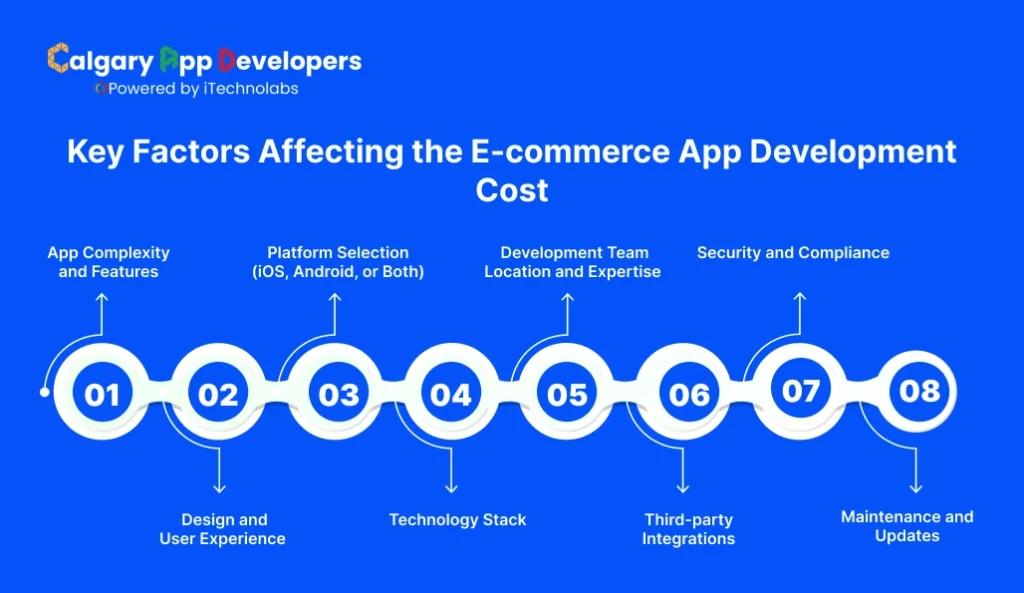
The e-commerce app development cost depends on multiple variables that shape the scope, performance, and overall experience of the final product. Understanding these factors helps you budget smartly and set realistic expectations.
Let’s look at the most significant ones in detail.
- App Complexity and Features
The more advanced the app, the higher the cost. A simple ecommerce app with a product catalog, cart, and payment gateway is faster and cheaper to build. Adding features like real-time tracking, personalized recommendations, AI-driven search, and augmented reality fitting rooms requires extra design, coding, and testing.
Each new feature adds development time and complexity, which directly increases the total investment.
- Design and User Experience
A clean, intuitive interface is essential for customer satisfaction and conversions. Custom UI/UX design that matches your brand identity involves wireframing, prototyping, and user testing.
A basic template-based design is affordable, while a custom design with animations, interactive elements, and seamless navigation can significantly raise the ecommerce app development cost. The goal is to find the right balance between visual appeal and usability.
- Platform Selection (iOS, Android, or Both)
The cost of developing an e-commerce app also depends on which platforms you want to target. Building for a single platform, such as Android, is less expensive than developing separate apps for both Android and iOS.
Native apps, which are built specifically for each platform, provide optimal performance and access to all device features, but they require two separate codebases, which increases the development cost. Cross-platform solutions like Flutter or React Native allow a single codebase to run on both platforms, reducing costs and development time. However, they may have some limitations in performance and access to certain native features.
Here’s a cost comparison to give a clearer picture:
| Platform Type | Estimated Cost (Basic App) | Estimated Cost (Mid-range App) | Estimated Cost (Complex App) | Notes |
| Android Only | $10,000 – $30,000 | $50,000 – $100,000 | $150,000 – $350,000 | Single platform, native performance |
| iOS Only | $12,000 – $35,000 | $55,000 – $110,000 | $160,000 – $375,000 | Single platform, high user engagement in iOS markets |
| Android + iOS Native | $20,000 – $65,000 | $100,000 – $200,000 | $300,000 – $700,000 | Separate native apps, full performance for both platforms |
| Cross-platform (Flutter/React Native) | $15,000 – $45,000 | $80,000 – $160,000 | $250,000 – $500,000 | Single codebase for both platforms, some native limitations |
- Technology Stack
The tools, frameworks, and backend architecture you choose have a direct impact on e-commerce app development cost. Cloud-based platforms like AWS or Firebase improve scalability and performance but increase expenses. Advanced capabilities such as AI recommendations, multi-language support, or real-time analytics require specialized expertise, which adds both development time and cost.
Here’s a cost comparison based on technology choices:
| Technology Stack Type | Basic App Cost | Mid-range App Cost | Complex App Cost |
| LAMP Stack (Linux, Apache, MySQL, PHP) | $8,000 – $20,000 | $20,000 – $50,000 | $50,000 – $120,000 |
| MEAN/MERN Stack (MongoDB, Express, Angular/React, Node.js) | $10,000 – $25,000 | $25,000 – $60,000 | $60,000 – $150,000 |
| Cloud-based (AWS, Firebase) | $12,000 – $30,000 | $30,000 – $70,000 | $70,000 – $200,000 |
| AI/ML Enabled Stack | $20,000 – $40,000 | $40,000 – $100,000 | $100,000 – $250,000 |
- Development Team Location and Expertise
The location and expertise of your development team significantly influence the e-commerce app development cost. Teams in North America or Western Europe generally charge higher rates, while teams in Eastern Europe, India, or Southeast Asia are more affordable. Choosing an experienced team may cost more upfront but often saves money by avoiding delays, rework, and performance issues.
Here’s a cost comparison by region:
| Region / City | Hourly Rate | Estimated Cost (Basic App) | Estimated Cost (Mid-range App) | Estimated Cost (Complex App) |
| USA | $80 – $150 | $15,000 – $35,000 | $60,000 – $150,000 | $200,000 – $500,000 |
| Western Europe | $70 – $130 | $14,000 – $32,000 | $55,000 – $140,000 | $180,000 – $450,000 |
| Eastern Europe | $40 – $80 | $8,000 – $20,000 | $35,000 – $90,000 | $100,000 – $250,000 |
| India / Southeast Asia | $20 – $50 | $5,000 – $15,000 | $20,000 – $60,000 | $50,000 – $150,000 |
| Calgary, Canada | $30 – $60 | $6,000 – $18,000 | $25,000 – $65,000 | $60,000 – $170,000 |
Calgary is emerging as one of the most cost-effective North American locations, offering skilled developers at rates that are lower than traditional tech hubs, without compromising quality or communication.
- Third-party Integrations
Most ecommerce apps rely on external services like payment gateways, CRM tools, analytics platforms, and marketing automation software. Each integration takes development effort and may also involve subscription fees.
For instance, integrating Stripe, PayPal, or Shopify APIs requires additional testing and maintenance, which impacts the overall budget.
- Security and Compliance
Handling user data and online payments means strong security measures are non-negotiable. Adding features like data encryption, two-factor authentication, and compliance with standards such as GDPR or PCI DSS raises the development cost.
While these add-ons increase upfront expenses, they protect your business from risks and build customer trust.
- Maintenance and Updates
Launching your app is just the beginning. Regular updates, bug fixes, server monitoring, and performance optimization are part of ongoing maintenance.
A good rule of thumb is to allocate about 15 to 20 percent of your initial e-commerce app development cost for annual maintenance. Continuous improvement keeps your app competitive and aligned with evolving market trends.
Read Also: How Much Does It Cost to Develop an App Like Shein in Calgary, Canada
How to Minimize E-commerce App Development Cost
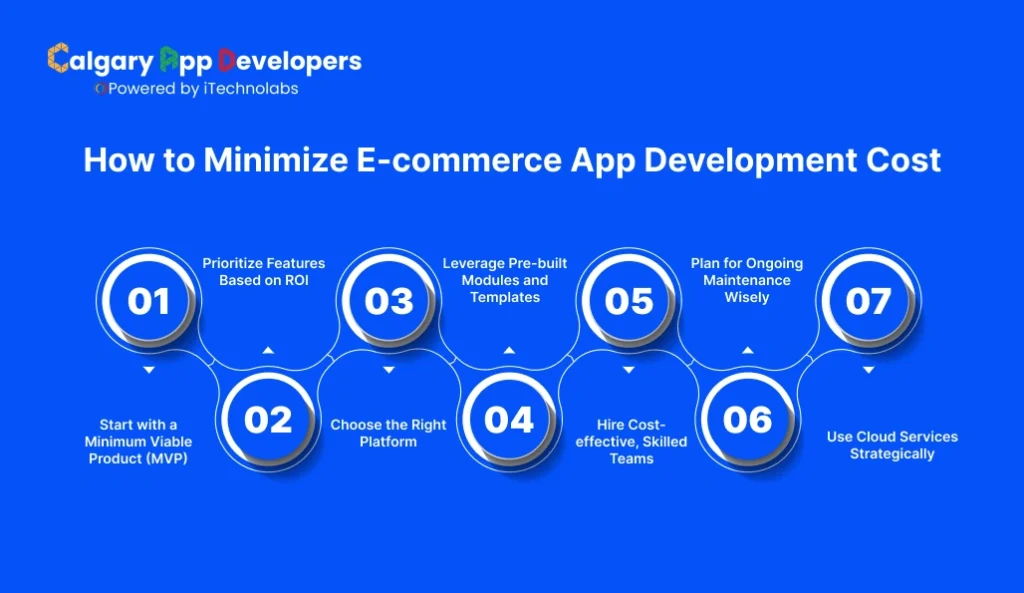
Reducing the e-commerce app development cost doesn’t mean cutting corners on quality. The key is strategic planning, prioritization, and leveraging the right resources. Here’s how businesses can minimize expenses without compromising functionality or user experience.
- Start with a Minimum Viable Product (MVP)
Instead of building a fully featured app from the start, focus on an MVP that includes only the core functionalities like product listings, shopping cart, and payment gateway. This allows you to test the market, get feedback, and validate your idea before investing heavily in advanced features.
An MVP development approach can reduce development time and cost significantly while ensuring you build the features users actually need.
- Prioritize Features Based on ROI
Not all features have equal impact. Identify which functionalities drive the most value to your business and your customers, and implement those first. Advanced features like AI recommendations, augmented reality, or multilingual support can be added in later phases as your app grows.
Prioritization helps control the e-commerce app development cost while ensuring the app delivers measurable results.
- Choose the Right Platform
Developing for a single platform (iOS or Android) or using cross-platform frameworks like Flutter or React Native can save both time and money. Cross-platform development reduces duplicate work while still reaching a wide audience.
Careful platform selection balances performance, user experience, and development cost.
- Leverage Pre-built Modules and Templates
Using pre-built components, templates, and libraries for common features can significantly cut down development time. These modules are tested and optimized, which reduces the chances of bugs and lowers both development and testing costs.
This approach is especially effective for features like login systems, carts, and payment integrations.
- Hire Cost-effective, Skilled Teams
Selecting the right development team is crucial. While North American or Western European teams charge higher rates, locations like Calgary, Eastern Europe, or India offer highly skilled developers at lower costs.
Choosing a cost-effective team with proven ecommerce experience helps minimize the ecommerce app development cost without compromising quality.
- Plan for Ongoing Maintenance Wisely
Unexpected maintenance expenses can quickly inflate your budget. By designing a scalable, well-structured app from the start and documenting your code properly, you reduce future costs. Scheduling regular updates and monitoring performance also prevents costly emergencies.
- Use Cloud Services Strategically
Cloud-based services like AWS or Firebase can reduce infrastructure costs and provide scalability. However, selecting only the necessary services and optimizing usage prevents unnecessary expenses.
By following these strategies, businesses can optimize their e-commerce app development cost while still delivering a high-quality, functional, and scalable app. Proper planning, phased development, and smart technology choices make all the difference in balancing cost and performance.
Also Read: Cost to Develop a Shopping App Like Costco Canada
How a Startup Can Build an E-commerce App
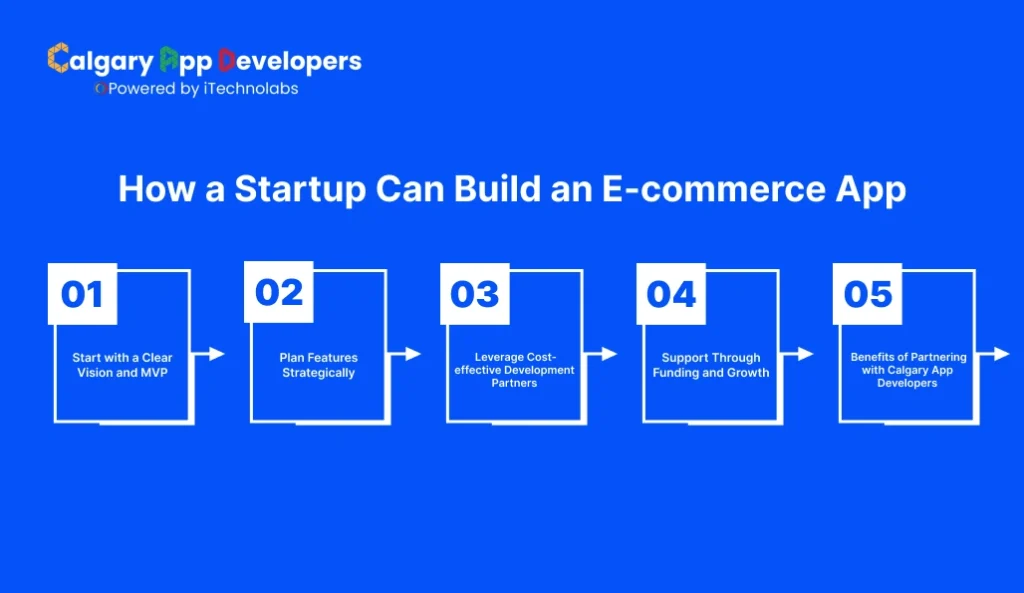
For startups, developing an e-commerce app can seem overwhelming. From defining core features to managing development costs and preparing for funding, there are many moving parts. Understanding the e-commerce app development cost and planning carefully is essential to building a successful, scalable product.
Here’s how startups can approach the process efficiently:
- Start with a Clear Vision and MVP
Every successful e-commerce app begins with a Minimum Viable Product (MVP) that addresses the core needs of your target audience. Focus on essential features like product listings, cart functionality, and secure payments. Starting with an MVP helps reduce initial costs, validate the business idea, and attract early users or investors.
- Plan Features Strategically
Once the MVP is validated, features can be added in phases. Prioritizing features based on user demand and potential return on investment ensures that every addition contributes to growth, helping startups manage the overall e-commerce app development cost effectively.
- Leverage Cost-effective Development Partners
Choosing the right development partner can make a huge difference in cost, quality, and timeline. Calgary App Developers specializes in helping startups build e-commerce apps from concept to launch. Our team provides full support through the entire development process, including:
- MVP development and prototyping
- Scalable architecture and technology selection
- UI/UX design tailored for your audience
- Third-party integrations for payments, analytics, and marketing
- Ongoing maintenance and support
By leveraging our expertise, startups can access high-quality development services at competitive rates without compromising on functionality or performance.
- Support Through Funding and Growth
Beyond development, Calgary App Developers guides startups in preparing for funding and scaling their app. From creating investor-ready prototypes to optimizing technology for growth, we ensure your startup is well-positioned for long-term success while keeping the e-commerce app development cost manageable.
- Benefits of Partnering with Calgary App Developers
- Complete end-to-end support from MVP to launch
- Cost-effective solutions for startups without sacrificing quality
- Expertise in modern technologies, integrations, and scalable architecture
- Focus on helping startups minimize e-commerce app development cost while maximizing impact
With Calgary App Developers, startups can confidently build e-commerce apps that meet market demands, stay within budget, and scale efficiently. We handle the complexities so founders can focus on strategy, growth, and customer engagement.
Why Businesses Choose Us for eCommerce App Development
Businesses choose Calgary App Developers for eCommerce app development because we focus on building platforms that convert users into customers and scale with business growth. Our approach blends practical engineering, user focused design, and commercial awareness to deliver e-commerce apps that perform reliably in real market conditions, not just in demos.
- Commerce First Development Approach: We design eCommerce apps around buying behavior. From product discovery to checkout, every flow is optimized to reduce friction, improve conversion rates, and increase repeat purchases. Features are built to support real revenue goals, not unnecessary complexity.
- Experience Across Diverse eCommerce Models: Our experience spans marketplaces, rental commerce, direct to consumer platforms, and culturally driven fashion apps. This allows us to anticipate challenges around inventory, payments, logistics, and scalability early, reducing development risk and improving delivery speed.
- Transparent Cost Planning and Clear Timelines: We provide detailed cost breakdowns and realistic timelines upfront. Businesses value this clarity because it keeps eCommerce app development budgets under control and prevents scope creep during implementation.
- Scalable and Growth Ready Architecture: Every eCommerce app we build is designed to scale. We focus on clean architecture, performance optimization, and backend flexibility so platforms can handle growing catalogs, traffic spikes, and new features without expensive rebuilds.
- User Experience Designed for Conversion: Our UI and UX decisions are driven by usability and sales performance. Navigation, product presentation, search, and checkout flows are designed to feel intuitive while guiding users toward confident purchase decisions.
- Reliable Communication and Ownership: Clients work with a dedicated team that prioritizes clear communication and accountability. Regular updates, milestone tracking, and documented decisions ensure alignment from planning through launch and beyond.
- Free eCommerce App Consultation in Calgary: We offer a free consultation in Calgary to help businesses validate their eCommerce ideas before investing. This includes feature planning, platform selection, cost estimation, and scalability considerations, giving stakeholders clarity from the start.
Our goal at Calgary App Developers is to help businesses build eCommerce applications that are stable, conversion focused, and ready for long term growth in competitive digital markets.
Our Experience in eCommerce App Development
At Calgary App Developers, our eCommerce app development experience goes beyond building standard online stores. We focus on creating platforms that blend discovery, storytelling, and commerce into a single, intuitive user experience. One strong example of this approach is Bazzarista, a global fashion marketplace designed around culture driven commerce.
Bazzarista reimagines how users discover, rent, and purchase event based and traditional fashion from around the world. Instead of browsing endless product grids, users explore fashion through geography, culture, and design stories, making shopping immersive rather than transactional.
Key features we delivered include:
- Interactive global map interface that lets users explore fashion by country and region
- Region specific fashion discovery, highlighting traditional and trending garments
- Designer profiles showcasing local creators and their collections
- Rental and purchase options for flexibility across different events and budgets
- Curated product listings tailored to cultural occasions like weddings, festivals, and galas
- Smooth e commerce flows covering browsing, selection, checkout, and order management
- Scalable backend architecture to support global users, designers, and inventory growth
This project reflects how we approach eCommerce app development. We build platforms that are visually engaging, culturally aware, and technically scalable. Our focus is always on creating experiences that feel intuitive for users while supporting real business models that can grow across markets and regions.
Conclusion
Building an ecommerce app is a significant investment, and the ecommerce app development cost depends on factors such as app complexity, design, platform, technology stack, integrations, and the development team’s location and expertise. By understanding these elements, businesses can plan strategically, prioritize features, and optimize budgets without compromising on quality.
For startups and growing brands, starting with a Minimum Viable Product and partnering with the right ecommerce app development company is key. Calgary App Developers helps businesses navigate the entire process, from MVP to full-scale launch, ensuring cost-effective solutions, scalable architecture, and long-term success.
With careful planning, phased development, and the right expertise, building a high-performing ecommerce app becomes manageable, efficient, and positioned for growth in a competitive market.
FAQ’s About Ecommerce Mobile App Development Cost:
1. How much does it cost to build an eCommerce app?
The cost of building an ecommerce app depends on complexity, features, platform, and technology choices. A basic app can start at $10,000, while a mid-range app ranges between $50,000 and $150,000. Complex, feature-rich apps for large enterprises can exceed $500,000. Calgary App Developers helps optimize costs without compromising quality.
2. What is a realistic budget for app development?
A realistic budget depends on the app’s scope and features. For startups, allocating $10,000 to $50,000 for an MVP is reasonable. Mid-sized apps require $50,000 to $150,000, while complex apps for global brands can exceed $500,000. Proper planning and phased development help keep the e-commerce app development cost manageable.
3. How much do you charge for app development?
At Calgary App Developers, we provide transparent and competitive pricing tailored to your project. Costs depend on app complexity, features, platform, and integrations. Our goal is to deliver high-quality e-commerce apps efficiently, from MVP to full-scale launch, while keeping the app development cost optimized for startups and growing businesses.
4. How much does it cost to develop an app in Canada?
App development in Canada is generally more affordable than in the U.S., but higher than some overseas markets. Basic apps start around $6,000 to $18,000, mid-range apps range from $25,000 to $65,000, and complex apps can reach $170,000 or more. Calgary, in particular, offers competitive rates with access to skilled developers.


Pankaj Arora is a seasoned technology leader and the Founder of Calgary App Developer, with 10+ years of expertise in crafting high-performance digital solutions. His core competencies include full-stack app development, cloud-native architecture, API integration, and agile product delivery. Under his leadership, Calgary App Developers has empowered startups and enterprises alike with scalable mobile applications, secure web platforms, and AI-driven SaaS products.