









How to Create an Android App: Android App Development Guide

Android applications have become essential for businesses that want to maintain their presence in the market while competing with rivals and maintaining customer relationships. From startups testing a new idea to established companies expanding their digital reach, the decision to create Android app solutions has become a practical business move rather than a technical experiment.
This guide is built on real experience in Android app development. Over the years, we have worked on apps across different industries, business models, and complexity levels. We have seen what works, what slows projects down, and where most teams make avoidable mistakes. Those lessons shape every part of this blog.
If you are planning to create android app in 2026, the process goes far beyond writing code. It involves choosing the right approach, understanding platform expectations, designing for real users, and planning for long-term growth. This guide walks through each stage with clarity and honesty, based on how Android app development actually happens in production, not just how it is described in theory.
By the end of this guide, you will have a clear understanding of what it takes to create Android app solutions that are stable, scalable, and ready for real users.
TL;DR
- Android app development in 2026 requires a clear strategy, structured execution, and long-term planning.
- Costs, timelines, and success depend heavily on app complexity, design depth, and technical decisions.
- Android remains a strong platform for global reach, scalability, and diverse business models.
- Real-world execution matters more than theory when building sustainable Android apps.
Key Points
- Creating an Android app goes far beyond coding and involves idea validation, planning, design, development, testing, launch, and continuous improvement.
- Android app development offers businesses and startups global reach, flexible customization, and multiple monetization opportunities.
- Choosing the right type of Android app early helps control development cost and avoid scalability issues later.
- A structured step-by-step development process reduces risk and improves product quality.
- Android app development costs in 2026 typically range from $15,000 to $250,000 or more, depending on features, design, backend needs, and maintenance.
- App complexity, design requirements, development approach, backend infrastructure, security, testing scope, team location, and post-launch support all influence total cost.
- Avoidable mistakes such as poor planning, weak testing, and ignoring performance or scalability can significantly impact app success.
- Android app development trends like AI integration, performance optimization, privacy focus, and multi-device support are shaping how modern apps are built.
Android App Development Market Overview
The mobile application market continues to grow at a notable pace. Analysts estimate the global mobile app market, which includes Android and iOS apps, was valued at more than $330 billion in 2025 and is expected to expand to over $1.2 trillion by 2035, with an annual growth rate above 14 percent through the next decade. This reflects sustained demand for mobile experiences across industries and regions.
Android, as a platform, maintains a broad global reach. It powers roughly 72 percent of smartphones worldwide, making it the dominant environment for mobile users in Asia, Africa, Latin America, and parts of Europe.
On the distribution side, the Google Play Store remains a central channel for Android app delivery. By 2025, there were about 2.06 million Android apps listed on Google Play, showing a large and active ecosystem.
It is a vibrant and expanding market for Android app development. The platform’s extensive user base, increasing download volume, and significant revenue potential make building Android apps an attractive opportunity for businesses planning to scale digital products in 2026 and beyond.
Also Read: Top Android App Development Companies in Calgary, Canada
Benefits Of Android App Development For Businesses And Startups
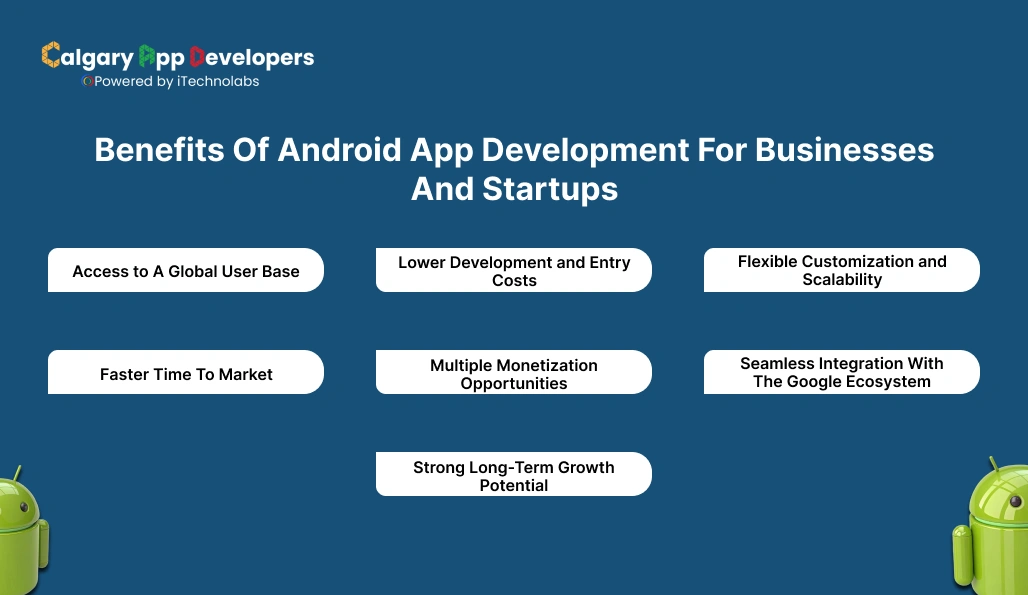
Android app development offers clear advantages for businesses and startups looking to build, scale, and sustain digital products. Its flexibility, reach, and cost efficiency make it a practical choice for both early-stage companies and established brands.
- Access to A Global User Base: Android powers the majority of smartphones worldwide. This gives businesses instant access to users across developed and emerging markets. For startups, this reach helps validate ideas faster. For enterprises, it supports large-scale user acquisition without being limited to a single region or device category.
- Lower Development and Entry Costs: Android app development is built on open-source technologies. Development tools like Android Studio, Kotlin, and Java are freely available, which reduces upfront investment. This is especially valuable for startups working with limited budgets while still aiming to launch a high-quality product.
- Flexible Customization and Scalability: Android allows deeper customization at both the app and system levels. Businesses can tailor features, user flows, and integrations based on their specific operational needs. As the user base grows, Android apps can scale efficiently with cloud services, modular architecture, and backend integrations.
- Faster Time To Market: With mature frameworks, reusable components, and a large developer ecosystem, Android app development supports quicker development cycles. This allows startups to release MVPs faster and businesses to roll out updates, features, or regional versions without long delays.
- Multiple Monetization Opportunities: Android apps support diverse monetization models, including in-app purchases, subscriptions, advertising, and enterprise licensing. Businesses can test and refine revenue strategies based on real user behavior, which helps improve long-term profitability.
- Seamless Integration With The Google Ecosystem: Android apps integrate easily with Google services such as Maps, Firebase, Analytics, and Cloud Platform. These tools help businesses track performance, improve user engagement, and manage infrastructure more efficiently.
- Strong Long-Term Growth Potential: Android continues to evolve with advancements in AI, IoT, wearable devices, and foldable hardware. Investing in Android app development positions businesses to adapt to future technology shifts without rebuilding their digital foundation.
For businesses and startups, Android app development is not just about building an app. It is about creating a scalable digital channel that supports growth, engagement, and long-term value.
Types Of Android Apps You Can Build
When planning to make Android app solutions, choosing the right app type is one of the most important early decisions. The type of app you build affects development cost, performance, user experience, and long-term scalability. Based on real-world Android app projects, these are the most common types businesses and startups choose today.
- Native Android apps: Native apps are built specifically for the Android platform using Kotlin or Java. They offer the best performance, smooth animations, and full access to device features such as camera, GPS, sensors, and offline storage. If your goal is to make Android app products that require speed, reliability, and deep system integration, native development is the strongest option.
- Web-based Android apps: Web apps run through a mobile browser and are built using standard web technologies like HTML, CSS, and JavaScript. They are easier to maintain and faster to launch, but have limited access to device features. Businesses often choose this approach when they want a lightweight presence without committing to full Android app development.
- Hybrid Android apps: Hybrid apps combine web technologies with a native container. They allow developers to reuse code across platforms while still publishing the app on the Play Store. This approach works well for startups looking to make Android app solutions quickly while keeping development costs under control.
- Cross-platform Android apps: Cross-platform apps are built using frameworks like Flutter or React Native. A single codebase supports Android and other platforms, reducing development time and maintenance effort. This option is popular among businesses that want consistent user experiences across devices while still benefiting from native level performance.
- Enterprise Android apps: Enterprise apps are designed for internal business use, such as workforce management, logistics, CRM, or reporting. These apps focus on security, performance, and system integration rather than public distribution. Many companies make Android app solutions specifically for internal efficiency and process automation.
- Ecommerce Android apps: Ecommerce apps focus on product browsing, payments, order tracking, and user retention. Android plays a major role in ecommerce growth due to its reach across diverse markets. Businesses that make Android app platforms for ecommerce often benefit from higher engagement compared to mobile websites.
- On-demand and service-based apps: These apps connect users with services such as delivery, transportation, home services, or bookings. They rely heavily on real-time data, location tracking, and notifications. Android app development works especially well for this model due to device accessibility and global adoption.
Choosing the right app type early helps avoid technical limitations later. Whether you plan to make Android app solutions for customers, employees, or partners, aligning the app type with your business goals sets the foundation for long-term success.
Read Also: Hire Android App Developers Calgary: Top Sites to Hire
Step-by-Step Process To Create An Android App
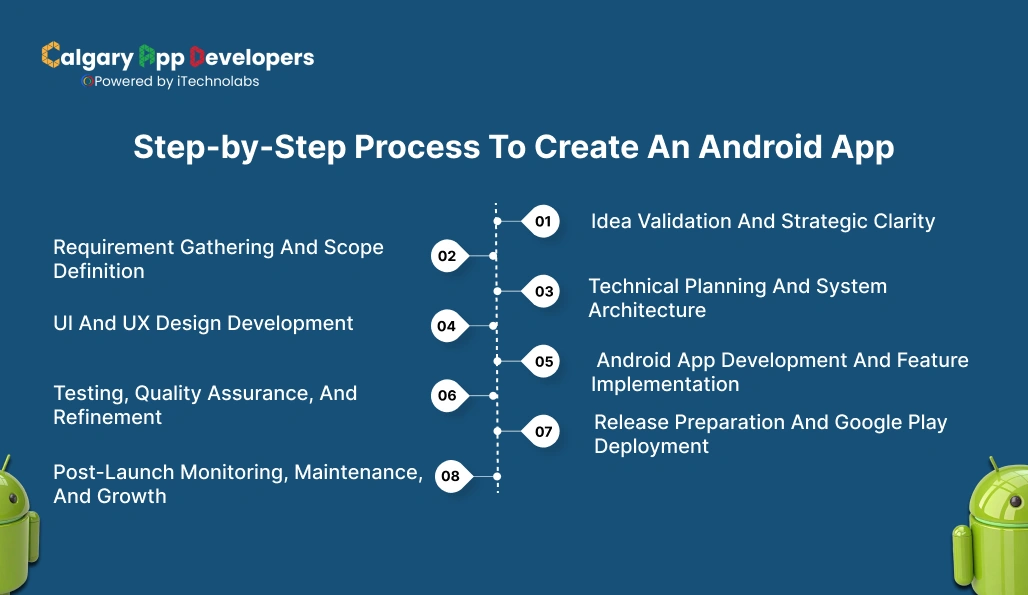
Building a successful Android product is a disciplined, multi-stage effort. When businesses aim to build Android app solutions that perform well in the real world, each phase must be executed with depth, structure, and long-term thinking. Below is a detailed, experience-driven breakdown of every step involved in professional Android app development.
1. Idea Validation And Strategic Clarity
This step defines whether the app should exist at all and what success looks like before a single line of code is written.
- Clearly articulate the core problem the app is intended to solve.
- Identify the primary and secondary user segments.
- Study existing solutions to understand strengths, weaknesses, and market gaps.
- Validate demand using research, interviews, or early concept testing.
- Define clear business objectives such as growth, revenue, efficiency, or retention.
- Set realistic expectations around timelines, investment, and outcomes.
Strong validation ensures that when you build Android app products, the effort is focused on solving a real problem with measurable value.
2. Requirement Gathering And Scope Definition
Once the idea is validated, it must be converted into structured and unambiguous requirements.
- Document all user-facing features in clear, simple language.
- Define detailed user journeys for every major interaction.
- Identify system requirements such as performance, security, and availability.
- List third-party services, APIs, and integrations required.
- Separate core MVP features from future phase enhancements.
- Finalize the scope to prevent constant changes during development.
Clear requirements create alignment across teams and reduce delays, rework, and misunderstandings.
3. Technical Planning And System Architecture
This phase lays the technical foundation that determines how reliable and scalable the app will be over time.
- Select the most suitable development approach based on goals and budget.
- Define an app architecture that supports the clean separation of concerns.
- Plan backend systems, databases, and API communication.
- Decide how data will be stored, cached, and synchronized.
- Plan authentication, authorization, and data protection mechanisms.
- Establish coding standards and development workflows.
Thoughtful architecture allows teams to build Android app platforms that can grow without frequent refactoring.
4. UI And UX Design Development
Design shapes how users experience the app and how easily they achieve their goals.
- Create wireframes to map screen layouts and navigation paths.
- Design visual elements aligned with brand identity and usability standards.
- Ensure intuitive flows that minimize user effort and confusion.
- Optimize layouts for different screen sizes, orientations, and resolutions.
- Apply accessibility best practices for wider usability.
- Review designs through internal feedback and usability checks.
Strong design decisions reduce friction, increase engagement, and improve user retention.
5. Android App Development And Feature Implementation
This is where planning turns into a working product through disciplined execution.
- Set up a clean and scalable project structure.
- Develop user interface components and interactive elements.
- Implement business logic following documented requirements.
- Integrate backend services, APIs, and third-party tools.
- Handle local storage, offline usage, and data synchronization.
- Optimize performance, memory usage, and responsiveness.
- Implement error handling and logging for maintainability.
When teams build Android app features incrementally, the codebase remains manageable and easier to test and enhance.
6. Testing, Quality Assurance, And Refinement
Testing ensures the app performs reliably across real-world scenarios.
- Conduct functional testing for every feature and user flow.
- Test compatibility across Android versions and device types.
- Validate performance under poor network and high load conditions.
- Perform security testing to protect user data.
- Review edge cases and failure scenarios.
- Fix bugs, refine interactions, and improve stability.
Thorough testing protects the app from negative reviews, crashes, and user frustration after launch.
7. Release Preparation And Google Play Deployment
Launching an Android app requires careful preparation and compliance.
- Prepare accurate and informative Play Store descriptions.
- Design high-quality screenshots and promotional visuals.
- Configure app signing, permissions, and version control.
- Ensure compliance with Google Play policies and guidelines.
- Submit the app for review and respond to feedback if needed.
- Plan a controlled rollout to monitor early user response.
A well-executed release improves discoverability and builds early trust with users.
8. Post-Launch Monitoring, Maintenance, And Growth
The lifecycle of an Android app continues well beyond its initial release.
- Monitor crashes, performance metrics, and user behavior.
- Analyze feedback and usage patterns to identify improvement areas.
- Release regular updates for bug fixes and performance improvements.
- Optimize features based on real-world data.
- Scale infrastructure as user demand grows.
- Plan long-term enhancements and feature expansion.
Teams that build Android app solutions with a post-launch strategy in mind achieve stronger adoption, better retention, and higher long-term value.
This structured and detailed process helps ensure that Android apps are not just launched successfully, but sustained, improved, and scaled with confidence over time.
Also Read: MVP App Development Services for Startups in Canada
How Much Does It Cost to Build An Android App In 2026
The cost to create Android app solutions in 2026 usually starts at $15,000 and can exceed $250,000 according to the application complexity and required features and future business objectives. The lower end of this range applies to simple applications while the upper limit applies to extensive applications that include multiple features and advanced system connections.
Cost is not just about development. It reflects the full lifecycle of Android app development, from planning and design to testing, launch, and post-launch support.
Estimated Cost Breakdown for Android App Development
| Development Stage | Estimated Cost Range |
| Idea validation and planning | $2,000 to $8,000 |
| UI and UX design | $3,000 to $15,000 |
| Android app development | $8,000 to $150,000 |
| Backend development and APIs | $5,000 to $40,000 |
| Testing and quality assurance | $3,000 to $20,000 |
| Google Play Store launch | $1,000 to $5,000 |
| Post-launch support and maintenance | $2,000 to $25,000 Annually |
| Total Estimated Cost | $15,000 to $250,000+ |
These numbers represent typical industry ranges. The actual cost to create Android app products depends on several key factors outlined below.
Factors That Affect Android App Development Cost
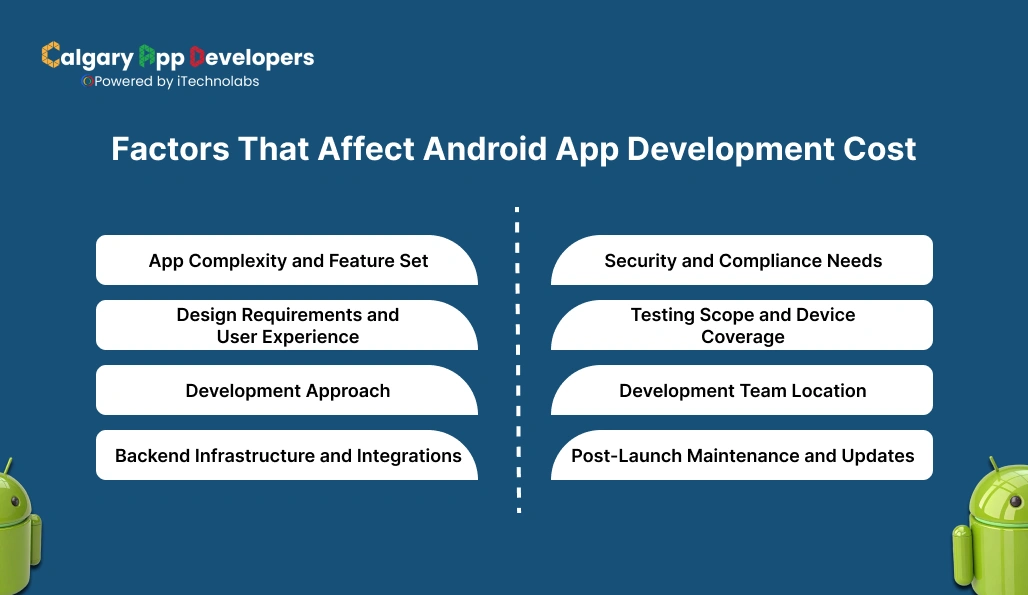
Several variables influence how much it costs to create Android app solutions in 2026. Understanding these factors helps businesses plan budgets realistically and avoid surprises during development.
- App Complexity and Feature Set: The number and depth of features have the biggest impact on cost. Apps with basic functionality, such as static content, simple navigation, or limited user interaction, are quicker and less expensive to build. In contrast, apps that include real-time data updates, user authentication, payments, advanced search, location tracking, or custom animations require more development time, testing, and ongoing support, which increases overall cost.
- Design Requirements and User Experience: UI and UX design directly affect both cost and app success. Apps built with standard components and minimal customization are more affordable. However, businesses that invest in custom layouts, branded visuals, smooth interactions, and accessibility optimization usually see higher engagement and retention. That added design effort increases upfront cost but often delivers better long-term results.
- Development Approach: The choice between native, hybrid, or cross-platform development plays a major role in pricing. Native Android development generally costs more due to platform-specific coding, but it delivers stronger performance, better stability, and greater flexibility. Hybrid and cross-platform approaches can reduce initial development costs but may introduce limitations that affect scalability and maintenance later.
- Backend Infrastructure and Integrations: Apps that rely on backend systems add another layer of cost. User databases, admin panels, APIs, payment gateways, analytics tools, and third-party services all require setup, integration, and testing. The more systems an app depends on, the more time is needed to build and maintain them.
- Security and Compliance Needs: Security requirements vary based on the type of app. Apps handling payments, personal data, or sensitive business information need stronger encryption, secure authentication, and compliance checks. These measures increase development and testing effort but are essential for trust, stability, and regulatory compliance.
- Testing Scope and Device Coverage: Android runs on a wide range of devices with different screen sizes, hardware capabilities, and OS versions. Thorough testing across multiple environments improves quality but adds to the cost. Teams that limit testing may save money initially, but often face higher expenses after launch due to crashes and poor user reviews.
- Development Team Location: Where your development team is based also affects cost and collaboration. Teams in different regions offer varying rates, communication styles, and working models. Many businesses choose development partners in cities like Calgary because they combine strong technical expertise with clear communication, reliable project management, and predictable timelines. This balance often results in better value over time, even if the hourly rates are not the lowest.
- Post-Launch Maintenance and Updates: Android app development does not end at launch. Regular updates are required to fix bugs, improve performance, support new Android versions, and add features based on user feedback. Ongoing maintenance should always be included in the total cost planning.
In 2026, the cost to create Android app solutions should be viewed as a strategic investment rather than a simple expense. Businesses that plan budgets carefully and invest in quality across each stage are far more likely to build apps that scale, retain users, and deliver long-term value.
Also Check: Android App Development Cost in Canada
Common Mistakes to Avoid When Creating Android Apps
Android app development offers huge opportunities, but many apps fail due to avoidable mistakes made early in the process. Based on real project experience, these are the most common issues that affect quality, performance, and long-term success.
- Skipping Proper Planning and Validation: One of the biggest mistakes in Android app development is starting without clear goals. Apps built without validating the idea, defining the target audience, or documenting requirements often suffer from scope creep, missed deadlines, and features that users do not need.
- Overloading the App With Features: Trying to include too many features in the first release increases development time, cost, and complexity. Feature-heavy apps are harder to test, slower to perform, and more difficult to maintain. A focused MVP allows teams to launch faster and improve based on real user feedback.
- Ignoring Android Design Guidelines: Android users expect familiar navigation patterns and consistent interactions. Ignoring platform design standards leads to confusing interfaces and poor usability. Strong UI and UX design aligned with Android guidelines improves adoption and reduces user friction.
- Poor Performance Optimization: Apps that feel slow or unresponsive lose users quickly. Common issues include inefficient data handling, heavy animations, and unoptimized network calls. Performance should be a priority throughout Android app development, not something addressed at the end.
- Inadequate Testing Across Devices: Android runs on a wide range of devices and OS versions. Testing on only a few devices often leads to crashes and layout issues after launch. Comprehensive testing across screen sizes and Android versions is essential for stability and user trust.
- Weak Security Practices: Underestimating security is a serious mistake, especially for apps handling user data or payments. Poor authentication, insecure APIs, or weak data storage can lead to breaches and compliance issues. Security must be built into the app from the start.
- Neglecting Backend Scalability: Many apps fail when user numbers grow because the backend was not designed to scale. Poor architecture and limited infrastructure planning lead to downtime and performance issues. Android app development must consider future growth, not just initial launch.
- Ignoring Post-Launch Maintenance: Launching the app is not the end of the process. Skipping regular updates, bug fixes, and performance improvements causes apps to degrade over time. Long-term success depends on continuous monitoring and improvement.
Avoiding these common mistakes helps ensure Android app development efforts result in apps that perform well, scale smoothly, and deliver lasting value to users and businesses alike.
Android App Development Trends to Watch In 2026
Android app development continues to evolve as user expectations, devices, and technologies change. Businesses planning to build Android app solutions in 2026 need to understand these trends to stay competitive and future-ready.
- AI-Driven Features and Automation: Artificial intelligence is becoming a standard part of Android apps. From personalized recommendations and chat-based support to predictive analytics and smart automation, AI helps apps deliver more relevant experiences. Teams that build Android app products with AI capabilities can improve engagement while reducing manual processes.
- Increased Focus On App Performance And Efficiency: Users expect fast, responsive apps even on mid-range devices. Performance optimization, efficient memory usage, and reduced battery consumption are gaining more attention. Apps that feel lightweight and reliable are more likely to retain users in competitive markets.
- Growth of Foldable and Multi-Screen Devices: Foldable phones and large-screen devices are becoming more common. Android apps now need layouts that adapt smoothly across screen sizes and orientations. Developers who build Android app interfaces with responsive design in mind will be better positioned as device diversity increases.
- Stronger Emphasis on Privacy and Data Protection: Users are more aware of how their data is handled. Android continues to introduce stricter permission models and privacy controls. Apps that clearly communicate data usage and follow best security practices build greater trust and long-term loyalty.
- Expansion of Wearable and Connected Device Apps: Android is no longer limited to smartphones. Wearables, smart TVs, and IoT devices are opening new use cases. Businesses that build Android app ecosystems across multiple devices can create more connected and valuable user experiences.
- Offline First and Low Connectivity Support: Many users operate in environments with unreliable internet access. Apps designed with offline functionality and smart data synchronization perform better in real-world conditions. This approach is especially important for global audiences.
- Subscription-Based And Value-Driven Monetization: One-time downloads are becoming less common. Subscription models, bundled services, and value-based pricing are shaping how apps generate revenue. When businesses build Android app solutions with clear value delivery, monetization becomes more sustainable.
- Faster Release Cycles and Continuous Updates: The pace of Android app development is accelerating. Frequent updates, feature rollouts, and performance improvements are now expected. Teams that adopt agile workflows and continuous improvement strategies stay ahead of competitors.
Keeping up with these trends helps businesses build Android app products that are not only relevant in 2026 but also prepared for future platform changes and user expectations.
How a Calgary App Developer Can Help You With Android App Development
At Calgary App Developer, we focus on building Android applications that solve real problems and support long-term growth. Our approach combines strong engineering fundamentals with practical decision-making, so every product is built with purpose, performance, and business outcomes in mind. Here is the thing. We care as much about how the app supports your goals as how the code is written.
- AI-Driven Features That Deliver Real Value: We integrate AI only where it makes sense. From smarter personalization to intelligent data workflows and automation, our Android apps use AI to improve efficiency and user engagement without pushing costs higher than necessary. What this really means is you get innovation that works in practice, not features added for show.
- Experience Across Multiple Industries: Our team has delivered Android applications for a wide range of industries, including mobility, media, and engagement-focused platforms. This experience helps us spot technical challenges early and apply proven solutions that keep projects on track, reduce risk, and improve delivery speed.
- Clear Cost Planning From Day One: We believe transparency builds trust. Clients receive detailed cost breakdowns and realistic timelines at the start of the project. This clarity helps teams plan budgets confidently and avoid unexpected expenses during development or after launch.
- Scalable Architecture Built for Growth: Every application is designed with the future in mind. We focus on clean architecture, performance optimization, and maintainability so your product can scale smoothly as usage grows, without requiring expensive rebuilds later.
- Ownership, Communication, and Accountability: Clients work with a dedicated team that takes full ownership of the project. Regular updates, milestone reviews, and clear documentation keep everyone aligned and make the development process predictable and efficient.
- Free App Consultation to Validate Ideas: We offer a free app consultation to help businesses refine ideas before committing resources. The session covers technical feasibility, feature prioritization, cost estimation, and growth planning, giving decision makers a clear view of scope and budget from the start.
Our goal is simple. We help businesses build Android applications that are reliable, cost-conscious, and ready to support long-term success.
Our Proven Expertise In Android App Development
Our expertise in Android app development comes from building real products that serve real users at scale. We at Calgary App Developer focus on creating Android applications that are reliable, scalable, and designed to perform well long after launch. Every project we take on is approached with a balance of technical depth, business understanding, and long-term usability.
Below are two Android projects that clearly reflect our ability to deliver market-ready solutions across different use cases, user expectations, and business models.
1. Zefir: Request a Ride
Zefir is an on-demand ride booking application built to simplify urban transportation while maintaining transparency and trust. The app allows users to request a ride with a single tap and get connected with nearby, top-rated drivers in real time.
Core Features Delivered
- One tap ride booking experience
- Real-time driver matching and live tracking
- Upfront fare visibility before confirming a ride
- Ride history and booking management
- Driver rating and feedback system
Technical Highlights
- Real-time location tracking with map integration
- Optimized driver matching logic for faster pickups
- Scalable backend designed to handle peak demand
- Secure fare calculation and payment processing
Zefir demonstrates our ability to build high-performance, location-based Android applications where speed, accuracy, and pricing transparency directly influence user trust and retention.
2. Pick A Side: Fun Poll Game
Pick A Side is an interactive polling application designed to encourage daily engagement through simple and entertaining opinion-based questions. Users participate in polls, compare results, and see how their opinions align with others in real time.
Core Features Delivered
- Daily poll updates across multiple categories
- Simple voting flow with instant result comparison
- Engagement-focused interaction mechanics
- Clean and intuitive user interface
- Social sharing to increase participation
Technical Highlights
- Real-time vote aggregation and result updates
- Backend architecture optimized for high interaction volume
- Scalable data handling for frequent content refresh
- Performance-focused design for quick user actions
Pick A Side highlights our strength in building engagement-driven Android apps that rely on smooth interactions, fast data processing, and repeat user participation.
Together, these projects reflect our hands-on expertise in managing Android app development costs while delivering stable, scalable, and user-focused applications. Our approach prioritizes practical execution, clean architecture, and long-term performance to ensure every Android app we build is ready for real-world success.
Final Words:
Android app development in 2026 is no longer about simply launching an app and hoping it gains traction. Success depends on clear planning, the right technical decisions, and a deep understanding of how real users interact with mobile products. From choosing the right app type to managing development cost and long-term maintenance, every step plays a role in determining whether an app delivers lasting value.
Throughout this guide, we have shared a practical view of how Android apps are actually built, based on hands-on experience rather than theory. Creating an Android app today requires a balance of performance, usability, scalability, and ongoing improvement. Teams that invest in quality early and plan beyond launch are far more likely to build products that grow with their users.
For businesses and startups, Android remains one of the strongest platforms to reach a global audience and build meaningful digital experiences. With the right strategy, the right development approach, and a focus on real-world execution, Android app development becomes a long-term asset rather than a one-time project.
If you are planning to move forward, the key is to treat Android app development as a strategic initiative. When done right, it opens the door to stronger engagement, sustainable growth, and products that continue to perform well in an increasingly competitive market.
FAQs
1. How long does it usually take to develop an Android app?
The timeline depends on app complexity and feature scope. A basic Android app can take 2 to 3 months, while a mid-level app usually requires 4 to 6 months. Complex apps with custom design, backend systems, and integrations may take 8 months or longer, including testing and launch preparation.
2. What is the average cost to create an Android app in 2026?
The cost to create an Android app typically starts around $15,000 for simple apps and can exceed $250,000 for complex platforms. Final cost depends on features, design depth, backend requirements, security needs, and ongoing maintenance. A clear scope and planning phase helps control the budget effectively.
3. Which technology stack is best for Android app development today?
Most modern Android apps are built using Kotlin with Android Studio. Backend technologies vary based on requirements but often include cloud services, REST APIs, and scalable databases. The best stack depends on app goals, performance needs, and long-term scalability rather than trends alone.
4. Is native Android development better than cross-platform development?
Native Android development offers better performance, deeper device integration, and long-term flexibility. Cross-platform development can reduce initial cost and development time, but may introduce limitations as the app scales. The right choice depends on budget, timeline, and how critical performance and customization are for the product.
5. Do Android apps require ongoing maintenance after launch?
Yes, maintenance is essential. Android apps need updates to support new OS versions, fix bugs, improve performance, and add features based on user feedback. Without regular maintenance, apps can degrade over time, leading to poor user experience, lower ratings, and increased long-term costs.
6. How can businesses reduce Android app development costs without sacrificing quality?
Cost can be controlled by validating the idea early, building a focused MVP, prioritizing essential features, and choosing the right development approach. Clear requirements, realistic timelines, and experienced development teams also help avoid rework, delays, and unnecessary expenses while maintaining app quality.


Pankaj Arora is a seasoned technology leader and the Founder of Calgary App Developer, with 10+ years of expertise in crafting high-performance digital solutions. His core competencies include full-stack app development, cloud-native architecture, API integration, and agile product delivery. Under his leadership, Calgary App Developers has empowered startups and enterprises alike with scalable mobile applications, secure web platforms, and AI-driven SaaS products.