









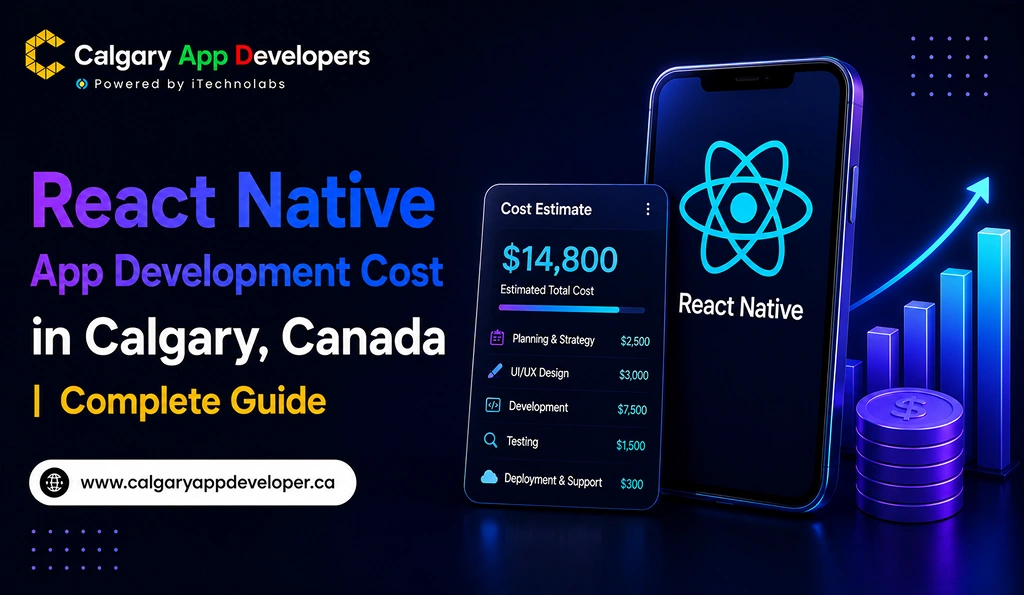
React Native App Development Cost in Calgary, Canada
Most businesses end up looking into React Native for one kinda simple reason. They want a mobile app that runs smoothly on iOS and Android, without doubling the dev time and cost via separate native builds. Somewhere in that talk, React Native comes up, because global brands like Meta use it to ship scalable cross-platform experiences. But once the conversation flips from tech to budget, everything gets a bit blurry, fast.
The reality is that the cost of React Native app development in Canada in 2026 is not a fixed number. It depends on the product vision, app complexity, UI expectations, backend infrastructure, third-party integrations, development approach, and the long-term roadmap after launch. A simple MVP built for market validation will cost very differently from a feature-rich enterprise platform designed for scalability and high user traffic.
This blog is written from our hands-on experience delivering React Native applications for startups, SMBs, and enterprises across Canada. Instead of vague estimates, you’ll find realistic cost ranges in CAD, detailed pricing breakdowns by development stage, factors that directly impact project budgets, and practical insights to help businesses avoid overspending while still building a high-quality mobile product.
TL;DR
- React Native app development cost in Canada typically ranges from $25,000 to $175,000+ CAD, depending on app complexity, feature scope, backend requirements, and team location.
- React Native’s shared JavaScript codebase covers both iOS and Android, reducing development costs compared to building two separate native apps.
- Hidden costs, including PIPEDA compliance, Over-The-Air update infrastructure, React Native version migrations, and bilingual localization, are real budget items that belong in your planning from day one.
- Calgary-based React Native development delivers senior-level expertise at rates significantly more competitive than Toronto or Vancouver, without the coordination risk of offshore engagements.
- Canadian businesses may qualify for SR&ED tax credits or CDAP grants to offset React Native app development costs, which is worth confirming with your accountant before finalizing your development budget.
Key Points
- React Native app development costs vary widely based on app type, feature depth, architectural complexity, and the development team’s experience level.
- React Native’s JavaScript foundation means businesses with existing web development teams can reduce ramp-up time and overall project cost compared to frameworks requiring new language expertise from scratch.
- Developer location within Canada has a direct and measurable effect on hourly rates and total project investment, with Calgary consistently offering strong value relative to other major Canadian tech markets.
- Hidden costs such as third-party API fees, PIPEDA compliance engineering, OTA update infrastructure, bilingual support, and post-launch maintenance should be scoped and budgeted from the start, not discovered after launch.
- Building an MVP first, leveraging React Native’s OTA update capability, and choosing a Calgary-based team are among the most effective ways to manage React Native app development cost without reducing product quality.
How Much Does React Native App Development Cost in Canada
React Native app development cost in Canada typically ranges from CAD $25,000 to $175,000+, depending on app complexity, feature scope, backend architecture, design standards, and the experience level of the team you engage. That’s a wide range, but it reflects genuine variation in project scope rather than pricing ambiguity. A focused MVP with core functionality costs a fraction of a full-featured enterprise platform with real-time data, complex integrations, and multi-role access.
Here’s a realistic React Native app development cost breakdown across the full development lifecycle.
Total Cost Estimation Table
| Development Stage | Description | Estimated Cost (CAD) |
| Discovery and Planning | Requirements analysis, feature definition, and technical planning | $2,500 to $7,500 |
| UI and UX Design | Wireframes, visual design, user flow mapping, prototypes | $5,000 to $18,000 |
| Backend Development | Server logic, APIs, databases, third-party integrations | $7,000 to $32,000 |
| React Native Frontend Development | JavaScript/TypeScript codebase, component architecture, state management | $10,000 to $48,000 |
| Quality Assurance | Functional testing, device compatibility across iOS and Android, and performance testing | $3,500 to $13,000 |
| Deployment | App Store and Google Play setup, release management, OTA infrastructure setup | $1,000 to $3,500 |
| Project Management | Sprint coordination, milestone tracking, stakeholder communication | $2,500 to $10,000 |
| Post-Launch Support | Bug fixes, OS compatibility updates, minor enhancements | $3,500 to $18,000 per year |
| Total Estimated Cost | From discovery through post-launch | $25,000 to $175,000+ |
These figures represent realistic React Native app development cost benchmarks for Canadian projects in 2026. One important structural note: React Native’s shared JavaScript codebase targets both iOS and Android simultaneously, so you’re funding one frontend development phase instead of two. That cross-platform efficiency directly reduces development hours and testing effort compared to maintaining parallel native codebases, and it’s one of the primary reasons businesses choose React Native when budget efficiency matters.
Also Check: How to Build React Native App: React Native App Development Guide
React Native App Development Cost by App Type and Complexity
React Native app development cost in Canada varies significantly based on the type of application you’re building and the level of technical complexity it requires. Feature depth, backend architecture, design standards, security requirements, third-party integrations, and scalability planning all interact to determine where your project lands in the cost range.
Based on our experience delivering React Native applications across different industries and business models, the table below outlines how complexity affects total cost and development timeline.
Estimated React Native App Development Cost by Complexity
| App Complexity | Typical Features | Estimated Cost (CAD) | Estimated Timeline |
| Basic App | Limited screens, simple UI, minimal backend | $25,000 to $50,000 | 6 to 10 weeks |
| Moderate App | User accounts, API integrations, dashboards, notifications | $50,000 to $100,000 | 3 to 5 months |
| Complex App | Real-time features, custom backend, advanced architecture, enterprise scale | $100,000 to $175,000+ | 6 to 10 months |
These estimates include design, development, testing, and deployment across both iOS and Android from a single React Native codebase.
- Basic React Native Applications
Basic React Native apps typically cost between CAD $25,000 and $50,000 and are well-suited for startups validating an early-stage idea or businesses launching a focused product with a defined, limited feature set.
Key Features
- Static or semi-dynamic content screens with standard navigation
- Simple user authentication with email or social login
- Basic user profile management
- Minimal third-party integrations
- Standard React Native component library implementations
- Limited backend logic with simple data storage needs
- Single user role with straightforward interaction flows
- Deployment to both iOS and Android from one shared codebase
- Basic push notification support
The cost efficiency at this tier is real and measurable. Building the equivalent product with separate native iOS and Android codebases could easily run $40,000 to $70,000+ combined. React Native’s shared codebase brings that number down significantly while still covering both platforms from launch day.
- Moderate Complexity React Native Applications
Moderate complexity React Native apps typically fall in the CAD $50,000 to $100,000 range and are designed for growing businesses that need data-driven features, external service integrations, and a more polished user experience than a basic app delivers.
Key Features
- User registration, profile management, and account settings
- Payment gateway integration with subscription and in-app purchase support
- Push notifications and in-app messaging
- Third-party API integrations with external platforms and services
- Admin or management dashboard for internal team use
- Cloud-based backend with structured data models and access controls
- Analytics, usage reporting, and event tracking
- Multi-screen navigation with custom UI component patterns
- Offline access with local data storage and sync on reconnect
- Role-based access for multiple user types
- OTA (Over-The-Air) update capability for JavaScript layer changes
State management architecture matters significantly at this tier. Getting the Redux, Zustand, or React Query setup right from the start keeps the codebase maintainable as features grow. React Native app development cost increases at this complexity level because the technical scope is genuinely broader, not because of padding.
- Complex and Enterprise-Level React Native Applications
Complex React Native apps typically start at CAD $100,000 and exceed $175,000, involving custom engineering, advanced infrastructure, and long-term scalability planning. This tier covers enterprise platforms, fintech products, healthcare applications, on-demand networks, and large-scale marketplaces with demanding performance and compliance requirements.
Key Features
- Real-time data synchronization across users and connected devices
- Custom backend architecture built for scale and high-availability
- Advanced security standards and compliance requirements, including PIPEDA
- AI-powered or machine learning-driven features and personalization
- Multi-role user access with granular permission systems and audit trails
- High-volume transaction handling with reliable performance under concurrent load
- Deep native module integration for platform-specific capabilities
- Bilingual UI support for English and French for the national market reach
- Integration with enterprise systems, including ERPs, CRMs, and data warehouses
- Comprehensive monitoring, alerting, and incident response infrastructure
- Performance optimization validated across a wide range of iOS and Android devices
At this level, React Native app development cost reflects specialized expertise, extended timelines, larger team composition, and ongoing infrastructure investment. The shared codebase advantage still applies at the frontend level, but the architectural complexity, compliance requirements, and performance standards are what drive cost, not the framework itself.
Defining the right complexity tier early and aligning it with your actual business stage is one of the most effective things you can do to control React Native app development cost. Teams that skip this conversation almost always discover scope misalignment mid-project, which is more expensive to fix than the time it would have taken to define it properly at the start.
Key Factors That Impact React Native App Development Cost
The React Native app development cost isn’t driven by a single variable. It’s the product of interacting decisions across scope, architecture, team structure, compliance requirements, and post-launch planning. Here’s where the real cost levers sit, based on direct project experience.
- Developer Location in Canada
Where your development team is based has a direct and measurable effect on hourly rates and total project cost. React Native developer rates vary across Canadian cities due to differences in market demand, local cost of living, and talent availability.
Average React Native Developer Hourly Rates by Canadian City
| City | Average Hourly Rate (CAD) |
| Toronto | $95 to $150 |
| Vancouver | $90 to $140 |
| Calgary | $65 to $105 |
| Ottawa | $75 to $120 |
| Montreal | $70 to $115 |
Calgary consistently offers one of the most cost-effective React Native development markets in Canada without sacrificing technical depth. For businesses that want experienced Canadian developers without paying Toronto or Vancouver market premiums, Calgary is the practical choice that doesn’t require the offshore trade-off.
- App Features and Functional Scope
Feature scope drives React Native app development cost more directly than any other single factor. Every feature adds design time, development effort, testing cycles, and long-term maintenance work across the lifecycle.
Scope elements that carry the most cost weight include real-time messaging or location tracking systems, payment and subscription management flows, multi-role user access with permission logic, advanced search and filtering, data-heavy dashboards with live updates, offline access with background sync, deep linking, and complex third-party integrations. Defining a clear MVP before development begins is the most reliable way to control initial React Native app development cost and avoid scope expansion that inflates the budget mid-project without delivering proportional value.
- React Native Architecture and State Management
React Native’s state management approach directly affects development complexity and long-term maintenance cost. Simple apps with useState and basic Context API are faster to build and maintain. Mid-complexity apps using Redux Toolkit or Zustand require more deliberate architecture planning. Large-scale enterprise apps with complex asynchronous data flows using React Query, Saga middleware, or custom state solutions add meaningful engineering overhead.
Choosing the right state management pattern for your actual product complexity, not just the most popular pattern on Reddit this month, keeps React Native app development cost proportional to what the app genuinely needs. Over-engineering the state layer for a simple product adds cost without adding user value.
- Technology Stack and Backend Architecture
Backend decisions shape both initial development cost and long-term infrastructure investment. React Native’s frontend is consistent regardless of backend choice, but backend complexity varies significantly based on data requirements, scalability needs, and integration depth.
Common React Native Technology Stack and Cost Impact
| Technology Component | Options | Cost Influence |
| Language | JavaScript, TypeScript | TypeScript adds setup time but reduces long-term debugging cost |
| State Management | Redux, Zustand, React Query, Context API | Complex patterns add to the architecture planning time |
| Backend | Node.js, Django, .NET, Firebase, Supabase | Custom backends raise cost vs. BaaS options |
| Database | Firebase, PostgreSQL, MongoDB, Supabase | Data modeling complexity affects setup effort |
| Navigation | React Navigation, Expo Router | Standard navigation; custom transitions add time |
| Cloud Hosting | AWS, Google Cloud, Azure | Advanced configuration increases infrastructure cost |
| Integrations | Payments, maps, analytics, auth, notifications | Each integration adds development, testing, and maintenance time |
Advanced stack choices may increase initial React Native app development cost, but typically reduce long-term technical debt and future rework.
- UI and UX Design Complexity
Design quality has a direct effect on user adoption, retention, and review scores. Higher design standards require more time and specialist involvement, which raises React Native app development cost in a real and measurable way.
Design cost drivers include custom component builds outside React Native’s standard library, branded animation systems and micro-interaction design, interactive prototype development for stakeholder review, accessibility compliance for screen readers and dynamic text sizing, and multi-device layout optimization across phones, tablets, and foldable devices. Strong design pays back through lower churn and better ratings, but it needs to be scoped and sized appropriately for your product’s stage and budget.
- React Native New Architecture and Hermes Engine
React Native’s New Architecture, enabled by default in recent versions, introduces JSI (JavaScript Interface), the Fabric renderer, and the TurboModule system. These components replace the old bridge model and improve performance, but they also require architecture-aware development practices that affect initial build time.
Teams working with the New Architecture need to verify that third-party dependencies are compatible, which sometimes requires custom native modules or upgraded package versions. The Hermes engine improves startup time and memory usage but needs performance validation across target devices. For projects that require New Architecture adoption from day one, this engineering overhead should be planned for explicitly in the React Native app development cost estimate.
- Backend Infrastructure and Scalability Planning
How your backend handles growth determines long-term infrastructure cost and system reliability. Apps built without scalability planning consistently require expensive structural changes once user volume increases faster than expected.
Infrastructure cost drivers include custom API development with complex relational data models, scalable cloud architecture with load balancing and auto-scaling, database query optimization for high read and write volume, real-time data synchronization across concurrent users, and monitoring and alerting systems that surface issues before they affect users. Planning for scale from the start is nearly always cheaper than retrofitting it under pressure.
- PIPEDA Compliance and Security Engineering
For any React Native app serving Canadian users and collecting personal information, PIPEDA compliance is a legal requirement, not an optional design consideration. Building it in from the start is significantly cheaper than retrofitting it after launch.
PIPEDA-related engineering costs include explicit consent flow design and implementation, data use disclosure mechanisms embedded in the user experience, user data access and deletion request handling, encrypted storage and secure data transmission practices, and privacy policy integration within the app. Apps in healthcare, fintech, or any sector handling sensitive user data face additional compliance layers. These costs belong in your React Native app development cost estimate from day one.
- Development Team Structure and Experience Level
Team composition affects delivery speed, architecture quality, and long-term product stability. Senior React Native developers and experienced specialists charge higher hourly rates but consistently deliver cleaner codebases, better architecture decisions, and fewer post-launch issues.
Team-related cost variables include the ratio of senior to mid-level developers on the project, dedicated QA involvement throughout development rather than only at the end, project management depth and milestone cadence, DevOps and CI/CD pipeline setup, and ongoing maintenance planning from the initial engagement. Experienced teams that get the architecture right the first time reduce total React Native app development cost over the life of the product, even when their initial rates are higher.
Understanding these factors before you request a proposal lets you evaluate quotes intelligently rather than just comparing top-line numbers that may be scoped very differently.
Read Also: Top Sites to Hire React Native App Developers
Hidden React Native App Development Costs You Should Plan For
The React Native app development cost is consistently underestimated because many real expenses don’t appear in an initial proposal or scope document. These costs surface during development or after launch, and they catch businesses off guard when they haven’t been planned for early. Here are the hidden cost areas that matter most for Canadian React Native projects.
- Third-Party Services and Licensing Fees
Most React Native apps depend on external services to deliver core functionality. These services run on recurring pricing models, not one-time fees, and their cost grows as your user base scales.
Common hidden expenses include payment gateway transaction fees applied to every processed payment, mapping and location service API calls priced by usage volume, push notification platforms that charge by message volume at scale, analytics and crash reporting subscriptions, and communication platforms for in-app messaging, SMS, or transactional email. These line items feel negligible early in a product’s lifecycle and can become high monthly costs as adoption grows. Budget for them as recurring operational expenses from day one.
- Device Testing and iOS/Android Compatibility
React Native’s cross-platform strength reduces device testing effort substantially compared to dual native builds, but it doesn’t eliminate it. Testing still needs to cover a meaningful range of physical hardware across both platforms.
Cost drivers include testing across multiple Android OS versions and iOS versions simultaneously, device-specific rendering differences that require targeted component adjustments, performance validation on lower-end Android devices where memory and CPU constraints are real, and compatibility fixes triggered by new iOS or Android releases that change system behavior. Skipping thorough physical device testing is one of the fastest paths to negative App Store reviews that are hard to recover from post-launch.
- React Native Version Migrations
React Native releases significant updates regularly, and staying current matters for security, performance, and App Store compliance. That’s a recurring engineering cost that doesn’t appear in the initial build estimate.
Migration-related work includes upgrading the React Native core version, updating third-party npm packages that may have breaking changes, verifying New Architecture compatibility across the dependency tree, and running full QA cycles after each significant version update. Teams that plan for annual upgrade cycles avoid the compounding technical debt that makes future feature development progressively more expensive.
- Over-The-Air (OTA) Update Infrastructure
One of React Native’s genuine advantages is the ability to push JavaScript layer updates directly to users without going through the App Store review process. That’s a real operational capability, but it requires infrastructure setup and ongoing management.
OTA-related costs include CodePush or similar service setup and configuration, deployment pipeline integration for OTA releases, monitoring for failed OTA updates and rollback planning, and compliance review to ensure OTA updates don’t violate App Store guidelines by changing core app behavior. Businesses that plan their OTA infrastructure early get more value from it. Those who set it up reactively pay a higher setup cost at a less convenient time.
- App Store and Google Play Compliance Changes
Both Apple and Google update their submission requirements, privacy guidelines, and technical standards on a regular cadence. Staying compliant is an ongoing engineering responsibility, not a one-time task.
Hidden compliance costs include policy-related code changes triggered by platform updates, privacy permission declaration reviews and updates after guideline revisions, security patch implementation for flagged vulnerabilities, and resubmission efforts after a rejection or policy change. React Native’s dual-platform deployment means you’re managing two compliance ecosystems simultaneously, which doubles the surface area for policy-related work across the app’s lifetime.
- Post-Launch Maintenance and Support
Launching the app is the beginning of the investment, not the end of it. Maintenance is a recurring cost that most initial budget discussions significantly undervalue.
Post-launch cost considerations include bug fixes surfaced by real user behavior that testing didn’t catch, performance tuning under live traffic conditions, OS compatibility updates after iOS and Android annual releases, minor feature enhancements driven by user feedback, and infrastructure monitoring and incident response. A reasonable baseline for annual post-launch maintenance is 15 to 20 percent of the original development investment. Plan for it from the start rather than treating it as an unexpected budget item that surfaces six months after launch.
- PIPEDA Compliance and Privacy Engineering
For Canadian React Native apps handling personal information, PIPEDA compliance carries real implementation costs that aren’t always included in initial project proposals. This is a hidden cost that’s also a legal requirement, which makes it worth surfacing early.
PIPEDA-related costs include building explicit consent flows before any personal data collection, implementing user data access request handling and deletion capabilities, ensuring encrypted local storage and secure data transmission for all personal information, and reviewing and updating privacy documentation as the app evolves. For apps in healthcare, fintech, or any sector where sensitive data is core to the product, additional provincial or sector-specific requirements may also apply.
- Bilingual App Support for National Market Reach
Canadian businesses building products for a national audience need to consider English and French language support, particularly for consumer-facing applications. Adding bilingual support after launch is significantly more expensive than building it in from the start.
Bilingual engineering costs include implementing React Native’s i18n localization framework for string management, translating all in-app content, error messages, and notifications accurately, testing layout integrity across both language variants since French strings are typically longer than English equivalents, and maintaining bilingual parity through every future feature release and content update. If national reach is part of your product roadmap, this belongs in your initial React Native app development cost estimate.
- Scalability and Infrastructure Growth
Apps that gain traction require stronger infrastructure than the initial build was sized for. Infrastructure scaling isn’t free, and it tends to happen faster than expected when adoption grows beyond early projections.
Infrastructure-related hidden costs include increased cloud server capacity as concurrent user volume grows, database scaling and query optimization under production load, load balancing and uptime monitoring configuration, CDN setup for faster content and asset delivery, and emergency engineering work when infrastructure limits are hit unexpectedly under real traffic. Designing for scale from the initial architecture discussion reduces this risk but doesn’t eliminate the ongoing operational cost of managing infrastructure as the product grows.
Also Read: Best Steps to Hire React Native Developers in Calgary, Canada
React Native vs Flutter vs Native: Cost Comparison
This is one of the most common framework decisions businesses face during mobile product planning. The right answer depends on your team’s existing skills, your product’s specific requirements, and your long-term platform goals. Here’s how the options compare on the factors that directly affect total React Native app development cost and project outcomes.
The table below covers the dimensions that matter most when making this decision for a Canadian product in 2026.
| Factor | React Native | Flutter | Native (iOS + Android) |
| Codebase | Single JavaScript/TypeScript codebase for iOS and Android | Single Dart codebase for iOS, Android, web, and desktop | Separate codebases for each platform |
| Development Cost (CAD) | $25,000 to $175,000+ | $25,000 to $180,000+ | $45,000 to $350,000+ combined |
| Timeline | Moderate; one build covers both platforms | Moderate; Dart ramp-up time for new teams | Longest: two full builds in parallel |
| UI Consistency | Near-consistent; wraps native components | Identical; own rendering engine | Platform-specific UI norms per platform |
| Performance | High; New Architecture removes JS bridge latency | High; compiles to native ARM, Impeller renderer | Highest; direct platform API access |
| Best For | Teams with JavaScript/React experience, standard mobile products | New teams or those needing web/desktop reach, too | Apps requiring deep OS integration or platform-exclusive features |
React Native wins on cost and accessibility for teams with existing JavaScript expertise. Flutter makes more sense when your team is starting fresh with no existing JS investment, and you need web or desktop reach alongside mobile. Native development is the right call when your product requires OS-level integration, hardware access, or performance at a level that cross-platform frameworks can’t reliably deliver. For most Canadian businesses building standard consumer or enterprise mobile products, both React Native and Flutter represent strong, cost-efficient choices. The right one depends on your team’s starting point.
Smart Ways to Reduce React Native App Development Cost Without Sacrificing Quality
Managing React Native app development cost strategically means making smarter decisions earlier in the process, not cutting scope that users actually need. Here’s what genuinely works, based on direct project experience across complexity tiers and industries.
Define the Scope Completely Before Development Starts:
That’s the most impactful cost control decision you’ll make. Every scope change mid-project adds rework, retesting, and team coordination overhead that compounds across the remaining timeline. Investing time in thorough requirements documentation and clear feature prioritization before development begins directly reduces total React Native app development cost and prevents the budget overruns that almost always trace back to an ambiguous scope at the start.
Build an MVP First and Validate with Real Users:
Launching with a focused set of essential features lets you test demand and gather real user feedback before committing to full-scale development. React Native’s shared codebase means your MVP already covers both iOS and Android from day one, which compresses your validation timeline and reduces the cost of learning what your users actually need versus what you assumed they needed.
Take Advantage of React Native’s JavaScript Talent Pool:
If your team already has React web development experience, transitioning to React Native mobile development is a fraction of the ramp-up cost compared to frameworks built on proprietary languages. That existing expertise reduces onboarding time, accelerates early development velocity, and keeps team-building costs lower than they would be for frameworks with less developer familiarity in Canada.
Use React Native’s OTA Update Capability Strategically:
Over-The-Air updates let you push JavaScript layer changes directly to users without waiting for App Store review cycles. That capability reduces the time and cost of deploying bug fixes, content updates, and minor feature changes post-launch. Plan your OTA infrastructure from the start so you can use it effectively from the first release, not as an afterthought three months after launch.
Leverage Proven npm Packages Instead of Building Custom:
The React Native npm ecosystem is extensive and well-maintained. For common needs like payments, authentication, navigation, maps, push notifications, analytics, and camera access, there are reliable packages that reduce custom development time significantly. Using proven solutions instead of building everything from scratch reduces both development hours and testing effort, and keeps long-term dependency maintenance costs manageable.
Plan Scalable Backend Architecture From the Start:
Backend systems that aren’t designed for growth require expensive structural changes when user demand scales faster than expected. Building with scalability in mind from the initial architecture discussion is always cheaper than retrofitting it under pressure. For React Native apps intended to grow, backend planning deserves real investment early, not after the first traffic spike reveals the limits of the initial design.
Choose a Cost-Effective Development Location With Senior Technical Depth:
Developer rates vary significantly across Canada, and that difference compounds across a multi-month project timeline. Calgary-based React Native development delivers senior expertise at rates that are meaningfully more competitive than Toronto or Vancouver, without the communication overhead and accountability gaps that offshore arrangements introduce at scale. That location advantage is a real and recurring cost lever for the full duration of the project.
Invest in Proper Testing from the Start, Not Just at the End:
Teams that treat QA as a final-phase activity consistently spend more fixing issues discovered late than they would have spent catching them early through continuous testing. Automated testing, early device testing across both platforms, and structured QA involvement throughout development reduce post-launch bug fix costs and protect your app’s review score from the issues that avoidable launch-day defects create.
Explore Canadian Government Funding Programs:
Canadian businesses investing in React Native app development may be eligible for SR&ED (Scientific Research and Experimental Development) tax credits if the project involves genuine technical innovation in areas like custom architecture, novel integrations, or performance engineering. CDAP (Canada Digital Adoption Program) grants are designed specifically to help small and medium-sized Canadian businesses adopt digital technology tools and platforms. Both programs can meaningfully reduce the net React Native app development cost, and both are worth discussing with your accountant or a funding specialist before you finalize your development budget.
Maintain Consistent Communication and Milestone Accountability:
Misaligned expectations and communication breakdowns are an underestimated source of cost inflation in development projects. Regular milestone reviews, shared documentation, and direct access to your development team reduce rework, limit scope drift, and keep the project moving efficiently. The cost of poor communication compounds quickly across a multi-month project timeline, and it’s almost entirely preventable.
Read Also: Top React Native Development Companies Calgary, Canada
Why Businesses Choose Us for React Native App Development in Canada
Businesses across Canada choose Calgary App Developer because we pair real React Native engineering expertise with transparent delivery practices and genuine accountability for outcomes, not just code output.
AI-Powered Development Where It Adds Measurable Value:
We integrate AI capabilities into React Native apps where they genuinely improve user experience or business performance. That includes intelligent personalization, smart recommendations, automated workflows, and predictive features built on real usage data. We don’t add AI because it looks impressive in a proposal. We add it when it makes the product work better for the people using it.
Proven Experience Across Industries and Complexity Levels:
Our React Native development work spans on-demand platforms, engagement apps, enterprise internal tools, and startup MVPs across multiple industries. We’ve seen what works at each complexity tier, and we apply that experience to help clients avoid the architectural decisions that look fine at the start and create expensive problems six months into the product lifecycle.
Transparent React Native App Development Cost Planning From Day One:
You’ll know what your project costs before we write a single line of code. Detailed cost breakdowns, realistic timelines, and clear scope documentation are standard parts of every engagement. We don’t give optimistic estimates to win work and manage scope expansions later. We give accurate ones so you can plan and commit with confidence.
Scalable Architecture Built for Long-Term Product Growth:
Every React Native app we build uses a clean, layered architecture designed to grow without requiring expensive rebuilds as user demand scales. Whether you’re launching with 500 users or scaling to 500,000, the codebase and infrastructure should be assets, not constraints. We design for scale from the start because the cost of retrofitting it later is always higher than building it early.
Full Accountability Through Every Phase of Delivery:
You work with a dedicated team, not a rotating roster of contractors. Regular milestone reviews, transparent progress reporting, and direct communication with the developers building your product are standard elements of how we work, not premium add-ons. That structure directly reduces the risk of late-stage surprises and budget overruns.
Bilingual Development Capability for National Market Reach:
For Canadian businesses building products intended for a national audience, English and French localization is a real requirement. Our team has experience implementing full React Native localization from the ground up, which means your product is ready for national deployment without requiring a separate build phase or a retroactive localization sprint that adds cost and delays.
Free React Native App Consultation:
Before you commit any budget, talk to our team. Our free consultation covers technical feasibility, realistic React Native app development cost estimation, feature prioritization, and growth planning specific to your product and market. You’ll leave with a clearer view of scope, investment, and the right approach for your situation, whether you work with us or not.
Conclusion
Understanding the React Native app development cost in Canada is about more than getting a number to put in a spreadsheet. It’s about making informed decisions that balance functionality, performance, scalability, and long-term product value from the first planning conversation. Costs vary based on app complexity, architecture depth, design standards, team location, and ongoing maintenance commitments, but clarity at the planning stage makes those costs predictable and manageable rather than stressful and reactive.
React Native’s shared JavaScript codebase means you’re building one product that covers both iOS and Android, and that structural cost efficiency is real and significant. The businesses that get the most out of it are the ones that combine React Native’s capabilities with disciplined scope definition, scalable backend planning, and a development partner that brings genuine accountability alongside technical delivery.
With the right React Native app development company, cost stops being an uncertainty and starts being a strategic advantage. A well-planned React Native app isn’t just a development expense. It’s a long-term business asset designed to grow, adapt, and deliver measurable returns across its full lifecycle.
Talk to the Calgary App Developer team today and get a clear, honest view of what your React Native app will actually cost to build right.
FAQs
1. How much does React Native app development cost in Canada in 2026?
React Native app development cost in Canada typically ranges from $25,000 to $175,000+ CAD, depending on app complexity, feature scope, backend architecture, design standards, and team location. A focused MVP with core functionality sits at the lower end of that range, while a complex platform with real-time data, enterprise integrations, and multi-role access sits at the higher end. React Native’s shared codebase for iOS and Android means you’re funding one frontend build instead of two, which directly reduces cost compared to separate native development. Getting a detailed, scope-based estimate from an experienced React Native team is the only way to land a reliable number for your specific product.
2. How long does React Native app development take?
React Native app development timelines range from 6 to 10 weeks for a basic focused MVP, 3 to 5 months for a moderate complexity app with integrations and a custom backend, and 6 to 10 months for complex or enterprise-level platforms. React Native’s cross-platform nature compresses delivery timelines compared to building separate native iOS and Android apps, but it doesn’t eliminate the time required for good design, thorough testing, and proper architecture. Projects that rush these phases consistently produce technical debt that costs more to address later than the time saved upfront.
3. Why does React Native app development cost vary across Canadian cities?
React Native app development cost varies by city because developer hourly rates reflect local market conditions, cost of living, and demand for technical talent. Toronto and Vancouver consistently charge the highest rates in Canada. Calgary offers senior React Native expertise at rates that are meaningfully more competitive, making it a strong choice for businesses that want Canadian-quality development without paying the highest-market premium. Offshore options often appear cheaper in initial quotes but regularly accumulate hidden costs through revision cycles, communication friction, and post-launch support gaps that erode the early savings quickly.
4. Does React Native cost less to develop than native iOS and Android apps?
Yes, in most cases, the React Native app development cost is meaningfully lower than building separate native iOS and Android apps. The reason is direct: one JavaScript codebase covers both platforms, so you pay for one frontend development phase instead of two. That saves development hours, testing effort, and ongoing maintenance work. The cross-platform advantage does have limits for apps requiring deep OS-level integration, hardware-specific features, or performance demands that the React Native framework can’t meet at the required level. For most standard consumer and enterprise mobile products, React Native’s cost efficiency relative to dual native builds is real and significant.
5. What hidden costs should I plan for in React Native app development?
The hidden costs that catch Canadian businesses off guard most often include third-party service fees that scale with user volume, React Native version migration engineering, OTA update infrastructure setup and management, App Store and Google Play compliance changes, PIPEDA compliance engineering for apps collecting personal data, bilingual localization for national market reach, post-launch maintenance and OS compatibility updates, and infrastructure scaling costs as user demand grows. These aren’t edge cases. They’re predictable, recurring expenses that belong in your initial budget. A good React Native development partner surfaces them during discovery rather than leaving them for you to find post-launch.
6. Can React Native app development cost be reduced without compromising quality?
Yes, and the most effective levers are specific. Defining a complete MVP scope before development begins, leveraging React Native’s OTA update capability to reduce post-launch fix costs, using the npm package ecosystem for common integrations instead of custom builds, choosing a Calgary-based team for competitive Canadian rates without offshore risk, and exploring SR&ED or CDAP funding programs are all real ways to control cost. What doesn’t work is cutting testing, skipping architecture planning, or choosing the lowest quote without understanding what scope has been removed to reach that number. Cost control and quality aren’t in conflict. They’re both the result of good planning.
7. What are the biggest factors that increase React Native app development cost?
The factors that push React Native app development cost toward the higher end of the range include complex real-time features like live tracking or multi-user messaging, custom backend architecture beyond standard BaaS options, advanced security and PIPEDA compliance engineering, AI or machine learning feature integration, multi-role user systems with granular permission logic, bilingual localization for national reach, high-volume transaction handling, React Native New Architecture migration requirements, and extensive device testing across Android and iOS versions. Any combination of these adds meaningful development, testing, and infrastructure effort. Identifying which of these your product genuinely needs at launch versus in a future phase is one of the most effective ways to control initial cost.
8. How can I get an accurate React Native app development cost estimate?
An accurate estimate requires more than a feature list. You need documented user flows, a defined feature set with clear scope boundaries, technical requirements around integrations and scalability, security and compliance needs, and a clear understanding of your target audience and go-to-market timeline. Sharing those inputs with an experienced React Native development team allows them to give you a realistic, scope-based cost breakdown rather than a broad estimate that may not reflect what you’re actually building. At Calgary App Developer, our free consultation covers exactly this ground, including technical feasibility, realistic cost estimation, feature prioritization, and growth planning, so you have the clarity you need to move forward with confidence.


Pankaj Arora is a seasoned technology leader and the Founder of Calgary App Developer, with 10+ years of expertise in crafting high-performance digital solutions. His core competencies include full-stack app development, cloud-native architecture, API integration, and agile product delivery. Under his leadership, Calgary App Developers has empowered startups and enterprises alike with scalable mobile applications, secure web platforms, and AI-driven SaaS products.