





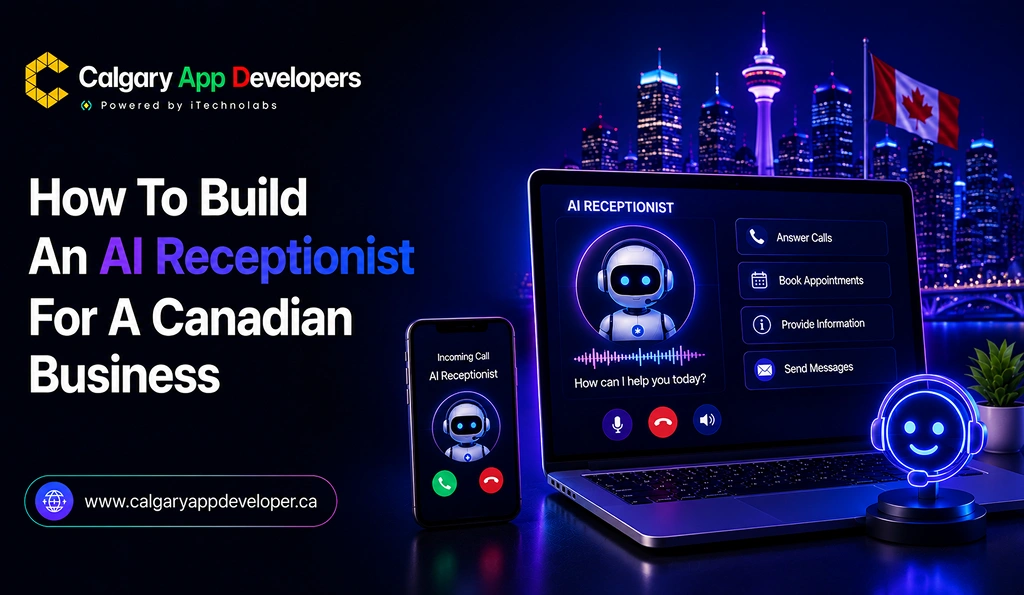
How To Build An AI Receptionist For A Canadian Business
Every missed call is like a door that closes, but also a potential missed opportunity. Whether it is a brand-new customer looking for a quick bit of info, a returning client asking for help, or a prospect that’s actually ready to book, organizations just can’t ignore communication gaps in a market that feels more competitive every year.
As customer expectations continue to rise, many Canadian businesses are turning to AI-powered solutions that can answer calls, respond instantly, and deliver consistent customer experiences around the clock. This shift has led many organizations to explore how to build AI receptionist systems that can handle routine interactions, reduce administrative workload, and improve operational efficiency without sacrificing service quality.
Building an AI receptionist involves far more than connecting a chatbot to a phone line. It requires intelligent conversation design, speech recognition, business system integrations, workflow automation, and compliance with privacy regulations. When developed correctly, an AI receptionist can function as an extension of your customer service team, managing inquiries, scheduling appointments, qualifying leads, and routing calls to the right departments.
This guide is based on our hands-on experience developing intelligent digital solutions, including complex eCommerce applications that require real-time customer interactions, automated workflows, secure data handling, and seamless system integrations. Through these projects, we have gained valuable insights into how businesses can leverage artificial intelligence to create efficient and scalable customer communication systems.
In this blog, we will walk through the complete process of building an AI receptionist for a Canadian business, from selecting the right technology stack and designing natural conversations to ensuring regulatory compliance and optimizing long-term performance.
TL;DR
- Building an AI receptionist helps businesses automate customer communication, reduce missed opportunities, and provide support around the clock.
- A successful AI receptionist requires strategic planning, AI technologies, business system integrations, and compliance with Canadian privacy regulations.
- Development costs typically range from CAD $15,000 to $120,000+, depending on complexity, integrations, and customization requirements.
- Businesses that invest in well-designed AI receptionist solutions can improve customer experience, operational efficiency, and long-term scalability.
Key Points
- An AI receptionist uses technologies such as natural language processing, speech recognition, and conversational AI to understand customer requests and respond in real time.
- Canadian businesses are increasingly adopting AI receptionists to improve response times, reduce administrative workload, and provide consistent customer service beyond regular business hours.
- The development process includes defining business requirements, selecting the right technology stack, designing conversation flows, training the AI, integrating business systems, establishing escalation workflows, ensuring compliance, and continuous optimization.
- Core features of an effective AI receptionist include intelligent call answering, appointment scheduling, CRM integration, multilingual support, call routing, and performance reporting.
- Industries such as healthcare, real estate, legal services, home services, retail, finance, hospitality, and professional services can achieve significant operational benefits from AI receptionist solutions.
- Common development challenges include understanding customer intent, maintaining natural conversations, integrating multiple systems, protecting customer data, and managing human escalation scenarios effectively.
- The decision to build or buy an AI receptionist should be based on business goals, customization requirements, scalability needs, budget, and long-term technology strategy.
- A custom AI receptionist offers greater flexibility, ownership, and competitive advantage, while off-the-shelf solutions provide faster deployment and lower initial costs.
What Is an AI Receptionist and How Does It Work?
An AI receptionist is a virtual assistant that manages customer interactions through phone calls, voice conversations, chat platforms, and messaging channels. Unlike traditional automated phone systems that rely on fixed menus and scripted responses, AI receptionists use technologies such as natural language processing, speech recognition, machine learning, and conversational AI to understand customer requests and respond naturally.
Acting as a business’s first point of contact, an AI receptionist can answer questions, schedule appointments, qualify leads, route calls, collect customer information, and provide support outside regular business hours. This helps businesses improve customer service while reducing the workload on administrative teams.
The system works by converting spoken language into text, analyzing customer intent, and generating appropriate responses in real time. Modern AI receptionists can also integrate with CRM systems, calendars, scheduling platforms, and internal databases, allowing them to complete tasks instead of simply providing information.
A typical AI receptionist workflow follows these steps:
- Receives and answers incoming customer calls
- Understands the caller’s request using conversational AI
- Accesses relevant business information or connected systems
- Provides accurate responses or completes requested actions
- Escalates complex issues to human staff when required
- Records conversation details for reporting and future interactions
As AI technology continues to evolve, AI receptionists are becoming increasingly effective at managing customer interactions while delivering consistent and professional service. For Canadian businesses, they offer a scalable way to improve responsiveness, reduce operational costs, and provide support around the clock.
Why Canadian Businesses Are Adopting AI Receptionists
Canadian businesses are under increasing pressure to deliver faster customer service, reduce operational costs, and remain available beyond traditional business hours. AI receptionists are helping organizations achieve these goals by automating routine interactions while maintaining a consistent customer experience.
Several market trends are accelerating adoption across Canada:
- The global conversational AI market was valued at approximately USD 14.29 billion in 2025 and is projected to reach USD 41.39 billion by 2030, reflecting strong demand for AI-powered customer engagement solutions.
- The AI customer service market is expected to grow from USD 15.78 billion in 2025 to more than USD 83.85 billion by 2033, highlighting the increasing role of intelligent automation in customer support operations.
- Gartner reported that 85% of customer service leaders planned to explore conversational generative AI technologies, demonstrating strong enterprise interest in AI-driven customer interactions. Source:
- Research shows that 88% of organizations were actively using AI in at least one business function by 2025, indicating that AI adoption has moved beyond experimentation and into mainstream business operations.
For Canadian businesses, AI receptionists are no longer viewed as a future innovation. They are becoming a practical solution for improving responsiveness, increasing efficiency, and scaling customer service without significantly increasing staffing costs.
Process of Building an AI Receptionist for a Canadian Business
Developing an AI receptionist requires careful planning, the right technology, and a deep understanding of customer interactions. While many businesses focus on the final product, the real success of an AI receptionist depends on the process behind it. From defining business objectives to ensuring compliance with Canadian regulations, every stage plays a critical role in creating a solution that delivers reliable and professional customer experiences.
Below is a detailed breakdown of the key steps involved in building an AI receptionist for a Canadian business.
Step 1: Define Your Business Requirements
The first and most important step is understanding exactly what the AI receptionist is expected to accomplish. Different businesses have different communication challenges, customer expectations, and operational goals. A healthcare clinic may require appointment scheduling and patient intake support, while a real estate agency may need lead qualification and property inquiry management.
Before selecting technologies or designing workflows, businesses should clearly identify the problems they want to solve and the outcomes they expect to achieve.
Important questions to consider include:
- What types of calls will the AI receptionist handle?
- How many customer interactions occur daily?
- Which tasks currently consume the most staff time?
- What information does the AI need access to?
- When should calls be transferred to a human representative?
- What metrics will define success?
At this stage, businesses should also map customer journeys and identify common interaction patterns. Understanding how customers communicate with the organization helps create a more effective and user-friendly AI experience.
A detailed requirements analysis reduces development risks, improves planning accuracy, and ensures the final solution aligns with business objectives.
Step 2: Choose the Right AI Receptionist Technology Stack
The technology stack serves as the foundation of the AI receptionist. The quality of conversations, response speed, scalability, and overall system reliability depend heavily on the technologies selected during development.
A modern AI receptionist typically combines several AI and communication technologies that work together to process customer interactions in real time.
Core components often include:
- Speech Recognition Systems: Convert spoken conversations into text with high accuracy.
- Natural Language Processing: Understand customer intent, identify key information, and interpret conversational context.
- Large Language Models: Generate intelligent responses based on business knowledge and customer requests.
- Text-to-Speech Engines: Deliver responses using natural-sounding voices that create a more engaging customer experience.
- Cloud Infrastructure: Provides scalability and supports high volumes of simultaneous interactions.
- Analytics and Reporting Tools: Measure performance, customer satisfaction, and operational efficiency.
Businesses should prioritize technologies that offer flexibility, integration capabilities, strong security controls, and long-term scalability. Selecting the right stack early helps avoid costly redevelopment and future limitations.
Step 3: Design Natural and Human-Like Conversations
Technology alone does not create a great AI receptionist. The quality of conversations often determines whether customers perceive the interaction as helpful or frustrating.
Conversation design focuses on creating communication flows that feel natural, professional, and easy to follow. Rather than forcing customers through rigid scripts, modern AI receptionists are designed to support dynamic conversations while still guiding users toward specific outcomes.
Conversation design includes:
- Creating welcome messages and introductions
- Developing call flows for common scenarios
- Anticipating customer questions and objections
- Designing clarification prompts for unclear requests
- Managing interruptions and conversational changes
- Maintaining a consistent brand voice and tone
- Supporting multilingual communication when required
For example, if a customer calls to schedule an appointment, the AI should be able to gather relevant details naturally while adapting to different conversation styles. The interaction should feel similar to speaking with a professional receptionist rather than navigating an automated menu.
Strong conversation design improves customer satisfaction, increases task completion rates, and creates a more positive brand experience.
Step 4: Train the AI on Business-Specific Information
An AI receptionist is only as effective as the information it has access to. Training the system with accurate business knowledge enables it to answer questions confidently and perform tasks correctly.
The training process involves building a structured knowledge base that reflects the organization’s operations, services, policies, and customer support procedures.
Common training data includes:
- Company information
- Products and services
- Frequently asked questions
- Pricing and package details
- Appointment scheduling policies
- Customer service procedures
- Office locations and operating hours
- Internal support documentation
Beyond initial training, businesses should establish a process for regularly updating the AI’s knowledge. New services, pricing changes, policy updates, and operational adjustments must be reflected within the system to maintain accuracy.
Continuous training ensures the AI receptionist remains reliable and relevant as the business evolves.
Step 5: Integrate Phone Systems, Calendars, and CRM Platforms
One of the biggest advantages of modern AI receptionists is their ability to interact with business systems and automate real tasks. Without integrations, the AI can answer questions but cannot perform meaningful actions.
Integrations transform the AI receptionist into an operational assistant capable of managing customer interactions from start to finish.
Common integration points include:
- Business phone systems
- Customer relationship management platforms
- Appointment scheduling software
- Calendar applications
- Help desk and support systems
- Marketing automation platforms
- Internal databases and business applications
For example, when a customer requests an appointment, the AI can check calendar availability, schedule the meeting, send confirmation details, and update the CRM automatically. This eliminates manual work and reduces the risk of human error.
Well-executed integrations create a connected ecosystem that improves efficiency across departments while delivering a smoother customer experience.
Step 6: Set Up Call Routing and Escalation Workflows
Although AI technology continues to improve, not every conversation can or should be handled entirely by automation. Certain situations require human judgment, specialized expertise, or personal attention.
This is why call routing and escalation workflows are essential components of any AI receptionist solution.
Businesses should establish clear rules that determine when calls remain with the AI and when they should be transferred to a human team member.
Typical escalation scenarios include:
- Complex customer support issues
- Sensitive complaints
- Billing disputes
- High-value sales opportunities
- Emergencies
- Requests requiring managerial approval
Effective routing ensures customers reach the appropriate department quickly without unnecessary delays. Equally important is creating a smooth transition between the AI and human staff so customers do not need to repeat information they have already provided.
A well-designed escalation framework combines automation efficiency with human expertise when needed.
Step 7: Ensure Compliance with Canadian Privacy Regulations
Data privacy is a critical consideration when developing AI-powered communication systems. AI receptionists frequently process personal information such as names, phone numbers, appointment details, customer inquiries, and transaction data.
Canadian businesses must ensure that their AI systems comply with applicable privacy laws and data protection requirements.
Key compliance priorities include:
- Secure collection and storage of customer information
- Data encryption during transmission and storage
- User consent management
- Access control and authentication measures
- Transparent privacy policies
- Data retention and deletion procedures
- Compliance with PIPEDA and provincial privacy regulations
Organizations should also conduct regular security assessments and establish governance policies for AI-generated data. A privacy-first approach not only reduces regulatory risks but also strengthens customer trust and confidence.
Step 8: Test and Optimize the AI Receptionist
Before deployment, the AI receptionist must undergo extensive testing across multiple scenarios and customer interaction types. Thorough testing helps identify weaknesses, improve response accuracy, and ensure the system performs consistently under real-world conditions.
Testing typically covers:
- Speech recognition accuracy
- Conversation quality
- Intent detection performance
- Response relevance
- Appointment booking workflows
- CRM and software integrations
- Escalation procedures
- Security and compliance validation
However, testing does not end after launch. The most successful AI receptionists continuously improve through ongoing monitoring and optimization.
Businesses should regularly analyze:
- Customer feedback
- Call completion rates
- Escalation frequency
- Response accuracy
- Customer satisfaction metrics
- Operational efficiency improvements
Continuous optimization enables the AI receptionist to adapt to changing customer expectations, new business requirements, and evolving industry standards.
By following these eight development stages, Canadian businesses can build AI receptionist solutions that improve customer experiences, reduce administrative workload, and create a scalable foundation for future growth.
Key Features Every AI Receptionist Should Include
When companies build an AI receptionist solution, the attention really should not stop at just picking up the phone. A modern AI receptionist ought to smooth out customer interactions, boost everyday operational efficiency, and blend in cleanly with the systems a business already has running. Below are the key parts that every AI receptionist should bring, in one way or another.
1. Intelligent Call Answering
An AI receptionist should be capable of answering incoming calls instantly, understanding customer requests, and providing accurate responses. This ensures callers receive immediate assistance without waiting for a human representative, improving both customer satisfaction and business responsiveness.
2. Appointment Scheduling and Calendar Management
The system should connect with scheduling tools and calendars to book, modify, or cancel appointments automatically. This eliminates manual scheduling tasks and helps businesses reduce missed bookings while providing customers with a convenient self-service experience.
3. Natural Language Understanding
A high-quality AI receptionist must understand conversational language rather than relying solely on predefined commands. Natural language processing enables the system to interpret customer intent, ask relevant follow-up questions, and maintain more natural interactions.
4. CRM and Business Software Integration
Seamless integration with CRM platforms, customer databases, and business applications allows the AI receptionist to access customer information, update records, and support business workflows. This helps create personalized experiences and improves operational efficiency.
5. Smart Call Routing and Escalation
Not every inquiry can be resolved through automation. An effective AI receptionist should intelligently route calls to the appropriate department or transfer customers to human agents when specialized assistance or complex issue resolution is required.
6. Multilingual Communication Support
For Canadian businesses serving diverse customer bases, multilingual support can be a valuable feature. An AI receptionist that communicates in multiple languages helps improve accessibility, enhance customer experiences, and support broader market reach.
7. Analytics and Performance Reporting
Comprehensive reporting capabilities allow businesses to track call volumes, customer inquiries, response accuracy, appointment bookings, and other key metrics. These insights help organizations continuously optimize performance and improve customer service outcomes.
Industries That Benefit Most from AI Receptionists in Canada
AI receptionists are transforming how businesses manage customer communication, appointments, and inquiries. While almost any organization can benefit from automated customer interactions, certain industries experience particularly strong results due to high call volumes, appointment-based operations, and the need for rapid customer response times.
1. Healthcare and Medical Clinics
Healthcare providers receive a constant stream of appointment requests, patient inquiries, follow-up calls, and administrative questions. An AI receptionist can assist with appointment scheduling, patient intake, clinic information, and after-hours support, allowing healthcare staff to focus more on patient care.
2. Real Estate Agencies
Real estate professionals often handle inquiries from buyers, sellers, renters, and investors throughout the day. An AI receptionist can qualify leads, answer property-related questions, schedule viewings, and route inquiries to the appropriate agent, helping agencies respond faster and capture more opportunities.
3. Legal Firms
Law firms frequently receive calls from prospective clients seeking consultations and legal guidance. AI receptionists can collect preliminary case information, schedule appointments, answer common questions, and ensure inquiries are directed to the right legal professional for further assistance.
4. Home Service Businesses
Plumbing, HVAC, electrical, landscaping, and other home service companies depend heavily on incoming customer calls. AI receptionists can manage service requests, schedule appointments, collect customer details, and handle after-hours inquiries, helping businesses improve response times and customer satisfaction.
5. Retail and ECommerce Businesses
Retailers and eCommerce companies often deal with questions regarding products, orders, returns, store locations, and business hours. AI receptionists can provide instant support, track inquiries, and assist customers without requiring human intervention for every interaction.
6. Financial and Insurance Services
Banks, insurance agencies, mortgage brokers, and financial advisory firms manage large volumes of customer inquiries daily. AI receptionists can answer routine questions, schedule consultations, gather customer information, and direct clients to the appropriate specialist when necessary.
7. Hospitality and Travel Businesses
Hotels, travel agencies, resorts, and tourism companies must provide timely responses to reservation requests and customer inquiries. An AI receptionist can handle booking inquiries, provide travel information, answer frequently asked questions, and deliver support around the clock.
8. Professional Service Firms
Accounting firms, consulting agencies, marketing companies, and other professional service providers can use AI receptionists to manage appointment requests, qualify leads, answer service-related questions, and maintain consistent communication with potential and existing clients.
As customer expectations continue to evolve, AI receptionists are becoming valuable assets across industries. Businesses that rely on customer communication, appointment scheduling, lead generation, or high call volumes can significantly improve efficiency and service quality by implementing AI-powered receptionist solutions.
Common Challenges When Building an AI Receptionist
While AI receptionists offer significant business benefits, building an effective solution comes with several challenges that organizations must address during development.
- Understanding Complex Customer Intent: Accurately interpreting diverse customer requests, accents, and conversational styles remains a challenge for many AI systems.
- Maintaining Natural Conversations: Creating human-like interactions without sounding robotic requires extensive conversation design, testing, and continuous optimization.
- Integrating Multiple Business Systems: Connecting phone systems, CRM platforms, calendars, and internal databases can increase development complexity and implementation time.
- Ensuring Data Privacy and Compliance: Businesses must securely handle customer information while complying with Canadian privacy regulations and industry standards.
- Managing Escalations Effectively: Determining when to transfer conversations to human agents is essential for maintaining service quality and customer satisfaction.
Despite these challenges, careful planning, the right technology stack, and ongoing optimization can help businesses build AI receptionist solutions that deliver reliable performance and exceptional customer experiences.
Cost of Building an AI Receptionist for a Canadian Business
The cost to build an AI receptionist in Canada typically ranges from CAD $15,000 to $120,000+, depending on the complexity of the solution, AI capabilities, integrations, compliance requirements, and customization needs.
A simple AI receptionist designed to answer basic inquiries and schedule appointments will require a significantly lower investment than an enterprise-grade solution capable of handling complex conversations, CRM integrations, multilingual support, and advanced workflow automation.
Estimated AI Receptionist Development Cost Breakdown
| Development Stage | Estimated Cost (CAD) |
| Business Analysis & Requirement Gathering | $2,000 – $5,000 |
| Conversation Design & User Flow Mapping | $3,000 – $8,000 |
| AI Model Development & Training | $5,000 – $25,000 |
| Voice AI & Speech Recognition Setup | $3,000 – $15,000 |
| CRM, Calendar & Phone System Integrations | $4,000 – $20,000 |
| Call Routing & Workflow Automation | $3,000 – $10,000 |
| Security & Privacy Compliance Implementation | $2,000 – $8,000 |
| Testing & Quality Assurance | $2,000 – $10,000 |
| Deployment & Launch Support | $1,000 – $5,000 |
| Total Estimated Cost | $15,000 – $120,000+ |
Note: These estimates may vary based on project scope, technology selection, customization requirements, and development partner rates.
Factors Affecting the Cost of Building an AI Receptionist
1. AI Complexity and Conversation Intelligence
The sophistication of the AI has a direct impact on development costs. A receptionist who answers basic questions will require significantly less development effort than one capable of handling complex conversations, lead qualification, customer support workflows, and contextual decision-making.
2. Number of Integrations
Integrating the AI receptionist with CRM platforms, scheduling tools, phone systems, help desk software, and internal databases increases both development time and complexity. The more systems involved, the higher the overall project cost.
3. Voice Capabilities and Language Support
Advanced voice features such as natural-sounding speech, multilingual communication, real-time transcription, and sentiment analysis require additional technologies and development resources. Businesses serving diverse Canadian audiences often invest in English and French language support.
4. Compliance and Security Requirements
Industries such as healthcare, finance, insurance, and legal services require stronger security controls and privacy measures. Implementing compliance frameworks, secure data handling processes, and regulatory safeguards can add to development costs.
5. Customization Requirements
Every business has unique workflows, customer journeys, and operational requirements. Highly customized AI receptionist solutions typically require more development effort than template-based implementations, resulting in higher project costs.
6. Development Location Within Canada
Development costs can vary based on the location of your technology partner. Major cities such as Toronto, Vancouver, and Montreal often have higher software development rates due to increased operational costs and talent demand.
Many businesses are increasingly exploring AI development services in Calgary, where they can often access highly skilled development teams, strong AI expertise, and competitive project pricing compared to some larger Canadian technology markets. This balance of quality and cost efficiency makes Calgary an attractive destination for AI receptionist development projects.
Typical Cost by Project Size
- Basic AI Receptionist: CAD $15,000 – $30,000
- Mid-Level AI Receptionist with Integrations: CAD $30,000 – $70,000
- Enterprise AI Receptionist Platform: CAD $70,000 – $120,000+
While the upfront investment may seem substantial, businesses often recover costs through reduced administrative workload, improved lead capture, enhanced customer service, and increased operational efficiency. For organizations handling high volumes of customer inquiries, an AI receptionist can quickly become a valuable long-term business asset rather than simply a technology expense.
Build vs Buy: Which Approach Is Better for Your Business?
When businesses decide to implement an AI receptionist, one of the first questions they face is whether to build a custom solution or purchase an existing platform. Both approaches offer advantages, but the right choice depends on your business goals, budget, scalability requirements, and long-term strategy.
For organizations with unique workflows, specialized customer interactions, or integration requirements, choosing to build AI receptionist solutions often provides greater flexibility and control. On the other hand, businesses looking for a faster and more affordable implementation may benefit from a ready-made platform.
Build vs Buy AI Receptionist Comparison
| Factor | Build an AI Receptionist | Buy an AI Receptionist |
| Initial Cost | Higher upfront investment | Lower upfront cost |
| Deployment Time | Several weeks to months | Days to weeks |
| Customization | Fully customizable | Limited customization |
| Business Process Alignment | Designed around your workflows | Must adapt to platform limitations |
| Integrations | Custom integrations available | Limited to supported integrations |
| Scalability | Built according to future growth plans | Depends on vendor capabilities |
| Data Ownership | Full control over data and infrastructure | Data is often managed by the provider |
| Competitive Advantage | Unique solution tailored to your business | Similar functionality available to competitors |
| Long-Term Flexibility | High flexibility and control | Dependent on the vendor roadmap |
| Ongoing Maintenance | Managed by your development team | Managed by a software provider |
- When Should You Build an AI Receptionist?
Building a custom AI receptionist is often the better choice when your business requires advanced functionality, unique workflows, or deep integrations with internal systems.
A custom solution may be ideal if:
- You need industry-specific conversation flows
- Your business handles complex customer interactions
- Multiple software integrations are required
- Data privacy and compliance are critical
- You want complete ownership of the platform
- Long-term scalability is a priority
Although custom development requires a larger initial investment, it allows businesses to create a solution that aligns perfectly with their operations and future growth objectives.
- When Should You Buy an AI Receptionist?
Purchasing an existing AI receptionist platform can be a practical option for businesses that need quick deployment and standard functionality.
A ready-made solution may be suitable if:
- Your requirements are relatively simple
- You need to launch quickly
- Budget constraints are a major consideration
- Extensive customization is not necessary
- You prefer a subscription-based model
For small businesses with straightforward customer communication needs, buying an existing platform can provide immediate value without the complexity of custom development.
- Which Option Delivers Greater Long-Term Value?
While off-the-shelf solutions can help businesses get started quickly, many organizations eventually encounter limitations related to customization, integrations, scalability, and vendor dependency. As customer expectations evolve and business processes become more sophisticated, these limitations can restrict growth and operational efficiency.
For businesses seeking a long-term competitive advantage, custom development often provides greater value. The ability to build AI receptionist solutions tailored to specific business objectives, customer journeys, and operational workflows creates a more scalable and future-ready foundation.
Ultimately, the decision comes down to your business goals. If speed and affordability are the primary priorities, buying may be the right choice. If flexibility, ownership, and long-term scalability are more important, building a custom AI receptionist is often the stronger investment.
Why Partner with Calgary App Developer for AI Receptionist Solutions
Building an AI receptionist requires more than technical expertise. It demands a deep understanding of customer communication, business workflows, system integrations, and long-term scalability. At Calgary App Developer, we help Canadian businesses design and develop AI receptionist solutions that deliver real operational value while creating exceptional customer experiences.
- Local Canadian Expertise: As a Canadian technology partner, we understand the unique challenges, customer expectations, and regulatory requirements that businesses face across Canada. Our team develops solutions that align with local business environments, privacy standards, and industry-specific needs.
- Custom AI Receptionist Development: Every business operates differently. Instead of relying on one-size-fits-all solutions, we build AI receptionist platforms tailored to your workflows, customer journeys, service processes, and business goals. This ensures the solution works the way your organization needs it to.
- End-to-End Development Services: From strategy and conversation design to AI development, integrations, testing, and deployment, our team manages the complete development lifecycle. This streamlined approach helps reduce project complexity while ensuring consistent quality at every stage.
- Seamless Business System Integrations: Our developers integrate AI receptionists with CRM platforms, scheduling systems, phone services, internal databases, and other business applications. This allows your AI receptionist to perform real tasks, automate workflows, and improve operational efficiency.
- Scalable and Future-Ready Solutions: As your business grows, your AI receptionist should grow with it. We develop scalable solutions that support increasing call volumes, additional business functions, new integrations, and evolving customer expectations without requiring major redevelopment.
- Security and Compliance Focused Development: We prioritize data protection, secure architecture, and privacy best practices throughout the development process. This helps businesses protect customer information while supporting compliance with Canadian privacy requirements.
- Free 30 Minute AI Consultation: Not sure where to start? Our experts offer a free 30-minute consultation to discuss your business requirements, evaluate potential use cases, and guide the best approach to build AI receptionist solutions that align with your goals.
Whether you need a simple virtual receptionist or a fully customized AI-powered communication platform, we provide the expertise, local knowledge, and technical capabilities required to transform customer interactions and support long-term business growth.
Conclusion
As customer expectations continue to evolve, businesses can no longer afford missed calls, delayed responses, or inefficient communication processes. An AI receptionist provides a practical way to deliver consistent customer support, automate routine tasks, and ensure every inquiry receives prompt attention, regardless of the time of day.
From defining business requirements and selecting the right technology stack to integrating business systems and ensuring regulatory compliance, building an AI receptionist requires a strategic approach. Organizations that invest in a well-designed solution can improve customer experiences, increase operational efficiency, and create a scalable foundation for future growth.
Whether you choose to build a custom AI receptionist or adopt an existing platform, the key is selecting a solution that aligns with your business goals and customer needs. As AI technology continues to advance, AI receptionists are becoming valuable business assets that help organizations stay competitive in an increasingly digital marketplace.
If you’re ready to build AI receptionist solutions tailored to your business, partnering with an experienced Canadian development team can help you turn your vision into a reliable, secure, and future-ready customer communication platform.
FAQs
1. How much does it cost to build an AI receptionist in Canada?
The cost of building an AI receptionist typically ranges from CAD $15,000 to $120,000+. Basic solutions with call answering and appointment scheduling usually cost between $15,000 and $30,000, while advanced systems with CRM integrations, multilingual support, and custom workflows can range from $30,000 to $120,000+.
2. How long does it take to build an AI receptionist?
Development timelines generally range from 4 weeks to 8 months, depending on project complexity. A basic AI receptionist can be developed within 4 to 8 weeks, while mid-level solutions typically require 2 to 4 months. Enterprise-grade AI receptionist platforms often take 4 to 8 months to design, develop, test, and deploy.
3. What technologies are used to build an AI receptionist?
Modern AI receptionists combine technologies such as natural language processing, speech recognition, machine learning, large language models, text-to-speech engines, cloud infrastructure, and workflow automation tools. These technologies work together to understand customer requests, generate responses, automate tasks, and integrate with business systems.
4. Can an AI receptionist integrate with existing business software?
Yes. AI receptionists can integrate with CRM platforms, phone systems, calendars, appointment scheduling software, help desk solutions, marketing tools, and internal databases. These integrations allow the system to perform actions such as booking appointments, updating customer records, routing calls, and managing support requests automatically.
5. Is an AI receptionist suitable for small businesses?
Absolutely. Small businesses often benefit significantly from AI receptionists because they provide 24/7 customer support without requiring additional staff. By automating call handling, appointment scheduling, and customer inquiries, small businesses can improve responsiveness, reduce administrative workload, and capture more potential leads.
6. Can an AI receptionist handle calls in multiple languages?
Yes. Modern AI receptionists can be trained to communicate in multiple languages, including English and French, which is particularly valuable for Canadian businesses. Multilingual capabilities help organizations serve diverse customer groups, improve accessibility, and deliver more personalized customer experiences across different regions.
7. How do I get started with building an AI receptionist for my business?
The first step is identifying your business goals, customer communication challenges, and automation requirements. From there, an AI development partner can evaluate your needs, recommend the right technology stack, estimate project costs and timelines, and create a roadmap for developing a custom AI receptionist solution.


Pankaj Arora is a seasoned technology leader and the Founder of Calgary App Developer, with 10+ years of expertise in crafting high-performance digital solutions. His core competencies include full-stack app development, cloud-native architecture, API integration, and agile product delivery. Under his leadership, Calgary App Developers has empowered startups and enterprises alike with scalable mobile applications, secure web platforms, and AI-driven SaaS products.