









Build an AI Trading Bot in 2026: Strategies, Tools, Costs, & Canadian Developer Advantage
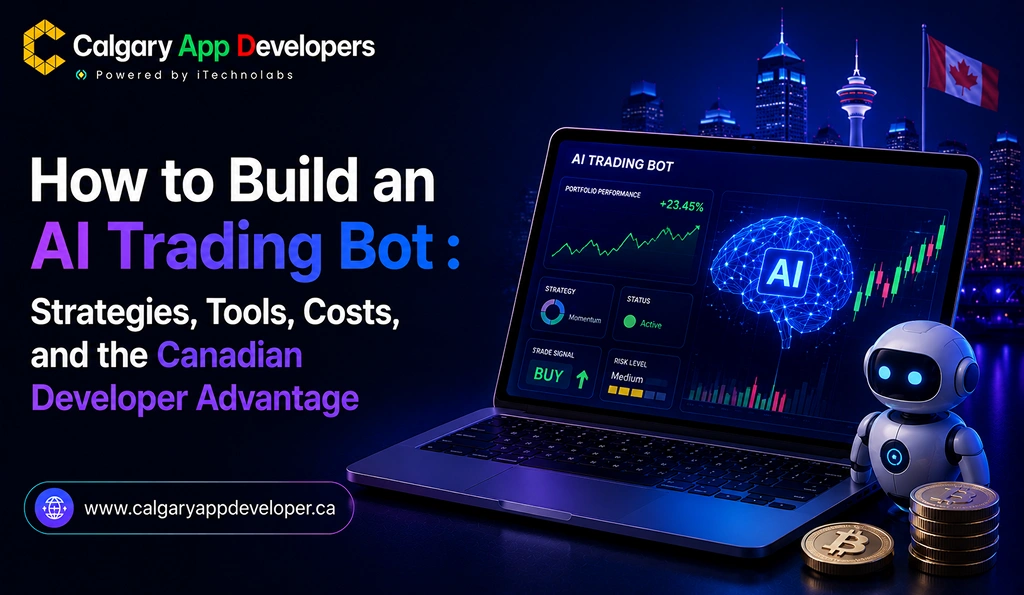
AI trading bots have evolved from niche tools used by hedge funds into mainstream investment technology. Today, retail traders, fintech startups, investment firms, and businesses are increasingly turning to AI-powered trading systems to automate market analysis, execute trades faster, and eliminate emotional decision-making from the trading process.
The momentum behind this shift is undeniable. According to Grand View Research, the global AI trading platform market was valued at USD 11.23 billion in 2024 and is projected to reach USD 33.45 billion by 2030, growing at a CAGR of 20.0%.
Meanwhile, the broader algorithmic trading market is expected to exceed USD 42.99 billion by 2030 as artificial intelligence becomes a core component of modern trading infrastructure.
AI trading is no longer an experimental technology. It is becoming a competitive necessity. From stock and forex trading to cryptocurrency markets, AI systems can process millions of data points in real time, identify patterns invisible to human traders, assess risk, and execute trades within milliseconds.
Yet most guides on building an AI trading bot focus exclusively on coding tutorials. They assume you already understand Python, machine learning frameworks, quantitative finance, and cloud infrastructure. For business leaders, investors, and entrepreneurs looking to launch an AI trading solution, that approach leaves a significant knowledge gap.
Drawing from our hands-on experience developing AI-powered trading platforms, algorithmic trading systems, market intelligence engines, and custom fintech solutions, we created this guide to provide a practical roadmap for every type of reader. Whether you want to build a trading bot yourself, launch one through a no-code platform, or partner with an experienced Canadian development team, you’ll find a clear path forward.
In this guide, you’ll learn how AI trading bots work, the most effective trading strategies in 2026, the tools and technologies required to build them, development costs in Canada, regulatory considerations, and the advantages of working with Canadian AI development specialists. By the end, you’ll have a realistic understanding of what it takes to launch a secure, scalable, and profitable AI trading solution in today’s rapidly evolving financial landscape.
TL;DR
- AI trading bots use machine learning to analyze market data, identify patterns, and automate trading decisions across stocks, crypto, forex, and other markets.
- There are three primary paths to getting an AI trading bot: building it yourself, using a no-code platform, or hiring a development team for a custom solution.
- Success depends on far more than the AI model itself, with data quality, backtesting, infrastructure, and risk management playing critical roles.
- Development costs in Canada typically range from $25,000 to $150,000+ CAD depending on complexity, integrations, and market coverage.
Key Points
- AI trading bots differ from traditional rule-based bots because they can learn from historical and real-time data, adapt to changing market conditions, and incorporate multiple data sources into decision-making.
- Different AI trading bot types serve different objectives, including trend following, arbitrage, sentiment analysis, market making, portfolio rebalancing, and multi-agent trading strategies.
- Businesses and investors can choose between building a bot from scratch, using a no-code trading platform, or commissioning a custom solution based on their technical expertise, budget, and long-term goals.
- A successful AI trading bot requires a combination of quality data sources, machine learning models, feature engineering, backtesting frameworks, cloud infrastructure, and ongoing monitoring.
- AI trading bots can be deployed across cryptocurrency, stock, forex, commodity, and ETF markets, each with unique opportunities, data requirements, and regulatory considerations.
- Risk management is one of the most important components of any trading system and should include stop losses, position sizing rules, drawdown limits, trade controls, and human oversight mechanisms.
- Canadian traders and businesses must understand regulatory considerations involving CIRO, provincial securities regulators, FINTRAC, and CRA tax treatment before deploying commercial trading systems.
- Development timelines vary significantly, ranging from a few days for no-code solutions to several months for self-built systems and six to sixteen weeks for professionally developed custom platforms.
- AI trading bots require continuous maintenance after launch because market conditions, regulations, data sources, and model performance evolve.
- The most effective AI trading bots combine strong predictive capabilities with disciplined risk controls, reliable infrastructure, and ongoing optimization rather than relying solely on advanced AI models.
What Is an AI Trading Bot And How Is It Different from a Regular Bot?
Not all trading bots are the same. That distinction matters a lot when you’re deciding how to build one.
A traditional rule-based bot follows a fixed set of instructions: if the price crosses this threshold, buy; if it drops below this level, sell. It’s essentially an automated version of a manual decision tree. Simple, transparent, and easy to break when market conditions change. These bots don’t learn; they execute. If you programmed them during a bull market, they’ll behave the same way in a crash.
An AI trading bot works differently. It uses machine learning algorithms to analyze historical and real-time data, identify patterns, and make probabilistic decisions, and it improves over time. That means it can adapt when the market shifts, recognize sentiment signals that no hard-coded rule would catch, and weigh dozens of variables simultaneously. A Random Forest classifier, an LSTM neural network, or a transformer-based model trained on price data, trading volume, and news sentiment is doing something fundamentally more sophisticated than a rule saying “buy when RSI crosses 30.”
The practical difference? Rule-based bots are predictable and brittle. AI-powered bots are adaptive and complex. Here’s what AI actually adds that a traditional bot can’t replicate:
- Pattern recognition at scale: AI models can scan thousands of data points simultaneously and identify correlations a human would never spot manually.
- Adaptive learning: The model can retrain on new data and update its predictions as market dynamics evolve.
- Natural language processing (NLP): AI can read news headlines, Reddit threads, earnings calls, and social media to gauge market sentiment in real time.
- Multi-signal fusion: A well-built AI bot combines technical indicators, on-chain data (for crypto), macroeconomic signals, and sentiment data in a single model.
- Self-optimization: Advanced systems can adjust their own confidence thresholds, position sizing parameters, and strategy weights based on recent performance.
None of this is magic. The bot is still limited by the quality of the data it’s trained on, the quality of its feature engineering, and the robustness of its risk management framework. But the ceiling is genuinely higher than anything a rule-based system can achieve.
Types of AI Trading Bots: Which One Fits Your Goal?
Before you decide how to build a bot, you need to decide what kind of bot you’re actually building. The type shapes every downstream decision about data, models, infrastructure, and complexity.
- Trend-Following Bots: Analyze price momentum and directional signals to ride existing market moves. They buy when assets are gaining strength and exit when momentum reverses. LSTMs and moving-average crossover models work well here. Best for: investors who want to capture medium-term price trends without active monitoring.
- Arbitrage Bots: Exploit price differences for the same asset across different exchanges or trading venues, buying where the price is lower and selling where it’s higher. Speed is critical here; the window is often seconds. Best for: technically advanced builders with access to low-latency infrastructure and multiple exchange accounts.
- Sentiment Analysis Bots: Process text data, news, social media, earnings reports, and analyst upgrades and translate them into trading signals. They use NLP models to score whether coverage is positive, negative, or neutral, then act accordingly. Best for: traders in markets with high sentiment volatility, like crypto, small-cap stocks, or meme stocks.
- Market-Making Bots: Provide liquidity by placing simultaneous buy and sell orders and profiting from the spread. In DeFi, this means managing positions in automated market makers (AMMs) like Uniswap. In traditional markets, it means placing limit orders above and below the current price. Best for: experienced traders with deep capital and strong risk controls.
- Portfolio Rebalancing Bots: Automatically shift allocation weights across asset classes based on AI-driven performance forecasts. They’re closer to a robo-advisor than a day trader. Best for: long-term investors who want systematic portfolio management without active intervention.
- Multi-Agent Systems: Combine several of the above into a coordinated network of bots that share signals, specialize by market, and operate collectively. This is genuinely frontier territory, powerful in theory, complex to build and maintain in practice. Best for: institutional investors or well-capitalized teams with serious engineering resources.
Here’s a practical comparison to help you decide which type fits your situation:
| Bot Type | Markets | Complexity | Best For | Typical Build Cost (CAD) |
| Trend-Following | Stocks, Crypto, Forex | Moderate | Long-term momentum investors | $25,000 – $70,000 |
| Arbitrage | Crypto, Stocks | High | Tech-savvy traders with fast infrastructure | $50,000 – $120,000 |
| Sentiment Analysis | Stocks, Crypto | Moderate-High | News-driven or meme-asset traders | $35,000 – $90,000 |
| Market-Making | Crypto (DeFi), Stocks | Very High | Experienced traders with deep capital | $60,000 – $150,000+ |
| Portfolio Rebalancing | Stocks, ETFs, Crypto | Moderate | Passive investors, wealth managers | $30,000 – $80,000 |
| Multi-Agent System | Any | Very High | Institutional/advanced teams | $100,000 – $300,000+ |
The right type isn’t the most sophisticated one; it’s the one that matches your actual goal, your capital base, and your tolerance for operational complexity. A mid-tier sentiment analysis bot that you trust and understand will outperform a multi-agent system you can’t diagnose when something goes wrong.
The 3 Paths to Getting an AI Trading Bot
Here’s something most guides skip entirely: you don’t have to build an AI trading bot from scratch. There are three genuinely distinct paths, and the right one depends entirely on your goals, budget, and technical background.
Path 1: Build It Yourself (The Developer Route)
If you’re a developer or you’re willing to become one, you can build a custom AI trading bot using Python and a set of well-established libraries. The upside is full control: your strategy, your data sources, your deployment. The downside is the time investment. A production-ready, backtested bot with solid risk management takes most developers three to six months of serious part-time work, minimum. You’ll also need to understand model evaluation, infrastructure, API rate limits, and regulatory compliance. If you’re up for it, it’s worth it. We cover this path in detail in the next section.
Path 2: No-Code / Low-Code Platforms (The Non-Developer Route)
If you don’t code, some platforms let you configure and deploy trading bots through a visual interface. Tools like 3Commas, Cryptohopper, Pionex, and Wealthsimple Autopilot (for Canadian investors) give you bot logic without requiring a single line of code. The upside: you can be live in hours. The downside: you’re limited to the strategies and parameters the platform supports. There’s no real “AI” learning in most of these tools; they’re closer to rule-based systems with a polished UI. They’re a reasonable starting point for testing ideas, but they can’t execute genuinely proprietary strategies.
Path 3: Commission a Custom Build (The Business Route)
For investors, wealth managers, or businesses that want a proprietary AI trading system built to their specifications, commissioning a development agency is the right path. You’re not writing code; you’re defining what you need, and an experienced team handles the architecture, model development, backtesting, compliance review, and deployment. This is how you get a bot that reflects your actual strategy, integrates with your existing portfolio systems, and has ongoing technical support when the market throws something unexpected at it. Calgary App Developer.ca works directly with Canadian businesses and investors to build custom AI trading systems designed for the Canadian market.
How to Build an AI Trading Bot: The Developer Path
To match the depth and style of your Ethereum example, you should expand each section as a practical walkthrough that explains not just what the step is, but why it matters, what decisions developers make, common mistakes, and the tools involved.
Here’s an expanded version:
Language and Core Libraries
Every AI trading bot starts with a technology stack. While you can build trading systems in languages like Java, C++, Rust, or Go, Python remains the preferred choice for most AI-driven trading applications.
Why Python?
The biggest advantage is the machine learning ecosystem. Almost every major AI framework, data science library, and quantitative finance tool is built with Python support first. This allows developers to focus on strategy development rather than low-level engineering challenges.
Core libraries you’ll use throughout the project:
- Pandas for working with historical market data and time series analysis
- NumPy for numerical calculations and matrix operations
- Scikit Learn for traditional machine learning models
- PyTorch or TensorFlow for deep learning models
- TA Lib for technical indicators
- Matplotlib and Plotly for visualization
- Backtrader or Zipline for strategy testing
Install the required packages:
| </> Bash
pip install pandas numpy scikit-learn torch ta backtrader matplotlib plotly yfinance |
What each package does:
- pandas manages structured financial datasets
- numpy powers mathematical calculations
- scikit-learn provides machine learning algorithms
- torch enables deep learning models
- ta generates technical indicators
- backtrader handles backtesting
- matplotlib and Plotly visualize results
- yfinance downloads historical market data
At this stage, the goal is not to build intelligence. The goal is simply to create a reliable environment where data can be collected, processed, analyzed, and tested.
Step 1: Collect Market Data
Before a model can make predictions, it needs historical examples to learn from.
Think of market data as the training material for your AI. If the data is poor quality, incomplete, or inaccurate, the model will learn bad patterns.
Most trading bots start with OHLCV data:
- Open price
- High price
- Low price
- Close price
- Volume
These values form the foundation of nearly every trading strategy.
For example, let’s fetch historical data for a stock using Yahoo Finance:
| </> Python
import yfinance as yf import pandas as pd ticker = “AAPL” data = yf.download( ticker, start=”2022-01-01″, end=”2025-01-01″, interval=”1d” ) print(data.head()) |
This gives us several years of historical trading activity.
Why historical data matters:
A machine learning model learns relationships between market conditions and future outcomes.
The more diverse market conditions you provide, the more robust the model becomes.
Good datasets should include:
- Bull markets
- Bear markets
- Sideways markets
- High volatility periods
- Low volatility periods
A model trained only during a bull market will often fail when market conditions change.
Common mistakes:
- Using too little historical data
- Ignoring data quality issues
- Training only on recent market conditions
- Forgetting to adjust for stock splits and dividends
At the end of this step, you should have a clean historical dataset ready for analysis.
Step 2: Add Alternative Data Sources
Most beginner trading bots only use price data.
Professional systems rarely do.
The real advantage comes from combining multiple information sources.
Additional signals may include:
News Sentiment
News often moves markets before price charts reflect the change.
Examples:
- Earnings reports
- Regulatory announcements
- Product launches
- Macroeconomic events
Using NLP models, we can convert news articles into sentiment scores.
Example:
| </> Python
sentiment_score = 0.82 |
A positive score may indicate bullish market sentiment.
Social Media Data
Many modern traders monitor:
- Reddit discussions
- X posts
- StockTwits activity
Sudden increases in discussion volume can signal unusual market interest.
Blockchain Metrics
For cryptocurrencies, on-chain activity provides unique insights.
Useful metrics include:
- Active wallet count
- Transaction volume
- Gas usage
- Exchange inflows and outflows
These metrics often reveal investor behavior before price movement occurs.
Economic Indicators
For stock markets, macroeconomic data can be valuable:
- Interest rates
- Inflation reports
- Employment numbers
- GDP growth
These indicators frequently influence broader market trends.
The objective here is to provide the model with additional context that pure price charts cannot capture.
Step 3: Feature Engineering
This is where raw market data becomes machine learning input.
Feature engineering is often the single most important step in the entire project.
A sophisticated neural network cannot compensate for poor features.
The goal is to transform raw information into signals that capture market behavior.
Example features:
Momentum
Measures the speed of price movement.
| </> Python
df[“momentum_5”] = df[“Close”] – df[“Close”].shift(5) |
Positive values indicate upward momentum.
Moving Averages
Used to identify trends.
| </> Python
df[“ma_20”] = df[“Close”].rolling(20).mean() df[“ma_50”] = df[“Close”].rolling(50).mean() |
Volatility
Measures market uncertainty.
| </> Python
df[“volatility”] = ( df[“Close”].pct_change() .rolling(20) .std() ) |
Higher volatility generally implies greater risk.
Relative Strength Index
Helps identify overbought and oversold conditions.
| </> Python
from ta.momentum import RSIIndicator df[“rsi”] = RSIIndicator( close=df[“Close”] ).rsi() |
Volume Features
Volume often confirms price movements.
| </> Python
df[“volume_ma”] = ( df[“Volume”] .rolling(20) .mean() ) |
Large volume spikes frequently precede significant market moves.
Creating the Target Variable
Now we define what the model should predict.
Example:
| </> Python
df[“target”] = ( df[“Close”].shift(-1) > df[“Close”] ).astype(int) |
Here:
- 1 means price rises tomorrow
- 0 means price falls tomorrow
This converts the problem into a binary classification task.
The model will learn patterns from today’s market conditions and attempt to predict tomorrow’s direction.
Step 4: Train the Machine Learning Model
Once features are prepared, we can train a model.
For a first trading bot, Random Forest is usually the best starting point.
Why?
- Easy to implement
- Resistant to overfitting
- Fast training
- Interpretable results
Example:
| </> Python
from sklearn.ensemble import RandomForestClassifier from sklearn.model_selection import train_test_split features = [ “momentum_5”, “ma_20”, “ma_50”, “volatility”, “rsi” ] X = df[features] y = df[“target”] X_train, X_test, y_train, y_test = train_test_split( X, y, shuffle=False, test_size=0.2 ) model = RandomForestClassifier( n_estimators=200, random_state=42 ) model.fit(X_train, y_train) |
The model now attempts to identify relationships between market features and future price movement.
At this stage, avoid chasing high accuracy.
Financial markets are noisy.
Even models with 55 to 60 percent directional accuracy can be profitable when paired with strong risk management.
Step 5: Evaluate Model Performance
Before trusting any model, we need to measure performance objectively.
Common metrics include:
- Accuracy
- Precision
- Recall
- F1 Score
- ROC AUC
Example:
| </> Python
from sklearn.metrics import classification_report predictions = model.predict(X_test) print( classification_report( y_test, predictions ) ) |
More importantly, evaluate trading performance:
- Win rate
- Average profit per trade
- Maximum drawdown
- Sharpe ratio
- Profit factor
A model with lower accuracy may still generate more profit if winners are significantly larger than losers.
This is why trading performance matters more than machine learning metrics alone.
Step 6: Backtest the Strategy
A prediction model is not a trading strategy.
We still need rules that convert predictions into buy and sell decisions.
Example logic:
- Buy when confidence exceeds 70%
- Sell when confidence drops below 40%
- Risk 1% of account per trade
Backtesting applies these rules to historical data.
Frameworks like Backtrader simulate:
- Trade entries
- Trade exits
- Transaction fees
- Slippage
- Portfolio growth
The objective is to answer one question:
“If this strategy had existed in the past, how would it have performed?”
This step often reveals weaknesses that are invisible during model training.
Step 7: Deploy the Trading Bot
Once backtesting results are acceptable, the system can move into a live environment.
A production architecture typically includes:
- Market Data Service
- Feature Engineering Pipeline
- Prediction Engine
- Trading Execution Module
- Monitoring System
- Risk Management Layer
Typical cloud platforms:
- AWS
- Google Cloud
- Microsoft Azure
The bot should run continuously and automatically:
- Fetch new data
- Update features
- Generate predictions
- Execute trades
- Log every decision
Every prediction should be traceable for debugging purposes.
Step 8: Risk Management and Capital Protection
This is the most important part of the entire system.
Many profitable models fail because risk management was ignored.
Essential controls include:
Position Sizing
Never risk too much on a single trade.
Example:
| </> Python
risk_per_trade = 0.01 |
This means risking only 1% of account equity per position.
Stop Losses
Automatically close losing trades.
Example:
| </> Python
stop_loss = 0.03 |
Exit if price drops 3%.
Take Profit Levels
Lock in gains before markets reverse.
Example:
| </> Python
take_profit = 0.06 |
Capture profits after a 6% move.
Maximum Drawdown Protection
Pause trading when losses exceed a threshold.
Example:
| </> Python
max_drawdown = 0.15 |
Stop trading after a 15% account decline.
Circuit Breakers
Disable trading when:
- Market volatility becomes extreme
- Data feeds fail
- APIs become unavailable
- Predictions become unstable
The primary goal of risk management is survival. A trading bot that survives difficult markets can recover and improve. A bot without protection eventually encounters a loss large enough to erase months or years of gains.
What Markets Can AI Trading Bots Trade?
Most AI trading bot guides focus exclusively on cryptocurrency. That’s a significant blind spot for Canadian investors, who often split their portfolios across stocks, ETFs, crypto, and forex. Here’s what you need to know about each market.
1. Cryptocurrency
Crypto is the most bot-friendly market in the world. It trades 24/7 with no market close, APIs are widely available and standardized, and the volatility creates frequent opportunities for systematic strategies. The risks are equally real: regulatory uncertainty, exchange counterparty risk, and the fact that crypto markets are heavily influenced by a small number of large holders (“whales”) who can move prices against your model’s predictions. Canadian crypto traders should be aware that the CSA (Canadian Securities Administrators) regulates crypto trading platforms operating in Canada, and the tax treatment of crypto trading profits under CRA rules is as taxable income or capital gains, depending on frequency and intent.
2. Canadian and US Stock Markets
Trading Canadian equities (TSX, TSX-V) or US equities (NYSE, NASDAQ) with an AI bot is absolutely viable, but more complex than crypto in a few ways. Market hours apply (9:30 AM to 4:00 PM Eastern, Monday to Friday), which changes the bot’s operating pattern. Data licensing for historical stock data is more expensive and more restricted than crypto data. And if you’re building a system that manages others’ money, even informally, you may trigger registration requirements under provincial securities law. CIRO (the Canadian Investment Regulatory Organization) sets rules for algorithmic trading in Canadian markets, and any firm or individual acting as a dealer needs to comply.
3. Forex
The foreign exchange market is the most liquid in the world, and it’s technically accessible 24/5. AI bots for forex typically trade major currency pairs (CAD/USD, EUR/USD, GBP/JPY) using a combination of macroeconomic signals and technical indicators. Leverage is common in forex, which amplifies both gains and losses significantly. Canadian forex traders fall under FINTRAC reporting obligations at high transaction volumes, and the regulatory status of forex bot operations depends on how they’re structured.
4. Commodities and ETFs
Oil, gold, and agricultural commodities are increasingly targets for AI trading systems, especially among Alberta-based investors with direct industry knowledge. ETF-based strategies that track sector performance are also well-suited to AI-driven rebalancing models.
Risk Management: The Part Most Builders Get Wrong
It’s the unsexy part of the conversation, and it’s the one that separates bots that survive from bots that don’t. Most first-time bot builders spend 80 percent of their energy on the prediction model and about 20 percent on risk management. That’s exactly backwards.
Here’s what a proper risk framework looks like in practice.
- Stop Losses: Set a maximum per-trade loss threshold. If the bot buys ETH at $3,000 and a 3 percent stop loss is set, the position closes automatically at $2,910. This prevents a single bad trade from doing meaningful damage. Don’t skip this because you think your model is too good to be wrong; your model will be wrong regularly.
- Take Profit Targets: When a position hits your target gain, the bot exits and locks in the profit. Markets reverse unexpectedly; there’s no such thing as “just let it ride” in algorithmic trading without defined parameters.
- Position Sizing: Where the Kelly Criterion becomes relevant. Rather than betting a fixed amount on every trade, you size positions based on the model’s confidence. Higher confidence means a larger position; lower confidence means smaller. The Kelly formula helps you maximize long-term growth without risking ruin on any single trade. Translated into practice: never risk more than 1 to 2 percent of your total portfolio on a single position, regardless of what the model says.
- Maximum Drawdown Triggers: Automatically pause the bot when the total portfolio has declined by a set percentage from its peak. If you set a 15 percent drawdown limit, the bot stops trading when total losses reach 15 percent of the high-water mark. This is your emergency brake. Without it, a malfunctioning bot during a volatile market can drain an account before you notice.
- Daily Trade Count Limits: High-frequency strategies generate fees with every trade, and death by a thousand cuts is a real failure mode. Set a ceiling on how many trades the bot can execute per day, and build in a review process when that ceiling is hit.
- Human-in-the-Loop Design: The bot escalates to you for manual approval above a certain threshold. Fully autonomous sounds impressive. But the most resilient systems flag unusual conditions and wait for a human to confirm rather than acting on edge cases the model was never trained to handle.
Canadian Regulations for Algorithmic Trading
No other “build an AI trading bot” guide addresses this. That’s a problem because Canadian investors who deploy algorithmic trading systems without understanding the regulatory framework are taking on real legal risk.
1. CIRO:
Canadian Investment Regulatory Organization is the national self-regulatory organization for investment dealers in Canada, formed from the 2023 merger of IIROC and MFDA. If you’re deploying an algorithmic trading strategy through a registered dealer, your activity falls under CIRO’s rules. Firms operating algorithmic trading systems must implement pre-trade risk controls, monitor for market disruption, and maintain records that can be audited. Individual retail investors trading their own accounts through standard brokerages aren’t registrants, but firms building commercial bot services absolutely need legal counsel before going live.
2. OSC and Provincial Securities Regulators:
If you’re running a fund, taking investor capital, or offering a “managed account” service powered by an AI bot, you’re almost certainly triggering registration requirements as a portfolio manager or exempt market dealer under provincial securities laws. This applies even if the fund is small and informal. The Ontario Securities Commission and the Alberta Securities Commission both actively monitor for unregistered investment advisors.
3. FINTRAC:
Financial Transactions and Reports Analysis Centre of Canada applies if you’re operating a business that involves currency exchange or certain financial transactions above reporting thresholds. Most individual algo traders won’t hit these thresholds, but anyone building a commercial AI trading service needs to assess their FINTRAC obligations.
4. CRA Tax Treatment:
Algorithmic trading income is worth understanding before your first profitable month. The CRA determines whether trading activity is business income (taxed at full marginal rates) or capital gains (50 percent inclusion rate) based on factors like trading frequency, holding periods, and whether you have specialized knowledge. High-frequency automated trading is almost always classified as business income. That changes your tax planning significantly, and it’s something a Canadian developer who understands the ecosystem will flag during the build process rather than leaving you to discover it at tax time.
How Much Does It Cost to Build an AI Trading Bot in Canada?
Most custom AI trading bot builds in Canada range from $25,000 to $150,000+ CAD, depending on the type of bot, target market, data infrastructure requirements, and the complexity of the model. Simple trend-following bots with standard API data sources sit at the lower end; fully custom multi-market systems with proprietary data pipelines and enterprise-grade deployment infrastructure push well past six figures.
| Development Stage | Estimated Cost (CAD) |
| Market Research & Strategy Validation | $2,000 to $10,000 |
| Business Requirements & Technical Planning | $3,000 to $12,000 |
| Data Acquisition & Integration Setup | $5,000 to $25,000 |
| AI Model Development & Training | $10,000 to $50,000 |
| Trading Algorithm Development | $8,000 to $35,000 |
| Backend Infrastructure Development | $5,000 to $30,000 |
| Broker & Exchange API Integration | $3,000 to $15,000 |
| Risk Management System Development | $5,000 to $25,000 |
| Backtesting & Strategy Optimization | $4,000 to $20,000 |
| Frontend Dashboard & Analytics | $5,000 to $25,000 |
| Security & Compliance Implementation | $5,000 to $30,000 |
| Quality Assurance & Performance Testing | $3,000 to $15,000 |
| Cloud Deployment & DevOps Setup | $3,000 to $20,000 |
| Post Launch Monitoring & Support (First Year) | $5,000 to $40,000 |
Factors That Affect Your Build Cost
- Target Market and Data Complexity: A crypto bot pulling from free-tier APIs has much lower data costs than a TSX equities bot that needs licensed historical tick data and real-time feeds from professional data vendors like Refinitiv or Bloomberg. The data infrastructure alone can add $10,000 to $30,000 CAD to a stock-market-focused build.
- Model Type and Training Requirements: A Random Forest classifier trained on publicly available price data is orders of magnitude cheaper to develop than a transformer-based sentiment analysis model trained on a proprietary corpus of earnings calls and news feeds. The more sophisticated the model, the more data science expertise and compute time are required.
- Market Scope: A bot that trades a single asset class on one exchange costs less than a multi-market system that needs to handle stocks, crypto, and forex simultaneously. Each additional market adds API integrations, compliance considerations, and testing complexity.
- Backtesting Infrastructure: Rigorous backtesting against years of historical data with realistic fee and slippage modeling takes time. If you need to validate strategies across multiple market regimes (bull runs, crashes, sideways periods), expect that to add meaningful hours to the engagement.
- Integration Complexity: Connecting the bot to your existing portfolio management software, your brokerage APIs, or your risk monitoring systems adds engineering hours. The more systems the bot needs to talk to, the higher the integration cost.
- Post-Launch Maintenance: AI models drift over time as market dynamics change. Budget for at least quarterly retraining sessions and ongoing infrastructure monitoring. Most agencies offer maintenance retainers. This is worth the investment because a degraded model that keeps running can lose money quietly for months before anyone notices.
- Developer Location: Calgary-based development agencies consistently deliver at rates 30 to 50 percent below Toronto equivalents with comparable technical capability. This isn’t about lower skill; it’s about lower overhead. For Canadian investors commissioning a serious build, engaging a Calgary team is the strategically intelligent move.
How Long Does It Take to Build an AI Trading Bot?
Timeline is one of the most common questions, and it’s one that almost no guide answers honestly.
- No-code platform route: Hours to a few days. You’re configuring existing infrastructure, not building anything. You could have a live bot running on Cryptohopper or 3Commas the same afternoon you start.
- Self-build developer route: Two to six months for a functional, backtested, responsibly risk-managed bot. This assumes part-time work by a developer with solid Python and ML fundamentals. The first month goes to data collection and exploration. The second is feature engineering and initial model training. The third is backtesting and iteration. The fourth and beyond to deployment, monitoring, and live testing with small capital.
- Custom agency build: Six to sixteen weeks from kickoff to live deployment, depending on scope. A well-structured engagement typically runs: two to three weeks for requirements definition and architecture design, four to eight weeks for development and model training, two to three weeks for backtesting and QA, and one to two weeks for deployment and handoff. More complex projects, multi-market systems, enterprise integrations, or regulatory compliance requirements push toward the longer end of that range.
One thing every path has in common: the testing phase takes longer than most people expect. Rushing a bot to production without extensive backtesting and paper trading is one of the most reliable ways to lose money quickly.
Maintaining and Improving Your Bot After Launch
Going live is not the finish line. It’s the beginning of a different kind of work.
AI trading models suffer from something called model drift, the gradual degradation of predictive accuracy as real-world conditions diverge from the data the model was trained on. A model trained during 2022’s bear market behaves differently when you deploy it into 2026’s liquidity environment. Market regimes change. Volatility patterns shift. New macro variables become relevant that your original model never saw.
Plan for quarterly model reviews at a minimum. That means evaluating the bot’s live performance against its backtested expectations, retraining on recent data, and recalibrating confidence thresholds if prediction accuracy has drifted. You should also monitor the underlying infrastructure API uptime, data feed latency, and server performance because those are the failure points that kill bots silently between reviews.
The trading landscape itself changes, too. Exchanges introduce new fees. Regulatory changes affect how certain strategies can operate. New data sources become available. A good post-launch maintenance plan keeps the bot competitive, not just functional. If you’re working with a Canadian development agency, this is something to negotiate into your original contract rather than treating it as a separate engagement each time.
Conclusion
Building an AI trading bot is genuinely within reach in 2026, whether you’re a developer writing every line of Python yourself, a non-technical trader configuring a no-code platform, or a business owner commissioning a fully custom system. The path you take depends on your goals, your capital, and how important proprietary strategy protection is to you.
What doesn’t change across all three paths: the importance of rigorous risk management, the need to understand Canadian regulatory requirements before going live, and the reality that a well-maintained bot is worth far more than a sophisticated bot that nobody checks.
For Canadian businesses and investors who want a custom AI trading bot built properly, Calgary App Developer builds production-grade AI trading systems designed for the Canadian market. We understand the TSX, crypto regulations under CSA guidance, and the CRA tax considerations that most offshore developers have never heard of. And we do it at rates that make the business case significantly stronger than engaging a Toronto agency.
Visit calgaryappdeveloper.ca to start the conversation about your trading bot project.
FAQs
1. How much does it cost to build an AI trading bot in Canada?
Most custom AI trading bot builds in Canada range from $25,000 to $150,000+ CAD, depending on scope, target market, and the complexity of the model. A focused single-market trend-following bot with standard API data is at the lower end; a multi-market system with proprietary data infrastructure and enterprise deployment sits at the high end. No-code platforms like 3Commas or Cryptohopper cost a few hundred dollars per year as SaaS subscriptions but can’t execute proprietary strategies. Calgary-based development agencies typically come in at 30 to 50 percent below Toronto rates for equivalent quality.
2. Is it legal to use an AI trading bot in Canada?
Yes, for trading your own accounts, algorithmic trading is legal in Canada. The complexity starts when you’re managing others’ money, which triggers registration requirements under provincial securities law (OSC in Ontario, ASC in Alberta) as a portfolio manager or exempt market dealer. If you’re building a commercial bot service or fund, you need legal counsel before going live. CIRO also has rules for registered dealers operating algorithmic systems. For individual retail investors using a bot on their personal brokerage accounts, the main compliance consideration is the CRA tax treatment of their gains.
3. What’s the best programming language for building an AI trading bot?
Python is the right starting point for the vast majority of use cases. It has the broadest machine learning ecosystem (Pandas, NumPy, scikit-learn, PyTorch), the best community support, and enough performance for most trading strategies. If you’re building high-frequency systems where latency is measured in microseconds, C++ or Rust becomes relevant, but that’s genuinely rare among retail and small institutional traders. Start with Python, build something working, and only optimize for speed if profiling proves you actually need it.
4. Can an AI trading bot trade Canadian stocks on the TSX?
Yes. You’ll need a brokerage that offers API access. Interactive Brokers and Questrade both support programmatic trading for Canadian equities. TSX historical data for backtesting is available through licensed providers like Refinitiv, though it’s more expensive than crypto data. The trading hours constraint (9:30 AM to 4:00 PM Eastern, Monday to Friday) also changes how you architect the bot compared to a crypto system that runs 24/7. A Calgary-based development team with experience in both markets can help you navigate the data sourcing and architecture decisions efficiently.
5. How long does backtesting take for an AI trading bot?
It depends on the scope. Backtesting a single strategy against one year of hourly data can run in minutes on a modern laptop. Backtesting a multi-market system across five years of tick data with realistic slippage and fee modeling can take hours per test run, and you’ll run dozens of iterations. The process isn’t just technical; it’s analytical. You’re not just running the code; you’re interpreting the results, identifying overfitting, stress-testing across different market regimes, and adjusting parameters. Budget at least four to six weeks for serious backtesting as part of any custom build project.
6. What’s the realistic success rate for AI trading bots?
Only 10 to 30 percent of bot operators achieve consistent profitability over time. That’s a real number, and it doesn’t mean bots don’t work; it means most people underestimate how much matters beyond the prediction model. Bad data, poor risk management, inadequate backtesting, and model drift are the real killers. A bot with 55 to 60 percent prediction accuracy that’s backed by serious risk management, clean data infrastructure, and regular retraining will outperform a sophisticated model running on stale data with no stop losses. Success comes from the full system, not just the AI layer.
7. When should I hire a developer instead of building the bot myself?
If your strategy is genuinely proprietary, you’re managing meaningful capital, or you need the bot to integrate with existing portfolio systems, hire a developer. The self-build route is viable if you have Python skills, time for a multi-month project, and a relatively straightforward strategy to implement. But most investors aren’t developers, and most developers aren’t experienced in building production trading infrastructure. A custom agency built from a team like Calgary App Developer gets you to a production-ready, backtested, compliance-reviewed system in weeks rather than months, and you own the code outright.


Pankaj Arora is a seasoned technology leader and the Founder of Calgary App Developer, with 10+ years of expertise in crafting high-performance digital solutions. His core competencies include full-stack app development, cloud-native architecture, API integration, and agile product delivery. Under his leadership, Calgary App Developers has empowered startups and enterprises alike with scalable mobile applications, secure web platforms, and AI-driven SaaS products.