







Agritech Mobile App Development: Complete Canadian Guide
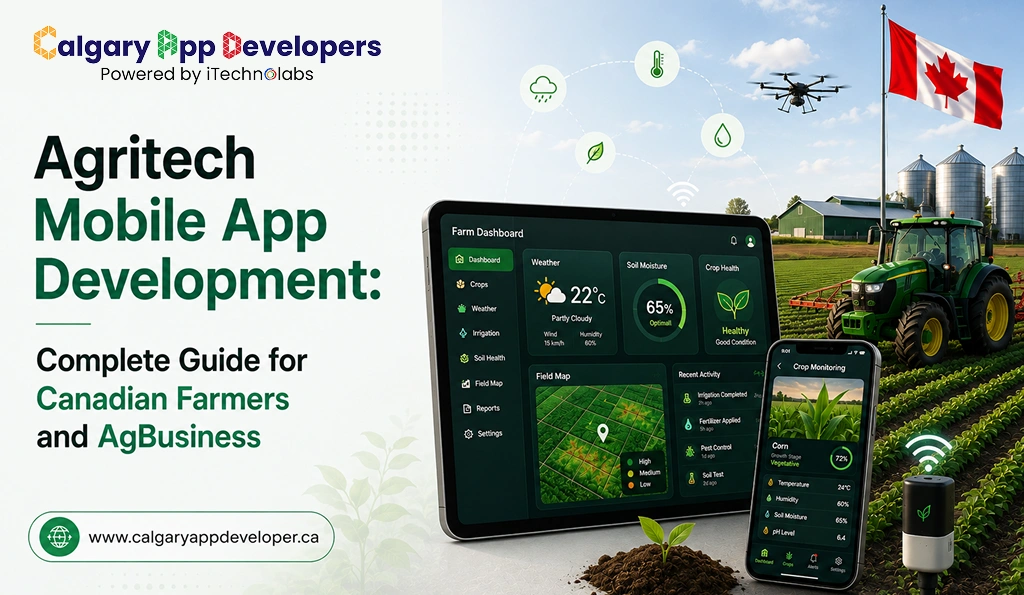
Canadian agriculture is getting more and more data driven. From the big grain operations in Alberta and Saskatchewan, all the way to dairy farms in Ontario, and also to the specialty crop producers in British Columbia, farmers are basically under constant pressure to improve yields, keep costs under control, manage labor shortages, and still satisfy the changing regulatory requirements. Meanwhile, weather volatility is not calming down, input prices are climbing, and profit margins get tighter, so there’s not much space left for inefficiency.
This is where agritech mobile applications are making a measurable difference. Modern agriculture apps help farmers monitor crops in real time, track equipment and field operations, optimize irrigation and fertilizer usage, automate compliance reporting, and make faster decisions based on accurate field data. For agribusinesses, these platforms create new opportunities to improve supply chain visibility, strengthen customer relationships, and streamline day-to-day operations.
Over the years, our team has worked closely on agritech mobile app development projects, helping agricultural businesses transform traditional workflows into connected digital ecosystems. Through this experience, we’ve gained firsthand insight into the challenges Canadian farmers face and the technologies that deliver the greatest impact in the field.
In this guide, we’ll explore what agritech mobile apps are, how they work, the features that matter most, development costs in Canada, implementation timelines, and the key considerations for building a successful agriculture platform in 2026. Whether you’re a farmer, agribusiness owner, startup founder, or industry investor, this guide will help you understand what’s involved in developing an agritech solution that delivers real value.
TL;DR
- Agritech mobile apps are purpose-built tools that help farmers manage crops, monitor livestock, access weather data, connect with markets, and make better decisions from their phones.
- Canada’s Prairie provinces are one of the most active agritech markets in the world, driven by farm scale, labour costs, and the push for sustainable production documentation.
- Core features include crop monitoring, soil analysis, weather forecasting, IoT integration, drone synchronization, pest alerts, supply chain tracking, and financial management.
- Agritech mobile app development cost in Canada typically ranges from $30,000 to $200,000+ CAD depending on complexity, platform choice, and integration depth.
- Calgary App Developer builds agritech apps for Canadian agricultural businesses, with real experience in IoT integration, AI analytics, and PIPEDA-compliant data architecture.
Key Points
- Agritech mobile apps address specific operational pain points for Canadian farmers: unpredictable weather, labour shortages, fragmented supply chains, and market access challenges.
- The right type of agritech app depends heavily on who you’re building for. A grain farmer in the Lethbridge area has very different needs from a greenhouse operator near Calgary or a livestock producer in the Peace Region.
- Technology choices, including IoT protocols, AI frameworks, GPS systems, and cloud infrastructure, directly affect what the app can do and what it costs to build.
- Canadian agribusinesses may qualify for SR&ED tax credits or CDAP grants to offset agritech app development costs. Planning for those before you commit to a budget is worth the time.
- Post-launch monetization strategy matters as much as the initial build, and the right model depends on whether you’re building for your own operation, for sale to other farmers, or as a platform business.
What Is an Agritech Mobile App?
An agritech mobile app is a digital platform designed to support agricultural operations through real-time data, automation, and connectivity. It helps farmers, agronomists, equipment operators, suppliers, and buyers work within a shared ecosystem where decisions are driven by accurate information rather than manual processes and guesswork.
Depending on the use case, agritech applications can support a wide range of agricultural activities, including:
- Crop monitoring and field management
- Weather forecasting and climate tracking
- Soil health and moisture analysis
- Livestock management and health tracking
- Equipment monitoring and maintenance scheduling
- Farm inventory and input management
- Commodity trading and market price tracking
At the simpler end, an agritech app might provide a grain farmer with daily weather forecasts, soil moisture readings, and a digital record of field activities across multiple parcels of land. These tools help reduce paperwork while improving visibility into day-to-day operations.
More advanced agritech platforms offer significantly broader capabilities, such as:
- Integration with GPS-enabled farm machinery
- Drone-based crop scouting and field imagery
- Satellite-powered crop health monitoring
- IoT sensor connectivity for real-time field data
- AI-driven recommendations for irrigation and fertilization
- Predictive analytics for yield forecasting
- Direct access to buyers, suppliers, and commodity markets
In practice, these applications collect data from farm equipment, sensors, weather stations, drones, and manual user inputs. The information is then processed through analytics systems that generate actionable recommendations when critical decisions need to be made. The platform can also facilitate communication between farmers, agronomists, equipment dealers, logistics providers, and buyers, reducing information gaps across the agricultural value chain.
The Canadian agricultural landscape makes these technologies particularly valuable. Farms across Alberta, Saskatchewan, Manitoba, and other agricultural regions often operate on a massive scale where every operational decision carries financial consequences. Labour shortages continue to challenge producers, input costs remain high, and narrow seeding and harvest windows leave little margin for error.
As a result, agritech mobile apps are seeing growing adoption throughout Canada. They enable farmers and agribusinesses to make faster, data-backed decisions, improve operational efficiency, reduce waste, maintain regulatory compliance, and spend less time on manual record-keeping while focusing more on productivity and profitability.
Common Challenges Faced By Modern Agricultural Businesses
Canadian farmers and agribusinesses operate in an increasingly challenging environment. Rising input costs, labour shortages, unpredictable weather patterns, stricter compliance requirements, and growing pressure to improve sustainability are making agricultural operations more complex every year.
Many farms still rely on spreadsheets, paper records, disconnected software systems, phone calls, and manual reporting processes. While these methods may work at a small scale, they become difficult to manage as operations expand across multiple fields, facilities, livestock groups, suppliers, and distribution channels.
Some of the most common problems encountered by modern agricultural businesses include:
- Limited visibility into field and livestock conditions
- Rising fertilizer, fuel, feed, and labour costs
- Difficulty coordinating large-scale farm operations
- Delayed access to market pricing and buyer information
- Time-consuming regulatory and compliance reporting
- Inefficient resource allocation and input management
- Lack of centralized operational and financial data
- Increasing demand for sustainability documentation
- Challenges managing geographically dispersed farmland
The Need for Smarter Agricultural Management
The reality is that modern farming generates enormous amounts of data every day. Equipment produces operational data, sensors capture environmental conditions, drones generate imagery, weather stations provide forecasts, and field teams create activity records.
The challenge isn’t the availability of information. The challenge is turning that information into timely decisions that improve productivity and profitability.
This is where agritech mobile app development delivers value. By connecting data sources, automating workflows, and providing real-time visibility into operations, agritech applications help farmers and agribusinesses solve many of the industry’s most persistent challenges.
How Agritech Mobile Apps Solve These Challenges
- Precision Resource Management: Agritech apps help farmers apply resources exactly where they are needed. Using soil data, field mapping, and variable rate application technologies, operators can optimize fertilizer, seed, and crop protection usage. On large Prairie farms, reducing unnecessary input application can generate substantial seasonal savings while improving field performance.
- Remote Field Monitoring: Agricultural operations often span thousands of acres across multiple locations. Through IoT sensors, satellite imagery, and connected monitoring systems, farmers can track soil moisture, temperature, crop health, and environmental conditions remotely without physically visiting every field.
- Better Decision Making Through Data: Agritech platforms consolidate weather forecasts, historical field performance, soil conditions, crop data, and agronomic recommendations into a single system. This gives farmers access to actionable insights that support planting, irrigation, fertilization, and harvest decisions throughout the growing season.
- Direct Market Access: Many agritech platforms connect producers directly with buyers, processors, distributors, and commodity markets. Real-time pricing visibility helps farmers identify better selling opportunities while reducing dependence on traditional intermediary channels.
- Improved Labour Efficiency: Labour remains one of the biggest challenges facing Canadian agriculture. Mobile apps automate scheduling, task tracking, equipment monitoring, and operational reporting, allowing farm teams to spend less time on administrative work and more time on productive activities.
- Livestock Health and Traceability: For livestock operations, agritech apps provide centralized tracking for animal health records, breeding programs, feeding schedules, movement history, and veterinary treatments. Digital traceability systems also help producers meet industry and export market requirements more efficiently.
- Sustainability Tracking and Reporting: As buyers increasingly prioritize sustainable sourcing, agricultural businesses must provide evidence of responsible farming practices. Agritech applications simplify the collection of data related to water usage, carbon management, tillage practices, and environmental stewardship initiatives.
- Greater Financial Visibility: Many agricultural businesses lack real-time insight into operational costs and profitability during the season. Agritech apps connect field activities, input expenses, labour costs, and revenue forecasts to provide a clearer picture of business performance throughout the year.
- Simplified Regulatory Compliance: Government programs, traceability requirements, environmental reporting, and industry certifications require extensive documentation. Agritech applications automatically capture operational data as work is completed, reducing paperwork and making compliance reporting significantly easier.
- Stronger Long-Term Business Performance: When combined, these capabilities help agricultural businesses improve productivity, reduce waste, increase profitability, strengthen operational control, and make faster decisions in a highly competitive market. Rather than functioning as simple farm management tools, modern agritech mobile apps have become strategic platforms that support the entire agricultural value chain.
Types of Agritech Mobile Apps
The agritech app category covers a wide range of products. Understanding the distinct types helps you identify where the highest-value opportunity sits for your specific operation or business model.
1. Farm Management Apps
Farm management applications serve as the operational hub of modern farming operations. They centralize records, workflows, and farm activities that would otherwise be spread across spreadsheets, notebooks, and disconnected software systems.
Key Features:
- Field activity and work order tracking
- Equipment maintenance scheduling
- Input and inventory management
- Expense and cost tracking
- Yield recording and performance analysis
For Canadian grain and oilseed operations, a well-designed farm management app creates a single source of truth for day-to-day operations while reducing administrative overhead.
2. Precision Agriculture Apps
Precision agriculture applications help farmers optimize field-level decisions by combining data from multiple sources, including GPS systems, soil sampling, weather stations, and satellite imagery.
Key Features:
- GPS field mapping and boundary management
- Variable rate application recommendations
- Soil analysis integration
- Yield mapping and performance tracking
- Satellite imagery and field health monitoring
These apps help farmers manage field variability more effectively and maximize productivity while reducing input waste.
3. Weather and Climate Monitoring Apps
Agricultural weather applications provide specialized environmental insights that support planting, irrigation, spraying, and harvest planning.
Key Features:
- Hyperlocal weather forecasting
- Frost risk alerts and notifications
- Growing degree day calculations
- Rainfall and precipitation tracking
- Crop stress and evapotranspiration monitoring
Unlike consumer weather apps, these platforms deliver agronomic data specifically designed for farming operations.
4. Crop Monitoring and Disease Detection Apps
Crop monitoring applications leverage AI, satellite imagery, drone technology, and IoT devices to help farmers identify crop issues before they become costly problems.
Key Features:
- Crop health monitoring dashboards
- AI-powered disease detection
- Pest infestation identification
- Nutrient deficiency analysis
- Drone and satellite image processing
Early detection enables farmers to take corrective action quickly and minimize potential yield losses.
5. Livestock Management Apps
Livestock applications help producers manage animal health, breeding programs, feeding schedules, and compliance requirements through a centralized platform.
Key Features:
- Individual animal record management
- Feeding and nutrition tracking
- Breeding and reproduction management
- Vaccination and health monitoring
- RFID and ear tag integration
These solutions are particularly valuable for cattle, dairy, poultry, and livestock operations that require detailed animal tracking and traceability.
6. Market Linkage and Commodity Trading Apps
Market linkage platforms improve transparency between producers and buyers while providing access to real-time market intelligence.
Key Features:
- Live commodity pricing updates
- Buyer and processor directories
- Digital contract management
- Market trend analysis
- Price alert notifications
These applications help farmers make more informed selling decisions and improve market access.
7. Supply Chain and Logistics Apps
Supply chain applications streamline the movement of agricultural products and inputs across complex distribution networks.
Key Features:
- Inventory and warehouse management
- Shipment tracking
- Route optimization
- Delivery scheduling
- Supplier and distributor communication
For large agricultural enterprises and cooperatives, these apps improve visibility and operational efficiency throughout the supply chain.
8. Agronomic Advisory and Expert Connection Apps
These platforms connect farmers with agronomists, crop consultants, and agricultural experts for remote support and decision-making.
Key Features:
- Expert consultation requests
- Photo-based crop diagnostics
- Agronomic recommendation reports
- Video and chat support
- Farm performance benchmarking
They provide farmers with easier access to specialized expertise without requiring on-site visits for every issue.
9. Financial and Insurance Management Apps
Financial management applications help agricultural businesses monitor profitability, manage budgets, and simplify reporting requirements.
Key Features:
- Farm budgeting tools
- Cost and revenue tracking
- Cash flow forecasting
- Crop insurance documentation
- Financial reporting dashboards
These solutions help producers maintain stronger financial control while reducing administrative burdens.
10. IoT and Equipment Integration Apps
IoT and machinery integration apps connect farm equipment, sensors, and smart devices into a centralized management platform.
Key Features:
- Real-time equipment monitoring
- Sensor data visualization
- Predictive maintenance alerts
- Fleet management dashboards
- Third-party platform integrations
These applications provide operators with a complete view of machinery performance, field operations, and equipment utilization across the farm.
Why Invest in Agritech App Development in 2026?
Agriculture is no longer driven solely by experience and intuition. Today’s farms operate as data-intensive businesses where profitability depends on making faster, more accurate decisions about crops, livestock, equipment, labor, inputs, and market timing.
As farms become increasingly connected through sensors, drones, AI, satellite imagery, and smart machinery, mobile applications are emerging as the primary interface that brings all this information together. For agribusinesses, startups, agricultural cooperatives, and technology investors, 2026 presents one of the strongest opportunities yet to invest in agritech app development.
1. The Market Is Growing at an Exceptional Pace
The global agritech market was valued at approximately $24.4 billion in 2024 and is projected to reach nearly $49 billion by 2030, representing annual growth of more than 12%. This growth is being fueled by rising food demand, labor shortages, sustainability initiatives, and rapid adoption of digital farming technologies.
At the same time, the broader smart agriculture market is expected to grow from $25.36 billion in 2024 to $83.72 billion by 2033, demonstrating strong long-term demand for digital farming solutions.
2. Canadian Agriculture Is Becoming More Digital
Canada’s agricultural sector faces several structural challenges that encourage technology adoption:
- Rising labor costs and workforce shortages
- Increasing input expenses for fertilizer, fuel, and crop protection
- Greater pressure to improve sustainability and resource efficiency
- More stringent compliance and traceability requirements
- Growing demand for data-driven decision-making
As a result, Canadian farmers are actively investing in technologies that help improve productivity while reducing operational complexity. Mobile applications are increasingly serving as the central platform that connects machinery, sensors, agronomic data, financial systems, and supply chain partners.
Why the Timing Is Right
The combination of rising food demand, labor shortages, digital transformation initiatives, and advances in AI, IoT, and precision agriculture is creating unprecedented demand for agricultural software solutions.
For startups, agribusinesses, agricultural cooperatives, and technology investors, 2026 represents a strategic moment to enter a market that is expanding rapidly and becoming increasingly dependent on mobile technology. Organizations that invest today will be better positioned to capitalize on the next generation of connected farming and digital agriculture innovation.
Essential Features of an Agritech Mobile App
The success of an agritech application depends on its ability to solve real agricultural challenges. While every platform has different objectives, most modern agritech solutions include a combination of operational, analytical, financial, and connectivity features. The following capabilities are commonly found in successful agritech mobile applications used across Canada’s agricultural sector.
- Crop Management: Crop management features allow farmers to monitor crop growth throughout the season while maintaining detailed records of field activities. Users can track planting dates, fertilizer applications, spraying schedules, crop stages, and expected yields. By centralizing field data, farmers gain better visibility into crop performance and can make more informed management decisions throughout the growing cycle.
- Soil Analysis Dashboard: A soil analysis dashboard transforms complex soil testing reports into easy-to-understand visual insights. Farmers can view nutrient levels, pH values, organic matter content, and soil variability across different field zones. This information supports precision farming practices and enables more effective fertilizer management while reducing unnecessary input costs.
- IoT Sensor Integration: Modern farms increasingly rely on connected devices to collect real-time field data. Agritech apps integrate with soil moisture sensors, weather stations, temperature monitors, humidity sensors, and other IoT devices. This continuous flow of information helps farmers respond quickly to changing field conditions and maintain greater control over crop health and resource usage.
- Pest and Disease Alerts: Early detection is critical when managing pests and crop diseases. Agritech applications can analyze weather patterns, field conditions, and historical data to identify potential risks before they become widespread problems. Automated alerts allow farmers to take preventive action, reducing crop losses and minimizing unnecessary pesticide applications.
- Market Access and Pricing: Market intelligence tools provide farmers with access to real-time commodity prices, elevator bids, futures data, and buyer information. By monitoring market conditions directly through a mobile app, producers can make more informed selling decisions and identify opportunities to maximize profitability throughout the marketing season.
- Livestock Management: Livestock management features help producers maintain detailed records for individual animals and entire herds. Users can track feeding schedules, breeding activities, vaccinations, health treatments, weight gain, and movement history. These capabilities improve herd productivity while supporting traceability requirements and regulatory compliance.
- Supply Chain Tracking: Supply chain management tools improve visibility across agricultural logistics networks. Farmers and agribusinesses can monitor inventory levels, track shipments, manage supplier relationships, and coordinate deliveries through a centralized platform. Improved visibility reduces delays, improves communication, and increases overall operational efficiency.
- Financial Management: Agricultural operations generate significant financial data that must be monitored throughout the year. Financial management features help farmers track expenses, monitor input costs, forecast revenue, manage budgets, and prepare compliance documentation. Access to real-time financial insights supports stronger business planning and profitability management.
- Push Notifications: Push notifications ensure that critical information reaches users at the right moment. Farmers can receive alerts related to weather events, pest outbreaks, irrigation requirements, equipment issues, commodity price movements, and operational deadlines. Timely notifications help users respond quickly to changing conditions and avoid costly delays.
- Payment Gateway Integration: For agritech marketplaces and service platforms, payment gateways enable secure online transactions. Farmers can purchase agricultural inputs, pay advisory fees, subscribe to premium services, or conduct marketplace transactions directly within the application. This creates a streamlined user experience while supporting platform monetization.
Technology Stack for Agritech App Development
The technology choices behind an agritech app directly affect what it can do, how reliably it performs in the field, and what it costs to build and maintain. Here’s how the key stack components map to agritech requirements.
The table below summarizes the common technology choices and their cost implications.
| Layer | Technology Options | Notes |
| Mobile Frontend | Flutter, React Native | Cross-platform reduces cost; native for deep hardware integration |
| Backend | Node.js, Python (Django/FastAPI), .NET | Python is preferred for AI/ML integration |
| Database | PostgreSQL with PostGIS, TimescaleDB, and MongoDB | PostGIS for geospatial; TimescaleDB for time-series sensor data |
| IoT Platform | AWS IoT Core, Azure IoT Hub, LoRaWAN Network Server | Choice depends on sensor hardware and connectivity environment |
| Cloud Hosting | AWS Canada (Montreal), Azure Canada Central | Canadian data residency for PIPEDA compliance |
| AI and ML | TensorFlow, PyTorch, AWS SageMaker | On-device inference for offline crop health analysis |
| Mapping | Mapbox, Google Maps Platform, ArcGIS Online | ArcGIS for advanced precision agriculture GIS requirements |
| Weather Data | ECCC API, DTN, The Weather Company | ECCC for official Canadian forecasts; DTN for agronomic metrics |
Choosing the right stack for your specific agritech use case matters more here than in most app categories. Getting it wrong at the architecture stage creates expensive rework once the app is in field use and the limitations become apparent.
Step-by-Step Process to Build an Agritech Mobile App
Building an agritech app that farmers will actually use in the field requires a development process that starts with real user understanding and stays disciplined through every phase.
Step 1: Discovery and User Research
The most important step happens before any design or development work starts. Discovery means getting into the field with actual farmers, agronomists, and agricultural business operators and understanding how they make decisions and manage information today. What data do they track, where do they track it, what decisions does that data inform, and where are the biggest friction points in their current process?
Canadian agriculture has real regional specificity. Prairie grain farmers have different workflows from BC greenhouse operators or Ontario dairy producers. Discovery needs to be targeted to your specific user, not to a generic farmer archetype. This phase should include user interviews, observation of current workflows, and a clear definition of the problem the app will solve before a single wireframe gets drawn.
Step 2: Market and Competitive Analysis
The agritech app market isn’t empty. There are established global platforms and Canadian-specific tools built for Prairie conditions. Understanding what’s already available, what it costs, and where it falls short for your target user is essential before committing to a build. Sometimes the right answer is integrating with an existing platform rather than building a competing one. A good development partner tells you that honestly.
Step 3: Compliance and Regulatory Review
This step gets skipped in generic app development guides. For Canadian agritech apps, it matters. If your app collects personal information about farmers or farm workers, PIPEDA applies. If it integrates drone operations, Transport Canada RPAS regulations apply. If it handles financial data for AgriStability or AgriInvest compliance, CRA documentation standards apply. Getting clear on the regulatory landscape before design begins prevents costly retrofits later.
Step 4: Product Definition and MVP Scope
Based on discovery and competitive analysis, define what the app does, what it doesn’t do, and what the minimum viable product looks like. Agritech apps tend toward feature sprawl because the problem space is genuinely broad. Discipline in MVP scoping is what determines whether the first version ships in six months or eighteen. The MVP should solve one core problem very well for a clearly defined user, not solve every agricultural problem moderately well for everyone.
Step 5: UI/UX Design
Agritech app design has specific requirements that general mobile UX doesn’t. Farmers use phones in direct sunlight, with gloves on, while operating equipment, and often in areas with limited connectivity. That means high-contrast interfaces, large touch targets, minimal tap sequences to reach critical information, and graceful handling when connectivity drops. Design for the actual use environment, not for someone sitting at a desk with full attention.
Step 6: Development
With design finalized, development builds the application layer by layer: core data models and backend first, then primary user flows, then integrations with IoT sensors, mapping services, weather APIs, and third-party agricultural data sources. Agritech development requires genuine expertise in geospatial data handling, IoT connectivity patterns, and offline data synchronization. The quality difference between a team with real agritech experience and one without shows up quickly in field testing.
Step 7: Testing in Real Field Conditions
Lab testing doesn’t catch agritech-specific issues. The app needs to be tested in actual field conditions: in direct sunlight, on rural cellular networks, while connected to real IoT sensors, with intermittent connectivity deliberately induced. This is where offline functionality gets stress-tested. If the app doesn’t work reliably when cellular drops mid-field, it doesn’t work for Canadian Prairie agriculture. That’s the standard, and testing needs to validate against it.
Step 8: Launch, Training, and Ongoing Support
Agricultural technology adoption moves at the pace of farmer trust. A technically excellent app that farmers don’t understand or don’t trust won’t be used. Launch needs to include training materials tailored to the specific farmer user, accessible support for questions during the first season, and a feedback loop that captures what’s working and what isn’t in real operation. Post-launch iteration based on real-world use is what turns a good agritech app into a genuinely valuable farm management tool.
How Much Does Agritech Mobile App Development Cost in Canada?
Agritech mobile app development cost in Canada typically ranges from CAD $30,000 to $200,000+ depending on app type, feature complexity, IoT integration depth, AI and ML requirements, and the experience level of the development team. A focused MVP covering one core use case sits at the lower end. A full-featured precision agriculture platform with IoT sensor integration, drone data processing, AI crop health analysis, and market access tools sits at the higher end.
Total Cost Estimation by Development Stage
| Development Stage | Description | Estimated Cost (CAD) |
| Discovery and Planning | User research, competitive analysis, regulatory review, MVP definition | $3,000 to $9,000 |
| UI and UX Design | Wireframes, field-condition UX design, interactive prototypes | $6,000 to $20,000 |
| Backend Development | Data architecture, APIs, IoT integration, geospatial database setup | $10,000 to $45,000 |
| Mobile Frontend Development | Cross-platform or native app, offline functionality, field UX implementation | $12,000 to $55,000 |
| AI and ML Integration | Crop health image analysis, yield prediction models, anomaly detection | $8,000 to $30,000 |
| Quality Assurance | Field condition testing, IoT integration testing, device compatibility | $5,000 to $15,000 |
| Deployment and Launch | App Store submission, cloud infrastructure setup, farmer onboarding materials | $2,000 to $6,000 |
| Post-Launch Support | Bug fixes, seasonal updates, OS compatibility, feature iteration | $5,000 to $25,000 per year |
| Total Estimated Cost | $30,000 to $200,000+ |
Agritech App Development Cost by Canadian City
| Location | Typical Cost Range (CAD) | Notes |
| Toronto, ON | $110,000 to $260,000+ | Highest Canadian rates; strong tech sector with premium overhead |
| Vancouver, BC | $100,000 to $240,000+ | Strong development talent; premium market pricing |
| Calgary, AB | $60,000 to $175,000 | Competitive rates, local Alberta agriculture context, senior technical expertise |
| Ottawa, ON | $75,000 to $195,000 | Strong tech talent; government-adjacent pricing structure |
| Montreal, QC | $55,000 to $160,000 | Cost-effective with bilingual capability |
| Offshore | $18,000 to $65,000 | Lower upfront cost; real risk on specialized agritech requirements and Canadian compliance |
Calgary’s position here isn’t just about cost. It’s about context. A Calgary-based development team understands Prairie agriculture, Alberta’s regulatory environment, the connectivity realities of rural Alberta, and the farming operations that make up the app’s target users. That contextual knowledge reduces discovery time, improves design decisions, and produces apps that fit the Canadian agricultural environment rather than ones designed for a generic global farm user.
Key Factors That Affect Agritech App Development Cost
- IoT Integration Depth: Basic sensor data ingestion is relatively straightforward. Real-time integration with multiple sensor types, proprietary equipment APIs, and drone imagery processing pipelines adds significant backend complexity.
- AI and Machine Learning Features: Crop disease identification from images, yield prediction models, and pest pressure forecasting all require ML model development, training data curation, and inference infrastructure. These features are high-value but need clear scoping before development begins.
- Offline Functionality Requirements: Robust offline operation with reliable sync on reconnection is a meaningful engineering challenge. The more complex the app’s data model, the more expensive it becomes to implement offline functionality correctly.
- Regulatory Compliance: PIPEDA-compliant data handling, Transport Canada RPAS integration, CFIA traceability compatibility, and Canadian farm program documentation requirements all add engineering scope that generic app development guides don’t account for.
- Canadian Funding Offsets: SR&ED tax credits can apply to the technical innovation components of agritech app development. CDAP grants support digital adoption for eligible small and medium-sized businesses. These programs can meaningfully reduce the net investment. Talk to your accountant before finalizing your budget.
Agritech App Monetization Models
If you’re building an agritech app as a product rather than an internal tool, a monetization strategy is part of the development plan, not an afterthought. The right model depends on your user base, the value you deliver, and the competitive landscape.
- Subscription (SaaS): The dominant model for agritech platforms. Farmers pay monthly or annually for platform access, typically tiered by acreage, number of users, or feature set. Most precision agriculture platforms use this model. Predictable recurring revenue makes it attractive for investors and sustainable for ongoing product development.
- Freemium: A free tier with basic functionality that converts to paid for advanced features. Works well for apps with broad farmer adoption goals where getting users on the platform is the first hurdle. The risk is that the free tier cannibalizes paid conversion if the free feature set is too generous.
- Marketplace Commission: For agritech platforms that connect buyers and sellers of farm inputs, commodities, or equipment, a transaction commission on completed trades is a natural revenue layer. This works when the platform generates enough liquidity to justify the commission over direct market relationships.
- Data Licensing: Aggregated, anonymized farm data has value to seed companies, input manufacturers, commodity traders, and agricultural researchers. Data licensing revenue is possible at scale but requires explicit farmer consent under PIPEDA and careful aggregation to prevent re-identification of individual farm data. It’s a long-term opportunity that requires trust-building before it’s viable.
- Government and Institutional contracts: Provincial extension services, agricultural industry organizations, and federal agricultural agencies are potential customers for agritech platforms with strong data and advisory capabilities. Contract-based revenue provides stability but requires a different sales motion than direct farmer subscription.
Why Choose Calgary App Developer for Agritech App Development?
Building an agritech application requires more than technical expertise. It requires a deep understanding of how Canadian farms and agribusinesses actually operate.
-
- Canadian Agriculture Expertise: Our team understands the realities of Canadian agriculture, including Prairie farming operations, seasonal workflows, rural connectivity challenges, regulatory requirements, and the increasing demand for data-driven decision-making. This industry knowledge helps us build solutions that align with real operational needs.
- AI and IoT Development Experience: We develop agritech applications that leverage modern technologies such as AI, IoT, GPS tracking, drone integration, predictive analytics, and real-time monitoring systems. These capabilities help farmers and agribusinesses improve productivity, reduce costs, and make faster decisions.
- Built for Rural Conditions: Agricultural operations often take place in areas with unreliable internet connectivity. That’s why we follow an offline-first approach, ensuring users can access critical data, record activities, and continue working even when network coverage is limited.
- Security and Compliance First: Farmer data, operational records, and financial information require strong protection. We build secure, scalable applications with PIPEDA-compliant architecture, encrypted data storage, and secure integrations to help protect sensitive agricultural information.
-
- Transparent Development Process: From discovery and planning to development and deployment, we provide clear project roadmaps, realistic timelines, and detailed cost estimates. You’ll know exactly what is being built and what to expect at every stage.
- End-to-End Development Support: Whether you’re building a farm management platform, livestock tracking app, agricultural marketplace, or precision farming solution, we provide complete support from strategy and design to development, launch, and ongoing maintenance.
- Get a Free Project Consultation: If you’re planning an agritech app, our team can help evaluate your idea, define the right feature set, estimate development costs, and recommend the best approach for your business goals.
Conclusion
Agritech mobile apps aren’t a future investment for Canadian agriculture. The farmers who are using digital tools to make better decisions, manage resources more precisely, access markets more efficiently, and document practices more reliably are already outperforming those who aren’t. That gap is widening.
The opportunity in 2026 isn’t to wait and see. It’s to build the right application for your specific operation or business model, with the right team, at the right investment level, with a clear plan for how it delivers value from the first season of use.
Canadian agribusiness deserves agritech built for Canadian conditions. Prairie-scale operations, rural connectivity constraints, Canadian regulatory requirements, and the trust standards that farming communities hold to. That’s the standard your agritech app needs to meet.
FAQs
1. What is an agritech mobile app, and how does it help Canadian farmers?
An agritech mobile app is a purpose-built digital tool that helps farmers and agribusinesses manage crops, monitor field conditions, access weather data, track livestock, connect with markets, and make better operational decisions from a smartphone or tablet. For Canadian farmers, particularly on large Prairie grain and oilseed operations, these apps address real operational challenges: labour shortages, input cost management, weather-driven decision timing, and market access. Apps that integrate with IoT sensors, GPS equipment, and commodity pricing data give farmers visibility and decision support that wasn’t practically available before mobile technology matured to this level. The result is more precise resource use, better yield outcomes, and lower operational overhead across the farm business.
2. How much does agritech mobile app development cost in Canada?
Agritech mobile app development cost in Canada typically ranges from $30,000 to $200,000+ CAD depending on app type, feature complexity, IoT integration requirements, AI capabilities, and team location. A focused MVP targeting one core use case sits at the lower end. A full-featured precision agriculture platform with sensor integration, drone data processing, market access features, and AI crop health analysis sits at the higher end. Calgary-based development teams offer senior agritech expertise at rates more competitive than Toronto or Vancouver, with the added advantage of local Alberta agricultural context that offshore teams genuinely can’t replicate. Canadian SR&ED and CDAP programs can also offset a meaningful portion of the development investment.
3. What features should I prioritize in an agritech mobile app?
The right feature set depends entirely on the specific agricultural operation and user. For Prairie grain and oilseed farmers, weather forecasting with agronomic metrics, crop monitoring, GPS field mapping, and financial management are typically the highest-value starting features. For livestock producers, animal health tracking, feeding records, and traceability documentation address the most pressing needs. For agritech platform builders targeting the broader market, market access and price intelligence features drive user adoption. The universal priorities for any Canadian agritech app are offline functionality for rural connectivity, IoT sensor integration, and data architecture that handles PIPEDA requirements for farmer data privacy. Start with the features that solve the most painful daily problem for your specific user, not the broadest possible feature set.
4. What technology stack is used to build agritech mobile apps?
Most agritech mobile apps are built using cross-platform frameworks like Flutter or React Native for the mobile frontend, which allows simultaneous iOS and Android deployment from a single codebase. The backend typically uses Python with FastAPI or Django for AI-heavy agritech apps, or Node.js for real-time data applications. PostgreSQL with PostGIS handles geospatial data for field mapping, while TimescaleDB manages time-series IoT sensor data efficiently. AWS or Azure with Canadian data residency handles cloud infrastructure for PIPEDA-compliant data storage. Weather data comes from Environment and Climate Change Canada’s API for official Canadian forecasts, supplemented by commercial agricultural weather services for agronomic metrics like growing degree days and evapotranspiration.
5. How do PIPEDA requirements affect agritech app development in Canada?
PIPEDA applies to agritech apps that collect personal information about farmers, farm workers, or farm operations. Your app needs explicit consent flows before collecting land parcel data, production records, financial information, or personal contact details. Users need to know clearly what data is being collected, how it’s being used, and who it might be shared with. Farmers need to be able to access their own data and request its deletion. For agritech apps considering data licensing as a monetization model, PIPEDA consent requirements are particularly important because historical data sharing consent needs to be explicitly obtained before that revenue stream is viable. Building PIPEDA compliance into the app’s data architecture from the start is significantly cheaper than retrofitting it after launch.
6. What are the biggest mistakes to avoid when building an agritech app?
Building before validating is the most expensive mistake. Agritech apps built on assumptions about what farmers need, without actual field research, consistently miss the features that matter most and include features users won’t touch. The second most common mistake is designing for ideal conditions rather than real field use: direct sunlight, gloves on, intermittent connectivity, and divided attention are the actual operating environment. Apps that don’t account for these conditions get abandoned after the first season. Underestimating IoT complexity is the third major mistake: sensor connectivity, data ingestion, offline handling, and real-time processing are harder than they look and require genuine specialist expertise. Skipping the regulatory review step is the fourth, and it means discovering mid-development that the app’s data handling doesn’t meet PIPEDA requirements.
7. Can Canadian agribusinesses get funding to offset agritech app development costs?
Yes, and it’s worth planning for before you commit to a development budget. The SR&ED tax credit program applies to software development projects involving genuine technical innovation, which custom agritech app development frequently qualifies for. Eligible expenditures, including developer salaries and contractor fees, can qualify for federal and provincial tax credits that reduce the net development cost meaningfully. CDAP provides grants to help small and medium-sized Canadian businesses adopt digital technologies, under which agritech app development can qualify. Provincial agricultural programs in Alberta and other Prairie provinces also periodically offer funding for technology adoption. Talk to your accountant and an SR&ED specialist before you finalize your agritech development budget.
8. How long does it take to build an agritech mobile app?
Timelines depend on complexity and feature scope. A focused MVP covering one core agricultural use case typically takes 3 to 5 months from discovery through launch. A moderate complexity app with IoT integration, weather data, field mapping, and basic AI features runs 5 to 8 months. A full-featured precision agriculture platform with multiple IoT integrations, advanced ML models, market access features, and enterprise-scale backend architecture can take 10 to 14 months for the initial version. For agricultural apps specifically, timing relative to the farming season matters. Planning your development start date with your target launch window in mind is a practical consideration worth raising at the beginning of the discovery phase, not as an afterthought.


Pankaj Arora is a seasoned technology leader and the Founder of Calgary App Developer, with 10+ years of expertise in crafting high-performance digital solutions. His core competencies include full-stack app development, cloud-native architecture, API integration, and agile product delivery. Under his leadership, Calgary App Developers has empowered startups and enterprises alike with scalable mobile applications, secure web platforms, and AI-driven SaaS products.