








How AI is Revolutionizing Mobile App Development in 2026
The current mobile development field uses artificial intelligence technology because it has become an essential part of their application design, building, testing, and scaling processes. Artificial intelligence creates new mobile application development standards through its intelligent chat systems and its ability to predict user behavior.
The shift is happening at a measurable scale. The global AI in mobile apps market is projected to grow from about $30.56 billion in 2025 to over $135 billion by 2030, reflecting rapid enterprise adoption and increasing demand for smarter applications.
On a broader level, the AI in the mobile apps market could reach approximately $354 billion by 2034, growing at a strong compound annual rate of over 30 percent.
This growth is not limited to one region or industry. The global AI market itself is expected to reach a multi-trillion-dollar scale within the next decade, driven by widespread adoption across software development, automation, and digital products.
What makes this transformation significant is not just the scale, but the impact. AI is helping development teams reduce manual effort, automate complex workflows, and deliver highly personalized user experiences without increasing development costs.
This blog is built on our hands-on experience in mobile app development, where we have seen firsthand how AI tools can accelerate timelines, improve product quality, and reduce overall costs. In the sections that follow, we break down the tools, strategies, and practical use cases that make AI an essential part of modern mobile app development.
TL;DR
- AI in mobile development is transforming how apps are designed, built, and optimized.
- AI tools improve speed, reduce costs, and enhance user experience across the app lifecycle.
- From design to testing, AI enables automation and smarter decision-making.
- Businesses adopting AI can build scalable, future-ready mobile applications faster.
Key Points
- AI in mobile development is now integrated across the entire app lifecycle, from design and coding to testing and post-launch optimization.
- AI-powered tools automate repetitive tasks such as code generation, debugging, and testing, which significantly reduces development time and effort.
- Design processes benefit from AI through faster prototyping, intelligent UI suggestions, and personalized user experiences based on behavior.
- AI-driven coding tools assist developers with real-time suggestions, error detection, and code optimization, improving both productivity and code quality.
- Testing and quality assurance become more efficient with AI by enabling automated test creation, early bug detection, and continuous performance monitoring.
- AI also plays a key role in analytics and personalization by analyzing user data to deliver relevant content, recommendations, and improved engagement.
- The use of AI reduces overall development costs by minimizing manual work, reducing rework, and enabling smaller teams to build complex applications.
- Businesses can leverage AI to make data-driven decisions, optimize features, and continuously improve app performance after launch.
- Hiring developers with experience in AI tools and frameworks is essential to successfully implement AI in mobile app development projects.
- Future trends indicate that AI will enable more adaptive, predictive, and intelligent mobile applications with a stronger focus on personalization and privacy.
What AI Means for Mobile App Development Today
AI in mobile development has moved from experimentation to everyday execution. It now plays a central role across the entire app lifecycle, from initial design concepts to post-launch optimization. Development teams are no longer relying solely on manual processes. Instead, they are using AI to automate repetitive tasks, enhance decision-making, and deliver smarter user experiences at scale.
Modern mobile apps are expected to be intuitive, responsive, and personalized. AI makes this possible by analyzing user behavior, predicting needs, and continuously improving performance in real time. It also enables developers to build faster without compromising on quality.
Key ways AI is shaping mobile app development today include:
- Intelligent user experiences that adapt based on behavior, preferences, and usage patterns.
- Automated coding assistance that speeds up development and reduces human error.
- Smart testing and debugging that identify issues early and improve app stability.
- Data-driven decision making through real-time analytics and predictive insights.
- Enhanced security with AI-powered threat detection and fraud prevention.
AI is no longer an add-on. It is becoming the foundation of how high-quality mobile apps are built and scaled.
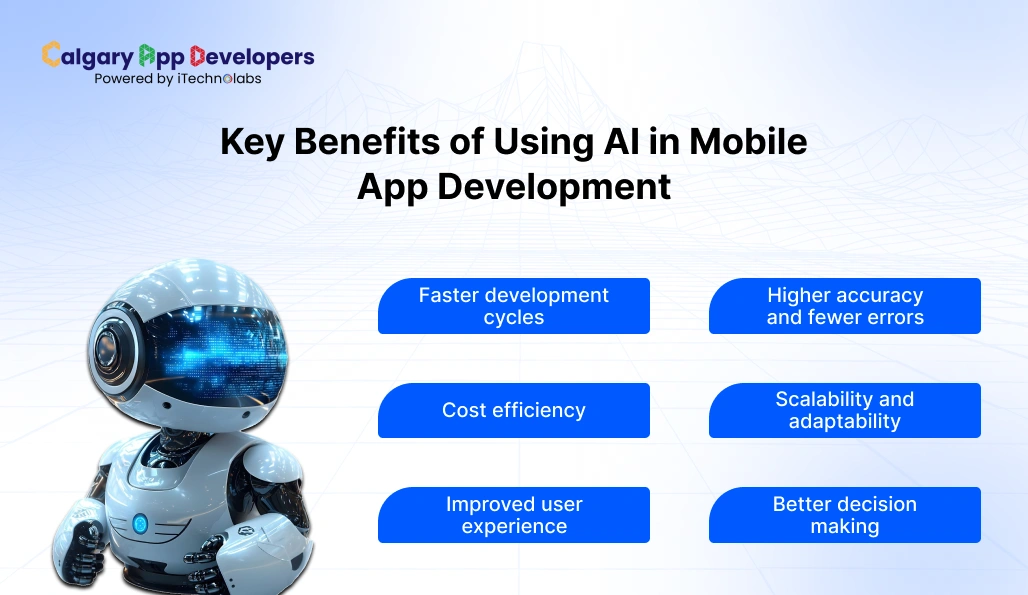
Key Benefits of Using AI in Mobile App Development
AI in mobile development brings a shift in how apps are planned, built, and improved over time. It allows teams to move beyond traditional development limits by introducing automation, intelligence, and continuous learning into the process. The result is not just faster delivery, but smarter and more adaptive applications that align closely with user expectations and business goals.
- Faster development cycles: AI tools assist with code generation, UI recommendations, and workflow automation. This reduces the time spent on repetitive tasks and allows developers to focus on core functionality and innovation. Projects that once took months can now be completed in significantly shorter timelines.
- Cost efficiency: Automation reduces dependency on large development teams for routine tasks. It also minimizes rework by identifying issues early. This leads to lower development costs and more predictable project budgets over time.
- Improved user experience: AI enables apps to understand user behavior and deliver personalized content, recommendations, and interactions. This creates a more engaging and relevant experience, which directly impacts user retention and satisfaction.
- Higher accuracy and fewer errors: AI-powered testing tools can simulate multiple scenarios and detect bugs before deployment. This improves app stability and reduces the need for frequent updates after launch.
- Scalability and adaptability: AI systems learn from data and user interactions, allowing apps to evolve as demand grows. This makes it easier to scale features and handle increased usage without major structural changes.
- Better decision making: With access to real-time insights and predictive analytics, teams can make informed decisions about features, updates, and user engagement strategies.
These advantages make AI in mobile development a practical investment for businesses aiming to build efficient, future-ready mobile applications.
Also Check: AI App Development: Build Intelligent Solutions
Categories of AI Tools for Mobile App Development
AI in mobile development is supported by a wide range of tools, each designed to improve a specific part of the app lifecycle. Understanding these categories helps teams choose the right tools based on their goals, whether that is faster development, better user experience, or improved app performance.
- AI Design and Prototyping Tools
These tools focus on user interface and user experience design. They use machine learning to generate layouts, suggest design improvements, and create interactive prototypes. Many can analyze user behavior data to recommend design patterns that improve engagement and usability. This reduces the time spent on manual design iterations while ensuring a more user-centric outcome.
- AI-Powered Development and Coding Tools
These tools assist developers during the coding phase. They can generate code snippets, auto-complete functions, detect errors, and even suggest optimized logic. By reducing repetitive coding tasks, they allow developers to focus on architecture and problem-solving. This category plays a key role in accelerating development timelines.
- AI Testing and Quality Assurance Tools
Testing tools powered by AI automate the process of identifying bugs, running test cases, and predicting potential failures. They adapt to changes in the codebase and can prioritize critical issues based on risk. This leads to faster testing cycles and more stable applications at launch.
- AI Analytics and User Behavior Tools
These tools analyze how users interact with an app. They provide insights into user preferences, engagement patterns, and drop-off points. With this data, teams can make informed decisions to improve features, personalize content, and increase retention rates.
- AI Personalization and Recommendation Engines
Personalization tools use AI to deliver tailored experiences to users. They power features such as product recommendations, content feeds, and predictive suggestions. This enhances user satisfaction and increases the likelihood of continued app usage.
- AI Chatbots and Virtual Assistants
These tools enable real-time user interaction through chat interfaces and voice assistants. They can handle customer queries, guide users through app features, and provide support without human intervention. This improves user experience while reducing support costs.
- AI Security and Fraud Detection Tools
Security-focused AI tools monitor user behavior and detect unusual patterns that may indicate threats or fraud. They help protect sensitive data and ensure compliance with security standards, which is critical for applications in finance, healthcare, and ecommerce.
- AI DevOps and Automation Tools
These tools streamline deployment, monitoring, and maintenance. They can automate workflows, predict system failures, and optimize performance in real time. This ensures smoother releases and ongoing app stability.
Each of these categories plays a distinct role, but their real value emerges when used together. A well-integrated AI toolset allows development teams to build smarter applications faster, while maintaining high standards of quality and user experience.
Read Also: How to Make an AI in 7 Simple Steps
AI Tools for Mobile App Design
AI-powered mobile app development begins with smarter design decisions. Design is no longer limited to static wireframes or manual iterations. With AI, teams can create interfaces that adapt to user behavior, improve usability, and accelerate the entire design process.
AI design tools bring speed and intelligence into UI and UX creation. They analyze patterns from successful apps, interpret user data, and generate layouts that are both functional and visually appealing. This allows designers to move from concept to prototype much faster without compromising quality.
1. Smarter UI and UX Creation
AI tools can generate multiple design variations based on a single input. They recommend layouts, color schemes, typography, and component placement that align with modern design standards. This reduces guesswork and helps teams focus on refining the user experience rather than building from scratch.
2. Rapid Prototyping and Iteration
Prototyping becomes significantly faster with AI assistance. Designers can convert ideas into interactive prototypes in minutes, test them, and make adjustments instantly. AI can also suggest improvements based on user interaction data, making each iteration more informed and effective.
3. Personalized User Experiences
One of the strongest advantages of AI in design is personalization. Interfaces can adapt to user preferences, behavior, and usage patterns. This creates a more engaging experience, as users see content and features that are relevant to them.
4. Accessibility and Design Consistency
AI helps maintain consistency across screens and ensures accessibility standards are met. It can automatically adjust contrast, spacing, and layout elements to improve readability and usability for a wider audience. This reduces manual effort while improving inclusivity.
5. Popular AI Design Tools
Several tools are leading this space by combining creativity with automation:
- Uizard for transforming sketches into digital designs.
- Figma AI for intelligent design suggestions and automation.
- Adobe Sensei for advanced design enhancements and asset management.
- Galileo AI for generating UI designs from text prompts.
These tools support teams in building high-quality interfaces faster, which is a key advantage of AI-powered mobile app development.
In practice, AI does not replace designers. It enhances their capabilities by removing repetitive tasks and providing data-driven insights. The result is a design process that is faster, more efficient, and closely aligned with user expectations.
AI Tools for Mobile App Development and Coding
AI in mobile development has significantly changed how code is written, reviewed, and optimized. Development is no longer a fully manual process. With AI integrated into coding environments, teams can build faster, reduce errors, and maintain cleaner codebases without increasing effort.
1. Where AI Fits in the Coding Workflow
AI tools are now embedded directly into development environments. They assist at every stage, from writing the first function to refining complex logic and fixing bugs. Instead of switching between tools, developers get real-time support as they work.
- Code generation: AI can generate complete functions or blocks of code based on simple prompts.
- Auto-completion: Predicts and completes lines of code with high accuracy.
- Error detection: Identifies bugs and suggests fixes instantly.
- Code optimization: Recommends more efficient or readable alternatives.
This level of assistance shortens development cycles and improves overall productivity.
2. Leading AI Tools Developers Are Using
Several AI-powered tools are now widely used in mobile app development workflows:
- GitHub Copilot: Assists with real-time code suggestions and supports multiple programming languages. It is particularly useful for speeding up routine coding tasks.
- Amazon CodeWhisperer: Provides intelligent code recommendations with a focus on security and best practices, making it suitable for enterprise-grade applications.
- Tabnine: Uses AI models to deliver context-aware code completions that adapt to a developer’s coding style.
- Replit Ghostwriter: Helps with code generation, debugging, and explanation, making it useful for both rapid development and learning.
These tools are not just productivity boosters. They also help maintain consistency across large codebases.
3. Impact on Development Efficiency
AI reduces the time spent on repetitive tasks such as writing boilerplate code, debugging simple issues, and searching for syntax solutions. Developers can focus more on architecture, feature logic, and performance improvements.
This also leads to faster onboarding. New developers can understand and contribute to projects more quickly with AI-assisted guidance and code explanations.
4. Improving Code Quality at Scale
AI tools continuously learn from large code repositories and best practices. This allows them to suggest cleaner structures, enforce coding standards, and reduce the risk of common errors. Over time, this results in more stable and maintainable applications.
5. The Bigger Shift
AI in mobile development is not about replacing developers. It is about enhancing their capabilities. Teams that adopt AI coding tools can deliver features faster, reduce development costs, and maintain higher quality standards.
As mobile applications grow more complex, AI-driven coding support is becoming a core part of modern development workflows rather than an optional add-on.
Also Check: AI App Development Cost Breakdown: From Idea to Launch
AI Tools for Mobile App Testing and QA
Testing in mobile applications that use AI technology now works as an uninterrupted testing system, which improves together with the application. AI testing methods replace traditional testing methods, which depend on unchanging test scripts and repeated manual procedures, through their ability to adjust testing requirements while delivering quick results and precise quality assessment.
1. What Makes AI-Driven Testing Different
AI testing tools do not just execute instructions. They learn from application behavior, user interactions, and past defects. This allows them to identify patterns, uncover hidden issues, and adjust test scenarios automatically as the app changes.
The result is a testing process that keeps up with rapid development cycles without requiring constant manual updates.
2. Core Functions of AI Testing Tools
AI-powered QA platforms focus on improving both coverage and efficiency through capabilities such as:
- Automatic generation of test cases based on real user flows.
- Detection of anomalies that signal potential bugs or performance issues.
- Continuous monitoring of app behavior across devices and environments.
- Intelligent selection of high-risk areas that need immediate testing.
These functions ensure that testing is both comprehensive and focused where it matters most.
3. Tools That Are Shaping Modern QA
A growing set of AI tools is helping teams streamline testing workflows and improve release confidence:
- Testim enables fast creation of automated tests that remain stable even as the UI evolves.
- Applitools uses visual AI to catch layout and design inconsistencies across screens.
- Functionize allows teams to create tests using natural language and optimize them with AI insights.
- Katalon Platform combines automation with AI-driven analytics for end-to-end testing coverage.
Each of these tools supports faster execution while reducing maintenance overhead.
4. Why It Matters for Development Teams
Testing traditionally consumes a significant portion of development time. AI changes that equation. Teams can run more tests in less time, detect issues earlier, and release updates with greater confidence.
It also reduces dependency on large QA teams by automating repetitive tasks and minimizing human error.
The End Result
AI-powered mobile app development transforms testing into a proactive system rather than a reactive step. Applications are validated continuously, issues are identified before they escalate, and overall product quality improves without slowing down delivery timelines.
This shift is essential for teams aiming to build reliable, high-performance mobile applications in a competitive market.
AI Tools for Android App Development
Android development is evolving quickly, and AI-powered mobile app development is playing a major role in that shift. With a wide range of devices, screen sizes, and performance conditions to account for, Android apps demand precision and efficiency. AI tools help developers manage this complexity while speeding up development and improving app quality.
1. Enhancing the Android Development Environment
AI is now integrated into Android development environments, offering real-time support during coding, debugging, and optimization. Developers can receive instant suggestions, detect issues early, and improve code structure without interrupting their workflow.
Tools built into platforms like Android Studio now leverage AI to assist with code completion, layout suggestions, and performance insights. This makes development more efficient, especially for large-scale applications.
2. Smarter UI Development for Android
Designing for Android often involves handling multiple screen sizes and device variations. AI simplifies this by suggesting responsive layouts and adaptive components that work across different devices.
AI can also analyze user interaction patterns to recommend UI improvements, helping developers create interfaces that feel natural and consistent across the Android ecosystem.
3. AI-Driven Performance Optimization
Performance is critical for Android apps due to device diversity. AI tools monitor app behavior in real time and identify performance bottlenecks such as memory leaks, slow load times, or inefficient background processes.
These insights allow developers to optimize apps proactively, ensuring smooth performance even on lower-end devices.
4. Key AI Tools for Android Development
Several tools are helping developers build better Android apps with AI support:
- Android Studio AI features: Provides intelligent code suggestions, debugging assistance, and performance analysis within the IDE.
- Firebase with AI capabilities: Offers analytics, crash reporting, and predictive insights to improve app performance and user engagement.
- ML Kit by Google: Enables easy integration of machine learning features such as text recognition, face detection, and language translation.
- TensorFlow Lite: Allows developers to run machine learning models directly on Android devices for real-time intelligence.
5. Supporting On-Device Intelligence
One of the key advantages of Android is its support for on-device AI. Tools like TensorFlow Lite and ML Kit enable apps to process data locally, reducing latency and improving privacy. This is especially useful for features such as image recognition, voice processing, and offline functionality.
6. Building Scalable Android Applications
AI-powered mobile app development helps Android teams build scalable applications that adapt to user behavior and device conditions. From development to deployment, AI tools streamline workflows, reduce errors, and improve overall app performance.
For teams working within the Android ecosystem, adopting AI is becoming essential to meet user expectations and deliver high-quality applications at scale.
Read Also: How Much Does It Cost to Hire an AI Developer?
AI Tools for iOS Development
AI-powered mobile app development is transforming how iOS applications are built, optimized, and scaled. Apple’s ecosystem places a strong emphasis on performance, privacy, and user experience. AI tools help developers meet these expectations while improving efficiency across the development lifecycle.
1. Integrating AI into the iOS Development Stack
iOS development environments now include AI-assisted capabilities that support coding, debugging, and interface building. Within Xcode, developers can benefit from smarter code suggestions, improved error detection, and faster navigation through complex codebases.
This integration reduces development time and allows teams to focus on building high-quality features rather than managing repetitive tasks.
2. Building Intelligent and Responsive Interfaces
AI plays a key role in enhancing UI and UX for iOS apps. It helps developers create interfaces that respond to user behavior and adapt dynamically. From personalized content layouts to intelligent navigation patterns, AI enables a more engaging user experience.
Apple’s design ecosystem also supports accessibility, and AI tools can automatically adjust layouts, text scaling, and contrast to ensure usability across different user needs.
3. Leveraging On-Device Machine Learning
One of the strongest advantages of iOS is its support for on-device intelligence. With frameworks like Core ML, developers can integrate machine learning models directly into apps. This allows for real-time processing without relying on external servers.
On-device AI improves performance, reduces latency, and enhances data privacy, which is a critical factor for modern applications.
4. Key AI Tools for iOS Development
Several tools and frameworks are widely used to enable AI capabilities in iOS apps:
- Core ML: Enables seamless integration of machine learning models for tasks such as image recognition, recommendation systems, and natural language processing.
- Create ML: Allows developers to build and train custom machine learning models using Apple’s ecosystem.
- Vision Framework: Supports image analysis, facial recognition, and object detection within iOS apps.
- Natural Language Framework: Provides tools for text analysis, sentiment detection, and language processing.
These tools make it easier to embed advanced AI features without extensive machine learning expertise.
5. Performance Optimization and Testing
AI also supports performance monitoring and optimization in iOS development. Tools can analyze app behavior, detect memory issues, and recommend improvements to ensure smooth performance across devices.
This is particularly important for maintaining Apple’s strict performance and quality standards.
6. Delivering High-Quality iOS Applications
AI-powered mobile app development enables iOS teams to build applications that are fast, intelligent, and user-focused. By combining AI tools with Apple’s robust ecosystem, developers can deliver apps that meet high expectations while reducing development effort.
As user demands continue to grow, integrating AI into iOS development is becoming a practical necessity rather than an optional enhancement.
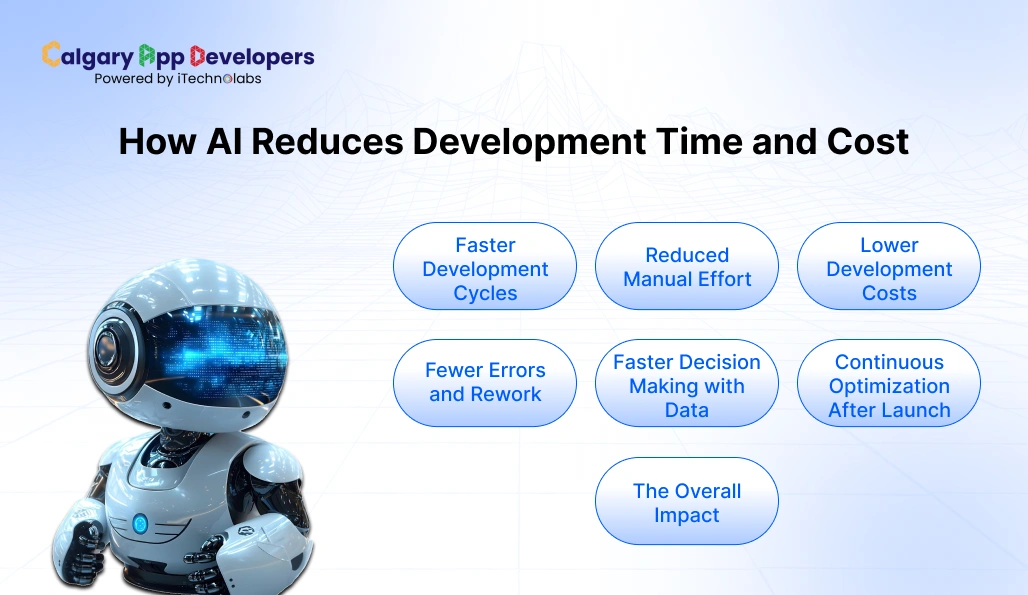
How AI Reduces Development Time and Cost
AI in mobile development is not just about adding smart features to apps. Its real impact lies in how it transforms the development process itself. By automating repetitive work, improving accuracy, and accelerating decision-making, AI helps teams deliver high-quality applications faster and at a lower cost.
1. Faster Development Cycles
AI significantly reduces the time required to build applications. Tasks that once took hours or days can now be completed in minutes.
- Code generation tools reduce the need to write boilerplate code.
- AI-assisted design tools speed up UI and UX creation.
- Automated testing eliminates long manual QA cycles.
This allows teams to move from concept to launch much faster, which is critical in competitive markets.
2. Reduced Manual Effort
A large portion of development effort traditionally goes into repetitive and low-value tasks. AI removes much of this burden.
Developers no longer need to spend time on routine coding, debugging basic errors, or maintaining test scripts. Designers can generate prototypes quickly instead of building everything manually. QA teams can rely on intelligent automation instead of repetitive test execution.
This shift allows teams to focus on high-impact work such as product strategy, architecture, and user experience.
3. Lower Development Costs
Time savings directly translate into cost savings. With AI handling a significant portion of the workload, teams can achieve more with fewer resources.
- Smaller teams can deliver complex applications.
- Reduced development time lowers overall project costs.
- Fewer post-release issues decrease maintenance expenses.
For businesses, this means better return on investment without compromising on quality.
4. Fewer Errors and Rework
Errors in development often lead to costly rework and delays. AI helps minimize these issues by identifying problems early in the process.
AI-powered tools can detect bugs during coding, predict potential failures during testing, and monitor performance after deployment. This proactive approach reduces the need for extensive fixes later, saving both time and money.
5. Faster Decision Making with Data
AI enables teams to make informed decisions based on real data rather than assumptions. Analytics tools provide insights into user behavior, feature performance, and system efficiency.
This helps teams prioritize the right features, avoid unnecessary development, and optimize resources effectively.
6. Continuous Optimization After Launch
The cost benefits of AI extend beyond development. After launch, AI continues to monitor app performance, user engagement, and system health.
It can suggest improvements, automate updates, and detect issues in real time. This reduces long-term maintenance costs and ensures the app remains competitive without constant manual intervention.
The Overall Impact
AI in mobile development creates a more efficient, streamlined workflow from start to finish. It reduces delays, minimizes waste, and improves output quality at every stage.
For businesses, this means faster time to market and controlled budgets. For development teams, it means the ability to build better applications with greater efficiency and confidence.
Also Read: How to Develop an AI App: A Breif Guide
Hiring AI-Driven Mobile App Developers
As AI in mobile development becomes a standard practice, hiring the right developers requires a different lens. It is no longer enough to evaluate only mobile app expertise. Businesses need professionals who can combine development skills with a practical understanding of AI tools, frameworks, and workflows.
1. What to Look for in AI-Driven Developers
The ideal candidate brings a mix of technical depth and adaptability. AI evolves quickly, so developers must be comfortable working with new tools and integrating them into existing systems.
Key capabilities to prioritize include:
- Strong experience in mobile frameworks such as Flutter, React Native, or native Android and iOS.
- Hands-on familiarity with AI and machine learning frameworks like TensorFlow Lite, Core ML, or ML Kit.
- Experience with AI-assisted coding tools and automated testing platforms.
- Understanding of data handling, model integration, and performance optimization.
- Ability to build scalable and secure mobile architectures.
This combination ensures that developers can not only use AI tools but also apply them effectively in real-world projects.
2. Evaluating Practical Experience
Resumes often highlight tools, but real value comes from implementation experience. When hiring, focus on what candidates have built rather than what they claim to know.
Ask for:
- Case studies or past projects involving AI features.
- Examples of apps with personalization, automation, or predictive capabilities.
- Details on how AI tools improved development speed or app performance.
This helps you assess whether the developer can translate AI capabilities into measurable results.
3. In-House vs Outsourcing
Businesses often face a choice between building an internal team or partnering with an external development company.
- In-house teams offer better control and long-term alignment but require higher investment in hiring and training.
- Outsourcing provides access to experienced AI-driven developers with faster onboarding and lower upfront costs.
The right choice depends on project scope, budget, and long-term strategy.
Hiring for AI in mobile development is not just about current needs. It is about preparing for future growth. Developers who stay updated with evolving tools and continuously improve their skills will bring long-term value to your projects.
Future Trends in AI for Mobile App Development
The current state of AI technology has started to transform mobile applications, yet upcoming innovations will produce even greater changes. Mobile applications will use AI as an essential component because AI technology will reach maturity, and computing resources will expand.
- Rise of On-Device Intelligence: More AI processing will shift to devices, reducing reliance on cloud infrastructure. This improves speed, enhances privacy, and enables real-time features like translation, image recognition, and offline personalization.
- Hyper-Personalized User Experiences: AI will deliver deeply personalized experiences by analyzing behavior, context, and preferences in real time. Apps will dynamically adjust content, layouts, and features to match individual user expectations.
- Voice and Conversational Interfaces: Voice and conversational AI will become central to app interaction. Users will navigate, search, and complete actions using natural language, making apps more intuitive and reducing dependence on traditional interfaces.
- AI-Driven Development Workflows: AI will take a larger role in development workflows by automating coding, suggesting architecture improvements, and optimizing processes. This will further reduce development time and allow teams to focus on innovation.
- Predictive and Autonomous Applications: Apps will become proactive, using AI to predict user needs and take action automatically. This includes suggesting tasks, optimizing performance, and adapting features based on behavior patterns without user input.
- Stronger Focus on Privacy and Ethical AI: As AI adoption grows, apps will need to prioritize transparency and data protection. Developers will focus on ethical AI practices, ensuring compliance while maintaining user trust and responsible data usage.
- Integration with Emerging Technologies: AI will increasingly integrate with technologies like AR, wearables, and IoT. This will enable more immersive, connected experiences across industries such as healthcare, retail, and smart home ecosystems.
The future is not just about smarter apps. It is about apps that continuously learn, adapt, and improve with every interaction.
Read Also: How to Build an AI App in Canada: A Complete Guide
Why Choose Calgary App Developer for AI-Powered Mobile App Development
Choosing the right development partner is critical when integrating AI into mobile applications. At Calgary App Developer, we combine technical expertise with practical implementation experience to deliver AI-powered mobile app development that drives measurable results.
Our approach focuses on building applications that are not only intelligent but also scalable, efficient, and aligned with business goals. We work closely with clients to understand their requirements and translate them into solutions that create real value.
What Sets Us Apart
- Deep Expertise in AI Integration: Our team has hands-on experience in implementing AI across design, development, testing, and analytics, ensuring every stage of the app lifecycle benefits from automation and intelligence.
- End-to-End Development Capabilities: From initial concept and UI design to deployment and post-launch optimization, we manage the complete development process with a structured and efficient approach.
- Focus on Performance and Scalability: We build applications that are optimized for performance and designed to scale as user demand grows, ensuring long-term reliability.
- Data-Driven Development Approach: Every decision is backed by insights. We use AI to analyze user behavior and continuously improve app functionality and engagement.
- Faster Time to Market: By leveraging AI tools and streamlined workflows, we reduce development timelines without compromising on quality.
- Transparent Communication and Support: We maintain clear communication throughout the project and provide ongoing support to ensure your app continues to perform at its best.
With Calgary App Developer, AI-powered mobile app development becomes a strategic advantage, helping businesses launch smarter applications, improve user experiences, and stay ahead in a competitive market.
Final Words
AI in mobile development is no longer an optional enhancement. It has become a core part of how modern applications are designed, built, and maintained. From intelligent design tools to automated testing and AI-assisted coding, every stage of the development lifecycle is now faster, more efficient, and more data-driven.
The real advantage lies in how AI enables teams to deliver more with fewer resources. Development cycles become shorter, product quality improves, and user experiences become more personalized and engaging. For businesses, this translates into reduced costs, quicker time to market, and stronger competitive positioning.
As AI continues to evolve, its role in mobile app development will only expand. Applications will become more adaptive, predictive, and capable of learning from user behavior in real time. Teams that adopt AI early are better positioned to build future-ready products that meet rising user expectations.
Partnering with an experienced company like Calgary App Developer makes a significant difference in how effectively AI is implemented. With the right expertise and tools, businesses can unlock the full potential of AI-powered mobile app development and turn innovation into measurable growth.
FAQs
- What are AI tools used in mobile app development?
AI tools in mobile app development are software solutions that automate and enhance tasks such as design, coding, testing, and analytics. They use machine learning to generate code, detect bugs, and personalize user experiences. These tools help developers build smarter applications faster while maintaining high quality and reducing manual effort.
- How does AI increase efficiency in mobile app development?
AI improves efficiency by automating repetitive tasks like code generation, testing, and debugging. It provides real-time suggestions, identifies errors early, and speeds up decision-making through data insights. This reduces development time, minimizes rework, and allows teams to focus on complex problem-solving and innovation.
- Which AI tools are commonly used by mobile app developers?
Popular AI tools include GitHub Copilot for code assistance, Amazon CodeWhisperer for secure coding suggestions, Figma AI for design automation, and Testim for AI-driven testing. These tools support different stages of development and help teams improve productivity, accuracy, and overall application performance.
- In what ways does AI reduce mobile app development costs?
AI reduces costs by automating tasks that would otherwise require significant manual effort. It shortens development timelines, reduces the need for large teams, and minimizes errors that lead to rework. Faster delivery and improved efficiency result in lower overall project costs without compromising quality.
- Can AI enhance user experience in mobile applications?
Yes, AI significantly improves user experience by enabling personalization, predictive recommendations, and intelligent interfaces. It analyzes user behavior to deliver relevant content and smoother interactions. Features like chatbots, voice assistants, and smart search create more engaging and user-friendly applications.
- Is AI in mobile app development a good fit for startups?
AI is highly beneficial for startups as it helps them build competitive products with limited resources. It accelerates development, reduces operational costs, and enables advanced features like personalization and automation. Startups can launch faster and scale efficiently without requiring large development teams.
- How can businesses choose the right AI-driven mobile app development partner?
Businesses should evaluate a developer’s experience with AI integration, technical expertise, and past projects. It is important to assess their ability to deliver scalable solutions, use modern tools, and provide ongoing support. Clear communication and a structured development approach are also key factors in making the right choice.
- Why should you choose Calgary App Developer for AI-powered mobile app development?
Calgary App Developer offers strong expertise in AI-powered mobile app development, delivering solutions that are scalable, efficient, and tailored to business needs. With end-to-end development services, data-driven strategies, and a focus on performance, they help businesses build intelligent applications that improve user engagement and drive long-term growth.


Pankaj Arora is a seasoned technology leader and the Founder of Calgary App Developer, with 10+ years of expertise in crafting high-performance digital solutions. His core competencies include full-stack app development, cloud-native architecture, API integration, and agile product delivery. Under his leadership, Calgary App Developers has empowered startups and enterprises alike with scalable mobile applications, secure web platforms, and AI-driven SaaS products.