









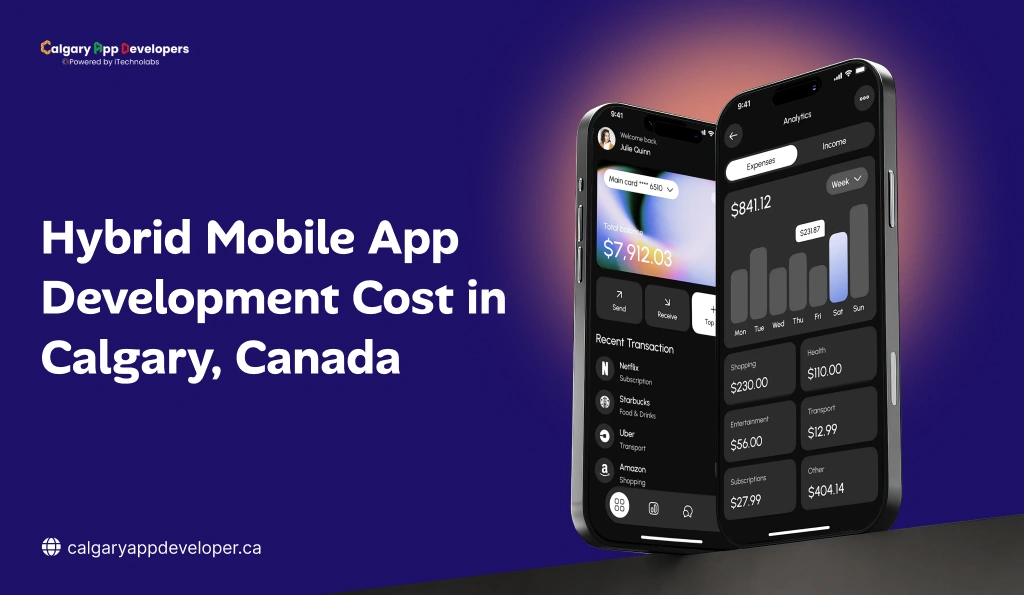
Hybrid Mobile App Development Cost in Calgary, Canada
If your business wants to reach both iOS and Android users, building two separate native apps is no longer the only path forward. In 2026, more Canadian businesses are choosing hybrid mobile app development because it delivers faster launches, lower development costs, and a unified experience across platforms without sacrificing quality.
Modern frameworks like Flutter and React Native have changed how businesses approach app development. Today’s hybrid apps offer smooth performance, responsive interfaces, and near native user experiences while significantly reducing development time and long-term maintenance costs. For startups validating an idea, growing businesses expanding digitally, or enterprises replacing outdated systems, hybrid development has become a practical and cost-efficient solution.
That said, the hybrid mobile app development cost in Calgary is not a fixed number. Pricing depends on the app’s complexity, features, integrations, design requirements, scalability goals, and the experience level of your development partner. Many businesses underestimate hidden costs such as third-party services, ongoing maintenance, security upgrades, and post-launch support.
This guide is based on our real-world experience delivering hybrid mobile app development projects for Canadian businesses across multiple industries. We’ll break down realistic development costs in Canadian dollars, explain what impacts pricing the most, and help you understand where your investment actually goes in 2026.
TL;DR
- Hybrid mobile app development in Canada costs between $25,000 and $160,000 CAD in 2026.
- Flutter and React Native are the dominant frameworks, each with different cost and performance profiles.
- App complexity, framework choice, and developer location are the three biggest cost drivers.
- Hidden costs like App Store fees, OS updates, and PIPEDA compliance audits add 15 to 25% on top of initial quotes.
- SR&ED tax credits and CDAP grants can significantly offset hybrid app development costs for qualifying Canadian businesses.
Key Points
- Hybrid mobile app development cost in Canada varies based on app type, feature scope, UI/UX complexity, and backend infrastructure requirements.
- Basic hybrid apps are faster and more affordable to build, while enterprise-grade hybrid platforms require larger teams, advanced architecture, and greater investment.
- Developer location within Canada directly affects hourly rates and total project cost, with Calgary offering strong value relative to Toronto and Vancouver.
- Hidden costs, including App Store fees, third-party API licensing, bilingual French support, and security testing, should be factored into your budget from day one.
- Starting with an MVP, choosing the right framework, and working with a local Calgary team are the most effective ways to control hybrid app development costs without sacrificing quality.
Hybrid Mobile App Market Trends and Key Statistics for 2026
Hybrid mobile app development is no longer viewed as a compromise between cost and performance. In 2026, it has become the preferred development approach for businesses that want faster launches, lower operational costs, and consistent user experiences across iOS and Android.
Here are the most important market trends and statistics shaping the hybrid mobile app industry in 2026.
The Cross-Platform App Market Is Growing Rapidly
The global cross-platform app development market is projected to reach more than $47 billion by 2035, driven by increasing mobile app demand, rising development costs for native apps, and growing adoption of AI-powered mobile experiences.
Flutter and React Native Lead Enterprise Adoption
Flutter and React Native are now mature, enterprise-ready technologies used by startups, SMBs, and global brands alike.
Industry reports in 2026 highlight several reasons behind their rapid adoption:
- Faster development cycles using a shared codebase.
- Reduced maintenance costs compared to separate native apps.
- Near native performance and smoother UI rendering.
- Easier integration with AI, cloud, and backend services.
- Faster feature rollouts across multiple platforms.
Modern versions of Flutter and React Native now deliver performance levels approaching fully native applications, making them practical even for feature-rich business apps.
Canadian Businesses Are Prioritizing Cost Efficiency
- In Canada, businesses are increasingly moving toward hybrid development due to rising software development costs and tighter digital transformation budgets.
- Hybrid development can reduce initial mobile app costs by 30% to 40% compared to building separate native apps, especially for startups and mid-sized businesses focused on faster time to market.
Industry experts also predict continued growth for Flutter, React Native, Kotlin Multiplatform, and .NET MAUI as businesses look for scalable multi-platform development solutions.
How Much Does Hybrid Mobile App Development Cost in Canada
Hybrid mobile app development cost in Canada generally falls between CAD $25,000 and $160,000, depending on the scope of the app, feature complexity, design requirements, framework choice, and long-term maintenance expectations.
Below is a realistic hybrid mobile app development cost breakdown covering the complete development process.
Total Cost Estimation Table
| Development Stage | Description | Estimated Cost CAD |
| Discovery and Planning | Requirements analysis, feature definition, and technical planning | $2,500 to $7,000 |
| UX and UI Design | Wireframes, visual design, and user flow optimization | $5,000 to $16,000 |
| Backend Development | Server logic, APIs, databases, and third-party integrations | $7,000 to $28,000 |
| Hybrid Frontend Development | Flutter or React Native development, UI implementation, app logic | $10,000 to $40,000 |
| Quality Assurance | Functional testing, device compatibility, and platform-specific QA | $3,500 to $11,000 |
| Deployment | App Store and Google Play setup, review, and release | $1,000 to $3,000 |
| Project Management | Sprint coordination, communication, and delivery oversight | $2,500 to $10,000 |
| Post-Launch Support | Bug fixes, framework updates, and minor enhancements | $3,500 to $16,000 per year |
| Total Estimated Cost | From planning to post-launch | $25,000 to $160,000 |
These figures represent practical hybrid mobile app development cost benchmarks in Canada for 2026, based on projects built with Flutter and React Native and optimized for efficiency and long-term scalability. The range is intentionally wide because the right number for your project depends on the decisions covered in the sections that follow.
Also Read: Best Hybrid App Development Companies in Calgary, Canada
Hybrid Mobile App Development Cost by App Type and Complexity
Hybrid mobile app development cost varies significantly based on the type of application you’re building and the level of technical complexity it requires. Feature depth, backend architecture, integration scope, security requirements, and design ambition all play a direct role in the final budget.
Based on real project experience delivering hybrid applications across industries in Canada, the table below outlines how app complexity affects cost and timeline.
Estimated Hybrid Mobile App Development Cost by Complexity
| App Complexity | Typical Features | Estimated Cost CAD | Estimated Timeline |
| Basic App | Limited screens, simple UI, minimal backend | $25,000 to $45,000 | 2 to 3 months |
| Moderate App | User accounts, API integrations, dashboards | $45,000 to $95,000 | 3 to 6 months |
| Complex App | Real-time features, custom backend, advanced architecture | $95,000 to $160,000+ | 6 to 10 months |
These estimates include design, development, testing, and deployment. They reflect hybrid app development specifically using Flutter or React Native, which reduces cost compared to building two separate native apps while maintaining strong performance across both platforms.
1. Basic Hybrid Applications
Basic hybrid apps typically cost between CAD $25,000 and $45,000 and are well-suited for startups testing a concept, small businesses launching a focused product, or organizations that need a simple mobile presence across both platforms without complex functionality.
Key Features
- Static or semi-dynamic content display
- Simple navigation structure
- Basic user authentication
- Minimal third-party integrations
- Standard cross-platform UI components
- Limited backend logic or a lightweight BaaS setup
These applications are faster to build and require smaller teams. The lower hybrid mobile app development cost at this level comes from reduced infrastructure complexity and a tightly scoped feature set. Flutter’s widget system and React Native’s component library both shine here, producing clean, consistent UIs across iOS and Android from a single codebase without the overhead of managing platform-specific designs.
2. Moderate Complexity Hybrid Applications
Moderate complexity apps usually fall between CAD $45,000 and $95,000 and are designed for growing businesses that need data-driven features, user management, and integrations with external services.
Key Features
- User registration and profile management
- Payment gateway integration (Stripe, Square, or Canadian-specific processors)
- Push notifications
- API integrations with third-party platforms
- Admin or management dashboard
- Cloud-based backend (AWS, Firebase, or Azure)
- Analytics and usage reporting
- Offline data caching for low-connectivity environments
This category requires careful planning around architecture, security, and scalability. Hybrid mobile app development cost increases at this level because of longer development timelines, expanded testing scope across device types, and the added complexity of keeping a single codebase performing consistently across both iOS and Android ecosystems at scale.
3. Complex or Enterprise-Level Hybrid Applications
Complex hybrid apps often start at CAD $95,000 and can exceed $160,000, involving custom engineering, advanced infrastructure, and long-term scalability planning. These are the right choices for fintech products, healthcare platforms, large-scale marketplaces, and enterprise tools that need to serve thousands of concurrent users reliably.
Key Features
- Real-time data synchronization
- Custom backend architecture with microservices or serverless functions
- Advanced security, encryption, and compliance standards, including PIPEDA
- AI-driven features or machine learning model integration
- Multi-role user access systems
- High-volume transaction handling
- Performance optimization for large user bases
- Deep integration with enterprise systems and third-party APIs
- Bilingual English and French support for the national Canadian reach
At this level, hybrid mobile app development cost reflects the need for specialized framework expertise, larger cross-functional teams, extended testing cycles across a wider device matrix, and ongoing infrastructure investment. The single codebase advantage of hybrid development still delivers meaningful savings compared to two native builds at this complexity level.
Choosing the right complexity tier should align with your business goals, your target market, and your growth trajectory over the next two to three years. Defining the appropriate scope before development begins is the single most effective way to control costs and avoid the expensive rebuilds that come from under-scoped initial builds.
Key Factors That Impact Hybrid Mobile App Development Cost
The cost of hybrid mobile app development is shaped by a combination of strategic planning decisions and technical requirements. Accurate budgeting depends on understanding how these factors interact across the full development lifecycle.
1. Developer Location in Canada
Geographic location plays a measurable role in total hybrid mobile app development cost. Hourly rates vary by city based on market demand, operating costs, and talent availability.
Average Hybrid App Developer Hourly Rates in Major Canadian Cities
| City | Average Hourly Rate CAD |
| Toronto, ON | $95 to $145 |
| Vancouver, BC | $90 to $140 |
| Calgary, AB | $65 to $100 |
| Ottawa, ON | $75 to $110 |
| Montreal, QC | $80 to $120 |
Calgary continues to offer one of the most cost-effective hybrid development markets in Canada while maintaining strong technical capability in Flutter and React Native. For businesses seeking the right balance of quality, accountability, and cost within Canada, Calgary is a consistently strong choice.
2. Framework Selection: Flutter vs React Native vs Ionic
Your framework choice is one of the most consequential decisions in a hybrid mobile app project. It affects development speed, long-term maintenance cost, performance, and the talent pool available to your team.
Framework Comparison for Hybrid App Development
| Factor | Flutter | React Native | Ionic |
| Language | Dart | JavaScript / TypeScript | JavaScript / TypeScript |
| Performance | Near-native (compiled) | Near-native (JS bridge) | Moderate (WebView-based) |
| UI Consistency | Pixel-perfect cross-platform | Platform-native components | Web-based UI |
| Development Speed | Fast | Fast | Fastest initially |
| Ecosystem Maturity | Strong and growing | Very mature | Established |
| Best For | High-performance consumer apps | Teams with React/JS expertise | Internal tools, simple apps |
| Avg. Cost Impact | Moderate | Moderate | Lower initially, higher maintenance |
Flutter is increasingly the default recommendation for new hybrid projects in 2026 because of its compiled performance, strong widget library, and single codebase that produces truly consistent UI across both platforms. React Native is the right call for teams with existing JavaScript expertise or projects that need tight integration with the broader JavaScript ecosystem. Ionic works well for internal tools and simple apps where ultimate performance isn’t a primary requirement.
3. App Features and Functional Scope
Feature scope has the most direct impact on hybrid mobile app development cost after framework and team location. Every feature adds effort across design, development, testing, and long-term maintenance.
Scope elements that meaningfully drive cost:
- Multi-role user access systems with fine-grained permissions
- Real-time messaging, tracking, or synchronization
- Payment systems, subscriptions, and financial transaction handling
- Advanced search and filtering with complex query logic
- Data-driven dashboards with custom visualization
- Offline access and conflict-resolution data syncing
- AI or ML feature integration
- Biometric authentication (Face ID, fingerprint)
Defining a clear Minimum Viable Product before scoping begins is the most reliable way to control initial hybrid mobile app development cost without compromising on what your core users actually need.
4. UX/UI Design Complexity
Design investment directly affects both development cost and product quality. Custom design systems take longer to build but produce significantly better user experiences and stronger brand identity.
Design approaches and their cost impact:
- Standard component libraries: Faster and lower cost. Works well for internal tools and utility apps where brand differentiation matters less.
- Custom design system: Higher investment upfront. Produces a distinctive, brand-consistent experience that compounds in value with scale.
- Branded hybrid design: Achieves platform-consistent feel while maintaining brand identity. Requires careful Flutter theming or React Native styling work.
Design revisions are cheap during wireframing and expensive during development. Getting a proper UX review done before coding starts is one of the most impactful cost-saving decisions you can make in any hybrid app project.
5. Backend Architecture
The backend infrastructure powering your app has a significant impact on hybrid mobile app development cost, particularly as feature complexity and user scale increase.
Backend approaches and their cost implications:
- BaaS (Firebase, Supabase): Lower initial cost, faster setup, good for simpler apps. Can become expensive and limiting at scale.
- Custom REST API backend: Moderate cost, strong flexibility, the standard choice for most mid-to-complex hybrid projects.
- Microservices architecture: Higher upfront cost, but enables independent scaling and team autonomy. Worth the investment for enterprise-grade platforms.
- Serverless functions: Cost-effective for event-driven workloads like push notifications, image processing, or scheduled tasks.
The backend decisions made during architecture planning also affect long-term hosting and infrastructure costs, which should be included in your total cost of ownership calculation.
6. PIPEDA Compliance and Canadian Regulatory Requirements
For Canadian businesses, PIPEDA compliance isn’t optional, and it adds a defined scope of work to any hybrid app project that handles personal data. This includes consent mechanisms in your user onboarding flow, data minimization in your data architecture, user access and deletion flows, and proper encryption and access controls.
Apps operating in Quebec need to comply with Law 25, which adds stricter provincial requirements on top of PIPEDA. Building compliance from the architecture phase costs less than retrofitting it after launch. A development partner who raises these requirements proactively is a partner worth working with.
7. Third-Party Integrations
Every integration with an external service (maps, payments, analytics, authentication, messaging, or industry-specific APIs) adds development, testing, and ongoing maintenance costs. Simple integrations using well-documented REST APIs are relatively affordable. Complex integrations with legacy systems, undocumented APIs, or real-time data feeds add significantly to the scope and timeline.
Also Read: How to Create Hybrid Mobile App: Hybrid App Development Guide
Hidden Hybrid Mobile App Development Costs You Should Plan For
Most initial quotes for hybrid mobile app development don’t include everything. Here are the expenses that consistently catch Canadian businesses off guard when they’re reviewing invoices six months after launch.
App Store fees:
Apple charges $99 USD per year for an Apple Developer account, which is required to distribute any iOS app. Google charges a one-time $25 USD registration fee for the Google Play Console. Neither is expensive on its own, but both need to be set up before launch and maintained annually for Apple.
Framework and OS compatibility updates:
Flutter and React Native both release major updates regularly. iOS and Android each ship significant OS updates annually. Your app needs to be tested and updated to stay compatible. Budget roughly $2,000 to $5,000 CAD per year for routine compatibility maintenance on a mid-complexity hybrid app.
Third-party API and service licensing:
Many useful features rely on paid third-party services: mapping (Google Maps, Mapbox), push notifications at scale (OneSignal, Pusher), analytics (Mixpanel, Amplitude), payment processing (Stripe, Square), and authentication (Auth0, Firebase Auth). These costs are usage-based and often start free but grow meaningfully as your user base scales.
PIPEDA compliance audits:
If your app handles personal data, periodic privacy compliance reviews are a real ongoing cost. These are particularly important after significant feature additions or after regulatory updates, like Quebec’s Law 25 amendments. Plan for a compliance review every 12 to 18 months.
Bilingual French support:
If your hybrid app targets a national Canadian audience, French localisation is a market requirement for Quebec reach. Localisation isn’t just translation: it involves UI layout adjustments (French text runs 20 to 30% longer than English), locale-specific date and number formatting, and ongoing translation for new content and features. Plan $3,000 to $8,000 CAD for initial localisation, depending on content volume, plus ongoing translation costs.
Security testing and penetration testing:
Apps handling financial data, health information, or sensitive personal data should undergo formal security testing before launch and after major releases. A professional penetration test typically costs $3,000 to $8,000 CAD and is worth every dollar for apps where a security breach would carry legal or reputational consequences.
Infrastructure and hosting costs:
Cloud hosting costs scale with usage. What costs $200/month at launch can cost $1,500/month with 50,000 active users. Model your infrastructure cost trajectory realistically when building your three-year business case for the project.
Post-launch maintenance:
Plan to spend roughly 15 to 20% of your initial development cost per year on ongoing maintenance: bug fixes, performance monitoring, dependency updates, and the next round of feature development. A $75,000 CAD hybrid app build should have $11,000 to $15,000 in annual maintenance budget.
Also Check: Hire Hybrid App Developers in Calgary: 10 Best Sites to Hire
Smart Ways to Reduce Hybrid Mobile App Development Cost Without Sacrificing Quality
Controlling hybrid mobile app development cost doesn’t mean cutting corners. It means making smarter decisions earlier in the process. Here are the strategies that consistently deliver results for Canadian businesses building hybrid apps.
Start with an MVP: Build the smallest version of your app that delivers real value to real users. An MVP lets you validate product-market fit before committing to the full build. It’s faster, cheaper, and gives you real user feedback to guide Phase 2 decisions rather than assumptions made in a conference room.
Choose Flutter: Flutter’s single codebase approach and compiled rendering engine mean you get strong performance across iOS and Android without the overhead of managing platform-specific code branches. For most Canadian SMB hybrid projects, Flutter is the most cost-efficient path to a high-quality cross-platform product.
Define the scope before the first sprint: Scope creep is the most reliable way to blow a hybrid mobile app development budget. Invest in a proper discovery phase to document requirements, define what’s in and out of scope for Version 1, and establish a change control process before development begins. Every hour spent in discovery saves three to five hours in development rework.
Prioritize features by revenue impact: Not every feature on your wish list needs to be in Version 1. Stack-rank your feature list by the revenue impact or operational value each one delivers, and build the top tier first. Features with high cost and low impact can wait for Version 2.
Use open-source libraries strategically: Both Flutter and React Native have mature, well-maintained open-source ecosystems. Using battle-tested libraries for common functionality (navigation, state management, form validation, networking) reduces development time significantly compared to building everything from scratch.
Claim your SR&ED tax credits: Canada’s Scientific Research and Experimental Development program provides substantial tax credits for development work involving genuine technical uncertainty. Hybrid app projects that involve novel architecture decisions, experimental framework usage, or technically challenging integration work frequently qualify. For Canadian-Controlled Private Corporations, the refundable credit rate can reach 35% on the first $3 million of eligible expenditures. Talk to an SR&ED specialist before your project starts so you’re capturing the right documentation throughout development.
Explore CDAP grants: The Canada Digital Adoption Program has provided grants to help small and medium-sized businesses adopt digital technology. If your business qualifies, this funding can meaningfully offset your hybrid app development cost. Verify current program availability and eligibility directly through the federal government, as program details and funding availability change.
Work with a Calgary-based team: Calgary offers senior Flutter and React Native development talent at hourly rates meaningfully below Toronto and Vancouver, without the communication friction, accountability gaps, and hidden revision costs that offshore development regularly introduces. For Canadian businesses that want experienced local expertise at a price point that makes the project viable, Calgary is the strategic choice.
Our Proven Expertise in Hybrid Mobile App Development
At Calgary App Developer, hybrid mobile app development is one of our core capabilities. We’ve built hybrid applications across Flutter and React Native for businesses in energy, real estate, logistics, healthcare, and professional services, delivering products that perform at near-native quality across both iOS and Android.
Our hybrid development process is built on a foundation that eliminates the most common failure modes: poor discovery, vague scope, weak QA, and no post-launch support plan. Every hybrid project we take on starts with a structured discovery phase that produces a clear requirements document, a realistic scope, and an honest cost estimate before a single line of code gets written.
We work in Agile sprints with regular reviews, so you’re seeing working software at every stage of development rather than waiting months for a finished product that doesn’t match what you imagined. Our QA process runs in parallel with development, not after it, and covers functional testing, device compatibility across a representative matrix of iOS and Android devices, and PIPEDA compliance validation for any app touching Canadian user data.
Every project we deliver includes a full source code handover and documentation, so you own your product outright and can work with any team to maintain or extend it going forward. We also offer ongoing maintenance agreements for businesses that want a committed partner for the post-launch life of their application.
Why Businesses Choose Us for Hybrid Mobile App Development in Canada
- Local Calgary team with national reach. We’re based in Calgary with clients across Canada. You get timezone-aligned communication, accountable delivery, and a team that understands the Canadian market without paying Toronto or Vancouver overhead.
- Transparent pricing in Canadian dollars. We quote in CAD with no currency conversion surprises. Our scopes are detailed enough that what you sign is what you pay, not a starting number that grows with every change request.
- Deep Flutter and React Native expertise. Our developers have shipped production hybrid apps in both major frameworks across multiple industries. We’ll recommend the right framework for your specific project based on your requirements, not based on what’s easiest for us to build.
- Canadian compliance built in. We raise PIPEDA requirements, data residency options, bilingual support considerations, and Law 25 implications proactively. You shouldn’t have to remind your development partner that PIPEDA exists.
- SR&ED guidance from project start. We help clients identify SR&ED eligibility and set up the documentation practices that support a successful claim before the build begins, not after the invoices are paid.
- Full IP ownership and source code handover. You own everything we build. Source code, design assets, documentation, and deployment configurations are all yours at project completion.
- Post-launch partnership, not just handoff. We offer ongoing maintenance agreements and remain a responsive partner for bug fixes, feature additions, and framework updates after your app goes live. Your app’s success after launch matters to us as much as the launch itself.
Conclusion
Hybrid mobile app development in Canada is one of the most cost-effective ways to reach users on both iOS and Android without doubling your development investment. In 2026, with Flutter and React Native at full maturity, the performance gap with native apps has narrowed to the point where hybrid is the right default choice for the majority of Canadian business apps.
The total cost of your hybrid project will fall somewhere in the $25,000 to $160,000 CAD range, shaped primarily by feature complexity, your framework choice, your team’s location, and the compliance and integration requirements specific to your industry and market. Understanding these variables before you start planning gives you the foundation to budget accurately and choose the right development partner for the job.
If you’re ready to explore what a hybrid mobile app would actually cost for your specific project, we’d love to have that conversation. Visit calgaryappdeveloper.ca to book a free consultation. You’ll get a straight assessment of your scope, a realistic cost estimate in CAD, and honest advice on the best path forward for your business.
FAQs
Q. How much does hybrid mobile app development cost in Calgary specifically?
Hybrid mobile app development cost in Calgary typically ranges from $25,000 to $130,000 CAD for most commercial projects. A focused MVP with core features and a clean UI comes in at the lower end of that range. A full-featured app with payment integration, a custom backend, an admin dashboard, and bilingual support will push toward $80,000 to $130,000. Calgary offers senior Flutter and React Native developers at hourly rates of $65 to $100 CAD, which is meaningfully more competitive than Toronto or Vancouver without the quality and accountability trade-offs that offshore development regularly introduces.
Q. Is hybrid app development cheaper than native app development?
Yes, in most cases. Hybrid development using Flutter or React Native produces a single codebase that runs on both iOS and Android. This means you’re paying once for design, development, and QA rather than twice. For a mid-complexity app, the cost savings compared to two separate native builds typically range from 30 to 50%. The tradeoff is that native development can achieve deeper platform integration and marginally higher performance for extremely demanding use cases, like advanced AR, complex camera processing, or health sensor data. For the vast majority of Canadian business apps, hybrid delivers an equivalent user experience at significantly lower cost.
Q. How long does it take to build a hybrid mobile app in Canada?
Timeline depends on complexity. A basic hybrid app with a focused feature set typically takes two to three months from discovery to App Store launch. A moderate complexity app with user management, integrations, and a custom backend runs for three to six months. A complex enterprise hybrid platform can take six to ten months or more. The discovery and design phases (typically four to eight weeks) happen before a single line of production code gets written and are often underestimated by businesses planning their first build. Rushing this phase creates problems that compound throughout development and are expensive to undo.
Q. What’s the difference between Flutter and React Native for hybrid app development?
Both are mature, production-ready frameworks for building hybrid apps that run on iOS and Android from a single codebase. Flutter, built by Google and written in Dart, uses a compiled rendering engine that produces pixel-perfect, consistent UI across platforms with near-native performance. React Native, built by Meta and written in JavaScript, uses platform-native components and is the better fit for teams with existing JavaScript expertise or projects that need tight integration with the broader JS ecosystem. For most new hybrid projects in 2026, Flutter is the default recommendation because of its performance characteristics and UI consistency. React Native remains the right choice for teams who are already invested in the JavaScript stack.
Q. Does hybrid mobile app development qualify for SR&ED tax credits in Canada?
Yes, in many cases it does. Canada’s Scientific Research and Experimental Development program provides substantial tax credits for development work involving genuine technical uncertainty and systematic experimental approaches. Hybrid app projects that involve novel framework integration, technically challenging API architecture, experimental performance optimization, or innovative use of emerging features in Flutter or React Native can qualify. The key is documenting technical challenges, approaches attempted, and outcomes throughout the project, not after the fact. Canadian-Controlled Private Corporations can receive refundable SR&ED credits of up to 35% on the first $3 million of eligible expenditures. Talk to an SR&ED specialist before your project starts so you’re building the right documentation from day one.
Q. What hidden costs should I budget for beyond the initial hybrid app development quote?
The most common hidden costs that Canadian businesses miss include: Apple Developer Program fees ($99 USD per year), framework and OS compatibility updates ($2,000 to $5,000 CAD per year for a mid-complexity app), third-party API licensing fees that scale with user volume, French bilingual localisation ($3,000 to $8,000 CAD initial investment plus ongoing translation), security penetration testing ($3,000 to $8,000 CAD for regulated industries), PIPEDA compliance audits every 12 to 18 months, and annual maintenance at 15 to 20% of your initial development cost. Building all of these into your three-year business case from the start gives you a realistic total cost of ownership rather than a pleasant initial quote followed by uncomfortable surprises.


Pankaj Arora is a seasoned technology leader and the Founder of Calgary App Developer, with 10+ years of expertise in crafting high-performance digital solutions. His core competencies include full-stack app development, cloud-native architecture, API integration, and agile product delivery. Under his leadership, Calgary App Developers has empowered startups and enterprises alike with scalable mobile applications, secure web platforms, and AI-driven SaaS products.