








How to Build an AI App in Canada: A Complete Guide
Artificial intelligence exists as an actual technology that people currently use. Businesses today depend on it to manage their operations, while customers use products and organizations make choices through their work. Companies use AI applications,s which deliver intelligent automation and predictive insights as essential tools to maintain their market position and industry relevance.
Canada has emerged as a strong hub for AI innovation, supported by advanced research, skilled talent, and a growing ecosystem of technology-driven enterprises. For businesses planning to invest in AI, the opportunity is not just about adopting new technology, but about building solutions that deliver measurable value and long-term impact.
This guide is built from our hands-on experience as an AI app development company, working with diverse industries and real-world use cases. It combines practical insights, proven approaches, and project-driven expertise to help you understand what it takes to design, develop, and launch a successful AI application in Canada.
- Building an AI app in Canada offers strong growth potential and innovation support.
- Development involves a structured process from idea to deployment and scaling.
- Costs vary based on complexity, data, and technology choices.
- Choosing the right development partner is critical for long-term success.
- Canada provides a strong ecosystem for AI app development with growing market demand, skilled talent, and government support, making it an attractive destination for businesses investing in AI solutions.
- The success of an AI app depends on a well-defined process that includes problem identification, data preparation, model development, integration, and continuous improvement after deployment.
- The cost of building an AI app in Canada typically ranges from CAD 70,000 to CAD 300,000 or more, influenced by factors such as complexity, data requirements, infrastructure, and development team expertise.
- Key cost drivers include the type of AI model, feature complexity, data processing needs, and the location of the development team within major Canadian cities.
- Selecting an expert AI development company in Canada ensures better execution, scalability, and alignment with business goals, ultimately reducing risks and improving project outcomes.
- AI app development comes with challenges such as data quality, high costs, integration complexity, and regulatory compliance, all of which require strategic planning and experienced execution.
- Future trends in AI app development in Canada include generative AI, edge computing, explainable AI, and increased adoption across industries, shaping how businesses build and scale intelligent applications.
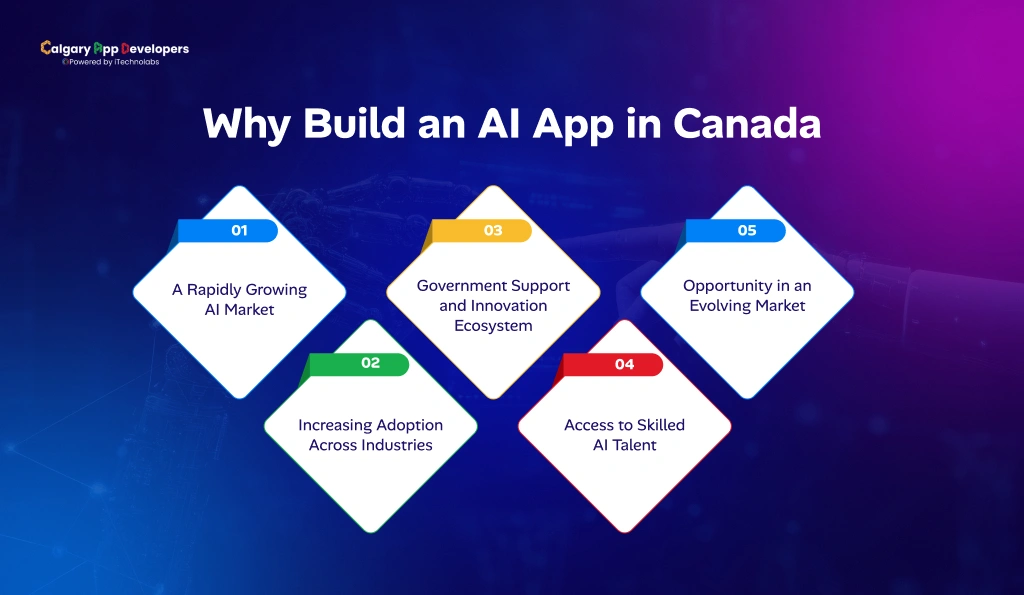
Why Build an AI App in Canada
Canada has positioned itself as one of the most promising environments for AI innovation, combining strong research capabilities, government backing, and a rapidly expanding market. For businesses planning to invest in an AI app, the country offers both immediate opportunities and long-term growth potential.
- A Rapidly Growing AI Market
Canada’s AI economy is scaling at an exceptional pace. The market was valued at over USD 40.8 billion in 2025 and is projected to reach USD 362.8 billion by 2033, growing at a CAGR of more than 30 percent.
This level of growth signals strong demand across industries, from healthcare and finance to retail and logistics. Building an AI app in this environment allows businesses to tap into a market that is still expanding and far from saturation.
- Increasing Adoption Across Industries
AI adoption among Canadian businesses is accelerating quickly. In 2025, 12.2 percent of businesses reported using AI in their operations, up from just 6.1 percent a year earlier.
Industries such as finance, professional services, and technology are leading this shift, using AI for data analytics, automation, and customer engagement. This rising adoption creates a strong demand for innovative AI applications.
- Government Support and Innovation Ecosystem
Canada has made significant investments in AI development, including funding, policy frameworks, and infrastructure. The government continues to support innovation across sectors such as healthcare, energy, and housing through AI-driven initiatives.
In addition, the country has introduced dedicated AI leadership and regulatory frameworks, reinforcing its commitment to becoming a global AI leader.
- Access to Skilled AI Talent
Canada is home to a highly skilled workforce in data science, machine learning, and cloud engineering. Demand for AI-related roles continues to grow, supported by strong academic institutions and research programs.
For businesses, this means easier access to top-tier talent capable of building and scaling advanced AI applications.
- Opportunity in an Evolving Market
Despite rapid growth, AI adoption in Canada is still in its early stages compared to global leaders. This creates a unique opportunity. Businesses that invest in AI now can gain a significant competitive advantage before the market becomes saturated.
Building an AI app in Canada is not just about technology adoption. It is about entering a high-growth ecosystem where innovation, investment, and demand are all moving in the same direction.
Also Check: AI App Development: Build Intelligent Solutions
Types of AI Applications You Can Build
AI applications are no longer limited to a single domain or use case. They are transforming how businesses operate, interact with customers, and make decisions. The right AI app depends on your business goals, data availability, and the problem you want to solve. Below are some of the most impactful types of AI applications being built across industries.
- Intelligent Chatbots and Virtual Assistants: AI-powered chatbots have evolved beyond basic scripted responses. Modern systems use natural language processing to understand intent, provide accurate answers, and deliver personalized interactions. These applications are widely used in customer support, banking, healthcare, and ecommerce to reduce response time and improve user satisfaction.
- Recommendation Systems: Recommendation engines analyze user behavior, preferences, and historical data to deliver tailored suggestions. Platforms in ecommerce, media streaming, and fintech rely heavily on these systems to increase engagement, improve conversions, and drive retention.
- Predictive Analytics Applications: Predictive AI applications use historical data and machine learning models to forecast future outcomes. Businesses use them for demand forecasting, risk assessment, fraud detection, and customer behavior analysis. These apps enable proactive decision-making instead of reactive responses.
- Computer Vision Applications: Computer vision-based AI apps interpret and analyze visual data such as images and videos. They are widely used in healthcare for diagnostics, in retail for inventory tracking, and in security for surveillance and facial recognition. These applications are especially valuable where visual accuracy and automation are critical.
- Natural Language Processing Applications: NLP-based applications focus on understanding and generating human language. Use cases include sentiment analysis, document summarization, voice assistants, and automated content generation. These apps are increasingly important for businesses dealing with large volumes of text or voice data.
- AI-Powered Automation Tools: Automation-driven AI apps streamline repetitive and time-consuming tasks. From workflow automation in enterprises to intelligent document processing, these applications improve efficiency and reduce operational costs while minimizing human error.
- Personalization Engines: Personalization-focused AI apps deliver customized user experiences across platforms. They are commonly used in marketing, ecommerce, and digital platforms to tailor content, offers, and communication based on individual user behavior and preferences.
- Healthcare AI Applications: In healthcare, AI apps are used for patient data analysis, early disease detection, medical imaging, and treatment recommendations. These solutions enhance accuracy, improve patient outcomes, and support healthcare professionals in decision-making.
- Financial AI Applications: AI is widely adopted in finance for fraud detection, credit scoring, algorithmic trading, and financial planning. These applications help institutions manage risk, improve compliance, and deliver smarter financial services.
- Industry-specific AI Solutions: Many businesses are now building custom AI applications tailored to their specific industry needs. Whether it is supply chain optimization in logistics, demand forecasting in retail, or predictive maintenance in manufacturing, industry-focused AI apps deliver highly targeted value.
Selecting the right type of AI application is a strategic decision. It should align with your business objectives, available data, and long-term vision. The most successful AI apps are those that solve a clear problem while delivering measurable impact.
Step-by-Step Process to Build an AI App in Canada
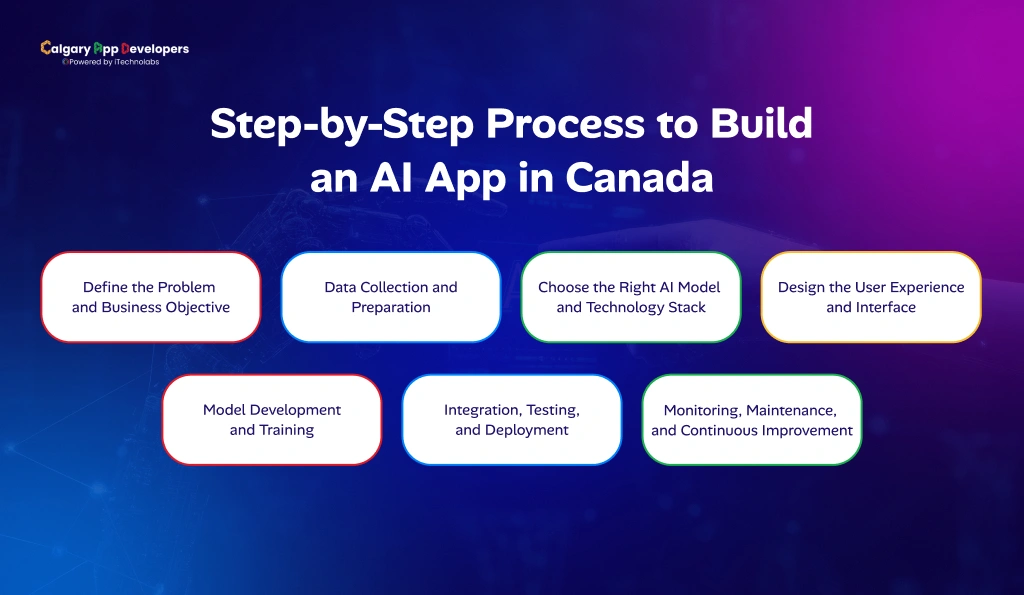
Developing a high-performing AI app is a multidisciplinary process that blends business strategy, data science, engineering, and user experience. Each stage plays a critical role in determining how effective, scalable, and reliable the final product will be. Below is a deeper and more comprehensive breakdown of the complete development lifecycle.
- Define the Problem and Business Objective
The foundation of any successful AI application lies in clearly defining the problem it aims to solve. Without this clarity, even the most advanced models can fail to deliver meaningful results.
- Identify a specific business challenge or opportunity that requires intelligent decision-making or automation.
- Define clear success metrics such as increased efficiency, reduced operational costs, improved customer engagement, or higher conversion rates.
- Assess whether AI is the right solution or if traditional software logic can achieve the same outcome.
- Understand the target users, their expectations, and how the AI feature will improve their experience.
- Establish a roadmap that aligns AI capabilities with long-term business strategy.
A well-defined objective ensures that development efforts remain focused, measurable, and aligned with real business value.
- Data Collection and Preparation
Data serves as the backbone of every AI system. The effectiveness of your AI app depends heavily on the quality, relevance, and volume of data used during development.
- Identify all potential data sources, including internal systems, third-party platforms, APIs, sensors, and user-generated data.
- Gather both structured data, such as databases and spreadsheets, and unstructured data, such as images, videos, and text.
- Clean and preprocess the data by removing duplicates, correcting inconsistencies, and handling missing values.
- Perform data labeling and annotation where required, especially for supervised learning models.
- Conduct exploratory data analysis to identify patterns, anomalies, and relationships.
- Ensure compliance with Canadian data privacy regulations and ethical AI practices.
Investing time in proper data preparation significantly improves model accuracy, reduces errors, and enhances overall performance.
- Choose the Right AI Model and Technology Stack
Selecting the right technologies and models determines how well your AI app performs under real-world conditions. This decision should be based on the complexity of the problem, available data, and scalability requirements.
- Evaluate different AI approaches such as machine learning, deep learning, natural language processing, or computer vision.
- Decide whether to use pre-trained models, fine-tune existing models, or build custom models from scratch.
- Select appropriate frameworks and libraries such as TensorFlow, PyTorch, or Scikit-learn.
- Choose cloud platforms like AWS, Google Cloud, or Azure for model training, deployment, and scalability.
- Define the backend architecture, database systems, APIs, and frontend technologies.
- Consider performance factors such as response time, processing speed, and system reliability.
A well-planned tech stack ensures flexibility, scalability, and efficient resource utilization.
- Design the User Experience and Interface
An AI app must be intuitive and easy to use, regardless of the complexity behind it. The success of the application often depends on how effectively users can interact with its features.
- Design user journeys that clearly define how users will interact with AI-driven functionalities.
- Create clean, responsive, and user-friendly interfaces across web and mobile platforms.
- Ensure transparency by providing explanations or insights into AI-generated outputs where necessary.
- Focus on accessibility and usability to accommodate a wide range of users.
- Incorporate feedback loops that allow users to report issues or refine results.
- Test prototypes with real users to identify usability gaps and improve design.
A strong user experience increases adoption, trust, and long-term engagement.
- Model Development and Training
This stage involves building, training, and refining the AI model using the prepared dataset. It is one of the most technically intensive phases of development.
- Train the model using selected algorithms and datasets.
- Fine-tune hyperparameters to optimize performance and accuracy.
- Split data into training, validation, and testing sets to ensure reliable evaluation.
- Use performance metrics such as precision, recall, F1 score, and accuracy to assess results.
- Identify and address issues such as bias, overfitting, and underfitting.
- Run multiple iterations to improve model robustness and generalization.
The goal is to develop a model that performs consistently across different scenarios and data variations.
- Integration, Testing, and Deployment
Once the AI model is ready, it needs to be integrated into a functional application and prepared for real-world usage.
- Integrate the trained model with backend systems, APIs, and user interfaces.
- Ensure smooth communication between the AI engine and other application components.
- Conduct functional testing to validate features and workflows.
- Perform performance testing to evaluate scalability under different loads.
- Implement security measures to protect sensitive data and prevent vulnerabilities.
- Deploy the application on cloud infrastructure or on-premises servers based on business needs.
A well-executed deployment ensures stability, performance, and readiness for user adoption.
- Monitoring, Maintenance, and Continuous Improvement
AI applications need continuous monitoring with ongoing improvements if they want to maintain their accuracy and effectiveness over time. AI models need ongoing data updates for their performance to maintain stability, while traditional software systems do not require such updates.
- Monitor real-time performance to detect anomalies or accuracy drops.
- Collect user interactions and feedback to identify areas for improvement.
- Retrain models periodically with updated data to maintain relevance.
- Optimize system performance and reduce latency.
- Fix bugs, improve features, and enhance overall user experience.
- Scale infrastructure as usage grows and business requirements evolve.
Continuous improvement ensures that your AI app adapts to changing conditions and continues to deliver value.
A disciplined and well-structured development process not only reduces risks but also ensures that your AI application is scalable, reliable, and aligned with business objectives from day one.
Also Read: How Much Does It Cost to Hire an AI Developer?
Cost of Building an AI App in Canada
The cost of building an AI app in Canada typically ranges from CAD 70,000 to CAD 300,000 or more, depending on complexity, features, and AI capabilities.
This range covers everything from basic AI integrations such as chatbots to advanced, enterprise-grade solutions powered by machine learning and large datasets. Projects with custom AI models, real-time processing, and high scalability requirements can exceed this range significantly.
Total Cost Estimation Breakdown
| Development Phase | Estimated Cost (CAD) |
| Planning and Requirement Analysis | 8,000 – 20,000 |
| Data Collection and Preparation | 10,000 – 40,000 |
| UI UX Design | 8,000 – 25,000 |
| AI Model Development and Training | 25,000 – 100,000 |
| App Development Frontend and Backend | 30,000 – 120,000 |
| AI Integration and APIs | 10,000 – 50,000 |
| Testing and Quality Assurance | 8,000 – 25,000 |
| Deployment and Infrastructure Setup | 5,000 – 20,000 |
| Maintenance and Updates Yearly | 10,000 – 50,000 |
How to Interpret These Costs
- Basic AI apps with limited features and pre-trained models usually fall between CAD 70,000 and CAD 120,000.
- Mid-level applications with custom features and integrations typically range from CAD 120,000 to CAD 200,000.
- Advanced AI solutions with complex algorithms, large datasets, and enterprise architecture can exceed CAD 300,000.
Factors That Affect AI App Development Cost
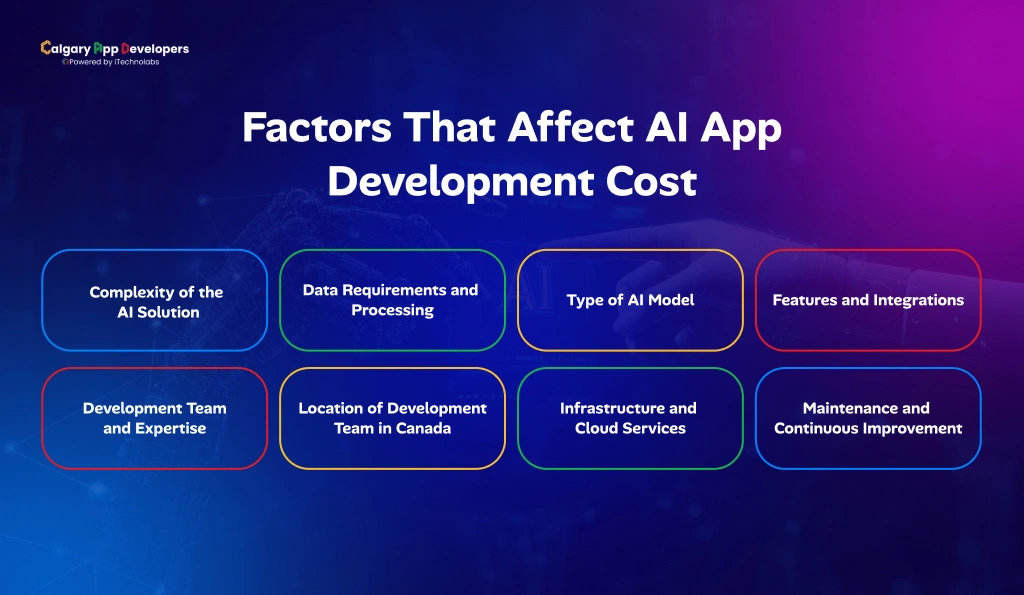
The cost of building an AI app in Canada is influenced by multiple variables that go beyond basic development. Each decision, from the type of AI model to the location of your development team, directly impacts the final budget. Understanding these factors helps in planning accurately and avoiding unexpected expenses.
- Complexity of the AI Solution
The level of intelligence and functionality you want to build plays a major role in cost.
- Basic AI features, such as chatbots or rule-based automation, require lower investment.
- Mid-level solutions with predictive analytics or recommendation engines require more data and training.
- Advanced AI systems, such as computer vision, deep learning, or real-time decision engines, significantly increase costs.
Higher complexity means more development time, specialized talent, and computational resources.
- Data Requirements and Processing
AI systems rely heavily on data, and managing that data can be one of the most expensive parts of the project.
- Large datasets increase storage, processing, and infrastructure costs.
- Data cleaning, labeling, and annotation require time and skilled resources.
- Real-time data processing adds to infrastructure and engineering complexity.
- Compliance with data privacy laws in Canada may require additional investment.
Poor quality data can lead to higher long-term costs due to rework and model inefficiencies.
- Type of AI Model
The choice between pre-trained models and custom-built models significantly affects cost.
| Model Type | Cost Impact (CAD) | Description |
| Pre-trained Models | Lower | Faster implementation using existing AI services |
| Fine-tuned Models | Medium | Customization of existing models for better accuracy |
| Custom AI Models | High | Built from scratch for specific business needs |
Custom models offer better control and performance but require higher investment in training and expertise.
- Features and Integrations
The number and complexity of features directly influence development effort.
- Integration with third-party APIs, CRMs, or enterprise systems increases cost.
- Real-time analytics, dashboards, and personalization features require additional engineering.
- Multi-platform support across web and mobile adds to the development scope.
- Security features such as encryption and compliance layers increase implementation effort.
Feature-rich applications require more time, testing, and maintenance.
- Development Team and Expertise
The experience and structure of your development team can significantly impact pricing.
- Hiring senior AI engineers, data scientists, and cloud specialists increases hourly rates.
- Larger teams reduce development time but increase overall cost.
- Specialized expertise in NLP, computer vision, or deep learning commands higher pricing.
- Outsourcing vs in-house development also changes cost dynamics.
A skilled team may cost more upfront,t but often reduces long-term risks and rework.
- Location of Development Team in Canada
Development costs vary across major Canadian cities due to differences in talent demand and operational expenses.
| City | Estimated Hourly Rate (CAD) | Key Insight |
| Calgary | 70 – 130 | Growing tech scene with high-quality talent and more competitive rates |
| Toronto | 120 – 200 | Strong tech ecosystem with premium talent rates |
| Vancouver | 110 – 190 | Competitive market with higher operational costs |
| Montreal | 80 – 150 | AI research hub with relatively balanced pricing |
Cities like Calgary are gaining attention for offering a balance between cost and expertise, making them an attractive option for businesses looking to optimize budgets without compromising on quality.
- Infrastructure and Cloud Services
AI applications require robust infrastructure for training, deployment, and scaling.
- Cloud platforms such as AWS, Azure, and Google Cloud charge based on usage.
- GPU and high-performance computing resources increase operational costs.
- Data storage, APIs, and real-time processing add to monthly expenses.
- Scaling infrastructure for high user demand requires additional investment.
Infrastructure costs are ongoing and should be planned beyond initial development.
- Maintenance and Continuous Improvement
AI apps require regular updates to maintain performance and relevance.
- Model retraining with new data increases long-term costs.
- Monitoring systems and analytics tools require ongoing investment.
- Bug fixes, feature updates, and performance optimization add to maintenance expenses.
- Scaling the app as user demand grows impacts infrastructure and development costs.
Unlike traditional apps, AI systems evolve continuously, which makes maintenance a critical cost factor.
A clear understanding of these factors allows businesses to make informed decisions, prioritize features, and allocate budgets effectively. The most successful AI projects are those that balance innovation with practical cost management.
Also Read: How to Hire AI Developer: A Complete Guide
How to Choose the Right AI App Development Company in Canada
Selecting the right partner is one of the most critical decisions when building an AI app. The capabilities, experience, and approach of your development company will directly impact the quality, scalability, and long-term success of your solution. Choosing an expert AI development company in Canada requires careful evaluation beyond just pricing.
- Evaluate Proven AI Expertise
Not every development company has true AI capabilities. Look for teams with hands-on experience in building and deploying AI solutions.
- Check their portfolio for real AI projects across industries.
- Assess expertise in machine learning, NLP, computer vision, or predictive analytics.
- Review case studies that demonstrate measurable business outcomes.
- Ensure they understand both technical and business aspects of AI.
A company with proven expertise can guide you from strategy to execution with confidence.
- Understand Their Development Approach
A structured and transparent development process is essential for delivering consistent results.
- Look for a clear roadmap that includes planning, data handling, model development, and deployment.
- Ensure they follow agile or iterative methodologies for flexibility.
- Check how they handle testing, validation, and performance optimization.
- Evaluate their approach to scaling and future enhancements.
A well-defined process reduces risks and keeps the project aligned with your goals.
- Assess Data Handling and Security Practices
AI applications rely heavily on data, making security and compliance a top priority.
- Verify how they collect, store, and process sensitive data.
- Ensure compliance with Canadian data privacy regulations.
- Ask about encryption, access control, and data governance policies.
- Check their experience in handling large and complex datasets.
Strong data practices are essential for building trust and avoiding legal issues.
- Check Technology Stack and Innovation Capability
The right technology choices determine the performance and scalability of your AI app.
- Evaluate their expertise with modern AI frameworks and cloud platforms.
- Check if they use scalable architectures that support growth.
- Ensure they stay updated with the latest AI trends and tools.
- Look for the ability to customize solutions rather than relying only on generic models.
Innovation combined with practical implementation is key to building competitive AI products.
- Review Communication and Collaboration
Effective communication ensures smooth execution and timely delivery.
- Assess how they manage project updates and reporting.
- Check responsiveness and clarity in communication.
- Look for collaborative tools and regular feedback loops.
- Ensure they understand your business requirements clearly.
A collaborative approach leads to better alignment and fewer misunderstandings.
- Evaluate Post-Launch Support and Maintenance
AI apps require continuous monitoring and improvement even after deployment.
- Check if they offer ongoing support, maintenance, and model retraining.
- Ask about performance monitoring and optimization services.
- Ensure they can scale your app as your user base grows.
- Look for long-term partnership capabilities rather than one-time delivery.
Reliable post-launch support ensures your AI app remains effective and up to date.
- Look for a Balance Between Cost and Value
While cost is an important factor, it should not be the only deciding element.
- Compare pricing with the level of expertise and services offered.
- Avoid choosing purely based on low cost, as it may lead to compromises in quality.
- Focus on long-term value, scalability, and reliability.
- Consider the return on investment your AI app is expected to deliver.
A strategic investment in the right partner often results in better outcomes and lower long-term costs.
A Practical Perspective
Many businesses today are choosing companies that combine technical depth with real project experience. Partnering with an expert AI development company in Canada, like Calgary App Developer, can build a strong reputation by delivering scalable AI solutions across industries, focusing on both innovation and business impact.
The right development partner should not just build your app but also help you shape your AI strategy, avoid common pitfalls, and ensure long-term success in a competitive market.
Also Read: Top AI Companies in Canada
Challenges in AI App Development
Building a reliable AI app involves navigating several practical and technical challenges. Each stage of development introduces complexities that can impact performance, cost, and long-term scalability if not addressed properly.
- Data Availability and Quality: AI models rely on large volumes of accurate and relevant data, but accessing such datasets is often difficult. Incomplete, unstructured, or biased data can reduce model accuracy and lead to unreliable outcomes, requiring extensive preprocessing and validation efforts.
- High Development and Infrastructure Costs: AI development demands significant investment in skilled talent, advanced tools, and computing infrastructure. Training models, managing cloud resources, and maintaining performance over time can quickly increase costs, especially for complex or large-scale applications.
- Complexity of AI Models: Designing and training AI models requires deep technical expertise and continuous experimentation. Selecting the right algorithms, tuning performance, and ensuring consistency across different scenarios can be challenging, particularly for applications involving real-time decision making.
- Integration with Existing Systems: Integrating AI into existing business systems can be complex, especially when dealing with legacy infrastructure. Ensuring smooth data flow, maintaining performance, and avoiding disruptions requires careful planning and strong technical architecture.
- Data Privacy and Regulatory Compliance: AI applications must comply with strict data protection regulations in Canada. Managing sensitive user data, ensuring secure processing, and maintaining transparency in AI decisions require robust compliance frameworks and ongoing monitoring.
- Model Maintenance and Performance Drift: AI models can lose accuracy over time as data patterns change. Continuous monitoring, retraining, and updating are required to maintain performance, which adds to long-term operational complexity and resource requirements.
- Talent Availability and Skill Gap: Hiring experienced AI professionals can be challenging due to high demand and limited availability. Skilled data scientists and AI engineers are essential for building reliable systems, but their scarcity can impact timelines and increase development costs.
AI app development comes with its share of challenges, but each one can be addressed with the right strategy, skilled team, and a clear understanding of the process. Businesses that plan proactively, invest in quality data, and focus on long-term scalability are far better positioned to overcome these hurdles.
Future Trends in AI App Development in Canada
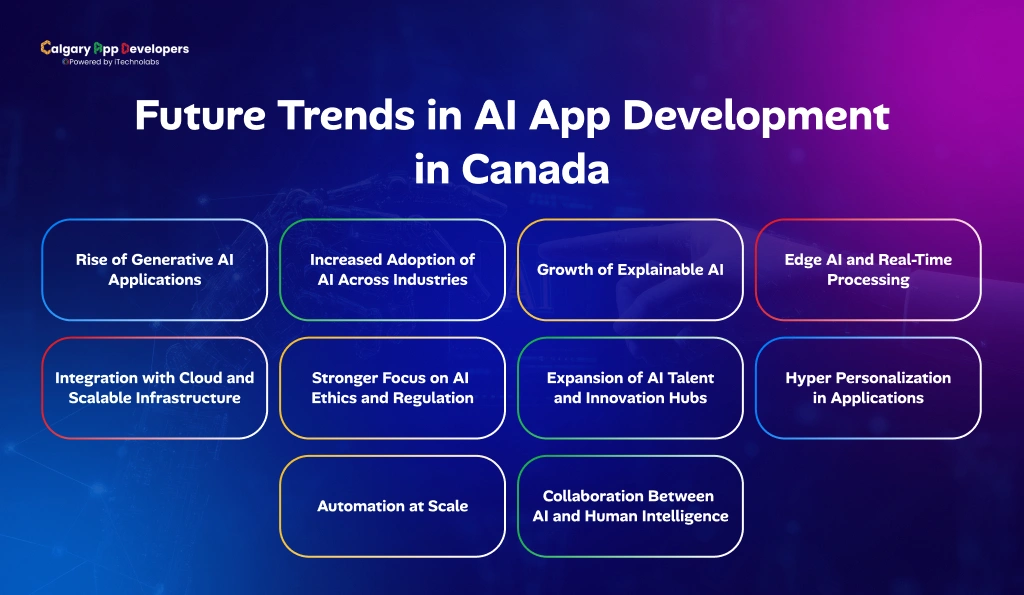
AI app development in Canada is entering a phase of rapid evolution, driven by advancements in technology, increased adoption across industries, and strong institutional support. Businesses investing in an AI app today are not only solving current problems but also positioning themselves for a future shaped by intelligent systems.
- Rise of Generative AI Applications: Generative AI is transforming how applications create content, automate workflows, and enhance user experiences. From text and image generation to code assistance, businesses are increasingly integrating generative capabilities to deliver more dynamic and personalized solutions.
- Increased Adoption of AI Across Industries: AI is expanding beyond tech companies into sectors such as healthcare, finance, retail, and manufacturing. Organizations are embedding AI into core operations, leading to higher demand for specialized applications tailored to industry-specific challenges and workflows.
- Growth of Explainable AI: As AI systems become more complex, there is a growing need for transparency and accountability. Explainable AI focuses on making model decisions understandable, which is especially important in regulated industries where trust, compliance, and ethical considerations are critical.
- Edge AI and Real-Time Processing: AI is moving closer to users through edge computing, enabling faster processing and reduced latency. Applications that require real-time decision making, such as autonomous systems and smart devices, are increasingly leveraging edge-based AI capabilities.
- Integration with Cloud and Scalable Infrastructure: Cloud platforms continue to play a central role in AI development, offering scalable resources for training, deployment, and data management. Businesses are adopting hybrid and multi-cloud strategies to improve flexibility, performance, and cost efficiency.
- Stronger Focus on AI Ethics and Regulation: Canada is actively shaping policies around responsible AI usage. Future AI applications will need to prioritize ethical considerations, data privacy, and compliance, ensuring fairness, transparency, and accountability in automated decision-making systems.
- Expansion of AI Talent and Innovation Hubs: Canada’s AI ecosystem is growing with continued investment in research institutions and talent development. Cities like Toronto, Montreal, and Calgary are becoming key hubs for AI innovation, attracting startups, enterprises, and skilled professionals.
- Hyper Personalization in Applications: AI-driven personalization is becoming more advanced, enabling applications to deliver highly tailored experiences in real time. Businesses are using AI to understand user behavior deeply and provide customized content, recommendations, and interactions.
- Automation at Scale: AI-powered automation is moving beyond basic tasks to more complex decision-making processes. Enterprises are adopting intelligent automation to improve efficiency, reduce operational costs, and enhance productivity across departments.
- Collaboration Between AI and Human Intelligence: Future AI applications will focus on augmenting human capabilities rather than replacing them. Systems will be designed to support decision-making, improve accuracy, and enhance productivity while keeping human oversight at the center.
AI app development in Canada is set to become more sophisticated, accessible, and impactful. Businesses that align with these trends will be better equipped to build innovative solutions that remain competitive in an increasingly AI-driven landscape.
Also Check: AI Integration Calgary Services: Smarter Business Solutions
Our Proven Expertise in AI Development
Our experience in building AI solutions is rooted in solving real business challenges with practical, scalable technology. As a professional AI development company in Canada, Calgary App Developer focuses on delivering AI applications that combine innovation with measurable outcomes. Our work reflects a deep understanding of data, models, and user experience, ensuring every solution is both intelligent and usable.
1. AI Splasher
Text to Image Generation Platform
AI Splasher is a powerful text-to-image generation solution designed to transform creative ideas into high-quality visuals within seconds. Built using advanced generative AI models, the platform enables users to create unique images based on simple text prompts.
- Converts textual input into visually rich and detailed images.
- Supports a wide range of styles, themes, and creative variations.
- Optimized for speed and scalability to handle multiple requests efficiently.
- Designed with an intuitive interface for seamless user interaction.
- Useful for marketing, design, content creation, and branding needs.
AI Splasher demonstrates our capability to work with complex generative AI models while maintaining performance, usability, and creative flexibility.
2. TBIO
AI-Powered Chatbot Solution
TBIO is an intelligent AI chatbot designed to automate conversations, enhance customer engagement, and streamline support processes. It leverages natural language processing to understand user intent and deliver accurate, context-aware responses.
- Handles real-time conversations with high accuracy and contextual understanding.
- Integrates with websites, mobile apps, and customer support systems.
- Learns continuously from interactions to improve response quality.
- Supports multiple industries, including healthcare, fintech, and ecommerce.
- Reduces operational workload while improving customer experience.
TBIO highlights our expertise in building conversational AI systems that are reliable, scalable, and aligned with business goals.
Conclusion
Building an AI app in Canada is a strategic investment that goes beyond adopting new technology. It requires a clear understanding of your business goals, the right development approach, and a strong focus on scalability and long-term value. With a growing AI ecosystem, access to skilled talent, and increasing industry adoption, Canada offers a solid foundation for innovation.
From defining the right use case to managing costs, selecting the right development partner, and overcoming technical challenges, every step plays a critical role in the success of your AI application. Businesses that approach AI with clarity, planning, and the right expertise are far more likely to achieve meaningful outcomes.
With proven experience in delivering AI solutions across industries, Calgary App Developer stands out as a trusted AI app development company, helping businesses bridge the gap between complex technology and real business impact. The right strategy, combined with expert execution, can turn your AI vision into a high-performing, future-ready application.
FAQs
- How long does it take to build an AI app in Canada?
The timeline for building an AI app in Canada typically ranges from three to nine months, depending on complexity, data availability, and feature requirements. Simple applications with pre-trained models can be developed faster, while advanced solutions involving custom models, integrations, and scalability requirements take longer due to training, testing, and optimization phases.
- What is the average cost of developing an AI app in Canada?
The cost of developing an AI app in Canada usually falls between CAD 70,000 and CAD 300,000 or more. Basic applications with limited AI features are more affordable, while advanced solutions with custom models, large datasets, and real-time processing require higher investment due to increased development effort and infrastructure costs.
- What industries benefit the most from AI applications?
AI applications are widely used across industries such as healthcare, finance, retail, logistics, and manufacturing. These sectors benefit from automation, predictive analytics, and data-driven decision-making. Businesses in these industries use AI to improve efficiency, enhance customer experiences, reduce risks, and gain a competitive advantage in rapidly evolving markets.
- Do I need a large dataset to build an AI app?
A large dataset is not always required to build an AI app, but high-quality data is essential. In some cases, pre-trained models or smaller, well-structured datasets can deliver strong results. However, complex applications such as predictive analytics or deep learning systems often require larger datasets to achieve higher accuracy and reliability.
- How do you ensure data security in AI app development?
Data security in AI app development is ensured through encryption, secure data storage, access control mechanisms, and compliance with Canadian data protection regulations. Development teams also implement secure APIs, regular audits, and monitoring systems to prevent breaches, protect sensitive information, and maintain user trust throughout the application lifecycle.
- Can an AI app be scaled after launch?
Yes, an AI app can be scaled after launch by upgrading infrastructure, optimizing models, and integrating additional features. Cloud platforms enable flexible scaling based on user demand, while continuous model training ensures performance improves over time. Proper architecture planning during development makes scaling more efficient and cost-effective.
- How do I choose the right AI development company in Canada?
Choosing the right AI development company in Canada involves evaluating their experience, technical expertise, portfolio, and development approach. It is important to select a team that understands your business goals, offers scalable solutions, and provides ongoing support. A reliable partner ensures better execution, reduced risks, and long-term success.


Pankaj Arora is a seasoned technology leader and the Founder of Calgary App Developer, with 10+ years of expertise in crafting high-performance digital solutions. His core competencies include full-stack app development, cloud-native architecture, API integration, and agile product delivery. Under his leadership, Calgary App Developers has empowered startups and enterprises alike with scalable mobile applications, secure web platforms, and AI-driven SaaS products.