





Custom On Demand App Development Guide 2026
Speed is no longer a feature. It is the baseline. Users expect results the moment they tap a screen, whether they are ordering food, booking a service, or moving money across platforms. That same expectation has shaped how modern on-demand apps succeed or fail.
If you’re a startup entrepreneur, product lead, or entrepreneur interested in the mobile opportunity, you’ve probably wondered, Should we build an on-demand app? Or better yet, how do we build one that actually gets used?
Our perspective on on-demand app development comes directly from building complex, high-trust platforms, especially for on demand & delivery apps. When you work on products where performance, security, scalability, and real-time transactions are non-negotiable, you learn quickly what actually matters in app architecture and user experience. Those lessons translate directly into on-demand platforms.
This blog draws from our hands-on experience in on-demand app development for various industries. We break down how on-demand apps really work, what goes into building them the right way, how to think about features versus complexity, and how to plan budgets and technology without guesswork. Whether you are validating an MVP or preparing to scale a full platform, this guide focuses on practical decisions that lead to apps people actually use.
TL;DR
- On-demand apps meet modern user expectations for instant access, real-time updates, and frictionless service delivery.
- Successful on-demand platforms require careful planning, the right feature set, and scalable technical architecture.
- Starting with a focused MVP reduces risk while allowing room for future growth.
- Real-world development experience plays a critical role in building reliable, high-performing on-demand apps.
Key Points
- On-demand apps connect users and service providers in real time through automated booking, tracking, and payment systems.
- Businesses across industries use on-demand platforms to reduce operational friction, improve customer experience, and scale efficiently.
- A structured development process, from problem definition to post-launch optimization, increases the chances of long-term success.
- Development costs vary based on features, platforms, and complexity, making early planning essential for budget control.
- MVP-first development helps validate demand, gather user insights, and prioritize features that deliver real value.
What Is an On-Demand App?
An on-demand app matches users and goods or services in an instant, straight from the phone. Uber, DoorDash, Airbnb, or even that one app that makes you arrange doctor appointments, to name a few. These apps are an intermediary between users who want something in the moment and service providers who are ready to offer it.
The on-demand mobile app development space is about being convenient, fast, and customized. Shoppers are able to get rides, food, service, and reservations as needed, and organizations have a more efficient, smarter way to connect with consumers.
Most on-demand apps have three sides:
- User App: Where customers browse, order, and pay.
- Provider App: Where service providers accept requests and deliver the service.
- Admin Panel: Where companies deal with users, providers, payments, and analytics.
What’s so powerful about on-demand apps is how they can be suited to just about any industry—healthcare, logistics, beauty, home services, pet care, and bespoke gifting. If there’s demand, there’s room for an on-demand solution.
Also Read: How to Create a Food Delivery App
Common Business Problems in Service-Based Industries
Businesses that rely on manual bookings, phone calls, or fragmented tools face the same challenges again and again. As customer expectations shift toward instant access and transparency, these problems become harder to ignore.
- Slow and Inefficient Booking Processes: Many businesses still depend on calls, emails, or WhatsApp messages to manage bookings. This creates delays, missed requests, and inconsistent customer experiences. When users cannot book instantly, they often move on to competitors that offer faster access.
- Poor Demand Visibility: Without real-time data, businesses struggle to understand when and where demand is coming from. This leads to overstaffing during slow periods and underdelivery during peak hours, directly impacting revenue and customer satisfaction.
- Manual Operations and Human Error: Scheduling, billing, and provider assignment handled manually increase the risk of mistakes. Double bookings, incorrect pricing, and delayed payments not only frustrate customers but also drain internal resources.
- Limited Scalability: Traditional service models do not scale easily. Expanding to new locations or handling higher demand often requires more staff, more coordination, and higher overhead. Growth becomes expensive and difficult to manage.
- Inconsistent Service Quality: When service delivery is not standardized or tracked, quality varies from provider to provider. Businesses lack clear visibility into performance, making it harder to enforce standards or identify issues early.
- Weak Customer Retention: If customers experience delays, lack of updates, or unclear pricing, they are unlikely to return. In competitive markets, even one poor experience can push users toward alternatives.
How an On-Demand App Solves These Challenges
An on-demand application directly addresses these operational and customer experience gaps by replacing manual processes with real-time, automated systems.
- Instant Booking and Faster Access: On-demand apps allow users to discover services, check availability, and book instantly. This removes friction from the customer journey and significantly increases conversion rates.
- Real-Time Demand Management: With live data on bookings, locations, and usage patterns, businesses gain clear visibility into demand. This enables smarter resource allocation, better scheduling, and improved service coverage during peak hours.
- Automation Across Operations: On-demand platforms automate provider assignment, payments, notifications, and status updates. Fewer manual steps mean fewer errors, faster service delivery, and lower operational costs.
- Built-In Scalability: Once the platform is live, adding new service providers or expanding to new regions becomes a system-level change, not an operational headache. Businesses can grow without increasing overhead at the same rate.
- Quality Control and Transparency: Ratings, reviews, and performance tracking create accountability on both sides. Businesses can identify top-performing providers, address issues early, and maintain consistent service standards.
- Stronger Customer Retention: Clear pricing, real-time updates, and reliable service experiences build trust. When customers know they can get what they need quickly and easily, they return more often and recommend the platform to others.
An on-demand application is not just a convenience layer. It becomes the operating system of the business, connecting demand, supply, payments, and data in one place and enabling companies to compete in a market where speed and reliability are no longer optional.
Popular On-Demand App Categories by Industry
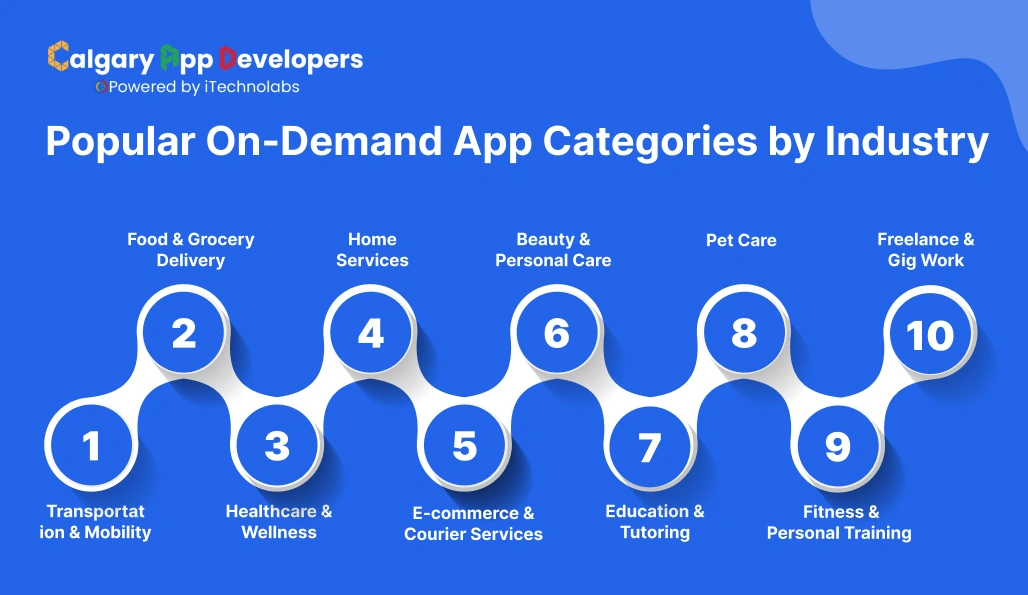
The goal of on-demand app development is simple: reduce friction between people and the services or products they need. But how that plays out varies by industry. Let’s explore further how different industries are using on-demand technology to serve customers better and grow faster.
1. Transportation & Mobility
This was the playing field where the on-demand model went into full sprint. Ridesharing apps like Uber and Lyft have fundamentally shifted people’s perception of obtaining rides; they don’t just create a more viable method of transportation.
Urban customers would expect real-time vehicle tracking, route optimization, driver feedback, and cashless payments all the way. The bike rentals and carpooling options form transit solutions for rural markets.
Business effect: Transport apps create enormous daily usage and are dependent on logistics, mapping, and price-setting based on demand. White-label app solutions now enable smaller businesses to enter niche markets—such as women-only ride services or EV taxi start-ups.
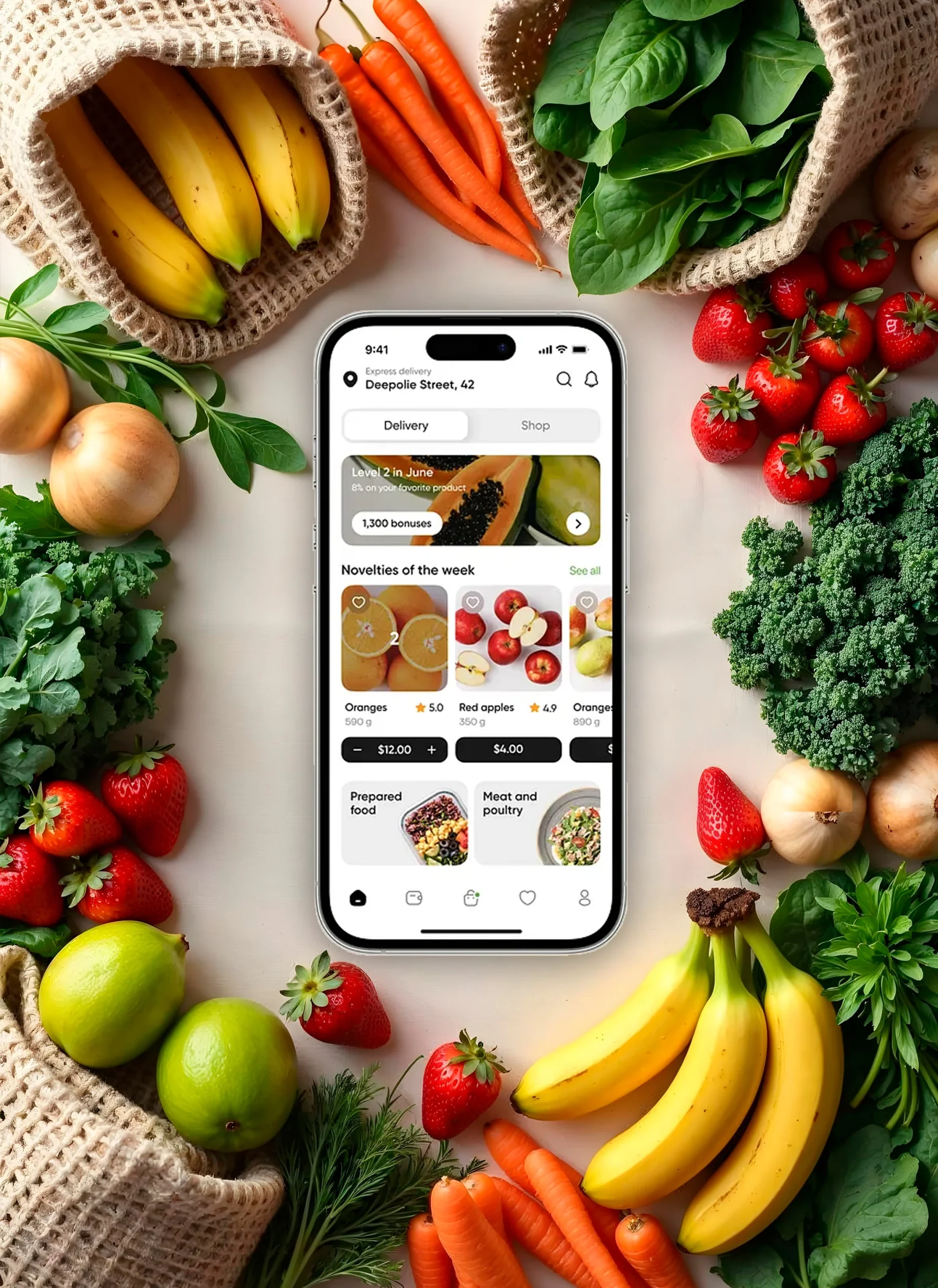
2. Food & Grocery Delivery
The luxury of ordering a meal or weekly shopping from your living room isn’t a luxury—it’s a habit now. Postmates, DoorDash, and Instacart normalized the expectation of 30-60 minute delivery.
Today’s food delivery apps provide:
- Real-time tracking of orders
- Personalized restaurant or product recommendations
- Subscription-based delivery passes
- In-app discounts and loyalty rewards
For companies, this model generates revenue in the form of delivery fees, partnerships, and surge pricing for rush hours. Restaurants and grocery chains are now opting to invest in bespoke on-demand app development to steer clear of paying third-party commissions.
3. Healthcare & Wellness
Medical care accessibility is being transformed by apps that enable users to consult physicians, schedule tests, and even have prescriptions delivered without stepping into a clinic.
Examples: Teladoc Health, Zocdoc, Babylon Health, Ada Health
Such apps typically feature:
- Video or voice consultation with qualified experts
- Electronic health records
- Online scheduling
- Emergency service requests
Wellness apps have taken the model even further—providing yoga sessions, mental therapy, diet guidance, and so on.
Why this is significant is that the healthcare industry is helped by on-demand apps, which decrease waiting times, enhance access in rural locations, and enhance health services to be proactive and more user-friendly.
4. Home Services
Picture hiring a cleaner, plumber, carpenter, or electrician with a single tap. That’s precisely what apps such as Urban Company or TaskRabbit offer.
These platforms provide:
- Confirmed service professionals
- Transparent prices
- Scheduling and cancellations via the app
- Service monitoring and support
On-demand home service apps are particularly attractive to urban professionals and busy families. Providers find them to open a steady stream of leads and bookings without word-of-mouth or classifieds.
5. E-commerce & Courier Services
Customers demand quick delivery. Customers demand delivery, not in three days, but today. This is why e-commerce businesses like Glovo, Gopuff, and Rappi are going all-in for hyperlocal logistics and same-day delivery.
On-demand courier apps enable users to:
- Book immediate pickups and deliveries
- Track packages in real time.
- Digitally view proof of delivery
- Utilize smart routing for multiple drops
From sending documents across town to managing bulk e-commerce shipments, on-demand logistics apps give individuals and small businesses the power to move goods fast.
6. Beauty & Personal Care
Why visit a salon when the salon visits you? On-demand beauty apps such as StyleSeat, Priv, and BeYou deliver personal care to your doorstep—be it a haircut, massage, waxing, or spa treatment.
They usually provide:
- Service menus along with prices
- Appointment booking
- Background-checked professionals
- Ratings and reviews
For freelancers and salons, these apps create a new source of revenue with low overhead. For consumers, it’s saving time and getting services at home.
7. Education & Tutoring
When you want to study, you don’t need to plan weeks in advance anymore. You can use an on-demand education app to connect you to a tutor in real-time—great for test prep, last-minute help with homework, or ongoing educational help.
Examples: Chegg Tutors and Cambly.
Common features include:
- Video one-on-ones
- Subject-specific search filters
- Instant scheduling
- Whiteboards or file transfer within the app
Some sites even provide 24/7 homework assistance or peer-to-peer tutoring. Educators have an opportunity to make money using their abilities without becoming part of a conventional institution.
8. Pet Care
Pet owners are utilizing on-demand applications like Rover, Wag!, and PetBacker for everything from walks and grooming to boarding and visits to the vet. With an increasing number of people considering pets family members, demand for quick, reliable care is only expanding.
Pet care applications typically feature:
- Verified walkers or caregivers
- Pet health monitoring
- Emergency booking capabilities
- Live GPS tracking for walks or transport
The pet market is growing, and on-demand app creation levels the playing field for local operators versus national chains and fosters loyalty with pet parents.
9. Fitness & Personal Training
You no longer need a gym membership to get a workout plan or a personal trainer. Fitness apps bring routines, coaching, and classes directly to your device.
Examples: FitOn, Freeletics, Myfitnesspal, and SWEAT
Core features:
- On-demand workout videos
- Personalized fitness plans
- Live coaching or one-on-one training
- Progress tracking
On-demand fitness apps enable people to train anytime, anywhere—breaking down barriers around cost, time, and access.
10. Freelance & Gig Work
Platforms like Upwork, Fiverr, Toptal, and PeoplePerHour connect skilled freelancers with real-time job opportunities in design, writing, coding, and more.
Core features:
- Job bidding or instant booking
- Profile verification and reviews
- In-app messaging and file sharing
- Payment protection and milestone tracking
Freelancers gain access to global clients, while businesses find skilled professionals fast—without hiring full-time staff.
Suggested: Top-Rated Custom App Development Agency, Calgary
How On-Demand Apps Work
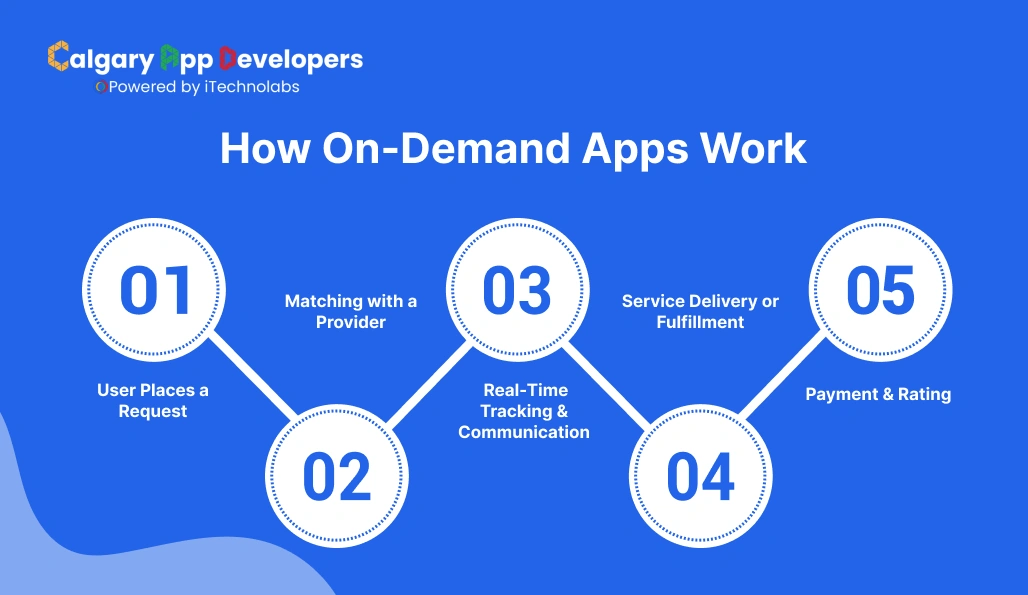
Here’s how it goes: someone needs a service—fast. They open an app, tap a few buttons, and get what they need delivered, scheduled, or confirmed within minutes.
The amazing thing about on-demand app development is that we are connecting users and service providers in real-time with a nice, clean experience with the help of amazing technology.
Let’s break down how this process actually works behind the scenes:
- User Places a Request
It begins with a requirement. The user opens the app, navigates through services or products, and issues a request—whether it’s taking a ride, ordering food, or securing a professional.
The app collects key info like:
- Type of service
- Location
- Preferred time
- Mode of payment
The request is then pushed into the system to match.
- Matching with a Provider
This is the place where all the real-time magic happens. Upon all factors such as proximity, availability, and past performance, the app applies algorithms to link the request with the most competent service provider.
In seconds, the provider is notified and given the option to accept or reject the request.
- Real-Time Tracking & Communication
Once the request has been accepted, the user is updated in real time. GPS tracking indicates where the provider is, how long they will be, and when they will arrive.
Many of these on-demand apps also provide:
- In-app calling or chat
- Status updates (on the way, started, completed)
- Push notifications
This keeps the user updated at each step.
- Service Delivery or Fulfillment
The service is rendered-whether it be delivery of food, home repairs or taxi transport. Providers and users can all mark the status as in progress or completed.
Some apps include the ability to add photos, obtain customer approval, or check off a checklist for quality control.
- Payment & Rating
When the service has been fulfilled, the user automatically gets charged by the selected mode of payment, whether it be UPI, card payment, wallet, or cash (whatever is supported).
Then there’s the feedback loop:
- Users rate the provider
- Providers can rate the user
- It’s this rating system that ensures quality and reliability at both ends.
The Tech Behind It
To make all this seamless, on-demand app development relies on several core technologies:
- Real-time GPS and mapping for location tracking
- Push notifications for status updates
- Secure payment gateways for transactions
- Matching algorithms to pair users with the right providers
- Admin dashboards for managing everything behind the scenes
Read Also: AI App Development: Build Intelligent Solutions
Why On-Demand Apps Are Good for Business
Let’s be real—people don’t want to wait, call, or chase down service providers anymore. They want things now. And that’s exactly why on-demand app development has become a smart move for businesses.
Whether you are a startup or an established business, an on-demand app is a true pathway to growth, reduced waste, and service for your customer.
Here’s how it pays off:
- Faster, Easier Customer Acquisition
Your service is at their fingertips 24/7 with an on-demand app in the customer’s pocket. No forms, no phone calls, no waiting.
That kind of convenience makes it simple to acquire new users—and more likely they’ll remain.
Example: A salon that introduces home service through an app experiences an increase in bookings from working professionals who don’t have enough time to come.
- Real-Time Service Delivery
On-demand apps do away with hassle and minimize waiting time. Be it ride-hailing, food delivery, or cleaning the house, services can be provided quicker, live-tracked, and instantly updated.
This not only enhances customer satisfaction—it establishes trust and reliability.
- Scalable Business Model
Once launched and deployed, scaling isn’t about hiring hundreds of people. You can activate more service providers or delivery partners and as much logistics as you can automate, city by city.
Just like a business that can grow without the aching pains of growth, an on-demand app allows you to do this too.
- Automated Payments and Transactions
No chasing for invoices and managing cash. On-demand apps are usually deployed with payment systems that automatically bill, refund, minus taxes, or tip.
This saves time, cuts down on errors, and gives your business a consistent cash flow.
- Data-Driven Decisions
Every interaction on your app generates data:
- What services are most popular
- When users are most active
- Where demand is coming from
- Which providers perform best
Data changes everything. You can use the data and information from on-demand apps to improve services, change prices, and enhance experiences. Without an app, it’s just an experience without sight.
- Higher Customer Retention
Convenience is sticky. Once your customers enjoy how easy it is to engage with your app, they will be more likely to repeat business, refer new customers, and be lifelong customers.
Loyalty programs, push notifications, and in-app rewards also help bring them back—without spending more on ads.
- Competitive Advantage
If your competitors aren’t offering real-time service, on-demand booking, or mobile convenience—you win. If they are, then building a better, faster, more reliable app becomes your advantage.
Either way, not having an app in industries that rely on instant access is a missed opportunity.
Also Check: Top 10 Business Mobile App Features to Scale Your Business
Step-by-Step: The On-Demand App Development Process
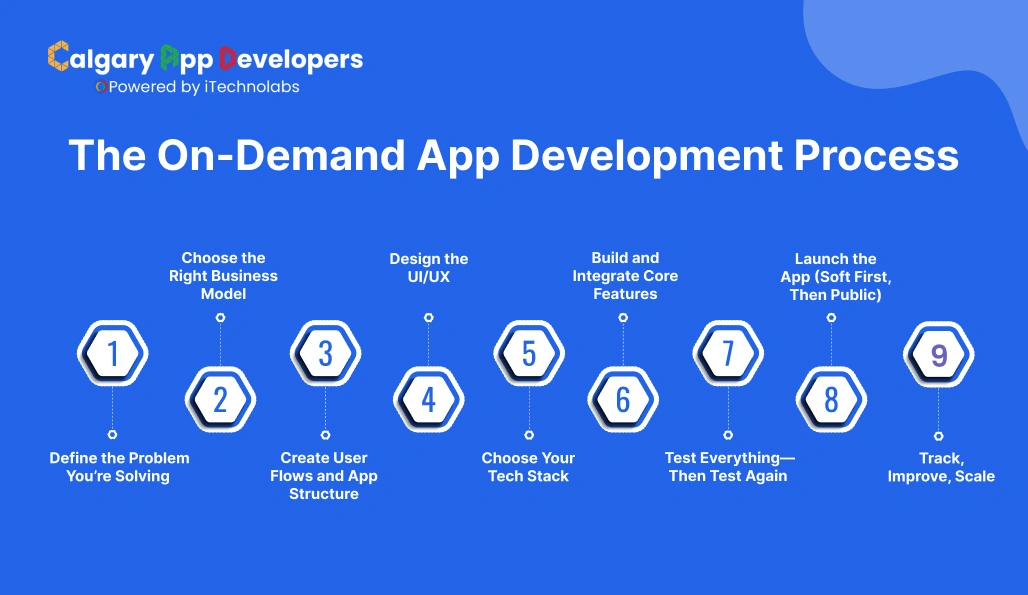
Building an on-demand app is not just writing code and dropping it in the app store. It’s a systematic procedure that constitutes research and design, development, testing, and scaling. Here’s the stepwise procedure if you want to create an on-demand app.
- Define the Problem You’re Solving
All successful on-demand applications must solve a problem for a defined group of people. Before you write a line of code, you need to understand:
- Who your users are
- What pain points they have
- How your app will make their life easier
Example: Urban Company solved the problem of unreliable home service providers by making it easy to book trusted professionals with upfront pricing.
- Choose the Right Business Model
Your revenue model should align with how people use your app. Common models include:
- Commission per transaction
- Subscription plans
- Surge or dynamic pricing
- Freemium access with paid upgrades
This choice will influence your app’s architecture and monetization strategy.
- Create User Flows and App Structure
Think about how users will move through your app. You’ll likely need three interfaces:
- User app: For booking and payments
- Service provider app: For accepting jobs and managing work
- Admin panel: For tracking activity, managing users, and handling payouts
Sketch out key flows like onboarding, browsing, checkout, and reviews.
- Design the UI/UX
This is where your app starts taking shape visually. The goal? Keep it clean, intuitive, and fast.
Your users should be able to:
- Find services easily
- Place a request in under 60 seconds
- See updates in real time
Design wireframes first, then build high-fidelity mockups before moving into development.
- Choose Your Tech Stack
What you build with your technology stack will determine performance, scale, and maintainability. A common on-demand application contains:
- Frontend: React Native, Flutter, or Swift/Kotlin for native apps
- Backend: Node.js, Ruby on Rails, or Django
- Database: PostgreSQL, MongoDB, or Firebase
- APIs: Maps (Google Maps), Payments (Stripe, Razorpay), Notifications (Firebase Cloud Messaging)
Choose tools based on your budget, timeline, and expected user load.
- Build and Integrate Core Features
Start with the must-haves:
- User registration/login
- Service listings and filters
- Real-time GPS tracking
- In-app chat or support
- Payment gateway integration
- Ratings and reviews
This forms your MVP (minimum viable product)—enough to launch, test, and iterate.
- Test Everything—Then Test Again
Test thoroughly before launch:
- Functional testing (does it work?)
- Usability testing (is it user-friendly?)
- Performance testing (does it scale?)
- Security testing (is data secure?)
Squash bugs early so your users don’t do it for you.
- Launch the App (Soft First, Then Public)
Soft launch in one region or with a limited audience first. Watch usage, gather feedback, and fix quickly.
Once stable, go public—listing on the App Store and Google Play and running launch campaigns to drive traffic.
- Track, Improve, Scale
Post-launch, use analytics to track:
- Active users
- Drop-off points
- Conversion rates
- Provider performance
Continue to upgrade and develop your app from your reports from users. Also, as your user base grows, you will most likely be optimizing your infrastructure, adding features, and considering new locations and markets.
On-demand app development is a marathon, not a sprint. However, when done right—with the planning, team, and execution actually done—you will not launch an app; you will create a system that runs your business, serves users in real-time, and grows with you.
Read Also: Top Mobile App Trends Shaping the Future of Technology
How Much Does It Cost to Build an On-Demand App?
You can get a working, user-facing on-demand app for $8,000 to $25,000 if you are just launching with a minimal MVP and a very small feature list. If you want a higher-end, full-featured app—think live tracking, bespoke UI, and multi-role permission—you could see enterprise estimates from $30,000 to $50,000 based on the complexity and the talent to define a meaningful MVP.
Here’s a rough breakdown to give you a clearer picture:
Cost Estimation Table for On-Demand App Development
| Component | Estimated Cost Range |
| UI/UX Design | $1,000 – $3,000 |
| User App (iOS or Android) | $4,000 – $10,000 |
| Service Provider App | $3,000 – $8,000 |
| Backend Development | $4,000 – $10,000 |
| Admin Dashboard | $1,000 – $4,000 |
| API Integration (Maps, Payments) | $500 – $2,000 |
| QA Testing & Deployment | $1,000 – $3,000 |
| Total (Basic to Advanced) | $8,000 – $25,000+ |
What Affects the Cost of On-Demand App Development?
Let’s walk through the key factors that influence how much your app will actually cost—and why they matter.
- Features and Functionality
This is the biggest cost driver alone.
A lightweight app with login, booking, payment, and ratings is cheaper (and therefore cheaper) to build than a feature-rich one with:
- Live tracking
- In-app messaging
- Sophisticated filters
- Multi-step processes
- Loyalty schemes
Begin with the key features your users require, not all they may want. You can always add the rest later.
- Number of User Roles
Most on-demand platforms have two or more roles:
- Customer (user app)
- Service provider (vendor or partner app)
Some businesses also need:
- Admin dashboard to manage operations
- Manager roles with higher control
The larger the number of roles you create, the more screens, logic, and backend infrastructure you’ll require—increasing development time and cost.
- Platform Choice: Android, iOS, or Both?
Developing for one platform is quicker and cheaper.
If the budget is very tight, begin with Android only (very popular in most markets) or iOS (if your intended audience is more high-end).
Want to support both? Use cross-platform such as Flutter or React Native. They allow you to code once and deploy on both platforms, saving 30–40% in development time and expense.
- Backend Development and APIs
Your app isn’t a simple front-end UI—it requires a robust backend to manage:
- Real-time service pairing
- Notifications
- Payments
- Order tracking
- User management
- Storage of data
The larger the amount of data your app handles and the quicker it must react, the more effort is put into designing a scalable backend.
Also, supporting third-party APIs (such as Google Maps or PayPal) requires effort and might have usage charges. These are minor expenses but are compounded.
- Development Team Location
The location of your team has a massive effect on costs. Here’s a rough estimate of hourly rates:
| Region | Avg Hourly Rate (USD) |
| US/Canada | $100 – $200/hr |
| Western Europe | $70 – $150/hr |
| Eastern Europe | $30 – $60/hr |
| India/South Asia | $20 – $40/hr |
While you can often get lower development costs in regions like India and Eastern Europe, there’s more to consider than just hourly rates. If you’re looking for a balance between quality, collaboration, and long-term value, Canada—especially Calgary—could be the better choice.
Calgary offers the best of both worlds: top-tier development talent and a growing tech ecosystem, but without the inflated costs of cities like Toronto or Vancouver.
Teams here work in your time zone, communicate clearly, and operate in a business environment built on transparency and trust.
For North American startups or enterprises looking for reliable on-demand app development solutions, a Calgary-based company offers strategic alignment, stronger IP protection, and smoother collaboration—making it a smart investment, not just a line item.
- Maintenance and Post-Launch Costs
It takes more than just an app launch. You’ll have ongoing:
- Bug fixes
- Feature updates
- Server monitoring
- User support tools
Most companies invest approximately 15–20% of the initial app price annually on maintenance. Therefore, if your MVP is $20,000, be prepared to pay $3,000–$4,000 per year to maintain it in top form.
Also Read: Top Features to Include in Your Next App Platform Calgary Project
Essential MVP Features to Include in On Demand App Development
When developing an on-demand app, the most intelligent thing to do is go lean. Your Minimum Viable Product (MVP) should incorporate the essential features that allow users to accomplish the fundamental task—book an appointment, pay for it, and check the outcome.
In on-demand app development, the purpose of an MVP isn’t to wow all the people on day one. It’s to try your idea in the real world, see what happens, learn quickly, and iterate based on what users do—instead of what you assume they might do.
Here’s what your MVP definitely needs to have:
- User Registration and Login
This is step number one, and it has to be fast.
Let users sign up with:
- Email and password
- Mobile number with OTP
- Social logins such as Google or Apple (optional for MVP, but useful)
Make it simple. Nobody wants to complete five screens just to use your app.
- Service Discovery and Search
Your users open your app for one purpose—to discover and book a service. Make that simple.
Your MVP should encompass:
- A simple list of services or categories
- Simple filtering (by location, price, or availability)
- A straightforward search function
Consider how fast a user can reach a particular service from the home screen. Less tap, more joy.
- Booking or Request Functionality
This is the heart of your app. Allow users to:
- Select a service
- Select an available time slot or request it on the spot
- Confirm the request with less input
For real-time services like ride-hailing or food delivery, instant booking is key. For scheduled services like home cleaning, allow users to pick a preferred time.
- Real-Time Status Updates
Even if you’re not building full live tracking yet, users should know:
- When their request is accepted
- When the service is en route or starting
- When it’s completed
Push notifications or in-app status indicators keep users informed without overwhelming them.
- In-App Payments
You want people to pay without friction.
Your MVP should support:
- Credit/debit cards
- UPI or digital wallets (especially important in India and Asia)
- Optionally, cash on delivery
Use secure, widely supported payment gateways like Stripe, Razorpay, or PayPal depending on your market.
- Ratings and Reviews
Once the service is complete, give users the chance to rate their experience and leave feedback.
This helps you:
- Maintain quality across providers
- Build user trust
- Identify weak spots early
For the MVP, a simple 1-to-5 star system with optional comments is enough.
- Basic Admin Panel
You’ll need a backend dashboard to manage:
- User and provider accounts
- Incoming requests and service status
- Payment and order history
Don’t need to be pretty—but must work. Even a minimal internal dashboard makes you aware of what’s going on and interject when necessary.
Must Check: Augmented Reality in Mobile Apps: Trends and Insights
Advanced Features That Add Value To On Demand App Development
Once your MVP is stable and live, then it’s time to build smarter. Advanced features here don’t only make your on-demand app more capable; they make it more competitive, more efficient, and more valuable to users.
These features are what allow you to progress from a core utility to a refined, user-adored product in the development of on-demand apps. These are things that are worth adding as you scale:
- Live GPS Tracking
If location is part of your service—rides, delivery, home visits—live tracking is no longer a nicety.
With GPS added, users can:
- View precisely where their provider or order is
- Receive accurate ETAs
- Feel more in control
This also reduces customer support calls wondering, “Where’s my service?”
- Smart Scheduling and Calendar Sync
Let users schedule services for later—and automatically sync them with Google Calendar, Apple Calendar, or in-app reminders.
Great for:
- Doctors
- Tutors
- Home maintenance
- Beauty appointments
It decreases no-shows and gets your app embedded in their routine.
- In-App Chat or Calling
Users and providers sometimes need to talk—faster.
Including in-app chat or encrypted VoIP calling lets them:
- Verify details
- Clarify requests
- Establish trust without revealing personal contact information
Especially necessary in multi-step services such as home repair or logistics.
- Loyalty Programs and Promo Codes
Provide cash back, referral rewards, or free credits upon repeat usage.
This keeps people coming back and provides a reason for them to return.
Make it:
- Easy to redeem at checkout
- Linked to actual milestones (such as 5 orders or referrals)
- Transparent—users must always know what they’re receiving
- Multi-Language and Multi-Currency Support
If you’re expanding into new regions or serving a diverse audience, localization matters.
Including support for:
- Multiple languages
- Regional currencies
- Local tax and legal adherence
This can unlock whole new markets and make your app feel native wherever it’s used.
- AI-Powered Recommendations
Apply machine learning to recommend services based on:
- Past activity
- Location
- Time of day
- User preferences
This creates a more personalized experience and often leads to higher engagement and conversion.
- Ratings for Both Sides
Allow providers to rate customers as well.
Why? Because it:
- Promotes respectful behavior
- Increases provider retention
- Alerts you to problematic users sooner
This is a feature shared by ride-sharing and freelance marketplaces, but it can be used on most on-demand platforms.
- Advanced Analytics for Admins
A clever admin panel can do better than just show bookings.
With informative dashboards, you’re able to monitor:
- Live demand by location
- Average response times
- Provider performance metrics
- Churn and retention trends
Good data = better decisions.
- Dark Mode and Accessibility Features
These may seem like polish, but they seriously improve user experience.
Dark mode saves battery and reduces eye strain, while accessibility tools, like voice input or larger text, make your app usable for everyone.
- Offline Mode or Poor Network Handling
If your app caters to users in regions with spotty internet (logistics, rural deliveries, and field services come to mind), design for it.
Let users:
- Store bookings offline
- Sync automatically when reconnecting
- Retry failed payments or actions invisibly
This makes your app feel more reliable—even when the network isn’t.
Also Read: On Demand Delivery App Development Guide
Our Proven Experience in On-Demand App Development
Our experience in on-demand app development comes from delivering platforms that operate in real time, handle high transaction volumes, and support multiple user roles without compromising performance or reliability. We approach every project with a clear focus on scalability, operational efficiency, and long-term business value. The following projects highlight how we apply this approach across different on-demand business models.
1. Hitchmail – Real-Time Parcel Delivery Platform
Hitchmail is an on-demand parcel delivery application designed to simplify last-mile logistics by connecting users with nearby delivery partners. The platform enables fast request matching, live tracking, and transparent delivery updates from pickup to drop-off.
Key Features Delivered
- Real-time parcel request creation and driver matching
- Live GPS tracking with accurate delivery status updates
- Dynamic availability management for delivery partners
- Secure in-app payments and transaction handling
- Automated notifications for pickup, transit, and delivery milestones
- Admin dashboard for order monitoring, driver management, and analytics
Business Impact
The platform reduced delivery turnaround times, improved visibility for customers, and enabled couriers to manage requests efficiently. Hitchmail demonstrates our ability to build location-driven, real-time systems that remain reliable under operational pressure.
2. Serve It Local – Online Food Delivery Platform
Serve It Local is an on-demand food delivery solution built to help local restaurants own their digital ordering experience. The platform allows customers to discover nearby restaurants, place orders directly, and track fulfillment without relying on third-party aggregators.
Key Features Delivered
- Restaurant discovery with location-based listings
- Digital menu management and real-time order processing
- Secure checkout with multiple payment options
- Live order status updates for preparation and delivery
- Vendor dashboard for order control, menu updates, and performance tracking
- Admin panel for managing users, vendors, and transactions
Business Impact
Serve It Local enabled restaurants to increase margins, retain customer data, and reduce dependency on commission-heavy marketplaces. The platform strengthened direct customer relationships while providing a smooth and reliable ordering experience.
These projects reflect our ability to design and deliver on-demand applications that balance speed, reliability, and scalability. We understand how real-time systems behave in production, how demand fluctuates, and how to architect platforms that grow without breaking.
We do not just build apps that function at launch. We build on-demand platforms that support day-to-day operations, scale with demand, and create measurable business value over time.
Conclusion
On-demand apps have reshaped how people expect to access services—faster, easier, and right from their phones. Whether you’re planning to build the next food delivery app, launch a home services platform, or streamline internal operations, the opportunity is real. But success depends on more than just a good idea—it comes down to execution.
From MVP features to advanced integrations, every decision you make should be guided by what your users truly need. And that’s where the right on-demand app development solutions make all the difference.
If you’re looking to turn your concept into a fully functional product, partner with an experienced on-demand app development company that understands the tech, the market, and the user mindset. The right team won’t just build your app—they’ll help you launch smarter, scale faster, and compete better.
Build lean. Launch fast. Improve constantly. That’s how winning on-demand platforms are made.
FAQ’s About On Demand App Development
1. What is an on-demand app?
An on-demand app connects users with products or services in real time through a mobile or web platform. Users can request a service, track progress, and make payments instantly. These apps are commonly used for food delivery, transportation, home services, healthcare, and logistics, where speed, convenience, and real-time updates are essential.
2. How long does it take to build an on-demand app?
A basic on-demand app MVP typically takes three to five months to design, develop, and launch. Timelines depend on feature complexity, number of user roles, integrations, and testing requirements. Advanced apps with live tracking, multiple dashboards, and automation may take longer to ensure performance, security, and scalability.
3. How much does it cost to develop an on-demand app?
The cost to build an on-demand app usually ranges from USD 8,000 to 25,000 for an MVP. Feature-rich or enterprise-level platforms can exceed USD 30,000. Pricing depends on functionality, platform choice, backend complexity, third-party integrations, and ongoing maintenance requirements.
4. Which industries benefit most from on-demand apps?
Industries that rely on quick access and service delivery benefit the most. These include food and grocery delivery, transportation, home services, healthcare, logistics, beauty and wellness, fitness, and freelance marketplaces. Any business where speed, convenience, and real-time coordination matter can gain value from an on-demand platform.
5. Can an on-demand app scale as the business grows?
Yes, if it is built with a scalable architecture from the start. A well-designed on-demand app uses cloud infrastructure, modular backend systems, and real-time data handling to support growth. This allows businesses to add users, service providers, and new locations without rebuilding the platform.
6. Do on-demand apps require ongoing maintenance?
Yes. Post-launch maintenance is essential to ensure reliability and performance. This includes bug fixes, security updates, server monitoring, feature enhancements, and compatibility updates. Most businesses allocate 15 to 20 percent of the initial development cost annually to keep the app stable and competitive.


Pankaj Arora is a seasoned technology leader and the Founder of Calgary App Developer, with 10+ years of expertise in crafting high-performance digital solutions. His core competencies include full-stack app development, cloud-native architecture, API integration, and agile product delivery. Under his leadership, Calgary App Developers has empowered startups and enterprises alike with scalable mobile applications, secure web platforms, and AI-driven SaaS products.