











What Is Vibe Coding Cleanup? Benefits & Best Practices

Software development rarely moves in a straight line, and the role of a Vibe Code Cleanup Specialist becomes increasingly important as teams iterate quickly, experiment often, and ship features under tight timelines. In that process, codebases naturally accumulate inconsistencies, shortcuts, and fragments that no longer serve their purpose. This is where Vibe Coding Cleanup becomes essential.
Vibe Coding Cleanup is not just about polishing code or fixing surface-level issues. It is a deliberate effort to bring clarity, structure, and consistency back into a codebase while preserving its original intent. It focuses on improving how code feels to read, understand, and maintain, which directly impacts long-term scalability and team productivity.
This perspective is shaped by real project experience. Across multiple development cycles, we have seen how unmanaged code can slow down delivery, create confusion within teams, and increase the cost of future updates. We have also seen how a focused cleanup approach can reverse that trend, making systems easier to work with and far more resilient.
In this blog, we break down what Vibe Coding Cleanup is, why it matters in modern development, and how teams can apply it effectively through proven practices.
TL;DR
- Vibe Coding Cleanup focuses on improving code clarity, consistency, and structure without changing functionality.
- It helps teams reduce technical debt and maintain scalable, high-quality codebases.
- A structured cleanup process improves development speed, collaboration, and system reliability.
- Regular cleanup ensures long-term efficiency in modern, fast-paced development environments.
Key Points
- Vibe Coding Cleanup is a disciplined approach to refining code so it remains readable, maintainable, and scalable as systems evolve.
- It plays a critical role in modern development by preventing codebase degradation caused by rapid iterations and multiple contributors.
- The process involves assessing the codebase, defining standards, refactoring safely, validating through testing, and integrating cleanup into ongoing workflows.
- Following core principles such as clarity, consistency, and incremental improvement ensures that cleanup efforts deliver lasting value.
- Applying best practices such as cleaning up code during development, prioritizing high-impact areas, and using automated tools helps maintain code quality at scale.
- Real-world implementation of Vibe Coding Cleanup leads to measurable improvements in development speed, performance, and system stability.
- Consistent cleanup reduces technical debt, improves developer experience, and creates a strong foundation for long-term product growth.
What Is Vibe Coding Cleanup
Vibe Coding Cleanup is a structured approach to refining a codebase so it feels clear, consistent, and easy to work with for any developer who interacts with it. It goes beyond fixing bugs or improving performance. The focus is on improving the overall quality and coherence of the code, including naming conventions, structure, readability, and logical flow.
In practical terms, it involves identifying parts of the code that feel confusing, redundant, or inconsistent and then improving them without altering the core functionality. This may include simplifying complex logic, removing unused code, standardizing patterns, and aligning the code with agreed development practices.
Unlike traditional cleanup efforts that are often reactive, Vibe Coding Cleanup is intentional. It considers how developers experience the code during development, debugging, and scaling. The goal is to create a codebase that not only works efficiently but also communicates its purpose clearly.
A well-executed cleanup process ensures that the code remains intuitive over time, even as new features are added. It reduces friction for developers, shortens onboarding time for new team members, and makes future changes more predictable and manageable.
Also Check: Vibe Coding: Smart Guide For Vibe Coding Tools & Platforms
Why Vibe Coding Cleanup Matters in Modern Development
Modern development environments demand speed, flexibility, and constant iteration. While this accelerates product delivery, it often leads to codebases that become harder to manage over time. Vibe Coding Cleanup plays a critical role in maintaining a balance between rapid development and long-term sustainability.
Here are the key reasons why it matters:
- Prevents Codebase Degradation: Frequent updates, quick fixes, and multiple contributors can gradually reduce code quality. Cleanup ensures the codebase does not become cluttered or inconsistent, preserving its integrity as it evolves.
- Supports Faster Development Cycles: Clean, well-structured code helps developers understand existing logic quickly. This reduces the time spent debugging or deciphering old implementations, leading to faster feature development.
- Reduces Technical Debt: Unoptimized and inconsistent code builds up technical debt that slows down future progress. Regular cleanup helps address these issues early, preventing costly rework later.
- Improves Team Collaboration: When code follows consistent patterns and is easy to read, teams collaborate more effectively. Developers can work across modules with confidence, reducing dependency bottlenecks.
- Enhances Scalability: As applications grow, messy code can become a major limitation. Cleanup ensures that the architecture remains adaptable, making it easier to scale features and systems without major disruptions.
- Minimizes Risk During Updates: Well-organized code reduces the chances of introducing errors when making changes. Developers can implement updates with greater confidence and fewer unintended side effects.
- Improves Developer Experience: A clean codebase is easier and more satisfying to work with. It reduces cognitive load, lowers frustration, and helps teams stay focused on solving real problems rather than navigating chaos.
In modern development, where speed often takes priority, Vibe Coding Cleanup ensures that quality is not compromised. It creates a strong foundation that supports both immediate delivery and long-term growth.
Key Benefits of Vibe Coding Cleanup
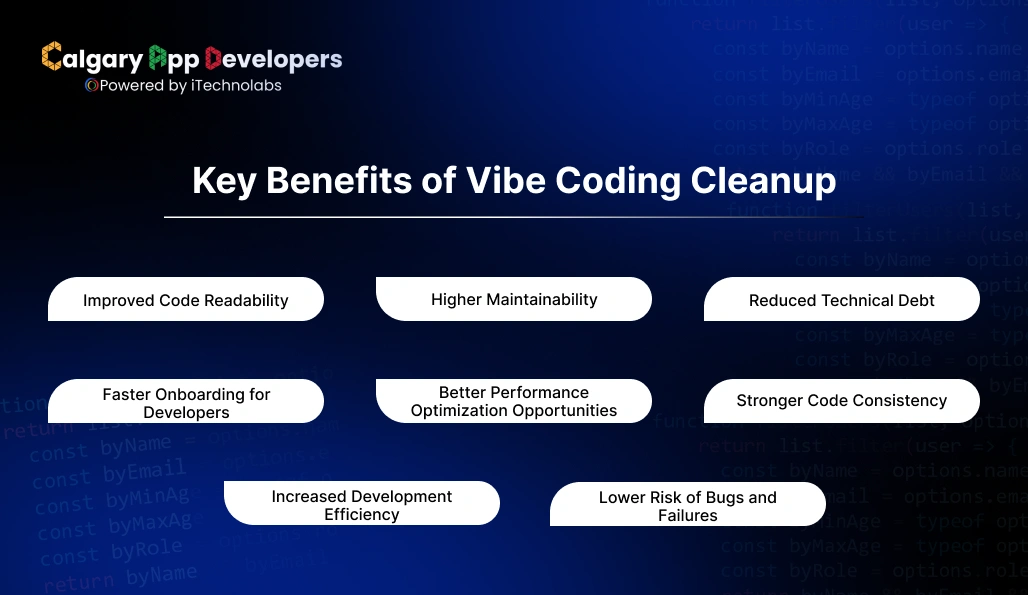
Vibe Coding Cleanup delivers meaningful, long-term advantages that extend far beyond improving how code looks. It directly impacts how efficiently teams build, maintain, and scale software. By focusing on clarity, structure, and consistency, it transforms the codebase into a reliable asset rather than a growing liability.
- Improved Code Readability
Readable code is the foundation of any maintainable system. When naming conventions are clear, logic is simplified, and structure is consistent, developers can understand what the code is doing without spending excessive time interpreting it. This becomes especially valuable during debugging or when revisiting older modules. Clear code reduces mental effort and allows developers to focus on solving problems instead of decoding intent.
- Higher Maintainability
As applications evolve, the ability to modify existing code without introducing instability becomes critical. Vibe Coding Cleanup ensures that the codebase remains flexible and easy to update. Well-organized modules, clear separation of concerns, and consistent patterns make it easier to introduce changes, fix issues, and extend functionality without unintended consequences.
- Reduced Technical Debt
Technical debt builds up when quick fixes and inconsistent approaches are left unaddressed. Over time, this slows down development and increases the risk of system failures. Cleanup helps eliminate unnecessary complexity, remove outdated code, and align the codebase with current best practices. This keeps the system efficient and prevents future bottlenecks.
- Faster Onboarding for Developers
A clean and structured codebase significantly reduces the learning curve for new developers. Instead of spending days trying to understand inconsistent logic or unclear naming, they can quickly grasp how the system works. This leads to faster onboarding, quicker contributions, and less dependency on senior team members for guidance.
- Better Performance Optimization Opportunities
During the cleanup process, inefficiencies often become more visible. Redundant operations, unnecessary loops, and poorly structured logic can be identified and improved. While the primary goal is clarity, these improvements frequently lead to better performance, making the application more responsive and resource-efficient.
- Stronger Code Consistency
Consistency plays a major role in maintaining quality across a codebase. When similar problems are solved using standardized approaches, it becomes easier for developers to predict behavior and follow existing patterns. Cleanup enforces this consistency, reducing variability and making the system more cohesive.
- Increased Development Efficiency
When developers spend less time navigating messy or confusing code, they can focus more on building new features and improving existing ones. This leads to smoother workflows, fewer delays, and better overall productivity. Teams can move faster without compromising on quality.
- Lower Risk of Bugs and Failures
Complex and unstructured code often hides subtle issues that can lead to bugs. By simplifying logic and organizing code properly, cleanup reduces these risks. It becomes easier to test individual components, trace issues, and ensure that changes do not break existing functionality.
Vibe Coding Cleanup is a strategic practice that strengthens both the technical and operational aspects of development. It ensures that as your product grows, your codebase remains stable, understandable, and ready to support future innovation.
Also Read: How Vibe Coding Helps Startups Turn Ideas into Prototypes
Process of Vibe Coding Cleanup
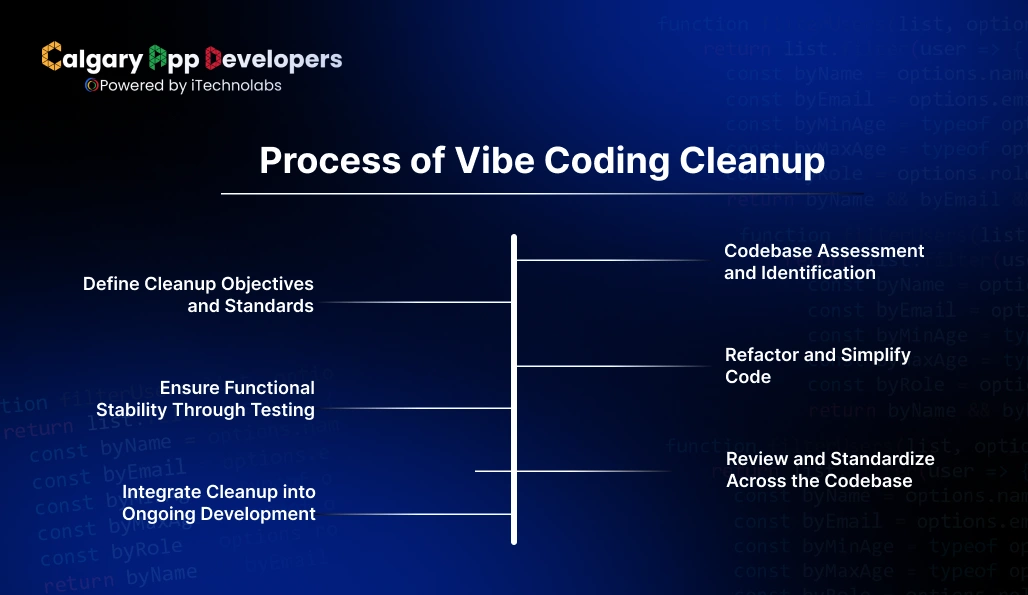
A successful Vibe Coding Cleanup is not random or one-time. It follows a structured process that ensures improvements are meaningful, safe, and aligned with long-term goals. Below is a practical step-by-step approach that teams can apply across projects.
- Codebase Assessment and Identification
The first step is to evaluate the current state of the codebase and identify areas that need attention.
- Review modules that are difficult to read, maintain, or extend.
- Identify duplicated logic, unused code, and inconsistent patterns.
- Analyze error-prone sections or areas with frequent bug fixes.
- Gather input from developers who regularly work with the code.
This step creates a clear roadmap of what needs to be improved instead of making arbitrary changes.
- Define Cleanup Objectives and Standards
Before making changes, it is important to establish clear goals and coding standards.
- Set priorities such as readability, performance, or maintainability.
- Define naming conventions, file structures, and formatting rules.
- Align the team on best practices and coding guidelines.
- Decide the scope of cleanup to avoid over-refactoring.
Having defined standards ensures consistency and prevents subjective changes.
- Refactor and Simplify Code
This is the core step where actual cleanup happens. The focus is on improving structure without changing functionality.
- Break down complex functions into smaller, manageable units.
- Replace unclear variable and function names with meaningful ones.
- Remove redundant or dead code that no longer serves a purpose.
- Simplify logic to make workflows easier to understand.
The goal is to make the code intuitive while keeping its behavior intact.
- Ensure Functional Stability Through Testing
Every cleanup effort must preserve the original functionality of the system.
- Run existing test cases to verify no regressions occur.
- Add new tests for previously uncovered scenarios.
- Validate edge cases and critical workflows.
- Use automated testing tools to speed up validation.
This step ensures that improvements do not introduce new issues.
- Review and Standardize Across the Codebase
After refactoring, consistency needs to be enforced across all updated areas.
- Conduct peer reviews to validate code quality and clarity.
- Ensure adherence to defined coding standards.
- Align similar modules to follow the same structure and patterns.
- Document key changes for future reference.
Consistency across the codebase is what makes cleanup truly effective.
- Integrate Cleanup into Ongoing Development
Cleanup should not be treated as a one-time activity. It must become part of the development workflow.
- Encourage developers to clean code as they build new features.
- Schedule periodic cleanup cycles for critical modules.
- Use linters and automated tools to maintain standards.
- Continuously monitor code quality over time.
By integrating cleanup into daily practices, teams can maintain a high-quality codebase without large-scale rework later.
This structured process ensures that Vibe Coding Cleanup delivers lasting value while keeping development stable, efficient, and scalable.
Also Check: Top Vibe Coding Companies in Canada for Small Businesses
Core Principles Behind Effective Vibe Coding Cleanup
Vibe Coding Cleanup works best when it is guided by clear principles rather than random improvements. These principles ensure that every change contributes to a cleaner, more reliable, and future-ready codebase without introducing unnecessary complexity.
- Clarity Over Cleverness: Code should be easy to understand, even for someone who did not write it. Avoid overly complex logic or smart shortcuts that make the code harder to read. Simple and explicit implementations are always more valuable in the long run.
- Consistency Across the Codebase: Consistency makes a codebase predictable. Similar problems should be solved in similar ways, using standardized patterns, naming conventions, and structures. This reduces confusion and helps developers move across the codebase with ease.
- Preserve Functionality at All Times: Cleanup is not about changing how the system behaves. Every improvement should maintain the existing functionality. The goal is refinement, not transformation, which is why testing and validation are critical during the process.
- Focus on Readability and Structure: Well-organized code with clear separation of concerns improves both understanding and maintainability. Logical grouping of components, clean file structures, and readable formatting make the system easier to navigate and extend.
- Eliminate Redundancy: Duplicate code and unnecessary logic increase complexity and maintenance effort. Effective cleanup focuses on removing repetition and consolidating logic wherever possible, leading to a more efficient and manageable codebase.
- Make Intent Obvious: Every piece of code should clearly communicate its purpose. Function names, variables, and comments should reflect what the code is doing and why it exists. When intent is obvious, developers can work faster and with greater confidence.
- Improve Incrementally: Large-scale cleanup can introduce risks and delays. It is more effective to make incremental improvements over time. Small, consistent changes are easier to manage, review, and validate without disrupting ongoing development.
- Align with Long-Term Scalability: Cleanup should always consider future growth. Decisions made during the process should support scalability, flexibility, and ease of extension. This ensures that the codebase remains sustainable as the product evolves.
By following these principles, Vibe Coding Cleanup becomes a disciplined and value-driven practice rather than a one-off effort. It helps teams maintain high standards while continuously improving the quality of their code.
Best Practices for Vibe Coding Cleanup
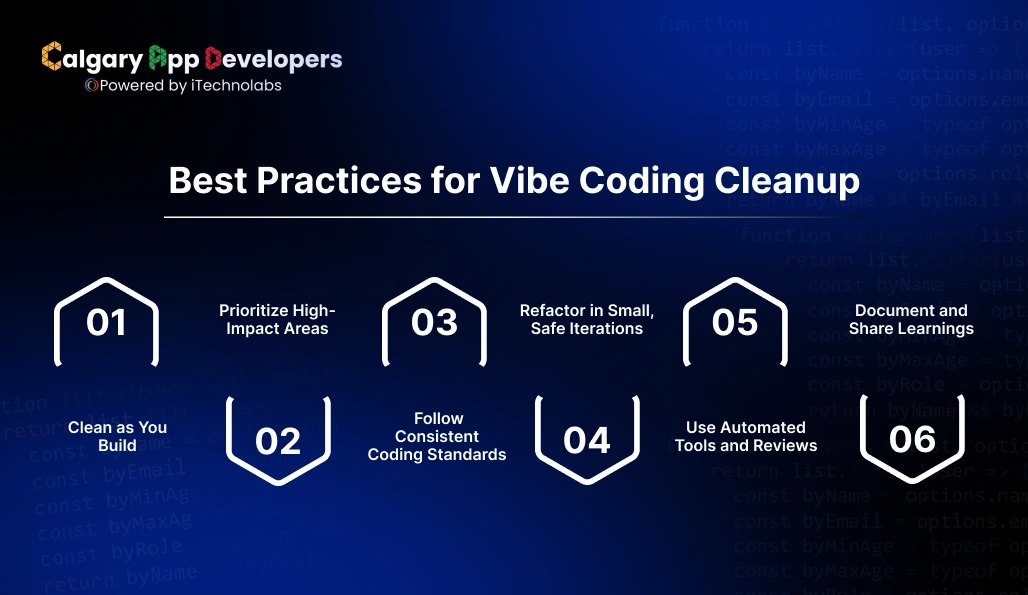
Applying Vibe Coding Cleanup effectively requires discipline and a clear approach. The following best practices help ensure that cleanup efforts deliver consistent and long-term value without disrupting development.
- Clean as You Build
Instead of postponing cleanup, make it part of daily development.
- Refine code immediately after writing it while the logic is still fresh.
- Avoid leaving temporary fixes or incomplete structures for later.
- Treat every commit as an opportunity to improve clarity and structure.
- Encourage developers to take ownership of code quality from the start.
This prevents the accumulation of messy code and reduces the need for large cleanup efforts later.
- Prioritize High-Impact Areas
Not all parts of the codebase require equal attention. Focus where it matters most.
- Target frequently updated or business-critical modules.
- Identify areas with recurring bugs or performance issues.
- Address sections that slow down development or cause confusion.
- Avoid spending excessive time on stable, low-impact code.
This ensures that cleanup efforts produce measurable improvements.
- Follow Consistent Coding Standards
Consistency is essential for maintaining a clean and predictable codebase.
- Establish clear naming conventions for variables, functions, and files.
- Use uniform formatting and code structuring practices.
- Apply consistent design patterns across similar features.
- Enforce standards through code reviews and automated tools.
A consistent codebase reduces friction and improves collaboration.
- Refactor in Small, Safe Iterations
Large changes increase the risk of breaking functionality. Incremental improvements are more effective.
- Break down cleanup tasks into smaller, manageable updates.
- Refactor one module or function at a time.
- Validate each change before moving to the next.
- Avoid combining cleanup with major feature changes.
This approach keeps the system stable while improving code quality steadily.
- Use Automated Tools and Reviews
Automation and peer reviews help maintain quality at scale.
- Use linters and formatters to enforce coding standards.
- Integrate static analysis tools to detect issues early.
- Conduct peer reviews to ensure clarity and consistency.
- Use version control effectively to track and manage changes.
These practices create a strong quality control system.
- Document and Share Learnings
Cleanup efforts should contribute to long-term improvement across the team.
- Document patterns, decisions, and improvements made during cleanup.
- Share best practices with the team to maintain consistency.
- Create internal guidelines based on real project experience.
- Continuously refine standards as the codebase evolves.
This ensures that improvements are sustained and replicated across future work.
By following these best practices, Vibe Coding Cleanup becomes an ongoing discipline rather than a one-time effort. It helps teams maintain a high-quality codebase while supporting faster and more reliable development.
Also Read: Best Vibe Coding Tools to Build Smart Apps
Real World Examples and Use Cases
Vibe Coding Cleanup is best understood through practical application. The impact becomes clear when teams compare how a system performs before and after a structured cleanup effort. Below are two real-world scenarios based on actual development experience.
1. Scaling a SaaS Dashboard for Performance and Maintainability
A growing SaaS platform began facing delays in feature releases due to a cluttered frontend and backend structure. Over time, multiple developers had contributed using different patterns, which led to inconsistent naming, duplicated logic, and tightly coupled components.
Before Cleanup
- Feature development cycles were slow due to difficulty in understanding existing code
- Frequent bugs appeared when updating shared components
- API response handling was inconsistent across modules
- Onboarding new developers took significant time
Cleanup Approach
- Standardized naming conventions and component structures
- Refactored large components into smaller, reusable units
- Removed redundant API handling logic and centralized it
- Introduced consistent state management practices
Results After Cleanup
- Development speed improved by 35 percent
- Bug occurrence in updated modules reduced by 40 percent
- Code review time decreased by 30 percent
- New developer onboarding time improved by 50 percent
This cleanup created a system that was easier to scale and significantly more predictable during updates.
2. Optimizing an E-commerce Backend for Stability and Efficiency
An e-commerce platform experienced performance issues during peak traffic. The backend had grown rapidly, with several quick fixes and patchwork solutions added over time. This resulted in redundant database queries, inefficient logic, and limited visibility into system behavior.
Before Cleanup
- High server load due to repeated and unnecessary database calls
- Difficult debugging process because of unclear logic flow
- Increased downtime risk during updates
- Inconsistent error handling across services
Cleanup Approach
- Identified and optimized redundant database queries
- Simplified complex business logic into clear service layers
- Standardized error handling and logging mechanisms
- Removed unused and outdated code paths
Results After Cleanup
- Server response time improved by 45 percent
- Database load reduced by 38 percent
- Production issues during releases dropped by 50 percent
- Overall system stability improved significantly under peak traffic
This transformation not only improved performance but also made the backend far more reliable and easier to maintain.
These examples highlight how Vibe Coding Cleanup directly impacts development efficiency, system performance, and team productivity. When applied consistently, it turns a struggling codebase into a structured and scalable foundation.
Conclusion
Vibe Coding Cleanup is not a cosmetic improvement. It is a strategic approach to maintaining code quality, improving developer efficiency, and ensuring long-term scalability. As codebases grow, even small inconsistencies can compound into major challenges. A structured cleanup process helps prevent that drift and keeps systems reliable, adaptable, and easy to work with.
Teams that invest in cleanup early and consistently gain a clear advantage. They ship faster, reduce errors, and create a development environment that supports innovation rather than slowing it down. More importantly, they build products that are easier to scale and sustain over time.
At Calgary App Developer, this approach is not theoretical. It is built into how we design, develop, and optimize software for our clients. Our experience across diverse projects has shown that clean, well-structured code directly impacts product success. From refining existing systems to building scalable solutions from the ground up, we focus on creating codebases that remain efficient and maintainable as they grow.
If your current system feels difficult to manage or is slowing down your development process, a focused Vibe Coding Cleanup Specialist can make a measurable difference. With the right expertise and a disciplined approach, it becomes a powerful step toward building stronger, future-ready software.
FAQs
- Why should you clean up code generated by AI tools?
AI-generated code often prioritizes speed over structure. It may include redundant logic, inconsistent patterns, or unclear naming. Cleanup ensures the code aligns with your standards, improves readability, and prevents long-term maintenance issues that can slow down development and increase technical debt.
- Is it safe to deploy AI-generated code without cleanup?
Deploying AI-generated code directly is risky. While it may function correctly, it often lacks optimization, consistency, and scalability. Without cleanup, hidden issues can surface later, leading to bugs, performance problems, and higher maintenance costs. A review and refinement step is always recommended.
- How frequently should Vibe Coding Cleanup be performed?
Cleanup should be an ongoing process rather than a one-time activity. Ideally, developers should refine code during development and schedule periodic reviews for critical modules. Regular cleanup prevents the accumulation of issues and keeps the codebase stable, efficient, and easy to manage.
- Does cleanup slow down project delivery timelines?
In the short term, cleanup may add slight overhead. However, it significantly improves development speed over time by reducing debugging, rework, and confusion. Teams that maintain clean code typically deliver faster and more consistently compared to those managing cluttered codebases.
- What factors influence the cost of Vibe Coding Cleanup?
The cost depends on codebase size, complexity, existing technical debt, and the level of restructuring required. Smaller projects may need minimal effort, while large systems require deeper analysis and refactoring. Investing in cleanup early usually reduces overall development and maintenance costs.
- Who is responsible for performing Vibe Coding Cleanup?
Cleanup is a shared responsibility across the development team. Developers, code reviewers, and technical leads all play a role in maintaining code quality. In complex projects, experienced engineers or external experts may be involved to ensure consistency and effective implementation.
- Is Vibe Coding Cleanup only relevant for startups?
Vibe Coding Cleanup is valuable for teams of all sizes. While startups benefit from early discipline, large enterprises rely on it to manage complex systems and multiple contributors. Any organization that wants scalable, maintainable, and high-quality software can benefit from this practice.


Pankaj Arora is a seasoned technology leader and the Founder of Calgary App Developer, with 10+ years of expertise in crafting high-performance digital solutions. His core competencies include full-stack app development, cloud-native architecture, API integration, and agile product delivery. Under his leadership, Calgary App Developers has empowered startups and enterprises alike with scalable mobile applications, secure web platforms, and AI-driven SaaS products.