


How to Create a Food Delivery App: A Simple 6-Step Guide
Late-night hunger no longer means waiting until morning. A few taps on a smartphone now bring a hot meal to the doorstep in under thirty minutes. This level of convenience has reshaped how people eat, order, and interact with food brands. In 2026, a food business without a delivery app will not fall behind on technology. It is falling behind on customer expectations.
Worldwide online food delivery revenue is estimated to be $1.54 trillion in 2026, increasing at approximately 7–10% every year to 2030. The subcontinent market increased from $31.8 billion in 2024 and is expected to reach $140.8 billion by 2030, with an eye-popping 28% CAGR.
In markets such as in the U.S., over 60% of customers place delivery orders on a weekly basis, primarily through mobile apps, and over 78% of deliveries are made through such apps. It makes clear that digital ordering is not just convenient—it’s central to modern dining behavior.
Digital ordering is no longer an added convenience. It is a core part of modern dining behavior. Owning your own food delivery app puts that behavior directly in your hands. Instead of depending on third-party platforms, you control the entire customer journey, strengthen brand loyalty, and retain a larger share of revenue. The demand already exists. The opportunity lies in building an app that serves it well.
Now let’s walk through the key steps involved in building a successful food delivery app, from planning to execution.
TL;DR
- Food delivery apps are now a core part of how customers order, not an added convenience.
- Owning your app gives you full control over experience, data, and revenue.
- The fastest path to success is a focused MVP backed by strong logistics and constant iteration.
Key Points
- Rapid market growth has made app food ordering a default behavior across multiple regions, creating clear demand for dedicated delivery platforms.
- A food delivery app must be designed around three stakeholders—customers, restaurants, and delivery partners—with each experience optimized for speed and reliability.
- Defining a clear niche and business model early shapes every technical and operational decision that follows.
- Building an MVP first allows faster market entry, lower upfront costs, and real user feedback before scaling features.
- Advanced capabilities like personalized recommendations, live tracking, loyalty programs, and fast refunds play a major role in user retention.
- Cost and complexity are driven by feature scope, platform choice, and development team location, making prioritization essential.
- Long-term growth depends on operational excellence, strong restaurant relationships, and continuous product improvement based on data and user behavior.
Step-by-Step Guide to Creating a Food Delivery App
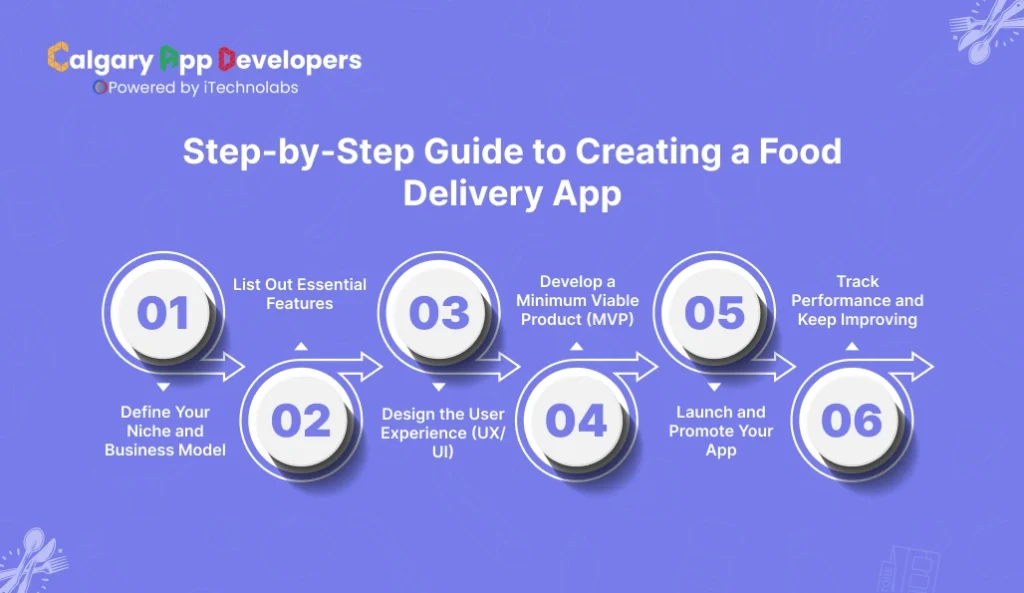
Building a food delivery application is more involved than simply putting menus online. It is about providing a seamless and reliable service to three separate groups of users: consumers, restaurant partners, and delivery drivers. Regardless of whether you are a founder of a startup or a restaurant owner venturing into delivery, these points will guide you through each important step along the way.
Step1: Define Your Niche and Business Model
Before any development begins, figure out what kind of food delivery app you’re building. There are a few common models:
- Aggregator model (like Zomato, DoorDash): You connect users to multiple restaurants.
- Single restaurant app: You build an app for one brand to take direct orders.
- Logistics support model (like Uber Eats): You provide delivery service for restaurants that don’t deliver themselves.
- Cloud kitchen apps: Apps built for delivery-only kitchen brands.
Your business model shapes the app’s core features, backend architecture, and revenue strategy.
Step2: List Out Essential Features
Every food delivery app has three main components:
a) User App – For customers ordering food
Must-have features:
- Easy sign-up/login (email, mobile, or social)
- Search and filter by cuisine, price, rating
- Menu browsing and item customization
- Real-time order tracking and status updates
- Multiple payment options (cards, wallets, UPI)
- Ratings and reviews
- Order history and reordering
b) Restaurant Dashboard – For restaurant partners
Features to include:
- Order management dashboard
- Menu and pricing updates
- Inventory control
- Earnings and analytics
- Chat or support integration
c) Delivery Partner App – For drivers/riders
Key functions:
- Order pickup and drop details
- Real-time GPS navigation
- Earnings tracking
- Status updates (picked up, delivered)
Admin Panel (for you, the app owner): You will also be looking at developing a backend dashboard that allows you to be able to manage users, restaurants, payments, complaints, and overall settings for the application.
Also Check: Top Food Delivery Apps in Canada
Step3: Design the User Experience (UX/UI)
This step makes or breaks your app. People will abandon clunky apps no matter how good the food is.
- Use wireframes to plan out screens and flows.
- Keep navigation intuitive and screens uncluttered.
- Prioritize speed—optimize images, keep steps short.
- Test your design with real people before development.
Start with mobile-first design. Over 90% of orders will come from phones.
Step 4: Develop a Minimum Viable Product (MVP)
Don’t build the full-blown app right away. Start lean.
Your MVP should include:
- User registration
- Restaurant listings and menus
- Ordering and payments
- Order status tracking
Test the MVP with a small group of real users. Gather feedback. Look for bugs, confusing flows, or delays. Then fix them fast.
Why MVP first? It saves time and money and helps you avoid building features no one needs.
Step 5: Launch and Promote Your App
Once your MVP is polished, it’s time to launch.
- List your app on Google Play and the Apple App Store.
- Create a landing page and social media presence.
- Use influencer shoutouts, referral discounts, or food bloggers to drive early downloads.
- Offer restaurant partners a limited-time commission-free period.
- Make sure your app loads fast and works on all major phone types.
Make sure to collect user feedback constantly during the first 90 days. This is when bugs and pain points will show up the most.
Step 6: Track Performance and Keep Improving
Launching is just the beginning. Use analytics tools to measure:
- Order conversion rate
- User retention
- Peak ordering times
- Delivery delays
- Most common drop-off points (where users quit)
Based on the data, improve features, remove friction, and keep updating the app. Apps that stop evolving quickly fall behind.
Bonus Tip: Don’t try to be everything at once. Focus on doing one thing really well—fast delivery, healthy food, or a hyperlocal area—then expand.
Read Also: AI App Development: Build Intelligent Solutions
Advanced Features to Stay Competitive
Once you have successfully built a food delivery application that does the essentials – allow users to order, pay, and track their order – you will quickly realize one thing: every other competitor is doing the same thing. So if you want to keep users engaged rather than simply downloading the app and forgetting it, you are going to need to offer something more than the standard food delivery app. This is when it comes time to explore advanced features.
These aren’t just nice-to-haves. They directly impact user retention, order frequency, and long-term growth.
- AI-Based Search and Smart Recommendations
A good food app shows what’s available. A great one knows what you’re likely to want next.
Using AI and machine learning, your app can analyze user behavior—past orders, browsing habits, time of day—and make personalized suggestions. This could mean:
- Showing breakfast items in the morning and comfort food at night.
- Recommending spicy dishes to someone who always orders Indian cuisine.
- Suggesting add-ons like drinks, dips, or desserts based on previous combos.
- Live GPS Tracking with ETA Accuracy
Order tracking isn’t new—but accuracy is everything.
Modern users appreciate what I’ve called visibility: where is my delivery partner, what route are they taking, how long is it going to take, and are they delayed? Modern-day users enjoy transparency and instant communication; this minimizes complaints.
You can also utilize live tracking on the restaurant side, so kitchen staff can time the preparation of the meal based on how close the driver is.
Bonus feature: Push notifications that update users as the order moves through each stage—confirmed, prepared, out for delivery, arriving soon.
- Scheduled Orders and Pre-Booking
Sometimes people want to plan ahead—office lunch for 12:30, birthday cake delivery at 7 PM, or weekly meal preps.
Let users schedule deliveries hours or even days in advance. Restaurants benefit too—they can manage staffing and prep based on incoming scheduled orders.
Offer bulk scheduling for catering or team meals.
- Loyalty Programs, Rewards & Gamification
Here’s what keeps users hooked: the feeling that they’re earning something every time they order.
A well-designed loyalty program could include:
- Points for each order, redeemable for discounts or free food.
- Badges or levels (like “Silver” or “Gold”) that unlock perks.
- Streak bonuses—order 3 times in a week, get ₹100 off.
- Invite-a-friend rewards for both parties.
Why it works: Customers are 60–70% more likely to order from a platform where they’ve already earned rewards or status.
- In-App Support with AI and Live Chat
Things go wrong—delays, wrong items, payment failures. Forcing users to call or email wastes time and kills trust.
Integrate an in-app support system where:
- AI chatbots instantly handle common issues (refunds, delivery questions).
- Human agents step in for escalated cases.
- Conversations stay within the app—no need to leave or repeat details.
Optional add-on: Allow users to chat with the delivery partner for quick updates.
Also Check: Top 10 Business Mobile App Features to Scale Your Business
- Multi-Language and Currency Support
For example: Canada has two official languages—English and French—but the population is far more linguistically diverse. Cities like Toronto and Vancouver have large communities speaking Mandarin, Punjabi, Arabic, and more. If your app only supports one language, you risk leaving out a huge portion of your potential users. In such a diverse country, multilingual support isn’t optional—it’s how you stay competitive.
Add support for regional languages based on your target market. Also, allow switching currencies or payment methods if you’re serving international users or travelers.
Outcome: Your app becomes more inclusive, approachable, and trustworthy—especially in Tier II & III cities.
- Contactless and Instruction-Based Delivery
Post-pandemic, many users still prefer not interacting directly. Let them:
- Opt for “leave at door” delivery.
- Add notes like “Ring once, don’t knock” or “Hand over to security.”
- Receive a photo of the food left at the doorstep.
- Dark Mode, Accessibility, and Personalization
Give users the ability to customize their experience:
- Dark mode for night browsing (reduces eye strain and saves battery).
- Text size and contrast settings for visually impaired users.
- Voice ordering or screen reader compatibility.
Accessibility is not just good design—it’s good business. You’ll reach users others are ignoring.
- Fast Refunds and Fair Dispute Handling
Order errors happen. But slow refunds or vague complaint handling push users away.
Build a system where:
- Minor issues (like a missing item) trigger instant wallet credit.
- Users can upload photos for faster resolution.
- Every complaint is tracked, time-stamped, and reviewed systematically.
- Restaurant Analytics Dashboard
Partner restaurants are the backbone of your platform. Help them succeed.
Offer a dashboard with:
- Order volume trends by day or week
- Best- and worst-selling items
- Peak delivery times
- Customer feedback summaries
- Earnings and payout tracking
When restaurants grow with your platform, they stay loyal and promote your app more actively.
Read Also: Top Mobile App Trends Shaping the Future of Technology
How Much Does It Cost to Build a Food Delivery App?
Let’s be real—cost is usually the first big question when building any app. And while pricing can vary a lot, ranging from $13,000 to $19,000 for custom food delivery application development.
Here’s a realistic estimate of what it might cost to build a basic, fully functional app with the essential features in 2026, especially.
Estimated Development Cost Breakdown (USD)
| Feature / Component | Estimated Cost Range |
| UI/UX Design | $800 – $1,200 |
| User App (iOS & Android) | $4,000 – $5,500 |
| Restaurant Panel (Web-based) | $1,000 – $2,000 |
| Delivery Partner App | $1,200 – $2,000 |
| Admin Dashboard (Web) | $1,000 – $1,800 |
| Backend Development & APIs | $2,000 – $3,500 |
| Database & Cloud Setup | $500 – $1,000 |
| Testing & QA | $800 – $1,200 |
| Basic Launch & Support (1–2 mo.) | $700 – $1,000 |
| Total Estimated Cost | $13,000 – $19,200 |
What Affects the Cost of a Food Delivery App?
Now, let’s break down what really drives the cost up or down.
Number of App Panels
Most delivery apps include:
- Customer-facing app
- Delivery partner app
- Restaurant dashboard
- Admin panel
The more you’re developing from scratch, the more expensive it will be. You can cut budget costs because you can utilize templates or no-code technologies to create the admin or restaurant dashboards initially.
Platform Choices: iOS, Android, or Both: If you go for developing both iOS and Android separately in different teams, it will double your cost. But there are cross-platform tools like Flutter or React Native that enable you to build together from a shared code base.
Custom Features vs. Off-the-Shelf: Real-time GPS tracking, smart search, or loyalty programs are great—but they take time to build. Prioritize only the essential features for your first version. You can add advanced functionality after launch.
UI/UX Design Complexity: A clean, user-friendly interface will cost less than a highly customized and animation-heavy experience. Get started with a clean layout, performance, and mobile-friendliness, and then enhance the design over time.
Developer Location and Team Size
This is the biggest cost factor. For example:
- A US-based dev team might charge $80–$150/hr.
- A team based in India or Eastern Europe might charge $20–$40/hr at the same proficiency.
Engaging a skinny, seasoned, remote team or agency is the most convenient method to keep the overall cost under control without sacrificing quality.
Backend and Hosting Options: Leverage managed services like Firebase, AWS, Render, etc. to avoid a lot of manual infrastructure work, which will pay for itself in initial setup and maintenance expenses.
Support & Iterations After Launch: You’ll have some bug fixes, small feature updates, or user feedback cycles after launch. Allocate $500-1,000/month for developer support for the first 2-3 months until your app gains momentum.
Also Read: How Mobile App Development Is Evolving in Calgary
Tech Stack Behind High-Performing Delivery Apps
A good food delivery app will be built on a technology stack that is performant, scalable, and provides an excellent customer experience. Whether you are constructing a simple MVP or planning to scale, if you are using the proper tools initially, you shouldn’t be worrying so much about tech debt or expensive rewrites down the line in future sprint cycles.
Here’s a breakdown of the most widely used and cost-effective technologies used by top delivery apps:
Recommended Tech Stack (2026)
| Component | Recommended Tools / Technologies |
| Frontend (App) | Flutter / React Native |
| Frontend (Web Admin) | React.js / Vue.js |
| Backend | Node.js / Django / Laravel |
| Database | PostgreSQL / Firebase |
| Cloud Hosting | AWS / Google Cloud / Render |
| APIs & Integrations | Google Maps, Stripe, Razorpay, Twilio |
| Authentication | Firebase Auth / Auth0 |
| Real-Time Updates | Socket.io / Firebase Realtime Database |
How to Succeed in the On-Demand Food Delivery Market
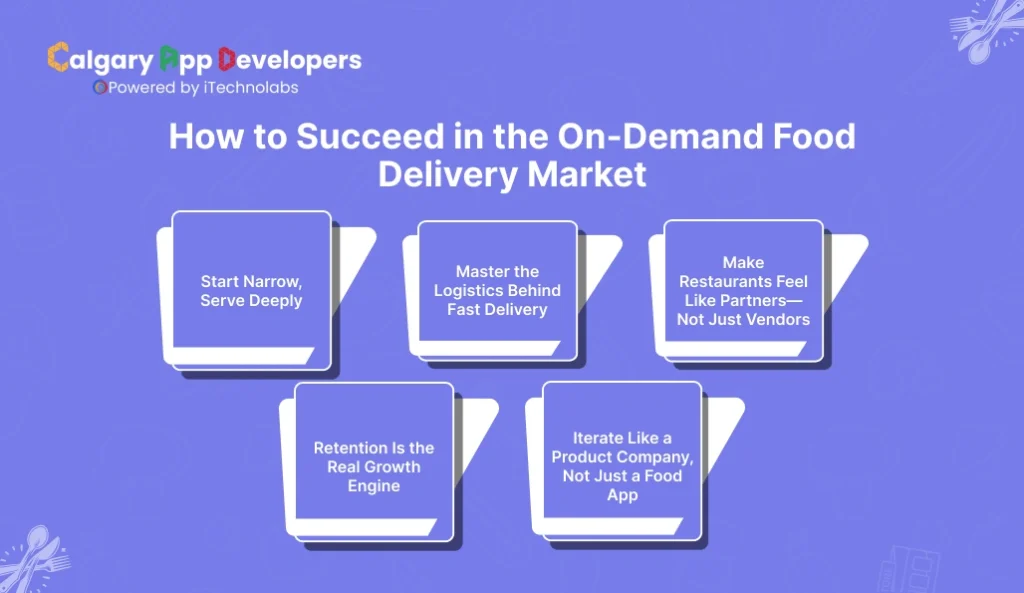
Launching a food delivery app is one thing. Making it work in the long run—that’s the real challenge. With dozens of platforms fighting for user attention, the ones that win are those that solve real problems better, faster, and more locally than the rest.
Here’s what separates high-performing delivery apps from those that fade out after launch:
- Start Narrow, Serve Deeply
Trying to be “the next Postmates” from day one is how startups burn out fast. Instead, pick a tight niche and own it.
That could mean:
- Focusing on one city or neighborhood.
- Targeting a specific cuisine—like vegan food, regional dishes, or late-night snacks.
- Partnering with select restaurants for exclusive deals.
When your app becomes the go-to for something, you build loyal users and word-of-mouth growth—something national platforms can’t do at a local level.
- Master the Logistics Behind Fast Delivery
You can have the best app in the world, but if the food is late or cold, you lose the customer.
Success in food delivery depends on:
- Optimizing delivery zones and avoiding overreach.
- Assigning orders smartly to reduce wait time.
- Having enough delivery staff in high-demand areas.
- Building restaurant workflows that prep food just as the rider arrives.
Invest in route optimization, real-time tracking, and delivery partner training from the start. The faster and more accurately you deliver orders, the fewer complaints, and most importantly, refunds, you will deal with in those early days.
- Make Restaurants Feel Like Partners—Not Just Vendors
Most platforms treat restaurants as just another name in a list. That’s a mistake.
The smartest apps:
- Offer competitive or flexible commission rates (especially in the early phase).
- Provide restaurants with dashboards showing real-time orders, sales trends, and customer reviews.
- Share marketing insights and promote top performers.
- Help small restaurants go digital—build menus, train staff, and onboard them smoothly.
When restaurants benefit directly from being on your app, they’ll push customers your way—and stay loyal even when bigger players try to poach them.
- Retention Is the Real Growth Engine
Acquiring users is expensive. Keeping them is where the profit lies.
To retain users:
- Use smart push notifications (not spammy ones) to remind users of deals, favorite meals, or reorders.
- Launch a simple loyalty program—points, badges, or cashback all work.
- Offer time-sensitive discounts during off-peak hours or when order volume is low.
- Make refunds, replacements, and support easy and fast.
Build habits, not just one-time transactions.
- Iterate Like a Product Company, Not Just a Food App
The most successful delivery apps don’t wait for problems to become obvious—they constantly analyze, test, and improve.
Set up a system to:
- Track every major metric: order completion rate, customer retention, average delivery time, refund rate, etc.
- Use session recordings or heatmaps to spot where users get stuck.
- A/B test new features before rolling them out fully.
- Talk to your users—get raw feedback regularly.
Ship fast, test often, and treat feedback like gold. This is what keeps your app relevant and ahead of the curve.
The food delivery market will keep growing—but growth won’t be evenly distributed. It’ll go to platforms that understand local markets, treat restaurants as partners, and serve users with speed, clarity, and care.
If you’re just starting, success isn’t about having all the features or a massive fleet. It’s about solving one specific problem so well that people come back again and again. Everything else builds from there.
Also Check: Steps to Choose the Best Mobile App Developers for Your Project
Top Food Delivery Apps in Canada for 2026
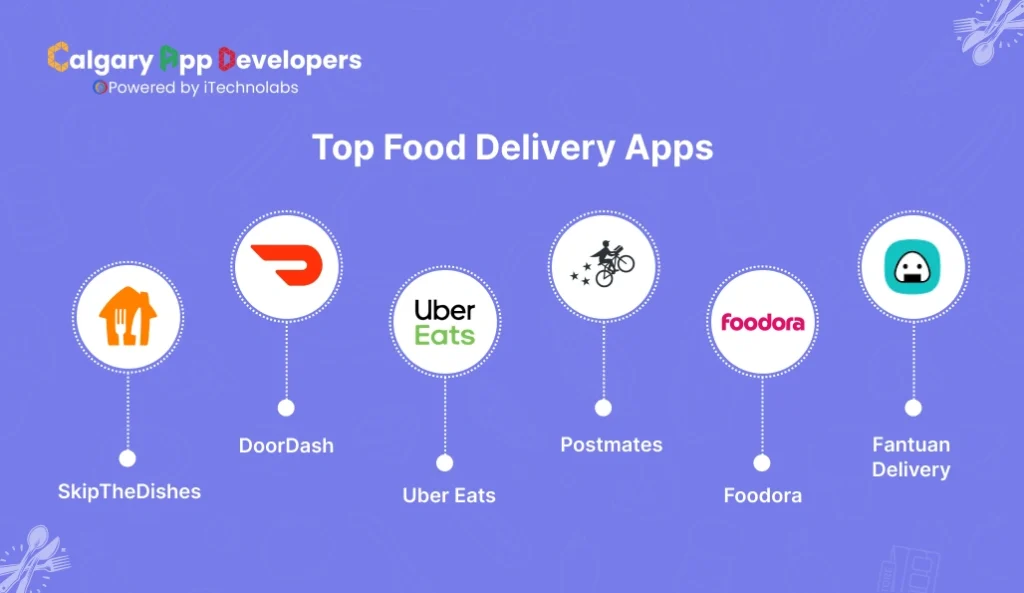
Canada’s food delivery market continues to grow in 2026, driven by convenience, app loyalty, and heavy competition. Six platforms dominate the landscape—each with a unique approach to service, pricing, and market presence. Here’s a breakdown of the key players.
Leading Food Delivery Apps in Canada
| App | Launched | Founded By | Key Features |
| SkipTheDishes | 2012 | Chris & Josh Simair | Loyalty rewards, strong local presence |
| DoorDash | 2013 | Tony Xu, Andy Fang, Stanley Tang | DashPass, fast delivery, deep restaurant network |
| Uber Eats | 2014 | Uber (Travis Kalanick, Garrett Camp) | Seamless experience, global scale, bundle deals |
| Postmates | 2011 | Bastian Lehmann, Sam Street, Sean Plaice | On-demand anything delivery, now integrated with Uber Eats |
| Foodora | 2014 | German-based (Delivery Hero) | Real-time tracking, curated restaurant partners |
| Fantuan Delivery | 2014 | Randy Wu, Yaofei Feng (Burnaby, BC) | Focus on Asian cuisine, bilingual experience |
Quick Facts & Performance
- Uber Eats holds the largest user base in Canada with over 6.6 million monthly active users and is the most downloaded food delivery app in 2026.
- SkipTheDishes remains the top homegrown brand, with a 36.9% market share, strong loyalty programs, and deep integration with local restaurants.
- DoorDash is growing fast, serving over 3 million monthly users, with aggressive promotions and wide coverage.
- Postmates, now operating under Uber Eats in Canada, is known for delivering beyond food—groceries, alcohol, even household items—with flexible delivery options.
- Foodora is active in major cities like Toronto and Vancouver, offering consistent service and exclusive deals.
- Fantuan is building momentum in urban centers by focusing on multicultural menus, especially Chinese and Korean cuisine.
Market Snapshot
The Canadian food delivery market crossed $19 billion USD in 2024, with a projected 7–8% annual growth rate toward 2030.
A recent Statista 2025 survey shows:
- 55% of users ordered via Uber Eats in the past year
- 47% via DoorDash
- 43% via SkipTheDishes
If you’re entering the Canadian delivery space, these five apps set the standard. SkipTheDishes and Fantuan win on local relevance. Uber Eats and DoorDash win on scale. Foodora holds a steady niche in major cities. Whether you’re building your own app or looking to partner, understanding their strengths helps you position your offering strategically.
Also Read: How to Build an On-Demand Delivery App?
Our Experience in Food Delivery App Development
Our experience in food app development comes from building platforms that operate in the real world, not just on design mockups. Food delivery is a high-pressure environment. Orders are time sensitive, users are impatient, and small failures quickly turn into lost trust. Every product we’ve worked on has forced us to solve different problems across logistics, user behavior, and operational flow.
Below is a deeper look at how that experience plays out across different food delivery models.
-
ServeItLocal
The Core Problem
Global migration has created a growing audience of people living far from their home culture. These users aren’t just looking for food. They’re looking for familiarity, authenticity, and emotional comfort. Traditional restaurants rarely meet that need, and home chefs often lack a trusted way to reach nearby customers without operational risk.
How We Solved It
ServeItLocal was built as a community-driven food platform rather than a high-volume delivery app. The focus was on enabling safe, local connections between home chefs and customers while maintaining quality and trust on both sides. Discovery was designed around neighborhoods and cultural relevance, not aggressive promotions or endless scrolling.
Key Capabilities Delivered
- Structured home chef onboarding with identity and food verification
- Localized discovery based on proximity and cuisine
- Scheduled ordering instead of instant delivery to match home kitchen workflows
- Clear meal descriptions, portion sizes, and preparation timelines
- Review systems designed to highlight consistency and authenticity
This project required balancing compliance, trust, and simplicity without making the platform feel restrictive or commercial.
-
Yummi Runs
The Core Problem
Most food delivery apps struggle with the same issue. Users download them once, place an order, and never return. The root cause is friction. Too many steps, unclear order updates, and a lack of personalization make the experience forgettable.
How We Solved It
Yummi Runs was designed as a focused iOS-first delivery app that prioritizes speed, clarity, and habit building. Every interaction was optimized to reduce effort. The app was built to feel familiar from the first use while becoming more personal over time.
Key Capabilities Delivered
- Fast onboarding and streamlined ordering flows
- Real-time order status visibility from preparation to delivery
- Personalized restaurant and dish suggestions based on order history
- Secure and flexible payment handling
- Order history with frictionless reordering for repeat users
The goal was simple. Make the second order easier than the first. That’s where retention begins.
-
Rapido Food Delivery
The Core Problem
In local markets like Costa Rica, delivery platforms compete on reliability and speed rather than feature volume. Users expect fast access to food and essential items, and any delay quickly pushes them to alternatives.
How We Solved It
Rapido was built as a performance-focused delivery platform with a lightweight interface and strong operational logic underneath. Instead of adding complexity, the product was optimized for fast decisions, quick dispatch, and predictable delivery outcomes.
Key Capabilities Delivered
- Minimal step ordering for faster conversions
- Smart delivery assignment to reduce wait times
- Live tracking with realistic ETAs
- Support for food and daily essentials in one app
- Operational tools designed for high-order turnover
This project reinforced a critical lesson. In competitive local markets, speed and reliability outperform novelty.
What This Experience Adds Up To
Building a food delivery app isn’t about copying features from market leaders. It’s about understanding what problem the app exists to solve and designing everything around that goal.
- Across these platforms, our experience covers
- Community-based food marketplaces
- Single- and multi-restaurant delivery models
- Essential and comfort-driven delivery services
The result is apps that launch with focus, scale with clarity, and improve through real usage rather than assumptions. That’s the experience we bring to every food delivery product we build.
Concluding Words:
Building a successful food delivery app in 2026 isn’t just about writing code or copying what the big players are doing. It’s about solving real problems for real users—quickly, reliably, and locally.
From defining your niche and building a lean MVP to choosing the right tech stack and adding features that actually matter, every step should serve a purpose: making ordering food easier and better for your users.
The market is competitive, yes—but it’s far from saturated. There’s still plenty of room for smart, well-executed ideas, especially in untapped regions, underserved cuisines, or niche delivery models. The key is to launch with focus, learn fast, and evolve based on data and user feedback.
If you’re looking to bring your idea to life, partnering with the right food delivery app development company can make all the difference. Don’t aim to be the biggest—aim to be the most useful. That’s where real growth starts.
FAQ’s on How to Start a Food Delivery App
1. How to develop a food delivery app?
6 Key steps to develop a food delivery app:
- Market Research and Planning: Conduct analysis to identify target audience and competitors. Define the app’s unique value proposition and core feature set.
- UI/UX Design: Create the user experience and interface for the three main panels: Customer, Restaurant, and Delivery Driver.
- App Development: Developers build the application using chosen technologies, creating both the front-end and back-end systems.
- Testing: The app undergoes rigorous quality assurance to identify and fix bugs, ensuring functionality and a smooth user experience.
- Deployment and Launch: Release the app on platforms like the Apple App Store and Google Play. Onboard partner restaurants and delivery personnel.
- Maintenance and Marketing: Provide ongoing technical support, app updates, and marketing campaigns to attract users and ensure long-term operation.
2. How much does it cost to develop a food delivery app?
The cost ranges from $13,000 to $19,000 for a basic version, but this is a rough estimate. The final price depends heavily on features, app complexity, and developer rates. A simple app with core functions falls in this range, while advanced features like real-time tracking, AI recommendations, or multiple payment gateways can significantly increase the cost. The development team’s location and expertise are also major pricing factors.
3. Can I make my own food delivery app?
Yes, you can create your own food delivery app. The process requires a clear plan, a defined budget, and either technical skills or a development team. You must decide on your business model, such as focusing on a niche market or specific location. Using pre-built solutions or white-label platforms can reduce time and cost. Success hinges not just on the app but on effectively marketing it and onboarding partner restaurants and delivery personnel.
4. What is the most profitable food delivery app?
Globally, DoorDash is often considered the most profitable, having captured significant market share in the US. Its profitability stems from its vast network of restaurants, high order volume, and additional revenue streams like advertising and DashPass subscriptions. However, profitability can vary by region; for instance, Just Eat Takeaway.com is a major player in Europe. Scale, operational efficiency, and diversified services are key drivers for profitability in this competitive industry.
5. Do delivery apps make money?
Yes, delivery apps generate revenue through multiple streams. The primary source is a commission fee, typically 15-30%, charged to restaurants on each order. They also earn from delivery fees charged to customers and surge pricing during peak demand. Additional profitable avenues include in-app advertising sold to restaurants and subscription programs for regular users (e.g., free delivery) and sometimes marked-up menu prices, creating a diversified income model beyond just the delivery charge.
6. How long does it take to build a food delivery app?
Building a basic food delivery app with core features usually takes 8 to 12 weeks. This includes planning, design, development, and testing. More advanced features such as live tracking, loyalty programs, or AI recommendations can extend the timeline to 4 to 6 months depending on complexity and team size.
7. Do I need separate apps for customers, restaurants, and delivery partners?
Yes. A complete food delivery ecosystem typically requires three interfaces: a customer app, a restaurant dashboard, and a delivery partner app, along with an admin panel. Each serves a different role and ensures smooth order flow, accurate tracking, and effective management across all sides of the platform.
8. Can I launch a food delivery app with a small budget?
You can start with a limited budget by building a minimum viable product. Focus on essential features like ordering, payments, and order tracking. Using cross-platform frameworks and third-party services for maps and payments can significantly reduce initial costs while still allowing room for future upgrades.
9. Is it better to build a custom app or use third-party platforms?
Third-party platforms offer quick access to customers but come with high commissions and limited control. A custom app gives you ownership of customer data, branding, and pricing. Over time, this leads to higher margins, stronger loyalty, and the ability to shape the entire customer experience.
10. What features are most important for user retention?
Fast performance, accurate delivery tracking, easy reordering, reliable support, and fair refunds play the biggest role in retention. Loyalty rewards and personalized recommendations also encourage repeat orders. Most users stay with apps that feel predictable, transparent, and easy to use rather than those with too many complex features.
11. How do food delivery apps make money?
Food delivery apps generate revenue through restaurant commissions, delivery fees, surge pricing during peak hours, and premium subscriptions. Some platforms also earn through sponsored listings or in-app promotions. Choosing the right revenue model depends on your market, competition, and whether you operate as an aggregator or a single brand.
12. How do I choose the right development partner for my app?
Look for a team with proven experience in on-demand or marketplace apps. They should understand logistics, real-time tracking, and scalability. Clear communication, transparent pricing, and post-launch support matter as much as technical skill. A good partner helps you prioritize features instead of overbuilding too early.


Pankaj Arora is a seasoned technology leader and the Founder of Calgary App Developer, with 10+ years of expertise in crafting high-performance digital solutions. His core competencies include full-stack app development, cloud-native architecture, API integration, and agile product delivery. Under his leadership, Calgary App Developers has empowered startups and enterprises alike with scalable mobile applications, secure web platforms, and AI-driven SaaS products.