




Wearable App Development: An Ultimate Guide
Wearable app development has come a long, long way from step counters and calorie tracking. It now occupies the position at the center of how individuals approach health, interact with information, and engage with the world at large. From fitness coaches in watches that double as personal trainers to AR glasses that put data in front of users’ faces, the transition is already well underway.
The global wearable app development market is already valued at around $5 billion in 2025 and is set to grow by 15 percent annually through 2033. That jump isn’t hype; it’s a clear signal that businesses and developers are ramping up to meet rising demand.
What it reveals is that developing for wearables is no longer an experiment. It has turned into a business strategy and a designer challenge for developers interested in defining the future of user experience.
This guide covers the essentials of wearable app development, the benefits, the industries leading adoption, the process of building apps, and the challenges that need smart solutions. By the end you will have a clear picture of why this field matters in 2026 and where it is heading next.
- Wearable apps have evolved into essential tools for health, productivity, and real-time interaction.
- Businesses are investing in wearable app development as demand grows across multiple industries.
- Successful wearable apps prioritize simplicity, context awareness, and battery efficiency.
- Future innovation will focus on predictive insights, advanced sensors, and adaptive user experiences.
- Wearable app development focuses on delivering fast, relevant interactions on small screens with minimal user effort.
- Unlike mobile apps, wearable apps are built for real-time use, hands-free interaction, and continuous data collection.
- Health, fitness, enterprise, retail, and education are leading adoption due to the practical value wearables provide.
- Must-have features include clear interfaces, real-time notifications, voice or gesture control, personalization, and strong security.
- The development process requires careful planning around hardware limitations, battery efficiency, and platform-specific tools.
- Common challenges such as privacy, fragmentation, and connectivity must be addressed early to ensure long-term usability.
- Future innovation will center on predictive health insights, adaptive interfaces, deeper AR integration, and smarter automation.
Understanding Wearable App Development
Wearable app development is the process of creating applications that run on devices worn directly on the body. These include smartwatches, fitness trackers, smart glasses, medical wearables, and even smart clothing. Unlike mobile apps that rely on phones or tablets, wearable apps are built to deliver quick, relevant information and smooth interactions without distracting the user.
The focus in wearable app development is simplicity and context. A smartwatch app, for example, must present insights like heart rate or notifications in seconds rather than minutes. A medical wearable app needs to capture and transmit health data continuously with high accuracy. Every interaction is designed for smaller screens, shorter attention spans, and real-time usage.
The real power of wearable app development lies in how it blends technology with daily habits. These apps are not just digital tools but constant companions, influencing how people exercise, work, rest, and even monitor their health. By understanding the principles behind it, developers and businesses can design experiences that feel natural, useful, and integrated into everyday life.
Also Read: How Much Does It Cost to Maintain an App?
Different Types of Wearable Applications
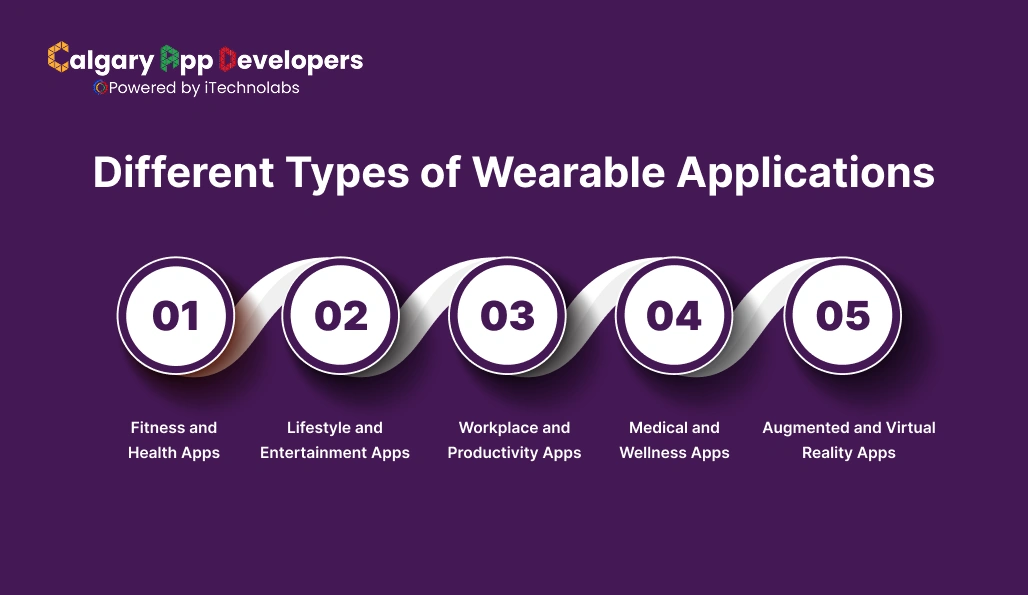
Wearable app development touches almost every aspect of daily life. These applications are built to make information accessible in real time, often with a focus on health, convenience, or efficiency. Let’s look at the main types of wearable applications and how they are used.
- Fitness and Health Apps: These are the most familiar. They track steps, workouts, calories, and heart rate, but today’s apps go far deeper. For instance, Apple Health and Fitbit not only log your activity but also analyze sleep cycles and provide recovery insights. Some devices, like the Withings ScanWatch or Samsung Galaxy Watch, track ECG and blood oxygen, giving users data once only available in hospitals.
- Lifestyle and Entertainment Apps: Wearable app development also caters to convenience. Smartwatches let users change music on Spotify, get turn-by-turn navigation from Google Maps, or make contactless payments with apps like Google Pay. The idea is to simplify small but frequent tasks so they can be done in seconds from the wrist.
- Workplace and Productivity Apps: In professional settings, wearable apps are becoming tools for efficiency. Logistics companies use smart glasses like Vuzix to help workers scan packages hands-free. Construction teams rely on wearables that deliver safety alerts in real time. Even meetings are changing, with apps on smartwatches helping professionals manage schedules, reminders, and notifications without breaking focus.
- Medical and Wellness Apps: This side of wearable app development supports healthcare. Devices like Dexcom G7 transmit glucose levels directly to an app, helping people with diabetes manage their condition in real time. Remote patient monitoring platforms connect smartwatches or patches to doctors, giving them live updates on blood pressure or heart rate so patients do not need constant clinic visits.
- Augmented and Virtual Reality Apps: Wearables are also gateways into immersive worlds. Oculus Quest headsets, Microsoft HoloLens, and Magic Leap are used for training pilots, teaching medical students with 3D anatomy, or even enhancing shopping experiences by letting customers visualize furniture at home. These applications go beyond entertainment and blend digital content into the physical environment.
What this shows is that wearable app development is not one-dimensional. From helping a runner track their progress to supporting a doctor monitoring a patient thousands of miles away, these apps are shaping how people use technology in ways that feel personal and practical.
Also Read: How to Build a Fitness App: A Step-by-step Guide
How Wearable App Development Stands Apart from Mobile Apps
At first glance, wearable app development might seem similar to building mobile apps. Both involve coding, design, and user experience. But the reality is that wearable apps are built for an entirely different environment. The differences come down to screen size, interaction style, data usage, and purpose.
- Screen Size and User Interface: Mobile apps have room for complex designs and detailed navigation. Wearable app development demands the opposite. A smartwatch app, for example, must show information on a screen no larger than a coin. This means bold text, simple visuals, and a focus on one action at a time.
- Interaction Style: On a mobile phone, users swipe, type, and scroll. Wearables rely on gestures, taps, haptics, or even voice commands. For instance, Google Pixel Watch integrates voice commands through Google Assistant, while Apple Watch allows quick responses with preset replies or scribbles. Designing for these interactions is very different from traditional mobile app development.
- Context of Use: People usually sit down to browse a mobile app. Wearable apps are built for moments on the go. Checking your heart rate mid-run, receiving an instant notification while driving, or paying with your wrist in a store requires ultra-fast and frictionless interaction.
- Data Collection and Processing: Wearable app development often involves continuous monitoring of health, location, or movement data. These apps need to process information in real time and often connect with cloud services or paired mobile apps for deeper analysis. Mobile apps, on the other hand, usually collect data only when the user is active within the app.
- Battery and Hardware Limitations: Smartphones carry larger batteries and processors, so mobile apps can afford heavy graphics or background processes. Wearables are compact and power-sensitive. Apps must be lightweight, efficient, and designed to work without draining the device in a few hours.
In short, wearable app development is not just about shrinking a mobile app onto a smaller screen. It is about rethinking how people interact with technology in short, meaningful bursts that fit seamlessly into their daily routines.
Benefits of Wearable App Development
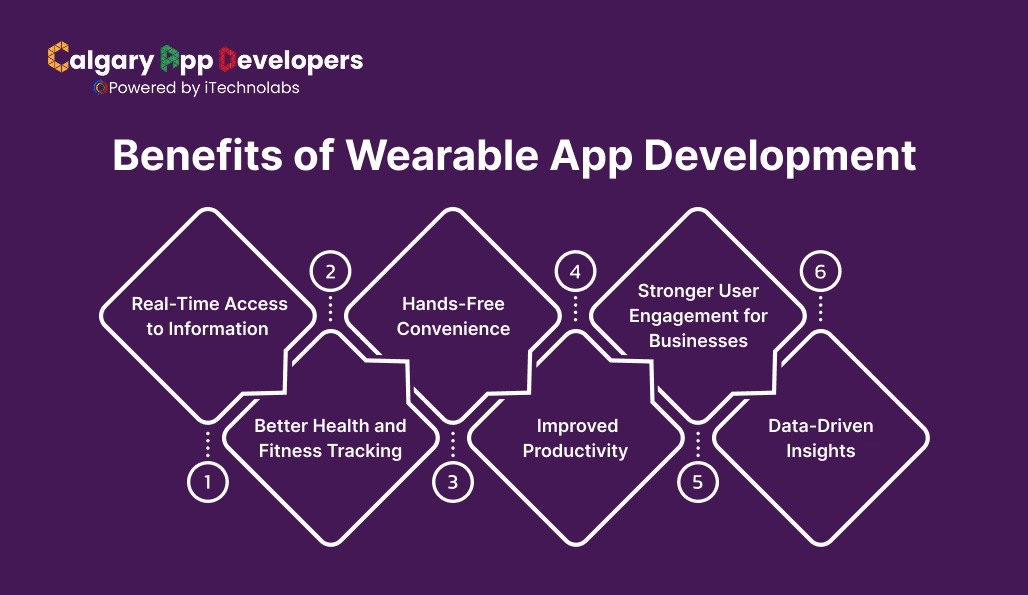
Wearable app development is more than a tech trend. It delivers practical value to users and strong opportunities for businesses. When done right, the benefits extend across convenience, health, efficiency, and engagement.
- Real-Time Access to Information:
Wearable apps bring essential data right to the wrist, eyes, or even clothing. A smartwatch alert about a meeting, or a fitness band showing heart rate during a run, saves time and keeps users informed without pulling out a phone. - Better Health and Fitness Tracking:
One of the biggest advantages of wearable app development is continuous health monitoring. Apps that track steps, blood oxygen, or sleep quality encourage healthier lifestyles and allow early detection of health issues. Medical wearables even share real-time data with doctors, improving preventive care. - Hands-Free Convenience:
Wearable apps remove friction from everyday tasks. Paying for coffee with a smartwatch, following navigation on smart glasses, or checking notifications while cycling are all made possible through quick, hands-free interactions. - Improved Productivity:
In workplaces, wearable apps boost efficiency. Logistics teams use smart glasses for scanning shipments, field workers receive instant instructions, and employees can track tasks without interrupting their workflow. This creates smoother operations across industries. - Stronger User Engagement for Businesses:
For companies, wearable app development opens new ways to connect with customers. Fitness brands can deliver personalized training plans, retail stores can send context-based offers, and healthcare providers can create more loyal patient relationships through continuous monitoring. - Data-Driven Insights:
Wearables generate rich streams of data. Businesses can use these insights to understand customer behavior, predict needs, and design better products or services, while users benefit from personalized recommendations.
In short, wearable app development creates value on both sides. Users gain convenience, health support, and efficiency, while businesses unlock deeper engagement and long-term growth opportunities.
Read Also: How Much Money Can You Make if You Own an App?
Must-Have Features in Wearable Apps
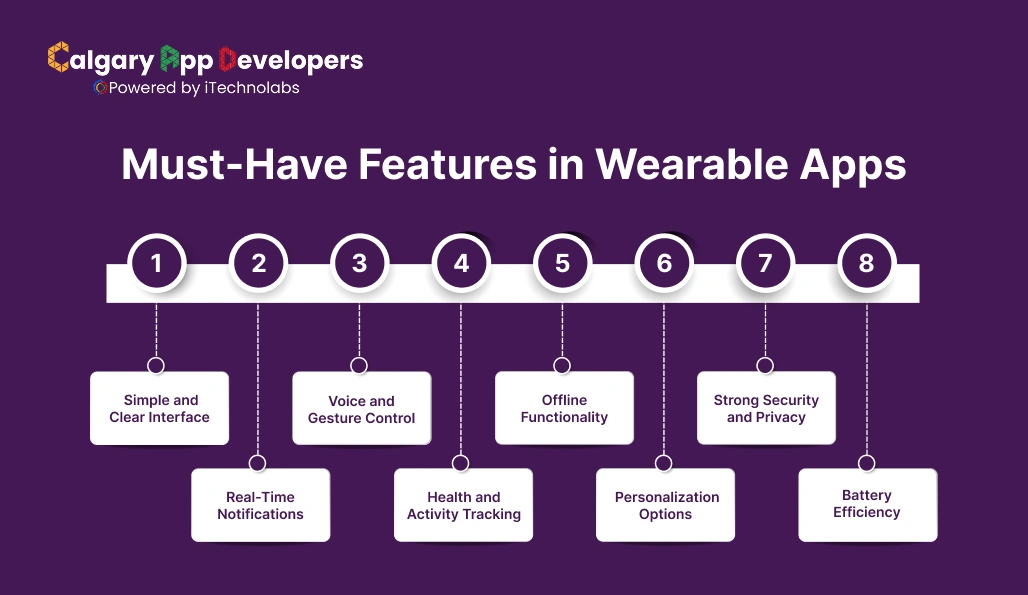
The success of wearable app development depends on how well an app adapts to the unique limitations and strengths of wearable devices. Small screens, limited battery life, and the need for instant access, make it important to design with precision. Here are the must-have features every wearable app should include.
- Simple and Clear Interface
Unlike smartphones, wearable devices do not allow complex menus or long content. The interface should be stripped down to essentials. Think large buttons, bold icons, and one action per screen. For example, the Apple Watch Activity Rings deliver motivation with three circles that instantly show progress toward daily fitness goals. This kind of simplicity helps users get information in seconds, not minutes. - Real-Time Notifications
One of the main reasons people buy wearables is instant updates. Whether it’s a call, a text, a calendar reminder, or a health warning, wearable apps must deliver notifications without delay. More importantly, alerts should be subtle and actionable. A vibration or a short buzz can signal urgency without overwhelming the user. For instance, a runner gets a quick tap on the wrist when it’s time to hydrate, or a driver receives a silent navigation update without needing to look at their phone. - Voice and Gesture Control
Typing on a small wearable screen is frustrating. This is why voice and gesture commands are central to wearable app development. Assistants like Siri, Alexa, and Google Assistant already power many voice-enabled apps. Smart glasses like HoloLens go further by allowing users to control apps with hand gestures. These features reduce friction and allow users to interact while multitasking, whether that’s cooking, exercising, or working. - Health and Activity Tracking
Most wearables are purchased with health in mind. Apps should be able to monitor and interpret data like steps, calories burned, heart rate, blood oxygen, and sleep quality. Advanced apps now track stress levels and provide guided breathing exercises. Fitbit, for example, uses continuous heart rate monitoring to suggest workout intensity, while Garmin devices deliver advanced metrics like VO2 max for athletes. This data empowers users to improve lifestyle choices and performance. - Offline Functionality
A good wearable app should not stop working without internet or phone connectivity. Features like offline music playback, GPS-based workout tracking, or offline maps are essential. Once the device reconnects, the app can sync data automatically. For instance, Spotify on the Apple Watch allows premium users to download playlists for runs without carrying their phone, a practical example of offline-first design. - Personalization Options
Wearables are personal devices, so apps must feel tailored. Personalized fitness goals, reminders based on daily activity, or adjustable notification settings make the experience more engaging. A meditation app on a smartwatch, for example, could suggest a breathing exercise right when it detects a user’s stress levels are high. This level of customization strengthens user trust and keeps them coming back. - Strong Security and Privacy
Since wearables handle sensitive health and personal data, security cannot be an afterthought. Apps must include end-to-end encryption, secure authentication, and transparent privacy settings that explain what data is collected and how it is used. For instance, Apple’s HealthKit emphasizes user control over who can access health records, setting an industry standard for privacy in wearable app development. - Battery Efficiency
Wearables run on small batteries that may only last a day or two. Apps must be designed to minimize background processes, avoid constant syncing, and make smart use of sensors. A fitness tracker app should log data throughout the day but only upload to the cloud when connected to Wi-Fi or paired with a phone. Optimized apps allow users to enjoy features without worrying about charging every few hours.
Also Read: How Long Does it Take to Develop an App?
Real-World Industry Use Cases
Wearable app development is no longer limited to fitness and personal health. Industries across the world are adopting these apps to solve real problems, boost efficiency, and create new experiences. Here are some of the most impactful use cases.
- Healthcare and Medicine
Healthcare is one of the biggest beneficiaries of wearable app development. Smartwatches and medical wearables now track vital signs such as heart rate, blood oxygen, and ECG data. Devices like the Dexcom G7 allow diabetes patients to continuously monitor glucose levels, with the app alerting them when readings go outside the safe range. Hospitals are also using wearable apps for remote patient monitoring, reducing the need for frequent visits while giving doctors real-time access to critical data. - Fitness and Sports
Wearables have become essential tools for athletes and fitness enthusiasts. Apps on devices like Fitbit, Garmin, or Apple Watch track performance metrics such as distance, speed, VO2 max, and recovery rates. Professional teams use wearable apps to monitor player performance and injury risks. This data-driven approach allows for customized training plans and better results. - Workplace Safety and Productivity
In sectors such as construction, logistics, and mining, wearable app development is enhancing safety and productivity. For instance, firms utilize intelligent helmets and wristbands that provide notice when employees venture into hazardous areas. DHL has piloted smart glasses that lead workers in warehouses through superimposing data on their visual field, streamlining order picking and minimizing mistakes. - Retail and Customer Experience
Retailers are beginning to use wearable apps to create smoother shopping experiences. Smartwatches support quick payments through apps like Apple Pay or Google Pay, while AR glasses allow customers to try products virtually. For instance, IKEA has explored wearable AR applications that let users visualize furniture in their homes before buying. - Military and Defense
Wearable app development is also playing a role in defense. Military personnel use wearable devices to monitor fatigue, hydration levels, and stress, helping commanders ensure soldier readiness. AR glasses are being tested to deliver real-time battlefield data directly to soldiers in the field. - Education and Training
Training programs are being transformed with wearable technology. Medical students use AR headsets like Microsoft HoloLens to study anatomy in 3D. Aviation companies use VR and AR wearables for pilot training, allowing realistic simulations without the risks or costs of live training.
The Wearable App Development Process Step by Step
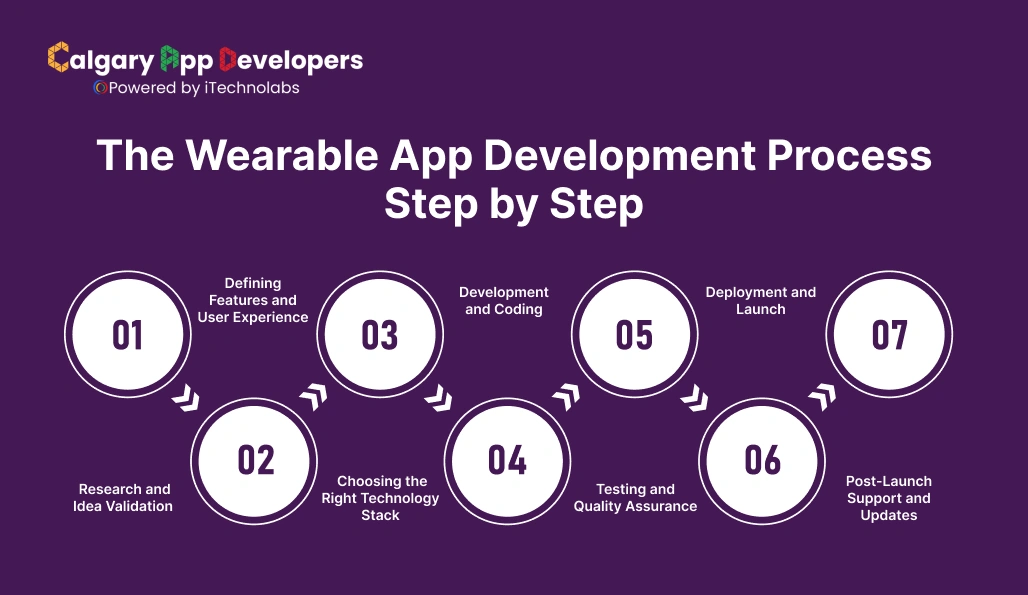
Creating a successful wearable app is not just about writing code. It involves a series of carefully planned steps, each of which ensures that the final product is useful, reliable, and aligned with user needs. Here is a breakdown of the process.
Step 1: Research and Idea Validation:
The first step in wearable app development is understanding the problem you want to solve.
- User research: Identify the target audience, such as fitness enthusiasts, patients, or industrial workers.
- Market analysis: Study existing wearable apps to understand what works, what does not, and where your app can stand out.
- Feasibility check: Confirm that the app idea can realistically work within the hardware and software limitations of wearable devices.
Step 2: Defining Features and User Experience:
Once the idea is validated, the focus shifts to deciding what features the app will include.
- Core functionality: Choose the single most important task the app must perform, such as health monitoring or navigation.
- User flow: Map out how users will interact with the app step by step.
- Interface design: Keep visuals simple, easy to read, and designed for quick actions on small screens.
Step 3: Choosing the Right Technology Stack:
Wearable app development involves selecting tools that match the target platform.
- Operating systems: Decide whether to build for Wear OS, watchOS, Fitbit OS, or a specialized medical device.
- Connectivity: Plan how the wearable app will connect with smartphones, cloud servers, or IoT devices.
- APIs and SDKs: Use the right frameworks offered by device makers to access sensors and other hardware features.
Step 4: Development and Coding:
This is where the app starts taking shape.
- Frontend development: Build the user interface with smooth navigation and responsive design.
- Backend development: Create the server-side system to handle data storage, syncing, and security.
- Integration with sensors: Ensure accurate data capture from hardware components such as accelerometers, GPS, or heart rate monitors.
Step 5: Testing and Quality Assurance:
Wearable apps need extensive testing because they operate in real-world, mobile environments.
- Functional testing: Check whether all features work as expected.
- Performance testing: Measure speed, responsiveness, and battery efficiency.
- Usability testing: Ensure that users can easily interact with the app in practical situations, such as while exercising or working.
- Compatibility testing: Verify performance across multiple devices and operating system versions.
Step 6: Deployment and Launch:
Once tested, the app is prepared for release.
- App store submission: Publish the app on Google Play, Apple App Store, or a specialized marketplace.
- Compliance checks: For medical or enterprise apps, ensure that the app follows legal and industry regulations.
- Marketing strategy: Promote the app to the target audience with messaging that highlights its unique benefits.
Step 7: Post-Launch Support and Updates:
Wearable app development does not end at launch. Ongoing support ensures long-term success.
- Bug fixes and updates: Regularly patch issues and update the app to remain compatible with new devices.
- User feedback analysis: Collect and analyze user reviews and behavior data to improve the app.
- Feature expansion: Add new functions based on user needs and market trends.
Read Also: Augmented Reality in Mobile Apps: Trends and Insights
Common Challenges and Practical Solutions
Wearable app development opens exciting opportunities, but it also brings unique challenges that differ from traditional mobile apps. Addressing these issues early ensures the app is not only functional but also sustainable in the long run.
- Limited Screen Size
- Challenge: Wearables have very small displays, which restricts how much information can be shown at once. Overloading the interface makes the app confusing and hard to use.
- Solution: Focus on minimal design. Use large fonts, bold icons, and one action per screen. Prioritize critical information and keep navigation simple. Apple’s Activity Rings are a perfect example of how complex data can be simplified visually.
- Battery Consumption
- Challenge: Wearables run on small batteries, and heavy apps can drain them quickly. Continuous data syncing or sensor use worsens the problem.
- Solution: Optimize code to reduce background processes. Use power-efficient APIs, batch data syncing, and leverage low-energy Bluetooth. Apps like Fitbit delay cloud uploads until connected to Wi-Fi or a phone, saving energy.
- Hardware and Platform Fragmentation
- Challenge: Different wearables run on different operating systems like Wear OS, watchOS, Fitbit OS, and proprietary medical platforms. Hardware such as sensors and displays also varies widely.
- Solution: Choose the primary platform based on your audience and design with scalability in mind. Use cross-platform frameworks when possible, and test on multiple devices before launch.
- Data Privacy and Security
- Challenge: Wearables often collect sensitive personal and health data. A single breach can damage trust and lead to legal issues.
- Solution: Implement end-to-end encryption, secure authentication, and transparent privacy policies. Follow standards such as HIPAA for healthcare apps. Apple HealthKit is a model for privacy-first wearable app development.
- Real-Time Data Accuracy
- Challenge: Wearable devices must collect and process data instantly, but sensor inaccuracies or connectivity issues can lead to unreliable insights.
- Solution: Combine sensor data with algorithms that filter noise and improve accuracy. Provide clear disclaimers about limitations, and allow syncing with smartphones for deeper processing.
- Connectivity Issues
- Challenge: Wearables often depend on Bluetooth or Wi-Fi to sync with other devices. Poor connectivity disrupts the user experience.
- Solution: Build offline-first features that let the app function without constant internet. For instance, a smartwatch can track a run offline and sync the data once reconnected.
- User Engagement and Retention
- Challenge: Many wearable apps lose relevance if they feel repetitive or intrusive. Users may stop using them after the novelty wears off.
- Solution: Personalize the experience with adaptive goals, contextual reminders, and rewards. Gamification, such as streaks or achievement badges, helps keep users motivated.
Also Check: Fitness App Development Cost | Complete Guide
Future and Upcoming Innovations in Wearable App Development
Wearable app development is moving into a phase where devices will feel less like gadgets and more like intelligent extensions of the human body. The next wave of innovation is focused on deeper personalization, smarter automation, and tighter integration with daily life.
- AI-Driven Predictive Health Insights:
Future wearable apps will move beyond tracking and start predicting. Instead of showing past data, apps will use AI to identify patterns and warn users before issues arise. This includes predicting fatigue, stress overload, dehydration, or potential cardiac irregularities based on long-term behavior and biometric trends. For healthcare, this shift from reactive to preventive care will be a major breakthrough.
- Noninvasive Advanced Biometric Sensors:
New sensor technologies are being developed to measure blood glucose, hydration levels, blood pressure, and hormone changes without needles or patches. As these sensors mature, wearable apps will gain access to clinical-grade data, opening doors for chronic disease management, elderly care, and medical diagnostics outside hospital settings.
- Context-Aware and Adaptive Interfaces:
Future wearable apps will automatically adapt based on user context. A watch interface may change during workouts, meetings, sleep, or driving without manual input. Notifications will become smarter, surfacing only what matters in that moment. This reduces distraction and makes wearables feel more intuitive rather than demanding attention.
- AR-Enabled Wearables for Everyday Tasks:
Augmented reality wearables are expected to move from niche use cases into everyday workflows. Apps will guide users visually through tasks such as equipment repair, navigation, training, or shopping. Instead of checking instructions on a phone, users will see real-time guidance layered directly onto their surroundings.
- Deeper Integration with Smart Environments
Wearable apps will increasingly act as control hubs for smart homes, vehicles, and workplaces. A wearable could adjust lighting, temperature, or security based on the user’s location and routine. In offices and factories, wearables will interact with machines and systems to improve safety and efficiency automatically.
- Emotion and Mental State Detection
Emerging research is enabling wearables to detect emotional states using heart rate variability, voice patterns, and movement data. Apps may soon support mental health by identifying anxiety, burnout, or mood changes and responding with breathing exercises, reminders, or professional support options at the right time.
- Longer Battery Life Through Smarter Software
While hardware improvements will continue, major gains will come from software optimization. Future wearable apps will use adaptive syncing, edge processing, and event-based sensor activation to extend battery life without sacrificing functionality.
Wearable app development in the coming years will be less about adding features and more about creating intelligent, invisible experiences. Apps that anticipate needs, respect attention, and deliver value in the background will define the next generation of wearables.
Conclusion
Wearable app development is no longer a futuristic concept. It is here, shaping how people monitor health, stay productive, and interact with technology in ways that feel natural and immediate. From smartwatches that help users track wellness to enterprise wearables that improve workplace safety, the possibilities are expanding with every new device.
For businesses, the message is clear. Investing in wearable app development today means staying relevant in a market that is set to grow rapidly in the years ahead. The key lies in building apps that are simple, efficient, secure, and tailored to real user needs.
At Calgary App Developers, we specialize in creating powerful and user-friendly wearable applications that fit seamlessly into daily life. Whether your goal is to launch a health-focused app, streamline operations with enterprise solutions, or explore immersive AR experiences, our team can help bring your vision to life.
If you are ready to explore the future of technology, now is the time to start. Calgary App Developers can guide you through every step of wearable app development, from idea to launch and beyond.
FAQ’s For Wearable App Development:
1. How much does it cost to develop a wearable app?
The cost of wearable app development depends on factors like complexity, features, platform, and integrations. A basic fitness tracker app may cost between $20,000 and $40,000, while advanced healthcare or enterprise solutions can range upwards of $100,000. Working with an experienced team ensures better efficiency, faster timelines, and long-term value.
2. How do you make a wearable app?
Wearable app development begins with market research and feature planning, followed by UI design tailored for small screens. Developers then choose the right platform, such as Wear OS, watchOS, or Fitbit OS, and integrate necessary sensors or APIs. After coding and testing, the app is launched on app stores, with updates and improvements handled post-release.
3. What are the benefits of outsourcing wearable application development?
Outsourcing wearable app development saves time, reduces costs, and provides access to specialized expertise. Experienced development teams bring knowledge of platforms, sensors, and compliance requirements that in-house teams may lack. Outsourcing also speeds up the process, ensures better scalability, and allows businesses to focus on strategy while professionals handle technical execution.
4. How long does wearable app development take?
The timeline depends on complexity. A simple smartwatch app with core features may take 2 to 4 months, while advanced apps for healthcare or enterprise use can take 6 to 12 months or more. Factors such as integrations, design complexity, testing, and compliance requirements all influence development speed and delivery.
5. What are some popular real-life examples of wearable apps?
Popular examples include Apple Health and Fitbit, which track activity, heart rate, and sleep patterns. Google Maps for smartwatches offers quick navigation on the wrist, while Spotify lets users control music hands-free. In healthcare, Dexcom G7 continuously monitors glucose levels. These apps show how wearable app development enhances convenience, health, and real-time access to information.


Pankaj Arora is a seasoned technology leader and the Founder of Calgary App Developer, with 10+ years of expertise in crafting high-performance digital solutions. His core competencies include full-stack app development, cloud-native architecture, API integration, and agile product delivery. Under his leadership, Calgary App Developers has empowered startups and enterprises alike with scalable mobile applications, secure web platforms, and AI-driven SaaS products.