








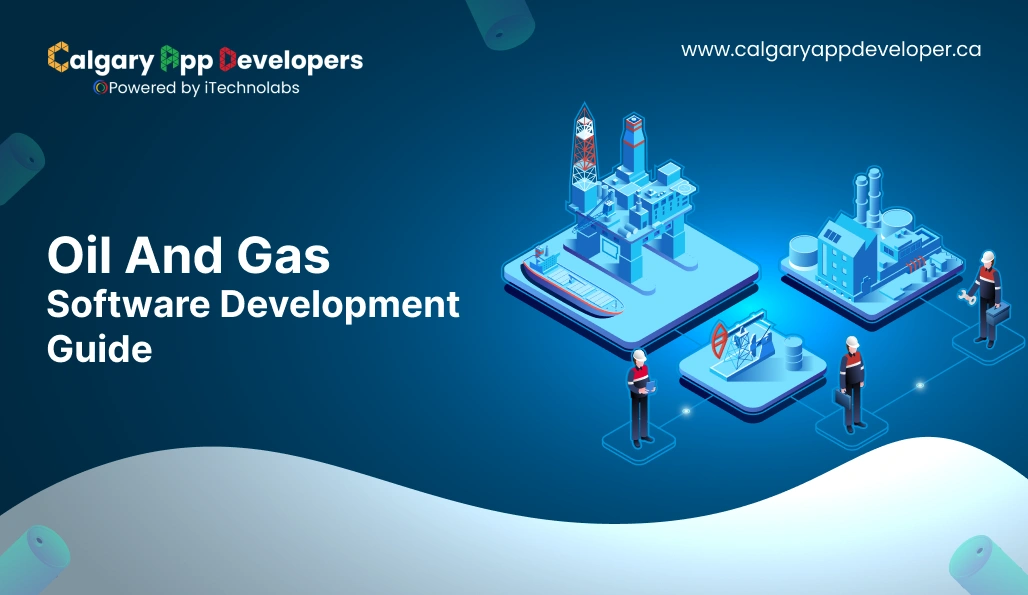
Oil and Gas Software Development Guide
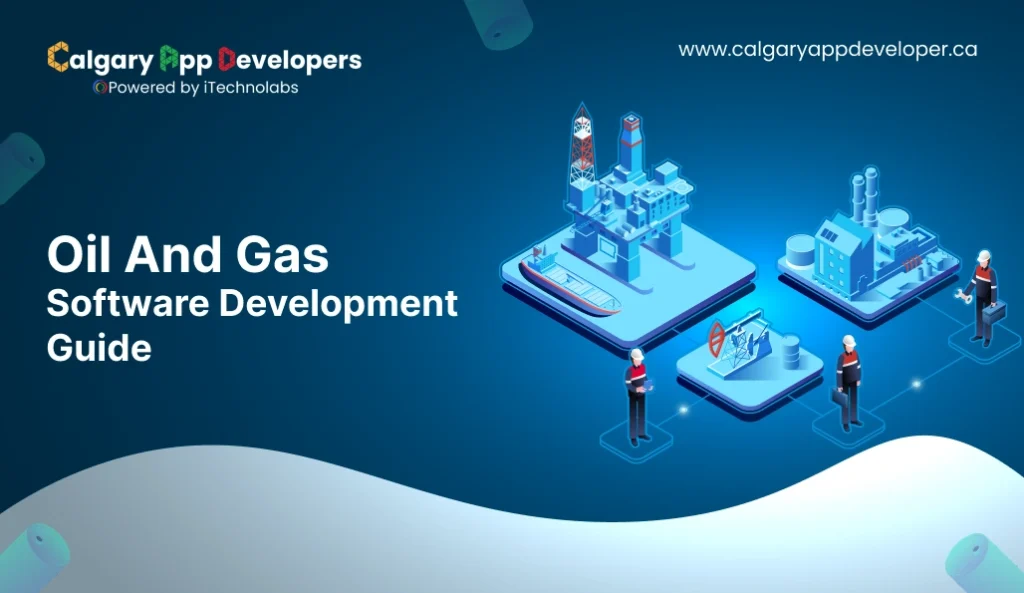
The oil and gas sector revolves around accuracy, data, and lightning-fast decisions. Every process from exploration to distribution relies heavily on systems that are capable of executing complex processes without margin for error. This is where oil and gas software development provides significant value.
Choosing an appropriate software solution doesn’t only create pathways for improved workflows. It also assists businesses in asset management, monitors production in real time, and anticipates maintenance needs ahead of damaging failures. Whether it’s helping in drilling improvement, enhancing safety standards, or overseeing logistics, custom software is changing how energy companies conduct their business.
This guide examines oil and gas software development, why it is becoming a necessity for contemporary energy operations, and how businesses design solutions that get results.
- Oil and gas software development supports complex, data-driven operations.
- Custom solutions improve efficiency, safety, and decision-making.
- Digital tools help manage assets, compliance, and scalability.
- Future-ready software enables long-term operational resilience.
- Oil and gas software development enables companies to manage exploration, production, logistics, and compliance through integrated digital systems.
- Custom software aligns technology with operational workflows, allowing businesses to reduce downtime, improve productivity, and respond faster to operational risks.
- Advanced analytics, AI, and real-time monitoring turn large volumes of operational data into actionable insights that support smarter decisions.
- Scalable and flexible software architectures help companies adapt to regulatory changes, operational growth, and emerging technologies.
- Investing in tailored software solutions strengthens safety standards, improves regulatory compliance, and supports sustainable long-term performance.
Understanding Oil and Gas Software Development
Oil and gas software development focuses on creating digital solutions that improve how energy companies operate, analyze data, and make decisions. It covers everything from exploration and drilling to refining and transportation. These software systems help teams track performance, manage assets, and ensure safety and compliance across highly regulated operations.
The industry generates enormous amounts of data from sensors, rigs, pipelines, and refineries every second. Without the right technology, most of that information goes unused. Custom-built software turns that raw data into insights that help companies boost efficiency, reduce downtime, and cut operational costs.
What this really means is that oil and gas software development isn’t just about coding applications. It’s about designing intelligent systems that support field workers, engineers, and decision-makers alike. When done right, it creates a connected ecosystem where every part of the operation works together with accuracy and speed.
Why Investing in Oil and Gas Software Development Matters for Businesses
Investing in oil and gas software development isn’t just a strategic choice; it’s becoming essential for businesses aiming to stay competitive and efficient in a rapidly evolving industry.
- Consider this: the global oil and gas software market was valued at USD 1.25 billion in 2024 and is projected to reach USD 2.03 billion by 2031, growing at a compound annual growth rate (CAGR) of 6.89%.
This growth is driven by the increasing complexity of operations and the need for real-time data analytics, predictive maintenance, and regulatory compliance.
- In Canada, the digital transformation is equally compelling. The Canadian software market generated a revenue of USD 73.34 billion in 2024 and is expected to reach USD 139.48 billion by 2030, growing at a CAGR of 11.2%
- Within this, the digital oilfield solutions market is projected to grow from USD 1.06 billion in 2024 to USD 1.76 billion by 2032, at a CAGR of 6.56%
These figures underscore a clear trend: businesses investing in digital solutions are positioning themselves for long-term success.
- Moreover, Calgary’s tech ecosystem is thriving. In 2025, till now the city attracted near-record venture capital investments exceeding $195 million, signaling strong investor confidence in technology-driven industries.
This environment fosters innovation and collaboration, making it an ideal location for businesses to develop and implement cutting-edge software solutions.
The takeaway is straightforward: investing in oil and gas software development is not just about keeping up; it’s about leading the way in operational efficiency, safety, and sustainability. As the industry continues to embrace digital transformation, those who invest in the right technologies will be best positioned to thrive in the future.
Also Check: What is Commercial-Off-the-Shelf (COTS) Software
Major Types of Oil and Gas Software
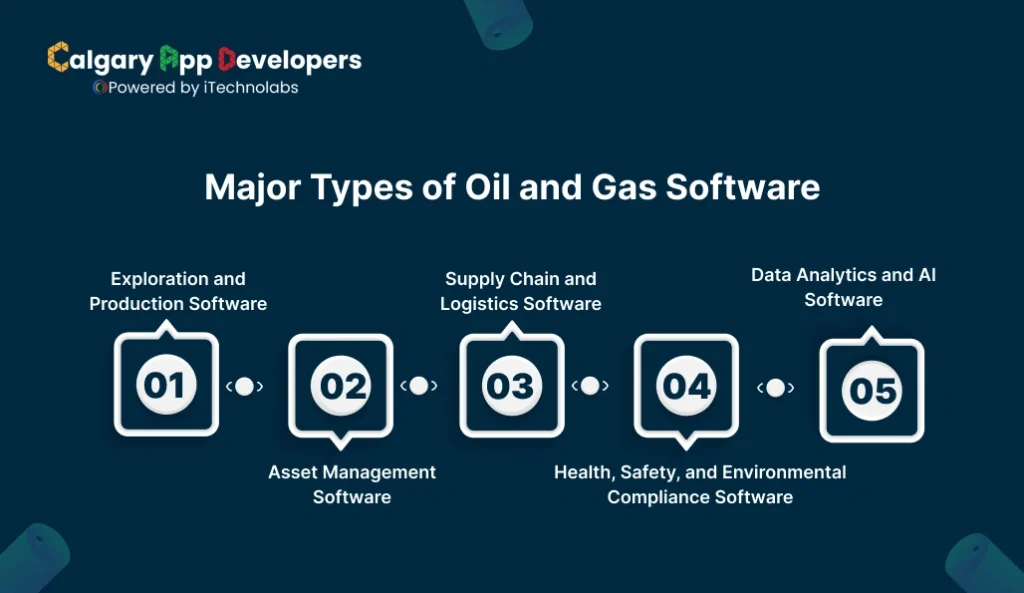
Oil and gas software development covers a range of solutions designed to address the unique challenges of each stage in the industry. These solutions improve operational efficiency, safety, and decision-making. Here’s a breakdown of the major types:
-
Exploration and Production Software
This software helps companies locate and extract resources more efficiently. It includes tools for geophysical data analysis, reservoir modeling, and drilling optimization. Engineers can simulate extraction scenarios, predict outcomes, and reduce operational risks before committing to expensive drilling operations.
-
Asset Management Software
Maintaining pipelines, rigs, and refineries requires constant monitoring. Asset management software tracks equipment performance, schedules preventive maintenance, and predicts failures. This reduces downtime, extends the lifespan of critical assets, and saves significant operational costs.
-
Supply Chain and Logistics Software
Oil and gas supply chains are complex, involving storage, transportation, and delivery. This type of software optimizes inventory management, tracks shipments, and streamlines transportation routes. The result is a more efficient flow of resources from production to market.
-
Health, Safety, and Environmental Compliance Software
Safety and regulatory compliance are critical in the oil and gas sector. These solutions monitor workplace safety, environmental impact, and adherence to regulations. They help prevent accidents, reduce environmental risks, and ensure that companies meet government and industry standards.
-
Data Analytics and AI Software
The industry generates enormous amounts of data from sensors, rigs, and refineries. Analytics and AI software transform this raw data into actionable insights. Companies can predict maintenance needs, optimize production, and make smarter operational decisions based on real-time information.
By investing in oil and gas software development across these categories, companies can boost productivity, reduce costs, improve safety, and make data-driven decisions. Each type of software addresses a specific operational need, creating a connected and efficient ecosystem for modern energy operations.
Key Challenges Oil and Gas Businesses Face Today
Oil and gas operations are among the most complex in any industry. Business owners are under constant pressure to improve performance while managing risk, cost, and compliance. Generic tools often fall short because they are not built for the realities of this sector.
- Fragmented operations and disconnected systems: Many companies rely on multiple tools for drilling, production, asset management, and reporting. These systems rarely communicate well, leading to data silos, delays, and inconsistent decision-making.
- Limited visibility into real-time operations: Field data is often delayed, incomplete, or difficult to access. This makes it harder for leadership to respond quickly to equipment issues, production inefficiencies, or safety risks.
- Manual processes and operational inefficiencies: Spreadsheets, manual reporting, and paper-based workflows still exist across many operations. These processes increase errors, slow down teams, and reduce overall productivity.
- Difficulty managing and using large volumes of data: Oil and gas operations generate massive amounts of data from sensors, equipment, and field activities. Without the right systems, this data remains underutilized instead of driving smarter decisions.
- Scaling challenges as operations grow: As assets expand or new fields come online, existing software often cannot adapt. Businesses are forced to bolt on new tools, increasing complexity rather than reducing it.
- Regulatory compliance and safety pressures: Meeting industry regulations and maintaining safety standards requires accurate reporting, traceability, and monitoring. Generic software rarely aligns fully with specific regulatory and operational requirements.
These challenges are exactly why many oil and gas companies move away from off-the-shelf tools. Custom oil and gas software addresses these issues directly by aligning technology with how the business actually operates.
Advantages of Building Custom Oil and Gas Software
Off-the-shelf software can handle basic tasks, but oil and gas operations are complex, unique, and constantly evolving. That’s why businesses are turning to custom oil and gas software development. Tailor-made solutions address specific operational needs, delivering advantages that generic software simply cannot match.
-
Operations Aligned to Business Needs
Custom software is built to match a company’s workflow, equipment, and operational requirements. Whether it’s drilling schedules, pipeline monitoring, or refinery management, the software adapts to the business rather than forcing the business to adapt to it.
-
Enhanced Efficiency and Productivity
With tailored features and automation, custom software reduces manual processes, minimizes errors, and accelerates decision-making. Engineers, field workers, and management can access the right data at the right time, improving overall operational efficiency.
-
Better Data Management and Analytics
Oil and gas operations generate vast amounts of data. Custom solutions can aggregate data from multiple sources, analyze trends, and generate actionable insights. This leads to predictive maintenance, optimized production, and more informed strategic decisions.
-
Scalability and Future-Readiness
As operations grow or evolve, custom software can be updated or expanded to meet new requirements. Companies are not limited by the constraints of generic solutions and can incorporate emerging technologies like IoT, AI, and advanced analytics seamlessly.
-
Compliance and Safety Optimization
Custom solutions can be designed to meet specific regulatory standards and safety protocols. This ensures that companies remain compliant, reduce risks, and maintain high safety standards across operations.
-
Cost Efficiency Over Time
While initial investment may be higher, custom oil and gas software development pays off by reducing downtime, avoiding operational inefficiencies, and minimizing reliance on multiple disconnected tools.
Custom software is not just a tool; it’s an investment in operational intelligence, safety, and long-term efficiency. Companies that prioritize tailored solutions gain a competitive edge by running smarter, safer, and more data-driven operations.
Read Also: Top Software Developers Calgary: 15 Best Sites to Hire
Essential Features to Include in Oil and Gas Software
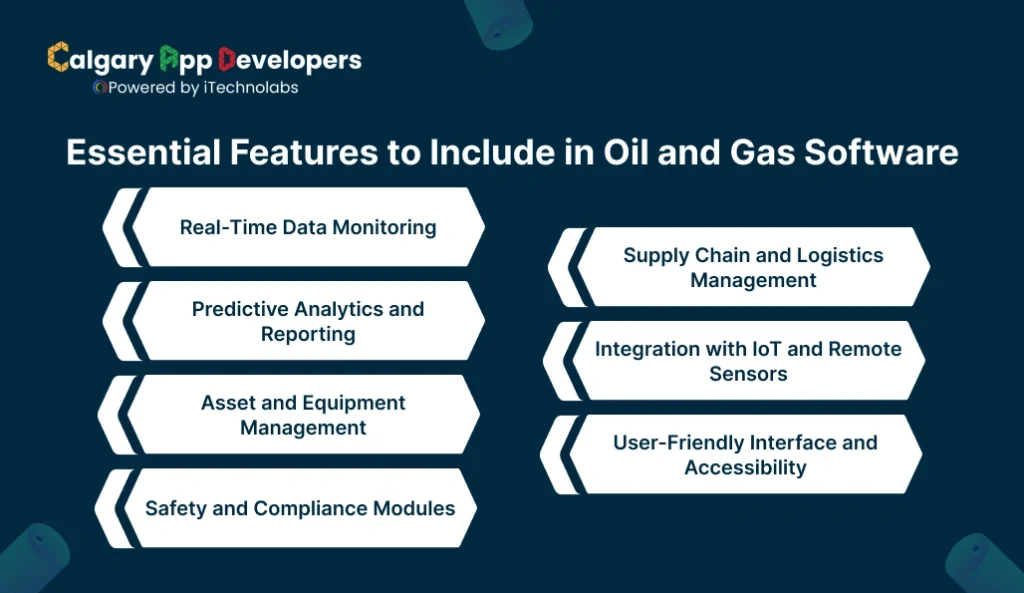
Creating effective oil and gas software development solutions means focusing on the features that directly impact operations, safety, and decision-making. The right combination of tools can transform raw data into actionable insights and streamline processes across exploration, production, and distribution. Here are the essential features companies should prioritize:
-
Real-Time Data Monitoring:
Operations rely on accurate, up-to-the-minute information from rigs, pipelines, and refineries. Real-time monitoring allows teams to detect anomalies, track performance, and respond to issues immediately, minimizing downtime and risk.
-
Predictive Analytics and Reporting:
Advanced analytics help anticipate equipment failures, forecast production trends, and optimize resource allocation. Customizable reporting tools turn complex data into insights that management and engineers can act on quickly.
-
Asset and Equipment Management:
Tracking the condition and performance of critical infrastructure is crucial. Software should provide maintenance scheduling, lifecycle tracking, and performance metrics to prevent costly breakdowns and extend asset life.
-
Safety and Compliance Modules:
Monitoring safety protocols and regulatory compliance is non-negotiable in the oil and gas industry. Integrated safety and compliance features ensure adherence to standards, reduce workplace risks, and simplify audits and reporting.
-
Supply Chain and Logistics Management:
Effective software connects production, storage, and transportation. Features that manage inventory, optimize transportation routes, and track deliveries ensure smoother supply chain operations and reduce operational bottlenecks.
-
Integration with IoT and Remote Sensors:
Modern operations increasingly rely on IoT devices for data collection. Software should integrate seamlessly with sensors and field devices to provide a complete picture of operations and enable automation where possible.
-
User-Friendly Interface and Accessibility:
Even the most advanced system is only effective if teams can use it efficiently. Intuitive interfaces, mobile access, and clear dashboards ensure field operators, engineers, and management can navigate the software effortlessly.
By incorporating these features into oil and gas software development, companies gain a toolset that drives operational efficiency, enhances safety, and turns complex data into actionable strategies, positioning them for sustainable growth and improved decision-making.
Step-by-Step Guide to Developing Oil and Gas Software
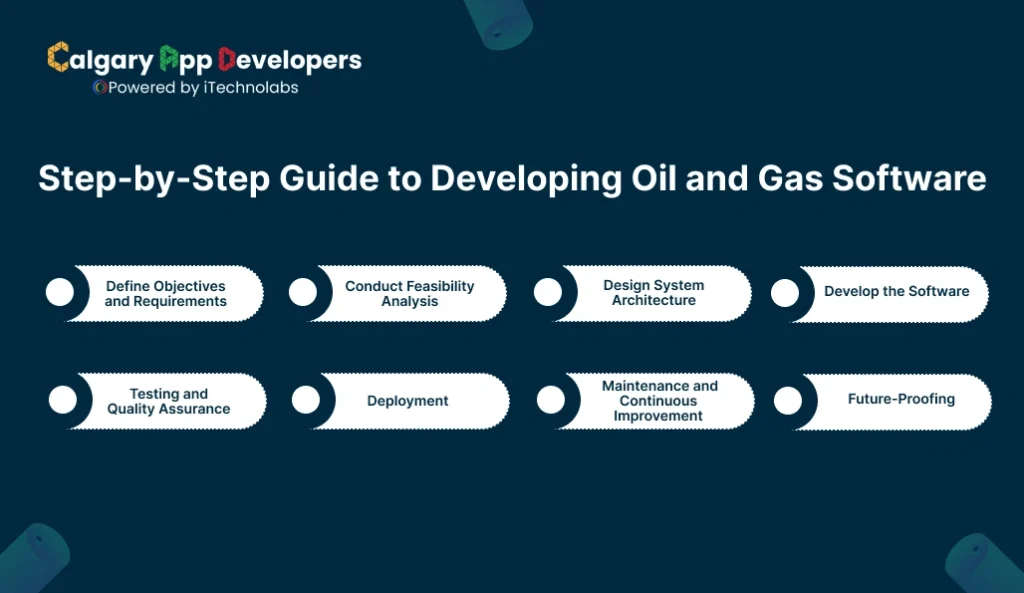
Developing effective oil and gas software development solutions is not just about writing code. It requires a deep understanding of industry-specific challenges, meticulous planning, and collaboration across multiple teams. The goal is to build software that improves operational efficiency, enhances safety, and enables data-driven decision-making. Here’s a comprehensive step-by-step guide to the process:
Step 1: Define Objectives and Requirements
The first step is understanding exactly what the software needs to achieve.
- Identify Operational Needs: Pinpoint areas where digital solutions can bring the most value. This could include monitoring drilling operations, optimizing pipeline flow, tracking inventory, or automating reporting.
- Stakeholder Consultation: Gather input from engineers, field operators, management, and IT teams. Each group interacts with operations differently, so their feedback ensures the software addresses real-world challenges.
- Regulatory and Compliance Considerations: Oil and gas is highly regulated. Understanding local and international standards for safety, environmental impact, and reporting is critical to avoid fines and maintain operational integrity.
- Define Key Performance Indicators (KPIs): Establish clear metrics for success, such as reduced downtime, faster reporting, improved safety compliance, or cost savings.
Step 2: Conduct Feasibility Analysis
Not every idea is feasible. Evaluating practicality at the outset saves time and resources.
- Technical Feasibility: Assess whether the current IT infrastructure can support the new software and if necessary hardware upgrades are required.
- Budget and Timeline Assessment: Estimate development costs, resource allocation, and realistic delivery timelines to align expectations.
- Risk Analysis: Identify potential challenges such as operational disruptions, cybersecurity risks, and integration difficulties, and plan strategies to mitigate them.
Step 3: Design System Architecture
The architecture is the blueprint of the software, defining how each component will function and interact.
- Modular Design: Organize the software into separate modules like monitoring, analytics, compliance, and asset management. This approach makes future updates easier and limits disruptions.
- Database Planning: Design robust data storage and retrieval systems to handle massive volumes of operational data securely.
- Integration Strategy: Ensure the software can seamlessly communicate with existing enterprise systems, IoT devices, and other digital tools.
Step 4: Develop the Software
This phase transforms plans and designs into functional software.
- Backend Development: Create the core logic, databases, and APIs that manage data flow and system operations.
- Frontend Development: Build user interfaces that are intuitive and accessible, allowing engineers and operators to interact with the system effortlessly.
- Automation and Analytics Implementation: Integrate predictive maintenance tools, AI-driven analytics, and real-time monitoring features to convert data into actionable insights.
- Security Measures: Implement robust cybersecurity protocols to protect sensitive operational and corporate data from threats.
Step 5: Testing and Quality Assurance
Thorough testing ensures the software is reliable, efficient, and safe for real-world use.
- Functional Testing: Verify that all modules and features work according to specifications.
- Performance Testing: Assess speed, scalability, and stability under heavy operational loads.
- Compliance Testing: Confirm the system meets all regulatory and safety standards.
- User Acceptance Testing (UAT): Engage end-users to ensure the software meets practical requirements and is easy to use.
Step 6: Deployment
Rolling out the software requires careful planning to avoid operational disruption.
- Staged Deployment: Introduce the software gradually, starting with a pilot phase to address issues before full-scale adoption.
- Training and Documentation: Provide comprehensive guides and training sessions to ensure all users can operate the system effectively.
- Integration with Existing Systems: Seamlessly connect the software with existing enterprise tools and infrastructure for smooth operations.
Step 7: Maintenance and Continuous Improvement
Deployment is not the end of the journey. Continuous updates and monitoring are critical.
- Regular Updates: Patch vulnerabilities, introduce new features, and enhance performance.
- Real-Time Monitoring: Track software performance and detect anomalies before they impact operations.
- Feedback Loops: Use feedback from field teams and management to refine functionalities and improve user experience.
Step 8: Future-Proofing
To remain effective over time, software must evolve alongside the industry.
- IoT and AI Integration: Prepare the system to handle increased sensor data and leverage AI for predictive analytics and decision support.
- Cloud and Mobile Compatibility: Ensure remote access to critical operational data for on-the-go decision-making.
- Adaptation to Industry Trends: Keep the software flexible to accommodate new regulations, emerging technologies, and changes in operational practices.
A systematic approach to oil and gas software development ensures that solutions are not only functional but also scalable, secure, and aligned with operational goals. It reduces costly errors, enhances productivity, improves safety standards, and enables companies to make smarter, data-driven decisions.
Also Check: Top Software Companies Near Me | Local Tech Experts
Estimating the Cost of Oil and Gas Software Development
Oil & gas software development costs around USD 50,000 for an entry-level custom oil and gas software system, with costs above USD 500,000 for an enterprise solution that is fully integrated, depending on complexity and features. Costs can vary significantly depending on phases of development and different operational modules.
| Process/Module | Typical Cost Range (USD) | Description |
| Exploration and Production | 70,000 – 200,000 | Includes geophysical data analysis, reservoir modeling, drilling optimization, and simulation tools. |
| Asset Management | 50,000 – 150,000 | Covers equipment monitoring, preventive maintenance scheduling, and lifecycle tracking. |
| Supply Chain and Logistics | 40,000 – 120,000 | Manages inventory, transportation, delivery tracking, and resource optimization. |
| Health, Safety, and Compliance | 30,000 – 100,000 | Software for regulatory reporting, safety monitoring, environmental compliance, and audit support. |
| Data Analytics and AI | 60,000 – 200,000 | Predictive maintenance, real-time analytics, operational dashboards, and decision support tools. |
| Integration & Interfaces | 20,000 – 80,000 | Connects modules with existing enterprise systems, IoT devices, and cloud platforms. |
| Testing and Deployment | 15,000 – 50,000 | Quality assurance, functional and performance testing, user training, and rollout support. |
Factors Affecting the Cost of Oil and Gas Software Development
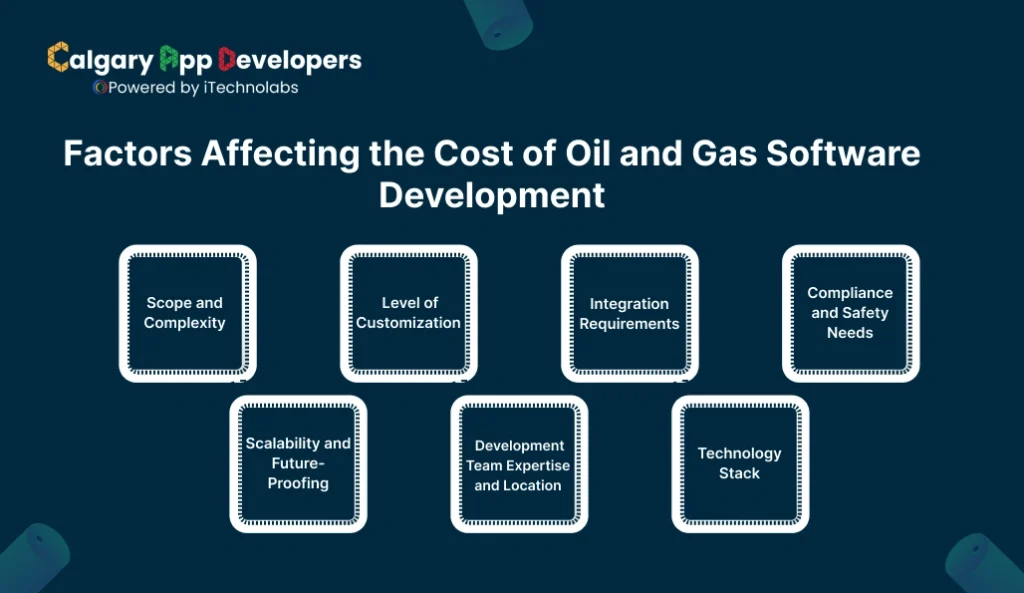
The cost of developing oil and gas software is influenced by multiple factors, each of which can significantly impact the budget. Understanding these elements helps businesses plan effectively and make informed investment decisions.
- Scope and Complexity
- More modules, features, and workflows naturally increase development costs.
- Advanced functionalities such as AI-driven predictive analytics, machine learning for optimization, or real-time IoT data integration add significant complexity.
- Complex projects require more development hours, testing, and specialized expertise.
- Level of Customization
Customization has a direct effect on cost, depending on the depth of tailoring required.
| Customization Level | Typical Cost Impact | Description |
| Off-the-Shelf | Low | Minimal tailoring, faster deployment, lower cost. |
| Partially Customized | Medium | Some modules or workflows are adapted to company needs. |
| Fully Custom | High | The entire solution is built to match operational processes and reporting requirements. |
- Integration Requirements
- Integrating new software with existing enterprise systems, IoT sensors, SCADA systems, or ERP platforms adds complexity.
- Integration often involves creating APIs, mapping data flows, and ensuring seamless communication between platforms.
- Compliance and Safety Needs
- Oil and gas operations must meet strict regulatory standards, including safety and environmental regulations.
- Development includes building reporting modules, audit trails, and real-time compliance monitoring.
- Higher compliance requirements, especially in regions like Canada, can increase development time and costs.
- Scalability and Future-Proofing
- Designing software to handle growing datasets, additional users, or new operational modules increases initial costs.
- Systems built for scalability reduce future redevelopment costs and support long-term growth.
- Development Team Expertise and Location
The location and expertise of a development team can significantly influence the overall cost and quality of oil and gas software development. Costs vary across global cities due to differences in labor rates, living expenses, and availability of industry-specialized talent.
| City / Region | Average Hourly Rate (USD) | Notes |
| San Francisco, USA | 120 – 200 | High costs driven by tech hub premiums and high living expenses. |
| London, UK | 100 – 180 | Strong tech talent, but expensive for long-term projects. |
| Bangalore, India | 25 – 60 | Affordable labor and good technical skills, but may require more coordination for international clients. |
| Calgary, Canada | 40 – 80 | Competitive rates, local oil and gas expertise, a strong industry ecosystem, and excellent infrastructure. |
| Sydney, Australia | 90 – 160 | Quality talent, moderate availability, higher project cost due to living expenses. |
While each location offers distinct advantages, Calgary presents a uniquely balanced proposition, combining specialized industry expertise with cost-effective development and seamless collaboration.
- Technology Stack
Using the right technologies ensures oil and gas software is scalable, secure, and capable of advanced analytics, real-time monitoring, and remote operations at the best price.
| Component | Purpose | Example Technologies |
| Programming Languages & Frameworks | Backend logic & APIs | Python, Java, C#, .NET, Django, Spring |
| Cloud Platforms | Storage & computing | AWS, Microsoft Azure, Google Cloud |
| AI & Big Data | Predictive analytics & optimization | TensorFlow, PyTorch, Hadoop, Spark |
| IoT Integration | Sensor & device connectivity | MQTT, OPC UA, ThingWorx, Azure IoT |
| Databases | Data storage & management | PostgreSQL, MySQL, MongoDB, InfluxDB |
| Frontend/UI | User interaction | React, Angular, Vue.js, Flutter |
Common Challenges in Oil and Gas Software Development and How to Solve Them
Developing software for the oil and gas industry comes with unique challenges. Operations are complex, data-intensive, and heavily regulated, so solutions must be precise, reliable, and scalable. Understanding these challenges and strategies to address them helps companies implement software that truly delivers value.
1. Handling Large Volumes of Data
- Challenge: Oil and gas operations generate massive amounts of sensor, drilling, and production data. Managing, storing, and analyzing this data can overwhelm standard systems.
- Solution: Implement scalable cloud-based storage, efficient database management, and big data analytics tools. AI-driven analytics can process real-time data streams for actionable insights.
2. Integration with Legacy Systems
- Challenge: Many companies rely on legacy SCADA, ERP, or asset management systems. Integrating new software without disrupting operations is difficult.
- Solution: Use APIs and middleware to connect new modules with existing systems. Adopt modular development to allow phased integration, minimizing operational disruptions.
3. Ensuring Compliance and Safety
- Challenge: Oil and gas is highly regulated. Software must support safety protocols, environmental monitoring, and regulatory reporting.
- Solution: Build compliance and safety modules directly into the software. Automate reporting, audit trails, and safety alerts to reduce human error and maintain standards.
4. Managing High Costs and Budget Constraints
- Challenge: Custom oil and gas software development can be expensive, especially for advanced analytics or IoT integration.
- Solution: Prioritize features that deliver the highest ROI first. Start with a minimum viable product (MVP) and scale functionality gradually. Consider Calgary-based development teams for cost-effective solutions without compromising quality.
5. Scalability and Future-Proofing
- Challenge: Oil and gas operations grow, and software must adapt to new sensors, modules, and technologies over time.
- Solution: Use modular architecture, cloud infrastructure, and flexible tech stacks. Plan for future integration with AI, IoT, and predictive analytics.
6. Ensuring User Adoption
- Challenge: Engineers, field operators, and management may resist new software if it’s difficult to use or disrupts existing workflows.
- Solution: Design intuitive interfaces, provide mobile access, and conduct thorough training. Engage end-users early in development to ensure the software aligns with operational needs.
Challenges in oil and gas software development are significant but manageable. By focusing on scalable data management, smooth integration, compliance, cost control, and user-centric design, companies can create systems that improve efficiency, safety, and decision-making across operations.
Read Also: Top 20 Software Companies in Calgary, Alberta
Emerging Trends Shaping the Future of Oil and Gas Software
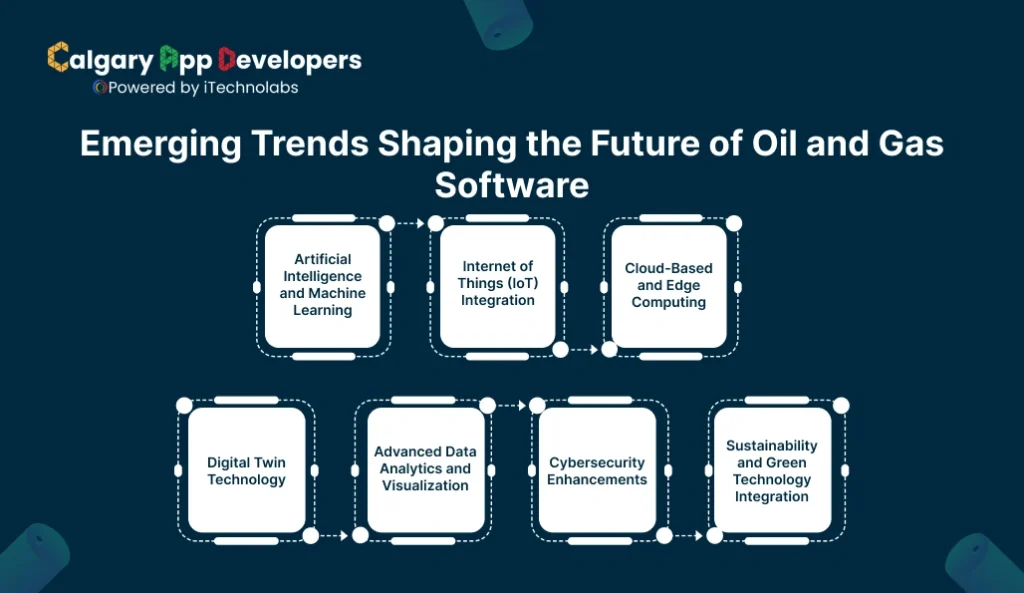
Oil and gas software development is evolving rapidly as the industry embraces digital transformation. New technologies are changing how companies manage operations, analyze data, and make strategic decisions. Understanding these trends helps businesses stay competitive and future-ready.
1. Artificial Intelligence and Machine Learning
- AI and machine learning are no longer limited to predictive maintenance.
- They optimize drilling operations, forecast production, and automate operational decisions.
- Advanced algorithms analyze large volumes of sensor and operational data to uncover patterns that humans may miss, improving efficiency and reducing errors.
2. Internet of Things (IoT) Integration
- IoT devices are increasingly deployed across rigs, pipelines, and refineries.
- Connecting these devices to software platforms enables real-time monitoring, automated alerts, and predictive maintenance.
- The result is safer operations, faster issue resolution, and better asset management.
3. Cloud-Based and Edge Computing
- Cloud platforms provide centralized storage and analytics capabilities.
- Edge computing processes data locally at remote sites or rigs, reducing latency and enabling faster decision-making.
- This combination allows oil and gas companies to scale operations efficiently while maintaining real-time operational control.
4. Digital Twin Technology
- Digital twins are virtual replicas of physical assets, pipelines, or entire facilities.
- They enable simulation, predictive modeling, and scenario testing without disrupting real operations.
- Companies can optimize performance, reduce risks, and anticipate maintenance needs before issues occur.
5. Advanced Data Analytics and Visualization
- Analytics platforms transform raw operational data into actionable insights.
- Interactive dashboards and visualizations help engineers, operators, and managers make faster, data-driven decisions.
- Predictive insights allow for better resource allocation, improved production efficiency, and cost reduction.
6. Cybersecurity Enhancements
- As software systems become more connected, protecting operational data and infrastructure is critical.
- Emerging cybersecurity solutions focus on real-time threat detection, secure cloud integration, and compliance with industry regulations.
- Strong cybersecurity safeguards prevent operational disruptions and protect sensitive corporate information.
7. Sustainability and Green Technology Integration
- Software is increasingly used to monitor environmental impact, optimize energy use, and support sustainability initiatives.
- IoT and analytics solutions track emissions, reduce waste, and ensure compliance with environmental regulations.
- Sustainable practices not only reduce costs but also enhance corporate reputation and regulatory compliance.
The future of oil and gas software development is intelligent, connected, and sustainability-focused. Companies that adopt these trends gain operational efficiency, minimize risks, and position themselves for long-term growth in a rapidly evolving energy landscape.
Why Partner with Calgary App Developers for Oil and Gas Software Development
When it comes to oil and gas software development, choosing the right partner can make all the difference. Calgary App Developers offers a combination of industry knowledge, technical expertise, and local insight that ensures software solutions are tailored to the unique needs of energy companies. Here’s why partnering with us is the smart choice:
First, our team has deep industry expertise. Being based in Calgary, a central hub for oil and gas operations in Canada, we understand the operational realities from exploration and production to logistics and asset management. This allows us to build software that aligns perfectly with the workflow and challenges of the sector.
Second, our solutions are cost-effective. Compared with major global tech hubs, Calgary offers highly skilled developers at competitive rates. Partnering with us gives access to top-tier talent without inflated international costs.
Third, we have strong local knowledge and compliance expertise. Navigating Canada’s regulatory landscape requires software that meets strict safety, environmental, and reporting standards. Our solutions are designed to be compliant and audit-ready.
Additionally, Calgary App Developers provides full-service capabilities:
- Consultation and requirement analysis
- System design and development
- Integration with legacy systems and IoT devices
- Ongoing maintenance and support
We also excel in advanced technology: AI, IoT, cloud computing, digital twins, and big data analytics. This ensures that every solution we develop is scalable, secure, and future-ready.
Finally, our proven track record speaks for itself. We have successfully delivered custom software solutions across upstream, midstream, and downstream operations, translating complex requirements into practical, user-friendly applications that improve efficiency and decision-making.
Partnering with our software development company means gaining software solutions that are reliable, compliant, and optimized for the challenges of the oil and gas sector, while also benefiting from cost efficiency and local expertise.
Final Thoughts
Oil and gas software development is no longer optional—it’s essential for companies aiming to stay efficient, safe, and competitive in a rapidly evolving industry. From exploration and production to logistics and compliance, custom software solutions help manage complex operations, turn massive data streams into actionable insights, and optimize decision-making at every level.
The future of the sector is increasingly digital, driven by trends like AI, IoT, cloud computing, and digital twins. Companies that adopt these technologies can improve operational efficiency, reduce risks, and support sustainability initiatives while preparing for long-term growth.
Ultimately, successful software development in oil and gas relies on understanding operational challenges, selecting the right technology stack, and building solutions that are scalable, secure, and adaptable. By focusing on these principles, businesses can transform data into actionable intelligence and create systems that truly drive operational excellence.
FAQ’s About Oil and Gas Software Development:
1. How long does it take to develop oil and gas software?
The timeline for oil and gas software development varies based on complexity, scope, and required features. A basic solution can take 3 to 6 months, while comprehensive enterprise-grade software with advanced analytics, IoT integration, and AI capabilities may require 9 to 18 months. Proper planning, phased development, and thorough testing ensure timely delivery without compromising quality.
2. What is the cost of developing oil and gas software?
Costs depend on software complexity, modules, integrations, and technology choices. Basic solutions typically start around USD 50,000, while fully integrated systems with AI, cloud, and IoT capabilities can exceed USD 500,000. Factors such as customization, compliance requirements, scalability, and the development team’s expertise also influence the total investment.
3. How does oil and gas software improve operational safety?
Oil and gas software improves safety by monitoring equipment, pipelines, and field operations in real time. It automates safety alerts, tracks compliance, and generates audit-ready reports. Predictive analytics identify potential failures before they occur, reducing accidents, minimizing downtime, and ensuring regulatory standards are consistently met across operations.
4. Can oil and gas software be integrated with existing systems?
Yes, modern oil and gas software is designed for integration with legacy SCADA systems, ERP platforms, IoT devices, and asset management tools. Using APIs and modular architecture, new software can communicate seamlessly with existing infrastructure, enabling real-time data flow, operational continuity, and enhanced analytics without disrupting ongoing operations.
5. How can Calgary App Developers help with oil and Gas Software Development?
Calgary App Developers offers end-to-end expertise in oil and gas software development, including requirement analysis, system design, integration, and ongoing support. With local industry knowledge, skilled developers, and experience in AI, IoT, and cloud technologies, they deliver scalable, secure, and efficient solutions tailored to operational needs, helping companies optimize performance and decision-making.


Pankaj Arora is a seasoned technology leader and the Founder of Calgary App Developer, with 10+ years of expertise in crafting high-performance digital solutions. His core competencies include full-stack app development, cloud-native architecture, API integration, and agile product delivery. Under his leadership, Calgary App Developers has empowered startups and enterprises alike with scalable mobile applications, secure web platforms, and AI-driven SaaS products.