






Last Mile Delivery App Development: Costs & Key Features
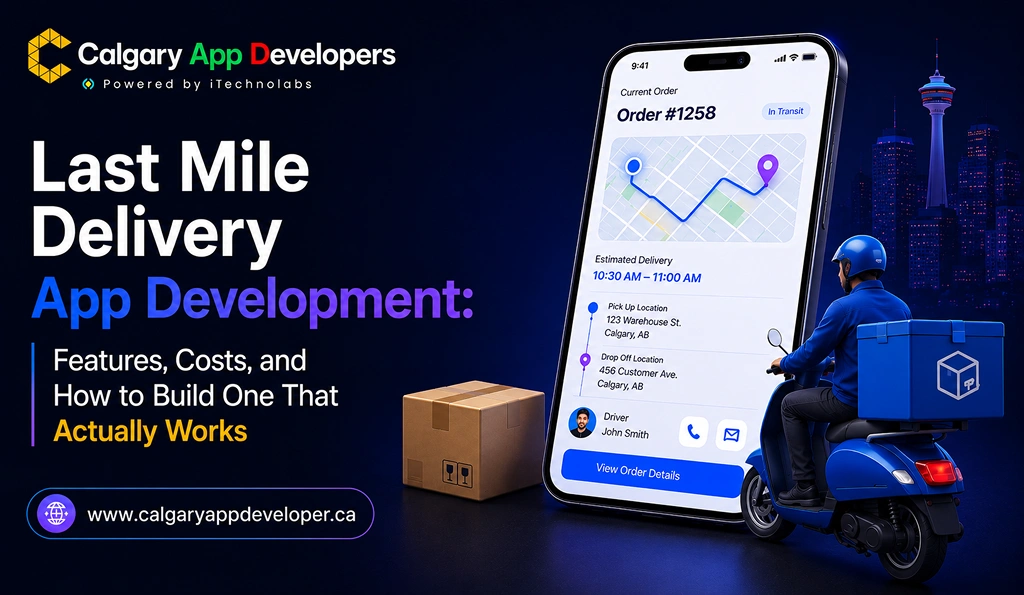
The Last Mile is where delivery businesses win or lose customer trust. Customers rarely think about warehouses, fulfillment centers, or transportation networks. What they remember is whether their order arrived on time, whether they could track it, and whether the delivery experience felt reliable. A delayed driver, inaccurate tracking information, or a missed delivery notification can quickly turn a one-time customer into a lost customer.
As eCommerce, grocery delivery, pharmacy logistics, and quick commerce continue to expand, businesses are under growing pressure to deliver faster while keeping operational costs under control. At the same time, relying on third-party delivery platforms often means paying recurring commission fees, losing visibility into operations, and giving away valuable customer data.
The market opportunity is enormous. According to Grand View Research, the global Last Mile delivery market was valued at approximately USD 167.4 billion in 2025 and is projected to reach nearly USD 348.9 billion by 2033, growing at a CAGR of 9.8%. Canada is expected to be among the fastest-growing markets during this period as consumer demand for same-day and next-day delivery continues to rise.
Industry forecasts also point toward a future shaped by AI-powered route optimization, predictive dispatching, autonomous delivery technologies, and electric vehicle fleets. Analysts expect last mile logistics networks to become increasingly automated over the next decade as businesses focus on reducing delivery costs while improving customer experience.
This shift is driving more companies to invest in custom last mile delivery applications. Instead of managing deliveries through spreadsheets, phone calls, and disconnected software tools, businesses are building platforms that provide real-time driver tracking, automated dispatching, delivery proof collection, customer notifications, and complete operational visibility.
This guide is based on our hands-on experience developing last mile delivery applications for logistics, retail, and on-demand service businesses. We’ll break down the essential features, development process, technology stack, and cost considerations involved in building a last mile delivery app that delivers measurable business results in the Canadian market.
What Is Last Mile Delivery, and Why Is It Harder Than It Sounds
Last Mile delivery is the final leg: goods move from a distribution hub to the customer’s door. You already know this. What’s worth saying out loud is why it’s disproportionately expensive and operationally painful compared to every other part of the supply chain.
Every other stage of logistics moves bulk. A truck from a warehouse to a distribution center carries hundreds of packages in a single trip. last mile delivery inverts that completely. You’ve got one driver, one vehicle, and twenty or thirty individual stops, each with its own address, time window, access instruction, and customer expectation. Traffic changes. Customers aren’t home. Addresses are wrong. The stop at 3:15 takes forty minutes because someone needs a signature and can’t find a pen.
In Canada, geography makes this worse in ways that don’t show up in American logistics software. Rural Alberta has road conditions that change with the season. Northern communities have connectivity gaps that break apps built without offline support. Even within Calgary, delivery density during peak hours creates routing problems that require local knowledge to solve properly.
The cost of getting this wrong is real. Each failed delivery attempt costs between $15 and $25 CAD once you account for the re-route, the driver time, and the customer service follow-up. At any meaningful scale, that adds up to a number that’s hard to ignore.
Also Check: How to Create a Food Delivery App: A Simple 6-Step Guide
Types of Last Mile Delivery Apps
Before starting development, it’s important to identify the type of last mile delivery app that aligns with your business model. Different solutions solve different operational challenges, and the required features, development timeline, and investment can vary significantly.
1. Route Optimization Apps
Route optimization apps are designed for small delivery teams, independent couriers, and local service providers. Their primary goal is to calculate the most efficient delivery sequence, reduce travel time, and lower fuel costs.
Typical features include route planning, GPS navigation, traffic analysis, and delivery scheduling.
2. Delivery Management Platforms
Delivery management platforms help businesses coordinate orders, drivers, dispatchers, and customers through a single system. These solutions are commonly used by retailers, logistics providers, wholesalers, and businesses handling a growing volume of deliveries.
Key capabilities often include order management, driver assignment, live tracking, delivery status updates, proof of delivery, and customer notifications.
3. Fleet Management Systems
Fleet management systems are built for organizations that operate their own vehicles and drivers at scale. In addition to delivery operations, these platforms focus on vehicle utilization, maintenance, compliance, and driver performance.
Common features include vehicle tracking, fuel monitoring, maintenance scheduling, driver behavior reporting, and regulatory compliance management.
4. On-Demand Delivery Apps
On-demand delivery applications support businesses that need to connect customers with available drivers in real time. This model is widely used in food delivery, grocery delivery, pharmacy services, courier networks, and same-day delivery operations.
Core functionality includes instant order placement, automated driver matching, real-time tracking, digital payments, and delivery confirmations.
5. Hybrid Custom Delivery Platforms
Hybrid platforms combine multiple delivery technologies into a single ecosystem. They typically include route optimization, dispatch management, fleet tracking, customer communication tools, analytics, and integrations with third-party business systems.
These platforms are best suited for companies operating across multiple regions, managing complex logistics workflows, or planning for significant growth.
Which Type Is Right for Your Business?
Most growing Canadian businesses fall somewhere between a delivery management platform and a hybrid custom solution.
If you’re launching with fewer than fifteen drivers and relatively straightforward delivery operations, a delivery management MVP often provides the fastest path to market while keeping development costs under control.
Businesses managing larger fleets, multiple delivery zones, or complex workflows involving warehouse management systems, ERP platforms, or inventory software typically benefit from a hybrid solution built for long-term scalability.
The key consideration is not just where your business is today, but where it will be two years from now. A scalable architecture can grow with your operations. A system built only for current needs often requires expensive redevelopment once delivery volumes increase.
Most growing Canadian businesses land between a delivery management platform and a hybrid solution. If you’re just starting with under fifteen drivers, a lean MVP based on core delivery management gets you running without over-building. If you’re managing fifty or more drivers across multiple zones, or you’ve got complex integration requirements with an existing WMS or ERP, the hybrid route is worth the investment.
The right call here depends on where you are today and where you need to be in two years. A well-architected app scales. A cheap one that wasn’t designed for scale gets rebuilt from scratch, which always costs more than doing it right the first time.
Also Read: How Much Does It Cost To Develop A Delivery App
Must-Have Features of a Last Mile Delivery App
Most feature lists for delivery apps are frustratingly shallow. Five or six bullets and a vague description of “real-time tracking.” That’s not a specification; it’s a marketing slide. A production-ready delivery app has to serve three completely different user groups at the same time, and cutting corners on any one of them breaks the experience for everyone else.
1. Customer-Facing Features
Your customers are the reason the whole system runs. These are the eight features that define their experience.
- Live Order Tracking on a Map: Not a status update that says “out for delivery.” A real-time map showing exactly where the driver is and a dynamically updating ETA. Uber and DoorDash have trained customers to expect this. If you can’t deliver it, you fall behind.
- Automated Notifications at Every Stage: Push notifications and SMS when the order is confirmed, a driver is assigned, the driver is en route, and the delivery is complete. Customers shouldn’t have to open the app to know what’s happening. Proactive communication eliminates the “where’s my order” support call before it happens.
- Accurate ETA Display: Shown prominently on the tracking screen and updated continuously as route conditions change. A static 2-hour window is not an ETA. It’s a guess dressed up as information.
- Delivery Scheduling and Rescheduling: The ability to select a delivery window at checkout and change it if plans change. This single feature reduces failed first-attempt deliveries more than almost anything else.
- Contactless Delivery Options: Instructions for safe drop, photo confirmation of the drop location, and digital proof of delivery are sent to the customer immediately. This matters for apartments, commercial addresses, and customers who won’t be home.
- In-app Support Messaging: Direct contact with support during the delivery window. Customers who can get a quick answer during delivery don’t leave a bad review.
- Post-Delivery Ratings and Feedback: A prompt that feeds directly into your driver performance data. You can’t improve what you’re not measuring, and customers actually use this when it’s frictionless.
- Bilingual Interface (EN/FR): If your business operates nationally, this isn’t optional. It’s a basic respect for francophone customers in Quebec, New Brunswick, and Ontario, and it’s the right thing to build from the start rather than retrofit.
2. Driver-Facing Features
Drivers are in the field with a phone mount, no desk, often spotty connectivity, and a full load to manage. Their app needs to be fast, reliable, and genuinely easier than the workarounds they’re currently using.
- Turn-By-Turn Navigation With Real-time Traffic: Integrated with Google Maps or HERE, with automatic rerouting when conditions change. If your app makes drivers switch between apps to navigate, they’ll ignore it within a week.
- AI-Optimized Delivery Sequence: The app automatically orders the stop list by route efficiency, not by the order jobs were entered. This alone can cut daily mileage by 15 to 20% for a typical urban driver.
- Offline-First Architecture: Route and delivery data are cached locally. In rural Alberta or anywhere with inconsistent LTE coverage, an app that freezes when connectivity drops is a liability. The app should keep working and sync when the signal returns.
- Proof of Delivery Capture: Photo, e-signature, QR code scan, or timestamp, whichever method fits the delivery type. Captured automatically and synced to the dispatcher dashboard without any extra steps from the driver.
- One-Tap Status Updates: En route, arrived, delivered, attempted. Single taps that push updates to both the dispatcher and the customer simultaneously. If status updates require more than one tap, drivers stop doing them.
- In-app Messaging With Dispatchers: Direct communication without leaving the app or picking up a personal phone. Keeps conversations logged and keeps drivers focused on the road.
- Per-Stop Delivery Notes: Gate codes, business hours, fragile item handling, access instructions. Visible right on the stop card without searching for it.
- Shift and Mileage Tracking: Clock in and out, break logging, and mileage records for payroll and compliance. Drivers who don’t have to maintain separate logs are more likely to use the app consistently.
3. Dispatcher and Admin Features
The dispatch team is running the whole operation from a single screen. Their dashboard needs real-time visibility across every driver, every order, and every zone, with enough control to handle anything that goes sideways during a shift.
- Live Fleet Map: Every active driver is visible with real-time location, current delivery, and status. At a glance, your dispatcher should know exactly where every driver is and whether anyone’s running behind.
- Automated Dispatch Logic: AI-based assignment of incoming orders to the nearest available driver with available capacity, factoring in delivery windows and current workload. Manual dispatching at scale is slow and error-prone.
- Bulk Route Optimization: Upload a full day’s delivery addresses, generate optimized routes across the entire fleet in seconds, and push them to drivers. This is where you recover the most operational time in a typical logistics operation.
- Manual Override and Reassignment: Drag-and-drop tools to move deliveries between drivers when a vehicle breaks down, a driver calls in sick, or a priority order comes in late. Automation handles the standard case; humans need to handle the exceptions.
- ETA Management and Customer Communications: Ability to push updated ETAs to customers when delays happen, with templated messages that go out automatically when a delivery goes outside its window.
- Performance Analytics: Delivery times, first-attempt success rates, driver efficiency, fuel usage, and customer satisfaction scores, broken down by driver, zone, and time period. This is the data that drives every operational improvement decision.
- Delivery Zone Management: Define zones geographically, set capacity limits, and manage surge handling across multiple geographic areas. Essential for any business operating across more than one city or region.
- Third-Party Integration Controls: API health monitoring, integration status for connected systems, and error alerting when a sync fails. If your ERP stops talking to the delivery app and nobody notices for six hours, you’ve got a serious operational problem.
- Scheduled Reporting: Automated daily, weekly, and monthly reports for operations, finance, and compliance teams. Nobody should have to manually pull data to know how yesterday’s deliveries went.
Advanced Features Worth the Investment
Once the core platform is stable, there’s a second tier of capabilities that separates a functional delivery app from a genuinely competitive one. These aren’t extras for enterprise businesses. They’re what serious logistics operators are building now.
1. AI-Powered Route Optimization
Traditional route planning focuses on finding the shortest path between delivery points. AI-powered routing takes this much further by learning from historical delivery data, seasonal traffic patterns, driver behavior, vehicle performance, and route preferences.
Over time, the system continuously improves delivery efficiency without requiring manual intervention. Many logistics operators report delivery cost reductions of 15% to 25% after implementing AI-driven route optimization. For businesses with significant fleet expenses, the savings can quickly justify the investment.
2. Predictive ETA Accuracy
Customers expect more than broad delivery windows. Predictive ETA systems use machine learning models and historical delivery performance data to generate highly accurate arrival estimates.
Instead of providing a vague timeframe, businesses can offer precise delivery predictions that improve transparency and reduce customer frustration. More accurate ETAs also decrease support inquiries and strengthen customer trust with every successful delivery.
3. IoT Sensor Integration
For businesses handling temperature-sensitive or high-value goods, real-time monitoring is becoming essential. IoT sensors can continuously track environmental conditions such as temperature, humidity, and product handling throughout the delivery journey.
If conditions fall outside acceptable thresholds, dispatchers receive immediate alerts and can take corrective action before the shipment reaches the customer. This capability is particularly valuable for pharmaceutical, grocery, healthcare, and industrial logistics operations.
4. Electric Vehicle Fleet Support
As more organizations adopt electric vehicles, delivery software must adapt to new operational requirements. Standard routing engines often overlook factors such as battery range limitations, charging station availability, charging durations, and route-specific energy consumption.
Dedicated EV fleet support helps businesses maximize vehicle utilization while reducing the risk of delays caused by charging constraints. It also provides a stronger foundation for future fleet electrification initiatives.
5. Carbon Footprint Tracking
Sustainability is becoming an increasingly important consideration for both customers and regulators. Carbon tracking features allow businesses to measure emissions at the route, vehicle, and delivery level while generating detailed environmental reports.
Beyond supporting regulatory compliance, carbon reporting can strengthen sustainability initiatives, improve performance in procurement and tender processes, and provide customers with greater visibility into the environmental impact of their deliveries.
Also Check: On Demand Delivery App Development Guide
How to Build a Last Mile Delivery App: Step by Step
Successful last mile delivery apps are built around real operational challenges, not assumptions. The development process involves much more than writing code. It requires understanding delivery workflows, validating user needs, and continuously improving the platform based on real-world feedback.
Step 1: Discovery and Operational Analysis
The first stage focuses on understanding how your delivery operation currently works. This includes mapping delivery workflows, dispatcher processes, driver responsibilities, customer interactions, integrations, and common operational bottlenecks.
The goal is to identify exactly what the software needs to solve before development begins. A thorough discovery phase typically takes two to four weeks and serves as the foundation for every decision that follows.
Step 2: UX Design and Prototype Validation
Last Mile delivery platforms usually require three separate interfaces: a customer app, a driver app, and an administrative dashboard.
Before development starts, interactive prototypes should be created and tested with actual users. Driver feedback is especially valuable because real-world delivery conditions often expose usability issues that may not be obvious during the design phase.
Validating workflows early reduces costly revisions later in the project.
Step 3: Define and Build the MVP
Rather than developing every possible feature at once, most businesses begin with a Minimum Viable Product.
A typical delivery app MVP includes:
- Real-time order tracking
- Basic route optimization
- Driver management
- Proof of delivery
- Dispatcher dashboard
- Customer notifications
Launching a focused MVP allows businesses to gather operational insights and prioritize future enhancements based on actual usage patterns rather than assumptions.
Step 4: Agile Development and Sprint Execution
Once requirements are finalized, development begins using an agile approach. Backend services, mobile applications, route optimization systems, and administrative dashboards are typically built in parallel.
Development is often organized into two-week sprints with regular reviews and demonstrations. This approach helps stakeholders monitor progress, validate functionality, and identify issues before they become expensive to fix.
Step 5: Quality Assurance and Performance Testing
Delivery applications operate in dynamic environments where reliability is critical. Comprehensive testing should cover functionality, usability, security, performance, and scalability.
Special attention should be given to scenarios such as:
- Weak network connectivity
- High order volumes
- Simultaneous driver updates
- GPS inaccuracies
- Third-party service interruptions
- Mapping API failures
Load testing should simulate traffic levels significantly higher than expected daily volumes to ensure the platform remains stable during peak demand periods.
Step 6: Pilot Launch and Feedback Collection
Before a full deployment, the platform should be introduced to a small group of drivers and dispatchers within a limited delivery area.
This pilot phase provides valuable operational feedback while minimizing risk. Real users often uncover workflow improvements, usability challenges, and edge cases that may not have surfaced during testing.
Addressing these findings before expansion improves adoption and reduces operational disruptions.
Step 7: Full Deployment and Continuous Improvement
After a successful pilot, the platform can be rolled out gradually across additional delivery zones, teams, and service areas.
The launch should not be viewed as the end of the project. Ongoing optimization is essential as delivery volumes grow and business requirements evolve. Most organizations begin planning their first major feature update within the first few months of launch based on real operational data and user feedback.
The most successful last mile delivery platforms are not built in a single release. They evolve continuously, becoming smarter, faster, and more efficient with each iteration.
Tech Stack for a Last Mile Delivery App
The technology stack you choose has a direct impact on development costs, platform performance, scalability, and long-term maintenance. While business owners do not need to understand every technical detail, they should be aware of the key architectural decisions that influence the success of a delivery platform.
The following technologies are commonly used in modern last mile delivery app development projects.
| Technology Layer | Recommended Options | Purpose |
| Mobile App Development | React Native, Flutter | Build iOS and Android applications from a single codebase, reducing development time and maintenance costs. |
| Native Mobile Development | Swift (iOS), Kotlin (Android) | Best suited for projects requiring advanced device-level functionality or specialized hardware integrations. |
| Backend Development | Node.js, Django, FastAPI | Power business logic, APIs, order processing, dispatch workflows, and real-time delivery operations. |
| Real-Time Communication | WebSockets, Firebase Realtime Database, MQTT | Enable live driver tracking, instant status updates, dispatch communication, and IoT connectivity. |
| Maps and Routing | Google Maps Platform, HERE Maps, GraphHopper, OSRM | Support navigation, route optimization, geolocation services, and delivery tracking. |
| Database | PostgreSQL with PostGIS | Store orders, users, delivery records, and location-based data with advanced geospatial capabilities. |
| Caching and Performance | Redis | Improve application speed, session management, and real-time data processing. |
| Cloud Infrastructure | AWS, Google Cloud | Provide scalable hosting, storage, monitoring, and deployment environments. |
| Security and Compliance | Canadian Cloud Regions, PIPEDA Compliance Controls | Help ensure customer data is stored and managed according to Canadian privacy regulations. |
How Much Does Last Mile Delivery App Development Cost in Canada?
Most last mile delivery app development projects in Canada fall between CAD $40,000 and $200,000+, depending on the number of features, integration requirements, platform complexity, and the size of the development team involved.
Estimated Cost Breakdown by Development Phase
| Development Phase | Typical Cost Range (CAD) | What It Includes |
| Discovery & Business Analysis | $3,000 to $12,000 |
|
| UX/UI Design | $5,000 to $20,000 |
|
| Backend Development | $12,000 to $60,000 |
|
| Driver Mobile App | $8,000 to $35,000 |
|
| Customer Mobile App | $8,000 to $40,000 |
|
| Admin & Dispatcher Dashboard | $7,000 to $30,000 |
|
| Route Optimization & Mapping | $5,000 to $25,000 |
|
| Third Party Integrations | $3,000 to $20,000 |
|
| Quality Assurance & Testing | $5,000 to $20,000 |
|
| Deployment & Launch | $2,000 to $10,000 |
|
| Post Launch Support (First Year) | $5,000 to $30,000 |
|
What Actually Drives the Cost
No two delivery app projects cost the same. The final budget depends on several technical and business factors that directly influence development effort, infrastructure requirements, and long-term maintenance costs. Understanding these variables helps set realistic expectations and prevents costly surprises during development.
- Feature Scope and Product Complexity
The breadth of features included in the application has the greatest impact on development costs. A basic MVP focused on order tracking, dispatch management, and proof of delivery can be developed relatively quickly. However, adding capabilities such as AI-powered route optimization, predictive ETAs, fleet management, IoT integrations, advanced analytics, and customer portals significantly increases both development time and overall project investment.
| Project Type | Estimated Cost (CAD) |
| Basic MVP Delivery App | $40,000 to $70,000 |
| Standard Delivery Management Platform | $70,000 to $120,000 |
| Advanced Last Mile Delivery Solution | $120,000 to $180,000 |
| Enterprise-Grade Hybrid Platform | $180,000 to $250,000+ |
- Number of Platforms
The platforms you choose to support will directly affect project scope. Most businesses require customer and driver applications for both iOS and Android, along with a web-based dashboard for dispatchers and administrators. Cross-platform frameworks such as React Native and Flutter help reduce costs by sharing code across mobile platforms, but each additional interface still requires dedicated design, testing, and optimization.
- Third Party Integrations
Integrations can range from straightforward to highly complex. Connecting with modern platforms such as eCommerce systems, payment gateways, SMS services, or CRM tools is often relatively simple. However, integrating with legacy ERP systems, warehouse management platforms, or proprietary business software may require custom development, extensive testing, and additional infrastructure, making integrations a major cost consideration.
- Real-Time Infrastructure Requirements
Real-time functionality is one of the most technically demanding aspects of a delivery platform. Features such as live driver tracking, dynamic route updates, instant customer notifications, and dispatcher communication require robust backend architecture capable of processing thousands of events simultaneously. Building a reliable real-time system requires careful engineering to maintain performance during periods of high delivery volume.
- Development Team Location
Development costs vary significantly depending on where your technology partner is located. Canadian businesses often balance cost, communication, and quality when selecting a development team. Local or nearshore partners typically offer stronger collaboration and regulatory familiarity, while offshore development may reduce upfront costs but can introduce challenges related to time zones, project management, and long-term support.
| Location | Typical Cost Range (CAD) |
| Toronto, ON | $100,000 to $250,000+ |
| Vancouver, BC | $90,000 to $220,000+ |
| Calgary, AB | $50,000 to $150,000 |
| Ottawa, ON | $65,000 to $160,000 |
| Montreal, QC | $45,000 to $130,000 |
| Offshore Development Teams | $20,000 to $70,000 |
Calgary sits in a genuinely strong position here. You get senior development talent at 30 to 40% below Toronto rates, in the same timezone, under the same legal jurisdiction, with direct accountability that offshore vendors can’t offer. For a $100,000 project, that’s a real and meaningful saving.
- Hosting, Maintenance, and Ongoing Support
Development is only one part of the total investment. After launch, delivery platforms require ongoing hosting, monitoring, security updates, bug fixes, performance optimization, and feature enhancements. Most production-grade delivery applications require a monthly maintenance budget ranging from CAD $1,500 to $5,000, depending on platform complexity, user volume, and infrastructure requirements. Factoring these operational costs into long-term planning is essential for accurate budgeting.
Build vs. Buy vs. White-Label: What’s Right for Your Business
This question is worth settling before you commit to anything. Each path has a different cost structure, timeline, and ceiling.
| Factor | Off-the-Shelf SaaS | White-Label App | Custom Build |
| Time to launch | Days to weeks | 4 to 8 weeks | 4 to 9 months |
| Upfront cost (CAD) | $0 to $5,000 | $15,000 to $50,000 | $50,000 to $200,000+ |
| Monthly cost (CAD) | $500 to $5,000/mo | $500 to $2,000/mo | $1,500 to $5,000/mo (hosting) |
| Brand control | None | Partial | Full |
| Data ownership | Vendor owns it | Shared | You own it |
| PIPEDA compliance | Varies, often risky | Depends on vendor | Built-in from day one |
| Scalability | Limited by vendor roadmap | Moderate | Unlimited |
| Custom features | Not possible | Limited | Fully customizable |
| Best for | Early-stage validation | SMBs needing speed | Scaling operations, complex needs |
If you’re running under ten drivers and testing whether a delivery operation makes sense for your business, SaaS gets you moving without a major commitment. If you need your own branding and basic customization in under two months, white-label bridges the gap. If you’re past 100 deliveries a day, managing multiple zones, or building toward enterprise scale, custom is the path that doesn’t create a ceiling you’ll hit in eighteen months.
One Canadian-specific point on SaaS: most major delivery platforms are built by US companies storing data on US servers. That’s not automatically PIPEDA-compliant. Before signing any vendor contract, ask explicitly where customer data is stored and who has access to it. The answer might change your decision.
Real-World Use Cases for Canadian Businesses
Last Mile delivery apps aren’t just for courier companies. Here’s how different Calgary and Canadian business types are putting them to work.
- E-Commerce and Retail Delivery: Retailers use custom delivery apps to offer live order tracking, automated notifications, and faster deliveries. By managing deliveries directly, businesses reduce dependency on third-party platforms, retain customer data, and create a more consistent brand experience while improving customer satisfaction.
- Oil and Gas Field Services: Oil and gas companies require specialized logistics for remote locations, restricted access sites, and complex delivery routes. Custom delivery apps help coordinate field deliveries, improve route planning, and ensure compliance with site-specific operational and safety requirements.
- Food and Grocery Delivery: Restaurants and grocery businesses use delivery apps to avoid marketplace commissions and maintain direct customer relationships. Features such as real-time tracking, route optimization, and automated updates help improve delivery efficiency while protecting profit margins.
- Pharmaceutical and Medical Supply Distribution: Medical suppliers need secure delivery workflows with chain-of-custody tracking, proof of delivery, and temperature monitoring. Custom applications help ensure compliance, reduce delivery errors, and maintain visibility throughout the transportation process.
- Courier and Multi-Drop Logistics Operations: Courier companies benefit from route optimization, automated dispatching, and driver tracking. These capabilities reduce fuel costs, increase delivery capacity, improve driver productivity, and help logistics providers manage large volumes of daily deliveries more efficiently.
Implementation Challenges and How to Solve Them
Any development team that doesn’t talk about implementation challenges is selling you something. Here’s what actually causes delivery app projects to struggle.
- Driver Adoption: You can build technically excellent software and still have your fleet ignoring it within two weeks if you didn’t involve drivers in the design process. The app needs to be genuinely faster and easier than whatever they’re doing now, not just technically superior on paper. Run your pilot with drivers who were involved in the feedback sessions, not just the ones who volunteered.
- Connectivity Gaps: Parts of rural Alberta, Northern Canada, and even suburban areas have inconsistent LTE. An offline-first driver app isn’t a premium feature for Canadian logistics businesses. It’s baseline. Your development team should be treating it as a core requirement, not an add-on.
- Data Security: Drivers, customers, dispatchers, and potentially third-party partners all touch your system. Role-based access control, AES-256 encryption at rest, end-to-end encryption in transit, and proper audit logging aren’t optional additions. They’re what PIPEDA compliance looks like in a delivery platform. Build it in from the start.
- Legacy Integration Debt: Your delivery app needs to talk to whatever order management, ERP, or warehouse system you already run. If that system is ten years old and has no clean API, integration becomes a project within a project. This is worth scoping explicitly during discovery, not discovering during development.
- Scaling From Pilot To Full Fleet: Build for three times your current volume from day one. Architectural decisions that look fine at twenty drivers create serious problems at two hundred. The cost of getting this right upfront is much lower than refactoring a production system while your operations team is depending on it.
The Bottom Line
Last Mile delivery is where your customer relationship either gets stronger or falls apart. Most businesses are managing it with tools that were never designed for it, which means there’s a real competitive opportunity for the ones that build properly.
A custom delivery app gives you control over the full experience, from the moment an order ships to the moment it lands at your customer’s door. You own the data. You own the brand experience. And you stop paying fees to platforms that profit from your customer relationships without improving your operations.
If you’re ready to scope a build, or just want to figure out what phase one actually looks like for your business, the team at CalgaryAppDeveloper.ca has built logistics and delivery platforms for Canadian businesses at every stage. Let’s figure out what yours needs.
Frequently Asked Questions
1. How much does it cost to build a last mile delivery app in Calgary?
Most Calgary-based delivery app projects run between $50,000 and $150,000 CAD, depending on scope, platforms, and integration requirements. A focused MVP with core tracking and dispatch sits toward the lower end; a full production platform with AI routing, bilingual support, and ERP integration pushes higher. Calgary development teams typically deliver the same quality as Toronto counterparts at 30 to 40% lower cost, without the timezone friction or accountability gaps that come with offshore development. The right budget depends on what you actually need in phase one versus what can wait for phase two.
2. How long does it take to build a last mile delivery app?
A well-scoped MVP takes 12 to 20 weeks from kickoff to pilot launch, assuming requirements are defined clearly and the team has real logistics software experience. A full-featured production platform with advanced dispatch and third-party integrations typically takes 6 to 9 months. The projects that end badly almost always rushed discovery or skipped QA. Both of those shortcuts cost more to fix after launch than they saved during development.
3. Does a Canadian delivery app need to be PIPEDA compliant?
Yes, and this applies to any business collecting personal information from Canadian customers, which every delivery app does. PIPEDA affects how you collect consent, where you store data, how long you retain records, and how you handle breach notifications. Most US-built SaaS platforms weren’t designed with Canadian data residency in mind. A custom build lets you architect compliance into the foundation. Retrofitting it later is more expensive and more disruptive than doing it right initially.
4. Should I build native or cross-platform?
For most Canadian logistics businesses, React Native or Flutter is the right call. You get one codebase for both iOS and Android, which cuts development costs and ongoing maintenance significantly. The performance gap versus native has narrowed to the point where it doesn’t matter for standard delivery app workflows. Native development makes sense if you’ve got unusually demanding hardware requirements, like deep IoT sensor integration that needs direct device API access.
5. What’s the difference between a delivery management platform and a fleet management system?
A delivery management platform manages the lifecycle of individual deliveries: order assignment, customer communication, proof of delivery, and dispatch. A fleet management system manages the vehicles: location tracking, maintenance scheduling, fuel monitoring, and driver hours compliance. Most small to mid-size logistics businesses need the delivery management platform first. Fleet management becomes the priority when you own a large vehicle fleet and operational compliance is a primary concern.
6. Can I start with an MVP and add features later?
Yes, and for most businesses, it’s the smarter approach. A solid delivery app MVP covers core tracking, basic route optimization, proof of delivery, and the dispatch dashboard. You launch, collect real operational data, and build your next features based on what’s actually creating friction rather than what a planning session predicted. The critical thing is making sure the MVP is built on a scalable architecture. An MVP built on shaky foundations doesn’t expand; it gets rebuilt, and that always costs more than the initial savings suggested.
7. What integrations does a last mile delivery app typically need?
The most common ones are e-commerce platforms (Shopify, WooCommerce) for automatic order import; ERP or WMS systems for inventory and fulfillment sync; mapping APIs (Google Maps, HERE) for navigation and routing; SMS and push notification services (Twilio, Firebase) for customer alerts; payment gateways for cash-on-delivery; and CRM platforms for customer data management. Integration complexity is one of the biggest variables in project cost. Legacy systems with no clean API are a particularly common source of scope growth that surprises businesses during development.
8. Why work with a Calgary-based development team specifically?
A Calgary team operates in your timezone, understands Canadian regulatory requirements including PIPEDA and bilingual obligations, and can sit down with your operations team to observe how your delivery workflow actually runs. For logistics software specifically, that direct access matters. Real delivery operations have quirks that prototypes don’t capture, and a local team can iterate on those discoveries quickly. Calgary’s development talent is genuinely strong, and rates remain meaningfully more competitive than Toronto’s or Vancouver’s without the accountability gaps that come with offshore development.


Pankaj Arora is a seasoned technology leader and the Founder of Calgary App Developer, with 10+ years of expertise in crafting high-performance digital solutions. His core competencies include full-stack app development, cloud-native architecture, API integration, and agile product delivery. Under his leadership, Calgary App Developers has empowered startups and enterprises alike with scalable mobile applications, secure web platforms, and AI-driven SaaS products.