









15 Best Cold Wallet for Crypto: Ultimate Security Guide
Crypto has created new opportunities for investors, but it has also introduced new risks. Unlike traditional banking, there is no recovery desk if your private keys are exposed. Security is entirely in your hands. That is why choosing the right cold crypto wallet matters more than ever.
A cold crypto wallet stores your private keys offline, away from internet-based threats such as phishing attacks, malware, and exchange breaches. By keeping your keys disconnected from online networks, cold storage dramatically reduces the risk of unauthorized access and gives you full control over your digital assets.
In this guide, we compare the top cold crypto wallets in 2026 based on security architecture, supported assets, usability, and overall reliability. Whether you are holding long term or securing large investments, this comparison will help you choose a wallet that protects your crypto with confidence.
- Cold crypto wallets store private keys offline, protecting assets from hacks and phishing.
- Hardware wallets, paper wallets, metal wallets, air-gapped wallets, and brain wallets offer different levels of security and convenience.
- Top wallets in 2026 include Cypherock X1, Ellipal Titan 2.0, Trezor Model T, Ledger Nano X, and CoolWallet Pro.
- Choosing the right wallet depends on security, coin support, usability, and investment strategy.
-
- Cold crypto wallets provide offline storage for private keys, ensuring maximum protection against online threats and exchange failures.
- Hardware wallets balance security and usability, while metal, paper, and air-gapped wallets focus on durability and long-term storage.
- Wallets like Cypherock X1 and Keystone Pro offer advanced security with air-gapped designs and encrypted key recovery.
- Mobile app support allows users to manage assets and approve transactions without exposing private keys online.
- Some cold wallets support staking, enabling investors to earn rewards while keeping funds offline.
- Factors such as portability, supported cryptocurrencies, price, and backup options should guide wallet selection.
The Current Crypto Market Landscape
The cryptocurrency market in 2026 shows a mix of stabilization, structural evolution, and growing institutional participation as digital assets continue shifting toward mainstream finance.
- Total crypto market capitalization has remained steady above $3 trillion, even as Bitcoin consolidates near roughly $95,000, indicating resilience after earlier volatility
- Institutional frameworks and regulatory clarity are major themes this year, with key markets advancing regulatory progress, clearer guidelines, and expanded exchange-traded products that help attract long-term capital into digital assets. Analysts expect this institutional influence to deepen in 2026, supporting market maturity beyond pure retail speculation.
- Forecasts for Bitcoin’s price in 2026 vary, with some analysts suggesting trading ranges between approximately $100,000 and $150,000 as liquidity improves and ETF participation grows, though volatility remains a core risk factor.
- Ethereum and other major tokens also remain central to the ecosystem, with price predictions spanning mid-to-high range growth, driven by DeFi expansion, real-world asset tokenization, and stablecoin activity.
- Beyond price, forecast reports highlight that the narrative for crypto is shifting toward institutional integration, regulatory normalization, and broader financial infrastructure use cases such as payments, settlements, and tokenized assets, suggesting a more durable and foundational role for digital assets in the global financial system by year-end and into the next phase of adoption.
- Approximately 559 million people worldwide now own cryptocurrency, equating to a 9.9% global adoption rate. This marks a significant increase from previous years, indicating broader acceptance and integration of digital assets into mainstream finance.
- The enactment of the GENIUS Act in the United States has provided clearer regulatory frameworks for stablecoins, enhancing investor confidence and market stability.
Understanding What a Cold Crypto Wallet Is
When it comes to cryptocurrency, security is paramount. Cold Crypto Wallets are designed for this very purpose. Unlike online or “hot” wallets, cold wallets store your private keys completely offline. This means your crypto is protected from hacking, phishing, and other online dangers.
A cold wallet may take a hardware form or a paper form, and it can also be a combination of the two. By using them, a person is able to complete a transaction without letting the keys be entered onto the internet. Being offline is one of the most secure ways of holding your cryptocurrency, especially if you are a long-term holder.
Here’s what sets cold wallets apart:
- Offline Security
The use of cold storage means that the risk for the attackers, both criminal and cyber, is very low. Even if someone hacked your computer or your phone, your coins would remain secure. - Full Control Over Funds
With a cold wallet, you hold the private key. You do not rely on an exchange or other service to hold your keys. You have total control and ownership of your assets. - Ideal for Long-Term Storage
Cold wallets give security assurance for investors with a lot of cryptocurrencies or those who intend to keep them for a long time, since the investment is secured against online threats as well as exchange failures.
Cold Crypto Wallets incorporate offline security and personal access, thus making them indispensable to anyone who is serious about protecting their digital assets.
Also Read: Blockchain Wallet Development: An Ultimate Guide
Main Types of Cold Crypto Wallets
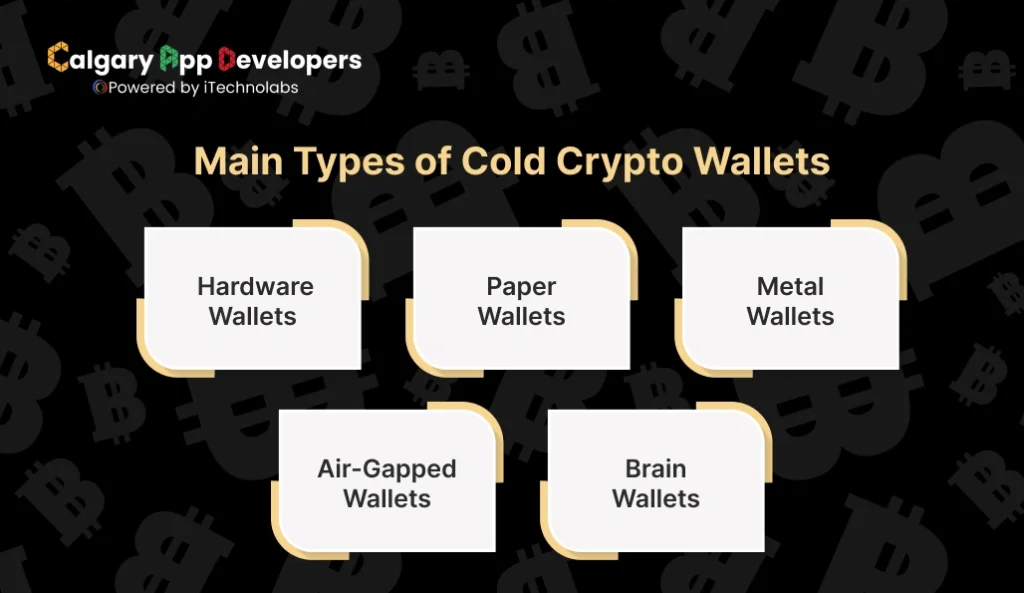
Not every Cold Crypto Wallet is alike; you must know about the different types in order to pick the one that meets your security requirements and investment strategy. On the whole, cold wallets are categorized into hardware wallets, paper wallets, and the emerging secure storage method.
1. Hardware Wallets
A paper wallet is the physical printing or handwritten note depicting your public and private keys. It is considered entirely offline and is immune to digital attacks. Key characteristics of paper wallets are:
- High Security: Private keys never leave the device.
- User-Friendly: Most devices come with intuitive interfaces and companion apps.
- Durability: Modern hardware wallets are built to resist physical damage and tampering.
2. Paper Wallets
A paper wallet is a physical printout or handwritten note containing your public and private keys. Since it exists entirely offline, it is immune to digital attacks. Key points about paper wallets:
- Offline Storage: Completely isolated from the internet.
- Simplicity: No complex devices or software needed.
- Cost-Effective: Essentially free, aside from printing.
3. Metal Wallets
Metal wallets are designed to store your backup seed phrases on metal plates, making them resistant to fire, water, and physical damage. These are especially useful for long-term storage and high-value portfolios.
- Extreme Durability: Protects against natural disasters.
- Offline Security: No connection to any network.
- Ideal for Backup: Complements hardware or paper wallets.
4. Air-Gapped Wallets
Air-gapped wallets are computers or devices completely disconnected from the internet, used exclusively to generate and sign transactions. They combine advanced security with the flexibility of software wallets while remaining offline.
- Maximum Security: Completely isolated from online threats.
- Customizable: Can store multiple types of crypto.
- Advanced Control: Suitable for tech-savvy users who want full management of their keys.
5. Brain Wallets
A brain wallet stores your private key or seed phrase in your memory rather than on a physical device. While highly secure against digital theft, it requires careful memorization and strong passphrases.
- No Physical Device Needed: Accessible anywhere if remembered.
- Offline Protection: Immune to hacking as long as not written down.
- Risk of Human Error: Forgetting or losing the passphrase means losing access to funds.
So, it really comes down to this: whether you pick a hardware wallet for its convenience, a metal wallet for its durability, an air-gapped setup for its advanced security features, or a brain wallet for its ultimate portability, Cold Crypto Wallets are the ones that give your cryptocurrency a crucial layer of protection, safeguarding your assets against online threats.
Read Also: Cryptocurrency Exchange App Development: An Ultimate Guide
Our Evaluation Criteria for Selecting the Best Cold Crypto Wallets
With dozens of hardware wallets on the market, choosing the right cold crypto wallet requires more than comparing price tags or brand names. Security devices protect long term digital wealth, so the evaluation must go deeper than surface features.
This list was built using practical, investor focused criteria designed to reflect what truly matters when safeguarding crypto assets in 2026.
- Security Architecture and Offline Protection
Security was the first and most critical filter. We assessed whether each wallet is fully air gapped or partially connected, how private keys are generated and stored, and whether transactions are signed offline. Devices with secure element chips, tamper resistant builds, and certified encryption standards ranked higher.
The goal was clear: minimize exposure to online threats and eliminate unnecessary attack surfaces.
- Recovery Mechanism and Key Management
Losing access to crypto can be permanent. We evaluated how each wallet handles recovery, including traditional seed phrases, Shamir Backup, encrypted key shards, or multi device recovery models. Wallets offering advanced recovery without compromising security received stronger consideration.
Reliable backup design is as important as initial protection.
- Supported Assets and Ecosystem Compatibility
Crypto portfolios are increasingly diversified. We reviewed how many coins and tokens each wallet supports, including compatibility with major blockchains, DeFi platforms, NFTs, and staking features.
Wallets with broad asset support and integration with reliable companion apps scored higher for long term usability.
- Ease of Use and Interface Design
Security should not come at the cost of usability. We assessed touchscreen quality, navigation clarity, transaction approval process, and mobile or desktop app experience. Devices that simplify secure transactions without overwhelming users were prioritized.
- Firmware Transparency and Software Updates
Regular firmware updates and transparent development practices are essential in a rapidly evolving threat landscape. We evaluated whether wallets use open source firmware, how frequently updates are released, and how the company communicates security improvements.
Long term trust depends on continuous improvement and transparency.
- Build Quality and Physical Durability
Cold wallets are physical devices. We examined their durability, tamper resistance, battery reliability, and overall construction quality. Devices built with reinforced casings, secure chips, and strong hardware integrity ranked higher.
A strong security model must be supported by strong physical engineering.
- Price to Value Ratio
Cost alone does not determine value. We compared pricing against feature sets, certification levels, asset support, and overall security architecture. Wallets that deliver strong protection at a fair price point received higher overall evaluation.
- Market Reputation and Brand Reliability
Finally, we considered brand history, user feedback, track record, and security incident history. Established manufacturers with proven reliability and transparent communication were given priority over unverified newcomers.
By applying these criteria, this list goes beyond marketing claims. It focuses on real security, long term reliability, and practical usability. Whether you are a long term holder, an active trader, or managing institutional scale assets, the wallets featured here meet the standards that matter most in 2026.
Top 15 Cold Crypto Wallets to Consider in 2026
| Wallet | Launch Date | Pros | Cons |
| Cypherock X1 | 2023 | • Keyless recovery via encrypted shards
• Air-gapped security • Supports 3,000+ coins and tokens |
• Higher price point
• Newer brand with limited user reviews |
| ELLIPAL Titan 2.0 | Nov 2023 | • 100% air-gapped design
• 4″ touchscreen • Tamper-proof construction |
• Bulkier size
• No Bluetooth or Wi-Fi connectivity |
| Trezor Model T | Feb 2018 | • Color touchscreen
• Supports Shamir Backup • Wide coin support |
• Higher cost
• Limited mobile app support |
| CoolWallet Pro | May 2021 | • Credit card-sized design
• Bluetooth connectivity • Supports DeFi and NFTs |
• Smaller screen
• Battery-dependent |
| Ledger Nano S Plus | Apr 2022 | • Compact design
• USB-C connectivity • Affordable price point |
• Smaller display
• Limited app storage |
| Keystone Pro | 2024 | • Air-gapped with 4″ touchscreen
• Supports multiple coins • Open-source firmware |
• Larger form factor
• Higher price point |
| SafePal S1 | 2023 | • Budget-friendly
• Air-gapped with QR code scanning • Compact design |
• No Bluetooth or USB-C
• Smaller screen |
| Ledger Nano X | May 2019 | • Bluetooth connectivity
• Supports 100+ coins • Rechargeable battery |
• Larger size
• Higher price point |
| BitBox02 | 2020 | • Compact design
• USB-C connectivity • User-friendly interface |
• Limited screen size
• No Bluetooth |
| KeepKey | 2015 | • Sleek design
• Supports ShapeShift integration • Affordable |
• Larger size
• Limited coin support |
| NGRAVE ZERO | 2020 | • EAL7 certified secure operating system
• Fully air-gapped with QR-based transactions • Biometric authentication support • Premium build quality |
• Very high price point
• Larger device compared to compact wallets |
| Tangem Wallet | 2022 | • Card-based hardware wallet with NFC support
• No seed phrase required by default • Waterproof and highly durable • Beginner-friendly setup |
• Requires NFC-compatible smartphone
• Limited advanced customization features |
| SecuX V20 | 2020 | • Large color touchscreen
• Bluetooth and USB connectivity • Supports 10,000+ tokens • Strong security chip protection |
• Bulkier than compact wallets
• Higher price compared to entry-level options |
| OneKey Touch | 2023 | • Open-source firmware
• Touchscreen interface • Air-gapped transaction support • Broad multi-chain compatibility |
• Smaller ecosystem compared to Ledger or Trezor
• Premium pricing for advanced version |
| Foundation Passport (Batch 2) | 2022 | • Fully air-gapped design
• Open-source firmware • Bitcoin-focused security • Replaceable battery |
• Primarily Bitcoin-only
• Not ideal for multi-asset investors |
1. Cypherock X1

Cold wallet type: Hardware
Cryptocurrencies supported: 3,000+ cryptocurrencies and tokens
Mobile app: Android and iOS apps
Price: $199
Certification level: Military-grade security encryption
The Cypherock X1 is a state-of-the-art hardware cold crypto wallet built for optimal security and convenience. Unlike traditional wallets, it does not require a recovery seed phrase but instead uses encrypted key shards for recovering access, ensuring that your crypto assets remain safe even if your device is lost or stolen.
All transactions are signed offline; your private keys are completely disconnected from the internet. You also can use your device in conjunction with the Cypherock mobile application, which allows you to check your balances, send transactions, and manage multiple wallets with ease.
Key features:
- Encrypted key shards for keyless recovery
- Air-gapped offline transaction signing
- Supports 3,000+ cryptocurrencies
- Mobile app for Android and iOS
- Tamper-proof, durable design
2. Ellipal Titan 2.0

Cold wallet type: Hardware
Cryptocurrencies supported: 10,000+ cryptocurrencies
Mobile app: Ellipal mobile app (Android and iOS)
Price: $179
Certification level: Air-gapped military-grade security
The Ellipal Titan 2.0 is a completely air-gapped, cold crypto wallet with no connections to Wi-Fi, Bluetooth, or USB, providing one of the highest security standards available. The Ellipal Titan 2.0 has a 4-inch touchscreen for easy communication and supports thousands of coins and tokens.
Transactions are signed offline using QR codes, so they are protected from the threats of online transactions. It is durable with a tamper-proof metal body, and you recover the Ellipal Titan 2.0 with a standard 12- or 24 word seed phrase.
Key features:
- 100% air-gapped design
- Tamper-proof metal casing
- Supports 10,000+ cryptocurrencies
- 4-inch touchscreen for easy navigation
- Mobile app for managing assets via QR codes
Read Also: What is MPC Wallet? Brief Guide to Multi-Party Computation
3. Trezor Model T

Cold wallet type: Hardware
Cryptocurrencies supported: 1,600+ cryptocurrencies
Mobile app: Trezor Suite (Android, iOS, Windows, Mac)
Price: $219
Certification level: Shamir Backup support and advanced firmware security
The Trezor Model T is a premium cold hardware cryptocurrency wallet that features a color touchscreen and supports a wide gap of cryptocurrency assets. The device has a feature called Shamir Backup, which allows you to split a recovery seed into multiple fragments for safety.
Users have the ability to sign transactions in an offline mode, and the device works with Trezor Suite, which allows you to manage your entire portfolio on a desktop. The color touchscreen of the Trezor Model T makes entering your PIN, approving transactions, and setting up your wallet simple and secure.
Key features:
- Color touchscreen for easy navigation
- Shamir Backup for secure recovery
- Supports 1,600+ cryptocurrencies
- Offline transaction signing
- Trezor Suite app for managing assets
4. CoolWallet Pro

Cold wallet type: Hardware
Cryptocurrencies supported: 5,000+ cryptocurrencies
Mobile app: CoolBitX app (Android and iOS)
Price: $179
Certification level: CC EAL5+ secure chip
The CoolWallet Pro is a cold hardware cryptocurrency wallet that is the size of a credit card and is designed for mobility and ease of use. The wallet connects to a mobile app through bluetooth, allowing the user to approve transactions while keeping their private keys offline.
The wallet is designed for DeFi and NFT management, which makes it desirable for an active cryptocurrency user. The device has a rechargeable battery that allows the device to run independently from a USB connection.
Key features:
- Portable credit-card design
- Bluetooth connectivity for mobile use
- Supports 5,000+ cryptocurrencies
- DeFi and NFT compatible
- Rechargeable battery
5. Ledger Nano S Plus

Cold wallet type: Hardware
Cryptocurrencies supported: 5,500+ cryptocurrencies
Mobile app: Ledger Live (Android and iOS)
Price: $149
Certification level: CC EAL5+ secure chip
The Ledger Nano S Plus is an upgraded version of Ledger’s popular Nano S cryptocurrency wallet. The Ledger Nano S Plus provides secure offline storage for thousands of cryptocurrencies, as well as support for USB-C connections to desktops and laptops.
The wallet uses a 24-word recovery phrase for the backup and a PIN for access to the wallet to prevent any unauthorized access. The wallet integrates with Ledger’s Live app easily for managing and tracking your portfolio and assets, as well as signing transactions.
Key features:
- Compact and durable design
- USB-C connectivity
- Supports 5,500+ cryptocurrencies
- PIN and 24-word recovery phrase for security
- Ledger Live app for portfolio management
6. Keystone Pro

Cold wallet type: Hardware
Cryptocurrencies supported: 10,000+ cryptocurrencies
Mobile app: Keystone app (Android and iOS)
Price: $199
Certification level: Air-gapped with military-grade encryption
The Keystone Pro is an advanced air-gapped cold crypto wallet designed for professional investors who value security above all else. Its interface is simple to navigate, featuring a 4-inch touchscreen and supports multiple coins and tokens. The device conducts all transaction signing while off the internet, trading private keys for QR codes, protecting against unauthorized online access.
Key features:
- Fully air-gapped design
- 4-inch touchscreen for intuitive use
- Supports 10,000+ cryptocurrencies
- Open-source firmware for transparency
- QR code offline transaction signing
Also Read: How Much Does It Cost to Build a Cryptocurrency Exchange App like Coinbase?
7. SafePal S1

Cold wallet type: Hardware
Cryptocurrencies supported: 10,000+ cryptocurrencies
Mobile app: SafePal app (Android and iOS)
Price: $49
Certification level: EAL5+ secure chip
The SafePal S1 is a low-cost option, an air-gapped cold crypto wallet that protects private keys while off the web. The S1 supports a comprehensive category of cryptocurrencies and uses QR code scanning in approving transactions. It is also compact and is easy to carry; therefore, it acts as a wallet.
Key features:
- Affordable and compact design
- Air-gapped offline security
- Supports 10,000+ cryptocurrencies
- QR code transaction signing
- Mobile app for asset management
8. Ledger Nano X

Cold wallet type: Hardware
Cryptocurrencies supported: 5,500+ cryptocurrencies
Mobile app: Ledger Live (Android and iOS)
Price: $149
Certification level: CC EAL5+ secure chip
The Ledger Nano X is a full-service Bluetooth hardware cold crypto wallet option for both beginners and seasoned investors. This wallet stores a variety of cryptocurrencies and secures transactions while offline. Ledger is a popular mobile and desktop authoring process performed through Ledger Live.
Key features:
- Bluetooth connectivity for mobile use
- Supports 5,500+ cryptocurrencies
- Rechargeable battery
- PIN and 24-word recovery phrase security
- Ledger Live app integration for portfolio management
9. BitBox02

Cold wallet type: Hardware
Cryptocurrencies supported: 1,500+ cryptocurrencies
Mobile app: BitBoxApp (Android, iOS, Windows, Mac)
Price: $129
Certification level: EAL5+ secure chip
The BitBox02 is a compact and user-friendly cold crypto wallet designed for secure offline storage. It allows users to manage multiple coins with simplicity and features a microSD card backup for secure recovery.
Key features:
- Compact, minimalist design
- Supports 1,500+ cryptocurrencies
- MicroSD backup for recovery
- USB-C connectivity
- User-friendly BitBoxApp for managing assets
10. KeepKey

Cold wallet type: Hardware
Cryptocurrencies supported: 40+ cryptocurrencies
Mobile app: ShapeShift platform (Android, iOS, desktop)
Price: $49
Certification level: EAL5+ secure chip
KeepKey is a sleek and durable cold crypto wallet that integrates with ShapeShift for easy cryptocurrency trading. It provides secure offline storage and a large display for transaction verification. It is ideal for beginners looking for a straightforward cold wallet solution.
Key features:
- Large OLED display for easy navigation
- Supports 40+ cryptocurrencies
- ShapeShift integration for in-app trading
- PIN and recovery phrase protection
- Affordable price point
Read Also: OTC Crypto Exchange Development: Benefits, Features, Process & Costs
11. NGRAVE ZERO

Cold wallet type: Hardware
Cryptocurrencies supported: 3,500+ cryptocurrencies and tokens
Mobile app: LIQUID app (Android and iOS)
Price: $398
Certification level: EAL7 secure OS certification
NGRAVE ZERO is positioned as one of the most security-focused cold crypto wallets available. It operates in a fully air-gapped environment and never connects via USB, Bluetooth, WiFi, or NFC. Transactions are signed using QR codes, and private keys are generated completely offline. The device also includes biometric authentication for additional protection.
Key features:
- Fully air-gapped transaction signing
- EAL7 certified secure operating system
- Biometric authentication support
- QR code-based communication
- Durable, tamper-resistant build
12. Tangem Wallet

Cold wallet type: Hardware card wallet
Cryptocurrencies supported: 6,000+ cryptocurrencies and tokens
Mobile app: Tangem app (Android and iOS with NFC support)
Price: $54.90 (2-card set)
Certification level: EAL6+ secure chip
Tangem Wallet takes a different approach by offering a card-based hardware wallet that connects via NFC. It eliminates the need for a traditional seed phrase unless users choose to enable it. The wallet is highly durable, waterproof, and designed for simplicity, making it ideal for beginners.
Key features:
- NFC-based secure access
- Card-style ultra-portable design
- Optional seed phrase backup
- Waterproof and tamper-resistant
- Beginner-friendly setup
13. SecuX V20

Cold wallet type: Hardware
Cryptocurrencies supported: 10,000+ cryptocurrencies and tokens
Mobile app: SecuX mobile and desktop app
Price: $139
Certification level: CC EAL5+ secure element
SecuX V20 combines security with usability through its large color touchscreen and Bluetooth connectivity. It supports a wide range of tokens and integrates with both desktop and mobile platforms. The secure element chip ensures private keys remain protected during transaction signing.
Key features:
- Large color touchscreen
- Bluetooth and USB connectivity
- Supports 10,000+ tokens
- Secure element chip protection
- Cross-platform compatibility
14. OneKey Touch

Cold wallet type: Hardware
Cryptocurrencies supported: 5,000+ cryptocurrencies and tokens
Mobile app: OneKey app (Android, iOS, desktop)
Price: $199
Certification level: Open-source firmware with secure element
OneKey Touch focuses on transparency and usability. It features open-source firmware for public auditability and a touchscreen interface for easier navigation. The wallet supports air-gapped transaction signing and multi-chain asset management, making it suitable for users who prioritize transparency and flexibility.
Key features:
- Open-source firmware
- Touchscreen interface
- Multi-chain compatibility
- Secure offline signing
- Cross-platform management app
15. Foundation Passport (Batch 2)

Cold wallet type: Hardware
Cryptocurrencies supported: Bitcoin-focused
Mobile app: Compatible with Envoy app and other Bitcoin wallets
Price: $199
Certification level: Open-source firmware with secure components
Foundation Passport is a Bitcoin-first cold wallet designed for maximum security and sovereignty. It operates fully air-gapped and uses QR codes for signing transactions. With a replaceable battery and open-source firmware, it appeals to users who prioritize long-term Bitcoin storage and transparency.
Key features:
- Fully air-gapped Bitcoin wallet
- QR code transaction signing
- Replaceable battery
- Open-source firmware
- Built specifically for Bitcoin security
Also Read: How Much Does It Cost to Create Crypto Trading App Like Swyftx?
Final Words:
Choosing the right cold crypto wallet is essential for anyone serious about securing their digital assets. Cold Crypto Wallets offer unmatched offline protection, keeping private keys isolated from online threats such as hacks, phishing attacks, and exchange failures.
From highly portable options like CoolWallet Pro to advanced air-gapped devices like Keystone Pro and Cypherock X1, there is a solution for every type of investor. Hardware wallets provide a balance of security, convenience, and usability, while options like paper or metal wallets focus purely on long-term storage and durability.
The key takeaway is that the safety of your cryptocurrency depends largely on how you store it. Investing in a reputable cold crypto wallet ensures that your assets remain under your control, accessible only to you, and shielded from digital vulnerabilities. By understanding the features, security levels, and usability of these wallets, you can select the one that aligns with your investment strategy and peace of mind.
In short, the right cold crypto wallet is not just a storage device; it is your first line of defense in protecting your crypto portfolio.
FAQ’s About Best Cold Wallet for Crypto:
1. What is the most secure way to store cryptocurrency?
The safest way to store cryptocurrency is using a cold crypto wallet, which keeps private keys offline, away from hacks and phishing attacks. Hardware wallets, paper wallets, or air-gapped devices provide robust protection. By holding your keys personally and avoiding online storage, you minimize exposure to cyber threats while retaining full control of your assets.
2. Which cold crypto wallet is considered the best?
The best cold crypto wallet depends on your priorities. For high security and advanced features, Cypherock X1, Keystone Pro, or Ellipal Titan 2.0 are excellent choices. For portability and convenience, wallets like Ledger Nano X or CoolWallet Pro combine offline storage with mobile app management. Look for security, supported cryptocurrencies, and usability.
3. What is the oldest cryptocurrency wallet still in use?
KeepKey, launched in 2015, is among the oldest hardware wallets still widely used. Alongside early models like the original Trezor and Ledger Nano S, it helped establish secure cold storage for crypto. These early wallets introduced offline key storage, PIN protection, and recovery phrases, laying the foundation for modern cold crypto wallet security standards.
4. Which cold wallets allow staking cryptocurrencies?
Some cold crypto wallets support staking, allowing users to earn rewards without leaving funds online. Wallets like Ledger Nano X, Trezor Model T, and Ellipal Titan 2.0 integrate staking for coins such as Tezos, Cosmos, and Polkadot. They combine offline security with the ability to participate in network validation directly through companion apps.
5. How should I choose the right cold crypto wallet?
When selecting a cold crypto wallet, consider security, coin compatibility, usability, and price. Hardware wallets are ideal for frequent users, while air-gapped or metal wallets suit long-term storage. Evaluate backup options, recovery phrases, and mobile app support. Choose a wallet that fits your investment strategy and ensures maximum protection for your digital assets.


Pankaj Arora is a seasoned technology leader and the Founder of Calgary App Developer, with 10+ years of expertise in crafting high-performance digital solutions. His core competencies include full-stack app development, cloud-native architecture, API integration, and agile product delivery. Under his leadership, Calgary App Developers has empowered startups and enterprises alike with scalable mobile applications, secure web platforms, and AI-driven SaaS products.