






How AI in Food is Changing The Food Industry
The whole process of food preparation, serving and consumption is going through a rapid evolution. The food industry is looking for ways to maintain its freshness, sustainability, and transparency standards, and one of those ways is by using AI. This indicates that there are already demand predictions by algorithms, quality monitoring by sensors or even robots mixing the ingredients with an accuracy similar to that of a laser in most of the meals we consume nowadays.
Consider this: the global market for artificial intelligence in food and beverage is estimated to be around US $4.5 billion in 2024 and is projected to climb to roughly US $12.25 billion by 2032.
That scale of growth signals more than a trend; it points to a transformation in how food gets made, delivered and consumed.
In the paragraphs ahead we’ll explore what AI means for this sector, how restaurants are adapting, and the benefits and real-world applications of this technology. By the time you finish reading, you’ll understand not just what’s possible now, but where the industry is heading.
- AI is reshaping how food is produced, managed and served across restaurants, factories and retail spaces.
- Businesses use AI to improve accuracy, planning, safety and overall efficiency.
- Customers benefit from personalized recommendations and smoother ordering experiences.
- The future of food is headed toward smarter automation, stronger sustainability and deeper data-driven decision-making.
- AI strengthens forecasting, reduces waste and helps food businesses maintain steady inventory levels by analyzing real-time and historical data.
- Connected kitchen systems rely on AI to guide cooking processes, improve consistency, support chefs and reduce production errors during busy hours.
- Food safety gains a major advantage through AI driven monitoring tools that track hygiene, detect contamination risks and maintain reliable compliance.
- Customer experiences become more intuitive because AI studies preferences, dietary needs and ordering patterns to deliver relevant suggestions.
- The future of AI in food focuses on sustainability, predictive insights, transparent supply chains and innovation that helps the industry operate with greater responsibility and efficiency.
How AI Is Changing The Food Industry
AI in food industry is becoming the quiet engine behind smarter decisions and smoother operations. Here’s the thing. It helps companies analyze huge amounts of data so they can understand demand patterns, improve inventory and maintain consistent quality. What this really means is that restaurants and manufacturers can cut waste, predict what customers want and keep shelves stocked with the right products.
AI is also supporting safer food. Systems can track temperature, detect contamination risks and monitor freshness in real time. It even helps with product development by spotting flavor trends and consumer preferences long before they hit the mainstream. As these tools become more accessible, the industry is moving toward faster production, reliable quality and more personalized food experiences.
How AI Is Transforming Restaurants
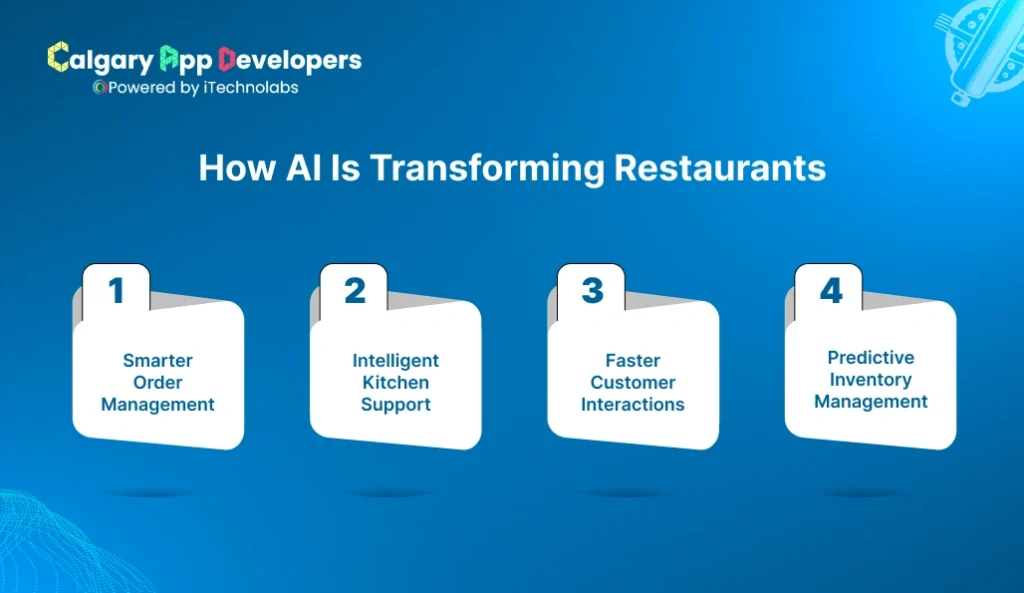
AI in food industry solutions is reshaping the restaurant world by taking everyday challenges and turning them into opportunities for better service, smarter planning and stronger customer loyalty. When restaurants weave AI into their workflow, the entire experience feels more thoughtful for both teams and guests.
Smarter Order Management: AI studies ordering habits across days, seasons and events. It helps kitchens prepare at the right moment, keeps queues under control and reduces the stress that usually builds during peak hours. The goal is to serve food faster without compromising quality.
Intelligent Kitchen Support: Modern kitchen equipment now uses AI to guide cooking settings. It tracks temperature, timing and moisture to deliver consistent results every time. This steadiness cuts wastage and supports chefs by handling routine adjustments so they can focus on flavor and presentation.
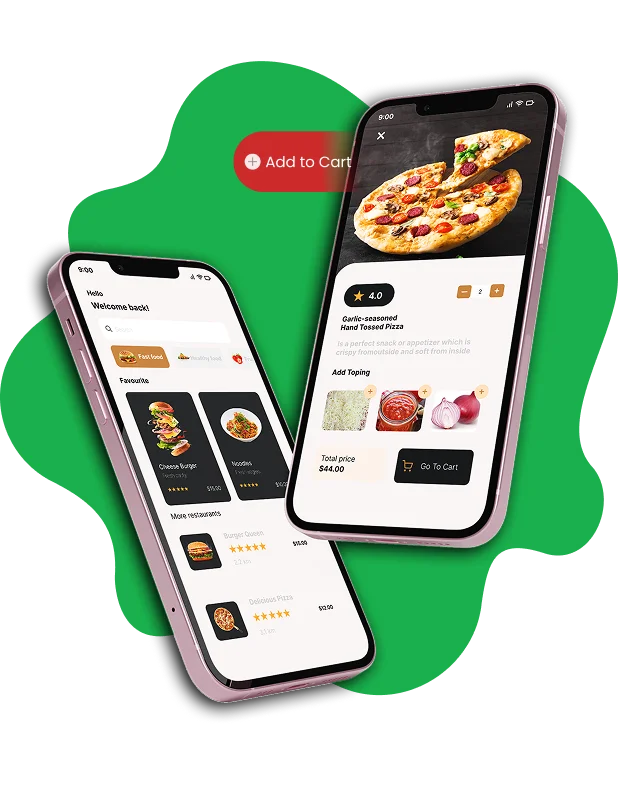
Faster Customer Interactions: Digital menus, chat-based ordering and voice systems make it easier for customers to place orders without confusion. Recommendations feel more personal because the system understands patterns in taste, allergies and portion preferences. That small touch adds noticeable comfort for diners.
Predictive Inventory Management: AI tracks buying trends and predicts what ingredients will run low. Managers no longer guess what to stock. They plan ahead with confidence, avoid last-minute shortages and maintain a stable inventory that keeps operations smooth.
These tools are not here to replace the human touch. They simply remove the friction from daily tasks so teams can focus on hospitality and creativity. What this really means is that restaurants become more organized, more responsive and more enjoyable places to dine.
Also Read: How To Build Restaurant App For Food Ordering Business
Why AI Matters in Food Service
AI in food industry operations is reshaping how restaurants, factories and retailers handle quality, speed and safety. The real value shows up in the way it takes pressure off teams, cuts waste and helps businesses make smarter choices without guesswork.
1. A Strong Push Against Food Waste
Food waste continues to challenge producers and retailers, but AI helps create a more responsible workflow. Systems watch production closely, evaluate how quickly stock moves and adjust operations before surplus builds up. Companies become more mindful of resources and more efficient in the way they process ingredients.
- AI tracks output minute by minute and warns when production exceeds storage capacity.
- It studies historical patterns to refine forecasts and reduce miscalculations.
- Automated adjustments slow or pause production when tanks or storage areas reach safe limits.
- Real-time visibility helps organizations adopt environmentally responsible practices without hurting productivity.
2. Better Sorting and Grading of Products
Sorting produce is time-consuming when done manually. AI vision tools evaluate size, color and shape with more consistency and accuracy. This helps processors maintain quality without slowing down operations.
- These systems identify imperfections far faster than manual inspection.
- They grade produce based on size, color, texture and ripeness, which keeps quality uniform across batches.
- Automated sorting reduces the need for heavy labor and speeds up the processing line.
- Customers receive products that meet stable standards, which strengthens trust in the brand.
3. Stronger Food Safety Compliance
Food safety is nonnegotiable. AI-assisted cameras monitor staff behavior and ensure hygiene rules are followed. Managers get alerts when something is missed, which cuts risk and strengthens accountability.
- Cameras equipped with AI spot when protective gear is missing and alert supervisors instantly.
- Real-time tracking helps managers maintain strict hygiene routines without constant manual checks.
- The system documents incidents automatically, which supports reliable safety reporting.
- This creates a workspace where mistakes are caught early and corrective action happens immediately.
4. Cleaner Equipment and Smarter Hygiene Routines
Clean equipment is the backbone of safe food production. Traditional cleaning systems do not always detect small remnants that hide inside machinery, but AI guided cleaning tools close that gap.
- Imaging and ultrasonic data reveal tiny traces of food or microbes that would otherwise go unnoticed.
- The system recommends precise cleaning steps based on the contamination detected.
- Continuous monitoring ensures hygiene stays consistent even during long production cycles.
- This creates a safer final product and reduces the risk of costly contamination events.
5. Improved Training and Documentation
Large food operations often employ workers from different language backgrounds, which can slow training. AI translation tools help teams understand instructions with clarity and confidence.
- They convert manuals and guidelines into preferred languages with high accuracy.
- Workers grasp safety protocols faster, which reduces early-stage errors.
- Teams communicate more effectively across shifts and departments.
- Training becomes smoother and more accessible for new employees.
6. Real-Time Monitoring Through Sensors
Sensors combined with AI deliver insights that improve quality control across the entire production chain. These systems make the work more precise and dependable.
- It completes quality checks at high speed and identifies issues during production instead of after the batch is finished.
- Its simple integration into existing equipment helps businesses upgrade without major disruptions.
- The reduced inspection time keeps production flowing while still protecting standards.
- Managers gain a clearer view of performance trends, which helps them fix problems before they grow.
7. Key Advantages You Cannot Ignore
AI speeds up repetitive work, reduces overtime pressure, keeps production lines moving and smooths the customer journey at the point of sale. It also helps teams stay compliant, spots hidden inefficiencies and lowers equipment upkeep costs. The result is a workforce that functions with greater confidence and a store that feels more organized from the moment customers step in.
AI is no longer a luxury for food service. It is becoming the foundation of cleaner kitchens, smarter factories and more confident decision-making across the entire industry.
Read Also: How to Create Restaurant Inventory Tracking Software
Real-World Uses of AI in Food and Beverage
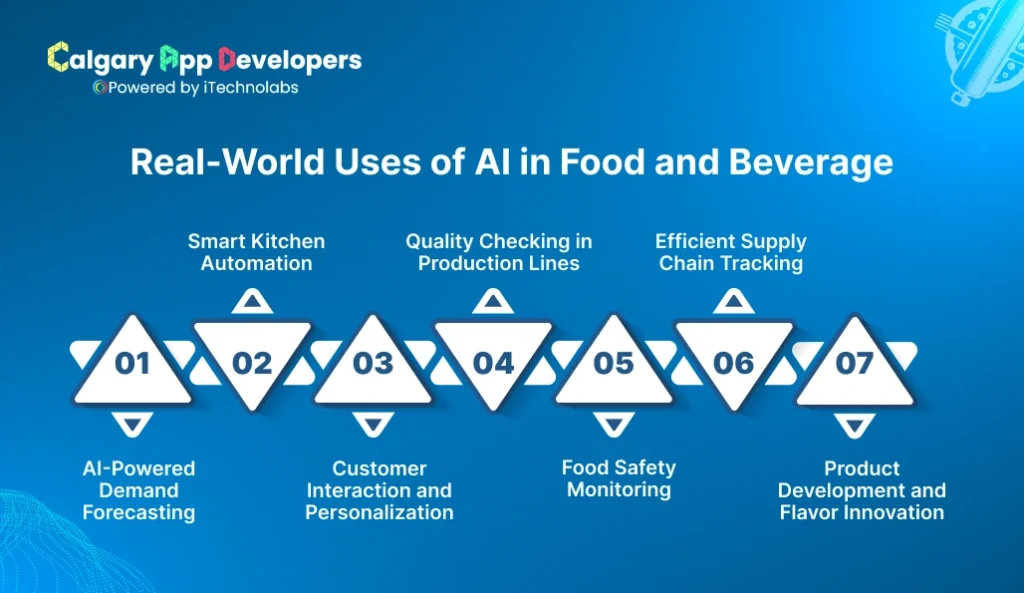
AI in food industry settings has moved far beyond early experimentation. It now sits at the center of production, service and customer experience. Each use case shows how this technology supports smoother operations and more thoughtful decision-making across the entire chain.
1. AI-Powered Demand Forecasting
AI studies sales patterns, customer behavior, local events and even season-based changes to predict how much food a business truly needs. This helps restaurants, stores and manufacturers plan their inventory with far more accuracy. It cuts unnecessary waste, keeps shelves stocked and helps staff prepare in a calmer, more organized way.
Example: A supermarket chain prepares accurate quantities of produce for weekends based on detailed demand forecasts instead of relying on instinct.
2. Smart Kitchen Automation
Modern kitchens use AI guided equipment that learns from previous cooking cycles and adjusts heat, timing and moisture without manual control. This brings stability to busy service hours and ensures that dishes taste the same every single time. Chefs spend less energy correcting mistakes and more energy refining flavors and presentation.
Example: A commercial oven detects the exact moment a batch of pastries is ready and adjusts its settings to maintain ideal texture.
3. Customer Interaction and Personalization
AI-powered platforms make ordering easier by studying individual preferences, allergies and past choices. This helps customers navigate menus without confusion and leads to recommendations that feel genuinely relevant. It also speeds up ordering during rush hours because the system already understands what different users tend to select.
Example: A food delivery app offers personalized meal suggestions that fit a customer’s eating patterns and nutrition goals.
4. Quality Checking in Production Lines
Factories rely on AI vision systems to maintain strong quality standards. These tools scan items at high speed and identify subtle defects that human eyes might miss. This improves consistency, reduces waste and keeps the final product aligned with brand expectations. It also frees workers from repetitive visual checks and allows them to focus on more valuable tasks.
Example: A fruit processing facility uses AI cameras to filter out bruised apples before packaging begins.
5. Food Safety Monitoring
Food safety depends on constant attention, and AI offers uninterrupted oversight. It watches staff compliance, equipment use and environmental conditions in real time. When something goes wrong, the system alerts managers instantly so they can fix the issue before it becomes a risk. This steady level of monitoring protects both workers and customers.
Example: A food facility uses AI enhanced cameras to confirm that workers wear proper protective gear throughout the shift.
6. Efficient Supply Chain Tracking
AI follows a product’s journey from source to storage to the final destination. It studies temperature, handling habits, transport duration and freshness data to prevent spoilage. Teams receive instant updates when conditions shift, allowing them to intervene early. This leads to better traceability and far less uncertainty in long distribution routes.
Example: A seafood supplier uses AI to track temperature inside transport containers to protect product quality during long trips.
7. Product Development and Flavor Innovation
Brands use AI to understand emerging trends, ingredient preferences and regional tastes. This shortens the research cycle and helps teams create products that resonate with customers. Instead of guessing what people might enjoy, companies test formulas against real data and design flavors that align with market demand.
Example: A beverage company uses AI insights to create a new reduced-sugar drink that matches growing interest in healthier choices.
AI is becoming the quiet backbone of food and beverage operations. It supports better decisions, safer processes and more meaningful interactions for every person involved in the journey from kitchen to customer.
Also Read: Restaurant Management Software Development Guide
Future Outlook for AI in Food
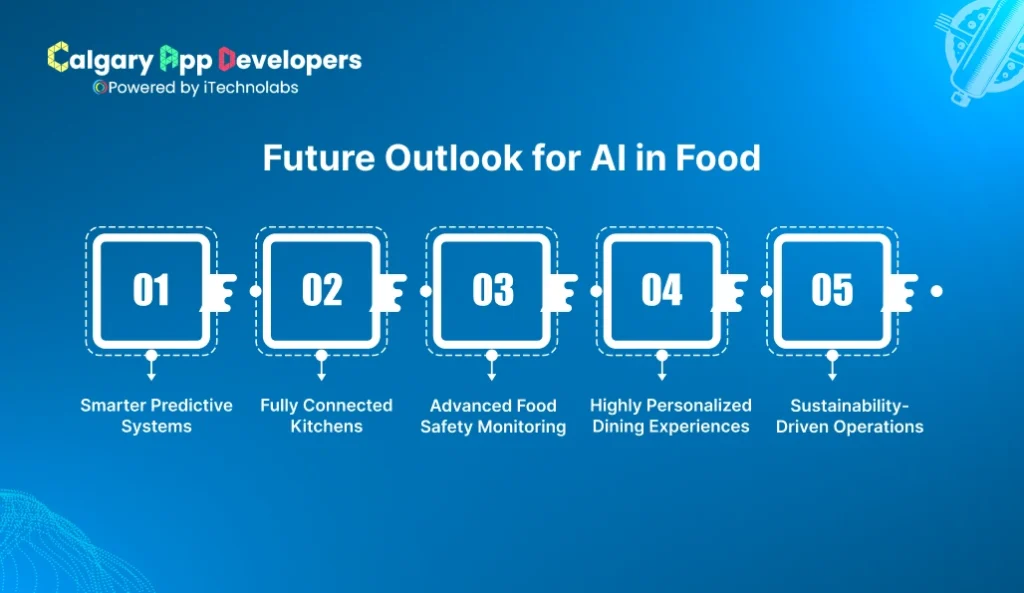
AI in food industry operations is still in its early stages, and the next decade will push the sector into a new era of intelligence, automation and creativity. The future is not about replacing people. It is about giving businesses sharper tools to work cleaner, faster and more sustainably.
1. Smarter Predictive Systems
AI in food industry operations will refine forecasting by studying real-time trends, customer behavior and supply patterns. Businesses will anticipate demand with higher accuracy and adjust production before issues surface. This shift will support steadier inventory levels and more reliable planning across restaurants and manufacturing units.
2. Fully Connected Kitchens
Kitchens will rely on equipment that communicates and coordinates tasks automatically. Appliances will adjust heat, timing and ingredient flow based on cooking progress. This level of connection will help chefs maintain consistency during busy hours while reducing errors that usually appear in manual processes.
3. Advanced Food Safety Monitoring
Food safety systems will grow more sensitive by analyzing continuous data from sensors and cameras. AI will identify small changes in temperature, hygiene practices or equipment status and alert teams instantly. This approach will strengthen compliance, reduce contamination risks and protect product quality more effectively.
4. Highly Personalized Dining Experiences
Menus and recommendations will become more tailored to individual preferences. AI will study eating habits, nutrition goals and flavor patterns to suggest meals that feel more relevant. This will help customers make choices quickly while giving restaurants a clearer understanding of what their audience responds to.
5. Sustainability-Driven Operations
AI will support environmentally conscious food practices by monitoring waste patterns, spoilage risks and resource usage. Businesses will use these insights to reduce excess production, optimize energy consumption and manage ingredients more responsibly. This direction will help the industry adopt cleaner, smarter and more efficient ways of working.
AI is shaping a future where food becomes safer, more personalized and more responsibly produced. The industry is moving toward a world powered by insight and innovation, not guesswork.
Also Check: Top 10 POS Systems for Restaurants with AI Tools
How We Can Help You Bring AI Into Your Food Business
Calgary App Developers helps food businesses and restaurants turn AI into practical results that improve operations, boost efficiency and elevate customer experience. Let’s break it down. We build AI ready mobile apps and online ordering systems that fit the way your business works. You can enhance your current platform with new intelligence features or launch a fully custom branded app built from the ground up.
Our team designs systems that help you predict demand, manage inventory with confidence, personalize customer interactions and streamline kitchen workflows. What this really means is that your business gets tools that support faster decisions, sharper accuracy and smoother service.
Here is how we support your growth
- AI integration for existing apps: You keep your current app or ordering system and we strengthen it with AI driven features. This includes demand forecasting, smart menu recommendations, automated order routing and real-time operational insights.
- Custom AI powered mobile apps: You get a complete mobile app shaped around your brand, backed by AI tools that support ordering, personalization, loyalty programs and data-guided decision-making.
- Online ordering systems with AI capability: We design intelligent ordering platforms that learn from customer behavior, reduce errors, speed up checkout and help your team work with less friction.
- End-to-end consulting and implementation: We guide you through strategy, development, deployment and ongoing optimization so your business captures the full benefit of AI innovation without added complexity.
Calgary App Developers gives you the technology and support to operate with clarity, confidence and future ready capability. If you want to make your food business smarter, faster and more efficient, we are here to help you move forward with purpose.
Conclusion
AI in food industry work has moved from a distant idea to a practical force that shapes how food is grown, prepared and served. Every part of the chain now benefits from clearer insight, steadier workflows and smarter decision-making. Restaurants gain consistency, factories improve safety and customers enjoy experiences that feel more thoughtful and reliable.
As these tools continue to grow in capability, the industry will shift toward cleaner operations, stronger sustainability and a level of precision that was once impossible. This is the moment where technology and food move forward together and set the tone for a more efficient and responsible future.
FAQ’s About AI in Food Industry
1. How is AI currently used in the food industry?
AI is used to improve demand forecasting, automate kitchen operations, monitor food safety, and personalize customer experiences. Restaurants use it to predict busy hours and manage inventory, while factories rely on AI for quality inspection and sorting. Retailers apply AI to reduce waste and improve supply chain tracking. Its role continues to expand across production and service.
2. Can small restaurants benefit from AI, or is it only for large chains?
AI is no longer limited to large enterprises. Many modern tools are affordable and scalable, making them accessible to small and mid-sized restaurants. From smart ordering systems to inventory prediction and personalized recommendations, smaller businesses can adopt targeted solutions that improve efficiency without requiring massive infrastructure investment.
3. Does AI replace human workers in food service?
AI is designed to support teams, not replace them. It handles repetitive tasks such as monitoring temperatures, forecasting demand, or processing orders. This allows chefs and staff to focus on creativity, hospitality, and customer service. The goal is to remove friction from operations while preserving the human element that defines great dining experiences.
4. How does AI help reduce food waste?
AI analyzes historical sales data, real-time demand, and seasonal patterns to improve forecasting accuracy. By predicting how much food is needed, businesses avoid overproduction and spoilage. Smart monitoring systems also track freshness and storage conditions, allowing teams to act early before products expire or quality declines.
5. Is AI safe for handling sensitive food data and compliance requirements?
Modern AI systems are built with strong data security and compliance protocols. They support documentation, hygiene monitoring, and regulatory reporting. With proper implementation, AI improves traceability and strengthens compliance efforts by tracking conditions in real time and documenting processes automatically.
6. How does AI improve customer experience in restaurants?
AI personalizes recommendations based on ordering history, dietary preferences, and behavior patterns. It also speeds up ordering through digital menus, chat interfaces, and voice systems. This reduces wait times and makes the dining experience feel more tailored and convenient for each customer.
7. What is the future of AI in the food industry?
The future points toward connected kitchens, smarter supply chains, predictive maintenance, and sustainability-focused automation. AI will continue improving safety, personalization, and efficiency while helping businesses operate with greater precision. As tools become more advanced and accessible, adoption will expand across restaurants, manufacturing, and retail environments.
8. How can a food business start implementing AI?
The first step is identifying operational challenges such as waste, slow service, or inconsistent quality. From there, businesses can adopt targeted AI solutions like smart inventory systems or intelligent ordering platforms. Starting with a focused use case allows gradual adoption while delivering measurable improvements early in the process.


Pankaj Arora is a seasoned technology leader and the Founder of Calgary App Developer, with 10+ years of expertise in crafting high-performance digital solutions. His core competencies include full-stack app development, cloud-native architecture, API integration, and agile product delivery. Under his leadership, Calgary App Developers has empowered startups and enterprises alike with scalable mobile applications, secure web platforms, and AI-driven SaaS products.