








Restaurant Website Development Cost Guide 2026

Creating a website for a restaurant is one of those decisions that feels simple at first, then quickly turns into a long list of choices. Design, features, menus, booking tools, photos, mobile experience, and the overall impression your brand leaves online. Every piece affects how customers see you and how confidently they decide to book a table or place an order.
A strong restaurant website does more than list dishes. It guides people through your story, showcases your space, captures the style of your food, and makes online reservations or orders feel effortless. It puts your business in front of customers long before they walk through the door.
The real question most owners have is about cost. The answer depends on how far you want to go with branding, functionality, and long-term digital goals.
This guide walks through the factors that influence pricing so you can plan with clarity and build a website that actually supports your restaurant’s growth.
- Calgary’s delivery market is growing quickly and restaurants need strong digital ordering tools to stay competitive.
- Marketplace apps bring reach, while direct ordering systems protect margins and customer data.
- Technology, sustainability and customer expectations are reshaping how restaurants approach delivery in 2026.
- The Canadian delivery market is expanding at a steady pace, and Calgary shows one of the highest adoption rates for app-based ordering.
- Marketplace platforms help restaurants access a broad audience, but their commission fees limit profit potential.
- Direct ordering systems give restaurants stronger control over branding, data ownership and long-term customer relationships.
- Technology-driven tools such as POS integrations, automated marketing, mobile-focused ordering and real-time delivery tracking improve operational efficiency.
- Sustainable practices, including reduced packaging waste, low-emission delivery methods and responsible sourcing, strengthen customer trust and long-term reputation.
- Restaurants that combine smart technology, balanced platform choices and ethical operations are best positioned to succeed in Calgary’s competitive delivery environment.
Why a Custom Restaurant Website Is Worth the Investment
When your restaurant launches a dedicated website, you’re building more than just an online menu; you’re building a digital storefront that attracts customers, boosts trust and creates revenue opportunities. Let’s look at the statistics and the future signals showing why such a website matters.
Strong online presence correlates with stronger business
- Only 69 percent of restaurants currently have a website. That leaves 31 percent of operators without this crucial front door.
- Research shows that 90 percent of people examine online presence before choosing a restaurant, and 88 percent trust online reviews as much as personal recommendations.
Signals for the future
- The global food service market (which includes restaurants broadly) is expected to grow from USD 3,982.24 billion in 2025 to USD 6,450.30 billion by 2032, at a CAGR of about 7.13 %.
- The online food delivery market globally is projected to reach USD 579.15 billion by 2034 from USD 167.62 billion in 2024, with a CAGR of about 13.2 %.
Investing in a custom website for your restaurant is not simply about being visible online. It is about owning your brand, converting interest into business, and keeping pace with evolving guest expectations. Given the data and forward trends, skipping a strong web presence now could mean missing out on meaningful growth or falling behind competitors who have already moved online.
Also Read: Expert Guide on Cost to Hire Calgary Web Developers
Cost Breakdown for Building a Restaurant Website
A restaurant website can cost between $800 and $15,000 depending on how simple or feature-rich you want it to be. The clearer your expectations, the easier it becomes to choose the right level of investment.
A restaurant website generally falls into one of three categories. Basic sites focus on essential pages. Standard sites offer stronger branding and more interactive features. Advanced sites support custom design, online ordering systems and deeper integrations. The table below compares what each level typically includes.
| Stage | Basic Restaurant Website | Standard Restaurant Website | Advanced Restaurant Website |
| Discovery and Planning | $150 to $300 | $300 to $600 | $600 to $800 |
| UI and UX Design | $200 to $800 | $800 to $2,000 | $2,000 to $4,000 |
| Front-End Development | $300 to $900 | $900 to $2,500 | $2,500 to $4,500 |
| Back-End Development | $200 to $800 | $800 to $2,500 | $2,500 to $5,000 |
| Content Creation | $100 to $400 | $400 to $1,200 | $1,200 to $2,000 |
| Third-Party Integrations | $50 to $300 | $300 to $900 | $900 to $1,500 |
| SEO Setup | $80 to $200 | $200 to $600 | $600 to $1,000 |
| Hosting and Maintenance | $10 to $40 per month | $20 to $80 per month | $50 to $150 per month |
A basic site works well for small restaurants that only need an online presence with essential pages like a menu, an about section and contact information. A standard site is suited for businesses that want better branding, improved design and tools like reservations or gallery sections. An advanced site is the best choice for restaurants that want custom workflows, online ordering, loyalty system integrations or multi-location support.
Key Factors That Influence Your Restaurant Website Cost
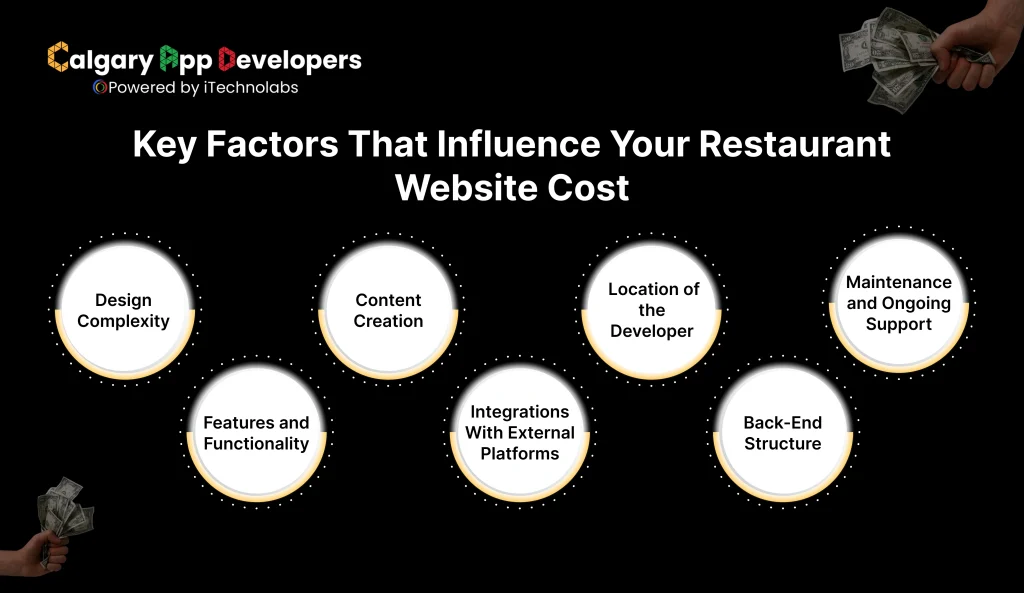
Building a restaurant website involves several decision points. Each point affects the time, skill and resources required. A well-structured overview of these factors helps you understand how the budget is shaped and why different restaurants end up with different cost levels.
1. Design Complexity
Design is one of the strongest cost drivers. It determines the visual quality, user experience, brand expression and overall feel of the site.
What increases or reduces design cost
- Basic design uses simple layouts and limited customization. It delivers clarity without advanced branding work.
- Standard design involves defined brand colors, typography systems and page layouts tailored to your restaurant identity.
- Advanced design introduces custom graphics, unique design patterns, premium page structures, high visual creativity and collaborative brand work.
| Level of Design | Cost Impact | Best Fit |
| Basic | Low | Small restaurants needing a clean presence |
| Standard | Medium | Restaurants seeking a strong branded look |
| Advanced | High | Premium restaurants requiring a fully original concept |
2. Features and Functionality
Features shape how users interact with your site. The more interactive or operationally useful the site becomes, the more development effort is required.
Categories of features
- Essential features include menu pages, basic information, contact forms and simple photo galleries.
- Interactive features include event listings, advanced galleries, booking tools, inquiry systems and newsletter subscriptions.
- Advanced features include online ordering, payment flows, loyalty modules, custom dashboards and multi-location management.
3. Content Creation
Content builds trust and communicates the soul of the restaurant. Visuals, text and menu presentation influence user decisions and require varying levels of effort.
What affects content cost
- Basic content uses your existing photos and short self-written descriptions.
- Standard content includes refined text, clearer dish descriptions, improved gallery curation and a consistent brand voice.
- Advanced content involves professional photography, detailed storytelling, chef profiles, location stories and frequent updates for seasonal menus.
Quality content increases customer confidence and leads to higher conversions.
4. Integrations With External Platforms
Most restaurants need connections to booking tools, delivery platforms or payment services. Each integration requires configuration, testing and adjustments for real-world use.
Types of integrations
- Simple integrations include booking widgets or map embeds.
- Moderate integrations include reservation engines, newsletter tools and review platforms.
- Advanced integrations involve ordering systems, payment services, loyalty programs and CRM platforms.
More integrations usually mean more testing and more ongoing adjustments.
5. Location of the Developer
The location of the development team plays a major role in the overall budget. Hourly rates vary widely across regions because of skill availability, operational costs and market demand. The same project can become significantly more or less expensive depending on where the work is done.
| Region | Typical Hourly Cost |
| Calgary | 25 to 60 USD per hour |
| Other Canadian Cities | 40 to 80 USD per hour |
| United States | 60 to 150 USD per hour |
| Western Europe | 50 to 120 USD per hour |
| Eastern Europe | 25 to 70 USD per hour |
| South Asia | 15 to 40 USD per hour |
Calgary offers some of the lowest development rates among mature markets, which makes it an attractive option for restaurants that want professional quality without premium city pricing.
6. Back-End Structure
The back end defines how easily your team can manage the site after launch. Restaurants that update menus often need a more capable system.
Back-end options
- Standard content managers allow basic updates such as changing text and adding images.
- Enhanced content managers simplify frequent menu changes, price edits and seasonal updates.
- Fully custom back ends are built around complex operations such as multi-outlet menus, custom ordering logic or detailed analytics.
7. Maintenance and Ongoing Support
After launch, every website needs continuous attention. The level of complexity directly affects the amount of maintenance required.
Maintenance tiers
- Basic maintenance includes hosting, backups and occasional updates.
- Standard maintenance includes regular updates, performance checks and small improvements.
- Advanced maintenance includes continuous monitoring, technical tuning, integration support and feature updates.
A structured maintenance plan protects performance, security and long-term reliability.
Read Also: Top Calgary Web Development Companies
Smart Ways to Control Your Restaurant Website Development Costs
Managing the budget for a restaurant website becomes much easier when you understand where strategic decisions can save money without reducing quality. The goal is to focus on the parts of the project that genuinely support customer experience and remove anything that does not add real value.
1. Prioritize essential features before adding enhancements
Start with the features your guests actually need. A clean menu page, clear contact information, an about section and a reservation option often cover the basics for most restaurants. Focusing on these essentials keeps your initial development cost grounded.
Once the site is live and begins generating traffic, you can add galleries, event pages or newsletters. This approach allows your investment to grow alongside your business instead of paying for every feature upfront.
2. Use structured content instead of reinventing everything
Content creation becomes expensive when the team must write every section from scratch or produce large sets of photos. You can reduce cost by supplying an organized list of dishes, descriptions and existing images in advance.
This reduces the time needed for revisions and content rewrites. Professional refinements can still be made later, but starting with well-prepared material allows the project to move faster and saves hours of billable work.
3. Choose a scalable design instead of a fully custom visual system
A completely original design requires concept research, multiple layout directions, custom graphics and long review cycles. A scalable design uses a clean foundation with room for future enhancements.
It still feels polished and professional, but it does not involve heavy creative production. This helps you avoid unnecessary design hours at the beginning while ensuring the website can evolve as your brand grows or your menu expands.
4. Pick the right development region for better pricing
Development rates vary greatly by location. Teams in highly competitive global markets often charge premium rates, which can inflate the budget for even simple features. Choosing a region with balanced pricing gives you professional quality at a lower total cost.
For example, Calgary developers typically offer experienced talent at more cost-friendly rates compared to major US or European cities. This creates a strong balance between affordability and capability.
5. Use prebuilt integrations instead of fully custom systems
Many restaurant tools already have ready-made widgets or plugins for reservations, maps, reviews and bookings. Leveraging these solutions gives you reliable functionality without the expense of building the same features manually.
It also reduces long-term support costs because updates come from the platform provider. This approach keeps the website flexible and easier to manage while still offering guests the services they expect.
6. Evaluate custom online ordering carefully before building from scratch
A custom online ordering system can easily become the most expensive part of your website if built without a clear strategy. The development involves product listings, cart logic, payments, user accounts and order management.
Instead of building every component from the ground up, consider proven platforms that deliver the same experience at a fraction of the cost.
For example, solutions like iShopo provide a complete ordering system that can be integrated quickly, reducing both development time and long-term maintenance expenses. This gives you the benefits of online ordering without the financial weight of a fully engineered custom product.
Also Check: Calgary Web Design Prices | Affordable Website Packages
Conclusion
Creating a restaurant website is an investment that shapes how customers see your brand long before they step inside. The cost varies because every restaurant has different needs, expectations and long-term goals. Once you understand the factors that influence pricing, it becomes much easier to plan a site that supports growth without stretching your budget.
If you are looking for a team that delivers clear communication, reliable work and pricing that respects your budget, Calgary App Developers is a strong fit. Our team builds websites that look polished, perform smoothly and help restaurants convert online visitors into paying customers. We focus on practical solutions, thoughtful design and features that genuinely support your business.
A well-built website is not just an expense. It is a tool that attracts guests, strengthens your brand and supports your restaurant every day.


Pankaj Arora is a seasoned technology leader and the Founder of Calgary App Developer, with 10+ years of expertise in crafting high-performance digital solutions. His core competencies include full-stack app development, cloud-native architecture, API integration, and agile product delivery. Under his leadership, Calgary App Developers has empowered startups and enterprises alike with scalable mobile applications, secure web platforms, and AI-driven SaaS products.